Introduction
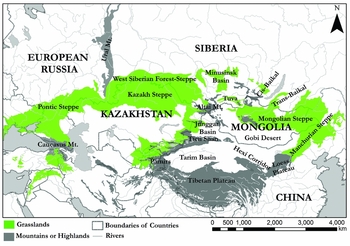
The Early Iron Age of the Eurasian steppe zone (c. 1000–300 BC) is characterised, above all, by connectivity. Rapid transmissions of ideas within the pastoral world are marked by the appearance of strikingly similar modes in material culture and stylistic representation from the Danube to Manchuria (Figure 1), matched by ever more specific material evidence of contact between these steppe societies and their agricultural neighbours to the south (Rawson Reference Rawson2013; Wu Reference Wu2013).
Map showing defined geographic regions within the Eurasian steppe.

Many researchers have sought to explain this increasingly interactive world as an outcome of migration or mobility, associated with rising equestrianism in both economic and martial contexts (e.g. Moskova & Rybakov Reference Moskova and Rybakov1992; Davis-Kimball et al. Reference Davis-Kimball, Bashilov and Yablonsky1995; Chernykh Reference Chernykh2014). Others have looked within to find new kinds of social and structural complexity in the societies of the steppe (e.g. Linduff Reference Linduff2004; Bokovenko Reference Bokovenko2006; Hanks & Linduff Reference Hanks and Linduff2009; Houle Reference Houle2010). Whatever the case, a clearer understanding of the patterns and character of interaction is one of the essential goals of archaeological research in this period.
Drawing together existing ‘legacy’ data on the composition of copper and bronze artefacts from the Early Iron Age of eastern Eurasia, new theoretical and methodological approaches to the study of artefact chemistry (see Bray & Pollard Reference Bray and Pollard2012) can begin to contribute to this discussion. Although such data are imperfect in many ways, they reveal structured patterns at a regional scale, providing a framework for the reconstruction of flow (Bray et al. Reference Bray, Cuénod, Gosden, Hommel, Liu and Pollard2015) in the circulation of copper and tin through contemporary society. By rejecting simple ideas about object and origin, we can begin to trace complex patterns of production and reproduction, mixing, movement and exchange across space and time, and to explore variations in the perception of both metals and metal objects in the societies that made and used them.
Archaeometallurgy in the eastern steppe
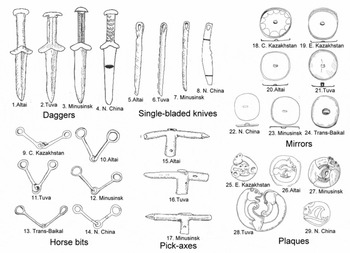
Although nominally attributed to the Iron Age, copper, bronze and occasionally gold remain dominant in archaeological metal assemblages for much of this period. These items—including personal weapons and tools, horse bits, mirrors, plaques, pendants and a range of ornaments (Figure 2)—have been extensively studied in terms of typology and style (e.g. Bunker et al. Reference Bunker, Kawami, Linduff and Wu1997; Wu Reference Wu2008). Such traditional discussions frequently use stylistic and typological similarities as markers of ‘interaction’ and exchange. The character of contact is rarely explored in detail, however, and the orientation of exchange often remains a matter of opinion.
Examples of steppe-style bronze artefacts during the Early Iron Age (redrawn after Moskova & Rybakov Reference Moskova and Rybakov1992; Wu Reference Wu2008).

Research into the metalwork of the Eurasian Bronze Age, particularly in the western steppe, has attempted to integrate these traditional modes of archaeological research within a single interpretive system, combining absolute chronology and technological and chemical analyses (e.g. Chernykh & Kuz'minykh Reference Chernykh1989; Chernykh Reference Chernykh1992, Reference Chernykh2007, Reference Chernykh2014). For some reason, this kind of approach has not been extended into the Iron Age. Despite more than 50 years of research, discussions of metal chemistry in the first millennium have remained solidly independent, locally focused and largely disconnected from the primary archaeological narratives.
The earliest significant archaeometallurgical study in the region, led by I.V. Bogdanov-Berezovaya (Reference Bogdanov-Berezovaya and Rudenko1963), analysed more than 400 artefacts from the Minusinsk Basin and applied a 1% cut-off to tin and arsenic to classify their metallic chemistry into four broad alloy types: clean copper, arsenical copper, arsenical tin-bronze and tin-bronze. The observed range of trace elements within each of these alloy types was also discussed. The author concluded that arsenical copper production played a primary role in Tagar metallurgy, with tin-bronze as the second largest copper alloy, and also noted that some objects attributed to the Tagar culture contained high quantities of nickel, sometimes up to 2–3%.
Sunchugashev (Reference Sunchugashev1969, Reference Sunchugashev1975) adopted a rather different approach by focusing on the survey and study of potential ancient mining and smelting sites, exemplified by Temir in the Minusinsk and Khovu-Aksy in Tuva. The results showed the extensive exploitation of copper deposits between the seventh and fourth centuries BC. Survey and excavation at the sites identified a wide range of evidence for metallurgical production including slags, casting moulds, crucibles, nozzles, and stone mining and processing tools.
Working on metal assemblages farther to the east, in the Baikal region, Sergeeva (Reference Sergeeva1981) employed cluster analysis to divide metal chemistry statistically into different groups. Sergeeva further noted that between 1300 and 700 BC, communities living in the Transbaikal used both tin-bronze and leaded tin-bronze, while communities of the Cisbaikal produced predominantly clean copper artefacts, with limited tin-bronze and arsenical copper items in the record around 700–500 BC (Sergeeva Reference Sergeeva1981: 19–27).
These works provide a good overview of the characteristics of Early Iron Age metalwork on the eastern Eurasian steppe, and in many cases their general conclusions remain valid. They follow the conventional provenance perspective, however, in assuming that it is possible to correlate metal artefact chemistry directly with geological sources of metal ores. This assumption overlooks technological factors and various human interactions with metal, which can significantly alter metal composition through re-melting and/or mixing of materials (Bray & Pollard Reference Bray and Pollard2012: 856). In our own study, we apply a developing methodological approach, which seeks to identify patterns of metal use, re-use and deposition at a regional scale (Bray et al. Reference Bray, Cuénod, Gosden, Hommel, Liu and Pollard2015). To do this, we have widened the field of analysis and shifted the focus of our interpretations.
An alternative chemical approach
The question of ‘provenance,’ which has been the dominant theme in archaeometallurgical research over the last 150 years, is based on the assumption that a static chemical connection exists between the composition of the metal and the ores from which it was smelted (Friedman et al. Reference Friedman, Conway, Kastner, Milsted, Metta, Fields and Olsen1966; Pernicka Reference Pernicka, Roberts and Thornton2014). Although this conclusion is potentially valid in certain circumstances, its extension as a universal assumption in archaeological research seriously underestimates the complexity of human relationships with metal in prehistory. As Budd et al. (Reference Budd, Haggerty, Pollard, Scaife and Thomas1996) pointed out, metallic ores are limited resources, especially for tin, and the recycling or mixing of metal must have been commonplace in ancient societies. Such practices would potentially break any chemical connection between ore source and metal artefact. Indeed, Ixer (Reference Ixer, Young, Pollard, Budd and Ixer1999) argues that ore deposits usually vary so significantly in geochemistry and mineralogy that any attempt to reconstruct precisely this connection is fraught with difficulty.
The method applied here (after Bray & Pollard Reference Bray and Pollard2012; Bray et al. Reference Bray, Cuénod, Gosden, Hommel, Liu and Pollard2015) is based on theoretical thermodynamics, industrial observations and the results of experimental archaeology (McKerrell & Tylecote Reference McKerrell and Tylecote1972; Sabatini Reference Sabatini2015; Doonan pers. comm.). It relies on the fact that some common trace elements in copper alloys (e.g. zinc [Zn], arsenic [As], antimony [Sb] and iron [Fe]) under high temperature are preferentially ‘lost’ through oxidation and volatilisation when compared with other more noble elements (e.g. gold [Au], silver [Ag] and nickel [Ni]). Where sufficient densities of data exist, these relative changes in chemical composition can be analysed at various scales, allowing us to explore patterns in the chemical data. These patterns can provide proxy evidence of metal flow within and between regions in the past, and can also expose different attitudes towards metal and metal objects at the level of the assemblage.
Although described more fully elsewhere (Bray et al. Reference Bray, Cuénod, Gosden, Hommel, Liu and Pollard2015), it is worth outlining the main steps in the analytical process, the first of which characterises the copper itself. For unalloyed artefacts, this is straightforward, but even where the copper has been intentionally alloyed with tin, lead or zinc, we can give some estimate of the underlying copper composition by stripping out these elements and renormalising the result. This calculation relies on the assumption that the remaining trace elements are associated with the copper itself rather than any of the added alloying components. Although this assumption is not always valid—the deliberate addition of lead, for example, may result in elevated silver content—the methodology is sufficiently sensitive to identify the resulting anomalous patterns and sufficiently flexible to allow us to treat these alloying practices accordingly.
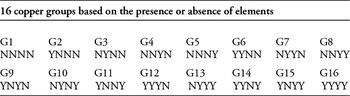
The modified data are classified into 16 copper types based on the presence or absence of certain trace elements (Table 1). As we are drawing on chemical data from a variety of sources, the cut-off value for presence/absence (0.1 wt% in this instance) is a pragmatic compromise, which allows us to include as much of the available data as possible in the analysis. To test the robustness of the conclusions, this value is routinely changed during the interpretive process to assess the significance of any changes to the patterns described.
Classification of copper groups.

Sequence: As/Sb/Ag/Ni.
N when the element is <0.1 wt%; Y when the element is ≥0.1 wt%.
Alloy types are next classified using an arbitrary 1% cut-off value to distinguish the presence/absence of deliberately added elements (tin, lead and zinc). This theoretically leads to an eight-fold classification: copper, leaded copper, tin-bronze, leaded tin-bronze, brass, leaded brass, gunmetal and leaded gunmetal. For this period and region, however, only the first four of these categories are relevant.
These preliminary organisational steps enable us to examine regional patterns in the composition of metal assemblages and to explore not only the movement or flow of metal differences, but also the ways in which metals are used and re-used in society (Bray et al. Reference Bray, Cuénod, Gosden, Hommel, Liu and Pollard2015). Each copper group does not necessarily relate to a single source, and over the course of its ‘lifetime’ a unit of metal may pass between different groups. The stepwise process of assigning a group then examining the distribution and median levels of key elements allows us to untangle aspects of this life-history.
The bronze data
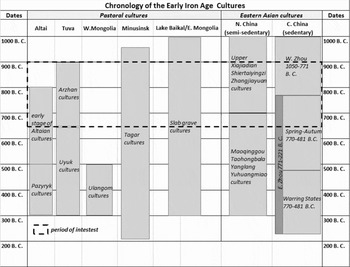
A database of 1900 chemical entries (1371 of which have trace elements) has been collected for this study (see online supplementary material 1 & 2). The data collated covers areas of the Altai, Tuva, Minusinsk Basin, Cisbaikal, Transbaikal and Xinjiang, which were occupied by predominantly pastoralist societies throughout the Early Iron Age. By way of comparison, we also include analyses of metal from contemporary semi-sedentary societies of northern and north-western China, and the agricultural world of the Central Plains. Copper-based artefacts under examination are roughly dated to between c. 900 and 650 BC (Figure 3; see online supplementary material 1 for discussion of the chronology).
Archaeological chronologies (dates modified after Moskova & Rybakov Reference Moskova and Rybakov1992; Alekseev et al. Reference Alekseev, Bokovenko, Boltrik, Chugunov, Cook, Dergachev, Kovalyukh, Possnert, van der Plicht, Scott, Sementsov, Skripkin, Vasiliev and Zaitseva2001; Zaitseva et al. Reference Zaitseva, Chugunov, Alekseev, Dergachev, Vasiliev, Sementsov, Cook, Scott, van der Plicht, Parzinger, Nagler, Jungner, Sonninen and Bourova2007; Wu Reference Wu2008; Svyatko et al. Reference Svyatko, Mallory, Murphy, Polyakov, Reimer and Schulting2009).

These chemical data were obtained from a variety of sources and derived using a wide range of analytical techniques. As a result, it is important to consider questions of comparability and reproducibility in our analysis. A large-scale, inter-laboratory investigation of this issue was carried out by Northover and Rychner (Reference Northover, Rychner, Mordant, Michel and Rychner1998). They concluded that most of the data obtained showed general agreement irrespective of the analytical technique employed and could, therefore, be used interchangeably with appropriate caution. Moreover, to minimise any resulting errors, we do not deal with absolute compositional values of isolated objects, but rather focus on the chemical trends within the dataset.
Classification of copper groups
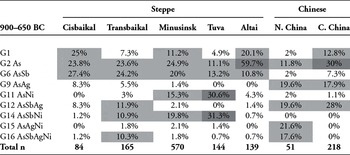
Table 2 summarises the distribution of the 16 copper groups in each of the geographic regions defined in this study. Where more than 10% of the analysed objects from a region belong to any single group, the corresponding cells are shaded to highlight major regional patterns.
Copper groups in analysed objects; see online supplementary material 2 for references.

 10–30%
 >30% G1 & G2: steppe/China; G6, G11 & G14: steppe; G9 & G12: China. n = 1371.
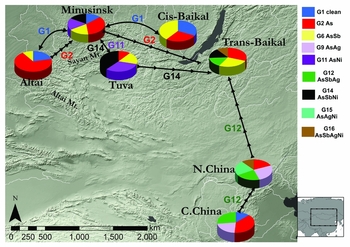
‘Clean’ copper (G1) and ‘arsenic-only’ copper (G2) are both present in almost all regions; ‘arsenic-antimony’ (G6) and ‘nickel-bearing’ copper (G11 and G14) are restricted to the steppe, while argentiferous copper (G9 and G12) is primarily Chinese (the silver in these cases is probably brought in with the lead during alloying; Figure 4).
Distribution of copper groups across eastern Eurasia.

The distribution of ‘clean’ copper (G1) is most abundant in the Altai, Minusinsk Basin and Cisbaikal, along the northern edge of the Altai-Sayan Mountains. ‘Arsenic-only’ copper (G2) is common in most areas, but dominant in the metalwork from the Altai, accounting for almost 60% of the analysed objects, and suggesting significant primary production. The proportion of G2 copper within the local assemblages diminishes with distance from the Altai. Although central Chinese objects similarly show a high proportion of G2, their arsenic content tends to be low, and most samples derive from ritual vessels, radically different in technology and style, from the metalwork of the steppe. The emergence of G2 copper in central China probably belongs to another metallurgical network as yet incompletely defined.
The distribution of G6 ‘arsenic-antimony’ copper, although interesting, does not reveal any clear patterns. Even though the Lake Baikal regions contain a higher percentage (55%) than in the west, we cannot rule out the possibility that other sources in other regions were also contributing to this pattern. Instead of linear directional exchange, the distribution of this copper type may help to highlight the complexity of the system and would be a potentially interesting focus for future research.
Nickel-bearing copper (G11 and G14) appears to be restricted to the steppe, and Tuva and the Minusinsk Basin are both excellent candidates as the source regions for these types of copper. The presence of metal of this type in the Transbaikal is potentially significant, but as it is relatively rare within the assemblage, its contribution to the wider flow of metal is not yet clear.
Some copper types suggest possible long-distance relationships between the steppe and China. For example, G12, silver-bearing copper typical of metalwork in China, correspondingly occurs in the Transbaikal, but is absent in other areas. Additionally, highly mixed G16 metal is found in both northern China and the Transbaikal.
Reconstructing flows of metal
Our chemical model predicts that elements vulnerable to oxidative loss (e.g. arsenic and antimony) will diminish during recycling events. Therefore, a decrease in the average levels of these elements at an assemblage level can be regarded as indicators for the dominant direction of metal flow between regions. By observing the profiles of these elements, we can begin to identify patterns of primary and secondary production.
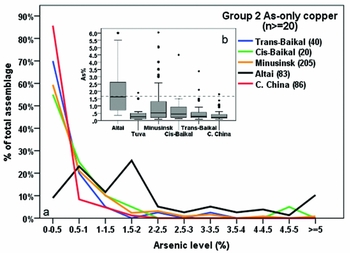
Figure 5a shows the profile of arsenic in G2 ‘arsenic-only metal’ for each region. In the Altai we see two pronounced peaks between 0.5–1% and 1.5–2%. Over 50% of the Altai G2 copper objects fall within one of these two bands. In this respect, the Altai region is quite different from the other areas. Such high arsenic levels imply easy access to high-arsenic copper ores.
(a) Distribution of arsenic in G2 artefacts; (b) comparison of median arsenic levels.

G2 metal in other regions tends to fall into the low-arsenic range (<0.5%). This pattern could be explained as the result of routine re-casting of the Altai G2 metal into new objects or locally appropriate forms. Figure 5b compares the median arsenic level across the regional assemblages. In the Altai, it is around 1.5%, which is far higher than in other regions.
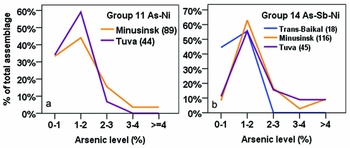
Of course, many other primary production centres would have existed beyond the Altai region during the Early Iron Age. These certainly contribute to the patterns we observe in the data; even with the relatively limited data, some potential candidates show up clearly. One such example is the nickel-bearing copper (G11 and G14) that appears concentrated in the Tuva and Minusinsk Basin. The profile of arsenic in G11 illustrates the general similarity of metal in both regions, with a common peak at 1–2% arsenic (Figure 6a). Arsenic levels in G14 metal further show a maximum at the same level (Figure 6b). This may suggest a shared ‘repertoire’ of nickeliferous metalwork in both Tuva and Minusinsk.
Arsenic profile in (a) G11 artefacts; (b) G14 artefacts.

This conclusion fits well with the available archaeological evidence of mining and metalworking activities in these regions, which have emphasised the importance of primary production in the Tuva and Minusinsk Basin; several Early Iron Age mining, smelting and casting sites have been discovered near the copper-nickel-cobalt deposits at Khovu-Aksy in eastern Tuva (Sunchugashev Reference Sunchugashev1969: 44). Likewise, the chemical analysis of copper ingots from Temir, a Tagar casting site in Minusinsk, show arsenic greater than 1% and nickel around 0.1–0.6% (Sunchugashev 1975: 124–25). This evidence demonstrates that, when sufficient data are available, our chemical approach can serve as an independent tool to predict probable areas of primary production for particular copper groups. This is especially important when no direct archaeological evidence of primary production is available.
Distribution of alloy types
Examining the alloy types used by different pastoralist groups can also provide valuable information regarding the circulation of alloying materials (tin or lead), whether as ore, metal or within finished objects. Regions with access to such resources will probably produce high proportions of tin-bronze or leaded tin-bronze in their assemblages. In order to determine the alloy type, we set the cut-off value at 1% for the significant presence/absence of tin and lead. This classification criterion is intended to highlight the characteristic history of these copper-based alloys rather than provide any window into the actual mechanical properties of the metal itself.
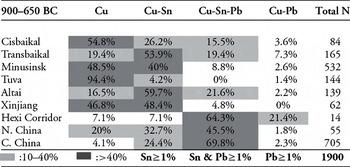
Table 3 shows the percentage of each alloy type in each region, revealing two separate traditions of metallurgical practice in the Early Iron Age of eastern Eurasia. The first is the steppe-style use of unalloyed copper and tin-bronze. This stands in sharp contrast to the strong tradition of leaded tin-bronze seen in central China and among some of its neighbours, the bronze-producing communities in northern China and the Hexi Corridor, although it is not yet clear how much of this latter material is recycled or acquired from Chinese sources (see Cao Reference Cao2014).
Alloy types in analysed objects.

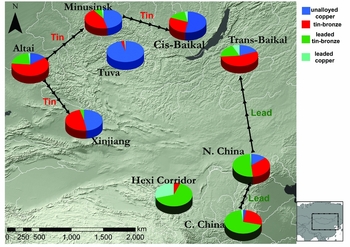
Plotting distributions for each alloy type on a map can further highlight the spatial relationships between different areas (Figure 7). In the Altai, tin-bronze production dominates; nearly 60% of the Altai objects from this period were alloyed with tin. This proportion drops steadily eastwards away from the Altai. Assemblages from the Minusinsk Basin and Xinjiang still contain quite high proportions of tin-bronze, while in the Cisbaikal, the proportion falls sharply. Interestingly, the use of tin-bronze in Tuva is similarly quite low, although this is potentially a function of the particular character of the analytical sample from this region. Equally of note is the significant proportion of tin-bronze in the assemblages of the Transbaikal, which may reflect the exploitation of local cassiterite (tin oxide) deposits near the Upper Onon River (Wolf Reference Wolf1982: 262).
Distribution of alloy types across eastern Eurasia.

The Baikal region is also noteworthy for the presence of leaded copper and bronze objects (Cu-Pb and Cu-Sn-Pb). As noted above, the addition of lead appears to be closely connected with China, and may suggest the use of leaded metal, acquired there or from its neighbours. Again, this would fit well with other lines of archaeological evidence (e.g. Hommel et al. Reference Hommel, Rawson and Sax2013).
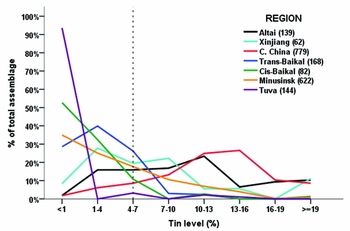
In order to develop a better picture of the use of tin and lead, it is important to look at the profiles of these elements in the regional assemblages. In the primary production regions, where ancient metalworkers had ready access to tin resources, they were able to produce tin-bronze/leaded tin-bronze within controlled compositional ranges (Figure 8). Central Chinese metalwork, for example, shows a unimodal distribution of tin between 7% and 19%. Such a broad tin distribution might be due to diverse types of bronze artefacts, which required different levels of tin. Objects from the Altai and Xinjiang do not show such prominent peaks, yet we can still regard both areas as tin-bronze production centres due to the frequent occurrence of high-tin objects. The Altai region has a faint peak between 10% and 13% tin, followed by Xinjiang with a peak between 7% and 10% tin. The similarity of the tin distribution in both regions may indicate that tin-bronze production in Altai and in Xinjiang were closely associated and tin resources or high-tin bronzes were either readily available or freely circulated in both regions.
Distribution of tin within the copper-alloy objects.

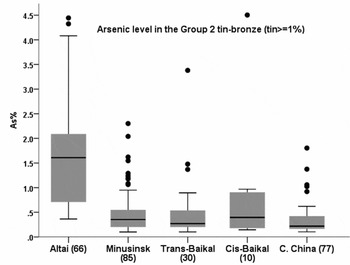
In other areas with limited access to local tin resources, we would expect a different pattern. Such ‘non-primary tin-bronze use’ would be characterised by a predominance of low-tin artefacts, perhaps primarily produced by recycling and recombining tin-bronzes acquired through exchange or other forms of contact. Given that the majority of objects from the Transbaikal, Cisbaikal, Minusinsk Basin and Tuva contain considerably less than 7% tin, we would argue that all of these areas fall into this latter category. Of course, on its own, this pattern could be interpreted as a local tradition of low-tin bronze production, but if we combine this with data on arsenic levels, this seems increasingly improbable. Arsenic, as discussed earlier in this paper, can be used as a marker of recycling, and if tin-bronzes from one region were routinely re-melted in another, we would expect an overall decrease in arsenic between their assemblages. Figure 9, which shows median arsenic levels in regional bronze (tin ≥ 1%) assemblages across the eastern steppe, illustrates precisely this pattern. Away from the Altai, which we consider to be a major source of tin and tin-bronze, the falloff seen in other regional assemblages in the steppe can be most plausibly explained as the result of re-melting imported tin-bronzes in combination with local unalloyed copper, resulting in objects with relatively low tin and arsenic values.
Comparison of the median arsenic levels in G2 bronze artefacts (tin ≥ 1%).

Typology and chemistry
Thus far, the discussion has considered all types of copper-alloy objects together at a regional scale. Where sample numbers permit, however, it is possible to begin to target individual artefact types and consider how they fit within or differ from the general trends. To demonstrate this, we have extracted data for the most iconic and widely distributed steppe artefacts of this period: single-bladed knives and cauldrons.
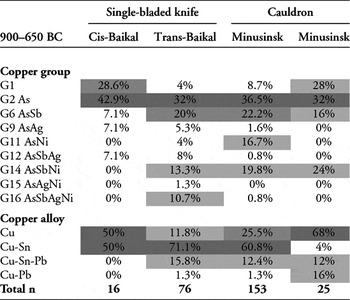
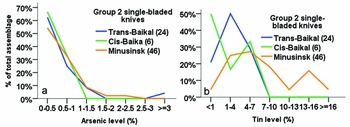
Knives from the Minusinsk Basin and the Baikal region allow for this kind of comparative study. As shown in Table 4, these knives mainly consist of G2 ‘arsenic only’ copper and tin-bronze. While we see a pattern of diminishing arsenic in the overall assemblages from these regions, the arsenic distribution in knives appears relatively stable. This implies that many of these knives were moving directly between regions, whether through exchange or population movements, without entering the recycling chain (Figure 10a). The similar profile of tin (1–7%) may suggest that some were even transported directly between Minusinsk and the Transbaikal (Figure 10b). Consequently, the circulation of metal in eastern Eurasia involved both general exchange and the recycling of metal (e.g. Altai G2 tin-bronze) and direct movement or exchange (e.g. single-bladed knives) to form a complex metallurgical network. Such patterns are clearly worthy of further study.
Summary of copper and alloy types in object typology.

(a) Distribution of arsenic in G2 single-bladed knives; (b) distribution of tin in G2 single-bladed knives.

Compositional data on cauldrons, although relatively limited, may also show evidence of technological transmission. In the Minusinsk Basin, the chemistry of cauldrons generally follows the same copper groups as single-bladed knives (G2, G6, G11 and G14). The alloy types used are, however, distinct: mostly unalloyed copper with a few leaded tin-bronze and leaded copper examples. The preference for pure copper in the production of cauldrons is again attested in Xinjiang (see Mei Reference Mei2002), suggesting a possible relationship in technological choice. Furthermore, these copper cauldrons often bear traces of casting seams, serving as evidence of the ‘piece-mould’ production. This method was characteristic of bronze vessel production in China, and its appearance in the eastern steppe further consolidates proposed links between these two areas (So & Bunker Reference So and Bunker1995: 108).
Discussion and conclusion
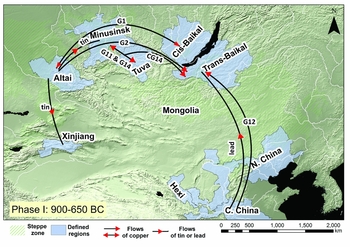
The provisional directional flows of metal described in this paper are summarised in Figure 11. G2 ‘arsenic-only copper’ was primarily produced in the Altai and filtered into the Minusinsk Basin and on into the Baikal region. A similar flow of tin from the Altai, and possibly from Xinjiang, is also apparent—probably in the form of finished tin-bronze products, reworked and recombined with other copper sources in the Minusinsk Basin and beyond. Only in the Transbaikal do we see the potential exploitation of other primary sources of tin. Simultaneously, nickel-bearing copper (G11 and G14), deeply rooted in Tuvinian and Minusinsk metalwork, reached as far as Transbaikal, where the presence of G12 (silver-containing copper) suggests other connections with the south. Although G2 metal produced in the Altai flowed into the Minusinsk, no corresponding flow of G11 and G14 metals in the opposite direction was identified. This apparent eastward drift in the flow of copper and tin resources during the first few centuries of the first millennium BC is intriguing and warrants further investigation, both in the context of subsequent developments and in relation to the extensive metallurgical network that emerged during the Final Bronze Age. The coincident distribution of Karasuk-related, bronze single-bladed knives, in particular, suggests that the patterns of flow in the Early Iron Age built directly upon the ‘modalities of exchange’ established in the preceding period (Legrand Reference Legrand and Linduff2004: 153–54; Molodin 2009; Gorelik et al. Reference Gorelik, Körlin, Samashev and Stöllner2013). Likewise, another metal-trading network, through the Mongolian steppe to central China, was established during the Final Bronze Age (Cao Reference Cao2014).
Schematic map showing the reconstructed flow of metal in the Early Iron Age of eastern Eurasia (c. 900–650 BC).

What seems clear from our initial analysis is that the structure of metallurgy and metal exchange among pastoral communities of the steppe is both complex and dynamic. It is tempting to attribute some of the ‘mobility’ seen in metal as markers of the routine seasonal movements and intercommunal contact, which is broadly characteristic of steppe societies. Certainly many of the patterns we see were shaped by short-distance, multi-stage exchange relationships of this kind, combined with significant local re-production. Indications of more extensive transfers, however, and even the direct movement of finished objects over considerable distances, seem clear.
Perhaps certain objects had sufficient social significance to escape the basic currents of metal circulation, in which re-working and re-melting was commonplace, changing hands multiple times in their original form. Perhaps they were deeply personal and closely bound to the people for whom, or by whom, they were made. New data, combined with detailed typological work and other lines of evidence, should allow us to target and unpick these patterns of movement and exchange; again, such questions provide potentially fruitful avenues for research.
Of course, as this paper has been reliant on ‘legacy data’ in its reconstruction of flow within the metallurgical network of the Early Iron Age, it inevitably faces the challenges of insufficient information, sampling bias and chronological uncertainty. In the absence of significant bodies of data on metal composition from key regions of northern China, Mongolia, Xinjiang and Kazakhstan, all the patterns we describe are to some extent incomplete, and the existence of alternate pathways of circulation and additional foci of primary production seems certain. Data collection in all these regions is an active focus of our on-going research.
Chronology is also a significant problem. Reliable series of radiocarbon dates for this period are only available for a limited number of sites in the Tuva, Minusinsk Basin and central China, and the majority of the Early Iron Age cultures have only broad and ambiguous chronological boundaries. This alone makes the comparison of synchronous events very challenging. As we know that some metal objects remained in circulation for significant periods, absolute chronology must be very carefully paired with typology. For many sites, this pairing is currently difficult to achieve.
Perhaps the most significant problem we face is the general lack of data, which limits our ability to work in detail on relationships between typology and composition. This work is crucial, as it is only through this combination of archaeological and chemical studies of metal that we can hope to find explanations for the structure in the data. Ultimately, both the patterns we have described and the questions we have left unanswered can only be tested and clarified through further research. For us, in spite of all the challenges, this seems an exciting prospect.
Acknowledgements
The research for this project has been mainly supported by Leverhulme Grant ‘China and Inner Asia 1000–200 BC’ (F/08 735/G) and by the Oxford University Press John Fell Fund. We are also grateful to Sascha Priewe and Quanyu Wang at the British Museum for providing additional northern Chinese data, and for the valuable feedback provided by our departmental colleagues, particularly R. Liu, B. Sabatini, L. Perucchetti and V. Sainsbury. We are especially grateful to the two reviewers whose helpful and constructive comments provided the foundation for considerable improvements to the final text. Any remaining errors or omissions are entirely our own.
Supplementary material
To view supplementary material for this article, please visit http://dx.doi.org/10.15184/aqy.2016.22.