Introduction
Desmoid fibromatosis (DF) is a benign, but locally aggressive tumour composed of myofibroblasts.Reference Cheon, Cheah and Turley1 These tumours are rare and form <3% of all soft tissue neoplasm.Reference Reitamo, Häyry, Nykyri and Saxén2 Most of the DF (also known as aggressive fibromatosis) occur sporadically but can be associated with familial adenomatous polyposis (FAP) syndrome.Reference Heiskanen and Järvinen3,Reference Clark, Neale, Landgrebe and Phillips4 Because of the rarity of this disease, the optimal treatment guideline for DF is yet to be established. Watchful waiting is an option for those DF which do not cause potentially life-threatening complications.Reference Fiore, Rimareix and Mariani5 DF is treated by surgery with or without post-operative radiotherapy (RT). Systemic agents such as tamoxifen, tyrosine kinase inhibitors (imatinib or sorafenib), single-agent chemotherapy with doxorubicin, combination chemotherapy with doxorubicin and dacarbazine, methotrexate and vincristine/vinblastine have shown objective response rates more than 60% in non-resectable DF.Reference Bonvalot, Desai and Coppola6
We analysed the treatment outcome of patients with DF treated over 10 years, to assess relapse-free survival (RFS) and the factors that influence local recurrence.
Aim of the study
To assess the RFS and the factors influencing local recurrence in patients with DF and to determine the role of post-operative RT in improving the local control.
Materials and methods
This study was conducted after clearance from the institutional review board. A retrospective analysis of the hospital records of patients treated with DF from January 2004 to December 2013 was done and collected data on demographic factors, tumour characteristics, surgery, pathology & RT details, and post-treatment follow-up from electronic medical records. The patients were contacted over telephone by the first and second authors to get follow-up data. The relapse status of the patients who were not contactable over telephone was noted from the hospital records of their latest outpatient visit to our hospital. Relapse is considered when there is disease recurrence in the operated site in case of complete resection, or an increase in the size of the residual tumour if it was a partial resection.
Patient characteristics were summarised as counts and percentages for categorical variables and median and range for continuous variables. Chi-square test was used to test the association between the occurrence of relapse and the associated clinical variables. RFS time was calculated from the date of diagnosis to the documentation of relapse or date of last follow-up, and the RFS rate was calculated using the Kaplan–Meier curve. Logistic regression analysis was done to assess whether tumour size, site, the extent of surgery, margin status or adjuvant RT influenced the RFS without adjusting the risk factors simultaneously. All analyses were done using statistical software STATA version 15 Stata Corp.2017. State statistical software; Release 15, College Station, TX: State Corp LLC.
Treatment
The diagnosis was confirmed by biopsy from the lesion. CT imaging with contrast was done for all anterior abdominal wall tumours and mesenteric DF. Magnetic resonance imaging was done for extremity DF. Surgery was wide local excision (WLE), partial excision or biopsy alone, depending on the location and extent of the tumour. A negative margin was defined as microscopically negative margin, which was ≥2 mm. A positive margin was defined as the resection margin involved by the tumour, and a close margin was defined as the microscopic resection margin of <2 mm. All patients with negative resection margin were kept on follow-up. Those patients with close or positive margins were offered adjuvant RT. The patients with intra-abdominal DF were offered RT if feasible, or else, they were offered medical management. The gross tumour volume (GTV) was defined as the entire operative bed/gross tumour as measured through imaging studies before and after surgery and intra-op findings. The clinical target volume (CTV) was 1·5–2 cm around the GTV, respecting the anatomical boundaries and organs at risk.Reference Choi, Yoon, Kim, Kim, Shin and Suh7 The planning target volume was 0·5–1·0 cm to the CTV, depending on the location of the tumour, immobilisation used and RT technique. The median RT dose was 54 Gy (range: 46–66 Gy), 1·8–2 Gy per fraction, five fractions per week.Reference Zlotecki, Scarborough and Morris8 Those patients who had a partial resection and were not willing to receive RT were started on medical management.
Results
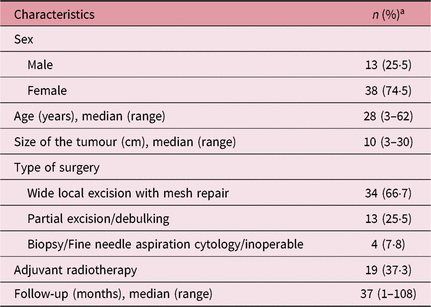
Fifty-one patients were treated for fibromatosis from January 2004 to December 2013. As described in Table 1, the most common age group was a second and third decade (59%) ranging from 3 to 62 years, with a median of 28 years. There were 13 males and 38 females with a male:female ratio of 1:3. The commonest location of the tumour was the anterior abdominal wall (47%) followed by extremities (21·6%). The tumour size ranged from 3 to 30 cm, with a median of 10 cm, and 19·6% of patients had tumour size >15 cm. Thirty-seven per cent of patients presented as a recurrent tumour, following earlier excision. Seven patients had intra-abdominal fibromatosis, out of which six were sporadic and one was associated with FAP. The patient characteristics are listed in Table 1.
Patient characteristics (n = 51)

a Values are n (%) unless otherwise stated.
Surgical excision
Out of 51 patients, 47 had surgical excision and 4 had a biopsy. WLE was done in 34 patients and partial excision in 13 patients. In addition, patients with anterior abdominal wall DF had mesh repair (MR). All patients with intra-abdominal fibromatosis had partial excision. The post-operative complications included wound infection and wound dehiscence in three patients and enterocutaneous fistula in one patient. The patient with FAP-associated intra-abdominal fibromatosis had undergone proctocolectomy and ileoanal anastomosis 15 months prior to the diagnosis of fibromatosis. He developed small bowel obstruction 10 days after the attempted debulking of the fibromatosis and developed aspiration pneumonia and died in the immediate post-operative period.
Eight patients had WLE with a microscopically negative margin of ≥2 mm and were kept on follow-up. Remaining patients had microscopic positive or close margins and were advised post-operative RT.
Post-operative RT
Out of the 43 patients who were advised post-operative radiation therapy, only 19 (37·3%) received post-operative RT. The RT dose ranged from 46 to 66 Gy (a median dose of 54 Gy), in 1·8–2 Gy/fraction, five fractions per week. Post-operative RT was delivered using conventional (12/19), 3D conformal (4/19) or intensity-modulated (3/19) technique. The beam used was cobalt 60 gamma rays or 6 MV photons. Among the 24 patients who did not receive RT, 1 patient died in the immediate post-op period and 4 had post-operative wound complications which delayed RT and they were kept on follow-up.
Systemic therapy
The patients who were not willing for post-operative RT were offered systemic therapy. Eight patients received systemic therapy, six with tamoxifen 40 mg twice daily for a year or more and two received metronomic chemotherapy for 1 year, one with oral cyclophosphamide and the other with vinblastine and methotrexate.
Outcome
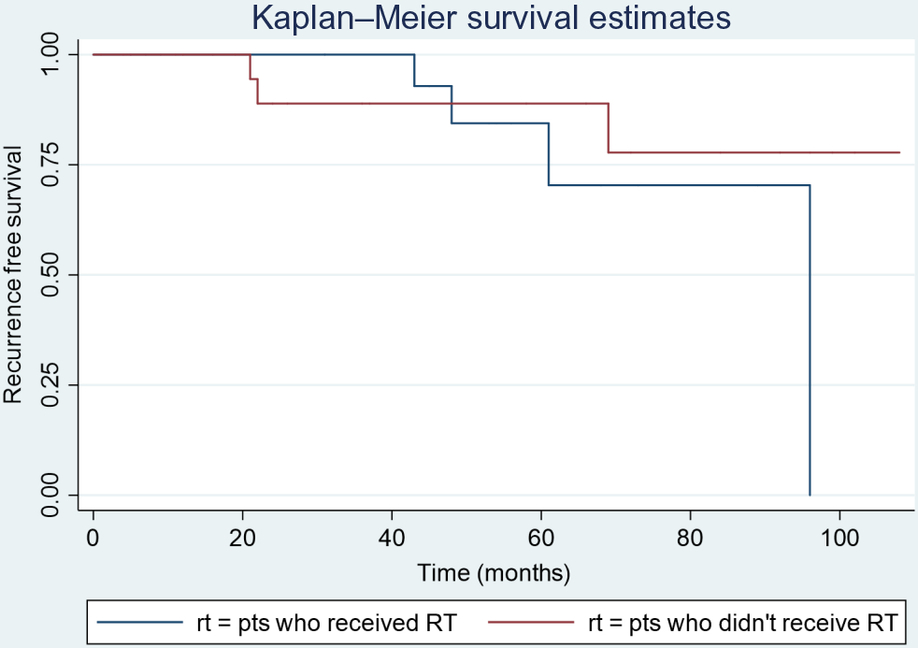
Initial follow-up was after 1–3 months from surgery and RT, to assess early toxicity and once a year thereafter. The follow-up ranged from 1 to 108 months, with a median follow-up of 37 months. There were four (4/19) recurrences in the radiated group which occurred 1–4 years after RT. The RFS in the irradiated group was 79%. The acute radiation-induced toxicity seen was grade 1 or 2 dermatitis only. There was no late toxicity reported in this cohort.
Among those who did not receive RT, five patients were lost on follow-up and three had documented disease recurrence which occurred within 2 years of surgery. All these patients underwent re-excision followed by RT at recurrence. Eight patients in this group received systemic treatment. The RFS among those who did not receive RT was 87%.
The patients who had complete excision (8/51) with a microscopic negative margin of ≥2 mm were kept on follow-up and there was no local recurrence. The RFS in the group who had surgery with negative margins was 100%. All were alive at last follow-up except the one who died in the immediate post-operative period.
Factors influencing local recurrence
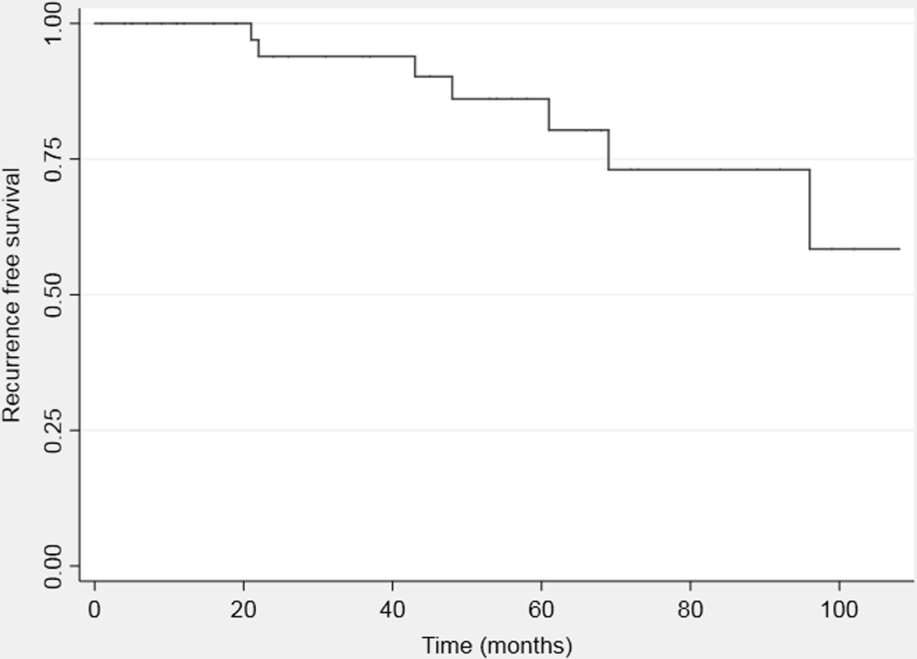
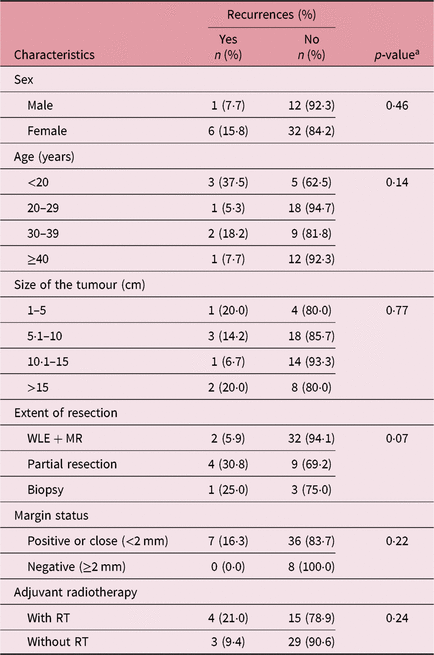
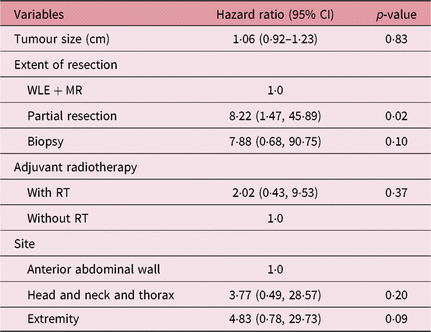
Factors such as age, sex and the tumour size did not affect the local recurrence. Extremity tumours showed a trend towards increased local recurrence. The extent of resection and margin status seemed to influence the RFS. There were 2/32 recurrences in the WLE group compared with 4/9 in the partial excision group and 1/3 in the biopsy-alone group. Those patients who had a microscopic negative margin of ≥2 mm had no local recurrence. All seven recurrences occurred in those patients who had close or positive margins. There were 4/19 recurrences in the radiated group compared with 3/32 in the non-irradiated group. Factors associated with local recurrence are shown in Tables 2 and 3. The Kaplan–Meier curves for RFS are shown in Figures 1 and 2.
RFS of all patients with desmoid fibromatosis after surgery.

Recurrence-free survival of patients with desmoid fibromatosis after surgery, with or without adjuvant radiotherapy.

Factors associated with local recurrence in desmoid fibromatosis

a p-value is obtained using the chi-square test.
Factors related to recurrence-free survival of desmoid fibromatosis patients: unadjusted Cox regression analysis

Discussion
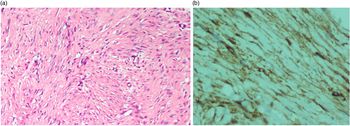
DF is a monoclonal proliferative disease which is locally aggressive, with the tendency to recur locally. Local failure rates range from 25 to 60%.Reference Francis, Zippel and Mack9 Macroscopically, fibromatosis is an ill-defined tumour with infiltrating borders and a firm white fibrous to the trabeculated cut surface. Histology shows long fascicles and sheets of spindle cells with plump mildly pleomorphic nuclei in a collagenous background with scattered punched out small calibre vessels (Figures 3a and 3b). It is a benign disease but can be associated with significant morbidity. According to literature, the median age of patients at diagnosis is 30 years,Reference Bonvalot, Desai and Coppola6 which was 28 years in our cohort. There was a female predominance with a male:female ratio of 1:3, similar to that reported by Bonvalot et al.Reference Bonvalot, Desai and Coppola6 All of our DF was sporadic except one patient with intra-abdominal DF, associated with FAP. Bertagnolli et al.Reference Bertagnolli, Morgan and Fletcher10 report that FAP-associated desmoid mainly arises from the intestinal mesentery. In the sporadic type of desmoids, the involvement of the abdominal wall and extremities is common.Reference de Bree, Keus, Melissas, Tsiftsis and van Coevorden11,Reference Johner, Tiwari, Zetler and Wiseman12 The most common site of involvement in this group is the anterior abdominal wall followed by extremities.
(a) Sheets of spindle cells with punched out vessels in collagenous background 200×. (b) Beta-catenin nuclear positive cells 400×.

Ballo et al.Reference Ballo, Zagars, Pollack, Pisters and Pollack13 concluded from a retrospective review of 189 patients with DF that WLE with a negative pathological margin is the best treatment approach for these tumours. Surgery was the treatment for the patients in this study group. Wide excision was attempted where possible. All patients with anterior abdominal wall tumour had a MR with WLE. Some patients, especially those with mesenteric fibromatosis, had partial resection and there were four patients who had a biopsy alone.
More recently, many authors have shown that ‘watch and wait’ is an option for desmoid tumours, as a primary modality of treatment.Reference Fiore, Rimareix and Mariani5 The local control rates are comparable with observation alone or with systemic treatment. No patient in our study group was offered observation as a primary treatment modality.
RT is used as a post-operative treatment in case of positive surgical margins. It is also considered as first-line treatment for unresectable tumours.Reference Bonvalot, Desai and Coppola6 In the meta-analysis on the effect of the influence of surgical margin and adjuvant RT on local recurrence in 1,295 patients by Jensen et al., local recurrence was higher for those patients with positive resection margin. Addition of RT to such patients improved the local control rates. Authors also noted that adjuvant RT to patients with negative resection margins had no detectable effect on preventing local recurrence.Reference Janssen, van Broekhoven and Cates14 We offered post-operative RT to those patients who had close or positive resection margins. The median RT dose was 54 Gy in conventional fractionation.
In this study, there was no association of age, sex or tumour size with RFS. But tumour location in extremities showed an increased incidence of local recurrence. Peng et al.Reference Peng, Hyder and Mavros15 reported that younger age and extra-abdominal tumour location were associated with poorer RFS. Lev et al.Reference Lev, Kotilingam and Wei16 in their study on DF noted higher local recurrence rates with extremity tumour site.
Margin status was one of the important factors that determined local recurrence in our study. We found that those patients with a microscopically negative margin of ≥2 mm had 100% local control. There are similar reports from many retrospective studies,Reference Huang, Wang and Chen17–Reference Mullen, Delaney and Kobayashi19 showing an increased recurrence rate for patients with microscopically positive margins when compared with microscopically negative margins. Mullen et al.Reference Mullen, Delaney and Kobayashi19 have reported that negative resection margin was the only predictor of freedom from local recurrence. Ramamurthy et al.,Reference Ramamurthy, Arumugam and Ramanandham20 in their surgical series on the desmoid tumour in the Indian population, showed that recurrent tumour status and positive surgical margins influenced local control rates.
In our study, 84% of the patients had positive or close resection margins. There was no significant difference in the recurrence rate among the 44% patients who received RT and those who did not. One reason for this is due to the lower number of recurrences in the entire group. The use of systemic therapy in patients with positive margins who did not receive RT might also have contributed to decreased recurrences in this group. Huang et al.Reference Huang, Wang and Chen17 reported that selective use of adjuvant radiation did not show a significant benefit over local control. Mullen et al.Reference Mullen, Delaney and Kobayashi19 in their retrospective review of 177 patients with desmoid tumours treated with resection with or without the addition of RT reported that fewer than half of the patients with positive margins will experience recurrence. This may be due to the natural history of the tumour, which is characterised by prolonged periods of stability or even regression. Because of this nature, there is a strong suggestion that watchful waiting policy may be one of the options for DF, except in situations which are potentially life-threatening.Reference Casali and Blay21 Based on the outcomes of our study, institutional policy has been made not to offer post-operative RT for all patients with DF. Management of each patient with DF will be discussed in our multi-disciplinary tumour board, and post-operative RT will be planned only for those patients with recurrent DF and positive resection margin.
The limitation of the study is the inclusion of a diverse spectrum of DF like intra-abdominal and extra-abdominal, primary and recurrent tumours. The failure to show the benefit of post-operative RT in margin positive DF is probably due to the less number of events and the addition of systemic therapy to this group.
Conclusions
Surgical excision with negative margins gives the best local control in DF. The benefit of post-operative RT could not be ascertained.
Acknowledgements
None.
Financial support
None.
Conflicts of interest
None.
Ethical standards
This study was initiated after approval from the scientific and ethics committees of institutional review board.