


Introduction
Paranoid delusions can be a particularly distressing experience that are reported by up to 70% of people with a first episode of psychosis (Freeman and Garety, Reference Freeman and Garety2014), as well as by people with other diagnoses and non-clinical populations (Bebbington et al., Reference Bebbington, McBride, Steel, Kuipers, Radovanovic and Brugha2013).
The role of anxiety in paranoid delusions
Paranoid ideation is the unfounded belief that harm is, or will be, purposefully inflicted on the individual (Freeman and Garety, Reference Freeman and Garety2000). Given that anxiety is commonly understood as threat-anticipation, and disorders of anxiety as chronic over-estimations of threat (American Psychiatric Association, 2013; Butler et al., Reference Butler, Fennell and Hackmann2010; Wells, Reference Wells1997), it makes intuitive sense that delusions involving anticipation of harm would be influenced by, and in turn influence, anxiety. Anxiety is given a key role in the threat-anticipation model of the formation and maintenance of paranoid delusions (Freeman et al., Reference Freeman, Garety, Kuipers, Fowler and Bebbington2002; Freeman, Reference Freeman2007).
The research base supporting the role of anxiety in paranoia is substantial. Anxiety has been found to be associated with paranoia in the general population (Freeman et al., Reference Freeman, McManus, Brugha, Meltzer, Jenkins and Bebbington2011), high-risk groups (Salokangas et al., Reference Salokangas, Schultze-Lutter, Hietala, Heinimaa, From and Ilonen2016) and clinical groups (Bosanac et al., Reference Bosanac, Mancuso and Castle2016; Huppert and Smith, Reference Huppert and Smith2005). Both anxiety and worry, a key cognitive component of anxiety, were found to have a dose–response relationship to paranoia in a study involving low paranoid, high non-clinically paranoid and clinically paranoid groups (Freeman et al., Reference Freeman, Pugh, Vorontsova, Antley and Slater2010). An experience sampling study found that increases in anxiety predicted the onset of paranoid episodes in people with and without clinical paranoia (Thewissen et al., Reference Thewissen, Bentall, Oorschot, van Lierop, van Os and Myin-Germeys2011) and anxiety has been found to predict the persistence of paranoia in high-risk groups (Salokangas et al., Reference Salokangas, Schultze-Lutter, Hietala, Heinimaa, From and Ilonen2016). In sum, there is good evidence that anxiety is associated with paranoia.
However, a systematic review (Hartley et al., Reference Hartley, Barrowclough and Haddock2013) concluded that, whilst there is convincing evidence that anxiety and depression are associated with psychotic experiences, there is a need for research that explores causal relationships between these affective states and specific psychotic experiences. An experimental investigation in a non-clinical population found that an anxious-mood induction led to significantly greater state-paranoia than a neutral-mood induction and that this was predicted by anxiety levels after the mood induction over and above other mood states (Lincoln et al., Reference Lincoln, Lange, Burau, Exner and Moritz2010). Furthermore, it was demonstrated that the anxious-mood induction increased paranoia only for those with higher baseline paranoia, adding support to the stress-vulnerability model inherent in cognitive models. However, these results may not be the same in people who have already developed clinically significant paranoid delusions; this remains to be investigated.
Research that helps to elucidate which factors are involved in the formation and maintenance of paranoia is crucial to indicate useful targets for prevention and treatment. Preliminary studies into treatments for anxiety in people with paranoia have had promising outcomes. A cognitive behavioural intervention targeting anxiety and reasoning biases was found to reduce anxiety and paranoia in people with anxiety disorders; this effect was greater for those with higher baseline paranoia (Giusti et al., Reference Giusti, Ussorio, Salza, Malavolta, Aggio and Bianchini2017). Pilot studies into brief cognitive behavioural therapy (CBT) interventions for worry have found that when worry is reduced, there are significant reductions in paranoid ideation and paranoia-related distress compared with treatment as usual in people with paranoid delusions and psychosis (Foster et al., Reference Foster, Startup, Potts and Freeman2010; Freeman et al., Reference Freeman, Dunn, Startup, Pugh, Cordwell and Mander2015). Further studies that clarify the role of anxiety and other factors in paranoia are necessary to develop and refine theoretical models and clinical interventions. Specifically, research is needed to explore if there is a causal role for anxiety in paranoid thinking and if this interacts with other factors (Freeman, Reference Freeman2007; Hartley et al., Reference Hartley, Barrowclough and Haddock2013).
Aims of this paper
No study to date has directly manipulated anxiety to see if it has an effect on paranoia in people experiencing such beliefs in the context of clinical psychosis. This study sought to investigate whether an anxious-mood induction led to greater paranoia than a neutral-mood induction in people suffering with psychosis and paranoia and, if so, whether this was predicted by anxiety over and above other variables.
It was predicted that: (1) the anxious condition would lead to more state-paranoia than the neutral condition; (2) state-paranoia after the anxious condition would be predicted by state-anxiety; (3) state-anxiety would predict state-paranoia to a greater extent than other affective states; and (4) higher trait-paranoia would predict higher state-paranoia after the anxious condition.
Method
Ethical approval was obtained from the NHS Health Research Authority (project ID: 201330) prior to conducting this study. Participants gave informed consent before taking part in the study and were fully debriefed at the end of the study.
Participants
Participants were recruited from community mental health teams in the South West of England. Inclusion criteria were: (a) primary psychosis-spectrum diagnosis (ICD-10 classification F20–F29); (b) experiencing paranoia with at least 50% conviction; (c) aged 18–65 years; (d) not acutely unwell at present; (e) sufficient English language and cognitive ability to take part in the study; and (f) being supported by a mental health team. Twenty-seven people were initially recruited and five of these were excluded: three due to insufficient levels of paranoia, and two as the neutral memory they chose to recall provoked intense emotion and therefore was not, as required by the research questions, neutral. The remaining 22 participants were between 20 and 60 years old (mean = 32.82; SD = 10.72) with nine being female and 13 being male. The time since first recorded psychotic episode ranged from 0.5 to 27 years (n = 22; mean = 9.13; SD = 9.22) and the most common psychiatric diagnosis was paranoid schizophrenia (10 participants).
Measures
Paranoia Checklist (PC; Freeman et al., Reference Freeman, Garety, Bebbington, Smith, Rollinson and Fowler2005). The PC was used to measure paranoia conviction. This is an 18-item self-report measure with statements relating to paranoid ideation. For the purpose of this study only the conviction sub-scale (18 items) was used; respondents use a 5-point rating scale (0 = ‘do not believe it’ to 4 = ‘absolutely believe it’). The scale has been found to have excellent internal reliability (Freeman et al., Reference Freeman, Garety, Bebbington, Smith, Rollinson and Fowler2005). Responses were summed with higher scores indicating more paranoia conviction (range: 0–72). Cronbach's alpha was .88 in this study, indicating good reliability.
Psychotic Symptoms Rating Scale – section B (PSYRATS-B; Haddock et al., Reference Haddock, McCarron, Tarrier and Faragher1999). The PSYRATS-B was used to measure degree of trait paranoia. This scale consists of six clinician-administered questions rated on a 5-point rating scale from 0 (none) to 4 (extreme). The scores are summed with high scores indicating greater severity of delusions; in this study only paranoid delusions were enquired about (range: 0–24). The scale has been found to have excellent reliability (Drake et al., Reference Drake, Haddock, Tarrier, Bentall and Lewis2007).
Brief State Measure (BSM). The BSM was used to measure fluctuations in state-anxiety, affect, paranoia and paranoia-related distress. This is an 11-item self-report measure designed specifically for this study to measure variables of interest in a short time frame.
All statements on the BSM were presented on a 10 cm visual analogue scale (VAS) with participants drawing a line where they felt that each statement applied to them right now (anchors: ‘not at all’, ‘extremely’). The order that the questions were presented in was different each time.
The items were derived from existing measures and previous research studies:
• State-paranoia was measured using the 3-item change sensitive version of the PC, which has been found to be a valid and change-sensitive scale for clinically paranoid populations (α = .74; Schlier et al., Reference Schlier, Moritz and Lincoln2016). Items were: ‘I have to be on my guard against others’, ‘Strangers and friends look at me critically’ and ‘People are trying to make me upset’.
• Measures of positive-affect, negative-affect and anxiety were derived from a reliable measure of state-affect (α = .81 to .94; Stemmler et al., Reference Stemmler, Heldmann, Pauls and Scherer2001). The measure was modified similarly to other studies in this area (Ascone et al., Reference Ascone, Sundag, Schlier and Lincoln2017; Lincoln et al., Reference Lincoln, Lange, Burau, Exner and Moritz2010). The following words were presented after the statement ‘I feel. . .’:
○ State-anxiety sub-scale – ‘anxious’, ‘calm’ (reversed), ‘relaxed’ (reversed)
○ State-negative-affect sub-scale – ‘ashamed’, ‘sad’, ‘irritated’
○ State-positive-affect sub-scale – ‘happy’
For the anxiety and negative-affect scales the mean score from the three items was used; higher scores indicated higher affect (range: 0–10).
• Paranoia-related distress was measured with the item, ‘I am distressed by thoughts of others wishing me harm’.
Materials
The Brief Relaxation Script was used before each condition. This was based on previous studies looking at paranoia (e.g. Ascone et al., Reference Ascone, Sundag, Schlier and Lincoln2017; Lincoln et al., Reference Lincoln, Hohenhaus and Hartmann2013) and directs the individual to breathe calmly and relax into their chair with eyes closed or gaze softened.
The Imagery Recall Script was used to enhance remembering of the chosen event. This included prompts to elicit in sensu memory recall (e.g. what can you see/hear/feel? What are you thinking/feeling?). This was based on previous studies looking at paranoia (e.g. Ascone et al., Reference Ascone, Sundag, Schlier and Lincoln2017; Lincoln et al., Reference Lincoln, Hohenhaus and Hartmann2013).
The Compassionate-Colour Imagery Script was used to reduce any distress and elicit soothing feelings. This was based on compassion-focused therapy techniques and existing imagery scripts (e.g. Gilbert, Reference Gilbert2010) and entails the individual imagining a colour they associate with compassion.
All scripts are available upon request from the corresponding author.
Design and procedure
A two condition crossover experimental design was used. Participants were randomized to either the neutral or anxious condition first, and completed the other condition after a break.
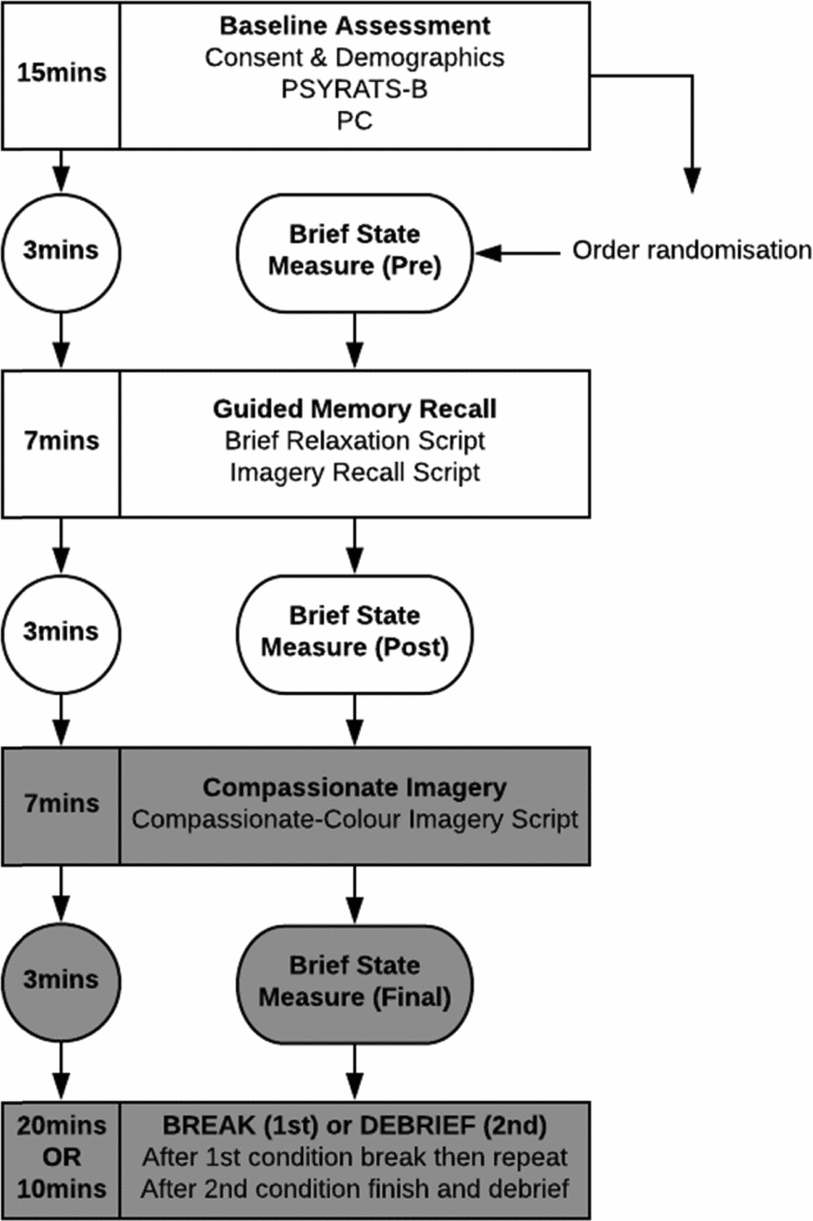
Participants were then asked to recall a recent (within the last 2 months) event that caused them to feel anxious, but that they did not consider to be traumatic, and an event that they considered to be emotionally neutral, such as a regular daily activity. Once an appropriate event had been identified (that did not directly involve paranoia), participants were guided through the brief relaxation script followed by the in sensu memory recall script for the first condition until the image was rated as at least 60% vivid. The BSM was completed before and after the memory recall in each condition. Following this, participants were guided through the compassionate colour imagery exercise to reduce any distress caused. There was a minimum 20-minute break before the procedure was repeated for the second condition. Please see Fig. 1 for a diagram of the study protocol which was completed twice, once for each condition, by each participant.
Flow diagram of study procedure with time estimates. Participants completed this procedure twice; order of recalling neutral and anxious memory was counterbalanced. Sections in dark grey were not analysed as part of this paper.

Statistical analysis
The effect of the anxious condition compared with the neutral condition on each variable of interest (paranoia, distress, anxiety, negative- and positive-affect) was explored using a 2×2 repeated-measures analysis of variance (ANOVA) with within-subjects factors ‘time’ (pre, post) and ‘condition’ (anxious, neutral). Significant interactions between time and condition were further analysed using paired t-tests to analyse which variables were significantly different between the two conditions. Once the impact of the anxious versus the neutral condition had been identified, regression analyses were used to assess whether state-anxiety predicted state-paranoia and whether this was to a greater extent than prediction by negative-affect. Simple linear regression was used to test if trait-paranoia predicted state-paranoia after the anxious condition. The analysis strategy was carried out using SPSS version 23.
A priori power analyses (calculated with G*Power software, version 3.1.5; Faul et al., Reference Faul, Erdfelder, Buchner and Lang2009) showed that a sample size of 21 would be needed to detect a significant difference from pre to post the anxiety condition using a paired samples t-test (based on p = .05, power = .8, and effect size = .66; based on Lincoln et al., Reference Lincoln, Lange, Burau, Exner and Moritz2010).
Results
Parametric assumptions check
Data were checked for skewness, kurtosis, normality of distribution and homogeneity of variance. All data were adequately normally distributed apart from paranoia after the anxious condition. An extreme outlier that was more than three standard deviations below the mean for this variable was excluded from further statistical analyses, resulting in adequately normally distributed data for this variable.
Order effects check
A mixed-model 2×2 ANOVA with between-subjects factor ‘randomization order’ (anxious first, neutral first) and within-subjects factor ‘time’ (pre, post) was carried out with each variable of interest as the dependent variable. The results were examined for significant interactions between randomization order and time to see if there were order-effects, despite counterbalancing. No significant interactions were found for any variable apart from paranoia distress in the neutral condition where there was a significant time × randomization interaction, F (1,20) = 5.05, p = .036. This shows that paranoia distress ratings were different in the neutral condition depending on which condition participants were randomized to experience first. Independent t-tests showed that paranoia distress was the same before the neutral condition for the anxious first (mean = 3.55; SD = 3.05) and neutral first (mean = 3.55; SD = 3.58) participants; t (20) = .0, p = 1. However, after the neutral condition, people who were randomized to have the anxious condition first had significantly less paranoia distress (mean = 1.31; SD = 2) than those who had the neutral condition first (mean = 4.15; SD = 3.36); t (16.28) = 2.41, p = .028. The neutral condition may have reduced paranoia distress in those who were already familiar with the protocol. Due to these carry-over effects, paranoia distress was not included in further analyses.
Manipulation check
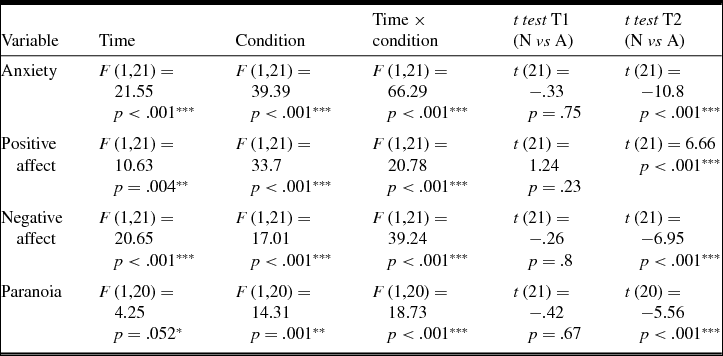
Results of the repeated measures ANOVAs and t-tests investigating significant interactions are given in Table 1.
2 (time) × 2 (condition) repeated measures ANOVA results and post-hoc t-test results

T1, pre-condition; T2, post-condition; N vs A, neutral versus anxious; *significant at .05 level; **significant at .01 level; ***significant at .001 level.
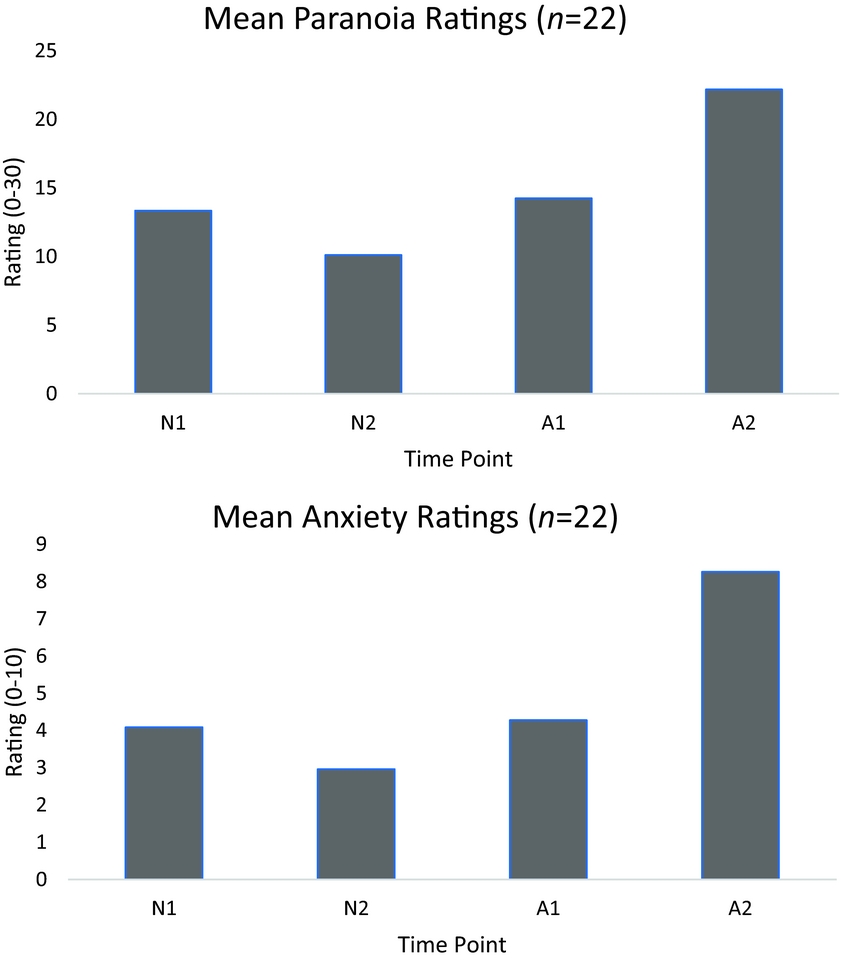
There were no significant differences between conditions at baseline (T1). Anxiety, negative-affect and paranoia were significantly higher, and positive-affect significantly lower, after the anxious condition compared with the neutral condition (T2). This confirmed that the anxious-condition was effective at increasing anxiety. Figure 2 provides a visual depiction of how anxiety and paranoia ratings changed from pre-to-post for each condition.
Mean anxiety and paranoia ratings at each time point. N1, pre-neutral condition; N2, post-neutral condition; A1, pre-anxious condition; A2, post-anxious condition.

Hypothesis 1: effect of anxious condition on paranoia
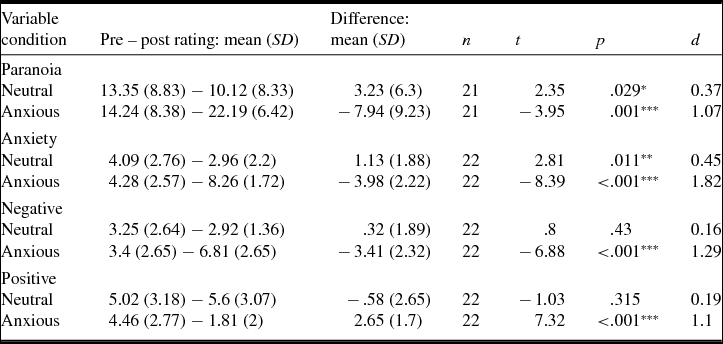
To check if these differences were due to changes from pre-to-post the anxious or the neutral condition, paired t-tests were conducted (Table 2).
Paired t-test tesults for pre-to-post condition scores

SD, standard deviation; *significant at .05 level; **significant at .01 level; ***significant at .001 level. Effect size indicated by Cohen's d, where 0.2 = small, 0.5 = medium, and 0.8 = large.
The results showed that there was a significant increase in anxiety, negative-affect and paranoia, and a significant decrease in positive-affect, from pre-to-post the anxious condition. There was also a significant decrease in anxiety and paranoia from pre-to-post the neutral condition. This confirms hypothesis 1, the anxious condition led to more state-paranoia than the neutral condition.
Although the anxious condition increased anxiety, it also significantly increased negative-affect and reduced positive-affect. For this reason, the relationship between these variables and levels of paranoia after the anxious condition was explored.
Hypothesis 2: state-anxiety will predict state-paranoia
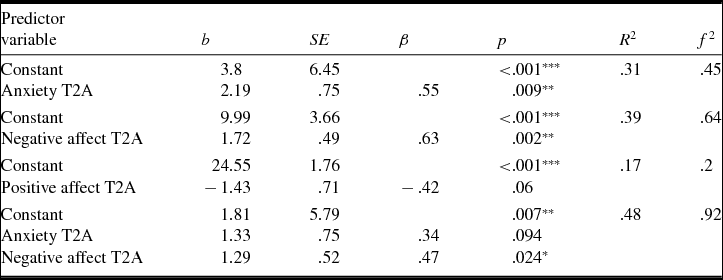
Simple linear regression showed that state-anxiety after the anxious condition was a significant predictor of state-paranoia after the anxious condition, R 2 = .31, F (1,19) = 8.41, p = .009 (Table 3). This supports hypothesis 2: state-anxiety was a significant predictor of state-paranoia.
Regression results for predictors of paranoia post the anxiety induction (n = 21)

T2A, post-anxiety condition; SE, standard error; *significant at .05 level; **significant at .01 level
Hypothesis 3: state-anxiety as a unique predictor of state-paranoia
Negative-affect after the anxious condition was a significant predictor of state-paranoia after the anxious condition, R 2 = .39, F (1,19) = 12.28, p = .002. Positive-affect was not a significant predictor, R 2 = .17, F (1,19) = 4.01, p = .06.
Multiple regression (Method: ENTER) was used to ascertain if anxiety still significantly predicted paranoia when the variance accounted for by negative-affect was taken into account (Table 3). Together, the two variables predicted 48% of the variance in paranoia, R 2 = .48, F (2,18) = 8.38, p = .003. However, anxiety no longer significantly predicted paranoia when negative-affect was included (β = .34, t = 1.77, p = .094), but negative-affect remained a significant predictor (β = .47, t = 2.47, p = .024). Hypothesis 3 was not supported; negative-affect, rather than anxiety, was a unique predictor of paranoia after the anxiety induction.
Hypothesis 4: the relationship between trait-paranoia and state-paranoia
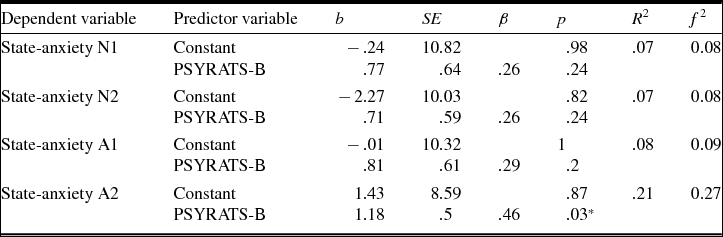
Regression analyses showed trait-paranoia, as measured by the PSYRATS-B, was a significant predictor of state-paranoia after the anxious-mood condition. Trait-paranoia did not predict state-paranoia before or after the neutral-mood condition or before the anxious-mood condition (Table 4). This supports hypothesis 4, suggesting that people with higher trait-paranoia are more sensitive to the impact of fluctuations in affect on levels of state-paranoia.
Regression results for trait-paranoia as a predictor of state-paranoia (n = 21)

N, neutral condition; A, anxious condition; 1, pre; 2, post; *significant at the .05 level.
Discussion
This experimental study set out to investigate the role of state-anxiety in state-paranoia in people experiencing paranoid delusions in the context of a psychosis-spectrum diagnosis. To the authors’ knowledge, it was the first study to attempt to directly manipulate anxiety in people with paranoia in the context of clinical psychosis.
The first hypothesis, that the anxious-mood induction would lead to greater state-paranoia than the neutral-mood induction, was supported. The second hypothesis, that state-paranoia would be predicted by state-anxiety after the anxious condition, was supported. The third hypothesis, that state-anxiety would predict state-paranoia to a greater extent than other affective states after the anxious condition, was not supported. The anxious-mood induction significantly increased anxiety but also significantly increased negative-affect and decreased positive-affect. Results showed that whilst level of anxiety predicted paranoia, negative-affect was also a significant predictor of paranoia, over and above anxiety. The fourth hypothesis, that higher trait-paranoia would predict higher state-paranoia after the anxious-mood induction, was supported.
Implications
Theory and research
This study confirmed findings that affect is linked to paranoia in clinically paranoid samples (Bosanac et al., Reference Bosanac, Mancuso and Castle2016; Drake et al., Reference Drake, Pickles, Bentall, Kinderman, Haddock, Tarrier and Lewis2004; Freeman et al., Reference Freeman, Pugh, Vorontsova, Antley and Slater2010; Hartley et al., Reference Hartley, Barrowclough and Haddock2013; Thewissen et al., Reference Thewissen, Bentall, Oorschot, van Lierop, van Os and Myin-Germeys2011). By directly manipulating anxiety, this study has demonstrated that anxiety appears to be causally implicated in paranoia, rather than being a consequence of it.
The study question was ‘does state-anxiety predict state-paranoia to a greater extent than other factors?’ and this study found the answer to be ‘no’. Negative affect was a unique significant predictor of paranoia when included in a model with anxiety. However, the threat-anticipation model of paranoia posits that anxiety interacts with negative-affect, reasoning biases, safety behaviours, anomalous experiences and previous life experiences (Freeman, Reference Freeman2007), similarly to other cognitive models (e.g. Chadwick et al., Reference Chadwick, Birchwood and Trower1996; Morrison, Reference Morrison2001). It may be that anxiety is necessary for state-paranoia to be triggered but that negative affect, at least in populations experiencing clinically significant paranoia, can play a more crucial role.
Lincoln and colleague's (Reference Lincoln, Lange, Burau, Exner and Moritz2010) contradictory finding, that anxiety was a unique predictor of paranoia when included in a model with negative affect, was found with a non-clinical population. It is feasible that anxiety is a unique predictor for state-paranoia in non-clinical populations but that once paranoia has reached clinically relevant levels, it is maintained in a different way. For example, feeling state-negative-affect may be less triggering of state-paranoia for someone who has not faced the stigma, shame and depression often inherent in having a diagnosis of psychosis or seeking help. Interestingly, the measure of affect used in this study included shame, which may have contributed to the strong links found between negative affect and paranoia. Indeed, high shame has been found to increase vulnerability to paranoia in the face of stressful situations (Johnson et al., Reference Johnson, Jones, Lin, Wood, Heinze and Jackson2014) and decrease sense of social safeness (Castilho et al., Reference Castilho, Pinto, Viegas, Carvalho, Madeira and Martins2017) in clinical populations. Clinically paranoid individuals have been found to experience significantly higher levels of negative cognitions about the self, such as low self-esteem and low self-compassion (Collett et al., Reference Collett, Pugh, Waite and Freeman2016).
The finding that trait-paranoia was predictive of state-paranoia after the anxious-mood induction fits with other research showing that anxiety has a greater impact on psychotic phenomena in people with higher baseline symptomology (Kesting et al., Reference Kesting, Bredenpohl, Klenke, Westermann and Lincoln2013; Lincoln et al., Reference Lincoln, Peter, Schäfer and Moritz2009, Reference Lincoln, Lange, Burau, Exner and Moritz2010). The finding that baseline paranoia did not predict state-paranoia at any time point other than after the anxious-condition supports the threat-anticipation model of paranoia, showing that a higher level of trait paranoia does not mean higher levels of state-paranoia unless other relevant factors are present (e.g. changes in affect).
Clinical
Although more rigorous research is needed to corroborate that state-anxiety and state-negative-affect play a causal role in state-paranoia in clinical samples, the results of this study imply that interventions for emotion regulation could be beneficial. There is emerging evidence that interventions for anxiety and worry can help to reduce trait paranoia (Foster et al., Reference Foster, Startup, Potts and Freeman2010; Freeman et al., Reference Freeman, Dunn, Startup, Pugh, Cordwell and Mander2015). Based on the findings of this study, it may be that basic emotion regulation skills could be useful as tools to manage state-paranoia in clinical populations not currently in crisis. For example, diaphragmatic ‘belly’ breathing, attention training, progressive muscle relaxation and compassionate imagery are all simple techniques that could be delivered at a low cost by most healthcare professionals to provide basic coping mechanisms for this population.
Interestingly, the neutral-mood induction in this study led to significant decreases in paranoia and anxiety. This is in line with findings that imagining a neutral object in detail can lead to reductions in paranoia and negative-affect in clinically paranoid populations (Ascone et al., Reference Ascone, Sundag, Schlier and Lincoln2017). It is likely that the attentional capacity needed to conjure up imagery in sensory detail allows attention to be diverted from other potentially distressing stimuli. Distraction has been found to effectively reduce state-anxiety in people with a psychosis-spectrum diagnosis (Grezellschak et al., Reference Grezellschak, Lincoln and Westermann2015). Further research could look to simple intervention strategies that involve attentional capacity to see if these are found to be effective at reducing negative-affect and paranoia in clinical settings.
Limitations
A crossover design with counterbalancing was used with both conditions being conducted on the same day, which risked carry-over effects. Counterbalancing controlled this for most variables, but order-effects were present for paranoia-distress, meaning that this variable of interest could not be further explored. Future studies would ideally replicate with an independent groups design and a larger sample size.
The anxious-memory recall manipulation was chosen as other studies have found this to lead to increases in anxiety in this population (Ascone et al., Reference Ascone, Sundag, Schlier and Lincoln2017; Lincoln et al., Reference Lincoln, Lange, Burau, Exner and Moritz2010). As it was a memory that the participants had already experienced and coped with, it was felt to be a task that this population could undergo with minimal chance of adverse effects and that would mimic ‘real-world’ anxiety. However, given the semi-ideographic nature of such a manipulation, it was not possible to ensure that the condition was matched across participants. Chosen memories may have involved affect other than anxiety, as indicated by the observed increases in negative-affect and decreases in positive-affect.
Future directions
Further research is needed to delineate the unique and interacting effects of different types of affect, and other factors such as reasoning biases, predisposition to anomalous experiences, safety behaviours and previous life experiences, in the maintenance of clinical paranoia. Based on the findings of this study it could be particularly interesting to look at shame, anger and sadness as individual components of negative affect rather than measuring them as one construct.
Much of the experimental research to date has been conducted in non-clinical groups. Experimental studies in clinically paranoid populations can help to advance theories of paranoia formation and maintenance, and inform interventions. It would be particularly interesting to further explore triggers of state-paranoia to elucidate possible targets for developing coping strategies. Brief interventions for state-paranoia may present a more targeted and efficient alternative to current CBT approaches for delusions and be less demanding on services.
The conflicting findings of this study in a clinical population with Lincoln and colleague's (Reference Lincoln, Lange, Burau, Exner and Moritz2010) findings in a non-clinical population requires further investigation. Studies that seek to untangle the relationship between negative-affect, anxiety and paranoia in both at-risk and clinical groups can help highlight which factors can be most usefully targeted to help with the prevention and management of paranoia. Future studies would benefit from addressing the methodological limitations outlined in this paper.
Conclusions
In summary, this was the first study to directly manipulate anxiety in order to explore its impact on state-paranoia in a population of people experiencing clinically significant psychosis. This study found that state-paranoia was higher after an anxious-mood induction and that this was predicted by levels of state-anxiety and negative-affect. Negative-affect was a unique predictor when both were taken into account. Trait-paranoia was also shown to predict levels of state-paranoia after the anxious mood-induction, indicating that greater intensity of trait-paranoia makes it more likely that changes in affective states will trigger state-paranoia. Although these findings need to be interpreted with caution due to methodological limitations, they highlight some interesting avenues for further research.
Acknowledgements
We would like to acknowledge all of the participants who took part in this study and the services who helped us to recruit, particularly Dr Kate Chapman who acted as a field supervisor. Many thanks also to Dr Emma Griffiths, Dr Angus MacBeth and the reviewers at Behavioural and Cognitive Psychotherapy who offered invaluable feedback on earlier manuscripts.
Conflicts of interest: None
Financial support: This research was conducted as part of a Doctorate in Clinical Psychology at the University of Bath.



Comments
No Comments have been published for this article.