Introduction
In rural India, smallholder livestock farming is one of the important available livelihoods. It is a source of supplementary income and acts as a nutritional and economic buffer during crop failures. Major societal classes in livestock farming are landless, small and marginal farmers. Livestock farming engages 75 million women and 15 million men. Among the rural women, 85% are engaged in livestock activities1. They account for 69% of the total labor force engaged in this sector2, while in crop farming, women account for only 35%2 of the total labor force. In addition, livestock farming increases women's control over their income and thus promotes gender equality and poverty reduction3. Women actively participate in all activities and act as a major source of labor for the livestock sectorReference Sharma, Tripathy and Gurung4–Reference Lal, Singh, Sharma, Ogra and Sharma7. They spend 77–210 min day−1 in livestock farming across the country. In the majority of families, women participate in indoor jobs such as cleaning of sheds, offering feed and water, making dung cakes for fuel, milking, ghee making and also grazingReference Vellamayil and Maheswari8–Reference Raut11. Male involvement is higher than that of women in bringing fodder from the field, chaffing fodder, cleaning of animals, breeding, health care and marketingReference Lal, Singh, Sharma, Ogra and Sharma7, Reference Hossain and Mishra9. In addition, past studies have found that the participation of youths in livestock farming as labor force was strong and their participation ranged from 29 to 59% of the labor force in livestock farming across the countryReference Devaki12–Reference Palmurugan14. In the past two decades, Indian agriculture has seen waves of changes in the context of globalization. During this period, the contribution of agriculture to the national gross domestic product (GDP) has declined from one-third to less than one-fifth15. Similarly, the dependence of rural populations on agriculture has been reduced. In 1983, agriculture accounted for 63% of all employment opportunities; in 2005, it was reduced to 56.6%Reference Arjun16 and these facts are further confirmed in the 2011 population census. Over the past two decades, specifically in Tamil Nadu state, the rural population has declined from 66 to 52%. Based on these facts the World Bank 2008 Report on Agriculture has designated India as a ‘transforming country’17. With this background, this paper attempts to understand the role of women and youths in livestock farming in the context of globalization.
Methodology
The research methodology employed for the present study was ex post facto design. In this study, semi-structured open-ended interviews, observation, interaction with key informants and the published information were utilized. Salem district of Tamil Nadu was selected on account of its high livestock activity in the state. Out of the 20 blocks (administrative divisions) in Salem district, the Sankari block was selected, which has a wide range of livestock activities and which represents the ongoing transformation of the state from an agrarian economy to an industrialized economy by increasing production of transport services for goods, truck body building and textiles. A total of 60 farm families from four revenue villages of Sankari block were selected randomly for the study.
Results and Discussion
Age profile of the farmers
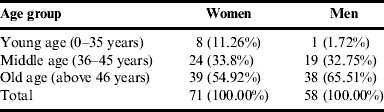
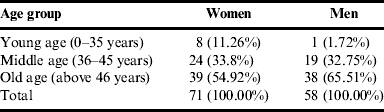
From the 60 farm families, 71 women and 58 men participated in livestock farming-related activities. Among the women, 11.26% were in the younger age group (≤35 years); 33.80% were middle aged (36–45 years), and the remaining 54.92% were in the old-age category (≥46 years). The average age of the women was 47.48 years, as shown in Table 1. In the case of men, 1.72% were in the young category; 32.75% were middle-aged and the remaining 65.51% were in the old-age category. The average age of farm men was 51.31 years. This study confirms that most livestock farmers were in the ‘old-age’ category, especially men. In addition to the above, participation of women members from households was higher than the male members (1.18:0.96). The results deviated from the past findings, which indicated strong youth participation in the 1990s. However, the findings of this study were similar to other recent studiesReference Rao, Ramkumar, Waldie, Morrenhof, Ahuja and Tripathy18–Reference Ravikumar, Reddy and Sudhakar Rao20. The results indicate a withdrawal of youths from livestock farming.
Age-wise distribution of farmers engaged in livestock farming.
Gender and role
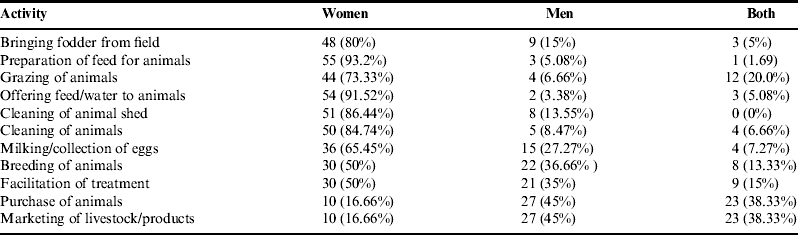
Table 2 shows that in the majority of households women were involved in preparation of feed (93%), offering feed and water to animals (92%), cleaning of animals and animal shed (>80%) and grazing (73%) (Fig. 1). In the above activities, the participation of men accounted for 6–14%. In 50–65% of the households, women were the sole source of labor for milking of animals, collection of eggs, breeding and health care management (Figs. 2 and 3). In 27–37% of the households, men were the sole labor source for these activities and in 7–15% of the households, both the genders were involved the above-mentioned activities in the study area. In 45% of the households, men executed the activities of purchasing animals and marketing of livestock and livestock products. In 17% of the households, women executed these activities, and in the remaining households it was a joint activity involving men and women. In comparison with the past studies, the present study found that female participation has increased in breeding, health care management and marketing. The average time women spent in various animal husbandry activities was 4.88 h day−1, whereas the men spend 1.76 h day−1 in livestock-related activities. This clearly indicates that there is an increasing workload for women compared to men, resulting in increased feminization in livestock farming. More than 52% of the farm women reported that in the past 10 years their workload in livestock activities has increased. Among them, 70% felt that men have shifted from agriculture to non agriculture activities; 13.5% of the women reported a lack of availability of hired labor for crop husbandry, which forces male labor to spend more time on crop farming, thus resulting in a shift of the workload related to livestock to women. Furthermore, 13.51% reported the aging and death of male counterparts as the reasons for the increased workload of women in livestock farming.
Women grazing the animals.

Women bringing the animals to health camp.
Women taking care of health and breeding.
Involvement of farm women and men in various livestock-related activities.
The above findings have occurred largely due to the growth of the industrial sector, such as textilesReference Manikandan and Thirunavukkarasu21 and transport services. In the study area, the goods transport industry had 1500 trucks in the 1990s and in 2005 it had increased to almost 25, 000. Similarly, other supporting industries, namely lorry body building, servicing and auto financing firms, have expanded and developed. In addition to cargo services, the textile sector has developed over the past two decadesReference Manikandan and Thirunavukkarasu21. The development of the cargo and textile sectors provides lucrative jobs which act as pull factors for the farm men and youths, enticing them to move out. This, in turn, results in the shifting of livestock-related activities to the women members of the household who have limited mobility outside the home, due to cultural reasons.
Reform policies in the livestock sector, namely the National Livestock Policy Perspective 1996, the Milk and Milk Products Order 1992, the Multi-State Co-operative Society Act, and state-level livestock sector policies, have encouraged private sector participation in the livestock sector22. In addition, the financial support to agriculture and allied sectors from state and central governments (public investment) has been in declineReference Mahendra23, Reference Harish, Balachandran and Pandit24, resulting in the slow displacement of government and dairy cooperatives from cattle breeding services and milk value chain2Reference Rangnekar and Rangnekar5, respectively, and private companies are taking their place. This, in turn, results in the withdrawal of low-cost, government-subsidized services and increased cost of production. In addition, poor access to veterinary services, high feed and fodder costs, poor institutional credits, low returns and limited marketing options have been the major constraints to smallholder livestock farmers wanting to move out from livestock farming. Withdrawal of subsidized public sector services and the opening up of market forces act as ‘push factors’ for the movement of youths out of small-scale livestock production. The push and pull factors in the Indian economy have resulted in the poor participation of men, withdrawal of youths and the increased workload of women and the elderly in the livestock sector. In the future, finding successors for running day-to-day livestock operations will likely be challenging. The withdrawal of youths on the production side may hasten the weakening of the smallholder production system, resulting in a severe labor shortage. In the long run, the exit of smallholders from livestock farming and the emerging demands from ongoing urbanization of the country17 may pave the way for industrialization of livestock farming. In Brazil, new economic policies acted as ‘push factors’ and have resulted in the closure of small-scale farms, which paved the way for establishment of large-scale livestock farms2Reference Sheokand, Singh, Sheoran and Pannu6. Indian smallholder livestock production is also being presented with a similar situation, with 70% of the rural population forced indirectly to move from their livestock-based livelihoods3.
In addition, Indian smallholder livestock production exists in a symbiotic relationship with crop husbandry. The livestock provides manure and draft power to the crop husbandry, and crop husbandry supports livestock with crop residues as feeding materials. This smallholder livestock production is more environmentally friendly and has low environmental costs in comparison with larger farms2Reference Lal, Singh, Sharma, Ogra and Sharma7. With poor participation of the young, the elderly labor force in smallholder livestock production may cause the relation between crop and livestock farming to be weakened. The disturbances in crop–livestock interaction may have an impact on the productivity of both crop and livestock. If the weakening smallholder livestock production system is replaced with large-scale farms, there may be higher chances of environmental disturbances2Reference Sheokand, Singh, Sheoran and Pannu6. Thus, these changes may threaten the livestock-based livelihood of rural populations and their environment.