Introduction
The European grapevine moth, Lobesia botrana (Denis & Schiffermüller, 1775) (Lepidoptera: Tortricidae) is a multivoltine species which, under Iberian Peninsula conditions, develops three to four annual generations (Martín-Vertedor et al., Reference Martín-Vertedor, Ferrero-García and Torres-Vila2010; Carlos et al., Reference Carlos, Gonçalves, Oliveira and Torres2018). This species is considered the most economically important pest of the grapevine in the wine-growing areas worldwide (Ioriatti et al., Reference Ioriatti, Anfora, Tasin, De Cristofaro, Witzgall and Lucchi2011), due to the damage caused by larval feeding on grape clusters, which renders them susceptible to the infection of pathogenic fungi like the gray mold disease, Botrytis cinerea (Roehrich and Böller, Reference Roehrich, Böller, Van der Gesst and Evenhuis1991) or the black mold Aspergillus spp. (Thiéry, Reference Thiéry2008).
Traditionally, the control of L. botrana relies on the use of chemical insecticides, namely insect growth regulators or pyrethroid insecticides once or twice a year, against the second and/or the third generations (Carlos, Reference Carlos2017). However, the increasing regulation of pesticides in Europe (Directive 128/2009/EC of the European Parliament and of the Council), public concerns about the environmental impacts of viticulture, and consumer demand for residue-free products, have led to the promotion, in the last decade, of the use of environmentally safe pest management strategies, with emphasis on conservation biological control (CBC). CBC is a sustainable approach to pest management that is based on the premise that the implementation of habitat management strategies and the countering of other environmental disturbances which negatively affect natural enemies (through, e.g., limited and selective use of pesticides) will conserve and enhance natural enemies, thus contributing to pest control (Poveda et al., Reference Poveda, Gomez and Martinez2008; Lu et al., Reference Lu, Zhu, Gurr, Zheng, Read, Heong, Yang and Xu2014; Begg et al., Reference Begg, Cook, Dye, Ferrante, Franck, Lavigne, Lövel, Mansion-Vaquie, Pell, Petit, Quesada, Ricci, Wratten and Birch2017).
To implement a successful CBC program, it is essential to have a good knowledge of the natural enemies that are present in a pest's environment, as well as the effects of environmental features on the natural enemy's community structure and diversity (Thacker, Reference Thacker2002); it is also important to understand their capacity to provide biological control services and consequent ability to suppress pests. Both local and landscape conditions must therefore be considered in the preparation and design of effective CBC strategies (Rusch et al., Reference Rusch, Bommarco, Ekbom, Sauvion, Calatayud and Thiéry2017a).
Although several studies have pointed to a positive influence of landscape diversity on the abundance and diversity of natural enemies at the field level (Bianchi et al., Reference Bianchi, Booij and Tscharntke2006; Tamburini et al., Reference Tamburini, Bommarco, Wanger, Kremen, van der Heijden, Liebman and Hallin2020), the impact of this diversity in enhanced biological control has not always been demonstrated (Begg et al., Reference Begg, Cook, Dye, Ferrante, Franck, Lavigne, Lövel, Mansion-Vaquie, Pell, Petit, Quesada, Ricci, Wratten and Birch2017; Lichtenberg et al., Reference Lichtenberg, Kennedy, Kremen, Batáry, Berendse, Bommarco, Bosque-Pérez, Carvalheiro, Snyder, Williams, Winfree, Klatt, Åström, Benjamin, Brittain, Chaplin-Kramer, Clough, Danforth, Diekötter, Eigenbrode, Ekroos, Elle, Freitas, Fukuda, Gaines-Day, Grab, Gratton, Holzschuh, Isaacs, Isaia, Jha, Jonason, Jones, Klein, Krauss, Letourneau, Macfadyen, Mallinger, Martin, Martinez, Memmott, Morandin, Neame, Otieno, Park, Pfiffner, Pocock, Ponce, Potts, Poveda, Ramos, Rosenheim, Rundlöf, Sardiñas, Saunders, Schon, Sciligo, Sidhu, Steffan-Dewenter, Tscharntke, Veselý, Weisser, Wilson and Crowder2017).
In European vineyards, about 90 species of L. botrana parasitoids are known (Scaramozzino et al., Reference Scaramozzino, Loni and Lucchi2017). Most of them belong to the Hymenoptera (Ichneumonoidea, Chalcidoidea and Bethyloidea) and there are also some Diptera (Tachinidae), varying in the abundance and diversity of species, with the geographical location of vines (Loni et al., Reference Loni, Samartsev, Scaramozzino, Belokobylskij and Lucchi2016). Recently, several Braconidae species have been associated, for the first time, with L. botrana namely, Bracon admotus Papp, Habrobracon concolorans (Marshall) and H. pillerianae Fisher, obtained from larvae living on Daphne gnidium Linnaeus (Thymeleaceae) (Loni et al., Reference Loni, Samartsev, Scaramozzino, Belokobylskij and Lucchi2016).
Despite the evidence of the importance of a biological control based on larval parasitoids against L. botrana (Thiéry et al., Reference Thiéry, Delbac, Villemant and Moreau2011), the development of such programs has received very little attention and suffers from a lack of research (Moreau et al., Reference Moreau, Villemant, Benrey and Thiéry2010; Thiéry et al., Reference Thiéry, Delbac, Villemant and Moreau2011). Also, neighboring natural landscapes have long been regarded as probably having an important role in a natural enemy's population level (Genini, Reference Genini2000); however, to our knowledge, studies about their role in enhancing CBC of L. botrana are scarce (e.g., Rusch et al., Reference Rusch, Delbac and Thiéry2017b), particularly with regard to their impact on the abundance and richness of parasitoids, as well as on their activity as biological control agents of pests.
The Douro Demarcated Region (DDR), where ‘Port’ D.O.C. wine and other remarkably high-quality table wines are produced, is one of the largest and most heterogeneous viticulture regions in the world (ICOMOS, 2001). Despite the intensification practiced during the last 30 years, given the need to reduce operating costs and introduce labor-saving devices, a significant part of the DDR area is still occupied by non-crop habitats, especially by scrublands and woodlands, grassy/shrubby slopes, and/or dry-stone walls, particularly in the most well-preserved area, the ‘Alto Douro Vinhateiro’ UNESCO World Heritage Site (Andresen and Rebelo, Reference Andresen and Rebelo2013). Moreover, as the DDR is one of the world's biggest regions of hillside vineyards, the use of ground cover vegetation against erosion is common. In addition to increasing water infiltration, protecting the soil surface from the impact of raindrops, facilitating the formation and stabilization of soil aggregates, and reducing soil erosion by enhancing the soil organic matter and microbiological function (reviewed by Prosdocimi et al., Reference Prosdocimi, Cerdà and Tarolli2016), ground cover also improves biodiversity by providing habitat and food for many different species below and above ground (Daane et al., Reference Daane, Brian, Hogg, Wilson and Yokota2018). As stated by Böller et al. (Reference Böller, Häni and Poehling2004), given that the ecological quality of the agroecosystem vineyard is determined by the quality of the ground cover and the availability of other neighboring ecological infrastructures (EI), DDR vineyards may be considered as an agroecosystem with high ecological potential, of interest as a study case on the tendency toward a more biodiversity friendly management that reflects a general change in the attitude of wine consumers and producers (see Viers et al., Reference Viers, Williams, Nicholas, Barbosa, Kotzé, Spence, Webb, Merenlender and Reynolds2013).
In this context, the implementation of a successful CBC program against L. botrana in the DDR requires more information about its parasitoids, their relationship with the different generations of the pest and the landscape/vineyard management practice determinants. The aim of the present study therefore was to try to answer the following questions: (1) which species of larval and pupal parasitoids are naturally associated with each of the three generations of L. botrana in DDR vineyards and what are the corresponding parasitism rates? (2) Are the parasitism rates of L. botrana related to soil management practices (bare soil vs. ground cover), the impact of the chemical treatments performed in the vineyards and/or with the proximity of ecological infrastructures?
Materials and methods
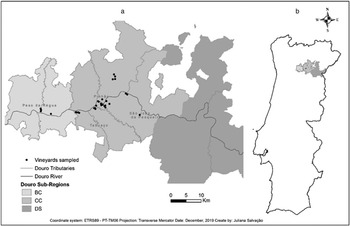
The study was carried out between 2002 and 2015 in 43 DDR vineyards designated hereafter as sampling points, located on 11 wine farms that differed in management and that were selected over a range of landscape gradients (fig. 1). The landscape of the DDR is generally characterized by vineyard plots, frequently separated by olives or almond trees, and surrounded by remnant vegetation (Mediterranean woodland or scrubland of the type Rusco aculeati Querceto suberis viburnetosum tini) (Carlos, Reference Carlos2017).
(a) Location of the wine farms with sampled vineyards assessed in the DDR. (b) Location of the Douro region in Portugal; sub-regions of the Douro region: BC, Baixo Corgo; CC, Cima Corgo; DS, Douro superior.

The study sites differed in terms of the organization of the vineyards on the land, the type of soil management of the vineyard inter-rows, the grape varieties, altitude, and production system (fig. 1, Appendix A – table A.1).
During the growing season (April–September) precipitation ranges, on average, from 189 to 326 mm, depending on the location, and mean temperatures (April–October) average 17.8°C (Jones and Alves, Reference Jones and Alves2012). Consequently, native ground cover generally dries from late May onward.
Landscape analysis
The landscape composition around each sampling point was calculated using a GIS framework (ArcGIS® 10×, ESRI) within buffers of a 50, 100, 150, 200 and 250 m radius, overlaying aerial photographs from World Imagery (ESRI, 2018). The different radii were chosen considering the reduced capacity of dispersion by parasitoids (Lavandero et al., Reference Lavandero, Wratten, Shishehbor and Worner2005; Scarratt et al., Reference Scarratt, Wratten and Shishehbor2008; Thomson and Hoffmann, Reference Thomson and Hoffmann2013; Irvin et al., Reference Irvin, Hagler and Hoddle2018). Eight measurements of landcover types were calculated: (1) vineyards; (2) woodland/forest; (3) scrubland/shrubby slopes; (4) riparian gallery; (5) water elements; (6) orchards and vegetable gardens; (7) roads; and (8) houses and other buildings. The elements of woodland/forest, scrubland/shrubby slopes, riparian gallery, water elements, as well as small orchards and vegetable gardens, were considered as part of EI. Based on this information, landscape variables (percentage of vineyards, percentage of EI, Shannon–Wiener diversity, and evenness indexes) were calculated for each buffer.
Management practices
Interviews with vine growers provided information about management practices implemented in the vineyard sampling sites. Most vineyards were managed under integrated production principles, receiving chemical applications for the control of weeds, main diseases (powdery, downy mildew), and pests (L. botrana). The vineyards were characterized according to soil management (bare soil or soil cover vegetation) (Appendix A – table A.1). In most vineyards with ground cover, native spontaneous vegetation is allowed to grow in the vineyard inter-rows. To prevent competition with the vines, and reduce vulnerability to disease outbreaks, vegetation under the vines and on the slopes (in terraced vineyards) was controlled by means of one application of herbicide at the end of winter (end of February). Later, between April and July, the vegetation on slopes and between vines was mowed once or twice, depending on the year. After mowing, the vegetation was left on the soil surface acting as a mulch. In vineyards with bare soil, tillage was performed during June/July (fig. 1, Appendix A – table A.1).
All pesticides used were applied at commercial doses. From the information on spraying applications obtained from growers, indices that quantify pesticide chemical impact were calculated, following the methodology proposed by Thomson and Hoffmann (Reference Thomson and Hoffmann2006) (Appendix A – table A.2). Hence, each product used per site was assigned with an environmental risk level (‘chemical impact’), according to the pesticide coding system available in Portugal (Oliveira et al., Reference Oliveira, Barata, Prates, Mendes, Bento, Gaspar and Cavaco2014), based on its potential impact on hymenopteran parasitoids. Environmental risk levels were weighted as follows: low risk = 1, medium risk = 2, medium–high risk = 3. Weights per product per site were summed to obtain a relative measure of the magnitude of the chemical impact of pesticides used (Appendix A – table A.2).
Estimation of damage and parasitism of L. botrana
L. botrana damage was estimated by examining 100 random bunches or clusters per sampling point at the end of each of the three pest generations. In the laboratory, larvae/pupae of L. botrana were placed individually and allowed to breed in small glass tube containers (2.5 cm diameter × 10 cm height), covered with perforated parafilm and maintained in a climate controlled chamber (22°C; RH: 65 ± 10%, photoperiod: 16:8 (L:D)); in the case of larvae, a natural substrate (i.e., parts of inflorescences or grapes) was provided until pupation. Individuals were checked daily until adults of L. botrana or parasitoids emerged. All parasitoids were sorted into morphospecies using a stereoscopic microscope. They were then preserved in 70% ethanol and identified. The Tachinidae identification was based on Martinez (Reference Martinez and Sentenac2011). In Hymenoptera, identifications of the most common species of vineyard tortricid parasitoids were done following Villemant and Delvare (Reference Villemant, Delvare and Sentenac2011), while identification of the less common species was done using specific keys (Tryapitsyn, Reference Tryapitsyn and Tryapitsyn1988; Graham, Reference Graham1995).
Data analyses
The damage caused by L. botrana was expressed as the number of nests per 100 bunches in the case of the first generation, and as the percentage of attacked clusters, for the second and third generations. As damage was expressed differently between the first generation and the second and third generations, only these last two were analyzed for statistical differences using a Mann–Whitney U test.
For the study of parasitoids associated with L. botrana in the DDR, the abundance (N) and richness (S) of parasitoid species were calculated for all samples per generation. The parasitism of L. botrana was calculated as the percentage of parasitized individuals divided by the total of individuals (larvae + pupae) observed, according to the following formula:

A Kruskal–Wallis test was performed to detect differences between generations, in the richness of parasitoids and in the percentage of parasitism. For this analysis, only samples with more than ten individuals of L. botrana were considered.
To evaluate the impact of EI proportions, as well as of management practices (soil cover vegetation and chemical treatments) on the percentage of parasitism, generalized linear models were used to perform an inferential approach. We first evaluated the correlation among the different landscape variables (percentage of vineyards, percentage of EI, Shannon–Wiener diversity and evenness indexes) using a Pearson correlation test. We found a strong correlation among them always higher than 0.7, thus preventing us from using them in the model to avoid problems with collinearity. We finally decided to use the percentage of EI because it is a much more recognizable metric that will allow the conclusions of this study to be better communicated to agricultural stakeholders. As variables for control, we included altitude, the year of sampling and the generations of L. botrana. Importantly, due to unbalanced data collection between years, we decided to reduce the year used for our analysis to 2011, 2012, and 2013 and the generations used to first and second generations. In this way we were able to extract more robust conclusions. For this analysis, the buffers were transformed into rings of 0–50 m (i.e., ring 50), 50–100 m (i.e., ring 100), 100–150 m (i.e., ring 150), 150–200 m (i.e., ring 200), and 200–250 m (i.e., ring 250), within which the proportion of EI was again measured, and this variable was used for subsequent analysis. We performed the same model with the different spatial scales considered in the study (ring 50, ring 100, ring 150, ring 200, ring 250) and then we compared the outputs with the Akaike information criteria (AIC) corrected for small samples. The model with the lowest value of AICc and a difference of two units with the following model indicates that the model with the highest value has virtually no support and can be omitted from further consideration, thus selecting the scale contained in the model with the lowest AICc. We finally chose the ring 250 for further considerations as it showed the lowest AICc (ΔAICc = 2.67). As the nature of the response variable is a proportion of counts (number of larvae parasitized out of number of larvae non-parasitized), a binomial distribution with a logit link function was chosen as the best way to model data. All analyses were taken with the function ‘glm’ contained in the package ‘lme4’ written for the R environment (Bates et al., Reference Bates, Maechler, Bolker and Walker2013; R Development Core Team, 2018).
Results
Parasitoids associated with L. botrana in the DDR
A total of 3226 individuals of L. botrana (larvae/pupae) were collected from which 485 parasitoids were obtained. Part of this assemblage (27 individuals) was damaged and could not be identified. Of the remaining 458 individuals, 16 taxa were recorded, from which ten were identified at the species level, the majority belonging to Hymenoptera. The most abundant parasitoids were Elachertus sp. (Eulophidae), Campoplex capitator Aubert (Ichneumonidae), and Brachymeria tibialis (Walker) (Chalcididae), which represented 62.5, 12.6, and 12.0% of the total assemblage of parasitoids emerging, respectively (table 1).
Abundance (N) and relative percentage (%) of L. botrana (Lb) parasitoids identified in the DDR, during the studied period (2002–2015), and parasitized generations

For the three main species, the generation with the highest number of individuals obtained is highlighted in bold.
Other Hymenoptera parasitoids were identified in smaller numbers: Dibrachys cavus (Walker), (Pteromalidae); Ascogaster quadridentata Wesmael (Braconidae); Elasmus aff. bistrigatus Graham, Elasmus aff. steffani Graham (Eulophidae); Itoplectis maculator (Fabricius) (Ichneumonidae); Goniozus gallicola (Kieffer), Goniozus claripennis Förster (Bethylidae) and the Diptera Eurysthaea scutellaris (Robineau-Desvoidy) (Tachinidae) (table 1).
Individuals from the Hymenoptera Baryscapus sp., Elasmus sp. (Eulophidae) and Hockeria sp. (Chalcididae), as well as from Cryptinae (Ichneumonidae) and Eulophinae (Eulophidae), were also reported. The Eulophidae dominated the assemblage of parasitoids collected, followed by the Ichneumonidae and Chalcididae (table 1).
Estimation of damage and parasitism rates of L. botrana
In the first generation, the level of infestation by L. botrana ranged between 1 and 187 nests per 100 bunches (median = 13.15 nests per 100 bunches). In the second generation, the infestation ranged between 0 and 75% of clusters attacked (median = 29.1%) and in the third generation it ranged between 1.0 and 67.0% of clusters attacked (median = 11.0). Thus, significant differences were found between the second and third generations (Mann–Whitney U = 266.0, P = 0.002, N = 65) (fig. 2).
Level of infestation by L. botrana per generation found in vineyards, during the study period (2002–2015). In the first generation (1st G), number of nests per 100 bunches; in the second (2nd G) and third (3rd G) generations, percentage of clusters attacked (viable eggs or berries damaged).

The percentage of parasitism was highly variable between sampling points, years, and generations (Appendix A – table A.3). It ranged from 0.0 to 61.5% (median: 6.9%) in the first generation, with the maximum values obtained in 2011 and 2012. In the second generation, parasitism ranged from 0.0 to 36.8% (median: 4.2%), with the maximum values found in 2002 and 2005. In the third generation, parasitism ranged from 0.0 to 12.1% (median: 0.0%), the highest value obtained being in 2011 (table 2 and Appendix A – table A.3). Significant differences were found between the first and third generations in the percentages of parasitism (χkw = 8.447, P = 0.015, d.f. = 2, N = 60) (fig. 3).
Median percentage of parasitism (on the left) and median richness (on the right) of parasitoids in each generation of L. botrana (1st G – first generation; 2nd G – second generation; 3rd G – third generation). Boxes with the same letter are not significantly different (P > 0.05).

Variation in the parasitism rates (%) caused in L. botrana by the five main species of parasitoids identified in the DDR during the studied period (2002–2015)

Regarding the richness of parasitoids, values ranged between 0 and 5 (median: 1 species) in the first generation, between 0 and 8 species (median: 1 species) in the second generation, and between 0 and 2 (median: 0 species) in the third generation. Significant differences were found between the first and third generations (χkw = 7.812, P = 0.02, d.f. = 2, N = 60) (fig. 3).
The percentages of parasitism found in the L. botrana first generation were mostly due to Elachertus sp. (up to 61.5%) and C. capitator (up to 47%) (table 2). Elachertus sp. is an ectoparasitoid associated mainly with young larvae; it is the only parasitoid found in the three generations of the pest, although 91.4% of the individuals were reared from the first generation (table 3); C. capitator is a larval endoparasitoid of which 80.3% individuals were also obtained from the first generation, while the rest emerged from the second generation (table 3). In the second generation, the percentage of parasitism were mostly due to B. tibialis (up to 32.8%) (table 2); this is a solitary pupal endoparasitoid, of which 87.9% of the individuals were reared from the L. botrana second generation, while the remaining emerged from the first generation (table 3). A. quadridentata, a solitary egg-larval endoparasitoid, was reared only from the first generation, while D. cavus, which develops as a gregarious larvo-pupal parasitoid, was only obtained from the second generation of L. botrana (table 3).
Abundance (N) and relative percentage (%) of the main parasitoid species of each generation of L. botrana in the DDR, during the studied period (2002–2015)

Only samples with more than ten larvae/pupae of L. botrana were included in the analysis.
Main determinants of parasitism
The inferential approach implemented showed a strong effect of the EI in a ring 200 to 250 m in width (Pr(>|z|) < 0.001; table 4). Specifically, parasitism was five times higher in areas with a higher percentage of EI, when compared with areas with a lower percentage of EI (fig. 4a). In addition, the use of ground cover significantly increased parasitism (50%) when compared with bare soil (Pr(>|z|) < 0.031; table 4). We took into account the year of sampling, the generation and the altitude as control variables, finding significant effects of altitude (Pr(>|z|) < 0.001; table 4) and the year of sampling (2012 = Pr(>|z|) < 0.001; 2013 = Pr(>|z|) < 0.003; table 4). However, we did not find any effect of generation on parasitism (Pr(>|z|) < 0.252; table 4).
Estimated effect from the inferential approach. (a) Predicted probabilities of parasitism along a gradient of increasing percentage of EI in a ring of 200–250 m radius. Shaded areas correspond to an interval of confidence of 95%. (b) Predicted probabilities of parasitism under ground cover and bare soil management treatments. Intervals show confidence at 95%.

Effects of the variables considered in the inferential approach on the likelihood of parasitism of L. botrana

Significant factors are highlighted in bold.
According to Ijala et al. (Reference Ijala, Kyamanywa, Cherukut, Sebatta and Karungi2019), altitude has been reported to directly affect insect pest regulation in mountainous ecologies, through its effect on the microclimates and/or quantity of plants that directly affect the natural enemies.
Discussion
Parasitoids associated with L. botrana in the DDR
The results from this study indicate that the cohort of parasitoids associated with L. botrana in DDR vineyards is quite vast and different from the complex identified in most European vine-growing areas (e.g., Coscollá Reference Coscollá1980; Xuéreb and Thiéry, Reference Xuéreb and Thiéry2006; Thiéry, Reference Thiéry2008; Moreau et al., Reference Moreau, Villemant, Benrey and Thiéry2010; Scaramozzino et al., Reference Scaramozzino, Di Giovanni, Loni, Ricciardi and Lucchi2018), being more related to the one found in Italian vineyards (e.g., Bagnoli and Lucchi, Reference Bagnoli and Lucchi2006). A complex of 16 taxa of parasitoids of L. botrana was identified, the majority belonging to Hymenoptera, the most abundant being Elachertus sp., C. capitator, and B. tibialis.
In Portugal, the published studies about L. botrana parasitoids are scarce. In the northwest of the country, Ribeiro et al. (Reference Ribeiro, Martins, Mendonça and Lavadinho2001) reported the presence of Dibrachys affinis Masi in the moth overwintering generation, while Carlos et al. (Reference Carlos, Costa, Tão, Alves and Torres2006) in a previous study carried out in the DDR, identified Elachertus affinis Masi, Brachymeria sp., C. capitator, D. cavus, Elasmus sp., A. quadridentata, and G. gallicola.
The tachinid species E. scutellaris, whose record in Italy was considered by Scaramozzino et al. (Reference Scaramozzino, Loni and Lucchi2017) as doubtful, was found in the present study in the first and second generations of the moth, although with a parasitism rate of only 0.6%.
Elachertus Spinola, 1811 (Hymenoptera: Eulophidae) are primary parasitoids of a variety of lepidopteran larvae, with several of their host species, like the spruce budworm Choristoneura fumiferana (Clemens, 1865) or the tomato leaf miner Tuta absoluta (Meyrick, 1917), being economically important (Schauff, Reference Schauff1985; Yarahmadi et al., Reference Yarahmadi, Salehi and Lotfalizadeh2016).
In Europe, 40 species of Elachertus are described and only two have been reported as parasitoids of L. botrana: Elachertus fenestratus Nees (quoted only once in Haeselbarth, Reference Haeselbarth1985) and E. affinis reported in France, Hungary, Italy, Spain, and North Africa (Coscollá, Reference Coscollá1980; Delrio et al., Reference Delrio, Luciano, Prota and Cavalloro1987; Mitroiu, Reference Mitroiu2013). According to Gérard Delvare (in litt.) it is currently impossible to give definitive conclusions on DDR specimen identification because of the lack of E. affinis types and their limited description by Masi (Reference Masi1911), whereas the European Elachertus fauna is very diversified with numerous species morphologically very close. A number of species have a large host diversity (Noyes, Reference Noyes2020) so that knowing the host of a given one is not sufficient to verify its identification. E. affinis is a gregarious ectoparasitoid (Silvestri, Reference Silvestri1912; Villemant et al., Reference Villemant, Delvare, Martinez, Sentenac, Kuntzmann and Sentenac2011) while in the DDR only one specimen of Elachertus sp. was obtained from each L. botrana larva parasitized, which suggests that it belongs to another species. Finally, based on specimens of his collection, G. Delvare (in litt.) confirmed that Elachertus sp. from the DDR was also found in France (Hérault, Var, Corsica and even Queyras at 1850 m a.s.l.). Currently, identifying this species remains impossible before a thorough revision of the genus in Europe, so that we cannot give conclusions on its host specificity.
Parasitism rate variation according to L. botrana generation
In the DDR, the cohort of parasitoids identified led to a reduction of the L. botrana population via a significant impact on the first and second generations of the pest. The decrease in parasitism rates found from the first and second generations to the third generation agree with those reported by Rusch et al. (Reference Rusch, Delbac and Thiéry2017b), Moreau et al. (Reference Moreau, Villemant, Benrey and Thiéry2010) for French conditions, Bagnoli and Lucchi (Reference Bagnoli and Lucchi2006) for Tuscany (Italy) and by Akbarzadeh (Reference Akbarzadeh2012) for Orumieh (Iran). This reduction in parasitism may have several potential explanations: (1) larvae of the second and third generations develop inside compacted clusters which may represent a physical barrier to parasitoids, since the larvae are hypothetically more protected from parasitoid activity in such conditions; (2) as shown by Xuéreb and Thiéry (Reference Xuéreb and Thiéry2006) for C. capitator, decreasing parasitism rates may also be related to reduced host density; and (3) the high temperatures that usually occur during the beginning of the third generation, in July and August in the DDR, may cause a high mortality of eggs and larvae of L. botrana, especially in vineyards more exposed to dry conditions. According to Moosavi et al. (Reference Moosavi, Cargnus, Pavan and Zandigiacomo2017), temperatures of 40°C reached by berries exposed to sunlight can cause high mortality of L. botrana eggs and larvae. On the other hand, under DDR conditions, in late spring/early summer, the ground cover vegetation turns into a dried mulch cover, reducing drastically the availability of flowering species and consequently pollen and nectar resources, that can lead to an expected reduction in parasitoid survival (Bianchi and Wäckers, Reference Bianchi and Wäckers2008). Accordingly, the reduction in parasitism rates found in L. botrana third generations may also be due to the drought of the soil ground vegetation during the hot and dry summer.
Determinants of parasitism
Impact of EI proportion/ground cover management
In this study, the strong impact of the EI on the parasitism of L. botrana was shown, parasitism being five times higher in areas with a higher percentage of EI, when compared with areas with a lower percentage of EI. It was also found that ground cover increased parasitism by 50%, compared to vineyards with bare soil.
The importance of non-crop vegetation or soil cover vegetation for providing resources to parasitoids, such as shelter, overwintering habitat, nectar, pollen, and alternate hosts or preys, have been reported elsewhere by several authors (e.g., Thomson and Hoffmann, Reference Thomson and Hoffmann2009; Thomson et al., Reference Thomson, McKenzie, Sharley, Nash, Tsitsilas and Hoffmann2010; Gaigher et al., Reference Gaigher, Pryke and Samways2015; Smith et al., Reference Smith, Hoffmann and Thomson2015; Daane et al., Reference Daane, Brian, Hogg, Wilson and Yokota2018; Shapira et al., Reference Shapira, Gavish-Regev, Sharon, Harari, Kishinevsky and Keasar2018; Segoli et al., Reference Segoli, Kishinevsky, Rozenberg and Hoffmann2020; Möller et al., Reference Möller, Keasar, Shapira, Möller, Ferrante and Segoli2021).
The availability of floral vegetation can provide adult parasitoids with sugar resources that are required for energy and physiological maintenance, thereby potentially enhancing their efficiency as biological control agents (Heimpel and Jervis, Reference Heimpel, Jervis, Wäckers, van Rijn and Bruin2005). Also, it is known that the potential of floral resources to enhance parasitoid success depends on their ability to move easily between flower and pest patches (Lavandero et al., Reference Lavandero, Wratten, Shishehbor and Worner2005; Lee et al., Reference Lee, Andow and Heimpel2006).
Thomson et al. (Reference Thomson, McKenzie, Sharley, Nash, Tsitsilas and Hoffmann2010) have found a positive impact of woody vegetation surrounding vineyards on Eulophidae, the dominant parasitoid family found in our study. On the other hand, as reviewed by Rusch et al. (Reference Rusch, Delbac and Thiéry2017b), temporal dynamics and disturbance regimes of perennial and annual crops greatly differ, and these differences may modify the effect of landscape composition on natural enemies, pest communities, and biological control services. Consequently, it is not known if landscape heterogeneity positively affects pest control over time or if antagonistic relationships between guilds emerge over time, neutralizing the effects of landscape heterogeneity (Rusch et al., Reference Rusch, Delbac and Thiéry2017b). Cultural practices also influence these dynamics. For example, the timing and frequency of weed control by herbicide applications or tillage of inter-row strips determines the diversity of the plants and arthropods that can inhabit these strips (Hall et al., Reference Hall, Penke, Kriechbaum, Krastschmer, Jung, Chollet, Guernion, Nicolai, Burel, Fertil, Lora, Sánchez-Cuesta, Guzmán, Gómez, Popescu, Hoble, Bunea, Zaller and Winter2020).
A comprehensive understanding of how natural enemy populations are altered by semi-natural elements in the surrounding landscape and vineyard inter-row management is necessary to foster natural pest control (Judt et al., Reference Judt, Guzmán, Gómez, Cabezas, Entrenas, Winter, Zaller and Paredes2019) and to execute a successful CBC program based on the implementation of habitat management strategies. In this way, the integration of ecological and viticultural practices can produce win–win solutions for both wine growers and nature conservation. For instance, the use of plants native to a region in the habitat management to support natural enemy populations has several other advantages (Landis et al., Reference Landis, Gardiner, Tompkins, Gurr, Wratten, Snyder and Read2012). Because they are locally adapted, they require, in general, little management after establishment and can persist within the agroecosystem for decades. The incorporation of such habitats into the vineyard, in addition to biocontrol, can provide other benefits such as conserving wildlife, protecting water quality, and reducing erosion and runoff (reviewed by Tillman et al., Reference Tillman, Smith, Holland, Gurr, Wratten, Snyder and Read2012). Furthermore, the use of native plants contributes to their conservation, which is especially important in the Mediterranean Basin, since this is one of the world's richest places in terms of plant diversity (Cuttelod et al., Reference Cuttelod, García, Malak, Temple, Katariya, Vié, Hilton-Taylor and Stuart2008), being considered a prime candidate for conservation support (Myers et al., Reference Myers, Mittermeier, Mittermeier, da Fonseca and Kent2000).
Conclusions
A complex of 16 taxa of parasitoids of L. botrana was identified in the DDR vineyards, the majority belonging to the Hymenoptera.
The cohort of parasitoids and the potential role played by each species in the control of the pest showed a great variability over space and time, with rates of parasitism being substantially higher in the first two generations of the pest, compared to the third generation. This could be linked to different biotic and abiotic factors, although the higher presence of vegetation cover mainly during the first generation, which results in a higher availability of floral resources, may explain such an increase in parasitism rates.
The most promising candidate to boost CBC of L. botrana in DDR vineyards was found to be the Elachertus sp., being, as far as we know, the first time this taxon has been referred to as a key parasitoid of this pest. The undeniable importance of Elachertus spp. in the DDR is due, on the one hand, to the fact that these ectoparasitoids have a wide geographic distribution in the region under study, and on the other hand to the fact that, under more favorable conditions, the percentage of parasitism caused may reach more than 50%, even when the population density of the host is low.
The results obtained suggest potential for CBC of L. botrana if ecological infrastructures around vineyards, and ground cover with native perennial plants within vineyards, is encouraged.
Supplementary material
The supplementary material for this article can be found at https://doi.org/10.1017/S0007485322000116.
Acknowledgements
This study was funded by the Association for the Development of Viticulture in the Douro Region. This manuscript is part of C. Carlos's PhD dissertation. We acknowledge the wine companies for allowing the fieldwork to take place and their viticulture managers for technical support. We thank the graduate students and ADVID technicians that participated in the collection of data. Authors from CITAB were supported by National Funds by FCT – Portuguese Foundation for Science and Technology, under the project UIDB/04033/2020. Fátima Gonçalves is also grateful to the Foundation for Science and Technology (FCT, Portugal) for financial support by means of national funds FCT/MCTES to CIMO (UIDB/00690/2020).
Conflict of interest
The authors declare none.