Acute renal failure (ARF) requiring renal replacement therapy (RRT) is common in patients admitted to an intensive care unit (ICU). Adverse clinical outcomes are frequent and include mortality rates approaching 60 percent (Reference Manns, Doig and Lee12), prolonged hospitalization, and irreversible kidney failure requiring chronic dialysis therapy in survivors. This patient population consumes large amounts of healthcare resources during initial presentation and treatment, and may continue to consume significant healthcare resources if chronic dialysis is required.
There are several methods of providing renal replacement therapy in this patient population, including intermittent hemodialysis (IHD), slow-low efficiency hemodialysis (SLED), and continuous renal replacement therapy (CRRT), that vary by dose and method of solute clearance for each modality. Although no clinically relevant differences between these various treatment approaches have been demonstrated (Reference Bagshaw, Berthiaume, Delaney and Bellomo1;Reference Pannu, Klarenbach and Wiebe18), significant practice variation exists, with some centers providing only CRRT and others only IHD. Whereas economic considerations of interventions in acute renal failure have been debated (Reference Manns, Doig and Lee12;Reference Mehta and Chertow14), no formal economic analysis evaluating all relevant outcomes and costs has been performed. We sought to determine the costs and cost-effectiveness, within a Canadian context, of CRRT versus IHD in the treatment of critically ill adults with ARF, using effectiveness data from a recent meta-analysis (Reference Pannu, Klarenbach and Wiebe18).
METHODS
A decision analytic model incorporating all relevant clinical and economic outcomes was created and analyzed according to recommended guidelines (5;Reference Claxton, Sculpher and McCabe6;Reference Weinstein, O'Brien and Hornberger21) from the perspective of the healthcare payor. In the base-case analysis, we evaluated a simulated cohort of representative adult patients (average age of approximately 60 years) with ARF, requiring treatment with RRT in a Canadian intensive care setting, who are candidates for treatment of renal failure with IHD or CRRT.
Decision Model
A model (Figure 1) was constructed representing the events occurring from the initiation of RRT in the ICU, until death or discharge during index hospitalization. Survivors entered a Markov model that represented biannual transitions between the following clinical states: “alive requiring dialysis,” “alive without dialysis,” and “death.” The analysis was continued until <1 percent of the original cohort remained alive, approximating a lifetime time horizon. The model outputs were quality-adjusted life-years (QALYs), life-years gained, healthcare costs, and the cost per QALY gained. QALYs were calculated by multiplying the time spent by the average patient in each clinical state, by the utility associated with that state. We performed base-case analyses using a Markov cohort analysis and used Monte Carlo simulation for a probabilistic sensitivity analysis. All analyses were performed using TreeAge Pro 2005.
Outline of model. ARF, acute renal failure; CRRT, continuous renal replacement therapy; ICU, intensive care unit; IHD, intermittent hemodialysis. Alternate prescriptions of CRRT and IHD are included (see text for details).

Treatment Comparators
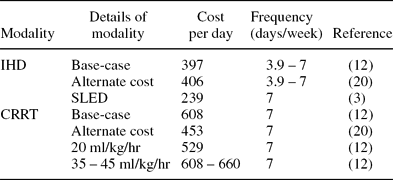
Treatment options considered included various prescriptions of IHD and CRRT. In the base-case, we considered commonly used methods for each modality in Canada; IHD provided from 3.5 to 4.5 hours per session averaging 3.9 days per week, and CRRT delivered through continuous venovenous hemodiafiltration (CVVHDF). Standard heparin anticoagulation was assumed for both modalities. Variations in prescription, such as more frequent IHD, SLED, and alternate anticoagulation, were also considered. A separate analysis compared standard with high dose CRRT (20 ml/kg/hr versus 35 to 45 ml/kg/hr).
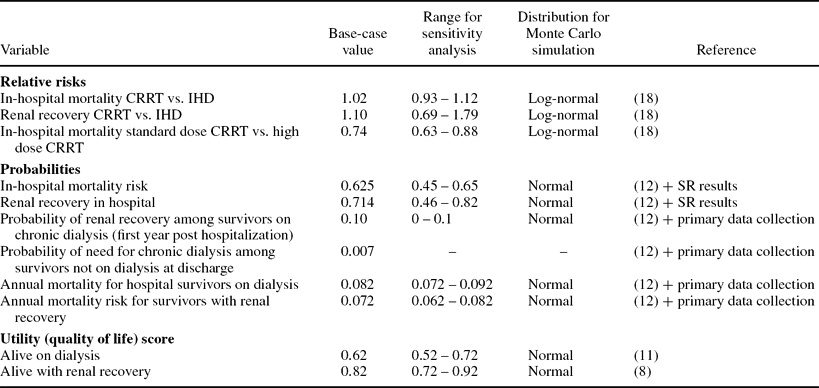
Baseline Event Rates and Clinical Outcomes. The baseline transition and event probabilities (Table 1) were based on a population-based analysis of Canadian patients with ARF admitted to ICUs in the Calgary Health Region, which provides services to a referral population of 1.3 million (Reference Bagshaw, Laupland and Doig2;Reference Manns, Doig and Lee12). All adult ICU patients with ARF requiring RRT were included in two observational cohorts (April 1996 to March 1999 and May 1999 to April 2002), from which model parameters were taken. Additional data were obtained from hospital survivors in the first cohort (n = 261) to determine the incidence of death and dialysis dependence after a follow-up of 4 years.
Base-Case Model Parameters and Ranges for Sensitivity Analysisa

aPrimary data collection from extended follow-up on subjects from Manns et al. (Reference Manns, Doig and Lee12).
CRRT, continuous renal replacement therapy; IHD, intermittent hemodialysis; SR, data from systematic review.
During the period of observation in this health region, intensive care settings were closed units and managed by qualified intensive-care physicians. RRT included IHD and CRRT, and either could be used at the discretion of the attending physician. As bias by indication is probable, data from all patients (regardless of renal replacement modality) were used to inform baseline model parameters for the IHD arm. We evaluated validity by comparing the health state transition probabilities obtained from this observational cohort with pooled estimates obtained from IHD arms of randomized controlled trials (RCTs) included in a recent systematic review (Reference Pannu, Klarenbach and Wiebe18).
Efficacy of RRT. The estimates of efficacy and effectiveness of CRRT were based on a previously published systematic review and meta-analyses that considered RCT only (Reference Pannu, Klarenbach and Wiebe18), the highest level of evidence recommended for economic evaluation (Reference Claxton, Sculpher and McCabe6). For outcomes where no statistically significant difference was found, a relative risk (RR) of 1.0 was used in the base-case analysis, and the impact of using the extremes of the 95 percent confidence intervals (CIs) from the pooled estimate was explored in sensitivity analysis.
Mortality. The RR of all-cause mortality for CRRT at the last reported time point for all included studies (ICU mortality for three studies, in-hospital mortality for five, 90-day mortality for one, and unknown but presumed in-hospital mortality for one) was nonsignificant compared with IHD (RR, 1.10; 95 percent CI, 0.99 – 1.23). Re-examination of the point estimate using 28-day instead of 90-day mortality for the paper that reported this (Reference Vinsonneau, Camus and Combes19) did not qualitatively change the point estimate (RR, 1.04; 95 percent CI, 0.95 – 1.14). The RR of overall mortality was applied to the interval between the start of dialysis in the ICU and hospital discharge, which is the period when the greatest mortality occurs and which is most commonly used for outcome ascertainment in clinical trials.
The model specified that postdischarge mortality was determined by the patient's clinical state (alive on dialysis or alive without dialysis dependence) and not directly influenced by the initial dialysis modality (Table 1).
Renal Recovery. The recovery of renal function, defined as the patient's independence from ongoing dialysis therapy, was determined from the systematic review. The pooled RR for dialysis dependence among surviving patients for patients treated with CRRT compared with IHD was 0.91 (95 percent CI, 0.56 – 1.49).
High Dose Compared with Standard Dose CRRT. The scenario of high vs. standard dose CRRT was examined in a scenario analysis. Our systematic review reported a pooled relative risk of death of 0.74 (95 percent CI, 0.63 – 0.88) favoring high dose CRRT compared with standard dose (35–45 ml/min/kg versus 20 ml/min/kg), with other clinical outcomes nonsignificant (Reference Pannu, Klarenbach and Wiebe18). We updated this estimate with data from the ATN study, which included high and standard dose RRT using both modalities of CRRT and IHD (Reference Noseworthy, Konopad, Shustack, Johnston and Grace16). After inclusion of this study, the updated RR of death became nonsignificant at 0.84 (95 percent CI, 0.67 – 1.05), although heterogeneity increased substantially (I2 = 72 percent) with inclusion of this study.
Duration of ICU, hospitalization, and RRT. The delivery of continuous dialysis, compared with intermittent dialysis, may theoretically influence the length of stay in various care settings. Whereas the data extracted from the systematic review on length of stay in the ICU and hospitalization could not be reliably pooled, there was no indication of a difference between the two treatments. The maximum reported differences in total hospital stay (9.2 days favoring CRRT and 8.5 days favoring IHD) were explored in a sensitivity analysis. The duration of treatment with RRT, although infrequently reported, did not appear to be different for CRRT compared with IHD.
Quality of Life. None of the identified studies determined differences in quality of life over the short time frame of the index hospitalization. As any between-strategy differences in quality of life during this period would be unlikely to influence conclusions due to the relatively short duration of critical illness, this parameter was not incorporated into the model. We performed a focused literature search to obtain the estimates of utility for patients who survive critical illness, including those who do or do not require ongoing chronic dialysis therapy. Hamel et al. (Reference Hamel, Phillips and Davis8) reported the utility estimates at 6 months in surviving patients. We obtained utility scores for patients receiving chronic HD from a Canadian cohort (Reference Laupacis, Keown and Plus9;Reference Manns, Johnson, Taub, Mortis, Ghali and Donaldson11). As patients recovering from ARF in the ICU may have different severities of illness and comorbid illness, this may over- or underestimate utility. The ranges for both these estimates were explored in a sensitivity analysis, as was an analysis where only life-years gained were considered. A discount of 5 percent was applied to QALYs (Reference Claxton, Sculpher and McCabe6).
Complications. No significant differences in complications were found between CRRT and IHD in the systematic review. Although a trend for increased filter clotting was noted for CRRT, the cost of managing this complication is captured in the cost of providing CRRT.
Hemodynamic instability could lead to greater difficulty in providing IHD compared with CRRT. Whereas some trials excluded patients with low mean blood pressures (Reference Mehta, McDonald and Gabbai15), an RCT by Vinsonneau et al. (Reference Vinsonneau, Camus and Combes19) provided recommendations to maintain hemodynamic stability (high sodium concentration, low temperature dialysate, isovolemic connections). IHD was provided every other day, and only three patients (1.6 percent) were switched to CRRT for hemodynamic instability, suggesting that this condition does not preclude treatment with alternate-day IHD in most critically ill patients. Alternative modes of delivering IHD (such as SLED, where IHD is provided for 8 hours, 6 days per week) that may be used in patients with hemodynamic instability, were explored in scenario analyses.
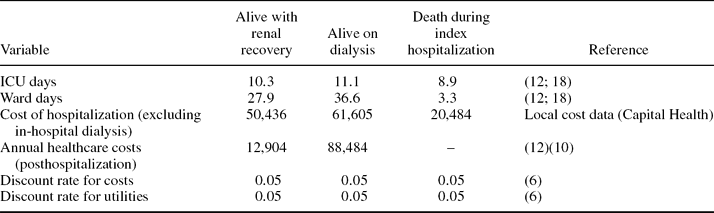
Costs. We identified a high-quality micro-costing study enumerating healthcare resource use and costs of this Canadian patient population to inform costs, including the submodalities of CRRT and methods of anticoagulation for each (Reference Manns, Doig and Lee12) (Tables 2 and 3). For the scenario analysis comparing SLED with CRRT, the costs reported in a Canadian study by Berbece and Richardson (Reference Berbece and Richardson3) were used, which included the costs of staffing and supplies. A focused literature search on the resources and costs of CRRT and IHD in a critical care setting found data for the United States (Reference Mehta, McDonald and Gabbai15) and Italy (Reference Vitale, Bagnis and Marangella20), which was assessed in sensitivity analysis.
Resource Use and Costsa by Patient Clinical Status

aIn 2005 Canadian dollars.
ICU, intensive care unit.
Resource Use and Costsa of Renal Replacement Therapy

aIn 2005 Canadian dollars.
IHD, intermittent hemodialysis; SLED, slow-low efficiency hemodialysis; CRRT, continuous renal replacement therapy.
Per diem costs for the various care settings were obtained from Canadian sources (Reference Palevsky, Zhang and O'Connor17), and the number of days spent in each care setting was obtained from Canadian data (Reference Manns, Doig and Lee12). As found in the systematic review, we assumed that there was no difference in the length of stay by modality in the primary analysis.
The Bank of Canada's exchange rate for the reported year was applied to all foreign currency. All costs were inflated to 2005 Canadian dollars using the general Consumer Price Index and discounted at 5 percent (Reference Claxton, Sculpher and McCabe6).
Long-term Costs of Surviving Patients. The direct healthcare costs incurred by surviving ARF patients for 1 year after discharge from hospitalization were taken from Manns et al. (Reference Manns, Doig and Lee12). In the sensitivity analysis, we considered the scenario where the cost differences between patients requiring or not requiring dialysis were only related to costs associated with provision of chronic dialysis (Reference Lee, Manns and Taub10), and other healthcare costs were equivalent.
Sensitivity Analysis
We performed one-way sensitivity analyses by varying the values for uncertain parameters (Tables 1 and 2). The point estimates and 95 percent confidence intervals for measures of effectiveness were evaluated. Statistical distributions were created around all variables with significant measurement uncertainty and for which distributions could be estimated (Table 1). The distributions were based on confidence intervals from the meta-analysis, ranges identified in the literature review, and common distributional forms (Reference Briggs, Goeree, Blackhouse and O'Brien4;Reference Drummond and Jefferson7), and a Monte Carlo simulation of 25,000 patients was performed.
RESULTS
Model Validity
Using published guidelines (Reference McCabe and Dixon13;Reference Weinstein, O'Brien and Hornberger21), we ensured that the results made sense and could be explained intuitively. We assessed for logical inconsistencies by evaluating our model under hypothetical conditions to establish internal validity.
We determined that our model had predictive validity by comparing model outputs (a function of input variables and model structure) with observed data from a Canadian source (Reference Bagshaw, Laupland and Doig2;Reference Manns, Doig and Lee12) and outcomes from studies in the systematic review. This included a comparison of in-hospital outcomes (mortality, dialysis dependence, costs for patients in each clinical category), status at hospital discharge, long-term outcomes of mortality and dialysis dependence, costs for in-hospital stay and the first postdischarge year for each health state (results not shown).
CRRT Compared with IHD
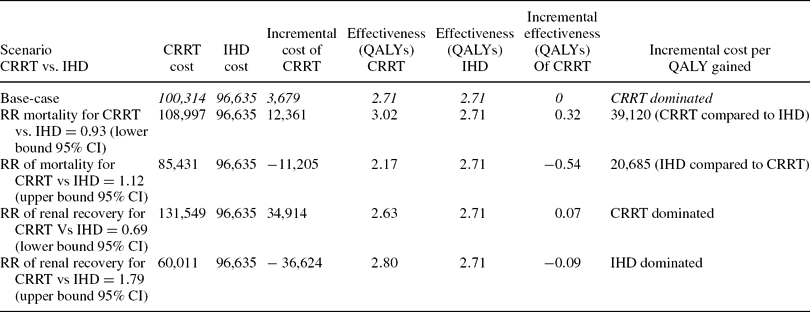
Compared with IHD, CRRT results in equivalent health outcomes but is C$3,679 more costly than IHD due to the higher direct costs of providing CRRT (Table 4). In one-way sensitivity analysis, modifying baseline probabilities and utility scores over their plausible ranges did not alter this result. Scenarios of provision of RRT, including inclusion of the higher costs associated with providing daily IHD or SLED also did not significantly alter the result, with the incremental cost of CRRT ranging from $2,007 to $5,904. Estimates of resource use and cost of CRRT and IHD from other settings did not alter results, with weekly costs of providing CRRT $1,100 to $5,900 greater with CRRT.
Base-Case Cost-effectiveness and Results of Sensitivity Analysis around Estimates of Effectiveness

CRRT, continuous renal replacement therapy; IHD, intermittent hemodialysis; QALYs, quality-adjusted life-years; RR, relative risk; CI, confidence interval.
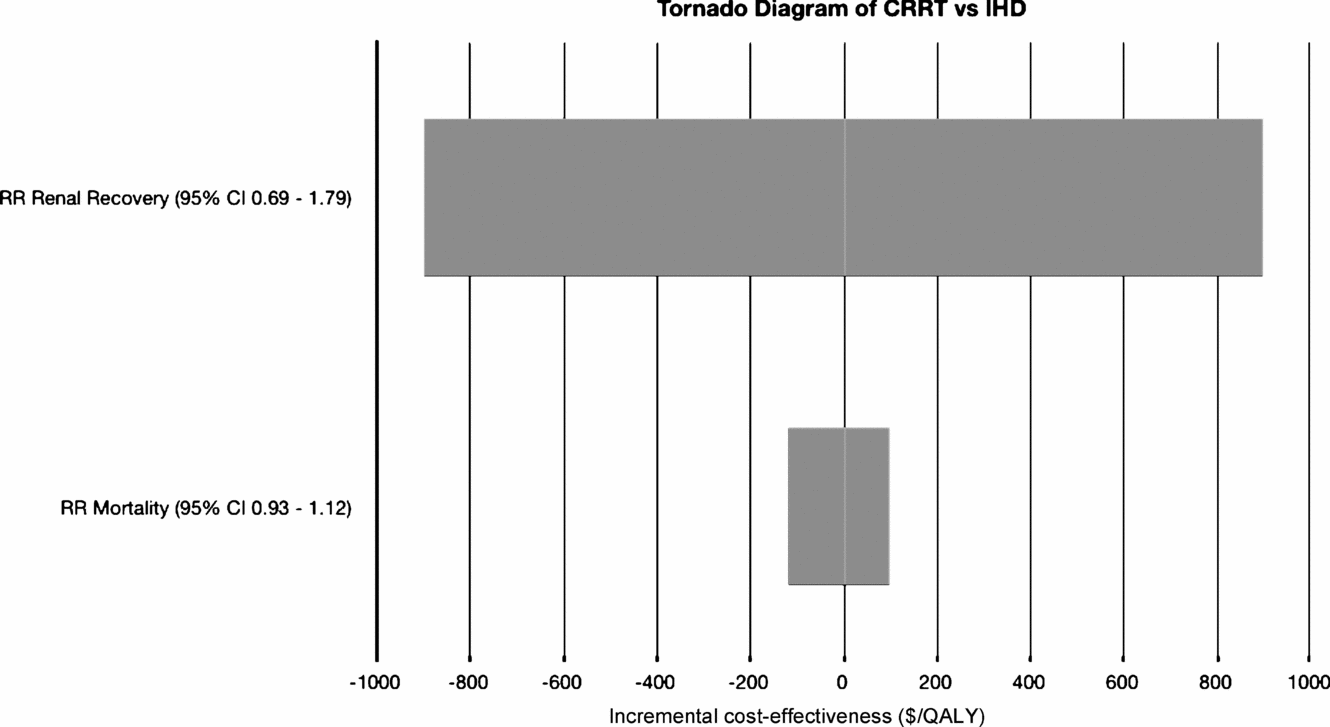
Varying the RR of mortality and renal recovery through attendant 95 percent confidence intervals resulted in striking differences in the incremental costs, benefits, and the cost-effectiveness of the various modalities (Table 4; Figure 2). Both strategies became dominant (less costly and greater benefit) at the extremes of the 95 percent confidence interval for renal recovery.
Incremental cost-effectiveness of CRRT vs. IHD over 95% confidence intervals of relative risk. CRRT, continuous renal replacement therapy; IHD, intermittent hemodialysis; QALY, quality-adjusted life-year; RR, relative risk; CI, confidence interval.

High Dose Compared with Standard Dose CVVH
Using data from clinical trials using CRRT only, high dose CRRT results in increased costs ($38,999) and additional QALYs (1.63), with an incremental cost-utility of $23,994/QALY. This result did not change substantively when the 95 percent confidence interval was examined, or when a larger dose (45 ml/min/kg) was used. If data from the ATN studied are included, the pooled estimate became nonsignificant (RR, 0.84; 95 percent CI, 0.67 – 1.05), suggesting that high dose CRRT increases costs by approximately $742 per patient but does not increase QALYs.
DISCUSSION
This analysis indicates that CRRT is more costly to provide than IHD (even when compared with more intensive forms of IHD such as daily IHD and SLED), with incremental costs per patient ranging from $1,100 to $3,700 per patient. This cost difference persisted when alternate sources of costing data were used (Reference Berbece and Richardson3;Reference Manns, Doig and Lee12;Reference Mehta, McDonald and Gabbai15;Reference Vitale, Bagnis and Marangella20). Given the absence of evidence that CRRT improves clinically relevant outcomes compared with IHD, and the reality of finite healthcare resources, provision of IHD appears to be the most attractive therapy in patients in whom either dialysis modality could be used.
However, while the incremental costs of providing CRRT per patient are sizable, compared with the total healthcare resources consumed by these critically ill patients they are relatively small. The most significant drivers of cost appear to be that of the index hospitalization with costs estimated at $26,000–$56,000 (1999 $CAN), and the significant costs of providing long-term chronic dialysis to patients who do not recover renal function ($73,000 per annum). The impact of these costs are demonstrated by the dramatic shifts in the cost-effectiveness ratio with even very small changes in the relative risk renal recovery. Our analysis suggests that even very resource intensive interventions may be considered attractive if they were to provide even relatively small improvements in renal recovery.
The results of our analysis interpreted within the context of its limitations. As in most economic evaluations, our model and results are limited by available evidence and the requirement to model all relevant clinical and economic consequences. Our evaluation has been strengthened by its rigorous methods and our systematic review. The use of observational data to assign costs is a common practice, by necessity, in economic models. Ideally, an RCT would have assessed the extent to which healthcare resource use influences the results in this model, by including these as an outcome measure, particularly the need for maintenance HD and its associated costs. Such an RCT is unavailable. Many sources of data, including studies observing costs and quality of life, were obtained from small studies with small sample sizes. A significant number of studies were obtained from one region of Canada. This may limit the generalizability of the results. Furthermore, no information was available on indirect and productivity costs. These may be substantial if survival and functional status are influenced by therapy. The lack of data on these outcomes and their modification with RRT preclude their incorporation here. Finally, controversy exists regarding the suitability of IHD for all critically ill patients with ARF. The results of the economic analysis are relevant only to patients who can be appropriately treated with IHD or CRRT. Although there is considerable controversy regarding the proportion of patients who are suitable for either treatment, there is some evidence that this proportion may be quite high (Reference Vinsonneau, Camus and Combes19).
Two recent systematic reviews have compared these two strategies for the treatment of acute renal failure in critically ill patients, neither of which demonstrate superiority of CRRT compared with IHD (Reference Bagshaw, Berthiaume, Delaney and Bellomo1;Reference Pannu, Klarenbach and Wiebe18). There is no question that the studies used to perform these meta-analyses have substantial limitations, which introduce the possibility of bias despite the rigorous methodology used to pool their results. Despite this, it is important to recognize that arguments used to support the use of CRRT are based on even weaker data (theoretical considerations and observational studies). Although it is possible that CRRT will yet be shown to benefit patients, the weight of current evidence does not support this hypothesis. Because the principle of opportunity demands that finite healthcare resources be used only for interventions for which there is clinical benefit, we suggest that IHD be considered the first-line therapy for renal replacement in critically ill patients. However, if future, high-quality trials demonstrate superiority of CRRT over IHD, this conclusion should be reassessed.
In summary, the higher incremental costs and absence of proven benefit of CRRT compared with IHD in critically ill patients with acute renal failure favor the use of IHD, although the incremental cost of CRRT compared with IHD is relatively small compared with the total cost of care. Given that the incidence of renal recovery has a large impact on our results, future RCTs should focus on the impact of therapies on renal recovery, in addition to mortality.
CONTACT INFORMATION
Scott Klarenbach, MD, MSc (swk@ualberta.ca), Assistant Professor, Department of Medicine, University of Alberta, 11-107 Clinical Sciences Building, 8440-112 Street, Edmonton, Alberta, T6G 2G3 Canada
Braden Manns, MD, MSc (braden.manns@albertahealthservices.ca), Associate Professor, Department of Medicine, University of Calgary, Foothills Medical Center, 1403-29th ST NW, Calgary, Alberta T2N 2T9, Canada
Neesh Pannu, MD (npannu@ualberta.ca), Assistant Professor, University of Alberta, 11-107 Clinical Sciences Building, 8440-112 Street, Edmonton, Alberta T6G 2G3, Canada
Fiona M. Clement, PhD (fclement@ucalgary.ca), Research Manager, Department of Medicine, University of Calgary, Foothills Medical Center, 1403-29th ST NW, Calgary, Alberta, T2N 2T9, Canada
Natasha Wiebe, MMath, PStat (nwiebe@ualberta.ca), Research Associate, 3048 RTF, University of Alberta, 8308-114 Street NW, Edmonton, Alberta T6G 2V2, Canada Marcello Tonelli, MD, SM (mtonelli@med.ualberta.ca), Associate Professor, Department of Medicine, University of Alberta, 11-107 Clinical Sciences Building, 8440-112 Street, Edmonton, Alberta T6G 2G3, Canada