Interparty animosity, or affective polarization, has increased in America over the past few decades (Iyengar et al. Reference Iyengar, Sood and Lelkes2012). Partisans today are more likely to say they dislike members of the other party, avoid interacting with them, and even take material losses in order to avoid helping the other side (for a review, see Iyengar et al. Reference Iyengar, Lelkes, Levendusky, Malhotra and Westwood2019). While there is a consensus that America today is affectively polarized, there is less consensus as to how it got to be that way.Footnote 1
Scholars have offered at least two competing explanations for the rise in affective polarization. Some argue that partisan identities have been the main drivers of affective polarization: As Americans have sorted into different homogeneous tribes (Mason Reference Mason2018; Mason and Wronski Reference Mason and Wronski2018), partisan identities have become more salient, and, as a consequence, intergroup animosity has increased. Others have argued that ideology plays a major role. In particular, elite polarization and partisan sorting have driven Americans to see large policy differences between their side and the other side (Fiorina Reference Fiorina2016; Rogowski and Sutherland Reference Rogowski and Sutherland2016; Webster and Abramowitz Reference Webster and Abramowitz2017), making affective polarization a logical outcome. The ideology and party identity perspectives have largely developed in parallel: Some studies have examined whether partisan identity is related to affective polarization (e.g., Mason Reference Mason2018), while other studies have examined whether policy preferences matter (e.g., Rogowski and Sutherland Reference Rogowski and Sutherland2016; Webster and Abramowitz Reference Webster and Abramowitz2017). No study has compared the predictive power of each perspective.
The current study examines whether the ideology of a political candidate or his or her party produces more affective polarization. Respondents were randomly assigned to learn about a candidate's ideology (which varied in extremity), their partisanship, or both. Compared to a control condition, learning that a candidate held ideologically extreme positions generated feelings that were 2–3 times as large as only learning about their partisan identity. These effects were moderated by the respondent's ideology. Respondents who hold moderate attitudes are not affected by the candidate's positions, while ideologues punish out-party extremists and reward in-party extremists.
In addition to comparing the main effects of ideology and party, this study also examines whether these effects depend on whether a candidate is a member of the in-party or out-party. Recent literature has argued that the current political environment is marked by “negative partisanship” (Abramowitz and Webster Reference Abramowitz and Webster2018). That is, people care more about the other party than their party; others find that people are motivated primarily by their in-group (Lelkes Reference Lelkes2018; McConnell et al. Reference McConnell, Margalit, Malhotra and Levendusky2018). I find that the effects of ideology and party identity are indeed asymmetric: information about the out-party yields effects that are between 50 and 100 percent bigger than information about the in-party. However, in-party information still yields substantively large effects on feeling thermometer scores.
While both the party and the ideology of candidates exacerbate affective polarization, the impact of ideology, especially that of an out-group member, is far greater than some literature implies. This also implies that while Americans themselves may be “ideologically innocent” (Kinder and Kalmoe Reference Kinder and Kalmoe2017), they still judge political elites by their political ideology.
1. What drives affective polarization?
Two lines of research seek to explain the rise of affective polarization. First, some argue that partisanship as a social identity is the principal driver of affective polarization (Iyengar et al. Reference Iyengar, Sood and Lelkes2012; Mason and Wronski Reference Mason and Wronski2018). As political parties have become more homogeneous in terms of the race, religiosity, ideological identity, and geography of their constituents, partisanship became an increasingly important social identity (Mason and Wronski Reference Mason and Wronski2018). As partisans no longer hold identities that cross across party lines, they become more strongly attached to their own group and hostile to the other side. This line of work implies that merely knowing someone is from the other side is enough to generate animus (Iyengar et al. Reference Iyengar, Sood and Lelkes2012).Footnote 2
A few scholars have offered an alternative to the social identity approach and claim that, at its root, affective polarization is ideological. Two sets of theories link affective polarization to ideology. Some scholars believe that affective polarization is causally linked to partisan-ideological sorting (Bougher Reference Bougher2017; Webster and Abramowitz Reference Webster and Abramowitz2017). Over the past half-century or so, partisan identities have become increasingly aligned with ideological position (Levendusky Reference Levendusky2009). That is, Republicans are more likely to hold conservative positions and Democrats are more likely to hold liberal positions than they were in the past. Bougher (Reference Bougher2017) and Webster and Abramowitz (Reference Webster and Abramowitz2017) argue that this process has increased affective polarization, but Lelkes (Reference Lelkes2018) shows that the two processes are only weakly linked: both the unsorted and sorted have become more affectively polarized; lagged affective polarization predicts sorting at all knowledge levels, while lagged sorting only predicts affective polarization among the most politically knowledgeable.
Others argue that rising elite ideological extremity has driven up partisan animosity (Rogowski and Sutherland Reference Rogowski and Sutherland2016; Webster and Abramowitz Reference Webster and Abramowitz2017) as it raises the stakes of politics. Having a political extremist in office means that change might not be incremental, but rather dramatic. While both Rogowski and Sutherland (Reference Rogowski and Sutherland2016) and Webster and Abramowitz (Reference Webster and Abramowitz2017) are important contributions to the literature, neither let us compare the relative effects of the party identity of a politician versus his or her political positions. Rogowski and Sutherland (Reference Rogowski and Sutherland2016) experiment does not identify the candidate's party and identifies ideology with their placement on an 11-point ideological self-identification scale, which potentially conflates identity with substantive ideology. Webster and Abramowitz (Reference Webster and Abramowitz2017) study gives respondents the operational ideology of the politician but does not vary the politician's party identity, which makes a comparison of the effect of party versus ideology impossible.
2. Data and methods
Partisans were recruited from the Qualtrics online panel; pure independents were not included in the sample (see Appendix for demographics). Although the panel is not representative of the US population, experimental studies find equivalent results with representative and non-representative samples (Berinsky et al. Reference Berinsky, Huber and Lenz2012; Mullinix et al. Reference Mullinix, Leeper, Druckman and Freese2016) Two experiments were run, one in which respondents were asked to rate someone from their in-party (N = 1526) and one in which respondents were asked to rate someone from the other party (N = 4272). For the sake of presentation, data from the two experiments were concatenated. Roughly 400 respondents took part in the second experiment (out-party) as well as the first experiment (in-party). Out-party data from these respondents were excluded from the analysis, although the results are substantively the same if they are left in the sample.
Within each of these experiments, respondents were randomly assigned to read about one of six fictitious candidates who was ostensibly a member of the respondent's in-party or out-party (see Appendix for wording). In the control condition, they read a short biography, and were then asked to rate the candidate on a feeling thermometer scale. In the partisan identity condition, they were also told whether the candidate was a Republican or a Democrat. In the moderate-no party id condition, they were told that the candidate held a host of moderate issue positions but not the candidate's party. If the candidate was a Republican, they took the issue positions of Susan Collins in 2017, the most moderate Republican in the Senate (DW-Nominate First Dimension Score of 0.11 as of writing). If the candidate was a Democrat, they took the issue positions of Joe Manchin, the most moderate Democrat in the Senate in 2017 (DW-Nominate First Dimension Score of −0.06 as of writing). In the extreme-no party id condition, they were told that the candidate held a host of extreme issue positions but not the candidate's party. If the candidate was a Democrat, they took the issue positions of Elizabeth Warren, the most liberal Senator in 2017 (DW-Nominate First Dimension Score of −0.78 as of writing). If the candidate was a Republican, they took the issue positions of Mike Lee, the most conservative Senator (DW-Nominate First Dimension Score of .92 as of writing). In the moderate-party id and extreme-party id conditions, they were also told whether the candidate was a Democrat or a Republican.
For instance, if the respondent was assigned to the extreme-party id, they would see the following:
William Richardson is a Republican. He is a 53-year-old businessman who has been married for 34 years and has two sons. He earned his college degree in 1974 and then served for ten years in the state legislature. After that, he was a co-founder of the state's public affairs television station. In addition, he is a member of the board for the state history museum.
Richardson strongly opposes government-run universal health care. He believes that the federal government should not be able to mandate health care and favors a free-market system. In addition, this candidate is strongly pro-life and wants to prohibit federal funding for abortions. Lastly, he supports legal immigration only and wants tougher enforcement of immigration laws. He wants the federal government to better secure the southern border and not grant amnesty for those who enter the US illegally.
On a scale ranging from 0 to 100, where a score of 0 means you feel “cold” towards this candidate, a score of 50 means you do not feel “particularly warm or cold” towards this candidate, and a score of 100 means you have “warm” feelings towards this candidate, how would score your feelings towards this candidate?
To estimate the effect of each condition, feeling thermometer scores towards the candidate were regressed on treatment condition. To determine whether ideological divergence predicted changes in affective polarization, feeling thermometer scores were regressed on a series of treatment dummies, ideological extremity, and the interaction between the two.
3. Results
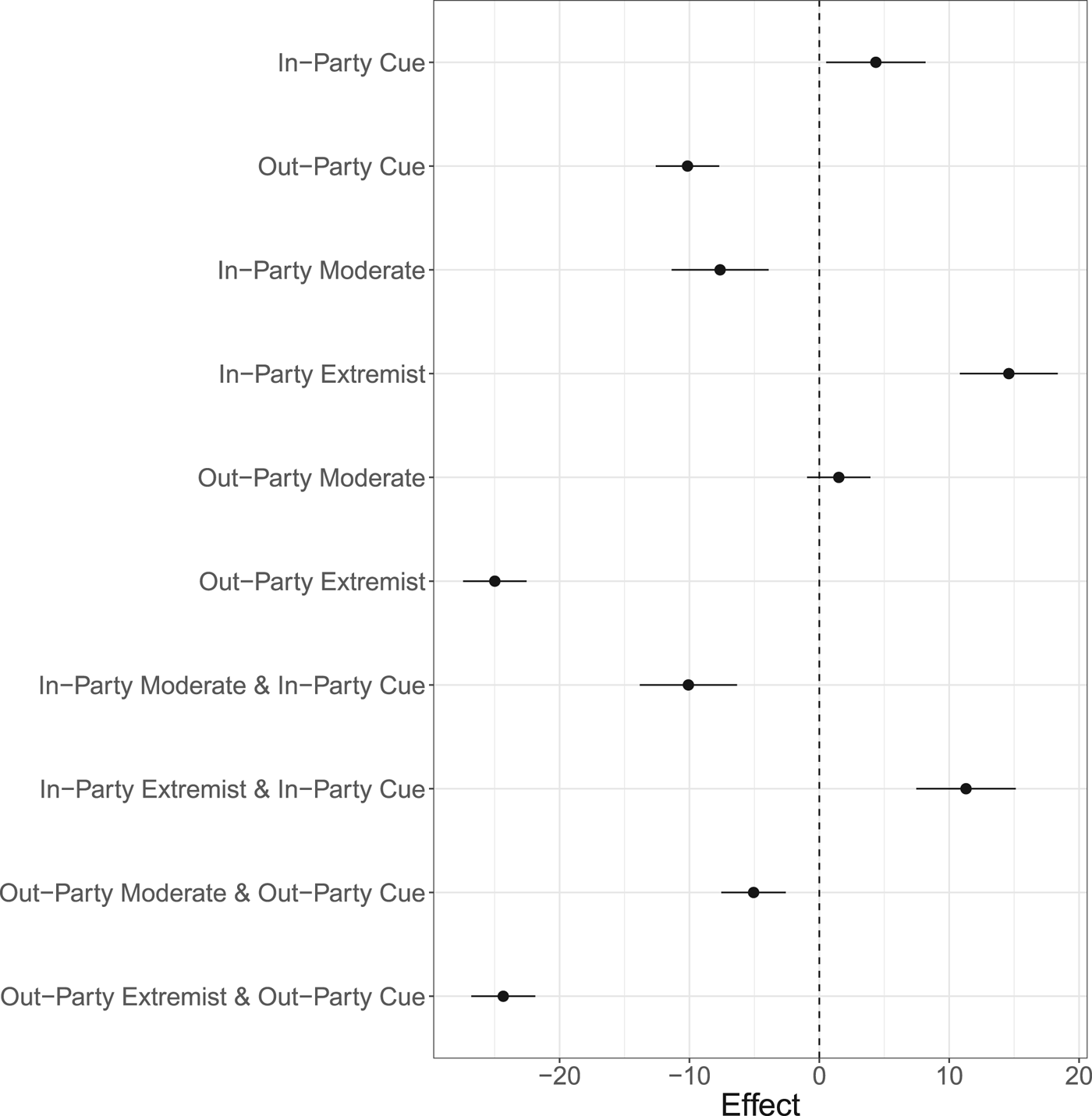
The effect of learning that a candidate had extreme political preferences was much larger than the effect of learning about the candidate's political party. Compared to those in the control group, learning a candidate from your side holds extreme policy preferences increases feeling thermometer scores roughly 3.5 times as much as learning that the candidate is from the same party (b = 14.59, se = 1.92, p < 0.001 versus b = 4.35, se = 1.95, p < 0.05, respectively; Rows 4 and 1 in Figure 1). Similarly, being told that a candidate holds extreme policy preferences associated with the other party decreases feeling thermometer scores roughly 2.5 times as much as learning that the candidate is from the other party (b = −24.99, se = 1.25, p < 0.001 and b = −10.15, se = 1.25, p < 0.001, respectively; Rows 6 and 2 in Figure 1).
The Impact of Candidate Party and Ideology on Feeling Thermometer Scores.

The absolute values of these coefficients also indicate that the effect of receiving an out-party cue is far larger than the effect of receiving an in-party cue. The effect of learning that a candidate from one's side held extreme attitudes was roughly 1.7 times smaller than learning that a candidate from the other side held extreme attitudes. The effect of learning that a candidate identified with the same party the respondent was roughly 2.5 times smaller than learning that a candidate was from the other side.
Additionally, learning that a candidate held positions associated with a moderate from one's own side slightly decreased feeling thermometer scores (b = −7.64, se = 1.90; Row 3 in Figure 1), while learning that the candidate policy positions associated with a moderate from the other side had no effect on feeling thermometer scores (b = 1.50, se = 1.24, p = 0.22; Row 5 in Figure 1). The combination of learning about party and policy were the same as learning about policy alone (Rows 7–10 in Figure 1).
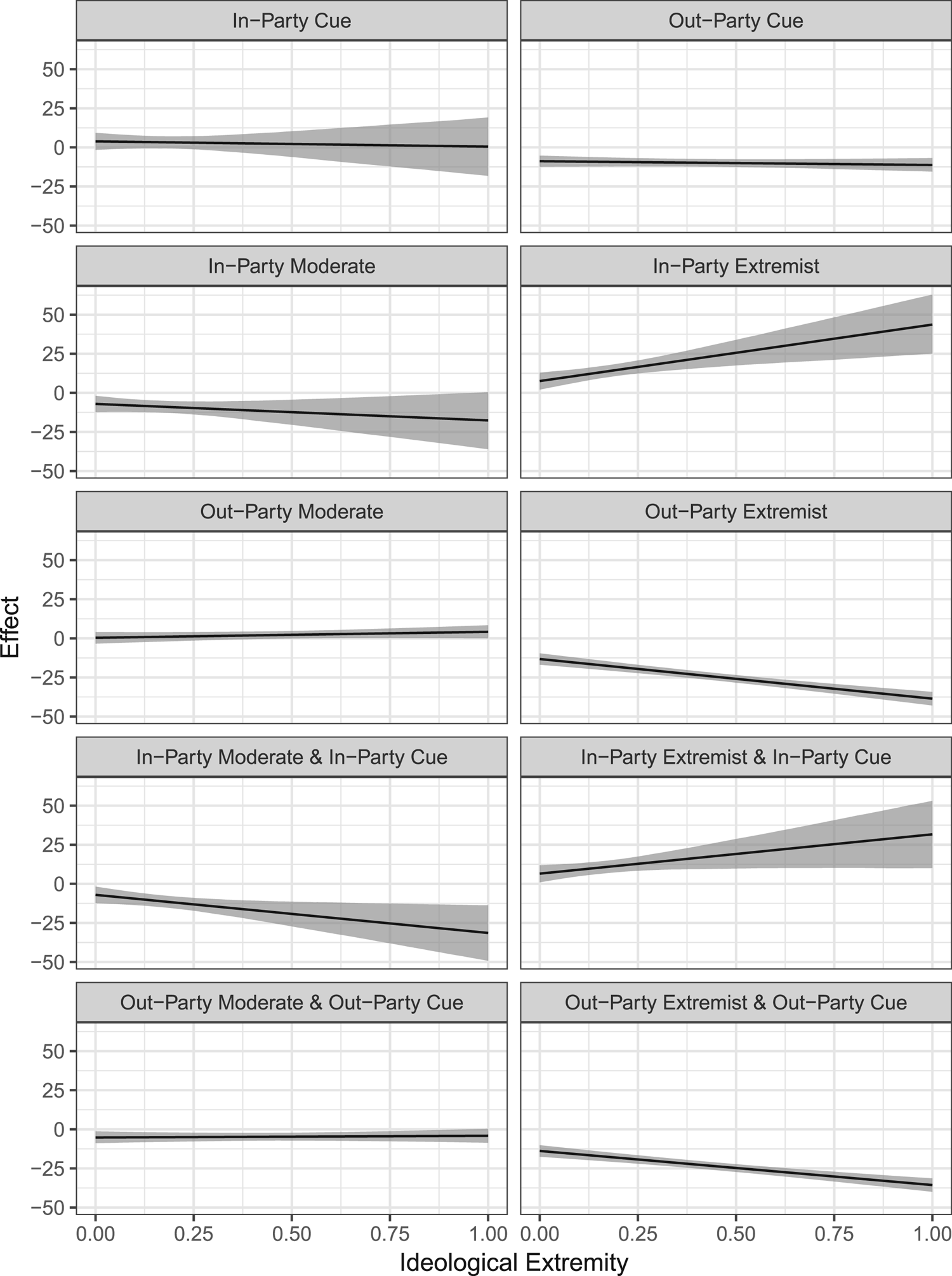
The impact of policy cues was particularly strong among respondents who held strong policy positions. If a respondent was told that candidate held extreme in-party views, ideologically extreme respondents registered feeling thermometer ratings 35.89 (se = 11.29) points warmer than ideologically neutral respondents (Row 2, Column 2 in Figure 2). If the respondent read about an ideologically extreme out-party candidate, ideologically extreme respondents rated the candidate 25 points lower than ideologically neutral respondents when only the ideology was given (−25.25, se = 3.21, p < 0.01; Row 3, Column 2 in Figure 2) or 22 points lower when both the ideology and cue were given (b = −21.76, se = 3.22, p < 0.01; Row 5, Column 2 in Figure 2).
The Impact of Candidate Party and Ideology on Feeling Thermometer Scores by Respondent Ideological Extremity.

The respondent's ideological extremity did not moderate the impact of receiving an inparty-cue (Row 1, Column 1 in Figure 2), an out-party cue (Row 1, Column 2 in Figure 2), or learning that the candidate held in-party moderate (Row 2, Column 1 in Figure 2) or out-party moderate (Row 3, Column 1 in Figure 2) views. Ideologically extreme respondents were more likely to rate candidates negatively if they were told that the candidate identified with the respondent's party and held moderate viewpoints (b = −24.32, se = 10.76, p < 0.05 (Row 4, Column 1 in Figure 2).
4. Discussion
These results support theories of affective polarization that privilege ideological preferences over social identity (Bafumi and Shapiro Reference Bafumi and Shapiro2009; Rogowski and Sutherland Reference Rogowski and Sutherland2016; Fiorina Reference Fiorina2017; Webster and Abramowitz Reference Webster and Abramowitz2017), while raising questions about studies that argue that party dominates policy (e.g., Converse Reference Converse and Apter1964; Cohen Reference Cohen2003; Kinder and Kalmoe Reference Kinder and Kalmoe2017; Mason and Wronski Reference Mason and Wronski2018). For instance, Mason argues that Americans dislike each other without necessarily disagreeing with one another. What matters, in her framework, is a shared social identity. The results of the current study suggest that a shared social identity had a relatively small impact on a person's feelings towards a candidate, while disagreements over policy had substantively large effects. Policy preferences matter, especially among respondents who held extreme policy preferences: Extreme respondents react most favorably to extreme candidates of their own side and most negatively to extreme candidates from the other side. Respondents with the least extreme attitudes were not moved by the policy preferences of a candidate.
Relatedly, this work points to the importance of ideology in structuring political evaluations. Many have assumed that party labels are enough to overcome “informational shortfalls about politics” (Sniderman Reference Sniderman, Lupia, McCubbins and Popkin2000, p. 81). As the present research shows, while party labels indeed help voters distinguish between candidates, party labels alone do not provide enough information to overcome not knowing policy positions. In fact, knowing both issue position and party labels offers no additional information beyond knowing issue positions alone. These results also imply that even in today's polarized environment, voters are not simply projecting the most extreme policy positions onto candidates.
I also find that people react more strongly to the ideology and partisanship of out-party candidates than in-party candidates, in line with theories of negative partisanship (Abramowitz and Webster Reference Abramowitz and Webster2018). These findings do not indicate that in-party cues and ideology do not matter, only that the candidate's ideology and out-group behavior matter more.
This work also points to a tension in the American politics literature: Americans are not ideologues (Kinder and Kalmoe Reference Kinder and Kalmoe2017), yet, as demonstrated by this research, they also care deeply about the ideological preferences of political candidates. How do we reconcile these seemingly antithetical empirical findings? One possibility is that although most people are not ideologues, they are increasingly aware of the ideological reputations of the political parties (Sniderman and Stiglitz Reference Sniderman and Stiglitz2012). This suggests that citizens are aware of the policy positions that would make a candidate a “good partisan,” even if they do not hold those positions themselves.
In addition to contributing to the role of policy and party in explaining affective polarization, this study also contributes to the literature on information and candidate evaluation. Alvarez (Reference Alvarez1998, p. 109) argues that “the more uncertain a voter is about the candidate, the less likely they are to support the candidate.” Respondents in the control condition, who received no substantive information were more positive about the candidate than respondents in all other conditions except for those in the in-party cue, extreme in-party policy preferences or the mix of the two. Counter Alvarez (Reference Alvarez1998), respondents did not “prefer the devil they know more about to the devil they know less about.”
While this study helps us understand the roots of affective polarization, there are important caveats. This work says nothing about the validity of the social sorting process and its effects on affective polarization (Mason and Wronski Reference Mason and Wronski2018). It may be that social sorting and the resulting identities are the distal reason that ideology exerts such strong effects. Strong identifiers may believe that strong co-partisan ideologues signal strong party allegiance, while strong out-partisan ideologues are a particular threat.
While the use of feeling thermometers as a measure of affective polarization has been validated (Druckman and Levendusky Reference Druckman and Levendusky2018), they are ultimately summary evaluations, and can be used, for instance, as an indicator of candidate utilities (e.g., Palfrey and Poole Reference Palfrey and Poole1987). Hence, there is some ambiguity in whether the use of a feeling thermometer in this experiment is indicative of affective attachment or something else. Future studies could implement other measures of affective polarization, including behavioral outcomes (McConnell et al. Reference McConnell, Margalit, Malhotra and Levendusky2018).
This study also does not shed light on the role of a third possible pathway to affective polarization: the information environment. Partisans, inadvertently and advertently, are now more likely to be exposed to vitriolic partisan messages than in prior years, and people with stronger identities, perhaps formed by the social sorting process described by Mason and Wronski (Reference Mason and Wronski2018), are more receptive to this information. Exposure to this information has also been linked to affective polarization (e.g. Levendusky and Malhotra Reference Levendusky and Malhotra2016).
Although this design is similar to that of many studies that examine political attitudes (Tomz and Van Houweling Reference Tomz and Van Houweling2009; Sniderman and Stiglitz Reference Sniderman and Stiglitz2012; Rogowski and Sutherland Reference Rogowski and Sutherland2016; Webster and Abramowitz Reference Webster and Abramowitz2017) in that it uses a fictional candidate, a cautious view of the external validity of this study should still be taken. Note that Rogowski and Sutherland (Reference Rogowski and Sutherland2016) find similar results in their experimental study with fictional candidates as well as their observational studies with real candidates.
This study indicates that, if we are to decrease affective polarization in the US, we need politicians that are politically moderate. Unfortunately, voters prefer politicians of their own party that are politically extreme. This incentivizes extreme political candidates, which will only exacerbate current tensions.
Supplementary material
The supplementary material for this article can be found at https://doi.org/10.1017/psrm.2019.18
Acknowledgments
I thank Nathan Kalmoe, Paul Kellstedt, Neil Stenhouse, and two anonymous reviewers for their comments. I thank Dave Vanette for running the study on the Qualtrics panel, and Eric Selzer for valuable research assistance.
Author ORCIDs
Yphtach Lelkes, 0000-0003-1805-056X.