Introduction
Frontotemporal dementia (FTD) refers to a group of neurodegenerative disorders comprising three canonical clinical presentations: behavioral variant FTD, semantic dementia, and progressive non-fluent aphasia. These clinical symptoms may share features with motor neuron disease, corticobasal syndrome and/or progressive supranuclear palsy. Frontotemporal lobe degeneration (FTLD) is the anatomical descriptive term denoting the relatively selective atrophy of frontal and temporal lobe that characterizes most FTD cases (Rhorer & Warren Reference Rhorer and Warren2011). Mutations in the progranulin gene (PGRN; MIM 128945) have been identified as a major cause of FTLD with ubiquitin-positive, tau-negative inclusions (FTLD-U; Baker et al., Reference Baker, Mackenzie, Pickering-Brown, Gass, Rademarkers, Lindholm and Hutton2006; Cruts et al., Reference Cruts, Gijselinck, van der Zee, Engelborghs, Wils, Pirici and Van2006). Subsequent research has identified more than 65 pathogenic point mutations and some deletions in the PGRN gene associated with FTD (www.molgen.ua.ac.be/FTDMutations). All PGRN mutations identified thus far appear to cause disease by reducing the amount of available functional PGRN progranulin. Progranulin deficiency, or haploinsufficiency, seems to be a lifelong condition and recent studies have shown that levels of the progranulin protein are below average in plasma and in cerebrospinal fluid in all carriers of PGRN mutations, regardless of whether they are affected by FTD (Ghidoni, Benussi, Glionna, Franzoni, & Binetti, Reference Ghidoni, Benussi, Glionna, Franzoni and Binetti2008).
Studies of asymptomatic carriers of PGRN, microtubule-associated protein tau (MAPT) and other FTLD-related mutations may assist in identifying potential neuropsychological deficits which could reflect an elevated risk for FTD or a prodromal stage of the disease. These studies are essential for targeting early intervention strategies to those at the greatest risk. Previous studies have identified deficits in frontal-executive and attentional functioning in asymptomatic MAPT mutation carriers (Geschwind et al., Reference Geschwind, Robidoux, Alarcon, Miller, Wilhelmsen, Cummings and Nasreddine2001). However, little is known about cognitive functioning in asymptomatic PGRN mutation carriers.
Our group identified the c.709-1G>A (Ala237Trpfsx4) mutation in the PGRN gene in patients with FTD, with a high proportion of cases developing corticobasal syndrome as the disease progressed (López de Munain et al., Reference López de Munain, Alzualde, Gorostidi, Otaegui, Ruiz-Martínez, Indakoetxea and Martí Massó2008; Moreno et al., Reference Moreno, Indakoetxea, Barandiaran, Alzualde, Gabilondo, Estanga and López de Munain2009). The age at disease onset ranged from 42 to 71 years (mean age, 59.2 ± 7.2 years), and the clinical and neuropsychological phenotypes were heterogeneous. Behavioral variant frontotemporal dementia (52.4%) and progressive non-fluent aphasia (23.8%) were the most common clinical syndromes. At the first neuropsychological evaluation, executive dysfunction was present in all the patients and language impairment was the second most common feature (López de Munain et al., Reference López de Munain, Alzualde, Gorostidi, Otaegui, Ruiz-Martínez, Indakoetxea and Martí Massó2008). As the disease progressed, symptoms consistent with parietal lobe damage were evident and corticobasal syndrome was a frequent (64.3%) secondary diagnosis (Moreno et al., Reference Moreno, Indakoetxea, Barandiaran, Alzualde, Gabilondo, Estanga and López de Munain2009).
The objective of this study was to assess neuropsychological functioning in asymptomatic c.709-1G>A PGRN mutation carriers compared to non-carrier relatives. We hypothesized that neuropsychological deficits could be present before the development of clinically significant symptoms and could reflect a prodromal stage in the development of FTD.
Methods
Study Population and Design
Twenty-three patients with frontotemporal dementia (FTD) carrying the c.709-1G>A mutation in PGRN were identified between 1995 and 2008 in Donostia Hospital, a tertiary referral center. First-degree relatives of these patients were invited to participate in a prospective longitudinal study to investigate early neuropsychological features of the disease. Exclusion criteria were: (i) history of neurological illness (cerebrovascular disease or any other neurological disease) or major psychiatric illness (schizophrenia, major depression, and bipolar disorder), (ii) use of drugs or toxic agents that could interfere with cognitive function, and (iii) estimated Global IQ score <85 (abbreviated WAIS-III). Subjects were interviewed by an experienced clinician and no recent changes in cognitive function or behavior were detected.
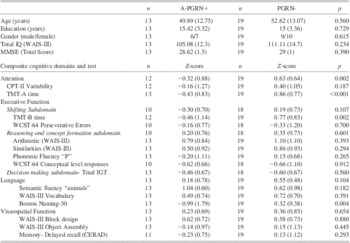
Thirty-two individuals from five families met inclusion and exclusion criteria and served as study participants. The participants were divided in two groups: asymptomatic PGRN mutation carriers (A-PGRN+; n = 13) and non-carrier relatives (PGRN-; n = 19). There were no significant differences between groups in age, education, estimated IQ, or gender (Table 1).
Demographic and global cognition characteristics and neuropsychological test performance (by composite domain scores and test scores, reported as Z-scores) in A-PGRN+ and PGRN- groups

Note. Values are means ± standard deviation.
MMSE = Mini Mental State Exam; CERAD = Consortium to Establish a Registry for Alzheimer's disease; CPT-II = Continuous Performance Test; IGT = Iowa Gambling Test; TMT = Trail Making Test (parts A and B); WAIS = Weschler Adult Intelligence Scale; WCST-64 = Wisconsin Card Sorting Test.
Molecular Procedures
DNA was extracted from blood cells using standard procedures. The c.709-1G>A nucleotide position was genotyped by PCR-RFLP: a fragment of 373 bp was amplified using primers GRN 7F and GRN 7R as described previously (Baker et al., Reference Baker, Mackenzie, Pickering-Brown, Gass, Rademarkers, Lindholm and Hutton2006; Cruts et al., Reference Cruts, Gijselinck, van der Zee, Engelborghs, Wils, Pirici and Van2006), and this was followed by restriction enzyme digestion, using HaeIII (New England Biolabs, USA).
Neuropsychological Assessment
All neuropsychological tests were administered by an experienced neuropsychologist blind to participant carrier status. Neuropsychological tests were selected to assess global intelligence and overall cognitive status, attention, executive function, language, memory and visuospatial skills.
Global intelligence was assessed using an abbreviated form of the Wechsler Adult Intelligence Scale (WAIS-III; Wechsler, Reference Wechsler1997), including Vocabulary, Similarities, Block Design, Arithmetic, and Object Assembly subtests (López, Rodríguez, Santín, & Torrico, Reference López, Rodríguez, Santín and Torrico2003). Attention was measured using the Variability Index from the Continuous Performance Test (CPT; Conners, Reference Conners2000) and completion time from Trail-Making Test Part A (TMT-A time; Reitan, Reference Reitan1958). Executive functioning was evaluated with the Wisconsin Card Sorting Test (WSCT-64; Heaton, Reference Heaton1981), completion time from Trail-Making Test Part B (TMT-B time), WAIS-III Similarities and Arithmetic Subtests WAIS-III, Phonemic Verbal Fluency (number of words beginning with “P” listed in 1 min), and the Iowa Gambling Test (IGT; Bechara, Reference Bechara2007). Because these tests evaluate different capacities within the executive functions, the executive function domain was subdivided into three subdomains. Cognitive shifting comprised TMT-B time and the number of Perseverative Errors from the WCST-64; reasoning and concept formation comprised Similarities and Arithmetic (WAIS-III), Conceptual level responses (WCST-64) and Phonemic Verbal Fluency; and decision making was measured with the IGT total score. Language skills were measured using the abbreviated Boston Naming Test (Fisher, Tierney, Snow, & Szalai, Reference Fisher, Tierney, Snow and Szalai1999), Vocabulary (WAIS-III), and Semantic Verbal Fluency Test (number of animals listed in 1 min). Verbal episodic memory was assessed using the Verbal Learning Test from the Consortium to Establish a Registry for Alzheimer's Disease (CERAD; Morris, Mohs, Rogers, Fillenbaum, & Heyman, Reference Morris, Mohs, Rogers, Fillenbaum and Heyman1988). Finally, visuospatial skills were evaluated using Block Design and Object Assembly (WAIS-III).
Statistical Analysis
We conducted data analyses using SPSS (version 19.00). Individual neuropsychological test scores were transformed into Z-scores using published normative data from NEURONORMA Study Team (Peña-Casanova et al., Reference Peña-Casanova, Blesa, Aguilar, Gramunt-Fombuena, Gómez-Ansón, Oliva and Sol2009) and from tests manuals (Bechara, Reference Bechara2007; Conners, Reference Conners2000; Fisher et al., Reference Fisher, Tierney, Snow and Szalai1999; Heaton, Reference Heaton1981; Morris et al., Reference Morris, Mohs, Rogers, Fillenbaum and Heyman1988, Wechsler, Reference Wechsler1997). Composite scores for each domain were computed by averaging the mean Z-Scores from the individual tests within each domain. Student's t tests were performed for comparison of the mean scores between carriers and non-carriers. To overcome the limitation of a relatively small sample size, Cohen's d values were also calculated as an estimate of effect size for the between-group comparisons. Cohen's d values near 0.2 are considered small, 0.5 is considered moderate, and values above 0.8 are considered high.
Protocol Approval and Consent From Participants
Written informed consent was obtained from all participants. The study was approved by the Donostia Hospital Ethics Committee.
Results
Thirty-two individuals (17 female and 15 male), from five families identified with FTD-PGRN were eligible for the study (10 participants from the family 1, 12 from the family 2, 4 from the family 3, 4 from the family 4, and 2 from the family 5) One subject was excluded because of cerebrovascular disease. There was no other eligible subject that met exclusion criteria. Of these 32 participants, 13 subjects were asymptomatic PGRN mutation carriers (A-PGRN+) and 19 were non-carrier relatives (PGRN-). Progranulin positive and negative groups were comparable in age [mean (SD) = 49.89 (12.75) and 52(13.07)], sex (6 males vs. 9 males) and years of education [mean (SD) = 15.42 (3.32) and 15.00 (3.36)]. There were no significant differences between A-PGRN+ and PGRN- groups in estimated total-IQ (WAIS-III) (see Table 1).
Neuropsychological Comparison Between Groups
The results of composite domains and neuropsychological tests (represented as Z-scores) are presented in Table 1. The mean raw scores of each test are available in the Supplementary data table.
The A-PGRN+ group performed worse on tasks related to the attention domain (t(30) = 3.487; p = .002) and the effect size associated with this difference was high (Cohen's d = 1.27). There were not any other statistically significant differences between the two groups in the other composite cognitive domains, but we detected some significant differences when we compare the performance of the two groups in some individual neuropsychological tests.
The A-PRGN+ group performed significantly slower than the PRGN- group on TMT-A time (t(31) = 4.509; p<.001, Cohen's d = 1.60) and TMT-B time (t(30) = 3.494, p = .002, Cohen's d = 1.28). Effect sizes associated with these differences were very high (TMTA Cohens’ d = 1.60; TMTB Cohens’ d = 1.28). There were no significant differences between A-PGRN+ and PGRN- in the other frontal-executive and attentional tasks performed. The A-PGRN+ group also performed significantly worse on the Boston Naming Test (t(31) = 2.598; p = .022, Cohen's d = 0.93). There were no significant differences between groups on all other measures administered. However, non-significant trends with moderate effect sizes were observed on several measures. Thus, there may be further deficits in neuropsychological functioning in asymptomatic carriers that may be detectable with a larger sample size.
Discussion
This study reveals subtle neuropsychological underperformance in c.709-1G>A progranulin asymptomatic mutation carriers compared with a healthy sample of non-carrier relatives. PGRN mutation carriers had significantly lower scores within tests of attention (TMT-A), set-shifting (TMT-B), and object naming (Boston Naming Test), which may be evidence of prodromal executive deficits and frontal dysfunction. These deficits were observed despite comparable performance on tests of general intelligence, reasoning and logic, visuospatial abilities, and memory.
These findings underscore the relevance of subtle attention, executive-mental flexibility, and language deficits that may arise as early symptoms of FTD. Previous studies in asymptomatic MAPT-mutation carriers and asymptomatic subjects with unspecified familial FTLD-U also reported frontal-executive, attentional, and language dysfunction before the onset of FTD (Geschwind et al., Reference Geschwind, Robidoux, Alarcon, Miller, Wilhelmsen, Cummings and Nasreddine2001). In another study (Torralva, Roca, Gleichgerrcht, Bekinschtein, & Manes, Reference Torralva, Roca, Gleichgerrcht, Bekinschtein and Manes2009), a battery of tests of executive functioning and social cognition was developed in an attempt to facilitate early diagnosis in FTD patients who have other general cognitive functions preserved, including memory, language and praxis. These “high-functioning” patients showed near-average performance on most components of a standard neuropsychological battery with the exception of TMT-A, TMT-B, the Boston Naming test and the Letters-Numbers Sequencing subtest from the WAIS-III (Torralva et al., Reference Torralva, Roca, Gleichgerrcht, Bekinschtein and Manes2009). Our results are consistent in detecting performance deficits on TMT-A, TMT-B, and the Boston Naming Test in these otherwise asymptomatic individuals. Thus, these specific tests may be sensitive indicators of early cognitive dysfunction and/or elevated risk for FTD in PGRN mutation carriers.
The TMT simultaneously assesses functioning in multiple domains, including visual motor tracking, divided attention, mental flexibility, and motor function. A recent functional magnetic resonance imaging study observed task-activated recruitment in the dorsal frontoparietal attention network during performance of TMT-A (Tam, Churchill, Strother, & Graham, Reference Tam, Churchill, Strother and Graham2011). In our sample, poorer performance on the TMT-A in PGRN mutation carriers may be primarily due to an attention deficit, which is common in preclinical phases of FTD. This deficit could be related to the alteration of one of the frontal nodes of this frontoparietal attention network. In frontal lesions, the alteration of attention is typically characterized by behavioral rigidity, loss of mental flexibility and perseverative responses (Zimmerman & Leclercq, Reference Zimmerman and Leclercq2002). These symptoms could account for the underperformance on TMT-B in the A-PRGN+ group.
The Boston Naming Test is used to assess object naming, which is primarily a function of the dominant temporal lobe (Sawrie et al., Reference Sawrie, Martin, Gillian, Faught, Maton, Hugg and Kuzniecky2000). Multiple studies have shown that FTD patients with PRGN mutations have anomia as the predominant language symptom, and this deficit may result from damage involving the temporoparietal junction (Rohrer, Crutch, Warrington, & Warren, Reference Rohrer, Crutch, Warrington and Warren2010). This deficit in our A-PRGN+ group may be reflective of temporal dysfunction in a prodromal stage of FTD.
The results of this cross-sectional study suggest that subtle language, attention and executive deficits in asymptomatic PGRN mutation carriers may reflect prodromal cognitive dysfunction that precedes dementia. Alternatively, these individuals may possess these deficits across their lifespan and not just at middle age, when they may be in the early stages of FTD. Indeed, one study (Geschwind et al., Reference Geschwind, Robidoux, Alarcon, Miller, Wilhelmsen, Cummings and Nasreddine2001) demonstrated that individuals who possess the P301L mutation may exhibit frontal-executive dysfunction up to three decades before the age of predicted onset of FTD. It is possible that PGRN mutation carriers may have subtle developmental deficits that affect attentional, executive and language networks, since these domains appear to be highly susceptible to FTD pathology.
From a biological perspective, it is difficult to identify the neuropathological basis that leads an individual to develop dementia in middle age, since progranulin deficiency is a lifelong condition. Progranulin is an extracellular glycoprotein that regulates cell division, survival and migration (Bateman & Bennett, Reference Bateman and Bennett2009). Asymptomatic relatives of FTD patients carrying PGRN mutations have low levels of circulating progranulin (Ghidoni et al., Reference Ghidoni, Benussi, Glionna, Franzoni and Binetti2008). Thus, mechanisms related to the physiological role of PGRN, including neurotrophic effects and neuroprotection, are chronically dysfunctional in these individuals and not just at the age of FTD onset. Furthermore, it is plausible that presymptomatic PGRN mutation carriers show subtle neuropsychological dysfunction throughout their lives, and that these become more pronounced in middle age as FTLD develops.
A strength of this study is the homogeneity of our sample. All subjects are of Basque descent and are first-degree relatives of FTD patients with the same c.709-1G>A mutation in PGRN. Since both groups contain first-degree relatives of carriers, this design controls for other related genetic or environmental influences on cognitive function in an attempt to isolate the mutation as the sole difference between groups. Additionally, our sample comprises relatively young adults with fewer comorbidities than are typically observed in older adults at-risk for dementia. The presence of comorbidities could confound studies of risk, and as such the age range studied in our sample represents another advantage of our design. Moreover, the present study addresses a novel topic with asymptomatic PGRN mutation carriers using a comprehensive neuropsychological battery.
However, we do acknowledge some limitations of our study. First, although we have a large sample of individuals carrying this specific single mutation in PGRN, it is relatively small in terms of statistical power. For this reason, we have calculated the effect sizes for the main results to complement traditional significance testing. Second, our results may reflect progranulin haploinsufficiency rather than risk for FTD, since all mutation carriers possess progranulin deficiencies and not all develop FTD. Furthermore, since there are multiple etiologies of FTD, it is questionable whether these findings can be generalized to the entire population of FTD patients.
In summary, our results provide insight concerning the neuropsychological performance of presymptomatic PGRN mutation carriers and suggest that the disease process begins before the onset of clinically significant symptoms of FTD. A more complete understanding of early symptoms of FTD that may be related to progranulin haploinsufficiency will be crucial for targeting potential novel therapeutic interventions in PGRN mutation carriers.
Acknowledgments
We are grateful for the generous contribution of the families who participated in the study. We also thank the Research and Editing Consulting Program, specially John L. Woodard and Mike Sugarman.