INTRODUCTION
African animal trypanosomiasis remains one of the major constraints to livestock production in subSaharan Africa. Within the tsetse belt, the parasite is transmitted cyclically by its vector the tsetse fly (Glossina spp.). Hence, understanding the interactions between the parasite and the vector is essential to develop effective control strategies to reduce disease transmission.
Various endogenous and exogenous factors that affect the proportion of trypanosome-infected tsetse flies have been identified (reviewed by Leak, 1998). Studies attempting to shed some light on the endogenous mechanisms involved, showed that a range of biochemical and immunological processes play a crucial role in the establishment and maturation of the parasite in the tsetse fly (reviewed by Aksoy et al. 2003). Furthermore, it has been suggested that the development of trypanosome infections in tsetse depends as much upon the genome of the tsetse as upon the trypanosome's genome (Maudlin et al. 1986). Limited studies have been conducted to assess the role of the parasite in the establishment of an infection in the vector (e.g. Reifenberg et al. 1997; Dale et al. 1995; Maudlin et al. 1986). However, none of those studies have focused on differences in transmissibility between strains belonging to the same trypanosome population present in a confined geographical area and isolated from one host species. Nevertheless, characteristics such as transmissibility of strains belonging to the same population may explain the relative abundance of certain strains in the trypanosome population. Especially the abundance and maintenance of strains with high levels of virulence is of particular epidemiological importance (Masumu et al. 2006a). According to the theory for the maintenance of parasite virulence (Anderson and May, 1982), parasite virulence is often one of those parasite-related factors that may be genetically correlated with fitness characteristics such as transmissibility. This study was conducted to determine the transmissibility of Trypanosoma congolense strains circulating in a cattle population kept in a confined geographical area. To assess the effect of virulence of a particular T. congolense strain on its transmissibility use was made of strains with different levels of virulence.
MATERIALS AND METHODS
Trypanosomes
A total of 17 cloned strains of T. congolense (Savannah subgroup) transmitted by Glossina morsitans morsitans and isolated from cattle kept in a trypanosomiasis endemic area in eastern Zambia were used in the experiment. In the area, cattle constitute the main host of tsetse and are the main reservoir of trypanosomes (Van den Bossche and Staak, 1997). All the strains used were genetically different as confirmed using a modified Amplified Fragment Length Polymorphism (AFLP) technique (Masumu et al. 2006b). Three trypanosome strains belonged to the extremely virulent category with a short pre-patent period, a high parasitaemia, and a short median survival time (between 5 and 9 days) in mice. The remainder of the strains belonged to the moderate (6 strains) or low (8 strains) virulence categories with median survival times between 10 and 30 days and >30 days, respectively (Masumu et al. 2006a).
Tsetse flies
A total of 2960 teneral males G. m. morsitans (less than 32 h old) originating from the colony maintained at the Institute of Tropical Medicine were used in the experiment. The origin of the tsetse flies used and rearing conditions were described by Elsen et al. (1993).
Experimental design
Trypanosomes of each T. congolense strain were multiplied in OF1 mice. Three times per week, tail blood of the infected mice was examined until the blood became parasitaemic. Drops of fresh parasitized tail blood, collected in phosphate-buffered saline glucose (0·2 ml/mouse), were injected into 6 uninfected OF1 mice. When the parasitaemia reached the level of 108·1 trypanosomes/ml of blood (Herbert and Lumsden, 1976), mice were anaesthetized by intraperitoneal injection of 60 μl of a mixture of ketamine (Anesketin®, Eurovet) (8 parts) and xylazine (Rompun®, Bayer) (3 parts). One batch of 40 flies was offered a single meal on 1 of the mice. A total of 3 to 5 batches of flies were infected with each of the T. congolense strains, batches being considered as a replicate for a particular strain. After being given the opportunity to feed, unfed flies were discarded from the experiment. The remaining flies were maintained on rabbits. To avoid reinfection of flies, rabbits were replaced weekly. Twenty-one days after the infected meal, flies were dissected according to the method described by Lloyd and Johnson (1924). The transmissibility of a strain was defined as the proportion of flies that had taken an infected bloodmeal and that developed a metacyclic infection in the mouthparts. The maturation of each of the strains was calculated as the proportion of flies infected in the midgut (procyclic infection) that developed a metacyclic infection in the mouthparts. Animal ethics approval for the experimental infections was obtained from the Ethics Commission of the Institute of Tropical Medicine, Antwerp, Belgium (Ref DG001-PD-M-TT).
Statistical analysis
The binary results were summarized by means of proportion, and analysed by logistic regression using Generalized Linear Latent and Mixed Models (GLLAMMs) in Stata8/SE® (Stata Corp, 2003). Virulence was used as a categorical explanatory variable while strain, fly batch (or replicate) and residual error were entered as random effects in that order.
RESULTS
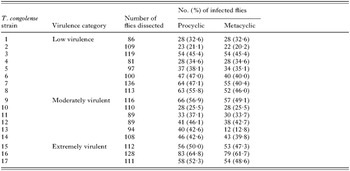
A total of 1796 flies were dissected. Upon dissection, 795 flies were found to be infected in the midgut (procyclic infection) and 707 in the midgut and the mouthparts (metacyclic infection). For each of the 17 strains, the number and proportion of flies with a procyclic and metacyclic infection are summarized in Table 1. The average proportion of flies with a metacyclic infection was 38·6±11·7%. The average proportion of flies with a metacyclic infection with T. congolense strains of low or moderate virulence was 36·8±8·3% and 33·9±13·1%, respectively. The average proportion of flies with a metacyclic infection with extremely virulent strains was 52·5±8·0%. The differences in the proportion of flies with procyclic infections between batches infected with an extremely virulent T. congolense strain and those infected with a strain of low or moderate virulence were statistically significant (P=0·033 and P=0·016 for the differences between strains with moderate or low virulence, respectively). The differences in the proportion of metacyclic infections between batches infected with an extremely virulent T. congolense strain and those infected with a strain of low or moderate virulence were also statistically significant (P=0·005 and P=0·019 for the differences between strains with moderate or low virulence, respectively). On the other hand, differences between the proportion of flies with procyclic or metacyclic infections and infected with strains belonging to the low and moderate virulence categories were statistically not significant (P>0·05).

With the exception of 1 trypanosome strain (strain 13 in Table 1) with a maturation of 30%, the proportion of procyclic infections that matured was high and varied between 83 and 100%. Maturation did not differ significantly between strains belonging to the different virulence categories (P>0·05).
DISCUSSION
Over the years, various factors that affect the establishment and subsequent maturation of a trypanosome infection in tsetse flies have been identified (reviewed by Aksoy et al. 2003). The biological mechanism of each of those barriers to infection is not fully understood. However, ongoing research in the innate immune responses of tsetse flies is shedding some light on the molecular basis of refractoriness or susceptibility to infection. Although much of the research focused on the fly-related factors, there is clear evidence that the trypanosomes themselves also affect the infection rate. It is, for example, well-known that between trypanosome species differences in the complexity of the life-cycle have repercussions for their transmissibility (Leak, 1998). Moreover, in polymorph trypanosome species such as T. brucei s.l. the developmental stage of the trypanosome significantly affects its transmissibility (Wijers and Willet, 1960). Within a trypanosome species the role of strains in transmission has also been demonstrated. Hence, some fly-trypanosome strain combinations produce higher infection rates than others. In T. congolense, differences in transmissibility between strains of the Savannah and Riverine subgroups have been reported (Reifenberg et al. 1997). Comparisons of the transmissibility or proportion of flies with a metacyclic infection of T. congolense strains belonging to the Savannah subgroup strains yielded varying results. In some experiments differences in transmissibility could not be observed (Maudlin et al. 1986; Moloo and Kutuza, 1988) whereas in other experiments the transmission rate differed substantially (Dale et al. 1995). However, in all cases those comparisons were based on trypanosome strains originating from geographically distinct areas and often isolated from different host species.
The results of this study show the large variation in transmissibility of T. congolense strains belonging to the trypanosome population infecting cattle in a confined geographical area. Considering the uniformity of the maturation, differences in transmissibility are attributed to differences in the establishment of the infection in the tsetse's midgut. Reasons for those differences in the establishment rate are not clear. It could be hypothesized that since all flies received an infective bloodmeal with a comparable parasitaemia some trypanosome strains may be less susceptible to the elimination process in the tsetse's midgut immediately after the bloodmeal has been ingested (Van den Abbeele et al. 1999).
According to our results, increased transmissibility is associated with virulence. This may not be surprising since the adaptive trade-off theory for the evolution and maintenance of parasite virulence requires that virulence is genetically correlated with other fitness characteristics of the parasite such as transmissibility (Anderson and May, 1982). The high parasitaemia associated with the development of virulent T. congolense strains in susceptible hosts and the subsequent high levels of host damage require higher transmission rates and thus increased parasite fitness for the virulent strains to survive. In a previous study, extremely virulent strains of T. congolense were found to be present in cattle in this endemic area (Masumu et al. 2006a). In the assumption that those results obtained in mice could be extrapolated in cattle, as reported elsewhere (Bengaly et al. 2002a,b), this observed higher transmissibility of virulent trypanosome strains may explain why, even in an area where susceptible cattle are the main reservoir of trypanosomes, virulent strains persist.
We thank the FWO (Fonds Wetenschappelijk Onderzoek – Vlaanderen, Krediet aan navorsers), the DGDC (Directory General for Development Cooperation) and the Wellcome Trust (Grant 07824/B/04/Z) for financially supporting this work.