Tetralogy of Fallot is the most common cyanotic congenital heart disease in children.Reference Lillehei, Varco and Cohen1 Intra-cardiac repair is typically performed at around 6 months of life, with closure of the ventricular septal defect and relief of right ventricular outflow tract obstruction. This carries a low surgical mortality and allows long-term survival with good quality of life.Reference Starnes, Luciani, Latter and Griffin2–Reference Mouws, de Groot and van de Woestijne4 The optimal management strategy for symptomatic tetralogy of Fallot in neonates and young infants is unclear.Reference Tamesberger, Lechner, Mair, Hofer, Sames-Dolzer and Tulzer5 Primary surgical repair can be achieved in this cohort with low mortality in select institutions, but this is usually associated with a longer post-operative intensive care unit stay.Reference Ramakrishnan, Zurakowski, Pastor, Jonas and Sinha6 This makes complete repair an unrealistic expectation in low and middle income countries where there are significant resource constraints. Hence, most institutions in low and middle income countries adopt a staged approach to manage symptomatic neonates and young infants with tetralogy of Fallot. The systemic to pulmonary artery shunt has long been the preferred initial palliation. However, mortality and morbidity still remain high in young infants undergoing systemic to pulmonary artery shunt.Reference Petrucci, O’Brien, Jacobs, Jacobs, Manning and Eghtesady7,Reference Cavalcanti, Sa and Santos8 Improvements in techniques used for trans-catheter procedures now allow palliative interventions for an increasing number of young infants with tetralogy of Fallot who are considered unsuitable for corrective surgery.Reference Santoro, Gaio and Palladino9 We reviewed the clinical profile, and immediate and short-term follow-up outcomes of infants with tetralogy of Fallot at our institution where the preferred initial palliation is catheter-based.
Methods
This was a retrospective descriptive case record analysis from a single institution in a low and middle income country setting. Approval was obtained from the institutional review board for carrying out the retrospective review, and the need for consent from individual patients was waived. All consecutive infants (<1 y of age) with a diagnosis of tetralogy of Fallot who underwent surgical or interventional procedure between January 2016 and June 2019 were included. Infants who had tetralogy of Fallot with pulmonary atresia or absence of pulmonary valve syndrome or complete atrioventricular septal defect were excluded. Infants with double outlet right ventricle as defined by greater than 50% override of the aorta, normally related great arteries, and pulmonary stenosis were included.
Demographic, clinical, and imaging characteristics were obtained from the patient’s medical records. The pre-procedural echocardiographic variables collected included measurements (absolute and z-score)Reference Pettersen, Du, Skeens and Humes10 of the pulmonary annulus, hilar left pulmonary artery and hilar right pulmonary artery, the presence of additional ventricular septal defects, the presence of a coronary artery crossing the right ventricular outflow tract, and description of the level(s) of right ventricular outflow tract obstruction. The anatomical descriptions of the arterial duct and outflow tract were also obtained for infants who underwent trans-catheter palliation.
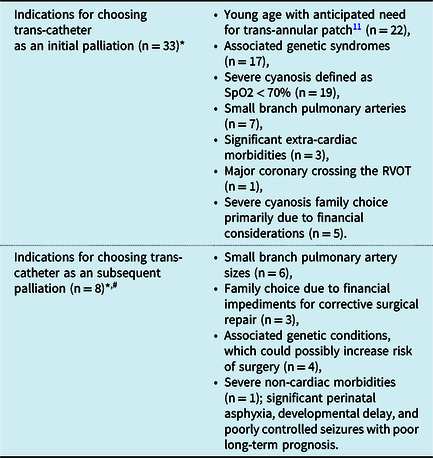
Our current institutional practice for decision-making regarding corrective or palliative interventions involves interdisciplinary consultation between cardiology and surgical teams. The indications for choosing trans-catheter approach for initial palliation are listed in Table 1.
Indications for choosing trans-catheter palliation as initial and subsequent palliation

* One or more of the indications possible.
# Not performing complete repair and opting for further palliative procedures.
Type of intervention and technique
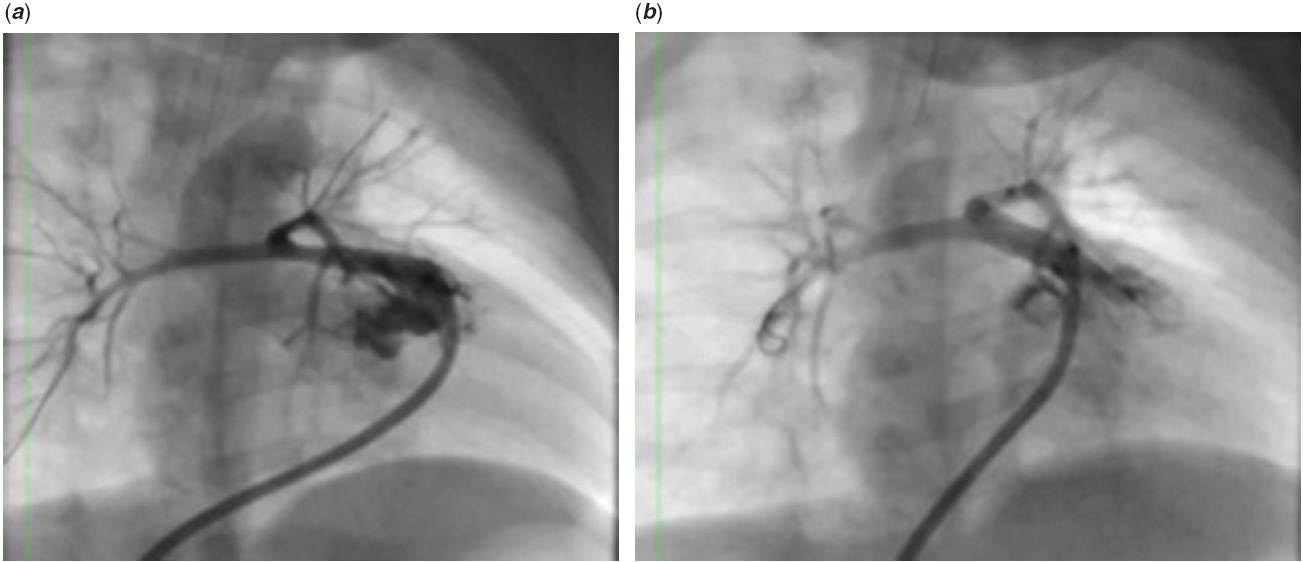
In infants in whom a trans-catheter palliation was offered, a careful pre-operative echocardiogram was performed to understand the level and severity of right ventricular outflow tract (RVOT) obstruction.Reference Kasturi, Balaji and Sudhakar11 Balloon pulmonary valvuloplasty was considered when the narrowing was predominantly at the level of the pulmonary valve.Reference Remadevi, Vaidyanathan, Francis, Kannan and Kumar12 Infants who had severe infundibular narrowing with hypertrophied muscle bundles underwent stenting of the right ventricular outflow tract. The diameter and length of the stent were decided on using the pre-operative echocardiogram and confirmed by angiography. The stent deployment was performed using a standard technique.Reference Stumper, Ramchandani and Noonan13 Angiograms were obtained prior to and after stent deployment (Fig 1). For smaller infants, coronary guiding catheters were used to enter the outflow tract, and bare metal coronary stents of appropriate length were utilised. A stent of 4 mm diameter was used for neonates and 4.5 mm for infants between 1 and 3 months of age. Stenting of the arterial duct using published techniques was reserved for situations when the pulmonary valve could not be crossed and the arterial duct was still patent.Reference Mahesh, Kannan, Vaidyanathan, Kamath, Anil and Kumar14
Angiograms of the right ventricular outflow tract (RVOT) in the postero-anterior projection prior to (Fig 1A) and immediately after (Fig 1B) the deployment of the RVOT stent in a 2 month old infant with tetralogy of Fallot who was initially palliated with a RVOT stent.

Follow-up
Infants who underwent trans-catheter palliation were followed at 1 and 3 months after the procedure followed by 3-monthly reviews till the next procedure. The clinical review included weight monitoring, SpO2 recording, and an echocardiogram to assess pulmonary blood flow as well as the size of the branch pulmonary arteries.
Analysis
Continuous variables which were normally distributed were described as mean ± standard deviation (SD), and those with a skewed distribution were described as median with an inter-quartile range. Independent sample t test or Mann Whitney U test was used to compare the continuous variables among the groups. Categorical data were described as numbers and percentage, and their relation was analysed using Chi-square test. Statistical analysis was conducted using Statistical Product and Services Solution version 26 for windows (IBM Corporation ARMONK, NY, USA).
Results
During the study period, a total of 120 infants with tetralogy of Fallot underwent initial cardiac intervention at our institution. Of these, 83 infants (75.4%) underwent a primary intra-cardiac repair. Of the 37 (24.6%) who underwent palliative interventions, 4 (10.8%) were surgical systemic to pulmonary artery shunt, and 33 (89.2%) underwent trans-catheter palliation. Compared to the primary surgical repair group, the infants who underwent trans-catheter procedures were younger (median age 32 days (inter-quartile range 7–144) versus 210 days (inter-quartile range 158–250), had a lower weight at intervention (Mean ± standard deviation 3.7 ± 1.4 kg versus 6.3 ± 1.2 kg) and lower pre-procedure SpO2 (Mean ± standard deviation 65 ± 12% versus 87 ± 7%), and had smaller pulmonary annulus as well as branch pulmonary arteries z-scores.
Trans-catheter palliation procedures included balloon pulmonary valvuloplasty (18, 54.6%), right ventricular outflow tract stent (14, 42.4%), or ductal stent (1, 3%). The indications for choosing trans-catheter palliation among 33 infants are described in Table 1. Procedure duration and the fluoroscopic time required were 70.5 ± 25.6 and 18.5 ± 8.9 minutes, respectively. The procedure was completed in all infants and resulted in a mean increase in SpO2 of 20% (Range: 6–35%). Periprocedural mechanical ventilation was utilised in 13 (45.4%) infants, and median duration of post-procedure mechanical ventilation in this subset was 24 hours (IQR 12–48). There was no in-hospital mortality in this group. The major post-procedure complications seen included post-procedure culture positive sepsis (4, 12%), seizures (1, 3%), and transient complete heart block (2, 6%), which recovered within 48 hours of the procedure in both the infants. In the infant with seizures, neuro-imaging was not pursued, as there were no recurrences of seizures or focal neurological deficits. The median duration of Intensive Care Unit (hours) and hospital stay (days) were 30 hours (IQR 24–48) and 6 days (IQR 4–10), respectively.
Complete follow-up was available for 31 of 33 infants in the trans-catheter palliation cohort. At a mean duration of 7 months (IQR 4–11), 12 (36%) underwent complete surgical repair, and eight (24%) required additional palliative interventions (five outflow tract stents, one balloon pulmonary valvuloplasty, one superior cavo-pulmonary anastomosis, and one surgical systemic to pulmonary artery shunt). Ten (30%) infants were awaiting complete repair at current follow-up with a median period of 235 days since the initial intervention. One infant died 6 months after the interventional procedure due to extra-hepatic biliary atresia. The median time to the next intervention (surgical or trans-catheter) in the trans-catheter palliation group was 210 days (IQR 120–332 days) with the earliest re-intervention 60 days after the procedure. The reasons for not performing complete repair and opting for further palliative procedures in the eight children are described in Table 1.
Among the 83 infants who underwent early corrective surgery, 52 (62%) underwent a valve sparing repair without the placement of a trans-annular patch. One post-operative death was related to massive pulmonary hemorrhage in a 6 month old infant with Turners syndrome. The major post-operative complications seen included catheter-related blood stream infections (4, 4.8%), endocarditis (1,1.2 %), pericardial effusion necessitating pericardiocentesis (2, 2.4%), chylothorax (1, 1.2%), significant aorto-pulmonary collateral necessitating emergency coil occlusion (2, 2.4%), and post-operative ventilation >7 days (7, 8.4%).
Discussion
We describe patient characteristics and outcome data on therapeutic interventions utilised in infants <12 months with tetralogy of Fallot and severe pulmonary stenosis in a low/middle income country. The majority of patients in our study underwent complete surgical repair, with a quarter undergoing palliation as the primary intervention. Trans-catheter palliation was employed in almost 90% of the palliation cohort with short procedural length of stay and minimal morbidity. At a median 7 months follow-up, two-thirds had undergone or were awaiting complete repair with a quarter requiring an additional palliative intervention. Our findings suggest that catheter-based palliation offers an effective treatment option, which is safe involving very low mortality and morbidity. Trans-catheter palliation is a reasonable treatment alternative in low and middle income countries for young infants with tetralogy of Fallot or those with unfavourable anatomy/comorbidities with the majority of children successfully bridged to complete repair at a later date, avoiding a high risk primary neonatal surgery.
Management strategies for symptomatic young infants with tetralogy of Fallot vary markedly between institutions.Reference Steiner, Tang and Gossett15 At our institution, infants older than 3 months of age with favourable pulmonary artery and without major non-cardiac co-morbidities underwent a primary repair with very low mortality. Many centres internationally are transitioning from surgical shunts toward either early surgical repair or trans-catheter palliation for the younger age group.Reference Ramakrishnan, Zurakowski, Pastor, Jonas and Sinha6,Reference Wilder, Van Arsdell and Benson16 A recent meta-analysis reviewing the influence of age on repair outcomes concluded that neonatal complete repair resulted in a greater mortality than at an older age.Reference Loomba, Buelow and Woods17 Early surgical repair has been demonstrated to be associated with an increased incidence of a post-operative low cardiac output state requiring inotrope therapy, longer post-operative mechanical ventilation, and prolonged intensive care unit stay.Reference Ramakrishnan, Zurakowski, Pastor, Jonas and Sinha6,Reference Hirsch, Mosca and Bove18 Savla and colleaguesReference Savla, Faerber and Huang19 reviewed 2 year outcomes after neonatal interventions for tetralogy of Fallot across 45 American paediatric cardiac centres using the Paediatric Hospital Information System. Of 2363 neonates, 1032 underwent complete repair, while 1331 underwent staged repair with initial surgical or trans-catheter palliation. Mortality including 2 year follow-up was higher in the complete repair cohort (8.9% compared with 3.9%) compared to the group that underwent later repair following early palliation.
A prolonged post-operative course after neonatal complete repair has notable implications for low and middle income countries. Increased expense associated with hospitalization is a significant challenge, and timely intervention is not provided to some children with Congenital Heart Disease (CHD) because of economic constraints.Reference Balaji and Kumar20 Although the number of paediatric cardiac centres is increasing across India, shortage of facilities and cardiac resources drives most surgical programs to focus on cardiac lesions amenable to repair with straightforward post-operative courses.Reference Kumar21 As a result, most centres in India do not offer early primary repair for tetralogy of Fallot (ToF), and therefore, in patients with inadequate pulmonary blood flow, a palliative procedure is required. Based on our observations, trans-catheter palliation is an attractive palliative option in this subgroup.
Trans-catheter palliation is an emerging strategy with increasing evidence to support its implementation.Reference Cavalcanti, Sa and Santos8,Reference Steiner, Tang and Gossett15,Reference Kumar21 Dorobantu and colleagues evaluated outcomes after surgical and trans-catheter palliation strategies from the United Kingdom National CHD audit between 2000 and 2013.Reference Dorobantu, Mahani and Sharabiani22 Comparing 311 surgical palliations with 107 trans-catheter procedures, they concluded that trans-catheter palliation may be the preferred palliative option in young infants. In our cohort of patients, there were no early deaths or major procedure-related complications, and all infants were discharged from hospital with a significant increase in SpO2. Similar to the UK experience, in the majority of palliated infants in our study, the procedure enabled complete surgical repair to be delayed until an age where the procedural risk is significantly reduced. Additionally, a catheter-based palliation was achieved with a short hospital stay, which places less strain on the health care system.
A frequently mentioned problem in infants who undergo trans-catheter palliation is the increased need for further catheter interventions.Reference Wilder, Van Arsdell and Benson16,Reference Dorobantu, Mahani and Sharabiani22 Trans-catheter palliation was only offered to highly complex patients in our cohort. Approximately, a quarter of infants required additional palliative procedures before complete repair, and in the vast majority of patients, this was related to small pulmonary artery size. These infants had smaller pulmonary annuli and branch pulmonary arteries compared to those who underwent primary repair. Indeed, small branch pulmonary arteries and young age are frequent indications for trans-catheter palliation in most published data.Reference Kumar21,Reference Dorobantu, Mahani and Sharabiani22 Wilder and colleagues reported that this was a strong risk factor for further catheter-based pulmonary artery interventions.Reference Wilder, Van Arsdell and Benson16 An important criterion in ensuring optimal outcomes is case selection. A careful pre-operative echocardiogram assessing the nature of the right ventricular outflow tract obstruction guides the optimal procedure for infants with ToF.
Limitations
This is a single centre retrospective review with clinical decision-making at the discretion of the interdisciplinary providers. Given the extreme heterogenicity of the cohort of infants with ToF and the need for an individualised management plan based on the infant’s anatomy, saturations, extra-cardiac associations, as well as socio-economic considerations, a randomised control study protocol would be challenging to design and implement. The duration of follow-up is also relatively short.
Conclusion
While complete surgical repair remains the treatment of choice for tetralogy of Fallot, this may not be the optimal management option in symptomatic neonates, young infants, and those with the unfavourable anatomy/comorbidities. Initial catheter-based palliation is a reasonable treatment option, offering a safe, effective, minimally resource intensive option with the majority of children successfully bridged to complete repair at a later date, thus avoiding a high risk primary surgery. Our findings suggest that this strategy may be particularly useful in low resource environments. A comprehensive pre-operative evaluation and multi-disciplinary consultation ensure that the right palliative option can be offered to the individual patient and help optimise their post-procedure outcomes.
Funding
This research received no specific grant from any funding agency, commercial or not-for-profit sectors.
Conflict of interest
None.