


In a recent article in the American Political Science Review, Robert Pape argues that terrorists adopt suicide tactics to encourage a state to withdraw its military forces from the terrorists' homeland (Pape, Reference Pape2003, 344). To support this claim, Pape collects information on every suicide attack between 1980 and 2001. He finds that almost every suicide terror attack is part of a coherent campaign aimed at democracies with forces on what the terrorist group considers its own soil.Footnote 1 He concludes that military occupation of the terrorist organization's homeland by foreign democracies increases the risk of suicide terrorism and, on this basis, makes policy recommendations about the presence of the U.S. military in the Middle East (Pape, p. 357).
By examining only instances of suicide terror, Pape “samples on the dependent variable” (Geddes Reference Geddes1990; King, Keohane, and Verba Reference King, Keohane and Verba1994; Shively Reference Shively2005).Footnote 2 As a result, he cannot elucidate the causes of suicide terrorism; he cannot determine why some groups choose suicide tactics rather than other forms of resistance; and he cannot answer questions about the implications of various foreign policy choices on the incidence of suicide terrorism. In this article, we establish sharp quantitative limits on what Pape's data can tell us about the statistical associations, showing that these data are only minimally informative about the relationship between the strategic environment and organizations' decisions to use suicide terror tactics. To be clear, we do not address the complexities of moving from statistical associations to statements about causality; we focus on showing why Pape's research design cannot even reveal the relevant statistical associations between the use of suicide terror and its possible correlates.
We focus on Pape's (Reference Pape2003) article not because his research design is an uncommon one, but because he asks important questions, and because some in the policy community describe the work as extracting policy prescriptions from “hard-data.”Footnote 3 Pape's article is also influential in the academic literature on terrorism—as of April 30, 2007, it has 40 citations in the Social Science Citation Index.Footnote 4 By highlighting what can and cannot be learned from Pape's research, we hope to show future researchers and policymakers the limitations of such a design.
THE STRATEGIC LOGIC OF SUICIDE TERRORISM
As Pape (Reference Pape2003) notes, terrorist groups (or self-determination movements) have become increasingly likely to use suicide tactics since 1980. In the 1980s, only 31 attacks involved suicide, but 53 suicide terror attacks occurred in 2000–2001 alone. This comparison raises the question: why did the number of suicide attacks increase between 1980 and 2001?
As Pape (Reference Pape2003) points out, scholars typically treat suicide terrorism as one of many tactics used by terrorists, and scholars typically do not distinguish between the use of suicide terror and other tactics (343).Footnote 5 According to Pape, suicide terrorism deserves special attention for two reasons. First, in contrast to a conventional view that suicide terrorism reflects extreme religious views (344), terrorist organizations decide strategically to use suicide because they believe that suicide tactics are especially effective. Second, suicide attacks kill more people (almost 13 more victims, on average, excluding the September 11 attacks) than other terrorist acts (346).
Pape (Reference Pape2003) collects data on all instances of suicide terrorism between 1980 and 2001 (188 cases in all). These data show that most suicide attacks are intended to coerce a target government, usually a democracy, to withdraw forces from territory the terrorists view as their homeland. In particular, Pape shows that all but ten attacks between 1980 and 2001 sought to persuade a democracy to remove its troops from the home soil of the terrorist organization (348, Table 1). These attacks were carried out both by groups responding to international intervention, such as the Hezbollah attacks on French troops in Lebanon, and by nationalist groups within established states, such as the Tamil Tigers in Sri Lanka. Pape argues that the conventional view—individuals adopt suicide terror tactics because of extreme religious beliefs—does not explain why the Marxist/Leninist Tamil Tigers carry out more suicide attacks than any other organization (75 of 188).
After an extensive discussion of the data, Pape draws policy conclusions for states facing suicide terrorism. Many of these, like hardening defense systems, follow from facts about the logistics of suicide tactics. Pape concludes, however, with the following argument:
Perhaps most important, the close association between foreign military occupations and the growth of suicide terrorist movements in the occupied regions should give pause to those who favor solutions that involve conquering countries in order to transform their political systems. Conquering countries may disrupt terrorist operations in the short term, but it is important to recognize that occupation of more countries may well increase the number of terrorists coming at us. (2003, 357).
Here Pape bases his conclusions on his belief that his data show a “close association” between military occupation and suicide attacks.
Pape deserves praise for the substantial work it took to collect these data, data that make a real contribution toward undermining stereotypes about suicide terrorists. But we think it is important to be clear about what they actually tell us: if a terrorist group chooses suicide tactics, then it is highly probable that a democratic country is occupying its homeland. This fact is certainly consistent with the existence of a “close association between foreign military occupations and the growth of suicide terrorist movements.” In the remainder of this paper, however, we show that it is also consistent with either a weak or nonassociation, as well as with a strong negative association. The data Pape collects are only minimally informative about the association between military occupation and suicide attacks.
CONDITIONAL PROBABILITY AND ATTRIBUTABLE RISK
To answer Pape's question—what accounts for suicide terrorism?—we need to determine how the propensity to use suicide tactics varies with territorial occupation and how it varies with religious extremism. To express ideas like “suicide terrorism is most likely to be used to achieve nationalist goals” (Reference Pape2003, 348) and “[s]uicide terrorism is more likely to be employed against states with democratic political systems than authoritarian governments” (349), we translate Pape's argument into the language of conditional probability.
Let occupation be the event that an act of resistance is motivated by a terrorist group's desire to force some, possibly democratic, state to withdraw from the group's home territory. Let occupation be the event that an act of resistance does not involve this motivation, either because the attacks have some other motivation (e.g., to secure the release of a leader), or because their territory is not occupied. Let suicide be the event that an act of resistance involves suicide, and let ~ suicide be the event that an act of resistance does not involve suicide. Finally, let religious be the event that an act of resistance is carried out by religious extremists, and let ~ religious be the event that an act of resistance is not carried out by religious extremists. (We develop the theoretical background in terms of occupation, but all of the issues are identical for religious.)Footnote 6
To measure the difference in the probability of a suicide attack given occupation and its absence, we need two conditional probabilities:
1. Pr(suicide|occupation)—the probability that an act of terror involves a suicide attack given that occupation as described above is satisfied; and
2. Pr(suicide|~occupation)—the probability that an act of terror involves a suicide attack given that occupation is not satisfied.
A precise statement of the statistical association relevant for Pape, the attributable risk, is defined as:

That is, we want to estimate the increased risk of suicide attack when a foreign occupation exists and when it does not. (See Manski Reference Manski1995, ch. 4 for discussion of the attributable risk.)Footnote 7
If stationing troops in the territory of a terrorist group raises the risk of suicide tactics, policymakers need to factor this cost into their troop deployment and withdrawal decisions. Pape uses this logic to defend his policy prescriptions, but it makes sense to do so only if Pr(suicide|occupation) exceeds Pr(suicide|~occupation).
Bounds on the Attributable Risk
The most straightforward way to estimate the attributable risk would be to start with the entire population of terrorist attacks or a suitably large random sample of that population. The conditional probability Pr(suicide|occupation) could be estimated by the fraction of occupation-motivated attacks that use suicide tactics, and the conditional probability Pr(suicide|~occupation) could be estimated by the fraction of non-occupation-motivated attacks that use suicide tactics. The estimate for the attributable risk is the difference between these fractions.
Pape's (Reference Pape2003) data, however, are not a random sample from the population of terror attacks because he only examines suicide attacks. His data therefore yield estimates only of the probabilities Pr(occupation|suicide) and Pr(~occupation|suicide).
Bayes's rule lets us write the probabilities conditional on occupation in terms of the probabilities conditional on suicide and the marginal probabilities of suicide and occupation:
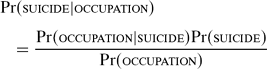
and
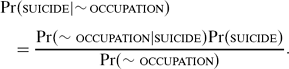
Combining these with the definition of attributable risk and the identities Pr(~occupation)=1-Pr(occupation) and Pr(~occupation|suicide)=1-Pr(occupation|suicide), we can express the attributable risk as:

To calculate the attributable risk we need: the probability that a terrorist organization uses suicide tactics Pr(suicide), the probability that foreign troops occupy the terrorist's home territory Pr(occupation), and the conditional probability of foreign troops on the terrorist group's home soil given a suicide attack, Pr(occupation|suicide). With enough observations from the underlying random process, we can estimate Pr(occupation) by the proportion of terrorist incidents committed by organizations with foreign troops on their home territory. The probabilities Pr(suicide) and Pr(occupation|suicide) can be estimated from the data in Pape's article and we present them in Table 1.
Probabilities Estimated from Pape's Data

Note: Pape notes that there were 4155 terrorist attacks in the period 1980–2001. Following Pape, we count the six attacks carried out by al-Qaeda as occupation-motivated, in response to U.S. troop presence on the Arabian peninsula. In addition, we assume that all attacks not by the Tamil Tigers are by extreme religious groups, and that the three isolated suicide attacks whose perpetrators could not be identified by Pape were motivated by occupation. The results are not sensitive to these assumptions.
Writing
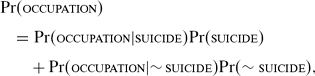
it is clear that without a measure of Pr(occupation|~suicide) we do not know, and cannot estimate, Pr(occupation) from Pape's data. Without this probability, we cannot calculate the probability of a suicide attack given territorial occupation, and therefore cannot calculate the attributable risk.
Even with imperfect data, an analyst may be able to learn about the range of the possible effects of a variable of interest by estimating bounds on the size of the effect rather than a point estimate (Manski, Reference Manski1995).Footnote 8 The expression in equation (3) implies that the attributable risk can take on values from -1 to 1. How much do Pape's data help to narrow these bounds?
To bound the attributable risk and recover the set of values consistent with Pape's (Reference Pape2003) data we calculate Pr(occupation) under two extreme assumptions: 1) all nonsuicide terror is occupation motivated, and 2) no nonsuicide terror is occupation motivated. Basically, this means substituting 1 and 0, respectively, for the unknown probability in equation (4). This gives the greatest and least values of Pr(occupation) consistent with Pape's data. The bounds are: 178/4155 ≤ Pr(occupation) ≤ 4145/4155. Plugging each value into equation (3) along with the probabilities from Table 1 yields the set of attributable risks that are consistent with Pape's data—any value between -0.957 and 0.944. Without additional assumptions about Pr(occupation), these data clearly do not limit the range of the attributable risk associated with occupation.
Similar results hold for the risk attributable to extreme religious ideology. In this case, the attributable risk is

Pape's (Reference Pape2003) data reveal that religious extremists launched at least 113 terror attacks–suicide or otherwise–and not more than 4080. Pr(religious) therefore ranges from 113/4155 to 4080/4155. Plugging these values into (5) yields attributable risks between -.973 and .981. Given the range of the bounds, Pape's data do not restrict the feasible values of the risk of suicide terrorism attributable to religious extremism in any meaningful sense.Footnote 9
CONCLUSION
The data Pape collects do not speak to the correlates of suicide terror, and the policy conclusions he advocates cannot be justified by appealing to the data he collects. These data are consistent with attributable risks from territorial occupation ranging from -.957 to .944 and with attributable risks from religious extremism ranging from -.973 and .981.
It is important to note that our critique of Pape's (Reference Pape2003) analysis does not make the well-known point that association does not imply causation. Rather, because Pape collects only instances of suicide terrorism, his data do not even let him calculate the needed associations. The conditional probability of suicide terror tactics given territorial occupation, religious extremism, or any other potential cause, is unidentified and, thus, the attributable risk is also unidentified. Only after these identification issues are resolved can the equally important issue of determining whether the correlations have a causal interpretation be addressed.
One might ask if our focus on conditional probabilities, attributable risk, and the relationship between inference and policy recommendations is either misguided or unfair. Surely, the objection might go, Pape (Reference Pape2003) advances the social scientific study of terrorism by presenting a theory of suicide terrorism and collecting data on terrorist attacks. Although Pape's data fail to falsify his theory, if the data instead revealed that almost every suicide terror act involved religious extremists and many acts were motivated by aims other than the reversal of territorial occupation by democracies, wouldn't that refute his theory?
No, it would not. Data on instances of suicide terror with either a high percentage of observations involving religious extremists or a low number of observations motivated with the aim of reversing territorial occupation would not justify rejecting the theory for exactly the reasons we outline above. Determining the correlates of terrorists' decisions to use suicide requires information about acts not involving suicide terrorism.
To highlight the importance of this fact about research design, consider a thought-experiment. Suppose that many kinds of resistance groups (e.g., religious groups, nationalist groups, and Marxist/Leninist groups) use suicide tactics to varying degrees and suppose that all religious extremists use only suicide tactics. Also assume that religious extremists are a small minority of all terror groups. What sort of data on suicide terrorism would such a world provide? Even if every religious extremist group used suicide terror tactics, so long as at least some of the non-religious groups also did so, the data would reveal many suicide terror attacks conducted by non-religious groups. Because the conditional probability of a group using such tactics given a religious orientation in the hypothetical world is 1, it would be wrong to conclude that there is a low probability of a group using suicide tactics given that they are religious. Evaluating any account of the causes of suicide terrorism requires comparing instances of terrorism involving suicide attacks to instances that don't, and determining if the cases of non-suicide terrorism include a higher or lower fraction of instances involving territorial occupation or religious extremism.
Finally, it is important to recognize that the key question of “why terror tactics” can not be answered even if data on all of the 4,155 terror attacks that Pape references are analyzed. Armed only with data on terror attacks we cannot escape a larger problem of “selecting on the dependent variable” because the sample contains only instances of terror. Identifying the correlates of terrorism requires data on groups that use terror tactics and groups with similar grievances that do not. These type of data are not easy to collect or even conceptualize, but we take some comfort from the fact that scholars interested in the correlates of war resourcefully address a similar problem by collecting data on all country dyads, regardless of war status, across many years. Understanding the causes of terror might require a similar research design. Alternatively, if the appropriate population of cases can be identified, progress on the terrorism question might be made using cost effective techniques like those suggested in King and Zeng (Reference King and Lenche2001a, 2001b, Reference King and Lengche2002), who show that combing “choice-based” samples with auxiliary data on marginal probabilities can produce informative estimates of attributable risk. In either case, researchers would also need to account for the important problems of spatial and temporal correlation of decisions to use terror, and for the possibility that multiple factors, for example, religion and occupation, interact to cause a group to adopt terror tactics.
APPENDIX: BOUNDS ON THE RELATIVE RISK
An alternative measure of the additional risk of suicide tactics associated with occupation is the relative risk, defined as:
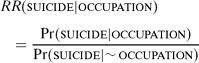
Focusing on the relative risk seems hard to justify in the case of suicide terrorism because the impact of averting a risk factor for suicide terrorism depends on the number of events averted. We care about the attributable risk times the size of the relevant population, and relative risk statistics are uninformative about this quantity (see Manski Reference Manski1995, 74–75 for more discussion of this point in a public health context.)
We can calculate bounds on the relative risk just as we can for the attributable risk. Given Pape's data, the bounds on the relative risk associated with territorial occupation are:

This calculation shows that many different levels of the relative risk of territorial occupation are consistent with the data and we have few grounds to support one decision or another regarding counterterrorism policy. Interpreting the bounds on the relative risk raises a second disadvantage of the measure: its scale is both nonlinear and asymmetric around the natural reference point of 1. Without any additional information we know only that the relative risk lies between .036 and 379.Footnote 10




Comments
No Comments have been published for this article.