Introduction
Methyl eugenol (ME) is a ubiquitous chemical found in over 450 plant species belonging to 79 families spanning 42 orders (Tan & Nishida, Reference Tan and Nishida2012). Howlett (Reference Howlett1915) first reported that the chemical in citronella grass, Cymbopogon nardus (Poaceae), responsible for attracting fruit flies was ME. However, ME was not used as an attractant for fruit fly pest control/management until four decades later (Steiner, Reference Steiner1955).
ME is the most potent male attractant to ME-sensitive Bactrocera species, except for B. correcta (Bezzi) which is more attracted to β-caryophyllene (Tan et al., Reference Tan, Nishida, Jang, Shelly, Shelly, Epsky, Jang, Reyes-Flores and Vargas2014; Wee et al., Reference Wee, Chinvinijkul, Tan and Nishida2018a). When a minute quantity of 1 ng (10−9 g) was spotted on a silica gel TLC plate placed in the field, it attracted a Bactrocera dorsalis (Hendel) male (Tan & Nishida, Reference Tan and Nishida2000). ME has been used extensively for the past five decades in detection, surveillance, monitoring and management of pest/invasive fruit fly species, especially B. dorsalis (Metcalf & Metcalf, Reference Metcalf and Metcalf1992; Tan et al., Reference Tan, Nishida, Jang, Shelly, Shelly, Epsky, Jang, Reyes-Flores and Vargas2014; Jang et al., Reference Jang, Dowell and Manoukis2017). Synthetic and natural ME sources elicit attraction, search and compulsive feeding behaviours in males of certain Dacini fruit fly species, particularly B. dorsalis (Metcalf et al., Reference Metcalf, Mitchell, Fukuto and Metcalf1975; Fletcher, Reference Fletcher1987; Metcalf & Metcalf, Reference Metcalf and Metcalf1992; Tan & Nishida, Reference Tan and Nishida2012; Tan et al., Reference Tan, Nishida, Jang, Shelly, Shelly, Epsky, Jang, Reyes-Flores and Vargas2014).
ME is a precursor of male sex pheromone for B. dorsalis (Tan & Nishida, Reference Tan, Nishida, McPheron and Steck1996; Tan et al., Reference Tan, Nishida, Jang, Shelly, Shelly, Epsky, Jang, Reyes-Flores and Vargas2014). Upon ingestion (pharmacophagy), a male fly biotransforms ME in the crop into two major sex pheromonal components – E-coniferyl alcohol and 2-allyl-4,5-dimethoxyphenol (Nishida et al., Reference Nishida, Tan, Serit, Lajis, Sukari, Takahashi and Fukami1988; Tan & Nishida, Reference Tan, Nishida, McPheron and Steck1996; Hee & Tan, Reference Hee and Tan2006). The pheromonal components are quickly transported by haemolymph (Hee & Tan, Reference Hee and Tan2004; Reference Hee and Tan2006) to the rectal gland for sequestration via a rectal papilla (Khoo & Tan, Reference Khoo and Tan2005) for temporary storage prior to release. The components are eventually emitted as sex pheromone during courtship (Khoo et al., Reference Khoo, Yuen and Tan2000; Wee & Tan, Reference Wee and Tan2007). Furthermore, the two derived chemicals also act as an allomone to deter vertebrate predation (Wee & Tan, Reference Wee and Tan2001) as well as a male aggregation pheromone (Tan & Nishida, Reference Tan, Nishida, McPheron and Steck1996). Laboratory reared males stored the sex pheromonal components in the rectal gland for up to 20 days with a peak quantity between 3 and 9 days after ME consumption (Wee & Tan, Reference Wee and Tan2007). No significant differences were shown between different populations of B. dorsalis (formerly, B. dorsalis s.s., B. invadens, B. papayae and B. philippinensis) in their response to ME (Wee et al., Reference Wee, Hee and Tan2002; Tan et al., Reference Tan, Wee, Ono and Nishida2013; Hee et al., Reference Hee, Ooi, Wee and Tan2015a,Reference Hee, Wee, Nishida, Ono, Hendrichs, Haymer and Tanb). While analysis of sex pheromonal components derived from this precursor in B. umbrosa (Fabricius) is still pending, nevertheless, ME has been shown to play an important role in promoting and enhancing male sexual communication in this species as well (Wee et al., Reference Wee, Abdul Munir and Hee2018b).
Using the capture-mark-release-recapture (CMRR) technique – a common method to estimate population sizes – Tan (Reference Tan1985) found that the percentage of recaptured marked-males tended to increase over subsequent days in ca 2 ha area of Batu Uban village, in Penang, Malaysia. Additionally, a study of marked native feral flies showed that <1% of marked flies moved among the forest, mixed farming and village ecosystems (Tan & Serit Reference Tan and Serit1998). ME was detected in the flower of golden shower, Cassia fistula L., its petals with ME concentration of 1.4–3.6 ppm only ‘very weakly attracted flies’ when placed in a cage containing B. dorsalis (Kawano et al., Reference Kawano, Mitchell and Matsumoto1968). Contrastingly, it was observed that a freshly bloomed orchid flower, Bulbophyllum cheiri (Lindley), possessed an average of 0.6 mg ME (Tan et al., Reference Tan, Nishida and Toong2002; Nishida et al., Reference Nishida, Tan, Wee, Hee and Toong2004); and it attracted as many wild males as either one or two unenclosed 1 ml (980 mg) ME sources set 10–20 m apart (unpublished data). Attraction to natural sources of ME may severely impact fruit fly pest detection, surveillance, monitoring and management; but hitherto, its impact has been neglected and not investigated. Furthermore, Shelly et al. (Reference Shelly, Lance, Tan, Sucking, Bloem, Enkerlin, Hoffman, Barr, Rodriguez, Gomes and Hendrichs2017) in their rebuttal challenging the validity of an ‘established population’ of B. dorsalis at an ‘undetectable level’ in California raised an important point that ‘males may need to “re-fuel” the pheromone precursor, which would increase the likelihood of detection’. Thus, the aims of this investigation were to determine, using the CMRR technique, whether feral endemic males of B. dorsalis and B. umbrosa (a) return to a single source of ME simulating a quantity of 0.6 mg found in a Bulbophyllum cheiri flower for replenishment of their sex pheromonal components, which, if the case, would render the males effective orchid pollinators; and (b) are recaptured after feeding ad libitum on a minute quantity of ME (simulating a quantity available as a natural source) when compared with an excessive quantity of 0.5 ml ME (i.e., 480 mg sufficient for >500 flies feeding till satiation).
Materials and methods
Traps to capture and temporarily cage feral flies prior to marking
Six traps were used. Each trap was constructed using a 1 l transparent plastic cylindrical jar (10.5 cm diameter × 10.5 cm height) that had 12 holes (each 1.8 cm diameter) burnt through at various heights around the entire container. The holes were covered with a fibre glass netting for ventilation. To capture attracted flies alive, the trap-body needed to be vertically suspended above its inverted cover during field trials. This was done by taping a V-shaped stiff wire on to the external surface at the centre of the trap-base, so that the trap-body, when inverted, could be suspended from a retort stand directly above its cover, thereby, allowing flies to access the ME source.
Chemicals
ME (4-Allyl-1,2-dimethoxy benzene; 98.0% pure; Wako, Japan) was diluted to a concentration of 0.6 mg/ml with pure ethanol for field Trial 1, while for field Trial 2 undiluted 0.5 ml (480 mg) ME was used in each trap to capture live flies.
Sixteen distinguishable colour enamel paints (quick drying) were used once as a day-specific colour for marking all captured live B. dorsalis and B. umbrosa flies on a given day.
Field setup to conduct the CMRR technique
A site (GPS co-ordinates: N05o 27.26′, E100o 17.516) under a non-host tree next to a small orchid nursery (where Bulbophyllum cheiri (Orchidaceae) plants are grown) on the fringe of a forest in Tanjung Bungah, Penang, Malaysia, was selected for capturing and releasing of feral fruit flies.
Trial 1
One ml of an alcohol solution containing 0.6 mg of ME was pipetted on to a circular filter paper (7 cm diameter – Macherey-Nagel GmbH & Co.) placed on aluminium foil lining the inner side of the trap-cover. The inverted trap-cover containing the ME bait was placed on a stool. The inverted trap-body was placed over its cover and then suspended via a hook tied to one end of a nylon fishing line (3 m long) with the other end clipped to a pole so that the trap body was suspended from a retort stand ca 5 cm directly above the cover. After 15–20 min, the trap-body was gently lowered on to the trap-cover by unclipping and gently releasing the free-end of the nylon line, so that the attracted male flies (<20) were trapped. The trap along with the captured live flies was brought indoors where the flies were allowed to continue feeding on the filter paper containing ME. Another trap containing the same quantity of ME was then set up following the procedure described above to continue capturing attracted feral flies. Over a 2 h period from 08:00 to 10:00 h, that coincided with the peak diurnal rhythm of fly attraction to ME, six traps were used sequentially to capture feral flies and allow them to feed ad libitum on ME within each trap for ca 1 h before marking with a day-specific colour enamel paint. The above CMRR procedure was repeated daily for 15 consecutive days to capture and recapture live flies for marking purposes. Trial 1 was conducted using the CMRR procedure over a 16-day period from 3 to 18 May 2017.
When all the flies had left the filter paper containing ME after feeding ad libitum in each trap, 6–8 flies were then transferred into a clear plastic bag for cold immobilization at 4–8°C. Every immobilized male B. dorsalis or B. umbrosa was marked with a day-specific colour of enamel paint on the anterior-half of the scutum using the head of an entomological pin (38 × 0.55 mm) under a dissecting scope with 7× magnification. For fly release, the cage holding marked flies was placed on the same stool and capture location with one side left open for the flies to take off on their own volition. Releasing of marked flies was done by noon for each of 16 marking days. After the 16th day of marking, a clear trap with four one-way entrances and 0.5 ml ME was suspended over the same spot daily. Trapped flies were collected daily after sunset, and checked individually, after freezing, for day-specific colour markings. This was done for at least 24 days as life-expectancy of sexually matured native males in the field was estimated to be 18–19 days for both B. dorsalis and B. umbrosa (Tan, Reference Tan1985) until no marked flies were captured for at least 7 consecutive days.
Captured flies were individually checked for day-specific colour marking(s). Daily records of total flies captured, flies marked with a day-specific colour (this was to determine the day post-release (DPR) when a fly was first recaptured), flies with >1 colour marks (repeat recaptures) and incapacitated individuals (if any) were recorded for both the species under investigation. This allowed for calculating the actual percentage of feral flies involved in the CMRR trial. It should be emphasized that the data obtained were solely meant for determining percentage and rate of recaptures, and not for the estimation of wild population.
Trial 2
This trial was initiated at the same site after a period of 5 weeks from completion of Trial 1. The same CMRR procedure was conducted between 08:00 and 10:00 h over a 16-day period (20 June–5 July 2017 and daily trapping for recaptured flies till 1 August 2017) with two exceptions: (a) 0.5 ml (480 mg) of undiluted ME was used in each trap instead of 0.6 mg ME, and (b) a day-specific colour mark was placed on the posterior-half of the scutum (close to the scutellum) so as to differentiate from marked flies, if any, released in Trial 1.
Statistical analysis
For each day post-release – particularly for 1–7 days after release, the percentage of recapture for B. dorsalis was based on the number of recaptured flies marked with a day-specific colour divided by the total released flies marked with the same colour. However, for B. umbrosa, this method could not be used due to very low numbers, as for each day post-release, <50% of the day-specific colours were represented by the recaptured flies. Therefore, the percentage of recapture was based on total recaptured flies for each day post-release divided by the total marked flies released.
The actual total percentage of recaptured flies for each species involved from the wild population was calculated by dividing total flies recaptured once by total recaptures minus the total repeated flies recaptured more than once, if any.
Comparison of means of recaptures within and between trials was done using the Student's t-test for pair-wise data.
Results
Means of flies captured and released per day within each trial were not significantly different. However, means of flies captured/day and flies released/day differed significantly between Trials 1 and 2 for both B. dorsalis and B. umbrosa (table 1). Therefore, for comparison of B. dorsalis flies recaptured within and between trials, the number of recaptures needed to be expressed as a percentage of total marked with the same day-specific colour that was released earlier.
Comparison of means for daily capture, and daily marked and released of B. dorsalis and B. umbrosa males.

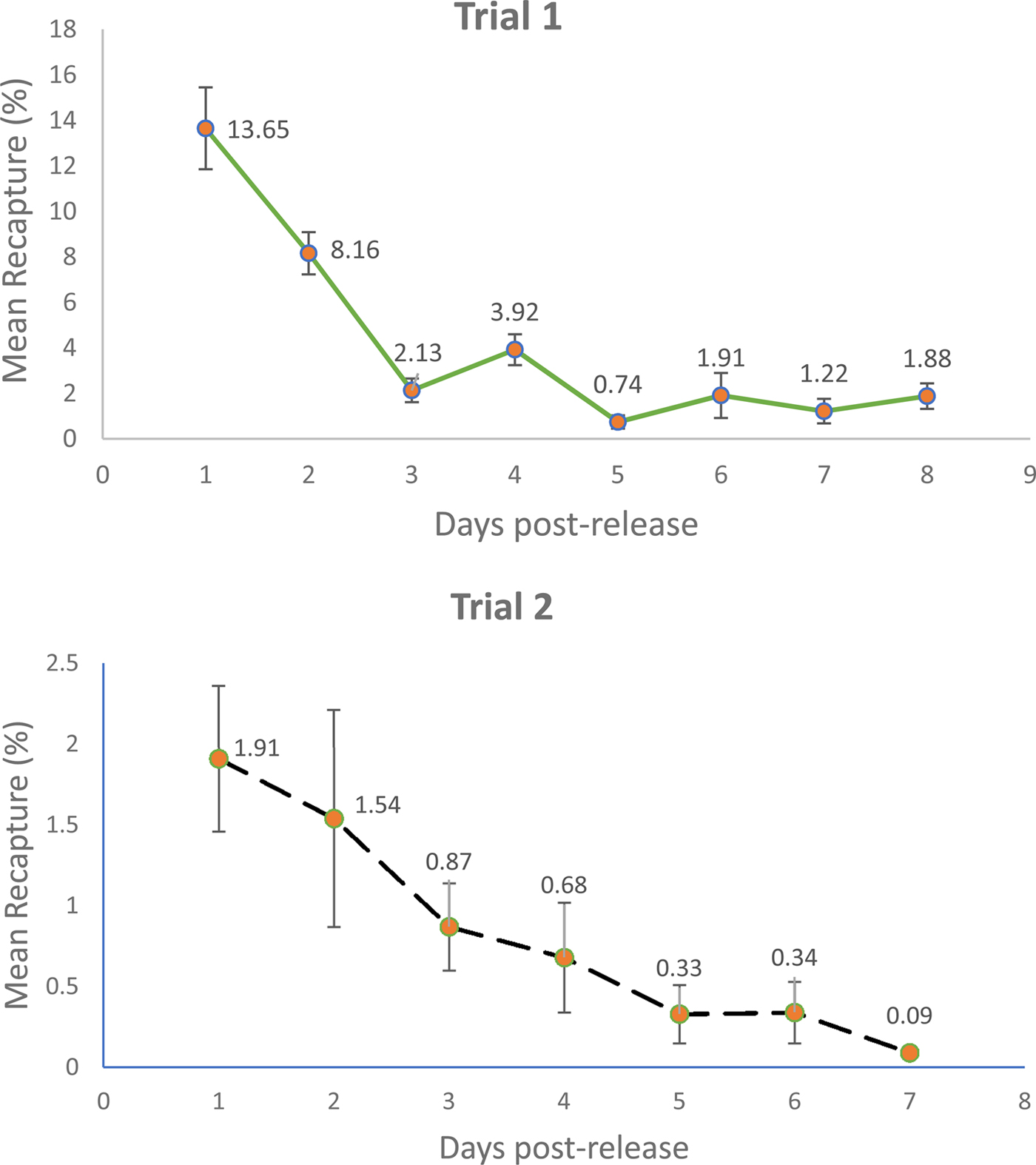
The mean percentages of recapture for B. dorsalis males fed on a 0.6 mg ME source were 13.65 and 8.16, not significantly different (P > 0.05), for first and second DPR, respectively. For subsequent DPR, the percentage recaptured fluctuated at significantly lower levels (at P = 0.001) (fig. 1). An alternative percentage of recapture based on total marked and released flies (N = 1) has no information of variability, while that based on numbers released for each day-specific colour mark (N = 16) show variation which should occur over the sampling period. Nevertheless, the two values show no significant difference for each DPR (table 2). In Trial 2, when males were allowed to feed on a 480 mg ME source, the percentages of recaptured flies were 1.9 and 1.5 for one and two DPR, respectively. These percentages of recapture were significantly lower (at P = 0.001) than that obtained in Trial 1 (table 2). The percentages of recapture flies in Trial 2 showed a gradual decline, although without significant differences (P > 0.05), for the first seven DPR (fig. 1). It is noteworthy that the number of recaptured flies after seven DPR was very low, with only 1 day-specific colour marked fly intermittently recaptured per day between eight and 38 DPR (table 2).
Mean percentage recapture of Bactrocera dorsalis vs. days post-release. Trial 1 – attracted flies exposed to a single source of 0.6 mg methyl eugenol. Trial 2 – attracted flies exposed to a single source of 480 mg methyl eugenol. Vertical bar = ±SE; and N = 16 for each day post-release.

Mean (±SE) percentage of recapture of marked B. dorsalis males captured days post-release after exposure to methyl eugenol (ME).

1 MR – marked and released for all 16 day-specific colours.
For B. umbrosa, it should be noted that the males were subordinate to aggressive B. dorsalis males. Males of B. dorsalis were observed to chase several B. umbrosa males away from the ME source, and these males remained on the trap's inner wall during the 1 h feeding period post-capture. Furthermore, the mean number of males captured, marked and released per day was four in Trial 1 and seven in Trial 2, which is approximately 10% of that for B. dorsalis in both (table 3). Although, the number of recaptured flies fluctuated for the first four DPR in both the trials, the total percentage of flies recaptured – 28 in Trial 1 and 26 in Trial 2 – was similar. This indicated that B. umbrosa males exposed to a much higher quantity of a ME-source were recaptured at a similar rate as those exposed to a 0.6 mg ME-source. It also showed that recapture of B. umbrosa males has a totally different effect as that shown by B. dorsalis after exposing to a much higher concentration of ME.
Number of recapture and percentage of marked B. umbrosa males captured days post-release after exposure to methyl eugenol (ME).

1 Total marked flies released excluding five recaptured >1 time, i.e., 119–5 = 114
Table 4 summarizes the total number of flies recaptured 1–4 times and also the percentage of recaptures. After being exposed to 0.6 mg ME in Trial 1, 276 of 756 marked B. dorsalis males were recaptured once, 58 twice, 18 thrice and three four times, yielding a 41% recapture rate. However, after exposure to 480 mg ME in Trial 2, only 69 of 1157 marked B. dorsalis males were recaptured once and only four twice, resulting in a 6% recapture rate (fig. 2). For B. umbrosa, after feeding on 0.6 mg ME, 19 of 67 marked males were recaptured once and none recaptured more than once, yielding a recapture rate of 28% (fig. 2). Interestingly, when exposed to 480 mg ME, 30 of 119 males were recaptured once, four twice and one thrice – yielding an actual percentage of recaptured flies as 27 which was not significantly different (at P = 0.05) from that obtained in Trial 1 (table 4).
Recaptures of Bactrocera dorsalis and B. umbrosa.

Total of feral male fruit flies captured, marked & released, and recaptured – and the recapture percentage after feeding on methyl eugenol (ME).

1 Total captured – total incapacitated flies.
2 Total actual fly number, i.e., total released minus repeated flies (recaptured >1x)
Discussion
The high percentage recapture of feral males after feeding on a single ME source of 0.6 mg, simulating an orchid flower, Bulbophyllum cheiri, corroborates with previous observations that both B. dorsalis and B. umbrosa are potentially good pollinators (Tan et al., Reference Tan, Nishida and Toong2002; Nishida et al., Reference Nishida, Tan, Wee, Hee and Toong2004). In Papua New Guinea, it was reported that, although B, umbrosa males represented 13% of all dacine flies captured, it represented 39% of all flies bearing pollinaria, the highest of 24 Bactrocera species (Clarke et al., Reference Clarke, Balagawi, Cliffore, Drew, Leblanc, Mararuai, McGuire, Putulan, Sar and Tenakanai2002). In addition, of a total 17,368 B. papayae (currently B. dorsalis) collected, 17 males bore pollinaria (Clarke et al., Reference Clarke, Balagawi, Cliffore, Drew, Leblanc, Mararuai, McGuire, Putulan, Sar and Tenakanai2002) – i.e., the former fly number represented 12% of total B. umbrosa flies collected and the latter number 13% of B. umbrosa flies bearing pollinaria. Such an extensive survey was not conducted in Penang due to limited primary rain forest areas and rapid urbanization. Nonetheless, several feral B. dorsalis males, but, thus far, no B. umbrosa (probably due to low population and aggressive behaviour shown by B. dorsalis males), bearing pollinaria on the thoracic dorsum have been captured in ME-baited traps (unpublished data) and observed on orchid flowers, e.g., Bulbophyllum cheiri and Bulbophyllum vinaceum that actively release ME (Tan et al., Reference Tan, Nishida and Toong2002; Reference Tan, Tan and Nishida2006). Therefore, a survey of feral flies bearing pollinaria in the tropics, especially in the rain forest where daciniphilous orchids coexist with many Dacini fruit fly species, is warranted.
The capture percentages of laboratory reared males exposed to synthetic ME for 1–24 h prior to release were 11–18%, significantly lower than the 34% obtained for the control males (Shelly, Reference Shelly1994). This study obtained an even more drastic reduction – with recapture percentages of 6% after exposure to 480 mg ME, compared with 41% for 0.6 mg exposure (excluding repeated males being recaptured more than once). Feral B. dorsalis males exposed to a high concentration of ME, not available naturally, were recaptured significantly less often than flies exposed to <1 mg ME. This is intriguing when considering the fact that laboratory-reared males can temporarily store ME for almost three weeks reaching a peak quantity between 3 and 9 days after initial consumption of 0.1 µl ( = 105 µg) ME (Wee & Tan, Reference Wee and Tan2007). However, the higher number of flies returning to refuel ME when exposed to the low quantity of ME (i.e., simulating that detected in an orchid flower) may provide the reason for the B. dorsalis males role in the true mutualism between fruit flies and daciniphilous Bulbophyllum orchids. It is noteworthy to emphasize that when flies were recaptured once, the flies had actually visited the ME source twice, but on different days, especially in Trial 1 in which at least 40 and 28% of B. dorsalis and B. umbrosa males were recaptured, respectively. Furthermore, this study also shows that a significant percentage (6–27%) of male flies after exposure to a higher ME-dose (not found naturally except in ME-traps) do revisit a single ME source.
Contrary to B. dorsalis, similar recapture rates of B. umbrosa were obtained regardless of exposure and feeding on either low or high quantity of ME. This may be the result of insufficient intake of ME due to the aggressive behaviour of B. dorsalis observed during feeding at or near the source of ME. Whether the aggression shown by B. dorsalis males in an interspecific competition does contribute to the low numbers of B. umbrosa in the wild population needs further investigation.
Recapture rates of between 50 and 65% were relatively high under control conditions when B. dorsalis flies were recaptured at 40–50 m from point of release (Shelly et al., Reference Shelly, Nishimoto, Diaz, Leathers, War, Shoemaker, Al-Zubaidy and Joseph2010; Manoukis et al., Reference Manoukis, Siderhurst and Jang2015) but highly variable 0–67% in another study (Jang et al., Reference Jang, Dowell and Manoukis2017). However, under field conditions with release and trapping points ranging from 2–10 km, the recapture rates were extremely low – of total estimated numbers of sterile flies in four releases – 43,259, 26,507, 57,716 and 90,078 – the recapture rates were 0.0005, 0, 0.10 and 0.98%, respectively (Froerer et al., Reference Froerer, Peck, McQuate, Vargas, Jang and McInnis2010). According to Jang and coworkers (2017), the low recapture rates of marked laboratory-reared flies have been suggested to be contingent on many factors mainly due to weather conditions and environmental variables, such as natural sources of attractant. All these studies were based on released flies previously unexposed to ME. However, in this study, albeit allowing attracted flies to feed on ME at a single site for capture and release, the recapture rate is significantly higher using the non-invasive CMRR technique, especially for using a single source simulating the quantity of ME detected in a solitary Bulbophyllum cheiri flower. This is corroborated by a study done in 1985, of 1932 native males captured 522 (27%) were recaptured over an 11-day period during a daily estimation of native B. dorsalis population size using ten clear traps, each baited with 0.5 ml ME (isolated in a small netting cage) without a toxicant (Tan, Reference Tan1985). Therefore, it shows that the initial and revisiting responses of feral B. dorsalis males to the attractant under tropical field conditions are different when compared with laboratory-reared B. dorsalis male releases under sub-tropical field conditions in Hawaii. A similar study using the CMRR technique for recaptures of feral B. dorsalis in infested areas/regions, particularly in the sub-tropics, is warranted to determine possible impacts of natural ME-sources on fruit fly surveillance, detection, mass trapping and IPM/eradication programmes.
Laboratory-reared B. dorsalis males that fed on flowers of Cassia fistula (with 1.4–3.6 ppm ME) or Fagraea berteriana (containing an analogue of ME) showed no significant decrease in trap capture probability when compared with control males unexposed to the flowers (Shelly, Reference Shelly2000). However, the simulated floral quantity of ME (0.6 mg) as a natural source did attract many males from the wild population, and many of them visited the single ME-source two or more times. This indicates for the first time that the feral males do make multiple visits to ME-bearing flowers, regardless of the sexually mature males having a relatively short estimated adult life expectancy of 2.5 and 2.7 weeks for B. dorsalis and B. umbrosa, respectively (Tan, Reference Tan1985). Therefore, this study confirms that feral males (i) are potentially good pollinators for certain daciniphilous orchid species (Tan et al., Reference Tan, Nishida and Toong2002; Reference Tan, Tan and Nishida2006; Tan, Reference Tan2009) and also (ii) do refuel their sex pheromone precursor perhaps even at regular intervals during a highly active phase of sexual reproduction. This is in order to biotransform it into sex pheromone components that are necessary for release during courtship in order to attract conspecific females and mate (Tan & Nishida, Reference Tan, Nishida, McPheron and Steck1996). Additionally, it indicates that the presence of natural sources should not be neglected, and thereby, needs to be investigated in terms of their potential impacts on the effectiveness of area-wide IPM or eradication programmes. Furthermore, it also supports the hypothesis that a very low population of B. dorsalis cannot remain undetectable over long periods – either months or years (McInnis et al., Reference McInnis, Hendrichs, Shelly, Barr, Hoffman, Rodriguez, Lance, Bloem, Suckling, Enkerlin, Gomes and Tan2017; Shelly et al., Reference Shelly, Lance, Tan, Sucking, Bloem, Enkerlin, Hoffman, Barr, Rodriguez, Gomes and Hendrichs2017). The reason being that every male, though with relatively short adult life expectancy after sexual maturity, needs to search and consume ME, perhaps, several times to maximize reproductive success in the natural ecosystems.
Acknowledgments
The invaluable support and assistance of L.C. Sim is greatly appreciated. Sincere appreciations are due to J. Hendrichs (IAEA), R. Nishida (Kyoto University) and T. Shelly (USDA) for their constructive and critical comments of the manuscript.