Food and shelter are considered the most universal and basic human needs, in contrast to prestige, luxury, and leisure. This difference has given rise to the distinction between practical and prestige technologies (Hayden Reference Hayden1998). Economic anthropologists have demonstrated the limitation of this distinction, noting that the usefulness of an item is determined in relation to cultural processes and social constructs (Douglas and Isherwood Reference Douglas and Isherwood1979:59; Herskovits Reference Herskovits1952:5-6). Thus, human needs emerge from and are satisfied by material objects endowed with value by the imperatives of culture and social order (Marx Reference Marx1987 [1847]:37). This is particularly true of goods obtained through exchange, a process that in many cases has a high cost associated with transportation (e.g., Malinowski Reference Malinowski2002 [Reference Malinowski1922]; Renfrew Reference Renfrew1969).
Exchange between communities with different cultural traditions not only contributes to complexity but also is one of the processes that actively contribute to defining, maintaining, and appropriating cultural difference. Resources obtained through exchange foster the flow of cultural knowledge and practices; they enable people to understand their existence in worlds beyond the local or family group (Lazzari Reference Lazzari and Meskell2005). This allows social distinctions and commitments to be forged through ceremonial consumption: festivities in which certain actors ostentatiously handle exotic goods (e.g., Dietler and Hayden Reference Dietler and Hayden2001; Hayden Reference Hayden2009).
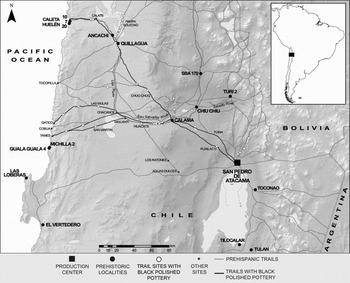
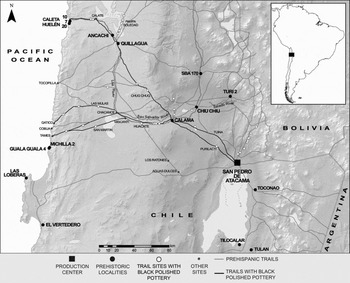
During the Formative period, goods circulated over an extensive area in the Atacama Desert and beyond. Exchange enabled the integration of communities inhabiting northwestern Argentina, the Bolivian altiplano, the Amazon, and the forested oases of Tarapacá (Gallardo Reference Gallardo2009; Nielsen Reference Nielsen, Hirth and Pillsbury2013; Núñez and Dillehay Reference Núñez and Dillehay1995 [1979]; Núñez et al. Reference Núñez, De Souza, Cartajena, Carrasco, Nielsen, Rivolta, Seldes, Vázquez and Mercolli2007; Yacobaccio Reference Yacobaccio2012). Study of the polished black ceramics of San Pedro de Atacama can shed light on exchange, given the characteristic technological, morphological, and decorative traits of this pottery. This pottery is identified by its thin walls; the fine-grained granitic paste, with quartz and mica temper, which makes it hard and gives it the tendency to fracture in a regular fashion (Uribe Reference Uribe2004); meticulously polished or burnished surfaces; and gray to black color achieved by smoking or coating. The pottery appears in a limited repertoire of shapes (Tarragó Reference Tarragó1989; Uribe Reference Uribe and Lechtman2006). More than 2,000 standardized vessels have been recovered from cemeteries in San Pedro. The pottery also appears as an exchange good in northwest Argentina (Jujuy and Salta), along the Bolivian-Argentinean border, on the eastern and southern edges of the Atacama Salt Flat, by the Copiapó River, on the Pacific coast near Taltal, along the upper and middle Loa River, in the oasis of Chiu Chiu, and at Caserones in the Tarapacá Ravine (Capdeville Reference Capdeville1928; Fernández Reference Fernández1978; Le Paige Reference Le Paige1972–73; Niemeyer and Cervellino Reference Niemeyer and Cervellino1985; Núñez Reference Núñez1982, Reference Núñez2005; Oyarzún Reference Oyarzún1934; Sinclaire et al. Reference Sinclaire, Uribe, Ayala and González1997; Tarragó Reference Tarragó1996). Recent studies indicate that the marine hunter-gatherers of the Antofagasta coast were part of this same interregional network, and polished black ceramics are found along trade routes connecting San Pedro with the coast (Figure 1).
Area of study, indicating trails with black polished ceramic finds. (Map by Francisco Gallardo.)
Two phases have been defined for this pottery: Sequítor (A.D. 100–400) and Quítor (A.D. 400–700). The temporal ranges of the two phases were first identified by cross-dating other artifacts present in funerary contexts and later supported through extensive and systematic thermoluminescence dating (Berenguer et al. Reference Berenguer, Deza, Román and Llagostera1986; Tarragó Reference Tarragó1989). Nevertheless, recent radiocarbon dates have raised doubts about chronology, and so we describe the pottery as belonging to a single period (Stovel Reference Stovel2013). On the Antofagasta coast, burial patterns were constant for the first eight centuries of our era, supporting this temporal simplification (Ballester and Clarot Reference Ballester and Clarot2014).
The study of exchange has concentrated on leaders, power, and social complexity (e.g., Renfrew Reference Renfrew1984; Webb Reference Webb1974), including research in the Atacama Desert (e.g., Llagostera Reference Llagostera and Lechtman2006a; Stovel Reference Stovel, Funari, Zarankin and Stovel2005). In contrast, we examine the circulation and consumption of exotic goods found in archaeological contexts with the objective of describing their value with particular reference to oasis-coast exchange.
San Pedro de Atacama as a Production Center
Around 500 B.C., the inhabitants of the oasis of San Pedro de Atacama adopted a village-based lifestyle that originated in the highland ravines where hunting wild camelids, early herding, and the extraction of mineral resources led to the emergence of a sedentary way of life and the intensification of production. This process greatly expanded with the incorporation of wild fruits (algarrobo [Prosopis sp.] and chañar [Geoffroea decorticans]) into the diet and the adoption of horticulture (Agüero Reference Agüero2005; Agüero and Uribe Reference Agüero and Uribe2011; Llagostera and Costa Reference Llagostera and Costa1999; Núñez Reference Núñez2005).
At this time the first polished black (and also red, known as Toconao) ceramics were made, beginning a ceramic tradition that lasted until the end of the Middle period, around A.D. 700 (Berenguer et al. Reference Berenguer, Deza, Román and Llagostera1986; Tarragó Reference Tarragó1989; Uribe Reference Uribe and Lechtman2006). Artisanal work led to the standardization of ceramic paste and forms (Stovel Reference Stovel, Funari, Zarankin and Stovel2005). Surplus production allowed trade over an extensive geographic area. Coastal groups of the Formative period traded their own goods for this pottery, such as shell instruments and adornments (made of several species of clams, scallops, Argopecten purpuratus, conch, Oliva peruviana, and Littorina peruviana). Fish vertebrae are also found in the oasis (Agüero Reference Agüero2005; Agüero and Uribe Reference Agüero and Uribe2011; Llagostera et al. Reference Llagostera, Barón and Bravo1984; Núñez Reference Núñez2005).
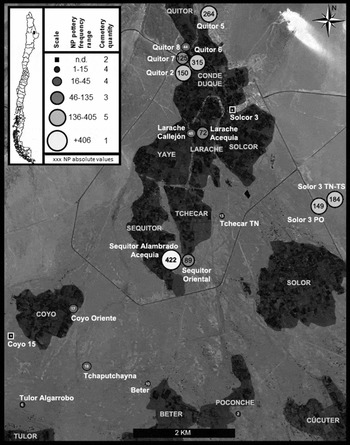
Beginning in the 1960s, Myriam Tarragó has worked to systematize polished black Atacameño ceramics, identifying 14 forms from 1,929 pieces found at 14 different prehispanic cemeteries (Tarragó Reference Tarragó1989:519). These ceramics are concentrated in the upper reaches of the San Pedro and Vilama Rivers, where individuals were accompanied by a greater numbers of vessels (Figure 2). According to Tarragó, who looked for patterns in the burials, the early assemblages show an association of polished black cups, bottles, and serving dishes with polished red bottles. The early date of these associated forms was supported by an independent program of thermoluminescence dating (Berenguer et al. Reference Berenguer, Deza, Román and Llagostera1986).
Distribution of black polished ceramics in the San Pedro de Atacama oasis. (Based on Le Paige Reference Le Paige1964; Llagostera and Costa Reference Llagostera and Costa1999; Tarragó Reference Tarragó1989; Torres-Rouff and Hubbe Reference Torres-Rouff and Hubbe2013; figure by José Blanco.)

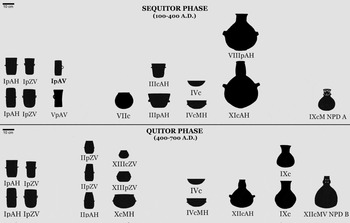
The Séquitor phase is dated to A.D. 100 to 400, at the end of the Formative period. This phase is characterized by the first appearance of polychrome baskets, tembetá lip ornaments, stone axes and mallets, and malachite beads in burials. Polished gray or reddish ceramic pipes, usually angled, also date to this period, although they have been identified earlier, in the Condorhuasi and Candelaria cultures of northwest Argentina. Also appearing during this era are the first wooden snuff tablets used for consuming hallucinogenic substances (Tarragó Reference Tarragó1989) and copper artifacts such as plates and bracelets (Mayer Reference Mayer1986). The polished black ceramic pieces from this phase tend to be cups, globular or cone-shaped bowls, or double-handled jugs with lifelike faces molded on their necks (Figure 3). These are commonly found in tombs accompanied by polished red ceramics, and very frequently with large amphorae. Foreign pottery of this period includes Vaquería, Ciénaga, and Condorhuasi ceramics from northwest Argentina (Stovel Reference Stovel, Silverman and Isbell2008; Tarragó Reference Tarragó1989).
Formative and Middle period ceramics phases of the San Pedro de Atacama oasis. (Figure by Itací Correa.)

The Quítor phase dates from A.D. 400 to 700 and is characterized by high-quality local and foreign craftwork. Wooden hallucinogenic tablets are very common and appear in a variety of shapes and decorative styles. Finely carved wooden items such as tubes, spoons, and mortars are abundant and have an extensive iconographic repertoire that includes Tiwanaku motifs (Llagostera Reference Llagostera2006b; Torres and Repke Reference Torres and Repke2006). Typical of this phase are the shells of the terrestrial snail Sthrophocheilus oblongus (Téllez Reference Téllez1997). The sophisticated craftwork exhibited in this period also extends to body ornaments and a wide variety of metal objects such as bronze axes, maces, and chisels. Copper ore bead necklaces also are abundant and a wide variety of textiles are known (Lindberg Reference Lindberg1963).
The burnished black ceramics of the Quítor period are beautifully made. New forms of cups and wide-bodied bowls with narrow mouths and bases became popular. The faces decorating the necks of bottles are more stylized than during the previous phase (Figure 3; Tarragó Reference Tarragó1989). Burnished black pottery rarely appears with polished red pieces, but Bolivian highland and northwest Argentinean ceramics are found, including some Tiwanaku-like forms (Stovel Reference Stovel, Silverman and Isbell2008; Tarragó Reference Tarragó1989).
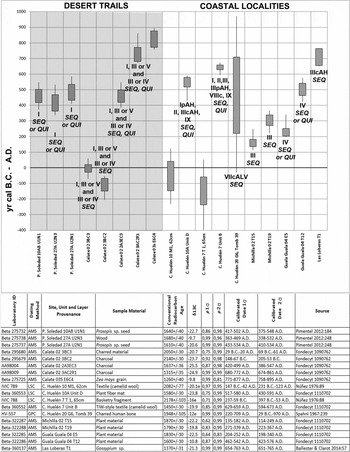
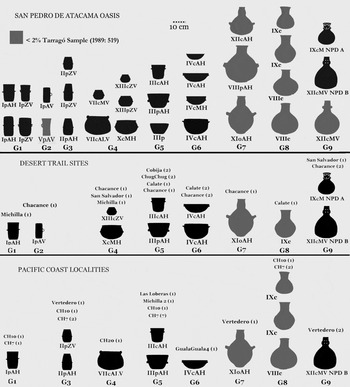
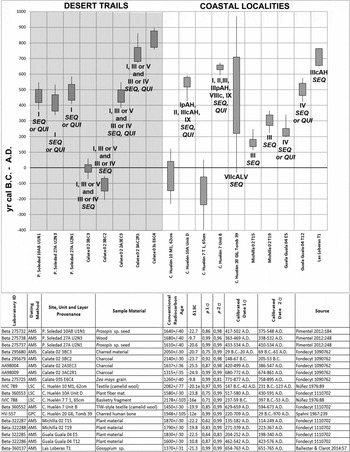
Radiocarbon assays have challenged the existing chronology (Stovel Reference Stovel2013; Torres-Rouff and Hubbe Reference Torres-Rouff and Hubbe2013). It was previously thought that red polished bottles were made in an earlier period (Toconao phase, 300 B.C.–A.D. 100), but dates indicate that red polished bottles may have been produced during the first seven centuries A.D. (Stovel Reference Stovel2013). This problem may apply to sites and contexts we have dated along routes to the coast (Figure 4). Thus, we need more in-depth studies of the chronology of San Pedro black polished ceramic types. For this reason, we consider polished black ceramics to belong to a single, long phase. Moreover, given the wide variety of shapes in the Tarragó typology and problems with working mainly with sherds, we have reduced formal classification to nine morpho-functional groups called G1 to G9 (Figure 5).
Calibrated radiocarbon dates of sites with black polished Atacameño ceramics on the Pacific coast and along trade routes. (Figure by José Blanco.)
San Pedro de Atacama black polished ceramic groups represented by variants of Tarragó (Reference Tarragó1989) types. The code for each Tarragó variant appears under its drawing. (Figure by Itací Correa.)

Coastal Sites
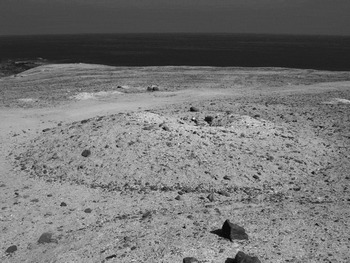
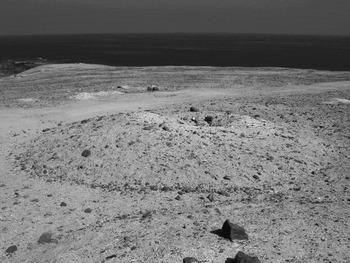
The desert coast of the Antofagasta region has very high marine resource productivity and has supported specialized hunter-gatherer communities since at least 10,000 B.P. (Llagostera Reference Llagostera and Figueroa2005). Remains there span all prehistoric periods, including numerous remarkable cemeteries dating back to the Formative period. These contain tombs with circular mounds several meters in diameter rising a meter above ground (Figure 6). The cemeteries contain from a few dozen to several hundred tumuli (Ballester and Clarot Reference Ballester and Clarot2014).
Burial mound at Michilla 2 cemetery. (Photograph by Francisco Gallardo.)
All the cemeteries have been looted, but a significant portion of non-metallic artifacts have been left behind. For example, during excavations of two cemeteries at the mouth of the Loa River, 113 burial mounds were examined. Eight complete and 35 partial vessels were recovered (see Spahni Reference Spahni1967). Pottery is scarce but regularly present in the domestic middens of the Antofagasta coast, suggesting that vessels were preserved with special interest (Bittman Reference Bittman, Bittmann, Ahumada and Garcés1984; Bravo Reference Bravo1981). This indicates that pottery had great symbolic and social value.
North Coast Study Area
We have identified 13 looted cemeteries north and south of the mouth of the Loa River that comprise more than 700 burial mounds. They date to about 400 B.C.–A.D. 700 (Núñez Reference Núñez1976a; Núñez and Santoro Reference Núñez and Santoro2011). Our recent work at three sites yielded fragments of numerous artifacts, including black polished Atacameño sherds.
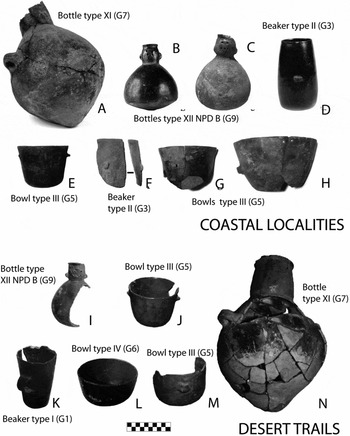
Caleta Huelén 10 is a burial site a few kilometers south of the Loa River. In the 1960s, an amateur archaeologist excavated 32 burial mounds there (Spahni Reference Spahni1967). Among the artifacts he recovered were Formative ceramics from the Tarapacá region (north of Antofagasta), copper and cactus-thorn fishhooks, double-edged knives with wooden handles, harpoon shafts, bird-bone tubes, and fragments of textile tunics. Later, Núñez (Reference Núñez1971) found similar items in four mounds in the same cemetery and in another burial zone without mounds (CaH10A). The mound sector was radiocarbon dated to a measured age of 2000 ± 70 B.P. (IVIC 789; Núñez Reference Núñez1976a:89); that is, 231 cal B.C. to 123 cal A.D. (2σ; p = 0.97). We dismiss another date, for the non-mound zone of 2320 B.P. (IVIC 790; Núñez Reference Núñez1976a:89) or 550–595 cal B.C. (2σ; p = 0.95), as anomalous.Footnote 1 We identified 106 mounds and determined that the intensely disturbed area—sector 10A—covers less than 10 percent of the entire site. Because of the great density of disarticulated human remains and broken artifacts, we collected samples from less than 8 percent of the surface area. The artifacts we recovered include harpoon heads and wooden darts, decorated baskets, reed mats, bone instruments, stemmed points with micro-serrated edges, double-edged knives with retouched margins, tunics, hats, cactus-thorn fishhooks, copper laminae and tubes, shell artifacts, a gourd, corn, and wild tubers. Our finds also included numerous sherds of bowls, pots, beakers, and jars from Tarapacá, including the Smoothed Brown Loa (Loa Café Alisado, LCA), Yellowish-Brown Quillagua Tarapacá (Quillagua Tarapacá Café Amarillento, QTC), and Polished Red Quillagua (Quillagua Rojo Pulido, QRP) types. These were found associated with polished black Séquitor-phase beakers, bowls, and bottles (Figure 7f). The AMS date of a plant-fiber mat we recovered is 1580 ± 30 B.P. (Beta 360553; δ13C = −23.8‰) or 430–591 cal A.D. (2σ; p = 0.99), consistent with ceramics and other materials collected on the surface. The site seems to have been used over a long period.
Black polished ceramics found at coastal and trail sites. Coast: El Vertedero site: A, B, C and D; Las Loberas site, E; Caleta Huelén 10a site, F; Caleta Huelén 7 site, G and H. Trail sites: San Salvador, I; Miscanti: J, K, L, M and N. (Photographs by Itací Correa.)

We found a similar variety and number of black polished Séquitor beakers and bowls at the Caleta Huelén 7 cemetery, located some 400 m south of CaH10 (Figure 7g–h). This site was excavated by Núñez (Reference Núñez1971, Reference Núñez1976a), who found some intact graves containing plant-fiber mats, polished bottles, truncated cone-shaped bowls, copper ore, marine artifacts, baskets, thick cords, knotted plant-fiber bags, cotton, gourds, quartz knives, and camelid wool. A date obtained from a mixed sample of plant fibers and baskets is 2030 ± 80 B.P. (IVIC 788; Núñez Reference Núñez1976a:88; Tamers Reference Tamers1973:310) or 397 cal B.C. to 53 cal A.D. (2σ; p = 0.99).Footnote 2 Our investigation reveals that the bodies were buried in overlapping layers, forming a dense burial mound 20 m in diameter and just over 1 m high. We collected artifacts from the surface of no more than 20 percent of the site. These include copper laminae, wooden darts and harpoons, cactus-thorn fishhooks, and several multicolored textile fragments, one of which is clearly Tiwanaku in style. A small sample of this textile yields an AMS age of 1450 ± 30 B.P. (Beta 360552; textile; δ13C = −19.9‰), or a calibrated interval of 594–673 cal A.D. (2σ; p = 0.99).
Some 3 km south of these two sites is the cemetery of Caleta Huelén 20. There we collected fragments of a black polished Atacameño bottle and bowl. Some 150 mounds with clear evidence of recent looting are still visible. Spahni (Reference Spahni1967) excavated 81 of these mounds. His collections reveal that the population possessed technologies for exploiting the marine environment and also had access to goods from the inland oases, including ceramics (LCA and, to a lesser extent, QTC and QRP), textiles, wood, copper metal and ore, and stone. Years later, Núñez (Reference Núñez1971) excavated the same site with similar results. Spahni obtained an absolute date of 1735 ± 100 B.P. (HV 557; Geyh Reference Geyh1967:207; Spahni Reference Spahni1967:239) for charred human bone, but we know these groups mostly consumed marine resources, so their remains should reflect the marine reservoir effect (e.g., Sveinbjörnsdóttir et al. Reference Sveinbjörnsdóttir, Heinemeier, Arneborg, Lynnerup, Ólafsson and Zoëga2010). When calibrated, the date yields a temporal interval of 29 cal B.C.–970 cal A.D. (2σ; p = 0.99) and 220–709 cal A.D. (1σ; p = 0.97).Footnote 3 This is roughly consistent with other dates for mound cemeteries in the region and the materials we collected from the surface (2 percent of the total site), although earlier dates are possible for other tombs.
Available data therefore suggest that some of these cemeteries were contemporary. Perhaps our most important conclusion is the undeniable connection with the inland farming and pastoral groups of the oases. The cemeteries contained monochrome (LCA and QTC) and polished red (QRP) ceramics from the Formative period of Tarapacá as well as fragments of tunics and headdresses from the same region. They also contained Tiwanaku polychrome textiles and instruments made of stone available only in the deep desert (Blanco Reference Blanco2013; Blanco et al. Reference Blanco, de la Maza and Rees2010), dart and harpoon shafts made of wood from the Loa River valley, and polished black ceramics from San Pedro de Atacama. These handcrafted items and raw materials were almost certainly obtained from the oasis of Quillagua, about 45 km upriver, where contemporary sites have similar artifacts (e.g., Agüero et al. Reference Agüero, Ayala, Uribe, Carrasco, Cases and Lechtmann2006; Gallardo et al. Reference Gallardo, Cornejo, Sánchez, Cases, Román and Deza1993). This oasis operated as a node through which multiple routes converged, connecting Guatacondo and the Tarapacá Ravine to the north with Calama and the San Pedro de Atacama oasis in the south.
South Coast Study Area
Marine hunter-gatherers who lived between the Mejillones Peninsula and Tocopilla had access to materials characteristic of the Tarapacá region. In contrast, their relations with people of the Loa river mouth was quite different. In that region, we registered 37 cemeteries containing more than 600 looted but identifiable mounds.
This strip of desert coast was occupied by humans from the early Archaic period onward, no doubt because of the presence of freshwater springs, many sheltered harbors, and extensive rocky shorelines that were home to abundant plant and animal resources. At Gualaguala Cove, we registered residential and burial sites dating as far back as the late Archaic. More than a hundred mounds there are found in groups of varying sizes corresponding to different eras. Unfortunately, looters left very few materials. Several radiocarbon dates indicate that the mound cemeteries were used between 500 B.C. and A.D. 900 (Ballester and Clarot Reference Ballester and Clarot2014:36). Only two groups have yielded fragments of black polished San Pedro de Atacama ceramics.
A fragment of a black polished, truncated, cone-shaped bowl was discovered at Michilla 2. This is a cemetery of around 40 mounds; 20 percent of its surface area has been destroyed. The scant remains recovered here (from 40 percent of the burial units) indicate that the inhabitants used fishing net weights and possessed stone and shell technologies for hunting and processing marine animals. We also recovered a copper lamina and fishhook, a few camelid hair fibers, small fragments of basketry, algarrobo seeds, and bird, fish, and whale bones. The ceramics that are most commonly found here are of Tarapacá origin (LCA and QTC). We date one mound to 114–249 cal A.D. (2σ; p = 0.99; Beta 322287; 1870 ± 30 B.P., plant material; δ13C = −22.29‰) and a second to 223–367 cal A.D. (2σ; p = 0.99; Beta 322288; 1790 ± 30 B.P.; δ13C = −19.8‰). Sherds of a black polished plate or dish were recovered from Gualaguala 4, another cemetery less than a kilometer south of Michilla 2. This is a small site with a ring of 17 mounds surrounding an area that is completely disturbed. Artifacts that we collected from a quarter of the site are like those found at Michilla 2, but we also recovered a plant-fiber brush. We obtained two radiocarbon dates for Gualaguala 4: 1830 ± 30 B.P. (Beta 322285; plant material; δ13C = −22.5‰), or 198–340 cal A.D. (2σ; p = 0.83), and 1600 ± 30 B.P. (Beta 322286; plant material; δ13C = −10.8‰), or 423–576 cal A.D. (2σ; p = 0.99).
Recent archaeological salvage operations at the Mejillones Peninsula and Antofagasta Bay have yielded San Pedro black polished ceramics from relatively undisturbed contexts. At Las Loberas on the peninsula, Mavrakis (Reference Mavrakis2003) studied three mounds disturbed by motorized vehicles. In one of them, he recovered the body of an elderly male whose grave goods included a truncated cone-shaped bowl in the black polished Séquitor style (Figure 7e). The context also included cotton fishing line, camelid-fiber ropes, harpoon heads, knives with handles, plant-fiber net bags and bundles, ceramics typical of the Tarapacá region (QTC), harpoon shafts or oar bodies, cactus fishhooks, knives made of mussel shells, bird skins, camelid-hair textiles, and baskets decorated with symbols from northwest Argentina. A sample taken from a fleck of natural cotton yielded a radiocarbon date of 1370 ± 30 B.P. (Beta 360137; cotton; δ13C = −21.3‰), or 651–765 cal A.D. (2σ; p = 0.99).
A final discovery at the Vertedero site, located in the city dump of Antofagasta, revealed an extraordinary deposit of polished San Pedro de Atacama ceramics (Ballester and Clarot Reference Ballester and Clarot2014). There, heavy machinery uncovered seven tombs containing grave goods typical of coastal populations, including Tarapacá-associated ceramics (LCA), necklaces and bracelets with seashell beads, bone harpoon heads, large stone knives with handles, tools made of sea lion ribs, and other tools made of copper laminae. What is truly surprising is the quantity and variety of goods from distant places in the Atacama Desert. Among these are the inverted T-shaped pipes of the El Molle culture. These could have been obtained through coastal trading with groups residing on the Taltal coast, where such items are frequently found in mound cemeteries. Even more remarkable are the pieces that must have come from the oasis of San Pedro de Atacama. These include two polished bottles with decorated necks, a black polished beaker and a bottle with a sub-globular neck (Figure 7a–d), and a small ceramic container for holding lime. Other items include two modeled tablets used for consuming hallucinogens, copper ore beads, a small wooden mortar, a freshwater shell (S. oblongus) from northwest Argentina used to hold red pigment, and a ceramic item from the same region. These types of artifacts are usually dated to the Quítor phase, when there was increased circulation of such goods at the oases (Berenguer and Dauelsberg Reference Berenguer, Dauelsberg, Hidalgo, Schiappacasse, Niemeyer, Aldunate and Solimano1989).
Routes from San Pedro de Atacama to the North Antofagasta Coast
Black polished ceramics made in the oasis of San Pedro were traded to northwest Argentina, the Pacific coast, the Loa River valley, southern Bolivia, and the Tarapacá region (e.g., Nielsen Reference Nielsen and Lechtman2006; Núñez et al. Reference Núñez, Agüero, Cases and De Souza2003; Pimentel Reference Pimentel2013; Tarragó Reference Tarragó1989). Such trade could have been conducted by local agents from San Pedro, by other groups capable of long-distance transport and exchange, or—most likely—by both. Most oasis communities had their own cargo animals. We also must consider that coastal groups could have traded the pottery because they made regular incursions into the desert (Knudson et al. Reference Knudson, Pestle, Torres-Rouff and Pimentel2012), although these trips were much shorter than trips to the highlands, which could be hundreds of kilometers (Gallardo Reference Gallardo2013).
Evidence for caravan traffic from San Pedro de Atacama and other oases into the desert dates back to the late Archaic and early Formative periods (Núñez Reference Núñez and Meggers1992; Núñez et al. Reference Núñez, De Souza, Cartajena, Carrasco, Nielsen, Rivolta, Seldes, Vázquez and Mercolli2007). Caravan traders would have had specialized knowledge of transportation routes (including rest stops and resupply areas in the desert), skill in handling camelid herds, and experience interacting with other peoples. These relations could have been passed on and renewed from generation to generation.
The prehispanic trails that connected the oasis of San Pedro to the Antofagasta coast, which stretched from the location of the present-day city to the mouth of the Loa River, formed a network that branched out considerably near the Pacific (Figure 1). Our investigations along these routes have recovered black polished San Pedro ceramics, indicating that pottery was transported to various locations inhabited by marine hunter-gatherers. People traveled to the Pacific along trails that passed through inhabited regions and sites such as Calama and Quillagua, which may have acted as down-the-line intermediaries. Other, more direct trails ran through the open desert. One such route appears on old maps (San Román Reference San Román1902), but we have not inspected it. Nonetheless, the Atacameño artifacts discovered at El Vertedero support its ancient use. Travelers from San Pedro also could have ventured on a more direct route to the coast that passed through the ancient rest stop of Huacate, where black polished ceramics have been found. If so, they could have stopped at the freshwater springs of Agua Dulce and Los Ratones, both fed by the Sierra Gorda aquifer.
Two major routes connected San Pedro to Calama, another settled oasis where polished black ceramics have been found. From Calama, the paths branched out in different directions to the coast. To go between San Pedro and Calama, 90 km distant and at the same altitude, travelers would have ascended to 3,400 m asl to cross the Cordillera de Domeyko. There are two possible routes: one to the south that passed by the spring of Purilacti and the other over the Cerros de Tuina range, where Aguada de la Teca is located. The first route passed through a prehistoric rest stop where use by Atacameño people has been dated to the Formative period. Also found there is rock art with iconography from northwest Argentina. This suggests use by travelers of different origins and cultures (Cartajena and Núñez Reference Cartajena, Núñez, Fiore and Podestá2010). Similar discoveries have been made along the route to Tuina, a journey made possible by the small freshwater spring of La Teca, situated around 40 km from the Calama oasis (Núñez et al. Reference Núñez, Cartajena, Loo, Ramos, Cruz, Cruz and Ramírez1997).
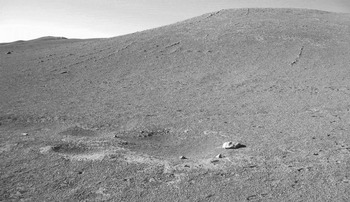
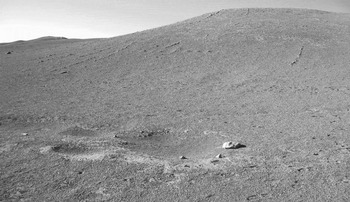
From Calama, the trails where polished Atacameño ceramics have been found bifurcate to the west and north. The western route ran between the Loa River and San Salvador in the direction of the historic staging posts of Huacate, Miscanti, and Chacance, from whence the western route divided to reach fishing coves south of the port of Tocopilla. In the first segment of this trail, Atacameño sherds have been found alongside the trail (Figure 7i). From Miscanti, a branching trail runs to the fishing coves of Tames and Michilla. Several sherds of San Pedro beakers, bowls, and bottles with decorated necks have been discovered. These have been recovered near the modern San Martín saltpeter mine from simple enclosures used as resting places and from the tombs of travelers buried along the way (Figure 7j–n; Castellón Reference Castellón1985). Further west on this trail, we have documented the same ceramics in a series of small, smooth, oval-shaped depressions associated with small-stone alignments (Figure 8). To the north, another major route winds toward the coast from Chacance on the Loa River through Pampa de Tupiza. There, we have found black polished sherds at similar temporary residential sites and burial grounds, some of which have hundreds of small-stone parallel alignments and figurative depictions made of the same sort, similar to geoglyph rock art (Núñez Reference Núñez and Niemeyer1976b; Pimentel Reference Pimentel2009).
Temporary camp and stone lines on the Miscanti trail. (Photograph by Francisco Gallardo.)
One of the most demanding routes to the Pacific runs from the Quillagua oasis. Between Calama and Quillagua there is a 110 km trail through the desert that is exposed to high solar radiation and strong winds. The freshwater spring of Chug Chug, about halfway along this route, offers foot travelers and their animals a much-needed rest stop. The abundant forest resources of Quillagua supported a large population from at least the first millennium B.C., and many of its residential sites and cemeteries have yielded fragments of black polished ceramics from the Atacama Salt Flat. Nonetheless, it is at Ancachi, several kilometers downriver along the Loa, where we have recovered the greatest quantity of polished black sherds. It is likely that Atacameño ceramics were transported from there to coastal camps at the river mouth along a 60 km trail winding through the coastal range. This trail was used intensively during the Formative period, as attested by the tombs, ceremonial mounds, and simple shelters along the route. Just as people and animals came down from the inland regions to the coast, marine hunter-gatherers went inland into the desert to gather wood, stones, minerals, and plants. Burial sites found along the route contain adults and children, demonstrating that families sometimes made this trip (Torres-Rouff et al. Reference Torres-Rouff, Pimentel and Ugarte2012).
Archaeological studies conducted between the historic rest stop of Calate and the mouth of the Loa River also have revealed ancient residential camps with a long occupational history (Pimentel Reference Pimentel2009; Pimentel et al. Reference Pimentel, Rees, de Souza, Arancibia, Núñez and Nielsen2011). The excavation of one such dwelling west of Calate revealed four stratigraphic layers, including an Archaic base layer and two intermediate ones with polished San Pedro ceramics. One is dated to 2050 ± 30 B.P. (Beta 295680; charcoal; δ13C = −20.7‰) or 69 B.C.–61 cal A.D. (2σ; p = 0.99). The other dates to 2140 ± 30 (Beta 295679; charcoal; δ13C = −23.7‰) or 205–53 cal B.C. (2σ; p = 0.99).Footnote 4 Perforated translucent gypsum plates (including a pendant with fastener), abundant chipped stone tools, fish otoliths and vertebrae, algarrobo pods, corncobs, seashells, camelid hair cordage, and guano were found within this structure. We found similar items at Calate 03 (south), another temporary residence along the route leading to the coast. These included gypsum plates and a huge quantity of algarrobo pods and camelid guano, as well as fewer seashells, fish vertebrae, and corncobs. Calate 03 (south) has a later date, 758–895 cal A.D. (Beta 275725; Zea mays seed; δ13C = −9.8‰; 2σ; p = 0.81).
Discussion
The route defined by finds of black polished ceramics south of Tocopilla was likely used by travelers and pack animals coming from the Atacama Salt Flat. Given the multiplicity of destinations and recipients on the coast, the travelers must have been from different family units. If trade at this early time was predominantly based on personal relationships, then the mode of exchange was simpler than those of altiplano states described in the early colonial literature (e.g., Gallardo Reference Gallardo2013). We have not determined the intensity of traffic to the Pacific, but discoveries of Atacameño ceramics along the route and on the coast suggest that this was a small-scale activity carried out over nearly seven centuries. The movement of goods no doubt included other craft products, as attested by discoveries at Las Loberas and Vertedero de Antofagasta. The enormous logistical investment of these journeys and the fact that they occurred repeatedly over time imply that these reciprocal exchanges were highly valued.
All forms of polished black vessels were exchanged, even rare groups such as Tarragó (Figure 5); thus we conclude that all were produced as surplus in excess of local demand at San Pedro de Atacama. The pottery has been found in numerous tombs and residential sites in the production zone, indicating common and daily use. Nevertheless, polished black vessels also were highly valued as objects of long-distance exchange, which bestowed identity on local consumers (Stovel Reference Stovel, Funari, Zarankin and Stovel2005; Stovel and Echeñique Reference Stovel and Echenique2015). We believe that ceramics of this kind were redistributed within the oases, a practice not replicated with marine products, which scarcely appear in residences or as grave goods. Access to marine resources, therefore, may have been a mark of social distinction in the salt flat.
The limited consumption of exotic goods at San Pedro de Atacama, their conservation, and the high labor investment required to obtain them make it certain that these products had a relatively high value. Thus, we hypothesize that those who had access to long-distance exchange were privileged. These individuals knew the trails and their clients and maintained control over the balance of exchange. Such trading partnerships are also expressed in the Andes (Heider Reference Heider1969; Mayer Reference Mayer2004). The greatest wealth of traders lies not in the materials exchanged but in the knowledge and intercultural ties they acquire and maintain.
Black polished ceramics were used widely in San Pedro de Atacama, but their use on the coast was limited. Individuals buried with Atacameño ceramics on the coast had diets characterized by a preponderance of coastal foods (Pestle et al. Reference Pestle, Torres-Rouff, Gallardo, Ballester and Clarot2015). Some early Atacameño vessels found in coastal burials were repaired, suggesting the high value of the pottery. It has aesthetic attributes radically different from local ceramics (LCA and QTC), which are rougher and more sparsely decorated. Nonetheless, local pottery was preferred for daily use. For marine hunter-gatherers, the utilitarian qualities of local ceramics (vessels with necks but no handles, very regular in shape in the case of LCA and with thick walls, coarse surfaces, and weak walls in the case of QTC) satisfied cultural imperatives. In contrast, the enormously different ceramics of the San Pedro oasis—with their variety of shapes, thin walls, polished surfaces, and finely finished handles and edges—clearly were valued for their distinctive appearance and exotic nature. The rarity of black polished ceramics in coastal cemeteries indicates that only a few individuals had access to these objects. We argue that although their aesthetic properties were highly valued, possession also implied an entire set of practices, including culinary knowledge, associated with a particular group of individuals.
Conclusion
The values of goods are relative in every form of reciprocal exchange but become absolute when the goods are consumed. Rare or exotic items can confer social status on those who are able to possess or redistribute them. In the case of exchange between San Pedro de Atacama and the Pacific coast, the oasis inhabitants had llamas and therefore could transport larger quantities of goods to the coast than marine hunter-gatherers could carry to the highlands. This imbalance provided an advantage to the Atacameños, but the distances they traveled, trafficking logistics, and stress on livestock significantly affected transport costs. Thus, down-the-line or direct trade from the oasis was more onerous than the simple, human-powered mode of the marine hunter-gatherers who journeyed inland toward the desert oases.
The marine hunter-gatherers of the coast transformed some of the resources available to them into goods that had exchange value: dried fish and seashells used as instruments, containers, and ornaments. The inland agricultural and pastoral groups, for their part, contributed ceramics, yarn, textiles, wooden objects, stone beads, and probably copper metal for smelting, all of which were produced by skilled crafters. This points to a final dissimilarity. Coastal products were comparatively simple to manufacture and made of abundant materials. In contrast, exotic ceramics and woven cloth found on the coast were repeatedly repaired rather than replaced (Cases et al. Reference Cases, Rees, Pimentel, Labarca and Leiva2008). Conservation indicates that these were highly valued.
Thus, fine black polished ceramics were highly prized by the marine hunter-gatherers of the northern Chilean coast. Nonetheless, seashells had great ceremonial value in the highlands (where they were needed for group ritual) and dried fish was another highly sought-after resource (Bresson Reference Bresson1875; Philippi Reference Philippi1860). A late nineteenth-century dictionary of Kunza, the native language of the Atacama salt flat spoken at that time, offers a double translation for the local word ckacktchi: something that is good, pleasant, tasty, and also simply “fish” (Vaïsse et al. Reference Vaïsse, Hoyos and y Reyes1896:16). This relatively recent attribution of value encapsulates the desire for goods that required substantial investments of energy to transport from the Pacific coast.
Acknowledgments
We wish to thank the members of our research team, especially those who worked along the proposed trade routes. We thank Mariana Ugarte, who revised the map that accompanies this article, and the reviewers of this work for their useful comments. This article is the result of work funded by FONDECYT 1110702 and FONDAP 15110006. Permission granted by Consejo de Monumentos Nacionales, Chile, permit 2250-12, May 30, 2012. Translation by Joan Donaghey.
Data Availability Statement
Physical and digital data are on file at the office of the Anthropology Program, Universidad Católica de Chile, Santiago. The data are available from Itací Correa (kusvetiver@gmail.com) upon request.