‘Libya, the wheat-bearing’, ‘…ταν πυροφόρον Λιβύαν,…’ Pindar (Isthmian, IV. 54); ‘The crops-bearing, Libya’, ‘…καρποφόρου Λιβύας, …’ Pindar (Pythian, IV. 6–8); ‘…πολυκαρποτάτας’, ‘the most productive of varied crops’ (Pindar, Pythian, IX. 7); ‘Libya, the land that produces the largest volume of crops of the earth’, ‘Λιβύη, μέγιστον γῆς πέδον καρπουμένη’ (Aeschylus, Suppliant Women, 315); ‘Κυρήνη…’, ‘Cyrene is horse-feeding ἱπποτρόφος and producer of good crop καλλίκαρπος’ (Strabo, XVII. 3. 21).
Cyrenaica’s natural potential for cereal’s cultivation and its agricultural methods
The successful cultivation of wheat and barley is based on the availability of the required factors for each. These are the following: soil type, seed quality and the climate, including the availability of water, whether rain or irrigation, and other factors. The quantity of water is an important matter as it can affect planting if one bears in mind that barley requires less in the way of nutrition. For barley, 250 mm will be sufficient while wheat requires no less than 350 mm (Garnsey Reference Garnsey, Bowman, Garnsey and Rathbone2008, 684).
In terms of the fertility of Cyrenaica’s lands, ancient writers emphasize its high productive capacity for different crops, especially cereal, from the fifth century BC to the Ottoman period (Abdelhamed Reference Abdelhamed2018a, Appendix. I. A.1). Pindar (Pythian, IV. 6) says: ‘Medea asked Battus (the founder of Cyrene) to find a city with fruit-bearing or crop-bearing (καρποφόρος) land in Libya.Footnote 1 The statement of Aeschylus (mid-fifth century BC) is an interesting example. He indicates that Libya yielded the largest quantities of crops: ‘Libya, the land that produces the largest volume of crops of the earth’, ‘Λιβύη, μέγιστον γῆς πέδον καρπουμένη’ (Aeschylus, Suppliant Women, 315). Furthermore, Pliny (Natural History, XVIII, 50), when he describes different methods that were required for planting cereal and pulses in many places, excludes Cyrene and Bactria. This is because crops in both places do not need any care after the seeds have been sown, farmers coming just to collect the harvest. Pliny considers the warm weather with dew and dry soil to be the main features which allow a better and easier cultivation of cereal. All of these factors are available in Cyrenaica. Similar observations about the practicalities of growing cereal at Cyrenaica are mentioned by Hamilton in his visit in 1852.Footnote 2 He reports on the productiveness of the lands located east of Benghazi. He also describes the methods used to cultivate cereal at the beginning of November each year. The mention of fertile land and traditional ploughing are seen in the following text:
The soil is rich loam, yielding, without any sort of tilling, abundant harvests of wheat and barley… In autumn, after the first rain, the seed is scattered broadcast on the ground, and over this a light plough of wood, shod with iron, is drawn, turning up, or rather scratching, to a depth of about two inches. By this process the seed is covered. The husbandman returns to Benghazi, and no other care is bestowed upon the crop until the sower returns in spring to reap it (Hamilton Reference Hamilton1856, 167–8).
It seems people still used the Hellenistic traditional method of using light ploughing for cultivating cereal, which better suits this type of soil when growing cereal.
The methods used for fertilizing land before the cultivation of cereal in Cyrenaica during the Hellenistic era were quite similar to those used elsewhere in the Mediterranean regions. The cereal/fallow or cereal/pulse rotation system seems to have been used in Cyrenaica’s arable lands (Applebaum Reference Applebaum1979, 90–6; cf. Abdelhamed Reference Abdelhamed2018a, 79–87). However, the order of the steps when planting cereal was different in Cyrenaica. People there started by fertilizing land via grazing livestock during the summer, from the end of May to September or October. Rain was usually expected in October or November; therefore, cultivators usually sowed their seeds after the first rain that softened the soil, this then being followed by light ploughing. These steps are still followed today, and they are exactly the same as described by Hamilton in Reference Hamilton1856. Applebaum (Reference Applebaum1979, 96) mentions that Cyrenaica is distinctive from other areas of the Mediterranean because it takes advantage of the summer grazing of sheep and goats. Sheep, as understood from the literary references, were bred in large numbers in Cyrenaica (Pindar, Pythian, IX. 7; Herodotus, IV.155). This seems to have continued throughout the region’s history and up to the present day. Livestock manure seems to have played a significant role in fertilizing land in ancient times, as nowadays.
As the general climatic character of the Mediterranean dominates the region of Cyrenaica, the rain is seasonal. It is usually restricted to the period between October and April. It reaches its highest level during January and February. However, the time of the rainfall is also an important factor that could have an effect, negatively or positively, on growing cereal in Cyrenaica. This can be understood from some of the present popular proverbs which have been passed down from previous generations. For example, people in Libya in general, and in Cyrenaica in particular, say:
مَطَر مَارس ذَهَبخَالص (matar maris dhahab khalis), which means ‘the rain of March is of pure gold’. Or مَطَر مَارس اطَّلْع الزَّرع الْكَارس (matar maris aitaleh alzareh alkaris) which means that the rain during March helps the crops which are hiding to grow up.
The Arabic word الزَّرع ‘alzareh’ refers generally to any plant grown by humans. However, in the Cyrenaican dialect it refers, in particular, to planting wheat and barley. This is an implicit indication of the significance of the rain that falls in the month of March for having a good harvest. Additionally, describing the rain in this particular time as ‘pure gold’ is evidence of its economic value for the cultivators. This obliquely suggests that they expect to gain a substantial profit from marketing such a fruitful harvest. Furthermore, dew in Cyrenaica does provide water for cereal in some areas, especially those lacking rain. Theophrastus (Historia Plantarum, VIII. vi. 6) lists some places, including the areas around Cyrene and Euesperides, where dews are sufficient to water the plants. Thus, the quantity of rain and the time of its falling are not the only factors that affect cereal production, but the level of the dew should also be taken into consideration. Abdelhamed (Reference Abdelhamed2018a, fig. III.2) makes a comparison between the amount of annual rainfall and the quantities of wheat production by kg per hectare over five years, and from an area around Barce. The comparison made is based on data provided by FAO (1969, 12) during the period between 1958 to 1963. This shows that in some years when the rainfall was small, the wheat production was higher than in other years, which had higher levels of rainfall. This may suggest that the dew provided the wheat with the necessary nutrition.
Local textual evidence for the cultivation of wheat and barley in Cyrene (epigraphic evidence: 4th–2nd centuries BC)
Wheat and barley seem to have been the main components of the Cyrenaican diet, as in other Mediterranean nations. The significance of growing and producing these crops in Cyrenaica can be understood from the data on agricultural products recorded in the damiergoi (δαμιεργοὶ) accounts. This epigraphic evidence spans the period from the fourth to the second century BC. Many of the accounts are official records written by people charged with managing financial matters in a place of worship (Mclean Reference McLean2002, 198). The records of Cyrene were documented by the damiergoi, priests of Apollo. They were responsible for managing the income from selling the products grown on the land devoted to Apollo and the expenditures related to the worship of this god. These inscriptions are unique as they reflect the agronomic culture of the society of this city over the three centuries. They record names of different products, followed by their fixed prices, and depict the total annual income with the expenditure statement from the recorded proceeds, the balance in hand and weighing units (Applebaum Reference Applebaum1979, 87). The damiergoi accounts from the fourth century BC are in better condition than those from the Hellenistic era and some of them provide a full text; there are also more of them. The inscriptions of the third/second centuries, however, provide more details on the products. There are also some variations between both groups in the ordering of the items. The inscriptions IGCyr011400 and IGCyr011500 are good examples of the fourth century BC accounts as they include complete information. These unique accounts were, and still are, a subject of interest for many scholars of today following the first publication of Oliverio in Reference Oliverio1932–1933.Footnote 3
In relation to wheat and barley in the damiergoi accounts, both are recorded at the beginning of each of the product lists that are not missing the first part of the inscription. This suggests the significance of both types of grain in the local and global markets, and should not, therefore, be a surprise, as the region, according to many ancient writers, was well known for being a good place for the rearing of animals. Herodotus, for instance, describes ‘Libya (Cyrenaica) to be a feeder of sheep’, ‘Λιβύην μηλοτρόφον’ (Herodotus IV.155, 157). Such a place would have a suitable pastoral area and be able to provide the needed grain and hay as fodder during the winter. It is also worth mentioning that the damiergoi inscriptions record many products that can be used as fodder for animals. These include wheat and barley, different types of legumes and some kinds of hay.Footnote 4
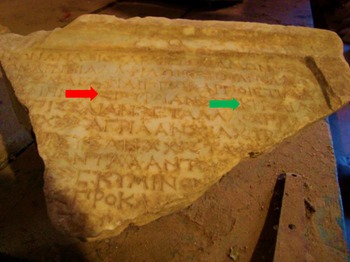
The order of the products listed in the damiergoi inscriptions demonstrates the agricultural concern regarding planting wheat and barley and their economic value. In addition to them being recorded at the beginning of the lists, it has also been observed that wheat and barley have swapped their positions. This change may suggest the increase of the wheat’s value in the local and international markets. Barley is recorded before wheat in the lists of the fourth century BC (Figure 1), while it swaps places with wheat in the lists of the other two centuries (Figure 2 and Figure 3). Green arrows in Figures 1–3 point to the Greek name for barley (κριθαί), while red arrows indicate the Greek names for wheat (σπυροὶ). The following text is an illustrative example of agricultural products of the damiergoi record in the fourth century (Figure 1) where one can see the position of each product, including those of barley and wheat (names of both products with their prices are in bold):
Gods. Being damiergoi Cleon son of Pollidas, Euruptolemos son of Euandros, Deinis son of Polyanthes, being priest of Apollo Timonax son of Hagis, the crops were estimated: barley, per unit, 1 drachma; wheat, per unit, 2 drachmas; pulse, per unit, 1 drachma 3 obols; cultivated hay, per unit, 10 drachmas; wild, per unit, 8 drachmas; straw, one net, 7 drachmas; grapes: early, under guarantee, per unit, 5 drachmas; black, per unit 4 drachmas; early, without guarantee, per unit 4 drachmas; black, per unit, 3 drachmas; figs, per unit, 4 obols; raisins, per unit, 1 drachma; olives, per unit, 1 drachma; oil, per unit 8 drachmas. Total income of the year: 302 mines 37 drachmas 3 obols 6/10; expense: 155 mines 39 drachmas 4 obols 6/10; remainder: 151 mines 97 drachmas 4 obols; allowance for the damiergoi 3 mines (IGCyr011500).
A completed damiergoi account dated to 330 BC. The green arrow points to the Greek name for barley (κριθαὶ) and the red arrow points to the Greek name for wheat (σπυροί) (IGCyr011500).

This is an incomplete damiergoi account, dated to 290–270 BC (DMI 25). Wheat (σπυροί) appears first at the beginning of the record (marked in red) and barley (κριθαὶ) the second (marked in green) (IGCyr063900).

Incomplete damiergoi account, dating to the second century BC. It shows some products in the second semester (IGCyr014400). Wheat (σπυροί), which is indicated by the red arrow, is the first product in the list and barley (κριθαὶ) (marked in green) comes next.

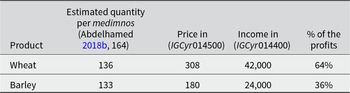
The records show some change in writing the name of the wheat during the three centuries in question. In all of the inscriptions of the fourth century BC, wheat was called σπυροὶ (allomorphic of πυροὶ). However, in the inscriptions IGCyr014200 and IGCyr014300, dating to the period between 220–180 BC, the term πυροὶ without the letter sigma (σ) is used to represent wheat. This is the common term for wheat in the whole of the Greek world; the same form is probably also used in IGCyr014600, since this account dates to the same period as IGCyr014200 and IGCyr014300 and had similar abbreviations (Rosamilia Reference Rosamilia2017). The standardization is possibly a sign of the increasing involvement of Cyrenean wheat in Mediterranean trade during the Hellenistic period. Wheat seems to be profitable in the local market and the income it generates would perhaps be much higher in the international markets. This can be understood from the prices and income of both wheat and barley, provided by two of the damiergoi accounts dated to the second century BC (IGCyr014400; IGCyr014500). The approximate volume of both products demonstrates a similar amount of wheat to that of barley (Abdelhamed Reference Abdelhamed2018b, 164). However, the income of 42,000 drachma from wheat is about double that from barley, at 24,000 drachma, comprising 64% of the total profits (Table 1). Thus, as wheat was more lucrative than barley, this may suggest its importance in exportation overseas.
The approximate quantities of wheat and barley production over six months, prices, income and percentages of the profits

It is important to mention in this context that the declining growth of silphium in the Classical period may have encouraged Cyrenaica to invest in other products such as wheat and barley. Silphium was, as can be understood from many literacy references, naturally grown in Cyrenaica and it was an important economic resource of the region during the Classical period (Hdt. IV, 169; Theophr. Hist. pl, ΙV. iii. 1; Pseudo-Skylax Periplus, 108). Some modern scholars also consider silphium to be one of the efficient keys to the region’s prosperity (Chamoux Reference Chamoux, Barker, Lloyd and Reynolds1985, 170). However, the value of this plant seems to have decreased from the fourth century BC. This can be understood from the literary references from the first century BC onwards. These report silphium’s scarcity and in some cases the reasons behind its extinction (Plin. HN, XIX. 15; XXII. 48; Strabo XVII. 3. 20). Additionally, the various representations of silphium on Hellenistic coins from Cyrenaica indicate a shift in the plant’s placement from the obverse to the reverse side. The plant, or its fruit, appears sometimes smaller in size or is depicted with other elements (Robinson Reference Robinson1927, Pl. II–V; Pl. X.6; Pl. XVI. 7, 9, 13; Pl. XVII, 8, 12; Pl. XXVI. 2 and many more). The appearance of the plough on two types of Ptolemaic coins found at Cyrene may support the suggestion of wheat and barley investment. It is depicted on the reverse side of both the bronze and golden coins, dated to the late fourth century BC (Robinson Reference Robinson1927, 47, 49, nos 208 and 223 respectively; Applebaum Reference Applebaum1979, 114, 115, 124).
Returning to the damiergoi inscriptions, despite the fact that some of them are incomplete and lacking some important information, such as the product name or the price, the available data can be considered as a vital resource for understanding the agronomic practices of the people of Cyrene and how they evolved over three successive centuries. Presenting wheat and barley at the beginning of these accounts, swapping their positions in the lists, the change in the wheat name and the noticeable increase in the cost of the wheat, in contrast to that of barley during the Hellenistic period, may suggest involving these products, especially wheat, in the global market. The significance of the cultivation and production of wheat and barley in Cyrenaica and their overseas economic contribution during the Classical and Hellenistic periods can also be evidenced by other epigraphic documents such as the Grain account of Cyrene dated to 330–324 BC.
The Hellenistic grain (wheat) consignment of Cyrene: export or donation?
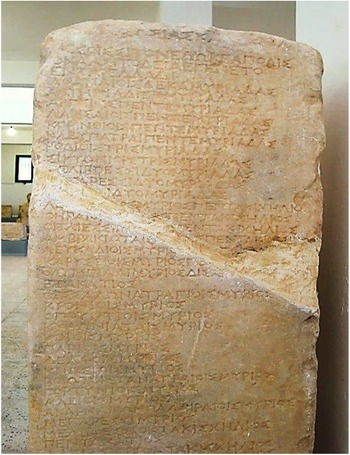
The Hellenistic account of Cyrene of supplying wheat to many Greek cities and groups is a well-known document. The stele was founded at Cyrene in 1922, probably in the sanctuary of Apollo, and dates to 330–324 BC. It is a unique example of commemorative epigraphic evidence for Cyrene itself and for the ancient Greek world in general (Figure 4; IGCyr010900). This account can be considered a remarkable testimony to the region’s agricultural potential and, in particular, the cultivation of cereal. It commemorates a consignment of 805,000 medimnoi of grain which was sent to Greece in the late fourth century BC. The significance of this commemoration to the Cyreneans can be understood from the account’s inscription found on the same marble panel, together with the Sacred Laws set up for the region at the end of the fourth century BC (IGCyr016700). This account indicates that Cyrene supplied more than 40 Greek cities and communities with cereal during a food shortage, including Athens itself. The value of this evidence lies in its detailed record of the amount delivered to each city or group of people. It seems that some of them received a single shipment of grain, while others received two (Applebaum Reference Applebaum1979, 97–109; Laronde Reference Laronde1987, 30–3; SEG 9. 2; IGCyr010900).
The upper part of the Grain account of Cyrene (lines 1–37) IGCyr010900 (Museum of Cyrene).

Although this evidence has come to the attention of many researchers, it is still an important subject that deserves more discussion.Footnote 5 In the last century, it has been thought by some scholars, such as Oliverio, Zebelev and Applebaum, that the consignment of 805,000 medimnoi was very large and might be sent over a period of two years or more (cited in Applebaum Reference Applebaum1979, 99). This is because those researchers relied on the value of the Attic medimnos (μέδιμνος) of 51.84 litres (Applebaum Reference Applebaum1979, 97, n. 137). Applebaum (Reference Applebaum1979, 99) estimates the load at 44,284 tonnes, while Laronde (Reference Laronde1987, 33; Fulford Reference Fulford1989, 173) approximates the quantity of the cereal at 48,000 tonnes. However, Bresson (Reference Bresson and Archibald2011) and Abdelhamed (Reference Abdelhamed2018a) have re-examined the amount and consider the load to be around 22.057 tonnes only. This is about half of the quantity suggested by Applebaum (Table 2). Bresson and Abdelhamed’s estimation is based on the new value of the Attic medimnos made by Stroud (Reference Stroud1998, 45–56). Stroud suggests a medimnos of barley is equal to about 26.46–27.72 kg and between 30.86 and 32.34 kg of wheat.
Different estimations of the Hellenistic consignment per tonnes, % of Cyrene production and the expected duration of the production in each case

Abdelhamed (Reference Abdelhamed2018a, 100–8) agrees with Bresson that the grain sent to the Greek cities amounted to around a quarter of Cyrene’s yearly production, or perhaps less than that.Footnote 6 This raises a question about the reasons for commemorating this consignment by the Cyreneans in the Hellenistic period. Abdelhamed believes that the primary reason the Cyreneans commemorated the Hellenistic grain consignment is the fact that it consisted solely of wheat. Reasons for this suggestion have been given and explained in detail: wheat shortage in the other regions, the noticeable difference in price between wheat and barley in the third and second centuries BC at Cyrenaica in contrast to their prices in the fourth century BC, swapping the sequence of barley and wheat in the damiergoi inscriptions of Cyrene and the mention and context of the wheat of Cyrene in ancient literary references. Furthermore, it is important to mention also that the cultivation of wheat in the lands around Cyrene was more successful than that of barley due to their fertility and sufficient amount of rainfall (Figure 5). In other words, the quantity of rain received in this area would lead to unsuccessful barley cultivation. This is because barley requires less rain, about 200–50 mm, and usually thrives in dry arable lands. You can see this today in the cultivation of wheat and barley in Cyrenaica. For all of these reasons and other textual evidence, it could be argued that a conceivable reason for commemorating the wheat consignment is that it was being given for free. Even though the Greek word for ‘gift’ (δῶρον) is not mentioned in the account, there is also no indication of particularly low prices. This suggestion can be supported by a unique local epigraphic document, and by several related literary references that highlight Cyrene’s wheat productivity and the widespread need for wheat in the ancient Mediterranean world, where this crop dominated the donated food items.
Map of rain distribution in Cyrenaica (Buzaian Reference Buzaian2022, figure: 1.4).

Honours for the city of Cyrene for having given free cereal shipments (local epigraphic evidence)
Although Cyrene sent the wheat to the Greeks at the beginning of the Hellenistic period, this great act seems to have stayed in the memory of the Greeks for the following five centuries. This can be seen in poetic epigraphic evidence inscribed to honour the city of Cyrene (GVCyr042). The poem dates back to the second century or the first half of the third century AD. The text is inscribed on a white marble stele thought to have been found in the sanctuary of Apollo. Though many words are missing from the inscription, providentially most of the important ones have been restored, read and published in the latest online version of GVCyr 2024, by Catherine Dobias-Lalou, as follows:
| (vac.)
[c. 7]Α ἀνακείμενον Γ̣[.. ? ..]
[c. 8] ὑφ' Ἑλλήνων (vac.)
(vac. 1 line)
[c. 7–9 δί?]σ̣σους καὶ ἐπὶ κ̣ι̣[c. 6–8]
[c. 10–12] | ν̣ λαούς Ι [c. 11–13]
5 | [c. 11–13 φ]α̣τ | ὶ ὅλου̣ [c. 15–17]
[ν]α̣ῦς ἑκατὸν π̣[έμψαc. 1–3] [c. 12–14]
σείτου δωρο<δο>κήσα[τε? c. 10–12]·
σ[ε]ῖτον ἀνελπίσ̣[τον c. 14–16] (vac. 1 line)
Ἕλλανες σώζεσθε [c. 14]
10 ματ«έ»ρα Κυράνα[ν ---]
[---] dedicated [---] by the Greeks. [---] double [---] on [---] the people [---] [says] that all [---having sent] hundred ships [---] you received as a gift [---] grain[---]; the unexpected grain [---] Greeks, you were rescued [---] motherly Cyrene.
The main message that can be understood from this inscription is that the Greeks were thankful to the city of Cyrene because it had saved them by sending lots of free grain. The verb ‘πέμψα’ confirms that the ships were sent from Cyrene in the past. Also, the word ‘gift’ ‘δῶρο’ clearly indicates grain that was freely given. The phrase, ‘unexpected grain’ ‘σ’ε’ῖτον ἀνελπίσ̣’τον’ with the verb, ‘were rescued’ ‘σώζεσθε’, which is derived from ‘I rescue’ ‘σώζω’, may refer to the time of famine when the Greeks were really in need of help to save them from hunger. Dobias-Lalou mentions that the use of the phrase ‘the Greeks were rescued’ may be a reference to Cyrene’s distribution of grain to various cities in the Hellenistic period (GVCyr042, 2024 version). She supports her point with a comparable use of σώζω and related terms in the context of famine relief in the Athenian decree for EpikerdesFootnote 7 (IG I3 125, lines 11–12). Additionally, as the number of ships mentioned in the poem is 100, it is possible to approximate the Hellenistic grain shipment. Wilford (Reference Wilford1993) indicates that the normal size of a Greek ship in the Hellenistic period did not exceed 150 tonnes.Footnote 8 If that is so, it would assume that each of the 100 ships was carrying 150 tonnes and the whole quantity would, therefore, be about 15,000 tonnes (150 x 100). This comprises about two-thirds of the amount mentioned in the Hellenistic grain account of Cyrene of 22,057 tonnes ‘805,000 medimnoi’. If this calculation is correct, the poem is possibly talking about another support made by Cyrene at some point, or points, during the second century or the beginning of the first century BC. This is reasonable if one bears in mind that the honour seems to have been made by Greeks who lived in Roman Cyrenaica.
However, assuming that this poem recalls the known Hellenistic amount of grain, it is impossible, of course, to expect that people can remember the exact number of ships which carried a consignment about five centuries before. Also, one should consider that the capacity of ships varied in the Hellenistic era and the amount of the grain that was sent from Cyrene differed from place to place. For example, 100,000 medimnoi were sent to Athens while Delphi received only 10,000 medimnoi. In the latter, the ship’s cargo would have included other products alongside the wheat. Furthermore, some cities such as Argos received the wheat in one shipment only, whereas others received it twice, as in the case of Megara, which received 30,000 (20,000 + 10,000) medimnoi (IGCyr010900, 7, 14, 36).
Nonetheless, it is possible to estimate, based on the Hellenistic grain account of Cyrene, the minimum number of ships that used to sail from the port of Cyrene (Apollonia) each summer, when cereal was ready to be marketed overseas. As the wheat was distributed to 43 different places or communities and, in eight cases, cargoes were sent twice, it appears that 51 (43 + 8) commercial sea journeys would have been made for delivering the wheat of 805,000 medimnoi. As mentioned above, those ships that carried small amounts of wheat would have loaded together other cargoes from Cyrene. These goods would most likely have been animals, or their by-products, and agricultural crops. The cargo of cereal and olive oil sent from Cyrene to the Italian city of Aquileia, in the second century AD, is a noteworthy example (Digest of Justinian: Liber XIX – Library. Dig.19.2.61.1. Scaevola 7 Dig.). It was loaded with 3,000 measures of olive oil and 8,000 bushels of cereal. However, silphium perhaps was not among the goods that used to be exported with cereal from Cyrene. This is for two reasons: the first being that trade in silphium was controlled by the Ptolemaic kings (Chamoux Reference Chamoux, Barker, Lloyd and Reynolds1985: 165–70), while the second is that grain was one of the most stable crucial foods for all nations in the past, especially in the critical time, as in the case of the famine occurring at the beginning of the Hellenistic period. Anyway, the most interesting point here is that Cyrene appears to have had a considerable commercial connection across the Mediterranean world in which wheat was one of the principle economic resources. This may suggest that the 100 ships mentioned in the poetical text also carried wheat (GVCyr042).
In order to propose whether the ships mentioned in the inscription under examination were loaded with wheat, barley or both, it is important to examine linguistically the Greek word that was used in Cyrene’s text which refers to grain. The form of the word σείτου in this inscription with epsilon ‘ε’ and the common form σῖτος are both sometimes used by Romans, as the Greeks did, to represent wheat.Footnote 9 This can be evidenced from some epigraphic documents which mention both wheat and barley. As to the form σῖτος, it appeared in Diocletian’s Edict on Maximum Prices of 301 AD as a first product in the list referring to wheat (Prantl Reference Prantl2011, 359–397).Footnote 10 Barley ‘κριθή’ was also mentioned in this document as the second recorded product. Both wheat ‘σίτου’ and barley ‘κριθή’ with these forms are also attested in two inscriptions from Epidaurus dating to the third/fourth centuries AD (IG IV2,1 92; Peek, Asklepieion 40).
Regarding the other form ‘σείτου’, which is attested in our inscription of Cyrene, it also appeared alongside the name for barley during the Roman era. The rescripts of the king Aspourgos Philoromaios to the prefects Pantaleon and Theangelos dating to 16 AD are a case in point. The form indicates both wheat and barley ‘σείτο[υ καὶ κριθῆς’ but their volumes are unfortunately missing (SEG 46:940). Another interesting example is the honourific inscription of the benefactor Manius Salarius Sabinus which dates back to 121/122 AD (SEG 1:276). The formula σείτος with epsilon ‘ε’ is used in both texts to represent the word ‘wheat’. It is worth mentioning that Sabinus supplied Hadrian’s army with 400 medimnoi of wheat ‘σείτου μεδ(ίμνους) υʹ’ (Garnsey Reference Garnsey1988, 247–48). This is much higher than the provided volume of barley, which comprises 100 medimnoi ‘κριθῶν μεδ(ίμνους) ρʹ’. This may support the hypothesis in this paper that a shortage of wheat occurred many times in the Greek cities. Therefore, the Greek words translated into ‘grain’ in the text under examination, GVCyr042, are most likely to be referring to wheat consignments.
Interestingly, the city of Cyrene has been described in the poem under discussion, which honours the city, as ‘the motherly’ city (GVCyr042, 10). This implicitly means that Cyrene used to care very much about people and their protection. This protection seems to be, in this context, relevant to saving the Greeks from famine during the Hellenistic time and thereafter. Describing Cyrene as ‘a mother’ may also suggest that the city was known to the Greek people via wheat supplements given to their cities every now and then. However, with regards to Cyrenaica’s climate, its cereal production would have fluctuated from one year to another. Applebaum (Reference Applebaum1979, 5, 91) mentions that a periodic drought used to occur in Cyrenaica every four years. Additionally, Cachia (Reference Cachia1945, 123), in his work on Libya during the Ottoman period between 1835–1911, reports that Turkish cultivators noticed, after watching the cereal harvests over years, that over a period of ten years there are four years with good harvests during which there are large surpluses. These surpluses were exported overseas and some grain was kept back for future use. In another four-year period the yield averaged enough grain for local consumption, but with little surplus. A further period of two years found the production smaller and, in this case, they managed to cover only enough for their needs, with additional surpluses saved from previous good harvests and with further importation of a little flour when needed. Therefore, one can confidently suggest that Cyrenaica was able to supply the Greek and Roman cities with its surplus at least four times each decade. This export would be mainly wheat if one bears in mind that growing barely was more successful than wheat in some of the Greek cities.
The wheat shortages in some of the Greek and Roman areas in the Hellenistic and Roman periods
Wheat shortages appear to have occurred in various cities and regions during several periods of the Hellenistic era. This can be proved by some epigraphic evidence. The Eleusis inscription of 329–328 BC, which was contemporary to the Hellenistic grain account of Cyrene, is a good illustration of this. It shows that the quantities of wheat available in many cities were much lower than those of barley (see table in Garnsey Reference Garnsey1988, 101; IG II2 1672). For example, the total barley harvest of the Attic cities was 339,925 medimnoi, while the wheat harvest was only 27,062 medimnoi (Figure 6). The volume of cereal, recorded in this inscription, gained by harvests from the island of Lemnos, which is located in the northern Aegean Sea, shows also a similar trend in the cereal yield. Barley production comprises 248,525 medimnoi while that of the wheat is equivalent to 56,750 medimnoi (Figure 7). In both cases wheat quantities are much lower than that of barley representing 7% and 19%. Furthermore, Garnsey (Reference Garnsey, Bowman, Garnsey and Rathbone2008, 685) suggests, based on modern statistics, that production of wheat in Athens and Thera fails about four years in ten, while that of barley fails only one year in ten. This may be an indication of the availability of barley at Attica, while wheat was perhaps needed more. This would support the argument in this paper that the volumes recorded in the inscription of Honouring the city of Cyrene GVCyr042 were gifts of wheat.
Wheat and barley production of the Attic cities per medimnos according to Eleusis’ inscription of 329–328 BC.

Wheat and barley production on the island of Lemnos per medimnos according to Eleusis’ inscription of 329–328 BC.

The need amongst Mediterranean nations for wheat is also clearly indicated by various textual references in Roman history. This is evident through trade or donations made by individuals, communities or cities. Cyrene appears to have been one of the most important resources of cereal for the Romans. One of the valuable historiographical references in this regard is that of Caesar in the first century BC. In his work entitled Caesar’s Civil War, Caesar (III. 5) reports that Pompey ‘…collected a great volume of cereal from Thessaly, Asia, Egypt, Crete, Cyrene, and other regions…’ ‘…Frumenti vim maximam ex Thessalia, Asia, Aegypto, Creta, Cyrenis reliquisque regionibus comparaverat…’. These amounts of grain were gathered to support Pompey’s fighters. Naming Cyrene alongside the famous cereal-productive places would suggest its great potential for producing cereal, especially wheat. This is because Cyrene’s lands are more suitable for producing wheat due to the sufficient rainfall, as mentioned above (Figure 5). Another important reason that should be taken into consideration is that Roman fighters needed wheat. Pompey’s soldiers required more nutritious food to keep them healthy during his war against Caesar. Foxhall and Forbes (Reference Foxhall and Forbes1982, 72) make calculations for the calories required by each member of a household. This indicates that males would require a high quantity of calories which can be provided by wheat. This would be the case for fighters whose ages ranged probably from between 15 and 39. Therefore, any supply of cereal should include a higher volume of wheat in contrast to that of barley. The honorific inscription of Manius Salarius Sabinus, mentioned above, is probably a case in point (SEG 1:276). Sabinus supplies Hadrian’s army, in the second century AD, with cereal, of which wheat comprised 75% of the total quantity.
Roman soldiers, as other Roman citizens, ate wheat and used barley to feed their animals (Plin. HN, XVIII, 15.94). Many of the historiographical statements that report the giving of grain, as aid to the Roman army, indicate greater quantities of wheat than barley. For example, Livy (59BC–17AD) reports that the Roman troops at Macedonia, Greece, Galatia were supplied with various volumes of wheat and barley (Roth Reference Roth1999, 228). These quantities coming from different states, during the period between 200–170 BC, show higher volumes of wheat (Table 3). It is worth mentioning that Carthage sent, alongside the amount of wheat devoted to the army, another 200,000 modii of wheat to the people in Rome (Liv., 31.19). The total volume of wheat, in this calculation in Table 3, would be 4,160,000 modii. The wheat quantity represents more than double that of barley (Figure 8).
The percentages of the total quantities of wheat and barley supplied to the Roman army based in Macedonia, Greece and Galatia and 200,000 modii of wheat sent to the people in Roma (200–170 BC).

Volumes of wheat and barley sent as contributions to the Roman armies based in Macedonia, Greece and Galatia (200–170 BC). Data from Roth (Reference Roth1999, 228, table V)

All quantities of barley recorded in Livy’s account would have been supplied just for horses. This can be supported by the statement of Polybius who lived in the second century BC. Polybius (VI, 39.12–16) mentions different rations of cereal per medimnos that were given to the Roman fighters.Footnote 11 He states that barley was issued alongside wheat to cavalrymen, while the infantries were only given the rations of wheat (cf. Waldemar, Reference Waldemar1997, 39). These literary assertions demonstrate the significance of wheat in the diet of Greeks and Romans. Therefore, it is reasonable to suggest that Cyrene, which is mentioned in Caesar’s list (III.5), was one of the substantial sources of wheat for these nations over time. Also, one could suggest that the quantities of cereal recorded in the Hellenistic account of Cyrene and the number of ships mentioned in the local poetic text of Cyrene, dating back to the second or the first half of the third century AD, are associated with donations, and specifically that of wheat.
It is important to note the absence of any textual evidence indicating a grain shortage in Cyrenaica. The sole reference to that is attested in the honorific decree of Aleximachos ‘Ἀλεξίμαχος’ from Taucheira (Tocra). This decree dates to the end of the second or the beginning of the first century BC (Laronde Reference Laronde1987, 472–79; Reynolds Reference Reynolds1973–1974; SEG 26. 1817; IGCyr066900). Fortunately, the inscription presents the main reason that led to a shortages of grain in this city. It explains that this was due to the city’s conflict with the indigenous Libyan tribes. These people usually lived on land around the Cyrenaican cities, rearing their animals. Conflicts with them could disrupt the supply to the city of much-needed grain. This suggests that general instability rather than failing harvests could be a reason for supply difficulties. Moreover, the literacy references generally support the indications presented by the epigraphic evidence regarding the region’s potential for producing cereal. They highlight Cyrenaica’s productivity and the quality of its cereal, especially wheat.
The cereal (wheat) of Cyrenaica in the literary references
Cereal, especially the wheat of Cyrenaica, appears to have been well known in the Greek world, at least since the fifth century BC. This is evident from many literary references that have highlighted, either directly or indirectly, the cultivation of wheat in Cyrenaica. Pindar (Isthm. IV.54) describes Libya as wheat-bearing ‘…ταν πυροφόρον Λιβύαν,…’. Libya here is unquestionably referring to Cyrenaica and Cyrene in particular (supra note 1). This can be evidenced by some of Pindar’s statements. In his Pythians, the fourth, fifth and ninth, celebrating Cyrenian chariot race-winners, he underlines the region’s productivity of different cropsFootnote 12 – for example: ‘Battus, the founder of the crop-bearing Libya, … οἰκιστῆρα Βάττον καρποφόρου Λιβύας, …’ (Pindar, Pyth., IV.6–8). He also mentions that Apollon makes Cyrene, the nymph, the controller of the land which is rich in sheep, … πολυμήλου… and the most productive of various crops, … πολυκαρποτάτας …; … πολυκαρποτάτας…’ (Pindar, Pyth., IX.7). Cereals were definitely among the desired crops in this regard. He also describes in the ninth Pythian Libya as a rich place of gold, ‘…Libya, rich in gold … πολυχρύσῳ Λιβύας …’ (Pindar, Pyth., IX. 68, 69). Gold here appears to be an implicit indication of the region’s abundant economic resources which logically would include cereal, the most-needed product for any nation. Furthermore, in the fourth century BC, the wheat of Cyrene was specifically mentioned by Theophrastus (Hist. pl., VIII.iv. 3). The writer specifies six types of wheat which were known during his time, each one taking its name from the area where it was cultivated. He mentions Libyan (Cyrenaican) wheat and provides a description as to some of its features. The naming of Libyan wheat alongside well-known wheat-producing regions such as Egypt and Sicily serves as evidence of its value and its distribution among Mediterranean nations during the writer’s time. Also, Strabo (XVI. 3. 21) mentions that one of the main factors of Cyrene’s prosperity is being a producer of good crops ‘καλλίκαρπος’ and horses and having fertile lands. Taken together, these statements may suggest that Cyrenaican cereal, especially its wheat, had a well-known and respected reputation among other nations. This is perhaps due to its availability in the Mediterranean market and Cyrenaica’s role in providing aid by sending wheat to support others, as seen in the Cyrenean inscriptions discussed above (IGCyr010900; GVCyr042). This can be also supported by the account of Thucydides (The Peloponnesian War, IV.53). He reports, during his description of the Peloponnesian war (431–404 BC), that the Athenians captured the port of Kythera (Κύθηρα) (an island located in the south-east of Greece), a place of Egyptian and Libyan (Cyrenaican) commercial ships:
τὰ δὲ Κύθηρα νῆσός ἐστιν, ἐπίκειται δὲ τῇ Λακωνικῇ κατὰ Μαλέαν: Λακεδαιμόνιοι δ᾽ εἰσὶ τῶν περιοίκων, καὶ κυθηροδίκης ἀρχὴ ἐκ τῆς Σπάρτης διέβαινεν αὐτόσε κατὰ ἔτος, ὁπλιτῶν τε φρουρὰν διέπεμπον αἰεὶ καὶ πολλὴν ἐπιμέλειαν ἐποιοῦντο. ἦν γὰρ αὐτοῖς τῶν τε ἀπ’ Αἰγύπτου καὶ Λιβύης ὁλκάδων προσβολή,…’ (Thucydides, The Peloponnesian War, IV.53, 2, 3).
This Cythera is an island upon the coast of Laconia, over against Malea. The inhabitants be Lacedaemonians, of the same that dwell about them. And every year there goeth over unto them from Sparta a magistrate called Cytherodikes. They likewise sent over men of arms from time to time to lie in the garrison there, and took much care of the place. [3] For it was the place where their ships used to put in from Egypt and Libya,… (Perseus Digital Library of Tufts (online)
Although Thucydides did not determine which harbour these Cyrenaican ships came from, his description of the site used by trading vessels and Libyan merchant vessels (ὁλκάδες) is an important indication of the region’s involvement in maritime trade from the fifth century BC. Cereals were certainly among the commodities that were exported in the fifth century BC. This can be true if one bears in mind that Kythera (Κύθηρα) island, which was mentioned by Thucydides (The Peloponnesian War, IV.53), is among the places which received wheat twice from Cyrene, as listed in the grain account of Cyrene (IGCyr010900, 48, 52). Kythera received in the first supply 5,000 medimnoi of wheat and in the second, 3,100 medimnoi. Furthermore, mentioning Libyan merchants alongside those of Egypt, who were well known as wheat suppliers, may suggest that Cyrenaican and Egyptian commercial activities were equally important in the Mediterranean, especially to Kythera. Furthermore, as the location of Kythera is closer to the Cyrenaican shores than Egypt this may suggest an easier connection between Kythera and Apollonia, the harbor of Cyrene, or other Cyrenaican ports (Figure 9).
Kythera location in the Mediterranean Sea.

As Egypt was known as a wheat supplier, mentioning Libya (Cyrenaica) alongside it by Thucydides in the context of trade may suggest that the latter was also involved in supplying wheat freely, and exporting it to some of the Greek cities. This can be supported by the account of the geographer Polemon in the second century BC. Polemon Periegetes (Polemon of Athens) (Fragmenta, Caput II, Ἑλλαδικός, B, Argolica XII) tells us about why the sanctuary of Demeter Libyssa ‘Λιβύσσα’ was established by Argolis. According to him, it was founded in memory of the wheat sent or brought by them from Libya:
ἐν τῇ Ἀργείᾳ σπαρέντος τῶν πυρῶν σπέρματος, ἐκ Λιβύης Ἄργου μεταπεμψαμένου. διὸ καὶ Δήμητρος Λιβύσσης ἱερὸν ἵδρυσεν ἐν τῷ Ἄργει, ἐν Χαράδραις οὕτω καλουμένῳ τόπῳ, ὥς φησι Πολέμων (Aristides, Παναθηναϊκός, Vol. I. 188. 12, Cited in Farnell Reference Farnell1896–1907, 223)
The seed of wheat was sown in Argos and it was sent from Libya. That is why the sanctuary of Demeter Libyssa (‘Libyan’) was founded in the place called Charadrai in Argos, as Polemon reported (Author’s translation).
The question here is whether the wheat was sent as a donation or exported from Cyrenaica. It is worth recalling here the comment on Polemon’s statement made by Farnell (1907, 69). He says: ‘it is interesting in regard to this point to observe that in Argive cult Demeter was recognized as the corn goddess, only under the title of Λιβύσσα, an alien name which is evidence of the importation of corn from Libya’. The writer highlights the association between Libya, where the wheat originated, and Demeter’s cult at Argos. This cult was well known in Cyrenaica and was associated with the provision of cereal and the protection of harvests during both the Greek and Roman periodsFootnote 13 (Kane Reference Kane, Barker, Lloyd and Reynolds1985, 237–48; White Reference White1984, Reference White1987: 67–84, Reference White2008: 161–66; Schaus Reference Schaus1985). It is important to mention that there are many dedication inscriptions from Cyrenaica, especially from Cyrene, to both goddesses dating back to the Greek and Roman periods.Footnote 14 The most interesting one is the text that describes ‘Kore to be who presides over the wheat’ ‘… Κόρης ἄγαλμα τὴν ἐπὶ τοῦ σείτου…’ (IRCyr.C.469; Kane Reference Kane, Barker, Lloyd and Reynolds1985: 455–56; Reynolds Reference Reynolds and Donald2012).
Turning back to the statement of Polemon, the key aspect of this text is the mention of the word ‘wheat’, ‘τῶν πυρῶν’, where Argives use the Libyan seeds which may reflect their high quality, and the phrase ‘being sent or brought from Libya ‘ἐκ Λιβύης Ἄργου μεταπεμψαμένου’. The writer here most likely talks about the wheat cargoes sent from Cyrene at the beginning of the Hellenistic period. Peloponnesian cities received the largest amount of wheat, which represents 210,100 medimnoi. This comprises about 26% of the total consignment (Figure 10; IGCyr010900). Argos itself, like Corinth, received the lion’s share among the Peloponnesian cities, accounting for approximately 24%. This would amount to around 50,000 out of the 210,100 medimnoi (Figure 11; IGCyr010900). As the portion of Argos is considerable, if one accepts that Argives had imported the wheat from Libya, as Farnell mentioned, that would not be a logical reason to, first, worship this goddess and, second, name her the Libyan Demeter. However, if such an amount of wheat was given for free, that would explain the reason for establishing such a cult in Argos. This view can be also supported by local metrical epigraphic evidence of Cyrene (GVCyr042) discussed above in which a donation of one hundred ships of grain sent from Cyrene to save the Greeks. Even if one assumes that the wheat mentioned in Polemon’s account was exported from Cyrenaica at some point prior to the second century, this still constitutes compelling evidence of the presence and circulation of Cyrene’s wheat in certain regions of the Greek world.
The percentages of the total quantity of wheat per medimnos received by Peloponnesian cities, in contrast to the total amount received by all other regions put together (Data from IGCyr010900).

The percentage of the total quantity of wheat per medimnos that was received by the Peloponnesian cities together, against that of Argos (Data from IGCyr010900).

Conclusion
This paper has discussed local textual data to identify the importance of the cultivation and production of wheat and barley in Cyrenaica during the Hellenistic and Roman periods. It concludes with a review of the possible reasons behind the Cyreneans’ celebration of the Hellenistic wheat consignment. It also examines the significant economic contribution of Cyrene’s wheat and the extent to which the city, Cyrene, was one of the main sources of this commodity. It seems that Cyrenaica had great natural potential and success in the cultivation of wheat and barley. This includes fertile lands with a suitable climate, annual rainfall, dew precipitation and a moderate temperature, all playing an important role. The region’s ability to produce a high quantity of cereal has been emphasized by ancient and modern writers. The region has been described as ‘crop-bearing’ and Cyrene as ‘wheat-bearing’. Having suitable pastoral areas for the raising and grazing of animals gives evidence of Cyrenaica’s great potential for growing cereal. These areas provide the necessary grain and hay as fodder during periods of winter. This view has been explicitly highlighted by many ancient writers and can still be seen now. Literary references describe Cyrenaica as ‘a nurse’ and ‘a feeder’ of sheep and horses. The damiergoi inscriptions of Cyrene, dating from the fourth to the second centuries BC, and the Grain account of Cyrene of 330–324 BC together indicate the significance of cultivating both products. The possible reason for commemorating the Hellenistic wheat consignment sent from Cyrene to many Greek cities and communities is re-examined. This paper suggests that the wheat quantity was most likely sent as free donations. This view is supported by three points: the amount supplied represents less than a quarter of Cyrene’s total production in a good harvest year; literary references highlight wheat cultivation in Cyrene and point to a shortage of wheat in other regions; and relevant local metrical epigraphic evidence. The latter comes specifically from Cyrene, dating back to the Roman period. Here we read verses which talk about a donation of 100 ships of grain being sent from the city of Cyrene to rescue the Greeks. Furthermore, the presentation of wheat and barley in all the damiergoi accounts has been taken into consideration. It is worth mentioning that wheat comes before barley in the lists of the third and second centuries BC, as opposed to those of the previous century, suggesting the intraregional and interregional commercial importance of wheat.
It goes without saying that the production and exportation of cereal in Cyrenaica appears to have continued throughout the region’s history. This is confirmed by relatively modern references which contain some interesting statistics about cultivated areas and exported consignments from the region during the Ottoman and Italian periods. It is possible to say that, despite the difficulties people in Cyrenaica are now facing, the planting of wheat and barley and the rearing of sheep are still the most important agropastoral activities in the region. The city of Cyrene also remains one of the most important wheat-producing areas in modern-day Cyrenaica.
Acknowledgements
I am sincerely grateful to Professors Catherine Dobias-Lalou and Charlotte Roueché for their invaluable support in various forms. They were always ready to answer my questions related to the inscriptions that were published in IGCyr and IRCyr. I would also like to extend my thanks to Victoria Leitch and Ahmed Buzaian for their different kinds of support. Many thanks should also go to my neighbour, Nicholas Brown, for his support and for proofreading parts of this work.
Abbreviations
- GVCyr
Dobias-Lalou, Catherine, 2024. Inscriptions of Greek Cyrenaica. Second edition in collaboration with Alice Bencivenni, Hugues Berthelot, with help from Simona Antolini, Silvia Maria Marengo and Emilio Rosamilia; Dobias-Lalou, Catherine. Greek Verse Inscriptions of Cyrenaica. Second Edition in collaboration with Alice Bencivenni, with help from Joyce M. Reynolds and Charlotte Roueché. Bologna: Alma Mater Studiorum Università di Bologna. Available at: https://igcyr2.unibo.it/en/ (accessed on 30 December 2024).
- IGCyr
Dobias-Lalou, Catherine, 2024. Inscriptions of Greek Cyrenaica. Second edition in collaboration with Alice Bencivenni, Hugues Berthelot, with help from Simona Antolini, Silvia Maria Marengo and Emilio Rosamilia; Dobias-Lalou, Catherine. Greek Verse Inscriptions of Cyrenaica. Second Edition in collaboration with Alice Bencivenni, with help from Joyce M. Reynolds and Charlotte Roueché. Bologna: Alma Mater Studiorum Università di Bologna. Available at: https://igcyr2.unibo.it/en/ (accessed on 30 December 2024).
- IRCyr
Reynolds, J.M., Roueché, C.M., Bodard, G., 2020. Inscriptions of Roman Cyrenaica. available at: https://ircyr2020.inslib.kcl.ac.uk/en/ (accessed on 6 August 2023).
- SEG
SEG = Supplementum Epigraphicum Graecum (1938) (Inscriptions of Cirenaica). Vol. IX, Lugduni Batavorum; Other volumes. Available at: https://epigraphy.packhum.org/book/172?location=1703 (accessed on 30th August 2025).