INTRODUCTION
Acidic soils occupy up to 0·40 of world arable land (Kochian Reference Kochian1995) and the extent of acid soil is increasing worldwide. In China, c. 0·21 of arable lands are acidic (Liu et al. Reference Liu, Zheng and Lin2004). As soil pH falls below 5·0, aluminium (Al) will be released mainly in the phytotoxic form of Al3+. The Food and Agricultural Organization (FAO) of the United Nations regards Al toxicity as the second largest soil constraint to agriculture globally (Hoekenga & Magalhaes Reference Hoekenga, Magalhaes, Costa de Oliveira and Varshney2011).
In recent years, much research has been directed towards elucidation of the mechanisms of Al toxicity and resistance in plants, but most of these papers have addressed mainly the mechanisms of Al toxicity and tolerance in the plant root system (Zhou et al. Reference Zhou, Bai, Carver and Zhang2007; Chen et al. Reference Chen, Zhang, Wang, Wang, Wang, Nian, Li, Yu and Chen2011, Reference Chen, Wu, Zhang, Phan, Li, Yu and Chen2012), because inhibition of root growth is one of the earliest symptoms of Al injury and the most easily recognized symptom in solution culture (Chen Reference Chen2006). Accumulating evidence shows that Al affects photosynthesis, organic acid metabolism, nitrogen (N) metabolism and photoprotective systems in plant shoots (Chen Reference Chen2006). Aftab et al. (Reference Aftab, Khan, Idrees, Naeem and Moinuddin2010) noted that net photosynthetic rate, stomatal conductance and internal carbon dioxide (CO2) concentration were reduced upon exposure to the toxic levels of Al. Furthermore, Al stress has been shown to induce changes in oxidative metabolism, caused by an increase in the concentration of reactive oxygen species (ROS) and an altered expression of antioxidant genes (Dong et al. Reference Dong, Sang, Jiang, Zhou, Kong, Hu and Wang2002; Panda & Matsumoto Reference Panda and Matsumoto2010).
Different mechanisms of Al3+ resistance have been reported. Plants may resist Al toxicity by avoidance (Al exclusion) and/or tolerance mechanisms (detoxification of Al inside the cells). Aluminium exclusion involves the exudation of organic acid anions from the root apices, whereas tolerance mechanisms comprise internal Al detoxification by organic acid anions (Inostroza-Blancheteau et al. Reference Inostroza-Blancheteau, Rengel, Alberdi, De La Luz Mora, Aquea, Arce-Johnson and Reyes-Diaz2011). It is almost impossible for plants to avoid Al uptake into the root, so plants have mechanisms for internal tolerance to some levels of Al stress. Internal tolerance may result from intracellular chelation of Al, ROS scavenging, modifications to lipid or cell-wall synthesis or other unknown mechanisms (Hoekenga & Magalhaes Reference Hoekenga, Magalhaes, Costa de Oliveira and Varshney2011).
Broad bean (Vicia faba L.) is a legume that can be used as a source of protein in human diets or as animal forage (Duc et al. Reference Duc, Bao, Baum, Redden, Sadiki, Suso, Vishniakova and Zong2010; Rubiales Reference Rubiales2010; Ma et al. Reference Ma, Yang, Guan, Wang, Wang, Sun and Zong2011). Broad bean has been shown to have a strong ability to uptake immobilized phosphorous (P) through the release of organic acids and protons from their roots to adjust the rhizosphere pH in P-deficient soils (Li et al. Reference Li, Li, Sun, Zhou, Bao, Zhang and Zhang2007). Antioxidant enzyme activities were enhanced in an Al-resistant broad bean cultivar under Al stress (Zhang et al. Reference Zhang, Zhang, Meng, Zou, Jiang and Liu2009). Chen et al. (Reference Chen, Wu, Zhang, Phan, Li, Yu and Chen2012) found that broad bean (V. faba L. cvar 8363) from Yunnan province of China was more resistant to Al than a cultivar of broad bean from Anhui Province and investigated the physiological and molecular responses of the broad bean root to Al stress. The present study investigated the physiological and transcriptional responses of Al-tolerant broad bean (V. faba L. cvar 8363) to Al stress in order to understand the mechanisms of Al resistance in broad bean leaves.
MATERIALS AND METHODS
Plant material and stress treatment
Broad bean (V. faba L. cvar 8363) seeds were supplied by the Yunnan Academy of Agricultural Science, Kunming 650205, China). Uniform and healthy seeds were selected and surface-sterilized with 75% alcohol for 5 min and rinsed 4–5 times with sterile water. After soaking in water for 24 h, seeds were germinated in the dark on moist filter paper at 25 °C. Germinated seeds were then cultured on a nylon net placed on a plastic pot containing tap water in the greenhouse of Kunming University of Science and Technology under natural conditions at 20–25 °C during the day and 13–18 °C at night. After 15 days growth, seedlings were initially grown in 0·5 mm CaCl2 solution (pH 4·2) for 24 h, and then were transferred to 0·5 mm CaCl2 solution containing 50 or 100 μ m AlCl3 for 12, 24, 48 and 72. The plants were maintained in a 16-h-light/8-h-dark regime and the control plants were grown without the addition of AlCl3. After the treatment, the young leaves of broad bean were collected, frozen in liquid nitrogen immediately and stored at −80 °C.
Lipid peroxidation, H2O2 content, protein carbonyl levels and total protein content analysis
The lipid peroxidation of leaves was determined after 100 μ m AlCl3 treatment for 0, 12, 24, 48 and 72 h by estimating the formation of malondialdehyde (MDA), a product of lipid peroxidation, using the thiobarbituric acid reaction method described by Madhava & Sresty (Reference Madhava Rao and Sresty2000). The concentration of MDA was calculated from the absorbance at 532 nm (correction was done by subtracting the absorbance at 600 nm for unspecific turbidity) by using extinction coefficient of 155 mm/cm. Hydrogen peroxide (H2O2) levels in the leaves of broad bean were examined according to Patterson et al. (Reference Patterson, Macrae and Ferguson1984). Measurement of protein carbonyl (PC) levels was performed as described by Gurel et al. (Reference Gurel, Coskun, Armutcu, Kanter and Ozen2005). Protein content was measured using bovine serum as a standard according to the method of Bradford (Reference Bradford1976).
The analysis of leaf stomatal closure under aluminium stress treatment
Broad bean plants were pre-treated with CaCl2 overnight and then treated with 100 μ m AlCl3 for 5 and 24 h. The first and second fully expanded leaves were taken and washed with double-distilled water (ddH20) before peeling off the epidermis, washing it again with ddH20 and cutting into strips 5 mm long. At least 20 cells per epidermal peel were measured under a microscope with a micrometre (Olympus). Measurements were performed on three to five plants per treatment.
13C-nuclear magnetic resonance (NMR) analysis
Broad bean plants (2 weeks old) were pre-treated with CaCl2 (0·5 mm, pH 4·2) overnight and then treated with 50 μ m AlCl3 for 24 h. Leaf samples (3 g each) were ground into powder with liquid N and then extracted with 4 ml 100 mm potassium phosphate buffer (KPB, pH 7·4, containing 100 mm maleic acid). The samples for 13C-NMR analysis were prepared following the method of Chen et al. (Reference Chen, Yurimoto, Li, Orita, Akita, Kato, Sakai and Izui2010). After thawing, the extract was boiled for 3 min and centrifuged at 12 000 rpm for 10 min to remove cellular debris. The supernatant was frozen, lyophilized and resuspended in 0·5 ml of 100 mm KPB. The methanamide was sealed in a capillary that was inserted into the 5-mm NMR tube containing the sample.
The 13C-NMR analysis was performed on a Bruker DRX 500-MHZ instrument as described previously (Chen et al. Reference Chen, Yurimoto, Li, Orita, Akita, Kato, Sakai and Izui2010) and the data were collected using described parameters (Chen et al. Reference Chen, Yurimoto, Li, Orita, Akita, Kato, Sakai and Izui2010). Chemical shifts were obtained by reference to maleic acid at 130·66 ppm. The resonances were performed based on chemical shifts of reference samples. To calculate the relative contents of the 13C relative contents of the metabolite, the target peaks (C4: 179 ppm, C1: 174 ppm, C2:73·5 ppm, C3: 42·7 ppm) of citrate were integrated relative to the maleic acid (reference) at 130·66 ppm.
Extraction of RNA and mRNA isolation
Leaves of broad bean were harvested at 0, 12, 24, 48 and 72 h after treatment with 0 (control), 50 and 100 μ m AlCl3 solution. Total RNA was extracted with TRIZOL reagent (Takara, Japan) according to the instructions of the manufacturer. The quantity and quality of the isolated total RNA were examined by spectrophotometry and gel electrophoresis, respectively. Genomic DNA was removed by DNAase I (Qiagen). For suppression subtractive hybridization (SSH), equal amounts of total RNA for each treatment or control were mixed and the mRNA was purified from the mixed total RNA using the Oligotex® mRNA Mini Kit (Qiagen) following the manufacturer’s protocol.
Construction of the suppression subtractive hybridization library
A forward (AlCl3 stress treatment as tester and control as driver) SSH library was constructed with the Clontech PCR-Selected™ cDNA Subtraction kit (BD Bioscience, USA) following the manufacturer's instructions, with some modifications. Briefly, driver and tester cDNAs were digested with RsaI, phenol/chloroform-extracted, ethanol-precipitated and resuspended in water. Tester cDNA was split into two pools and then ligated with different adaptors (supplied in the cDNA subtraction kit). Two rounds of hybridization and PCR amplification were carried out to normalize and enrich the differentially expressed cDNAs according to the protocol: the primary PCR was performed as follows: 75 °C for 5 min, 94 °C for 25 s, and then 27 cycles of 94 °C for 10 s, 66 °C for 30 s and 72 °C for 1·5 min. The second PCR was performed for 12 cycles (94 °C for 10 s, 68 °C for 30 s, 72 °C for 90 s), and then secondary PCR products were purified and inserted into pMD18-T vector (Takara, Japan) and transformed into Escherichia coli DH5α-competent cells. The bacteria were plated on ampicillin-containing LB agar plates, which were overlaid with X-Gal and IPTG and incubated overnight at 37 °C.
Amplification of cDNA inserts
Nine hundred and sixty cDNA clones were selected randomly from the SSH library. The clones were freshly grown in 96-well plates overnight at 37 °C and used as templates. The cDNA inserts were amplified with nested PCR primers 1 and 2R provided in the PCR Select-cDNA Subtraction Kit, which were complementary to sequences flanking both ends of the cDNA insert.
The PCR reaction contained 16·1 μl sterile water, 2·5 μl 10×buffer (including Mg2+), 0·5 μl dNTP (2·5 mm each), 0·5 μl of each primer (10 μ m each), 0·5 units of Taq DNA polymerase and 1 μl of bacterial culture. Thermocycling conditions were as follows: initial denaturation at 94 °C for 5 min, and then 30 cycles of 94 °C for 30 s, 65 °C for 30 s, 72 °C for 1·5 min and a final extension of 72 °C for 10 min. The PCR products were electrophoresed on a 0·8% agarose gel to confirm the amplification quality and quantity.
Sequence analysis
The insert cDNAs of the selected clones were sequenced using M13F and M13R primers. After removal of sequences of the vector and adapters (low-quality sequences), the sequences were submitted to the National Center for Biotechnology Information (NCBI) database, and BLASTX programs were used to search for known proteins homologous to cDNA sequences. After BLASTX, query coverage of >0·50 or an E-value <0 were identified as effective. Functional classification of the expressed sequence tags (ESTs) was carried out according to the MIPS Functional Catalogue (http://mips.helmholtz-muenchen.de/proj/funcatDB/, accessed 19 July 2013).
RT–PCR analysis
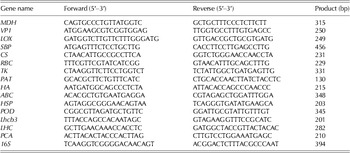
Total RNA of leaves isolated by TRIZOL reagent (Takara, Japan) from 0, 12, 24, 48 and 72 h treatments were used for RT–PCR analysis. Genomic DNA was removed by DNAase I. First strand cDNA was synthesized from 2 μg total RNA from each sample using Moloney Murine Leukaemia Virus (M-MLV) reverse transcriptase (Invitrogen, USA) according to the supplier's instructions. Broad bean 16S rRNA was used as inner control for RT–PCR analysis. The cDNAs were diluted to 20- or 40-fold. All primers for the candidate genes and 16S rRNA are listed in Table 1. General PCR was conducted according to the following programme: an initial denaturation at 94 °C for 3 min, followed by 23–30 cycles of 94 °C for 30 s, 55 °C for 30 s, 72 °C for 30 s and a final extension at 72 °C for 3 min. The RT–PCR experiments were repeated three times and the PCR products were detected by 1% agarose gel in 1×TAE with EtBr.
Primers used for RT–PCR analysis in the leaves of broad bean under AlCl3 stress (MDH: malate dehydrogenase; VP1, vacuolar-type H-pyrophosphatase; LOX, lipoxygenase; SBP, sedoheptulose-1,7-bisphosphatase, chloroplast; CS, citrate synthase; RBC, rbcS-3A gene for ribulose 1·5-bisphosphate carboxylase (RBC) small subunit; TK, transketolase; PAT, patatin homolog mRNA; HA, P-type H+-ATPase; ABC, ABC1 family protein; HSP, heat shock protein 70; POD, peroxidase 2; Lhcb3 gene for chlorophyll a/b-binding protein; LHC, PSI light-harvesting antenna chlorophyll a/b-binding protein; PCA, phytochrome A

Statistical analysis
Data were analysed with OriginPro8 (Version8E, OriginLab Corporation, Massachusetts, USA) and presented as means of three replicates±standard errors.
RESULTS
The lipid peroxidation, H2O2 content, protein carbonyl levels and total protein content under aluminium stress in broad bean leaves
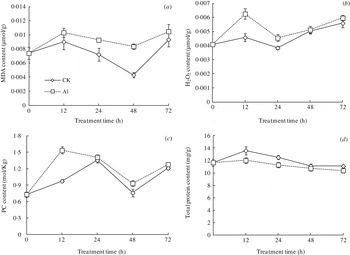
To understand the toxic effects of Al on broad bean leaves at the physiological level, changes in physiological characteristics of broad bean plants exposed to 100 μ m Al stress were investigated. As shown in Fig. 1, MDA content, H2O2 content and PC levels were increased after 100 μ m Al stress treatment compared with the control plants. The MDA content increased after 100 μ m Al treatment for 12 h and then the content decreased in 48 and 72 h, but the MDA content was still higher than the control without Al treatment in leaves of broad bean (Fig. 1 a). The results indicated that there was lipid peroxidation after Al stress in broad bean leaves. After Al treatment for 12, 24, 48 and 72 h, the H2O2 content increased at 12 h and then decreased at 24 h (Fig. 1 b), which meant that Al stress-induced oxidative stress in broad bean leaves. The PC content after Al stress treatment showed a trend similar to that of the H2O2 content (Fig. 1 c). The PC contents in broad bean leaves of 100 and 0 μ m Al stress treatment for 12 h were 1·53 and 0·972 mmol/kg, respectively. After 12 h treatment, the total protein content increased, and then the content decreased gradually, but the content was lower than the control plants (Fig. 1 d).
Effect of Al stress on (a) MDA content, (b) H2O2 content, (c) PC levels and (d) total protein content in leaves of broad bean after 100 μ m Al treatment for 0, 12, 24, 48 and 72 h. Values presented were means of three replicates.

Stomatal conductance of broad bean leaves
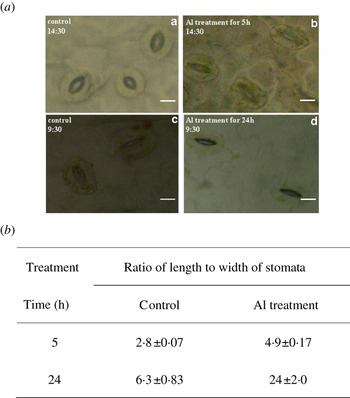
To evaluate the effect of Al stress on the leaf stomatal conductance, the stomata were observed using a microscope and the lengths and widths of the stomata after Al treatment for different lengths of time were measured. As shown in Fig. 2, the stoma after Al treatment for 5 h were more fully closed than in the control plants without Al treatment. The ratio of length to width of the stoma was increased after Al stress treatment, especially after 24 h treatment (24·0±2·0, compared with the control of 6·33±0·83) (Fig. 2 b). These results indicated that the photosynthesis rate of broad bean leaves might be affected by Al stress treatment.
(a) Observations of stomatal conductance in broad bean leaves after 100 μ m Al treatment for different times. (b) The ratio of length to width of stomata of broad bean after 100 μ m Al stress treatment. Colour version available online.

13C-nuclear magnetic resonance analysis of the relative citrate content in leaves of broad bean
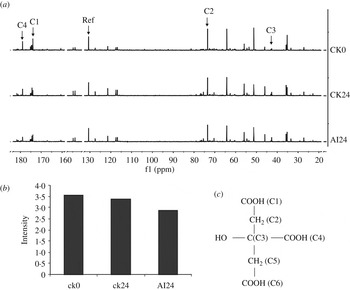
The synthesis of citrate took place mainly within mitochondria and was catalysed by citrate synthase (CS). The relative citrate content was analysed using 13C-NMR. The relative citrate content of broad bean leaves after Al treatment for 24 h (Al 24) decreased to 80% of that in the control plants (Fig. 3 b).
13C-NMR analysis of relative citrate content in broad bean leaves with or without Al stress treatment. (a) Complete 13C-NMR spectra of broad bean leaves without Al treatment for 0 and 24 h (CK0 and CK24) and 50 μ m Al treatment for 24 h (Al24). Peak assignments of C1, C2, C3, C4 indicate different C atoms of citrate as shown in (c). Ref indicates the resonance peak of malate acid in 130·66 ppm. (b) Relative intensity of CK0, CK24 and Al24 was estimated by adding the sum of C1, C2, C3 and C4.

Construction of the suppression subtractive hybridization library
In order to identify up-regulated genes during Al stress, a forward SSH library was constructed with 50 and 100 μ m AlCl3 treated leaves for 0, 12, 24, 48 and 72 h as tester and treated with 0 mm Al for the same as the driver set. A set of 960 bacterial colonies were picked randomly from the library and assayed for the presence of a cDNA insert with nested primers. Electrophoresis of the PCR product showed that the insert fragments ranged from c. 200 to 1200 base pairs (bp) (data not shown).
Sequence analysis of the cDNA clones
The size distribution and the sequence of cDNAs were determined for 301 clones. All of the clones from these 301 that showed a single PCR product were sequenced. The insert length varied from 210 to 1172 bp. Using BLASTX, a total of 208 putative ESTs (including 156 non-redundant ESTs) were identified, of which 47 failed to match any EST in the public database and were therefore considered as new.
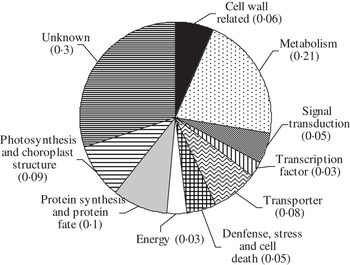
The 156 non-redundant differentially expressed genes were functionally annotated by blasting against the GenBank protein database, and subsequently classified into ten functional categories according to their putative functions as follows: cell-wall-related, metabolism, signal transduction, transcription factor, transporter, defence stress and cell death, energy, protein synthesis and protein fate, photosynthesis and chloroplast structure and unknown (Fig. 4). The category of cell wall-related contained ten distinct proteins deduced from 16 ESTs, which accounted for 0·06 of the classified ESTs. Other categories were as follows: metabolism (33 distinct proteins; 43 ESTs, 0·21), signal transduction (eight distinct proteins; eight ESTs, 0·05), transcription factor (four distinct proteins; four ESTs, 0·03), defence, stress and cell death (eight distinct proteins; 15 ESTs, 0·05), transporter (12 distinct proteins; 17 ESTs, 0·08), protein synthesis and protein fate (15 distinct proteins; 21 ESTs, 0·10), energy (five distinct proteins; six ESTs, 0·03), photosynthesis and chloroplast structure (14 distinct proteins; 31 ESTs, 0·09) and unknown proteins (47 distinct proteins, 47 ESTs, 0·30) (Fig. 4).
Distribution of differentially expressed genes in broad bean under Al stress. A total of 156 non-redundant ESTs were grouped into ten categories based on MIPS functional categories. The proportion of gene transcripts in each group is listed.

Genes involved in organic acid metabolism, transporter, defence, stress and cell death, photosynthesis and chloroplast structure
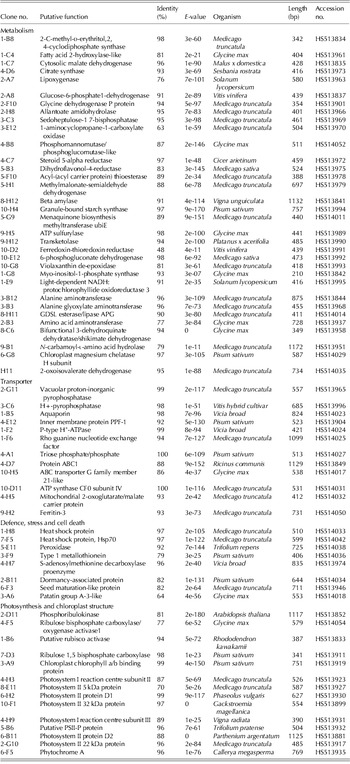
In the EST database, genes encoding enzymes involved in organic acid metabolism, transport, defence, stress and cell death, photosynthesis and chloroplast structure were identified and summarized (Table 2). There were genes encoding for organic acid metabolism in the SSH library created in the present work, such as cytosolic malate dehydrogenase and CS, which might play important roles under Al stress. In the present study, two clones encoding protein ABC were found. There were also some genes involved in defence, stress and cell death, such as heat shock protein (HSP), peroxidase, type 1 metallothionein to release Al stress. Fourteen distinct genes encoding photosynthetic and chloroplastic proteins were identified, such as ribulose bisphosphate carboxylase/oxygenase activase1, ribulose 1,5 bisphosphate carboxylase, chloroplast chlorophyll a/b binding protein, photosynthesis II protein.
Selected known Al-responsive genes in broad bean leaves

Validation of the suppression subtractive hybridization results
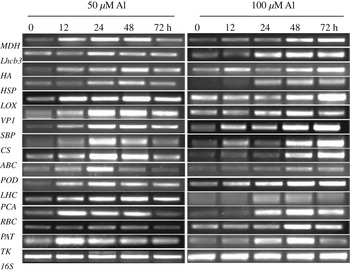
To validate the reliability of the SSH library data, 15 genes were investigated for response to Al stress by RT–PCR, including organic acid metabolism [malate dehydrogenase (MDH), CS], photosynthesis and chloroplast structure (Lhcb3, SBP, LHC, PCA, RBC), transporter (VP1, ABC), defence, stress and cell death (HSP, POD, PAT) and other genes involved in Al stress. Total RNA was isolated from the leaves of additional plants under 50 and 100 μ m Al stress for 0, 12, 24, 48 and 72 h. The expression analysis of the selected genes increased in a time-dependent manner (Fig. 5). The result confirmed that the expression of all 15 ESTs tested was regulated by Al treatment in broad bean and demonstrated that the SSH analysis was reliable.
RT–PCR analysis of ESTs of broad bean treated with 50 and 100 μ m Al treatment for different times (MDH: malate dehydrogenase; Lhcb3:Lhcb3 gene for chlorophyll a/b-binding protein; HA, P-type H+-ATPase; HSP, heat shock protein 70; LOX, lipoxygenase; VP1, vacuolar-type H-pyrophosphatase; SBP, sedoheptulose-1,7-bisphosphatase, chloroplast; CS, citrate synthase; ABC, ABC1 family protein; POD, peroxidase 2; LHC, PSI light-harvesting antenna chlorophyll a/b -binding protein; PCA, phytochrome A; RBC, rbcS-3A gene for ribulose 1·5-bisphosphate carboxylase (RBC) small subunit; PAT, patatin homolog mRNA; TK, transketolase).

DISCUSSION
Oxidative stress is an important part of Al toxicity (Richards et al. Reference Richards, Schott, Sharma, Davis and Gardner1998). It has been reported that Al3+ can alter cell redox homeostasis as a consequence of enhanced production of ROS (Tamás et al. Reference Tamás, Huttová, Mistrík, Simonovicová and Siroka2003). The MDA content, H2O2 content and PC levels increased after Al stress, which meant that Al stress produced oxidative stress in broad bean (Fig. 1). Several genes encoding antioxidative enzymes such as glutathione S-transferase, peroxidase and superoxide dismutase (SOD) were induced under Al stress. Peroxidase has previously been shown to be induced upon Al exposure (Richards et al. Reference Richards, Schott, Sharma, Davis and Gardner1998; Milla et al. Reference Milla, Butler, Huete, Wilson, Anderson and Gustafson2002). In the SSH library created through the present work, one gene encoding peroxidase (HS514038) was isolated and RT–PCR confirmed that the expression of peroxidase was up-regulated after Al treatment. Heat shock proteins are a key component of defence systems in the stress responses of higher plants. Induction of HSPs under stress helps to maintain normal protein structure and function in all organisms (Basha et al. Reference Basha, Lee, Demeler and Vierling2004). The present study identified an HSP and RT–PCR analysis found that the HSP expression was increased dramatically, and expression maintained, 48 and 72 h after Al treatment.
Organic acids, such as malate and citrate are able to form strong complexes with Al by chelating Al ions present in the apoplast or by the internal detoxification of this metal by reversing its toxic effects inside the cell (Ma et al. Reference Ma, Yang, Guan, Wang, Wang, Sun and Zong2011). In the SSH library of the present work, Al stress induced the expression of three transcripts involved in the organic acid pathway: CS (HS513973), malate dehydrogenase (HS513835) and alanine aminotransferase2 (HS513844). The synthesis of citrate takes place mainly in mitochondria and is catalysed by CS, which converts oxaloacetate to citrate and is the ‘pace-maker’ of the tricarboxylic acid cycle, modulating synthesis of other organic acids. Of the organic acids that participate in normal respiratory metabolism, citrate has the highest binding activity for Al (Samac & Tesfaye Reference Samac and Tesfaye2003). In the present study, it was found that the relative citrate content in broad bean leaves decreased after Al stress for 24 h compared with the control plants, indicating that the citrate synthesized in leaves might be transported to the root to alleviate Al stress. Tesfaye et al. (Reference Tesfaye, Temple, Allan, Vance and Samac2001) found that overexpression of a malate dehydrogenase in transgenic alfalfa produced a 7·1-fold increase in root exudation of organic acids. However, Zhou et al. (Reference Zhou, Sauvé and Thannhauser2009) found that in tomato root, the MDH protein was suppressed.
Previous studies have shown that Al toxicity affects photosynthesis in many plant species (Jiang et al. Reference Jiang, Chen, Zheng, Han, Tang and Smith2008; He et al. Reference He, Zhang, Hu and Wu2011). Photosynthesis is principally conducted by leaves that can supply sufficient precursors for the synthesis of organic acids. In Al-tolerant rye plants, the decrease in net photosynthetic rate was found to be accompanied by stomatal closure after Al treatment (Silva et al. Reference Silva, Pinto, Dias, Correia, Moutinho-Pereira, Pinto-Carnide and Santos2012). Stomata provide the major pathway of gas exchange. In the present experiment, the stomata of Al-treated plants closed more fully than in control plants, which might affect the photosynthesis rate under Al stress. Light activates proton (H+)-ATPases in guard cells, to drive hyperpolarization of the plasma membrane to initiate stomatal opening, allowing diffusion of ambient CO2 to photosynthetic tissues (Merlot et al. Reference Merlot, Leonhardt, Fenzi, Valon, Costa, Piette, Vavasseur, Genty, Boivin, MüLLER, Giraudat and Leung2007). The RT–PCR analysis showed that the expression of H+-ATPases decreased after 24 h of 100 μ m Al stress treatment, which meant that the H+-ATPase might function to enhance the closure of stomata under Al stress.
The impact of Al toxicity in photosynthesis is indirect: it leads to a disturbance in the chloroplast architecture. Moreover, the reduction of electron transport in photosystem II (PSII) resulted in a decrease of photosynthesis (Panda et al. Reference Panda, Baluska and Matsumoto2009). Ribulose 1, 5 bisphosphate carboxylase/oxygenase (Rubisco) has been found to be deactivated after heat stress (Law et al. Reference Law, Crafts-Brandner and Salvucci2001). However, in the forward SSH library of the present work under Al stress, the gene encoding ribulose 1, 5 bisphosphate carboxylase/oxygenase (Rubisco) was isolated. One gene with high homology to Rubisco activase was also found in the present study. It is generally believed that Rubisco activase plays a vital role in releasing sugar phosphate from the active site of Rubisco to facilitate CO2 fixation. Enhanced expression of Rubisco activase might be important to maintain some protein functions under Al stress conditions.
This work was supported by the foundation from Yunnan province for Training Adult and Young Leaders of Science and Technology (grant no. 2006PY01-10), National Natural Science Foundation of China (grant no. 31101557), Yunnan Natural Science Foundation of China (grant no. 2010ZC053), and the Education Department Key Fund of Yunnan Province (grant no. 2001Z109).