Introduction
Sexuality is a part of human nature throughout the life cycle. While frequency of sexual activity often decreases in elderly persons, sexual interest may not (Mulligan and Siddiqi, Reference Mulligan and Siddiqi2003). Between 50% and 80% of people aged over 60 years report sexual activity more than once a month, and regular sexual activity continues through the seventh and eighth decades (Marsiglio and Donnelly, Reference Marsiglio and Donnelly1991). Factors influencing sexual behaviors in the elderly include the availability of a willing and able partner, the physical and mental health of the parties involved, the availability of privacy, and sexual history and practices (Comfort and Dial, Reference Comfort and Dial1991).
Sexual dysfunctions (e.g. inhibited sexual desire, erectile dysfunction) are frequent but often overlooked and under-treated disorders in the elderly. However, hyper-sexuality or inappropriate sexual behaviors (ISB) can also be problematic and warrant clinical attention. There is no universally accepted definition of ISB. It has been described as sexually related activities or heightened sexual drive that interferes with function and is pursued at inappropriate times or with non-consenting persons (Alkhalil et al., Reference Alkhalil, Tanvir, Alkhalil and Lowenthal2004)). Types of ISB described in other studies include unwanted verbal remarks, unwanted touching (both non-sexual and touching of breasts or genitalia), disrobing, public masturbation, unwanted sexual advances, delusions of marital infidelity and sexual aggression (Nagaratnam and Gaygay, Reference Nagaratnam and Gaygay2002; Alagiakrishnan et al, Reference Alagiakrishnan2005).
Most published studies of ISB in the elderly use one or both of the following definitions: (1) overt acts associated with increased libido; and (2) persistent, uninhibited, sexual behaviors directed at oneself or other people. These are verbal and/or physical acts with sexual meaning or intent. Behaviors include, but are not limited to, sexual comments, excessive hugging/kissing, preoccupation with sex, masturbation in public, grabbing at the genitals and/or breasts of other residents or staff, sexual hallucinations, delusions of spousal infidelity, attempting to seduce other residents or staff, chasing other residents for sexual purposes, exposing one's genitals in public, and disrobing in public (Kuhn et al., Reference Kuhn, Greiner and Arseneau1998; Higgins et al., Reference Higgins, Barker and Begley2005; Johnson et al., Reference Johnson, Knight and Alderman2006).
The onset of ISB impacts significantly on families and care providers, with reciprocal effects on the individual. For example, a mother who begins propositioning strangers may not be allowed to have visits from her grandchildren. People with ISB may be at risk of engaging in dangerous or criminal sexual activities. There are also potential threats to the welfare of others including residents in long-term care facilities who may not only be unwilling but also unable to consent. These behaviors may result in difficulties concerning residential placement. ISB provokes safety concerns as well as moral and ethical dilemmas. To date, there are no empirically established treatment protocols for ISB in the elderly.
The estimated prevalence of ISB ranges between 2% and 17% of patients with dementia (Tsai, Reference Tsai1991; Alkhalil et al., Reference Alkhalil, Tanvir, Alkhalil and Lowenthal2004; Johnson et al., Reference Johnson, Knight and Alderman2006). There are differing reports of the rates of ISB according to the type and the severity of dementia, with some suggesting there is no difference with respect to cognitive status or type of dementia and others suggesting that ISB is more common with moderate-severe dementia and more common with vascular dementia (Tsai Reference Tsai1991; Alagiakrishnan et al., 2004). These behaviors have been reported to occur more frequently in men (Alagiakrishan et al., 2004).
The etiology of ISB remains unclear. Disruption of neural pathways with neurological insult has been suggested to play a role (Miller et al., Reference Miller, Cummings and McIntyre1986). Misidentification, misinterpretation, loss of learned sexual manners, and orbital frontal disinhibition with cognitive impairment has also been suggested to play a role in ISB (Levitsky and Owens, Reference Levitsky and Owens1999; Alagiakrishan et al., 2004). Other factors suggested to be involved in the etiology of ISB include the Kluver-Bucy Syndrome, Parkinson's disease treated with dopaminergic agents, delirium, substance use, mania, psychosis, and post-ictal confusion (Alkhalil et al., Reference Alkhalil, Tanvir, Alkhalil and Lowenthal2004).
There is limited empirical evidence regarding the efficacy of interventions aimed at reducing ISB in the elderly. Behavioral and environmental strategies such as redirection, distraction, sensory stimulation, and time with a sexual partner have been suggested, with case reports indicating reduction of ISB (Tune and Rosenberg, Reference Tune and Rosenberg2008).
Pharmacological strategies are often used in the management of ISB due to ease of administration and perceived efficacy of use (Harris and Weir, Reference Harris and Wier1998). The evidence for the use of pharmacological agents is primarily in the form of case reports. Medications that have been reported to reduce ISB include selective serotonin reuptake inhibitors (SSRIs), tricyclic antidepressants (TCAs), venlafaxine, atypical antipsychotics, first generation antipsychotics, medroxyprogesterone acetate (MPA), cyproterone acetate, trazodone, LH/GnRH analogues, estrogens, cholinesterase inhibitors, gabapentin, and cimetidine (Simpson and Foster, Reference Simpson and Foster1986; Cooper, Reference Cooper1987; Kyomen et al., Reference Kyomen, Nobel and Wei1991; Weiner et al., Reference Weiner, Denke and Williams1992; Ott, Reference Ott1995; MacKnight and Rojas-Fernandez, Reference MacKnight and Rojas-Fernandez2000; Wiseman et al., Reference Wiseman, McAuley and Freidenberg2000; Chemali, Reference Chemali2003; Kobayashi, Reference Kobayashi2004). Little information is known about the adverse effects, if any, of pharmacologic treatment of ISB.
Methods
Ethical approval was obtained from the Royal Ottawa Mental Health Centre Research Ethics Board for a controlled retrospective chart review study.
A retrospective chart review was performed for inpatients admitted to the Geriatric Inpatient Unit of the Royal Ottawa Mental Health Centre for the identified specific reason of sexually inappropriate behavior (study group), and inpatients matched on gender, age and marital status (control group). All patients in the study group were reported to have exhibited a wide range of repeated ISBs prior to admission. They comprised all inpatients (no exclusions) admitted in the past three years for the identified reason of admission of ISB as noted in the medical chart.
This study of geriatric patients with ISB is the first to include a matched control group. As there are conflicting reports in the literature regarding the prevalence of ISB with respect to both severity and type of dementia, these factors were not controlled for in patient selection. There were no exclusion criteria.
The chart review inventory consisted of demographic information, current and remote medical history, current and remote psychiatric history, length of stay in hospital, criminal history, history of legal charges, medications (prior to admission and at discharge), cardiovascular risk factors, scores on cognitive testing, substance use history, presence and type of dementia, history of, and location of stroke or brain injury, if any.
For the study group, the chart review included effectiveness of interventions aimed at reducing ISB including discontinuation of any medications, adverse effects of interventions for ISB, discontinuation of interventions due to adverse effects. Effectiveness of interventions was rated as “no effect on ISB”, “some reduction but not complete extinction of ISB”, or “extinction of ISB”.
The study group and control group were compared using Fisher's Exact Test and Mann-Whitney U tests for non-parametric variables and t-tests for parametric variables. Two-tailed significance levels were used for all of the analyses.
Results
No statistically significant difference was noted between control and study groups in length of stay in hospital, current or remote psychiatric history, criminal history, history of legal charges, substance abuse, current or remote medical diagnoses, quantity and class of medications at admission and discharge, or cardiovascular risk factors (obesity, smoking, hypertension, diabetes, or hyper-lipidemia). There were nine males and one female in each group, as the control group was matched to the study group for age and gender. A comparison of the study and control groups is outlined in Table 1.
Comparison of study and control groups

*mean +/− standard deviation; **significant with P < 0.05
MMSE = Mini-Mental State Examination
There was a statistically significant difference in Mini-Mental State Examination (MMSE) scores between the control (x = 22.10; sd = 5.90) and study group (x = 15.44; sd = 6.88) with worse performance in the study group (t17 = 2.27; p < 0.05). There was also a trend noted for the clock drawing, with 9/9 patients in the study group having an impaired clock drawing compared to 7/10 of the control group (Fisher's Exact Test Probability Test p = 0.211).
While the difference between the control and the study group regarding history of any stroke was not significant (Fisher's Exact Probability Test p = 0.170), there was a statistically significant difference if the patient had a history of a right frontal lobe stroke. Of patients in the ISB study group, 6/10 patients had a history of right frontal lobe stroke while 0/10 in the control group had a history of right frontal lobe stroke (Fisher's Exact Probability Test p < 0.05).
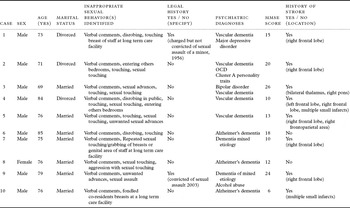
The difference between the control (5/10) and the study group (10/10) on the presence of dementia was statistically significant (Fisher's Exact Probability Test p < 0.05). Also, there was a trend towards vascular dementia in the study group with 5/10 patients in the study group (compared to 1/10 with vascular dementia in the control group). Table 2 provides a summary of the cases in the study group.
Study group case summaries

MMSE = Mini-Mental State Examination; OCD = Obsessive Compulsive Disorder
Interventions aimed at reducing ISB
No interventions aimed at reducing ISB resulted in complete extinction of these behaviors. However, interventions were documented to be effective in some cases, with reduction in severity and/or frequency of ISB documented in the clinical record. Two documented behavioral-environmental interventions were noted to be effective; one involved consistent redirection and the other enhanced communication through the use of an interpreter.
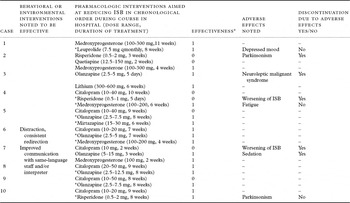
The majority of interventions documented were pharmacological interventions. There were no reports of reduction of ISB as a result of discontinuation of benzodiazepines, trazodone, or dopaminergic agents. Table 3 summarizes the interventions aimed at reducing ISB including behavioral and pharmacological interventions, as well as their effectiveness, cases of reported adverse effects, and discontinuation due to adverse effects in each study group case.
Interventions aimed at reducing ISB

* denotes concurrent administration
a 0 = no effect; 1 = some effect but not extinction of ISB; 2 = extinction of ISB
Citalopram was the most frequently prescribed pharmacological intervention (7/10 cases). However, citalopram resulted in “no effect” in four cases, and “some reduction” in three cases. There were no documented adverse effects associated with citalopram. One patient was prescribed mirtazapine with “some reduction” in ISB and no reported adverse effects. There was one case in which lithium was prescribed with “some reduction” of ISB and no noted adverse effects (this patient had a diagnosis of bipolar disorder, manic episode). In this case, prior to treatment, the targets of the patients’ ISB were both male and female, but after treatment with lithium, ISB was reduced, and the targets were confined to those of the opposite sex. In six cases olanzapine was prescribed to reduce ISB, and in all six cases there was “some reduction” of ISB. However, in two cases, there were adverse effects that required discontinuation of olanzapine.
There were three cases in which risperidone was prescribed to reduce ISB. In one case, there was “some reduction” of ISB. Extrapyramidal effects (EPS) were documented but in this case did not result in discontinuation of the medication. In another patient, risperidone was “not effective” and was discontinued due to EPS. In one case, risperidone was noted to worsen ISB. There was one case in which a trial of quetiapine for ISB was documented as “not effective”. Five cases involved a trial with orally administered medroxyprogesterone acetate (MPA), with a reduction of ISB being noted in all cases. In one of these patients, there were concerns regarding possible sedative effects of MPA but treatment with MPA was not discontinued. In order to reduce sex drive, one patient was prescribed the gonadotrophic medication leuprolide, which resulted in a reduction of ISB with no adverse effects reported.
Discussion
This study is the first to use a control group to identify potential factors contributing to ISB in an in-patient geriatric psychiatry ward. A significant finding in this study was a higher frequency of right frontal lobe stroke associated with ISB.
While no statistically significant differences were noted between type or severity of dementia, patients in the study group were more impaired on cognitive testing (MMSE). It was also noted that an increased proportion of patients with ISB had a diagnosis of vascular dementia.
There are several important limitations to this study, the most important being the small sample size and retrospective study design. However, as indicated, these limitations are less than those of previous studies that have consisted of mainly uncontrolled case reports. A further important limitation is the fact the charts were reviewed with no specific hypothesis concerning the nature or etiology of ISB. We also did not attempt to correct statistically for multiple comparisons because this is an exploratory study.
There were nine males and one female in each group, since the control group was matched for gender. The observation of 90% males exhibiting ISB is consistent with other reports in the literature (Nagaratnam and Gayagay, 2002, Alagiakrishnan et al., 2005).
While citalopram was the most frequently utilized pharmacological agent and citalopram was well tolerated, no effect on ISB was noted in 4/7 cases, and only “some effect” was noted in 3/7 cases. Both olanzapine and risperidone were noted to be effective in some cases. However, both agents were associated with adverse effects that required discontinuation of these medications. MPA was effective in reducing ISB in all five cases in which it was prescribed. MPA was well tolerated, with an adverse effect of fatigue noted in one case (which did not require discontinuation). Single cases trials with leuprolide or lithium were noted to produce a reduction in ISB with no noted adverse effects.
Results of this study suggest that citalopram is well tolerated but not effective at reducing ISB. The atypical antipsychotics risperidone and olanzapine were noted to be helpful in some cases, but also raised concerns due to adverse effects requiring discontinuation. Medications used to reduce testosterone (leuprolide and MPA) were well tolerated and effective at reducing ISB in male geriatric patients.
ISB is an important but neglected problem affecting the geriatric population. This study identified an association of ISB with dementia, right frontal lobe stroke, and more severe dementia. The most effective treatment intervention was MPA both in terms of efficacy and tolerability.
A frequent concern is whether an elderly man who displays ISB is enacting interests he has always had. For example, if a man with a right hemisphere stroke touches his grand-daughter inappropriately, is this the result of underlying pedophilia or an example of opportunistic disinhibition? The fact that only two people in the study group exhibiting ISB had any previous criminal history or concerns about paraphilic interests suggest that, in most cases, ISB in geriatric patients with no previous ISB represents disinhibition. However, the fact that novel sexual behaviors were observed supports the hypothesis that sexual interest and behavior can change, even in the elderly. Fortunately, this study also suggests that effective treatments are available.
Another important question is whether the fact that the study group had more impairment on measures of cognitive ability (e.g. the MMSE) can account for the higher incidence of ISB. Previous studies have indicated no difference in the prevalence of ISB with more severe dementia. Further studies are needed to investigate this possibility, perhaps by matching study and control groups on measures of cognitive impairment. A second important innovation would be the establishment of a standardized instrument (analogous to the MMSE) that would permit an objective measure of the nature and quality of ISB concerns.
Perhaps the most important finding of this study was the relative rarity of cases in which ISB was identified as the chief complaint in clinical records. Given published prevalence estimates of ISB in up to 17% of patients with dementia, it seems likely that ISB is not being identified as a treatable (or legitimate) problem meriting referral for assessment and treatment. This study indicates that treatment (especially pharmacologic) can be of assistance.
Future studies should also include men and women who are out-patients. Further investigation of the role of dementia and location of cerebrovascular infarctions is also warranted. In addition, consideration should be given to the moral and ethical issues arising from both the treatment and withholding of treatment in the elderly with ISB.
Conflict of interest
None.
Description of authors’ roles
Andrea Bardell designed the study, collected the data and wrote the paper. Timothy Lau supervised the design of the study and assisted with writing the paper. J. Paul Fedoroff initiated collaboration, supervised the design of the study and assisted with writing the paper.