Introduction
The periconceptional period of mammalian embryo development is a critical window during which diverse environmental conditions, including available nutrients, have both short-term consequences, for example, effects on cell proliferation and long-term consequences, for example, lasting influences on metabolic and developmental processes throughout gestation and even during postnatal and adult life.Reference Sun, Velazquez and Fleming 1 During preimplantation development, dynamic epigenetic rearrangements involving substantial changes in DNA methylation and histone modification occur, which epigenetically regulate specific and heritable patterns of gene expression.Reference Sun, Velazquez and Fleming 1 – Reference Hatanaka, Inoue and Oikawa 3
Thioredoxin-interacting protein (TXNIP) is a protein which binds to and thereby inhibits the activity of thioredoxin (TRX), a major cellular thiol-oxidoreductase.Reference Nishiyama, Matsui and Iwata 4 The TRX-mediated reducing system is a fundamental mechanism for cellular redox regulation and TXNIP also exerts various TRX-independent metabolic effects. Therefore, pathophysiological effects induced by TXNIP activity cover wide range including metabolic, cardiovascular, malignant and immune disorders.Reference Chong, Chan and Nguyen 5 , Reference Spindel, World and Berk 6 In a mouse model, expression of TXNIP in preimplantation embryos depended on the environment in which the embryos developed and, surprisingly, the epigenetic and transcriptional TXNIP misregulation seen in the embryos persisted in certain adult tissues concomitant with alterations in the postnatal growth trajectory and metabolic homeostasis.Reference Feuer, Liu and Donjacour 7 Therefore, TXNIP may be a marker of preimplantation stress that contributes to subsequent postnatal phenotypes. Intriguingly, TXNIP gene has been associated with production traits in livestock, for example, growthReference Yu, Geiger, Deeb and Rothschild 8 and responses to mammary infections.Reference Toufeer, Bonnefont and Foulon 9 , Reference Kerro Dego, Oliver and Almeida 10
Recently, the importance of one-carbon metabolism in mammalian preimplantation development has successively been reported.Reference Ikeda, Sugimoto and Kume 11 – Reference Shojaei Saadi, Gagne and Fournier 15 One-carbon metabolism consists of methionine and folate (vitamin B9) metabolic pathways with the participation of several other B vitamins as cofactors. One-carbon metabolism is involved in epigenetic mechanisms via provision of S-adenosylmethionine, the only donor of methyl groups to DNA and histones.Reference Ducker and Rabinowitz 16 The relationship between one-carbon metabolism and epigenetic mechanisms of gene expression is of particular interest in terms of nutritional sensing by organisms that outputs long-lasting phenotypic effects via epigenetic modifications.Reference Mentch and Locasale 17 , Reference Xu and Sinclair 18
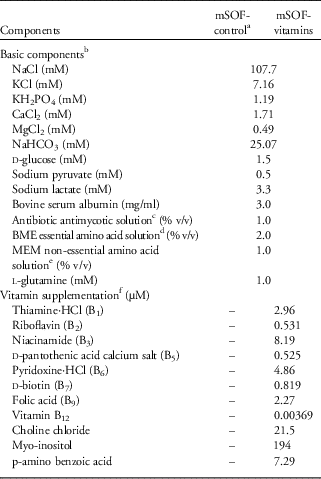
For the study reported herein, we focused on how addition of Roswell Park Memorial Institute 1640 (RPMI-1640Reference Moore, Gerner and Franklin 19 ) vitamins (Table 1) into a conventional culture medium affects bovine embryo development. Two previous reports found no beneficial effects of minimum essential medium- (MEM) type vitamins on bovine embryo development.Reference Takahashi and First 20 , Reference Rosenkrans and First 21 We assessed how the mixture of B vitamins and B vitamin-like substances in the RPMI-1640 formulation affected blastocyst development, TXNIP gene expression and an epigenetic histone modification including that of TXNIP promoter during bovine embryo development in vitro.
Compositions of modified synthetic oviduct fluid (mSOF) used in the present study

BME, basal medium eagle; MEM, minimum essential medium.
a mSOF-control was supplemented with 1% (v/v) PBS (vehicle of the vitamin solution used).
b Identical to20 except for the concentration of sodium pyruvate, omission of phenol red and the composition of antibiotics.
c From Wako Pure Chemical Industries; containing 10,000 units/ml penicillin G, 10 mg/ml streptomycin sulfate and 25 μg/ml amphotericin B.
d From Sigma-Aldrich; 50×.
e From Sigma-Aldrich; 100×.
f From Sigma-Aldrich; RPMI-1640 Vitamins Solution (100×).
Methods
In vitro culture of bovine embryos with or without the RPMI-1640 vitamin mixture
Bovine oocytes were recovered from commercial abattoir-derived ovaries of Japanese Black or Japanese Black×Holstein F1 cows. Groups of 10 cumulus-enclosed oocytes (CEOs) were in vitro matured (IVM) for 22 h in 50-µl drops of Medium 199 with Earle’s salts (Life Technologies) supplemented with 5% (v/v) fetal calf serum (FCS) and 0.2 IU/ml follicular-stimulating hormone (Kyoritsu Seiyaku) under a layer of mineral oil. The total number of CEOs per culture was ~200 and allocated to 20 drops in a Petri dish (Falcon 351007; Corning Incorporated). The matured CEOs were subjected to in vitro fertilization (IVF) with frozen-thawed sperm from a Japanese Black bull as described elsewhere.Reference Ikeda, Sugimoto and Kume 11 The day of IVF and the beginning of insemination were designated day 0 and 0-h post-insemination (hpi), respectively. At 21 hpi, the resulting one-cell embryos were freed from cumulus cells and subsequently in vitro cultured (IVC) in 500 µl of modified synthetic oviduct fluid (mSOFReference Takahashi and First 20 ) with some modifications (Table 1). At 72 hpi, only the embryos that had developed to the five-cell stage or more (~n=30 per group) were further cultured up to 192 hpi in 500 µl of mSOF supplemented with 1% (v/v) of phosphate buffered saline (PBS) (control) or RPMI-1640 Vitamins Solution (Sigma-Aldrich). The compositions of the control and vitamin-supplemented mSOF are shown in Table 1. These media were used under a 500-µl layer of mineral oil in four-well multidishes (Nunc 179820; Thermo Fisher Scientific). The cultures were performed at 38.5°C under 5% CO2 in air for IVM and IVF or under 5% CO2, 5% O2 and 90% N2 for IVC. The rate of blastocyst development and that of complete hatching from the zona pellucida were evaluated at the end of the culture. To assess the number of cells and their allocation to inner cell mass (ICM) and trophectoderm (TE) in the blastocysts, the blastocysts were differentially stained by CDX2 immunolabeling as previously described.Reference Kudo, Ikeda, Sugimoto and Kume 22
Reverse transcription-quantitative polymerase chain reaction (RT-qPCR) analysis of TXNIP gene expression in blastocysts
Blastocysts in each experimental group were collected (n=30) in a small volume of RNAlater (Sigma-Aldrich). Total RNA was extracted from the samples by using RNeasy Micro kit (Qiagen) and reverse transcribed in a 31.5-μl volume with SuperScript III reverse transcriptase and the oligo (dT)20 primer (Life Technologies). The synthesized complementary DNA (2 µl) was used as a template in a qPCR reaction with 0.2 µM of each primer and 1×SYBR Select Master Mix (Life Technologies) in a volume of 20 µl. qPCR was performed using the StepOnePlus Real-time PCR system (Life Technologies) with the following cycle parameters: 50°C for 2 min and 95°C for 2 min, followed by 40 cycles of 95°C for 15 s and 60°C for 1 min. Melting curve analysis and agarose gel electrophoresis were performed after the amplification to confirm the specificity of the PCR products. The data analysis was performed with the StepOne Software V 2.3. Quantification of TXNIP transcripts was performed by the ΔΔCt method using glyceraldehyde-3-phosphate dehydrogenase (GAPDH) and succinate dehydrogenase complex flavoprotein subunit A (SDHA) transcripts as multiple internal controls. The primer pairs were 5'-CTCCGGAACCTGTGCATCAT-3' and 5'-AGGGACGCTAACGTAGATCAGT-3'for TXNIP and as a previous reportReference Goossens, Van Poucke and Van Soom 23 for GAPDH and SDHA. The experiments were repeated three times.
Semi-quantitative chromatin immunoprecipitation polymerase chain reaction (ChIP-PCR) of trimethylated histone H3 at lysine 27 (H3K27me3) at TXNIP promoter
Sample collection for ChIP was performed in wells of a four-well multidish. Blastocysts in each experimental group were collected (n=60) and crosslinked for 10 min with 1% formaldehyde in PBS containing 20 mM Na-butyrate (PBS-NaBu) and then quenched with 125 mM glycine for 10 min. After washing with PBS-NaBu containing protease inhibitor cocktail (PBS-NaBu-PIC), the blastocysts were transferred to a 1.5-ml tubes with a small volume of PBS-NaBu-PIC and stored at −80°C. ChIP was performed with True MicroChIP kit (Diagenode) according to the manufacturer’s protocol with some modifications. The frozen blastocysts were suspended in Lysis Buffer to a final volume of 37.5 µl, and the lysate was mixed with 82.5 µl of PBS-NaBu-PIC. The sample was sonicated to shear chromatin using a Bioruptor UCD-250 (Cosmo Bio) for 10×30 s with 30-s pauses in ice-water. The sample was centrifuged for 10 min at 14,000 g and the supernatant (110 μl) was transferred to a new tube and mixed with 110 µl of ChIP Buffer. From each 220-µl sample of sheared chromatin, 20 µl was set aside at 4°C as ‘Input’ and the rest (200 µl) was mixed with 2.5 µg of anti-H3K27me3 antibody (17–622; Merck Millipore) and incubated for 16 h at 4°C with rotation at 40 rpm. Protein A-coated magnetic beads (10 µl) were added to the sample, which was then rotated at 40 rpm for 2 h at 4°C. The DNA was eluted from the immunoprecipitate, decrosslinked and subsequently purified with MicroChIP DiaPure columns (Diagenode), which resulted in 12 µl of ChIPed DNA. The same DNA purification method was also applied to the Input sample. From the 12 µl of ChIPed or Input DNA, 4 µl was used as a template in a real-time-PCR reaction. The PCR condition was as described above with the exceptions that PowerUp SYBR Green Master Mix (Life Technologies) was used and 45 cycles of PCR were performed. The primer pairs were 5'-TCCTCCGCCCCATCCTAAA-3' and 5'-CCGGCTCACAAATCGCAAG-3'. The amount of ChIPed DNA was calculated as the percentage of the Input (%Input) from Ct values semi-quantitatively. The experiments were repeated four times.
Western blot analysis of H3K27me3
Blastocysts in each experimental group (n=38–58) were lysed in NuPAGE LDS Sample Buffer with Reducing Agent (Invitrogen) in 30 µl volume and boiled for 5 min. The samples were subjected to Sodium dodecyl sulfate polyacrylamide gel electrophoresis through a 12% Bis-Tris gel and transferred to Polyvinylidene difluoride membrane using iBlot Dry Blotting System (Invitrogen). The blotted membrane corresponding to 15–20 kDa was blocked with 10% (v/v) FCS in PBS containing 0.05% (v/v) Tween 20 (PBST) for 30 min. The aforementioned anti-H3K27me3 antibody was diluted 1000 times with PBST containing 5% (v/v) FCS and mounted onto the membrane for 1 h. After extensive washing with PBST, the membrane was treated for 30 min with 2000 times-diluted alkaline phosphatase-conjugated bovine anti-rabbit IgG (sc-2372; Santa Cruz Biotechnology). After washing, the signal was developed for 5 min with Novex AP Chemiluminescent Substrate (Invitrogen) and exposed to Hyperfilm ECL (GE Healthcare). After the detection of H3K27me3 band, the blot was freed from antibodies by washing with Restore PLUS Western Blot Stripping Buffer (Thermo Fisher Scientific). The blot was then re-blocked and reprobed by an anti-H3 antibody (2650S; Cell Signaling Technology). The degree of total H3K27me3 was calculated as a ratio of band intensity of H3K27me3 to that of H3. The experiments were repeated three times.
Statistical analyses
Embryonic development expressed as a percentage, cell number and the RT-qPCR results were analyzed by the t-test. Semi-quantitative ChIP-PCR and Western blot data were analyzed by the paired t-test which included replicate pairs. The data are presented as means ± standard error of the mean. All analyses were performed using SPSS (SPSS Inc.). Significance was accepted at P<0.05.
Results
Effects of the RPMI-1640 vitamin-mixture treatment on in vitro development of bovine embryos
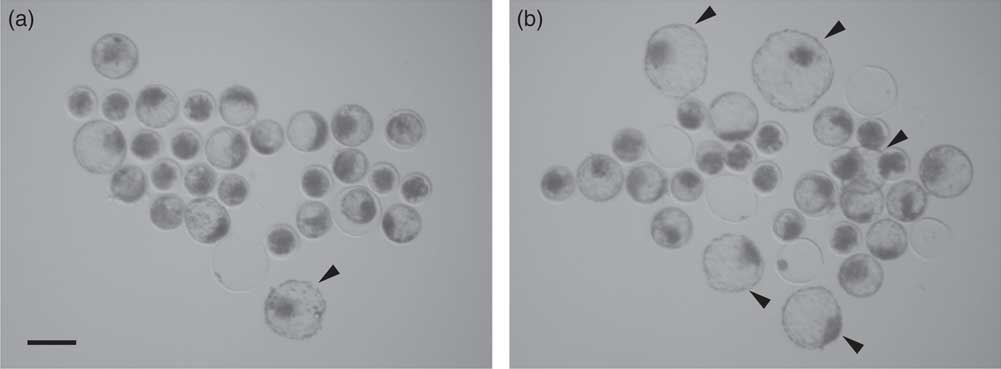
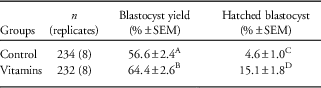
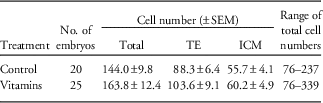
We first examined the effects of the RPMI-1640 vitamin mixture on blastocyst development of bovine preimplantation embryos in vitro. Addition of the vitamin mixture significantly (P<0.05) increased the rate of blastocyst development and tripled the rate of complete hatching from the zona pellucida compared with the control (Table 2; Fig. 1). Although the mean number of cells in the blastocysts and their allocation to ICM and TE were not significantly different for the two groups, the vitamin-mixture treatment widened the cell number range toward the upper direction (Table 3).
Representative images of embryos at the end of culture in control (a) and vitamin-mixture-treated (b) groups. Hatched blastocysts are indicated by arrowheads. Scale bar represents 200 µm.

Effects of Roswell Park Memorial Institute 1640 vitamin mixture on blastocyst development

A v. B, P<0.05 and C v. D, P<0.001 by t-test.
Effects of Roswell Park Memorial Institute 1640 vitamin mixture on the total, inner cell mass (ICM) and trophectoderm (TE) cell numbers of blastocysts

Effects of the RPMI-1640 vitamin-mixture treatment on expression of TXNIP messenger RNA (mRNA)
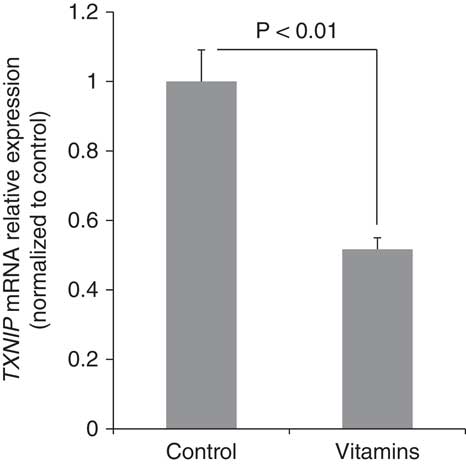
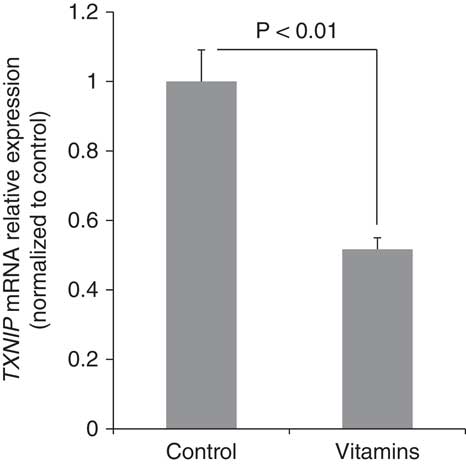
We assessed the effects of the vitamin mixture on expression of TXNIP mRNA in the blastocysts using RT-qPCR. The vitamin-mixture treatment significantly decreased (P<0.01) TXNIP mRNA expression in comparison with the control (Fig. 2).
Effect of Roswell Park Memorial Institute 1640 vitamin mixture on the expression of thioredoxin-interacting protein (TXNIP) messenger RNA (mRNA) in blastocysts. P<0.01 by t-test.
Effects of the RPMI-1640 vitamin-mixture treatment on H3K27me3 at TXNIP promoter
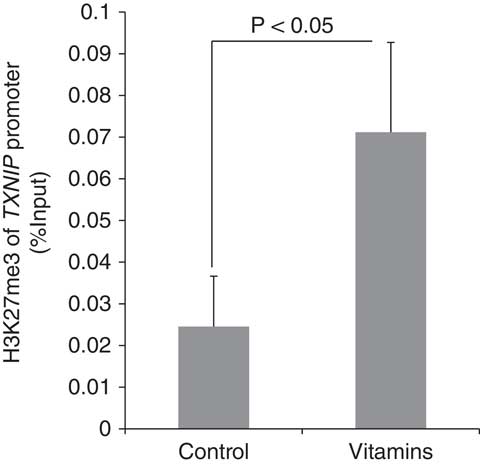
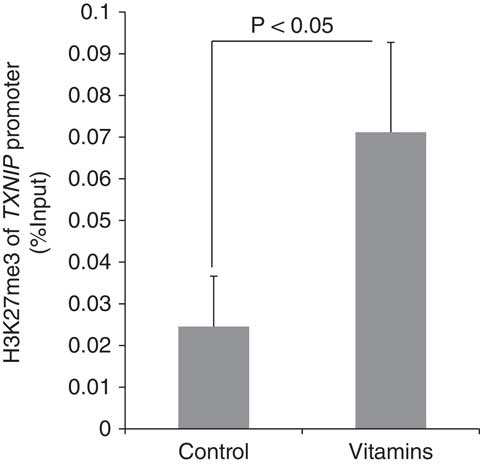
As the vitamin-mixture treatment significantly decreased expression of TXNIP gene, we hypothesized that the treatment affected the transcriptionally repressive histone modifications at the gene loci. We focused on repressive H3K27me3Reference Kimura 24 , Reference Hublitz, Albert and Peters 25 and carried out semi-quantitative ChIP-PCR to examine H3K27me3 at TXNIP promoter (Fig. 3). The vitamin-mixture treatment significantly enhanced (P<0.05) the level of H3K27me3 compared with the control.
Effect of Roswell Park Memorial Institute 1640 vitamin mixture on the levels of trimethylated histone H3 at lysine 27 (H3K27me3) at thioredoxin-interacting protein (TXNIP) promoter in blastocysts. P<0.05 by paired t-test.
Effects of the RPMI-1640 vitamin-mixture treatment on total H3K27me3
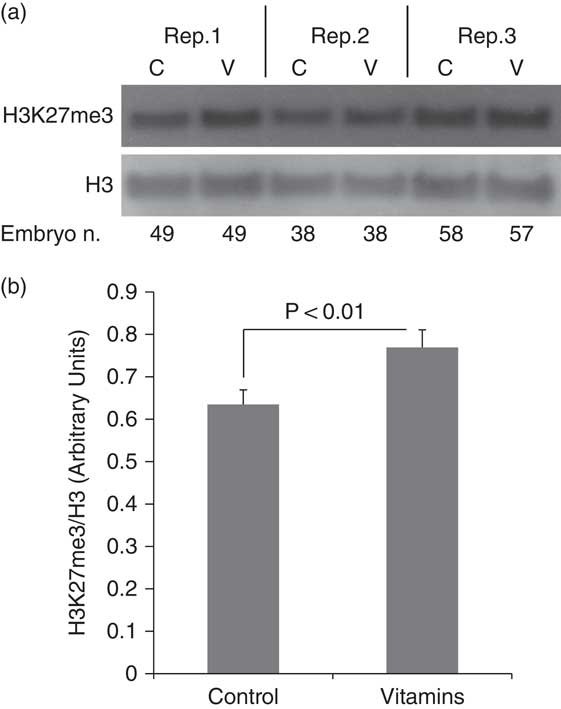
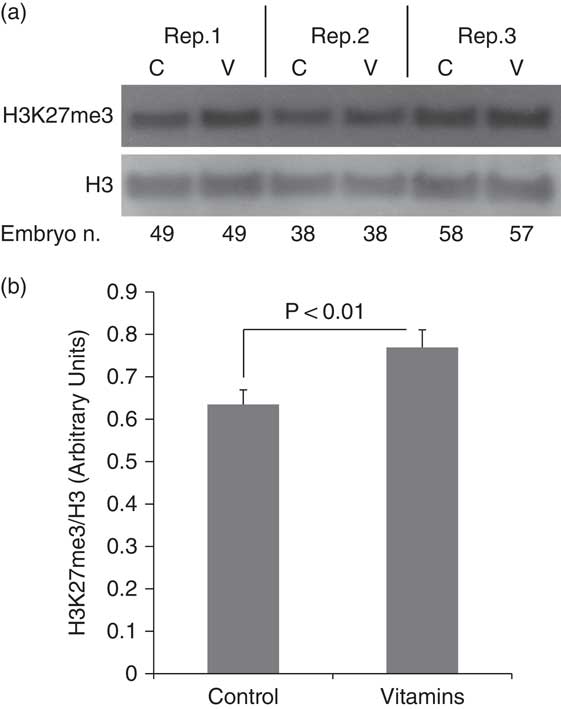
In order to compare the degree of total H3K27me3 in blastocysts between the treatments, Western blot analysis was performed (Fig. 4). The signal of H3K27me3 normalized to pan-H3 was significantly higher (P<0.01) in the vitamin-mixture treatment compared with the control.
Effect of Roswell Park Memorial Institute 1640 vitamin mixture on the levels of total trimethylated histone H3 at lysine 27 (H3K27me3) in blastocysts. (a) The image of Western blot analysis from three biological replicates (Rep. 1, 2 and 3) are shown. C and V mean control and vitamin-treated groups, respectively. Embryo n. represents the numbers of blastocysts loaded. (b) Semi-quantitative values of the band intensity shown in (a). P<0.01 by paired t-test.
Discussion
Several studies have reported the effects of adding B vitamins and B vitamin-like substances, for example, choline and myo-inositol, into the culture media of bovine preimplantation embryos in an attempt to improve the culture system.Reference Takahashi and First 20 , Reference Rosenkrans and First 21 , Reference Holm, Booth, Schmidt, Greve and Callesen 26 In contrast to the results for rodent and rabbit embryos for which B vitamins had beneficial effects on preimplantation development in vitro,Reference Kane and Bavister 27 , Reference Kane 28 MEM-type vitamins had no effect onReference Takahashi and First 20 or tended to decrease bovine blastocyst development.Reference Rosenkrans and First 21 When myo-inositol was added into a bovine serum albumin-supplemented culture medium, it had no effect on blastocyst development and embryo hatching from the zona pellucida, despite it being added at a much greater concentration (2.77 mM) than used in our present study (194 µM).Reference Holm, Booth, Schmidt, Greve and Callesen 26 Therefore, the vitamin composition of the RPMI-1640 so far would have been an undiscovered resource to improve the culture system of bovine preimplantation embryos. The major differences in the MEM-type and RPMI-1640-type vitamin compositions are the absence of d-biotin, vitamin B12 and p-amino benzoic acid in the MEM vitamin mixture. These differences may cause the distinctive effects on preimplantation development of bovine embryos. In addition, the favorable effects of B vitamins and B vitamin-like substances may partially reflect the importance of folate-mediated one-carbon metabolism in preimplantation development; evidence for which has accumulated recently.Reference Ikeda, Sugimoto and Kume 11 – Reference Shojaei Saadi, Gagne and Fournier 15
The susceptibility of preimplantation embryos to surrounding environment, which can have long-lasting phenotypic effects in later life is an emerging issue in periconceptional maternal/paternal care and assisted reproductive technologies.Reference Sun, Velazquez and Fleming 1 , Reference Norman 29 Many studies have reported that exposure of preimplantation embryos to poor nutritional environment can lead to physiological changes in the offspring’s pre- and postnatal growth trajectories, can upregulate metabolic processes involving insulin resistance and fat accumulation, and can cause cardiovascular and immune dysfunctions and these phenotypic changes correlate with the symptoms of human metabolic syndrome.Reference Sun, Velazquez and Fleming 1 The correlation of poor periconceptional nutrition with the phenotypic changes often postulates the existence of (1) ‘thrifty genotype’ that would have been evolutionally selected during a time of poor food availability and the need for large energy expenditures and (2) ‘thrifty phenotype’ that might in part reflect epigenetic changes associated with ‘thrifty genes’ induced by a nutrient deficient periconceptional environment in order to adapt to predicted deprived environment during subsequent development.Reference Gluckman and Hanson 30 In addition, the thriftiness can enhance inflammatory response via adipocyte-derived cytokines and reservation of energy for high cost of the immune system, which, for our ancestors, might have been advantageous for recovery from and survival in infection and trauma.Reference Rubio-Ruiz, Peredo-Escarcega, Cano-Martinez and Guarner-Lans 31 Therefore, the ‘thrifty genes’ might have been evolutionally co-selected with and/or had overlapping functions with ‘proinflammatory genes.’ Chronic inflammatory aspects of human metabolic syndrome can be seen as maladaptation of such ‘proinflammatory genotype.’Reference Rubio-Ruiz, Peredo-Escarcega, Cano-Martinez and Guarner-Lans 31 , Reference Fernandez-Real and Ricart 32 By binding TRX, TXNIP modulates TRX-binding-dependent oxidative, inflammatory and apoptotic processes, and in addition, TXNIP negatively affects glucose uptake independently of TRX activity.Reference Chong, Chan and Nguyen 5 , Reference Spindel, World and Berk 6 Given the close relationship between TXNIP and both glucose homeostasis and inflammatory response, it is tempting to speculate TXNIP as one of the ‘thrifty genes.’Reference Shalev 33 Indeed, the higher expression of TXNIP gene is a candidate marker of preimplantation disturbance in relation to postnatal metabolic programming in a mouse model.Reference Feuer, Liu and Donjacour 7 In the blastocysts that had been derived from IVF and subsequent culture of the mouse model, TXNIP gene expression was upregulated compared with TXNIP expression found in their in vivo-generated counterparts, and the IVF-conceived offspring showed long-term metabolic alterations toward glucose intolerance and fat accumulation compared with their in vivo-generated counterparts. Furthermore, the upregulation of TXNIP in response to oxidative stress and its attenuation by melatonin, an antioxidative indoleamine, have been shown in bovine preimplantation embryos.Reference Pang, Sun and Sun 34 We found that the vitamin-mixture treatment can reduce expression of TXNIP gene in bovine blastocysts produced in vitro (Fig. 2).
Regulation of TXNIP gene expression involves epigenetic histone modifications at the promoter region of the gene.Reference Feuer, Liu and Donjacour 7 , Reference De Marinis, Cai and Bompada 35 Therefore, in an attempt to reveal the mechanism of the TXNIP downregulation by the RPMI-1640 vitamin mixture, we examined whether the vitamins could affect a repressive histone mark H3K27me3 at TXNIP promoter. The results of our ChIP-PCR study demonstrated that the vitamin treatment enhanced the level of H3K27me3 at this region in the blastocysts compared with blastocysts that were not exposed to the vitamin mixture (Fig. 3), which suggests that the vitamin treatment during in vitro culture of the bovine embryos downregulated TXNIP gene expression via epigenetic modification of histones. This epigenetic modification of TXNIP may be heritable during subsequent development and may exert its long-term effects on developmental and metabolic trajectory as demonstrated in the aforementioned mouse model.Reference Feuer, Liu and Donjacour 7 How the vitamin treatment affects the histone methylation of TXNIP gene remains unknown. The RPMI-1640 vitamin mixture includes compounds, that is, folic acid, choline, vitamins B2, B6 and B12, involved in folate-mediated one-carbon metabolism. One-carbon metabolism provides the methyl groups for specific methylation of DNA and histones, which are two major epigenetic modifications of the mammalian genome.Reference Mentch and Locasale 17 , Reference Friso, Udali, De Santis and Choi 36 Therefore, it is possible that the vitamin treatment of the bovine preimplantation embryos acts via one-carbon metabolism in a manner similar to that of methionine treatment,Reference Kudo, Ikeda, Sugimoto and Kume 22 where methylation of histones at a specific gene locus is altered. In addition, it is also possible that the decreased TXNIP expression in the vitamin-mixture treatment directly promotes the blastocyst development because TXNIP has prooxidative, proapoptotic and anti-proliferative properties.Reference Chong, Chan and Nguyen 5 , Reference Spindel, World and Berk 6
The involvement of TXNIP in metabolic process and cellular redox regulation implicates its association with the welfare and production traits in farm animals. For example, a single-marker and haplotype analytic study showed significant effects of SNPs of TXNIP gene on carcass weight and daily gain and TXNIP mRNA expression in skeletal muscle was significantly lower in the fast-growth group compared with the slow-growth group in pig.Reference Yu, Geiger, Deeb and Rothschild 8 Concerning mastitis, decreased TXNIP mRNA expression was found in Staphylococcus aureus-stimulated dendritic cells from clinically resistant ewes compared with their susceptible counterparts.Reference Toufeer, Bonnefont and Foulon 9 TXNIP mRNA expression was also altered in bovine mammary epithelial cells cocultured with Escherichia coli depending on their acute or persistent strains.Reference Kerro Dego, Oliver and Almeida 10 These findings suggest that epigenetic control of genes such as TXNIP may improve livestock health and valuable production traits.
In the present study, only TXNIP was investigated gene specifically. However, the Western blot analysis showed significant increase of total H3K27me3 in the vitamin-treated group compared with the control (Fig. 4), suggesting that the vitamin treatment widely affects histone modifications involved in other gene expressions. For example, we conducted supplemental examination of interferon τ (IFNT) gene expression in consideration of the possible association between immunological and metabolic processes and found that IFNT was also downregulated by the vitamin treatment (Supplementary Fig. S1). IFNT is well characterized as a ruminant-specific key factor for the maternal recognition of pregnancy and its immunomodulatory properties contribute to the function.Reference Bai, Sakurai and Fujiwara 37 The downregulation of IFNT by the vitamin treatment suggests the influences of the nutrients preferentially on immune-related genes. In addition, given the correlation of the higher IFNT expression with compromised blastocyst survival,Reference Kubisch, Sirisathien and Bosch 38 , Reference Rodina, Cooke, Hansen and Ealy 39 vitamin-supplemented embryo culture may be advantageous. Collectively, comprehensive and integrated analyses of gene expressions and histone modifications in response to the vitamin treatment are of interest in the context of investigating the range and specificity of nutrients-associated epigenetic gene regulations.
In summary, we demonstrated that treatment with the RPMI-1640 vitamin mixture during bovine embryo culture promotes blastocyst development and downregulates TXNIP gene expression with epigenetic modification of histones in the blastocysts. Addition of the commercially available RPMI-1640 vitamin mixture to culture media appears to be a simple and practical mean of increasing blastocyst yield. Furthermore, optimal control of B vitamins in in utero and/or in vitro environment may be applicable for the developmental programmingReference Ikeda 40 – Reference Triantaphyllopoulos, Ikonomopoulos and Bannister 42 in preimplantation embryos so as to improve the welfare and production traits in farm animals.
Acknowledgments
The authors thank Mari Kudo for her contribution to preliminary examination of ChIP analysis.
Financial Support
This work was supported in part by JSPS KAKENHI Grant Number 15K07779 and Kieikai Research Foundation.
Conflicts of Interest
None.
Ethical Standards
This study was carried out in accordance with the Regulation on Animal Experimentation at Kyoto University. The bovine ovaries were purchased from a commercial abattoir.
Supplementary material
To view supplementary material for this article, please visit https://doi.org/10.1017/S2040174417000563