





Introduction
Chronic obstructive pulmonary disease (COPD) remains a leading cause of morbidity and mortality worldwide, and there is increasing evidence for the link between exacerbations of COPD and cardiovascular events (Hurst et al., Reference Hurst and Gale2024). Effective pharmacological and non-pharmacological treatments are available (Agustí et al., Reference Agustí, Celli, Criner, Halpin, Anzueto, Barnes, Bourbeau, Han, Martinez, Montes de Oca, Mortimer, Papi, Pavord, Roche, Salvi, Sin, Singh, Stockley, Varela, Wedzicha and Vogelmeier2023), and there is evidence-based guidance on the management of COPD (National Institute for Health and Care Excellence, 2018; Agustí et al., Reference Agustí, Celli, Criner, Halpin, Anzueto, Barnes, Bourbeau, Han, Martinez, Montes de Oca, Mortimer, Papi, Pavord, Roche, Salvi, Sin, Singh, Stockley, Varela, Wedzicha and Vogelmeier2023), yet management is often sub-optimal (Halpin, Reference Halpin, Dickens, Skinner, Murray, Singh, Hickman, Carter, Couper, Evans, Pullen, Menon, Morris, Muellerova, Bafadhel, Chalmers, Devereux, Gibson, Hurst, Jones, Kostikas, Quint, Singh, van Melle, Wilkinson and Price2023). For example, although COPD remains one of the most common reasons for emergency hospital admission in the United Kingdom (UK) (National Institute for Health and Care Excellence, 2018), in one study, one third of patients hospitalized for an exacerbation of their symptoms had not been reviewed in a primary care COPD clinic during the previous 12 months (Buckingham et al., Reference Buckingham, Lowe, Pursey, Roberts and Stone2008). Sub-optimal management of patients with COPD, in terms of clinic review and pharmacological and non-pharmacological treatment, is associated with increased risk of exacerbations, increased lung function decline, and increased healthcare costs (Halpin et al., Reference Halpin, Decramer, Celli, Mueller, Metzdorf and Tashkin2017; Kunisaki et al., Reference Kunisaki, Dransfield, Anderson, Brook, Calverley, Celli, Crim, Hartley, Martinez, Newby, Pragman, Vestbo, Yates and Niewoehner2018; Zheng et al., Reference Zheng, Zhu, Liu, Lai, Lin, Qiu, Wu and Yao2018; Kerkhof et al., Reference Kerkhof, Voorham, Dorinsky, Cabrera, Darken, Kocks, Sadatsafavi, Sin, Carter and Price2020).
Health services, including the National Health Service (NHS) in England, are moving towards a population health management (PHM) approach, which aims to improve health through data-driven planning and the delivery of proactive care to optimize health outcomes (NHS England, 2024b). PHM aims to reduce the risk of hospitalization and address inequalities. Given the limited resources in primary care, successful implementation of PHM will depend on identifying and targeting those patients at greatest risk.
Many patients with COPD are susceptible to future exacerbations and could benefit from improved management including regular reviews, advice regarding medication, smoking cessation, vaccinations, and clinically appropriate therapies (Hurst et al., Reference Hurst, Vestbo, Anzueto, Locantore, Müllerova, Tal-Singer, Miller, Lomas, Agusti, Macnee, Calverley, Rennard, Wouters and Wedzicha2010; Halpin et al., Reference Halpin, de Jong, Carter, Skinner and Price2019; Fekete et al., Reference Fekete, Pako, Nemeth, Tarantini and Varga2020; Palli et al., Reference Palli, Zhou, Shaikh and Willey2021). Patients with a history of exacerbations or comorbidities have a greater risk of future exacerbations and adverse cardiovascular events (Vanfleteren et al., Reference Vanfleteren, Lindberg, Zhou, Nyberg and Stridsman2023; Halpin et al., Reference Halpin, Healey, Skinner, Carter, Pullen and Price2024; Hurst et al., Reference Hurst and Gale2024; Wallström et al., Reference Wallström, Stridsman, Lindberg, Nyberg and Vanfleteren2024). Patients who are at higher risk of exacerbations but are sub-optimally managed represent a ‘modifiable high-risk’ (MHR; see Table 1 for full description) group, as there may be scope to optimize management of these patients through additional pharmacological and non-pharmacological interventions. The group comprises patients with diagnosed COPD, but also those with the symptoms of COPD but not yet diagnosed, who also experience events identical to COPD exacerbations and are at increased risk of future events (Halpin et al., Reference Halpin, Healey, Skinner, Carter, Pullen and Price2024). To reduce the burden of the disease, early identification, assessment, treatment, and follow-up of these patients are a high priority. In many practices, the number of such patients will not be large, but they are likely to utilize a disproportionate amount of resource. For example, in Southampton 6% of COPD patients had ≥3 hospital admissions in the previous year and accounted for 22% of total COPD admissions (Wilkinson et al., Reference Wilkinson, North and Bourne2014).
Key terms (adapted from Pullen et al. Reference Pullen, Miravitlles, Sharma, Singh, Martinez, Hurst, Alves, Dransfield, Chen, Muro, Winders, Blango, Muellerova, Trudo, Dorinsky, Alacqua, Morris, Carter, Couper, Jones, Kostikas, Murray and Price2021)

Table 1. Long description
A table with two main sections: Target population for CONQUEST and Exacerbations. The table has two columns: Term and Definition. The Target population for CONQUEST section includes terms such as Patient with modifiable high-risk Chronic Obstructive Pulmonary Disease, Patients with scope for management optimization, Already diagnosed patients with modifiable high-risk COPD, Undiagnosed patients with potential modifiable high-risk COPD, and Newly diagnosed patients with modifiable high-risk COPD. The Exacerbations section includes terms such as COPD exacerbation, Moderate exacerbation, and Severe exacerbation. Each term is defined in the corresponding row. Row 1: Patient with modifiable high-risk Chronic Obstructive Pulmonary Disease, Patients with COPD either already diagnosed or as yet undiagnosed who have experienced >=2 moderate, or >=1 severe exacerbations in the last 24 months with at least one exacerbation occurring in the last 12 months, and whose medical record data indicates clearly that there is scope for management optimization. Row 2: Patients with scope for management optimization, Patients who continue to exacerbate while on their current therapy including no therapy, SABA, SAMA, or SABA/SAMA only and/or whose management may be optimized by correct diagnosis, or additional pharmacological and non-pharmacological interventions. Row 3: Already diagnosed patients with modifiable high-risk COPD, Patients with an existing COPD diagnosis who fit the modifiable high-risk criteria with respect to recent COPD exacerbations and are >=40 years of age. Row 4: Undiagnosed patients with potential modifiable high-risk COPD, Patients without a COPD diagnosis who fit the modifiable high-risk criteria with respect to recent exacerbations of undiagnosed COPD, and who are smokers or former smokers >=40 years of age. Row 5: Newly diagnosed patients with modifiable high-risk COPD, A subset of the above undiagnosed patients who receive a COPD diagnosis following diagnostic assessment. Row 6: COPD exacerbation, A significant worsening in respiratory symptoms in people with COPD or an event analogous to a COPD exacerbation in people with suspected but undiagnosed COPD, categorized as moderate or severe using validated code lists. Row 7: Moderate exacerbation, Requiring an acute course of systemic corticosteroids and/or a course of antibiotics within 3 days of a lower respiratory consultation indicative of a probable COPD exacerbation, or an emergency room visit for a COPD-related cause. Row 8: Severe exacerbation, An exacerbation resulting in a hospital admission.
* Identified using validated code lists for moderate and severe COPD exacerbations.
CONQUEST: COllaboratioN on QUality improvement initiative for achieving Excellence in STandards of COPD care; SABA: short-acting beta-agonist; SAMA: short-acting muscarinic antagonist.
The COllaboratioN on QUality improvement (QI) initiative for achieving Excellence in STandards of COPD care (CONQUEST) programme was developed to address this problem. CONQUEST comprises an interventional registry and integrated quality improvement programme (QIP). The interventional registry includes primary and secondary care MHR patients, whose anonymized data are collected from electronic health records (EHRs), questionnaires, and clinical assessments. The QIP is underpinned by four quality standards (Pullen et al., Reference Pullen, Miravitlles, Sharma, Singh, Martinez, Hurst, Alves, Dransfield, Chen, Muro, Winders, Blango, Muellerova, Trudo, Dorinsky, Alacqua, Morris, Carter, Couper, Jones, Kostikas, Murray and Price2021) and integrated clinical decision support (CDS) (Alves et al., Reference Alves, Pullen, Hurst, Miravitlles, Carter, Chen, Couper, Dransfield, Evans, Hardjojo, Jones, Jones, Kerr, Kostikas, Marshall, Martinez, van Melle, Murray, Muro, Nordon, Pollack, Price, Sharma, Singh, Winders and Price2022) to provide relevant assessment and management considerations for care. The CONQUEST quality standards aim to improve the management of patients with COPD through accurate and timely diagnosis, holistic disease assessment, quantification of future risk of exacerbations and cardiac events, appropriate non-pharmacological and pharmacological interventions, and regular follow-up.
Previous work has quantified how current UK management of high-risk patients compares to the CONQUEST quality standards and has shown opportunities for improvement (Halpin et al., Reference Halpin2023). For example, in 2019 over 40% of newly diagnosed patients had not had spirometry recorded in the previous year, and 39% of patients with an existing COPD diagnosis had not had their exacerbation history reviewed in the same period. The current situation is likely to be much worse as spirometry was suspended during the COVID-19 pandemic, and there are still wide variations in availability and use in the UK (Joo et al., Reference Joo, Lee and Weiss2008; Howard, Reference Howard2023).
Implementing QIPs, including those for COPD, across whole health systems such as primary care presents challenges and often leads to only modest improvements in outcomes (Lau et al., Reference Lau, Stevenson, Ong, Dziedzic, Treweek, Eldridge, Everitt, Kennedy, Qureshi, Rogers, Peacock and Murray2015; Licskai et al., Reference Licskai, Hussey, Rowley, Ferrone, Lu, Zhang, Terebessy, Scarffe, Sibbald, Faulds, O’Callahan and To2024). Hard-to-reach populations, such as non-English speakers, those from more deprived backgrounds, and those with poor health behaviours, tend not to engage in QIPs (Flanagan and Hancock, Reference Flanagan and Hancock2010; Walters et al., Reference Walters, Kharicha, Goodman, Handley, Manthorpe, Cattan, Morris, Clarke, Round and Iliffe2017); therefore, implementation of QIPs may result in greater health inequalities, as those who participate and benefit are those who already have an advantage. Identifying ways of encouraging the participation of those with the most to gain is a key challenge for implementation of QIPs in diverse populations. Successful implementation of QIPs depends on using strategies that have been designed to manage known challenges in the setting.
In this article, we discuss the practical barriers encountered, the solutions identified, and the lessons learned during implementation of the CONQUEST QIP. Although the QIP was implemented in primary care practices in the UK, the underlying principles and the approaches to overcoming practical issues of implementation are relevant to the management of other chronic conditions and could readily be applied in other countries and healthcare settings.
CONQUEST quality improvement programme implementation
Quality improvement programme and clinical decision support design
The CONQUEST QIP was implemented within participating primary care systems in the UK, guided by scientific and clinical input from the CONQUEST UK National Steering Committee. Implementation of the QIP involved nine steps: i) recruiting practices, ii) acquisition of the data needed for QI, iii) data processing, iv) identifying the MHR patients, v) delivering CONQUEST questionnaires to the MHR patients, vi) spirometry for undiagnosed populations, vii) assessment of newly and already diagnosed MHR patients with COPD, viii) institution of appropriate non-pharmacological and pharmacological interventions, and ix) appropriate follow-up.
Each of these steps is described below, in terms of the practical barriers encountered, the solution developed and the lessons learned. For ease of reference, a summary is provided in Table 2.
Summary of CONQUEST UK QIP practical barriers, solutions, and lessons
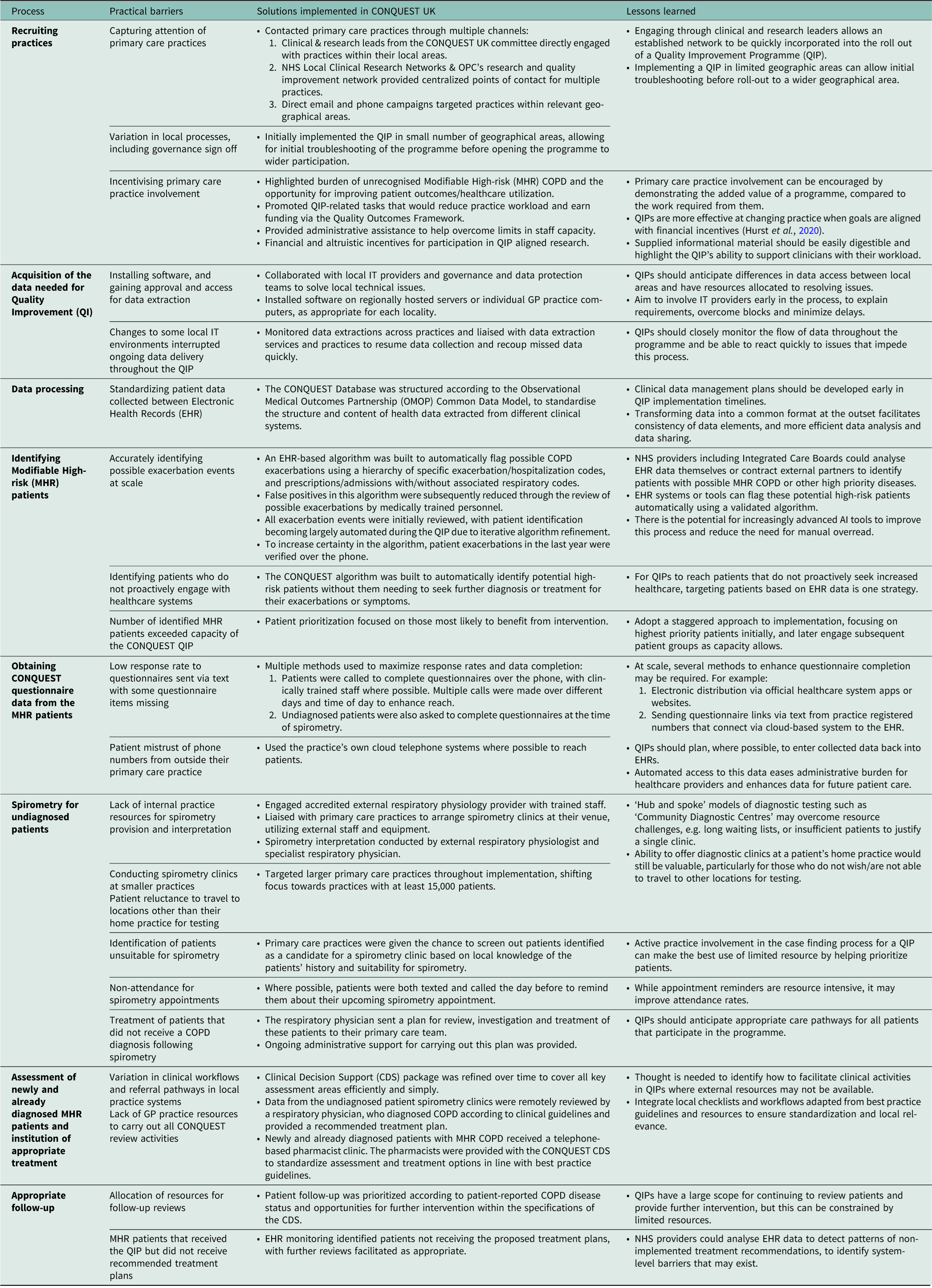
Table 2. Long description
Panel A: Table listing practical barriers in recruiting practices, solutions implemented in CONQUEST UK, and lessons learned. Panel B: Table detailing barriers in acquiring data for quality improvement, solutions, and lessons. Panel C: Table outlining data processing barriers, solutions, and lessons. Panel D: Table describing barriers in identifying high-risk patients, solutions, and lessons. Panel E: Table summarizing barriers in obtaining CONQUEST questionnaire data, solutions, and lessons. Panel F: Table listing barriers in streamlining patients to appropriate treatment, solutions, and lessons. Panel G: Table detailing barriers in assessing risk and streamlining patients to appropriate treatment, solutions, and lessons. Panel H: Table outlining barriers in appropriate follow-up, solutions, and lessons.
CONQUEST: COllaboratioN on QUality improvement initiative for achieving Excellence in STandards of COPD care; COPD: Chronic Obstructive Pulmonary Disease; CDS: Clinical Decision Support; EHR: Electronic Health Record; IT: Information Technology; MHR: Modifiable High-risk; NHS: National Health Service; OPC: Optimum Patient Care; QIP: Quality Improvement Programme.
Recruiting practices
Practical barriers
Capturing the attention of primary care practices and communicating the benefits of a QIP is challenging, largely due to the pressures of a high workload and limited resources within UK primary care (Marshall and Ikpoh, Reference Marshall and Ikpoh2022; Jackson et al., Reference Jackson, Nicholson, Job, Sussex and Morris2025). Furthermore, once practices agreed to engage, local geographical areas had differing governance and technical requirements regarding installation of the software required for the QIP.
Solution
To increase the chances of practices being receptive to our approach, two main strategies were adopted. Several clinical and research leads from the CONQUEST UK national steering committee had close ties to practices in their local health areas and were able to directly engage practices to promote the QIP. Second, NHS Local Clinical Research Networks provided a central point of contact for reaching practices that would be interested in carrying out a QIP aligned with research. Similarly, Optimum Patient Care (OPC) was also able to promote the QIP within the OPC network (an established network of practices that engage with other QI activities provided by OPC). In addition to the described strategies, practices were contacted directly with phone and email campaigns if they were located in the geographical areas where the QIP was being implemented.
To encourage engagement with CONQUEST UK, there was clear communication to primary care practices of the likely benefits from participation. These included improved patient health outcomes, fewer patient consultations, and financial benefits. It was explained to practices that as patients with MHR COPD have increased risk of future exacerbations and cardiovascular events, optimizing their management is likely to reduce exacerbations and healthcare utilization. It was also explained how components of the QIP related to performance indicators in the Quality Outcomes Framework (a financial incentive programme within the UK primary care system that measures performance against specific indicators), assuring receipt of the associated financial incentives. The provision of support to practices including administrative assistance and staff to conduct QIP activities helped offset potential concerns about workload implications for the practice.
Liaisons with governance teams in each geographical area helped explore and address local requirements concerning the use of QIP-related software at each practice. Local processes varied regarding review, installation, and testing of the software for the QIP, and on-site and remote help was provided by OPC to address any challenges in implementing the software.
Lessons learned
Using established connections and networks within the primary care setting appeared to be an effective way of contacting practices. This would likely be an effective way for a health system to implement a QIP across practices.
Targeting practices known to be interested either in broad QI initiatives, or the clinical area of relevance to a specific QI programme, may result in higher uptake rates compared to approaching practices at random. Locally or nationally available data could be used to identify practices with high prevalence of the relevant disease. To further maximize practice engagement in QIPs, careful thought should be given to how the workload and potential benefits are presented and there should be clarity about what help is available to support implementation.
Liaising with local governance teams was crucial to ensure the successful implementation of the QIP. Early and ongoing contact allowed operational processes to be planned and adapted as local conditions shifted throughout the rollout of the QIP.
Acquisition of the data needed for quality improvement
Practical barriers
The QIP required patient-level EHR data to be extracted from practices into the Optimum Patient Care Research Database, via bespoke software to identify MHR patients. Operationalizing the QIP across multiple geographic localities required implementation in various local IT environments, using different software and with different infrastructures and data policies. Notwithstanding the variation between localities, interruptions to data transfer were experienced due to data policies being revised over time, as well as practices turning off or replacing the computer with the data extraction software installed.
Solution
Experience was gained by focusing initially on a small number of geographic areas, with only two different IT environments, allowing the OPC team to understand the different requirements and tailor their approach accordingly. Once the initial practices had signed data use agreements, the OPC team liaised with the NHS IT providers to explore potential issues regarding software compatibility. This led to varying approaches to suit each locality, with QIP-specific data extraction software being installed either on servers hosted by the regional IT provider or on individual practices’ computers, to maximize software compatibility.
Monitoring the flow of data received from engaged practices enabled the OPC team to detect interruptions due to unanticipated changes in local IT environments over the course of QIP implementation. The team was then able to work with IT providers to make amendments to resume data collection.
Lessons learned
Implementing the QIP in a small number of practices and localities before expanding to other areas enabled the OPC team to identify and address problems in a manageable way. Once the initial operationalization of the QIP was completed, it was easier to anticipate and avoid challenges when rolling out to different areas or contexts.
Liaising with local IT providers helped the OPC team understand the requirements of different localities, so that modifications could be made before the QIP was implemented. Fostering good working relations with IT providers and monitoring data flows may enable unanticipated barriers to be overcome more quickly, and minimize disruption to data transfer.
Data processing
Practical barriers
To enable the CONQUEST QIP to be implemented in all practices, it was essential for the interventional registry to collect and store data from general practice EHRs extracted from the different clinical systems used in primary care (SystmOne, EMIS, Vision). Although each system uses the same clinical terminology (SNOMED CT) for its coding, the data are stored differently, hence data cannot be directly compared between systems.
Solution
The data management plan for the CONQUEST UK interventional registry specified a standardized structure according to the Observational Medical Outcomes Partnership (OMOP) Common Data Model. OMOP was created to allow analysis of data from different clinical systems.
Lessons learned
Mapping EHR data into an OMOP structure allowed standardized interpretation of patients’ EHR data, regardless of the source clinical system. Data standardization was essential to support the implementation of the QIP across all practices.
Identifying modifiable high-risk patients
Practical barriers
Patient eligibility for the CONQUEST UK programme was based on EHR-recorded data on age, COPD diagnosis, or potential undiagnosed COPD, and MHR status. Patients were deemed to meet MHR criteria according to exacerbation history and scope for management optimization (Table 1). The OPC team needed to verify that patients met this definition prior to participating in the CONQUEST UK programme.
Solution
To identify patients meeting the CONQUEST UK eligibility criteria, OPC developed an EHR-based algorithm to detect recorded evidence of clinical events that were highly likely to correspond to exacerbations of COPD. Initially, potential exacerbations recorded in the EHR were manually reviewed by a clinician to verify patients’ MHR status. Manual review was a robust but resource-intensive method, which was later replaced with verifying exacerbation history with patients during the first phone contact. Common reasons for false positive identification of MHR patients detected through the reviewing and verification processes, and broader quality checking, were used iteratively to improve the accuracy of the EHR-based algorithm over time. The algorithm used EHR codes conforming to the standardized OMOP model, permitting its use across all practices, irrespective of the clinical system.
CONQUEST UK identified more potential undiagnosed COPD patients than could be reviewed within the resources of the programme. Patients with the greatest scope for benefit were prioritized. The highest priority was given to patients not on any inhaled therapy, those on monotherapy with a long-acting beta-agonist (LABA) or long-acting muscarinic antagonist (LAMA), and those with a blood eosinophil count ≥300 cells/µl who were not on inhaled corticosteroids (ICS) maintenance therapy.
Lessons learned
Developing an EHR-based algorithm that could be iteratively modified over time was an efficient means of identifying potentially eligible patients while minimizing the number of inappropriate patients needing to be contacted. Data recorded in EHR can be used to identify patients with specific clinical characteristics, either via bespoke searches in individual general practice clinical systems or standardized algorithms applied across multiple healthcare providers.
Searching for patients automatically in an EHR system may have enabled the CONQUEST UK programme to target patients who would not have sought, or realized they needed, clinical review and better treatment. Identifying patients proactively via EHR algorithms, rather than opportunistically when patients contact healthcare settings, may overcome the risk of worsening health disparities caused by only reaching those who are more actively engaged with their health care.
Prioritizing patients at greatest risk of future respiratory or cardiac events, such as those on minimal inhaled therapy, was a pragmatic way of delivering the programme within the available resources. Although this criterion was specific to COPD, QIPs in other disease areas could similarly prioritize patients at greatest risk where capacity is limited.
Obtaining CONQUEST questionnaire data from the MHR patients
Practical barriers
The collection of patient-reported outcomes was essential for both confirmation of patient eligibility and disease assessment. Questionnaires were the most efficient method of collecting data from large numbers of patients, though they posed challenges in terms of cost, response rates, and data completion.
Solution
When the QIP was first implemented in a practice, patient questionnaires were delivered via text message, representing substantial cost savings compared to questionnaires sent via post. The text message included the customized sender ID that practices used for other texts, indicating it was a genuine message sent on behalf of the patient’s practice. There was a poor response rate (17.5%) to these text-based questionnaires and data quality checks revealed that some questionnaires were only partially complete. To address both issues, the questionnaires were instead administered by OPC staff, either face-to-face with undiagnosed potential COPD patients attending spirometry appointments (described in following section) or by telephone with all remaining eligible patients. Clinically trained staff administered the questionnaires wherever possible, to minimize incorrect interpretation of question items by patients.
Patients completing questionnaires sent by text message alone, without requiring follow-up by phone or in person, may have been those who were more engaged in the healthcare system. To extend the reach of the programme, calls to non-responding patients to complete questionnaires were made on multiple days and at different times, to maximize the representativeness of patients providing questionnaire data.
Lessons learned
Using multiple modes of administration maximized the number of questionnaire responses received, including from patients who may not otherwise interact with healthcare via clinics or correspondence. Other solutions for capturing this data in the future may include distribution via official healthcare system apps/websites or sending questionnaires via practice registered phone numbers where systems allow this.
Spirometry for undiagnosed patients
Practical barriers
Spirometry is required to confirm the diagnosis of COPD in patients with respiratory symptoms and a relevant clinical history. Detecting new COPD diagnoses was a fundamental component of the CONQUEST UK QIP, but many practices in the UK lack the equipment, trained staff, time, and financial incentives to provide spirometry (Primary Care Respiratory Society, 2023). The NHS is currently implementing Community Diagnostic Centres (NHS England, 2024a), representing ‘hub-and-spoke’ models for a wide range of diagnostic testing, often including spirometry. However, accessibility issues at some of these services (Healthwatch England, 2024) highlights the need for continued provision of spirometry at local practices to maximize service coverage and accessibility.
Spirometry clinics provided as part of the QIP needed to maximize the number of patients booked to be cost effective. Challenges encountered during the delivery of spirometry clinics included patient attendance rates, yield of new COPD diagnoses, practices with small patient list sizes, and follow-up for patients not diagnosed after the clinic visit.
Screening calls were conducted with patients about one week before the spirometry clinic date, and eligible patients who agreed to attend the clinic were given an appointment time. Initial clinics had a non-attendance rate of 25%, often due to patients forgetting or having conflicting commitments. Amongst patients attending the initial clinics, the proportion subsequently diagnosed with COPD (the yield) was low, resulting in fewer newly diagnosed patients receiving the QIP than anticipated in some practices.
Based on one physiologist and one administrator attending each clinic, a full clinic had up to 18 patients per day, allowing sufficient time for required physiological tests and questionnaire completion. Some clinics were conducted with notably fewer patients, for instance if low number of undiagnosed potential MHR patients were identified at smaller practices. All scheduled clinics were conducted, regardless of whether all appointment slots were filled. Plans for a hub-and-spoke model, with patients from nearby small practices attending a spirometry clinic at a central practice, were not implemented due to patients’ reluctance to attend other practices and, practices being unable to host patients from other general practice registers.
Solution
To overcome the lack of spirometry clinics at many practices, OPC provided all required resources, including administrative support to schedule patients and an external spirometry service with accredited staff, equipment, and interpretation of the results by clinicians. Practices only needed to provide a clinical room for the spirometry clinic.
To optimize the use of resources and ensure fully booked spirometry clinics, larger practices were recruited to increase the pool of potentially eligible patients. Practices with ≥15,000 registered patients typically enabled at least one fully booked spirometry clinic to proceed.
To improve the clinic attendance rate, patient reminders were introduced in the form of a text message and a phone call the day before the clinic visit to confirm availability. If patients could no longer attend, patients from a waiting list were booked when possible. The implemented reminders increased attendance rates from 74.6% to 85.5%.
Several actions were taken to improve the yield of new COPD diagnoses from spirometry clinics. As described above, the specificity of the EHR-based algorithm was improved over time, informed by the exacerbation verification conducted during the first phone contact with patients, as well as characterization of patients receiving new diagnoses. At practices with many patients eligible for spirometry, priority was given to those with the greatest likelihood of COPD diagnosis according to their clinical history, based on EHR and questionnaire data. These actions increased the yield of new COPD diagnoses from 21.7% to 48.2% of patients attending the first eight and last eight spirometry clinics, respectively.
Practices were invited to screen out patients based on their history and suitability for spirometry. Practice involvement in this process varied depending on available resources.
For patients not diagnosed with COPD following spirometry, a respiratory physician sent a letter to their practice, suggesting further assessment, investigation, and management that could be considered to investigate the cause of the patient’s symptoms. Administrative support was given for the follow up of these patients.
Lessons learned
Providing practices with additional resources was essential to successfully implement the QIP in UK general practice. Similar programmes may require fewer additional resources in future, if Community Diagnostic Centres become widespread and are able to support QIPs. Where spirometry is available at these centres, they could potentially integrate patient identification and prioritization for spirometry services based on the CONQUEST model, to improve the diagnostic yield. The ability for these centres to see patients from multiple smaller practices may improve the cost-effectiveness of spirometry testing; however, they would not overcome patients’ reluctance to travel. The CONQUEST UK QIP shows that practice-based services are well received and effective at identifying MHR COPD patients.
Implementing the QIP in practices with large patient list sizes enabled all spirometry clinic appointments to be filled, maximizing the number of patients assessed. Determining a minimum practice list size required for future QIPs may vary based on their local context and efforts should be made to adapt programmes such that they are able to effectively cover smaller practices.
Sending patient reminders about booked appointments substantially improved clinic attendance rates. Although the reminders required extra resources, this must be balanced against the high cost of patient non-attendance in the provision of QIPs.
By treating the QIP as an iterative process, it was possible to modify processes over time that improved the yield of new COPD diagnoses. Monitoring process data throughout the lifetime of a QIP allows adjustments to be made as required, ensuring maximum benefit for the practices and patients involved.
Assessment of newly and already diagnosed MHR COPD patients and institution of appropriate treatment
Practical barriers
In practices with ≥15,000 registered patients, between 8–14 MHR patients were identified, with approximately one third being newly diagnosed via the QIP spirometry clinics. The CONQUEST UK QIP aimed to standardize patient reviews where possible, as outlined in the CDS package. OPC provided a pharmacist to review the patients through a remote consultation, which required an agreement with each practice. Pharmacists needed to work within the workflows and referral pathways of local practice systems; hence some independent actions that a pharmacist could take in one practice were not possible in others. Furthermore, although the pharmacists provided practices with considerations for patient care, such as referral to smoking cessation or pulmonary rehabilitation, influenza vaccinations, and referral to specialists, some practices were reluctant to action considerations due to workload.
Solution
Pharmacists signed agreements with individual practices, allowing them to work on behalf of the practice and access their clinical system. Pharmacists were provided with the CDS that summarized the considerations for best-practice assessment, treatment, and management of MHR patients, based on current national and international COPD guidelines, as well as expert opinion from steering committee members. The CDS was updated over time in response to clinician feedback. To minimize general practitioner burden in relation to the QIP, the pharmacist sought permission to action as many of the generated considerations as possible, within the local clinical pathways.
Each patient’s care and treatment was agreed upon by the patient and their general practitioner according to individual needs and circumstances. For example, over 90% of newly diagnosed and 50% of already diagnosed patients had been prescribed either no inhaled maintenance therapy or single agent therapy only (LAMA or LABA or ICS) at the time of the remote clinic despite their MHR status; considerations to optimize their therapy were therefore suggested. In addition, more than a quarter of identified MHR COPD patients had a cardiovascular disease risk score (QRISK3) of ≥20% and required further assessment of potential cardiovascular disease.
Lessons learned
Developing a CDS package based on evidence-based guidance and expert opinion ensured that the remote pharmacist reviews and subsequent considerations reflected best practice and were standardized where possible. However, variations between localities, such as formularies, availability of practice-based respiratory nurses, and availability of specialists for referrals needed to be taken into account.
Appropriate follow-up
Practical barriers
The CONQUEST QIP aimed to review all patients within 3–4 months following the initial remote pharmacist clinic. This was an ambitious schedule with the resources that were available. In some cases, practices were resistant to additional workload, whilst others preferred to carry out aspects of the review themselves. During some follow-ups it was found that patients did not receive the treatment plans recommended by the pharmacist after the initial remote clinic.
Solution
Patients were prioritized for further review based on questionnaire responses regarding ongoing COPD burden and suitability for further intervention as per the CDS. This allowed allocation of administration and clinician time to patients that were potentially more likely to benefit from further intervention. If practices preferred to conduct reviews themselves, OPC provided support to guide them through this process and align with the CDS. Where EHR monitoring found that patients were not receiving the treatment plans proposed by the QIP, further patient reviews were arranged to discuss patients’ symptoms before sending updated considerations to the practice.
Lessons learned
Follow-up is necessary to ensure the effectiveness of a QIP. Prioritizing patients based on disease burden and scope for benefit was a pragmatic way of following up patients with the greatest need within the limited resources available. Options for less intensive follow up could be explored in the future, to ensure that all patients received a review after their initial treatment, irrespective of clinical need. For patients deemed lower priority for clinical follow-up, monitoring of EHR data was useful to determine if the previously recommended treatment plans were actioned.
Overview
This manuscript provides a detailed description of the steps involved in implementing the CONQUEST QIP, acknowledging the practical barriers encountered, their solutions, and the lessons learned. These are clearly delineated and summarized in Table 2.
Conclusion
Implementation of the CONQUEST QIP was possible in the UK and successfully identified MHR COPD patients. More than a quarter of patients identified in this programme had high cardiovascular risk according to QRISK3. Identification and treatment of this high-risk group may represent a considerable opportunity for improvements in patient outcomes and health care utilization whilst focusing resources on relatively few patients per practice. The impact of the CONQUEST QIP on patients’ respiratory and cardiac health outcomes will be evaluated as part of an ongoing cluster randomized trial (PREVAIL UK, registration number ISRCTN15819828), the results of which will be reported in due course.
A review of previous research on the common barriers in implementing QIPs identified ten key challenges (Dixon-Woods et al., Reference Dixon-Woods, McNicol and Martin2012). Some of the practical barriers we encountered reflect these issues. The hurdles we encountered in recruiting practices reflect the recognized challenges of convincing people that there is a problem and that the solution chosen is the right one. Similarly, the difficulties we encountered with data acquisition and processing mirror the well documented challenges of getting data collection and monitoring systems right. In other QIPs tribalism and lack of staff engagement have been described but we did not encounter this problem. The scale of resource required to support QIPs is often underestimated, and adequate support and dedicated time are needed. The implementation and success of QIPs is difficult in situations where organizational capacity is inadequate, and culture is adverse (Dixon-Woods et al., Reference Dixon-Woods, McNicol and Martin2012). In some practices, we encountered reluctance to take on extra reviews and follow-up appointments, and the availability of spirometry was generally poor – extra resources were needed to overcome these barriers.
There has been much discussion of the importance of involving patients in the design of QIPs but relatively little consideration of how individual patients can be encouraged to participate in the programmes. It is well recognized that within groups of patients likely to benefit from QIPs there will be a spectrum of willingness to engage. Across different social and economic groups, people with low willingness to engage are less likely to seek help or to follow management advice and more likely to have worse outcomes (Kinney et al., Reference Kinney, Lemon, Person, Pagoto and Saczynski2015; Shnaigat et al., Reference Shnaigat, Downie and Hosseinzadeh2022), making the QIP particularly relevant for these people. The variability in the return of questionnaires in our patients reflected this spectrum.
Whilst the challenges we identified were in many ways similar to some of those encountered in implementing other programmes, the novelty of our work is the identification of practical generalizable solutions that an Integrated Care Board or equivalent health care provider would need to take to implement the CONQUEST QIP in similar settings. The exact number and types of patients identified are likely to vary between different implementations. A future challenge with a wider rollout of CONQUEST is the provision of resources to primary care practices to allow them to carry out CONQUEST activities as independently as possible. This includes appropriate resources, incentives, and training for quality-assured spirometry clinics and for carrying out patient reviews in line with the CONQUEST standards and CDS. Previous work has demonstrated that QIPs are more effective at changing practice when targets are aligned with financial incentives (Hurst et al., Reference Hurst, Quint, Stone, Silove, Youde and Roberts2020), and this is likely to be an effective investment in future QIPs. The identification of high-risk patients was streamlined in the current CONQUEST implementation using an algorithm based on EHR data. This algorithm did not solely rely on proactive healthcare seeking behaviours in patients to identify those at high risk and may allow the QIP to reach patients that do not actively engage with traditional healthcare. Similar EHR identification processes could be used by health care providers or outsourced to healthcare partners in future implementations of the QIP.
Potential challenges to implementing a large-scale QIP have been identified and addressed. Key implications for other large-scale QIPs include the value of designing a programme that can apply to a wide range of local contexts, investing in monitoring data across all steps of a programme to efficiently detect and troubleshoot issues, and how prioritization of patients based on potential impact allows allocating limited resources in a QIP.
Acknowledgements
Katie Lang, Megan Preston and Ziggy Burnett-Kirton of Optimum Patient Care are acknowledged for their contributions to the management and implementation of CONQUEST in the UK. Hannah Urbanski of AstraZeneca commented on the initial draft manuscript. We wish to acknowledge James Chalmers and Martin Gibson of the CONQUEST UK National Steering Committee for their valuable contributions in making this publication possible. Writing, editorial support, and/or formatting assistance in the development of this manuscript was provided by Shilpa Suresh, MSc, of the Observational and Pragmatic Research Institute, Singapore.
Author contributions
The authors meet criteria for authorship as recommended by the International Committee of Medical Journal Editors. All authors made a significant contribution to the work reported, whether that is in the conception, study design, execution, acquisition of data, analysis, and interpretation, or in all these areas. All authors took part in drafting, revising or critically reviewing the article. All authors gave final approval of the version to be published. All authors have agreed on the journal to which the article has been submitted and agree to be accountable for all aspects of the work. All authors have given approval for the submission of this article. The authors received no direct compensation related to the development of the manuscript.
Funding statement
This study was conducted by Optimum Patient Care Global and the Observational and Pragmatic Research Institute Pte Ltd and was co-funded by Optimum Patient Care Global and AstraZeneca. No funding was received by the Observational & Pragmatic Research Institute Pte Ltd for its contribution.
Competing interests
David MG Halpin has received sponsorship to attend international meetings, and honoraria for lecturing, attending advisory boards and preparing educational materials from AstraZeneca, Boehringer Ingelheim, Chiesi, GlaxoSmithKline, Inogen, Meanrini, Novartis, and Pfizer.
James Gatenby was an employee of Optimum Patient Care Ltd, a co-funder of the CONQUEST initiative, at the time this work was completed.
Alejandro Adan Coronado and Victoria Carter are employees of Optimum Patient Care Ltd.
Katherine Hickman reports no conflict of interest.
John Hurst has received personal payment and payment to his institution (UCL), including research grants, reimbursement for advisory work and educational activities, and support to attend meetings from pharmaceutical companies that make medicines to treat COPD, which includes AstraZeneca, Boehringer Ingelheim, Chiesi, and Novartis.
Amy Couper is contracted by the Observational and Pragmatic Research Institute, a research collaborator for the CONQUEST initiative, and by Optimum Patient Care Global, a co-funder of the CONQUEST initiative.
Andrew P Dickens, Alexander Evans, and Rachel Pullen are employees of the Observational and Pragmatic Research Institute, which is a research collaborator of the CONQUEST initiative with Optimum Patient Care and AstraZeneca.
Luís Alves has served as an advisor or consultant for AstraZeneca, GlaxoSmithKline and Merck Sharp & Dohme; served as a speaker or a member of a speakers bureau for AstraZeneca, GlaxoSmithKline, BIAL, Viatris and Novartis Pharmaceuticals Corporation.
Mona Bafadhel reports grants from AZ and personal fees and non-financial support from AZ, Chiesi, GlaxoSmithKline, and others from AlbusHealth, outside the submitted work.
Michael Crooks has received grants from the National Institute for Health and Care Research, Asthma + Lung UK, AstraZeneca, Boehringer Ingelheim, Chiesi, Phillips, and Pfizer; honoraria, fees and/or non-financial support from AstraZeneca, Boehringer Ingelheim, Chiesi, GlaxoSmithKline, Orion, Novartis, Pfizer, Synairgen and Sanofi.
Marc Miravitlles reports speaker fees from AstraZeneca, Boehringer Ingelheim, Chiesi, GlaxoSmithKline, Cipla, Menarini, Rovi, Bial, Sandoz, Zambon, CSL Behring, Grifols and Novartis, consulting fees from AstraZeneca, Boehringer Ingelheim, Chiesi, GlaxoSmithKline, Bial, Gebro Pharma, Kamada, CSL Behring, Laboratorios Esteve, Ferrer, Mereo Biopharma, Verona Pharma, TEVA, Spin Therapeutics, Palobiofarma SL, pH Pharma, Novartis, Sanofi and Grifols and research grants from Grifols.
Tamsin Morris and Hana Mullerova are employees of AstraZeneca and hold stock and/or stock options in the company. AstraZeneca is a co-funder of the CONQUEST initiative.
Mukesh Singh reports previously received fees from AstraZeneca, BI, Cheisi, GlaxoSmithKline, Napp/Mundipharma, Pfizer, Teva.
Jennifer K Quint reports grants from MRC, grants from The Health Foundation, grants and personal fees from AZ, grants from Bayer, grants and personal fees from Chiesi, grants and personal fees from GlaxoSmithKline, grants and personal fees from BI, outside the submitted work.
Dave Singh received sponsorship to attend and speak at international meetings, honoraria for lecturing or attending advisory boards from the following companies: Adovate, Almirall, Anaveon, Apogee, Arcutis Biotherapeutics, Arrowhead, AstraZeneca, Belenos Biosciences, Bial, Celldex, Chiesi, Cipla, CONNECT Biopharm, Covis, DevPro Biopharma LCC, Elpen, Empirico, EpiEndo, Generate Biomedicines, GlaxoSmithKline, Glenmark, Jasper, Kinaset Therapeutics, KOLON, Kymera, Lupin, Melodia, Menarini, MicroA, OM Pharma, OrientEuroPharma, Recipharm, Revolo, RIGImmune Inc, Roche, Roivant Sciences, Sanofi, Sitryx, Synairgen, Tetherex, UCB, Upstream, Verona Pharma, Winward, Zura Bio, Zymeworks; and is supported by the National Institute for Health and Care Research (NIHR) Manchester Biomedical Research Centre (BRC) (NIHR203308).
Tom Wilkinson has received personal fees from AstraZeneca, GlaxoSmithKline, Enanta, Epiendo, j&J, Novartis, Genentech, Synairgen, my mhealth, biomerieux, Rocheand Sanofi/Regeneron alliance. Research grants from AZ, Biomerieux, GlaxoSmithKline, my mhealth, synairgen, Janssen and Sanofi/Regeneron.
Tonya Winders has received personal fees from AstraZeneca, Chiesi, Eli Lilly, GlaxoSmithKline, Novartis, Roche, and Sanofi/Regeneron alliance. Global Allergy & Airways Patient Platform has received funds for unbranded disease awareness and education from AZ, BI, CHIESI, Eli Lilly, GlaxoSmithKline, Novartis, Genentech, Roche, and Sanofi/Regeneron.
David Price has advisory board membership with AstraZeneca, Boehringer Ingelheim, Chiesi, GlaxoSmithKline, Novartis, Viatris, Teva Pharmaceuticals; consultancy agreements with AstraZeneca, Boehringer Ingelheim, Chiesi, GlaxoSmithKline, Novartis, Viatris, Teva Pharmaceuticals; grants and unrestricted funding for investigator-initiated studies (conducted through Observational and Pragmatic Research Institute Pte Ltd) from AstraZeneca, Chiesi, Viatris, Novartis, Regeneron Pharmaceuticals, Sanofi Genzyme, and UK National Health Service; payment for lectures/speaking engagements from AstraZeneca, Boehringer Ingelheim, Chiesi, Cipla, GlaxoSmithKline, Viatris, Novartis, Regeneron Pharmaceuticals and Sanofi Genzyme, Teva Pharmaceuticals; payment for travel/accommodation/meeting expenses from AstraZeneca, Boehringer Ingelheim, Novartis, Teva Pharmaceuticals; owns 74% of the social enterprise Optimum Patient Care Ltd (Australia and UK) and 92.61% of Observational and Pragmatic Research Institute Pte Ltd (Singapore); 5% shareholding in Timestamp which develops adherence monitoring technology; is peer reviewer for grant committees of the UK Efficacy and Mechanism Evaluation programme, and Health Technology Assessment; and was an expert witness for GlaxoSmithKline.


 Open access

