

Introduction
Citizens’ trust in government is fundamental to democratic legitimacy and the effectiveness of government policies and services (Dalton Reference Dalton2004; OECD 2017; Citrin and Stoker Reference Citrin and Laura2018). Trust, for instance, provides public organizations and employees with legitimate bureaucratic discretion and power to make decisions (Carpenter Reference Carpenter2001; Cooper, Knotts, and Brennan Reference Cooper, Gibbs Knotts and Brennan2008; Lee and Van Ryzin Reference Lee and Van Ryzin2020) and encourage citizen compliance with government regulations (Scholz and Lubell Reference Scholz and Lubell1998; Marien and Hooghe Reference Marien and Marc2011).
Political scientists have consistently emphasized that citizens base their trust and support in political institutions on whether those institutions provide them with societal outcomes (e.g. a healthy economy) and decisions that fit policy preferences (Popkin Reference Popkin1991; Nannestad and Paldam Reference Nannestad and Paldam1994; Keele Reference Keele2007; Pop-Eleches and Pop-Eleches Reference Pop-Eleches and Pop-Eleches2012; Van Erkel and Van der Meer Reference Van Erkel and Van der Meer2016). Government institutions, however, also make decisions based on interactions where citizens apply for services such as welfare benefits or healthcare. Even though street-level bureaucrats have legitimate discretion to make many significant decisions with direct implications for an individual’s welfare (Lipsky Reference Lipsky1980; Maynard-Moody and Musheno Reference Maynard-Moody and Musheno2003), much less is known about the relationship between these decisions and citizens’ trust. I examine to what extent decisions provided in bureaucrat–citizen encounters influence citizens’ trust in government.
Decisions can be favorable or unfavorable and research has emphasized that decision favorability is important for improving citizens’ trust (e.g. Allen and Birch Reference Allen and Sarah2015). However, we might not fully understand how citizens make sense of bureaucratic encounters if we only consider whether decisions are favorable to the individual (Hibbing and Alford Reference Hibbing and Alford2004). Social psychology teaches us that upon encountering others, people spontaneously form impressions of how the other performs on warmth-related traits and this impression predicts evaluative judgments (Wojciszke, Bazinska, and Jaworski Reference Wojciszke, Bazinska and Jaworski1998; Judd et al. Reference Judd, Laurie, Vincent and Yoshihisa2005; Fiske, Cuddy, and Glick Reference Fiske, Cuddy and Peter2007; Cuddy, Fiske, and Glick Reference Cuddy, Fiske and Peter2007). Warmth is widely acknowledged as the main dimension along which people evaluate each other, and it encompasses traits such as friendliness, kindness, and likability (Fiske, Cuddy, and Glick Reference Fiske, Cuddy and Peter2007; Laustsen and Bor Reference Laustsen and Alexander2017; Pedersen Reference Pedersen2017). I expect citizens to react with lower trust when receiving negative decisions because their interests are not fulfilled. Warmth, however, gives some counterweight to the negative decision, which can make citizens less inclined to lower their trust when decisions are unfavorable. I test this argument in a 2 × 2 survey experiment fielded to a representative sample of Danish citizens (N = 1,613) in which I manipulate the favorability of decisions and how public employees act according to warmth-related traits.
This study applies broadly to bureaucratic behavior since citizen–state interactions are a key part of delivering core public services across countries. The survey experimental findings show that citizens respond with higher levels of trust in government when bureaucrats deliver favorable decisions to the individual and when bureaucrats behave in a warm way. However, warmth appears not to reduce citizens’ negative reactions to unfavorable outcomes.
Decision favorability, warmth impressions, and citizens’ trust
At its core, trust in government relates to whether citizens have positive perceptions of the government’s ability, benevolence, and integrity (Grimmelikhuijsen and Meijer Reference Grimmelikhuijsen and Meijer2014; Mayer, Davis, and Schoorman Reference Mayer, Davis and David Schoorman1995). For decades, studies have established that politicians and political institutions earn citizens’ trust by generating favorable outcomes. Most prominently, positive perceptions of macroeconomic outcomes lead to greater trust in and support for government (Citrin and Green Reference Citrin and Philip Green1986; Nannestad and Paldam Reference Nannestad and Paldam1994; Hetherington Reference Hetherington1998; Chanley, Rudolph, and Rahn Reference Chanley, Rudolph and Rahn2000; Lewis-Beck and Stegmaier Reference Lewis-Beck and Stegmaier2013; Van Erkel and Van der Meer Reference Van Erkel and Van der Meer2016). Hence, demonstrating results and producing outcomes “that matter to citizens” is seen as key to securing citizens’ trust in government (Van Ryzin Reference Van Ryzin2011, 746). Public employees daily make decisions of significant importance to individuals when interacting with citizens in the delivery of public services (Lipsky Reference Lipsky1980). In these situations, I argue that citizens’ trust depends on whether decisions made by bureaucrats are favorable.
Psychologically, people can approach new information, such as decisions made by bureaucrats, in different ways. Sometimes, individuals search for accurate information to draw correct conclusions, and sometimes individuals engage in making judgments that fit pre-defined conclusions (Kunda Reference Kunda1990; Kruglanski and Webster Reference Kruglanski and Webster1996). Regarding the latter, recurring studies have revealed that people, in general, tend to evaluate new evidence in a way that reflects a myside bias (Perkins Reference Perkins1985; Wolfe, Britt, and Butler Reference Wolfe, Anne Britt and Butler2009; Stanovich, West, and Toplak Reference Stanovich, West and Toplak2013). That is, when no cues to avoid doing so are given, people will tend to “evaluate propositions from within one’s own perspective” (Stanovich and West Reference Stanovich and West2007, 225). Furthermore, since bureaucrats’ decisions have significant meaning for the individual, I expect citizens to be even more inclined to defend their prior beliefs, positions, and interests. The longer-term result of defending their pre-defined position is to react with higher or lower trust in government depending on whether the decision is favorable to the individual. Thus, citizens will make trust judgments in a biased manner such that receiving a favorable decision yields greater trust in government compared to receiving an unfavorable decision.
H1: Citizens have lower trust in government the more unfavorable a decision is to the individual.
Yet citizens might be willing to overlook unfavorable decisions if they have positive perceptions of encounters with bureaucrats on other dimensions; such as how decisions come about (Hibbing and Theiss-Morse Reference Hibbing and Theiss-Morse2002; Grimes Reference Grimes2006; Bøggild and Petersen Reference Bøggild2016). A well-established finding in social and organizational psychology is that procedural fairness can reduce the negative impact of unfavorable outcomes on support for authorities (Tyler Reference Tyler1990; Brockner and Wiesenfeld Reference Brockner and Wiesenfeld1996; Colquitt et al. Reference Colquitt, Conlon, Wesson, Porter and Yee Ng2001; Brockner Reference Brockner2011). Informed by this psychological research, political scientists have recently begun to investigate this interaction in a political context (Bøggild Reference Bøggild2016; Esaiasson et al. Reference Esaiasson, Persson, Gilljam and Lindholm2019; Magalhaes and Aguiar-Conraria Reference Magalhaes and Aguiar-Conraria2019). These studies focus strictly on principles of fairness related to the process such as voice or impartiality.
However, when we talk about concrete interactions between citizens and public employees, people might also be interested in other aspects than fairness. Scholars in social psychology consistently argue that impressions of the other’s warmth Footnote 1 (e.g. friendliness or likability), is fundamental to impression formation in such encounters (Wojciszke, Bazinska, and Jaworski Reference Wojciszke, Bazinska and Jaworski1998; Fiske et al. Reference Fiske, Cuddy, Peter and Jun2002; Fiske, Cuddy, and Glick Reference Fiske, Cuddy and Peter2007; Abele et al. Reference Abele, Cuddy, Judd and Yzerbyt2008). While warmth is not theoretically orthogonal to procedural fairness (for instance, both dimensions refer to honesty), the warmth perspective might add new knowledge about what citizens find important in encounters with public employees. Importantly, the broad warmth dimension encompasses separable and distinct sub-components (Leach, Ellemers, and Barreto Reference Leach, Ellemers and Barreto2007; Brambilla et al. Reference Brambilla, Sacchi, Rusconi, Cherubini and Yzerbyt2012). In particular, scholars argue and find experimental evidence of that a conceptually distinct part of the broader warmth dimension consists of “pure” warmth traits which are related to sociability and forming connections with others (Goodwin, Piazza, and Rozin Reference Goodwin, Piazza and Rozin2014). Footnote 2 For instance, Brambilla et al. (Reference Brambilla, Rusconi, Sacchi and Cherubini2011) define this aspect by referring to five traits: kind, friendly, warm, likable, and helpful. These traits are clearly distinct from fairness criteria. We would overlook these pure warmth-related traits if we only examined the interactions with a narrow procedural fairness lens. This article contributes by asking whether this core aspect of the general warmth dimension interacts with outcome favorability.
Social psychology argues that warmth impressions build on evolutionary pressures where the other’s warmth is more important for survival than the other’s abilities (Fiske, Cuddy, and Glick Reference Fiske, Cuddy and Peter2007). Thus, we can expect that warmth impressions carry weight when citizens form trust evaluations based on bureaucrats’ decisions. This idea of warmth being a driver of trust also aligns well with the argument that we judge the trustworthiness of other individuals by evaluating their benevolence (Mayer, Davis, and Schoorman Reference Mayer, Davis and David Schoorman1995).
The question then becomes how warmth impressions shape citizens’ trust when we also consider the favorability of decisions. How do people update their trust in government when they encounter an unfavorable decision delivered by a warm bureaucrat? I argue that street-level bureaucrats can mitigate citizens’ negative responses to unfavorable decisions by genuinely emphasizing warmth in the decision-making process. Citizens receive not only negative information in terms of an adverse decision, but also positive information concerning warmth. Individuals need cues to avoid evaluating negative decisions according to a myside bias (Stanovich and West Reference Stanovich and West2007), and people are generally only motivated to arrive at a particular, pre-defined conclusion “if they can muster up the evidence necessary to support it” (Kunda Reference Kunda1990, 483). I contend that warmth function as a cue of positive information, which could somewhat counterweigh the negative information from the unfavorable decision, even though warmth does not change the factual basis of the decision. Evidence suggests that information incongruent with expectations can reduce the motivation to engage in biased evaluations (see, e.g. Redlawsk, Civettini, and Emmerson Reference Redlawsk, Civettini and Emmerson2010).
In the case of citizens’ interactions with government, the theoretical mechanism connecting warmth and trust might be that citizens infer perceptions of the bureaucrat’s competence or procedural fairness when receiving cues about warmth (a halo effect). That is, when you encounter a warm and friendly bureaucrat, you might use this as a cue for that the process generally has been fair, which we know increases citizens’ trust and decision acceptance (e.g. Tyler Reference Tyler1990; Hibbing and Alford Reference Hibbing and Alford2004; Bøggild Reference Bøggild2016). Another theoretical mechanism might be that cues about warmth work through perceived competence (Fiske, Cuddy, and Glick Reference Fiske, Cuddy and Peter2007, 79).
When individuals benefit from the decision it is less clear whether warmth impacts citizen trust. On the one hand, individuals genuinely care about warmth and should, thus, improve citizens’ experience of the interaction and their trust. However, following an argument from the procedural fairness literature, people might tend to overlook other dimensions of the social context, such as warmth, when they are at the receiving end of decisions (Brockner and Wiesenfeld Reference Brockner and Wiesenfeld1996; Esaiasson et al. Reference Esaiasson, Persson, Gilljam and Lindholm2019).
H2: The effect of decision favorability on citizens’ trust in government depends on whether bureaucrats show warmth in the decision-making process. The negative effect of unfavorable decisions is weaker when bureaucrats show high warmth compared to showing low warmth.
Experimental design
The study is based on a 2 × 2 factorial survey experiment Footnote 3 among 1,613 Danish citizens recruited through YouGov’s web panel from 25 February to 6 March 2021. The sample is representative of the Danish population on age, gender, education, and residence (see the Appendix for a power analysis and sample characteristics).
Case: elderly care in Denmark
To examine the hypotheses, I need a case that meets three main criteria. First, to enhance experimental realism, the case has to concern a salient service area to which most people can relate. Second, I need a case where bureaucrats have the discretion to make important decisions for citizens. Third, the case requires a bureaucrat–citizen interaction for citizens to evaluate the bureaucrat on warmth-related traits. Danish public nursing homes provide a suitable case for this purpose. In a Danish setting, most respondents can relate emotionally to elderly care, since it is a core part of the Danish universal welfare system (85% of Danish nursing homes are public organizations) (Thomsen and Jensen Reference Thomsen and Jensen2020). In Denmark, there are about 80,000 housing units for senior citizens, and around 150,000 elderly citizens receive assistance in their own homes (out of about a million citizens above the age of 65). Footnote 4 Thus, in a Scandinavian context, “most adults have relatives or friends who use such services and will eventually need such services” (Berg and Johansson Reference Berg and Tobias2020, 6). Furthermore, elderly care and shortage of senior housing (Berlingske 2019) are highly prioritized on citizens’ agenda. For instance, according to data from the Danish National Election Study 2019, more than 70% of citizens responded that elderly care had some or a big influence on their vote choice in the 2019 general election and 65% believe that unsatisfactory conditions in elderly care is a big problem. Footnote 5
Furthermore, decisions about who is entitled to a place in a nursing home in Denmark require bureaucratic discretion. This decision, which is provided by the municipalities, involves an individual judgment since no fixed eligibility criteria or decision rules exist (Ministry of Health 2017). The elderly citizen interacts with a bureaucrat from the municipality who evaluates the citizen’s general health situation and specific needs. The citizen can bring a companion or relative to the meeting. Based on a recommendation from the bureaucrat, the municipality decides whether to approve the application and offer the elderly citizen care at a nursing home. Given that the municipality is responsible for these decisions, I focus on trust in the local government.
Experimental stimuli
In the experiment, participants were instructed to read a brief vignette on the issue of approval to Danish nursing homes. To improve mundane realism, the vignette closely depicts how people interact with public employees regarding elderly care in the real world. Thus, I asked each respondent to imagine helping a close relative with the application for a place in a nursing home and being involved in the interaction with a bureaucrat from the municipality, who has to clarify the need for care (see Appendix A).
As I experimentally manipulated decision favorability and the bureaucrat’s warmth, respondents were randomly assigned to one of the four treatment groups. Other studies have successfully manipulated warmth by providing respondents with a written vignette (e.g. Laustsen and Bor Reference Laustsen and Alexander2017), as the survey experimental design allows us to make strong causal claims. However, asking people to imagine being granted or denied access to social benefits should yield a smaller reaction compared to a real-world bureaucratic encounter. Thus, we should expect to obtain conservative estimates.
Warmth was manipulated with reference to whether the caseworker is friendly, kind, likable, good-natured, and warm. These features are well-established traits characterizing warmth across a variety of settings (Fiske et al. Reference Fiske, Juan, Cuddy and Peter1999; Fiske et al. Reference Fiske, Cuddy, Peter and Jun2002; Halkias and Diamantopoulos Reference Halkias and Diamantopoulos2020), and more importantly capture the “pure” part of the broad warmth dimension (Brambilla et al. Reference Brambilla, Rusconi, Sacchi and Cherubini2011; Brambilla et al. Reference Brambilla, Sacchi, Rusconi, Cherubini and Yzerbyt2012; Goodwin, Piazza, and Rozin Reference Goodwin, Piazza and Rozin2014; Abele and Hauke Reference Abele and Hauke2020). To increase realism and measurement validity (see Fiske et al. Reference Fiske, Juan, Cuddy and Peter1999), the two conditions depicting the bureaucrat as low in warmth use not only negative items (e.g. unfriendliness), but also cues about low performance on a positive trait (e.g. “the caseworker does not seem very likable and good-natured.”). While other experimental studies manipulate criteria of fairness (Hibbing and Alford Reference Hibbing and Alford2004), the manipulations in this vignette enable me to examine whether cues that only concern “pure” warmth in fact influence trust through perceptions of procedural fairness (or perceptions of competence).
Along with manipulations of warmth, I provided participants with information about decision favorability by stating whether the application to enter a nursing home was rejected (unfavorable condition) or approved (favorable condition) by the municipality. The vignette clearly indicates that the care recipient (the participant’s close relative) needs a place in a nursing home.
Measures
To measure citizens’ trust, this study poses a question about citizens’ trust in the local government (municipalities in a Danish context) and a question about citizens’ trust in the caseworker. Both items are measured on 0–10 scales, but recoded to 0–1 scales (higher values indicating higher trust). Particularly, participants responded to “How much do you personally trust the municipality/the caseworker to make the right decisions?”
To explore the theoretical mechanism, respondents indicated how they perceived the caseworker from the vignette on traits related to the overall dimensions of pure warmth, competence, and procedural fairness. The decision favorability manipulation was assessed on a 7-point scale (1 = “Very unfavorable”; 7 = “Very favorable”), and participants’ attention to the experimental material was examined by asking them to indicate with which service area the vignette was concerned. Footnote 6 Finally, participants answered demographic questions about their gender, age, political ideology, education, attitudes toward public service provision, and whether they have close relatives living in a nursing home (users of elderly care). The two experimental manipulations were coded into two dummy variables. The full question wordings can be found in Appendix A.
Results
First, as expected based on the design of the treatment material, the rejection was perceived as significantly less favorable than the approval (M LowOF = .23, M HighOF = .67, p < .001) and respondents rated the caseworker significantly more warm in the high warmth condition compared to the low warmth condition (M Lowwarmth = .19, M Highwarmth = .7, p < .001).
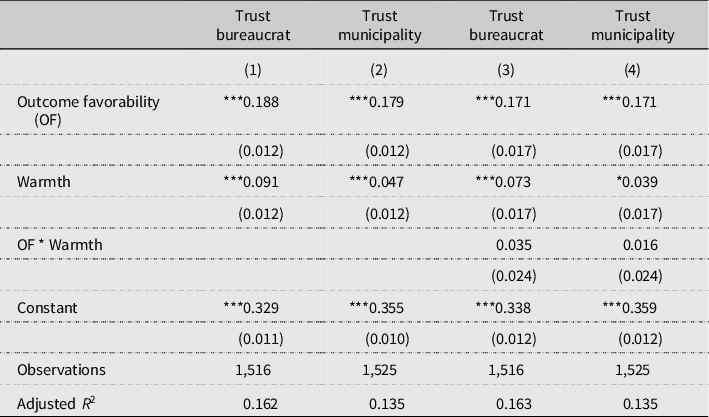
Models 1 and 2 in Table 1 present the results from ordinary least squares regressions (OLS) of the two trust outcomes on dummy variables for the outcome favorability treatment and warmth treatment. The first theoretical expectation (H1) predicted that the favorability of decisions has a direct positive effect on citizens’ trust in government. The findings suggest that the outcome favorability manipulation significantly increases trust in the bureaucrat with 18.8% points (p < .001). Moreover, in line with H1, it appears from model 2 that the municipality receives significantly higher levels of trust when delivering a favorable decision to citizens relative to delivering an unfavorable decision (17.9% points; p < .001). In terms of substantial significance, the coefficients for outcome favorability correspond to large effect sizes of .76–.78 standard deviations on the dependent variables. Even though no formal hypothesis was formulated, it follows from the theory that the warmth manipulation also should have a direct effect on citizens’ trust in government. Models 1 and 2 exploratively reports significant effects (p < .001) of the bureaucrat’s warmth on trust in the bureaucrat (9.1% points) and trust in the municipality (4.7% points). The effects are smaller with Cohen’s d of .36 for trust in the bureaucrat and .19 for trust in the municipality.
Experimental Results

NOTES: OLS regressions. Standard errors are represented in parentheses in models 1 and 2.
Heteroscedastic robust standard errors are used in models 3 and 4.
*p < 0.05; **p < 0.01; ***p < 0.001.
H2 predicted that the effect of outcome favorability would be weaker when bureaucrats show high warmth compared to low warmth. To find support for this expectation, we should observe that the mean difference in trust between unfavorable and favorable outcomes is significantly different in cases of high warmth compared to cases of low warmth. However, the insignificant interactions terms between the two treatments in models 3 and 4 show that warmth does not reduce the overall effect of outcome favorability. This implies that citizens, contrary to the expectation (H2), respond strongly to unfavorable outcomes with lower levels of trust even in cases of warm behavior by bureaucrats.
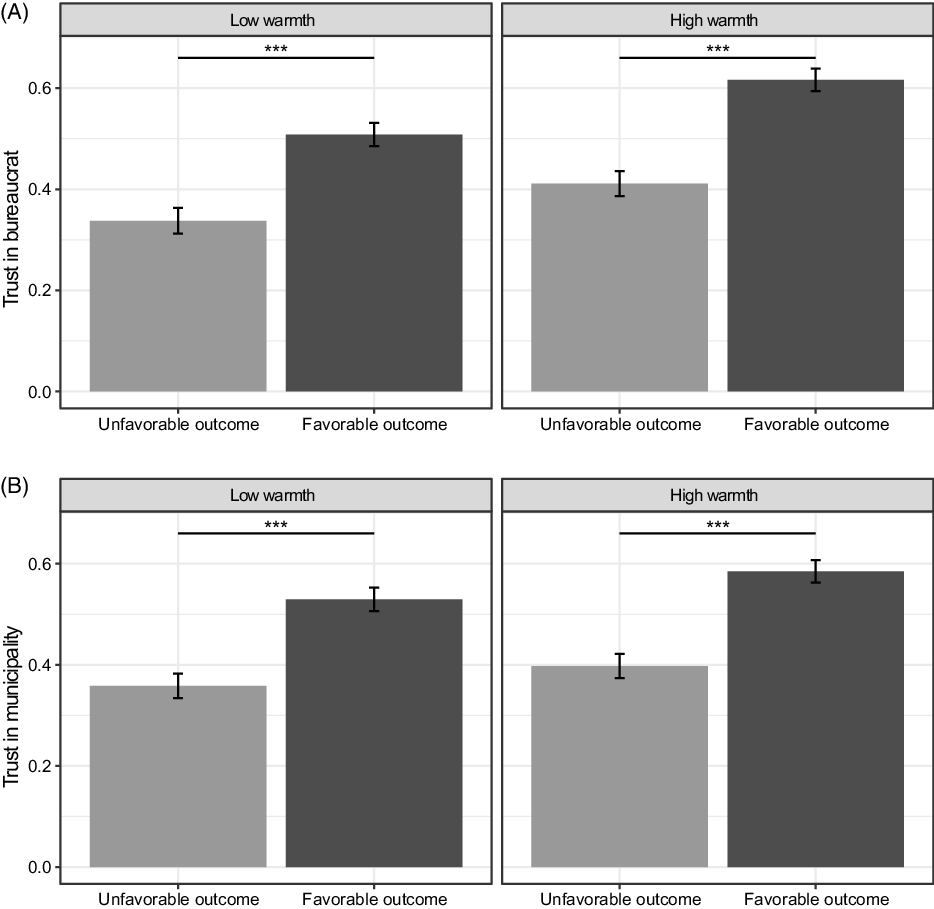
Comparing the gray bars in Figure 1 demonstrates that in cases of receiving unfavorable decisions, higher warmth significantly increases both trust outcomes (p < .05; see also the coefficients for “warmth” in models 3 and 4). Yet, the figure further shows that the reason behind the insignificant interaction terms is that warmth also increases the effect on trust in cases of favorable outcomes (comparing the black bars; p < .001). This underlines that warmth still is important since warm behavior by bureaucrats influence citizens’ trust judgments independently of outcome favorability. Footnote 7
Interaction Estimates.
Notes: Effect of the outcome favorability manipulation on trust in the bureaucrat (panel A) and trust in the municipality (panel B) conditional on the warmth treatment. Bars are means and lines are 95% CIs. ***p < 0.001.

Discussion and conclusion
This experimental study sought to contribute to our understanding of what drives citizens’ trust in government (e.g. Citrin and Stoker Reference Citrin and Laura2018; Van Ryzin Reference Van Ryzin2011); more specifically the impact of bureaucratic behavior and performance in citizen–state interactions. In particular, it was examined through a large-scaled survey experiment whether warm behavior by bureaucrats in interactions with citizens could mitigate the negative effect of providing citizens with unfavourable outcomes on citizens’ trust in government.
In line with earlier work (e.g. Popkin Reference Popkin1991; Allen and Birch Reference Allen and Sarah2015), the main results show that, also in bureaucrat–citizen interactions, citizens respond with higher levels of trust in government when bureaucrats provide them with favorable outcomes. In addition to outcomes, the results suggest that citizens are influenced by the bureaucrat’s warmth traits and respond with higher levels of trust when the bureaucrat is perceived as acting in a warm manner. It is important to note that the findings imply wider-ranging effects of both warmth and outcomes since both aspects have independent effects on not only trust in the bureaucrat but further on trust in the municipality more generally. Even though the effect sizes are smaller for warmth, the estimates might be lower bounds. That is, the identified effects should be larger in the real-world where people are expected to react stronger to the treatments since real outcomes are at stake. Yet, even small changes in trust can have substantial implications for smooth and successful citizen–state interactions.
While the findings back up the conclusions from earlier studies about that citizens genuinely care about (pure) warmth (Wojciszke, Bazinska, and Jaworski Reference Wojciszke, Bazinska and Jaworski1998; Fiske, Cuddy, and Glick Reference Fiske, Cuddy and Peter2007; Brambilla et al. Reference Brambilla, Rusconi, Sacchi and Cherubini2011; Fiske Reference Fiske2018), the findings do not support the theoretical expectation that warm bureaucratic behavior reduces the effect of outcome favorability on citizens’ trust in either the bureaucrat or the municipality. However, the results (see Appendix F for details) indicate that the effect of warmth on citizens’ trust might potentially be mediated by perceived fairness. Thus, the lack of an interaction effect speaks to the literature about whether outcome favorability and procedural fairness interact in predicting citizens’ reactions (Brockner and Wiesenfeld Reference Brockner and Wiesenfeld1996; Bøggild Reference Bøggild2016; Esaiasson et al. Reference Esaiasson, Persson, Gilljam and Lindholm2019). On the one hand, the findings presented here are in line with Bøggild (Reference Bøggild2016) who finds no interaction between outcome favorability and procedural fairness. However, it is also possible that warmth did not affect procedural fairness enough to offset the negative effect of unfavorable outcomes. Given that the estimates of warmth are conservative, we might find the expected interaction effect in a real-world situation. Yet, this is a question for future research, and such studies could also include experimental manipulations of both warmth and procedural fairness.
This study is limited by the low external validity of the survey experimental setting, but as stated earlier the estimates are likely to be larger in a real-world situation compared to the experiment. Still, future studies may want to examine whether the findings generalize across service areas of the public sector and to countries where the public sector plays a lesser role in providing services to citizens.
Concluding, the direct effects of warmth imply that public leaders should be concerned about whether their employees behave in a warm manner if they want to build greater trust. Either by motivating them to show warmth when interacting with citizens or by taking warmth into consideration when recruiting new bureaucrats.
Supplementary Material
To view supplementary material for this article, please visit https://doi.org/10.1017/XPS.2021.23.
Data Availability Statement
Support for this research was provided by the Department of Political Science, Aarhus University. The data, code, and any additional materials required to replicate all analyses in this article are available at the Journal of Experimental Political Science Dataverse within the Harvard Dataverse Network (Hansen Reference Hansen2021), at: https://doi.org/10.7910/DVN/KAMSQK
Acknowledgments
I thank Lasse Laustsen, Martin Bækgaard, Lene Aarøe, the editor, and the anonymous reviewers for helpful comments on previous drafts of this article.
Funding
This research was supported by funding from the Department of Political Science, Aarhus University.
Conflicts of Interest
The author declares no conflicts of interest.