


1. MOTIVATION: THE PROBLEM OF PERSPECTIVAL DIVERSITY IN THE IMPLEMENTATION OF LIBERAL RIGHTS
Many of us today live in a free democratic society in which we enjoy an array of liberal rights such as freedom of religion, freedom of thought, freedom of conscience, and so forth. One might say that a key defining feature of a liberal democratic society is to give priority to the protection of such basic rights and liberties that each citizen enjoys. The classical liberal political theorist, John Stuart Mill, summarized this basic view as follows:
Whatever theory we adopt respecting the foundation of the social union, and under whatever political institutions we live, there is a circle around every individual human being, which no government, be it that of one, of a few, or of the many, ought to be permitted to overstep. . . . That there is, or ought to be, some space in human existence thus entrenched around, and sacred from authoritative intrusion, no one who professes the smallest regard to human freedom or dignity will call in question. (Mill Reference Mill and Riley1994: Book 5, Chapter 11, Section 2: 326 emphasis mine)
In the part which merely concerns himself, his independence is, of right, absolute. Over himself, over his own body and mind, the individual is sovereign. (Mill Reference Mill and Warnock2003: Chapter 1: 95)
It is this circle around each individual, i.e. each individual's private sphere that any liberal democratic society seeks to protect by the assignment of basic rights and liberties by its very own constitution. By the assignment of these basic rights/liberties, each individual is conferred the exclusive power to control what happens in his/her own protected private sphere.
There is a specific way liberal rights have been interpreted in the tradition of social choice theory. According to the social choice theoretic tradition, an individual having a liberal right means that whenever two social states differ only in the specific aspects that solely concern what happens in the individual's private sphere, the individual's preferences over the two social states should be socially decisive – in the sense that the social state that is dispreferred by the individual must never be chosen whenever the preferred social state is socially available. This is essentially how the notion of liberal rights has been defined in the seminal works of Sen (Reference Sen1970a, Reference Sen1970b) and Gibbard (Reference Gibbard1974). Suzumura calls this 'the preference-contingent power of rejection' (Suzumura Reference Suzumura, Arrow, Sen and Suzumura2010: 617).
Now, suppose that we all accept as a matter of basic principle that a social choice made in a liberal democratic society must be consistent with the protection of each individual's basic rights/liberties. That is, a liberal democratic society must not impose a social alternative if it violates the basic rights/liberties of some individual; or, more specifically, in matters that only concern what happens in that individual's protected private sphere, the individual's own preferences must reign sovereign. It seems that this basic principle will not be that hard to implement as long as two things hold: (a) everybody agrees with the public demarcation of each individual's private sphere, and (b) everybody agrees with the specific nature (or ontology) of any given social state or alternative that may be socially realized. The problem is that in a pluralistic society, where different individuals are likely to hold radically different and incompatible world views, it will not be easy to satisfy these conditions.
Political philosophers have long noted that liberal institutions lead to diversity. For instance, the political philosopher John Rawls explained that modern liberal democracies are characterized by a 'diversity of conflicting and irreconcilable – and what's more, reasonable' comprehensive religious, philosophical and moral doctrines their citizens affirm and he further noted that, absent the use of oppressive state power, this kind of irreconcilable diversity will remain as a permanent feature of modern liberal democracies that any workable liberal political theory must accommodate (Rawls 1993/Reference Rawls2005: 36–38). Accordingly, he described one of his central philosophical tasks to show how 'there may exist over time a stable and just society of free and equal citizens profoundly divided by reasonable religious, philosophical, and moral doctrines' (Rawls 1993/Reference Rawls2005: xxv).
More recently, political philosophers have focused on a specific type of diversity that has not received its due attention in the past. The type of diversity that I am referring to now goes by the name 'perspectival diversity' (see Gaus Reference Gaus2016; Muldoon Reference Muldoon2016, Reference Muldoon2017). Perspectival diversity occurs when different people see or perceive the social world or social reality in fundamentally different and incompatible ways.
Figure 1 illustrates the case of perspectival diversity figuratively. In the figure, there is an objective 3-dimensional object. However, this 3-dimensional object is seen or perceived from three different perspectives. Based on the specific perspective, the object is seen or perceived as a 2-dimensional circle; or a 2-dimensional square; or a 2-dimensional triangle. The point is that depending on one's particular perspective, the same social reality can be interpreted and perceived in radically different ways. Gerald Gaus gives a more concrete illustration of how perspectival diversity may unfold in real political life:
A fundamental reason why these struggles [of religious conflict] are so deep and wide is not simply (perhaps not even at all) because various religious perspectives and secular world views have radically different understandings of justice, but because they have fundamentally different understandings of the social world that principles of justice are intended to regulate. A Catholic has a very different understanding of the social world – its real, underlying features – than does, say, a secular Darwinist philosopher. The social world that a Catholic occupies is one where sin and sanctity are features of states of affairs; they are not merely values or preferences, but basic features of the ontology of the world that determine the circumstances of social life. These features simply do not exist in the social world of the secular Darwinist – as he sees it, they are illusions or fantasies. (Gaus Reference Gaus2017: Section 3.2)
Perspectival DiversityFootnote 1

As Gaus explains, the fundamental disagreement between a Catholic and a secular Darwinist philosopher can be best understood, not as a disagreement in the principles of justice each side endorses, but rather as a disagreement in each side's perspective regarding the fundamental ontology of the social world we inhabit. Even when a Catholic and a Darwinist philosopher are confronted with the same objective social reality, they each assign different features or properties to it. This results in the violation of condition (b) – that is, perspectival diversity leads to disagreements in the specific nature or ontology of social states or alternatives.
Gerald Gaus nicely explains how perspectival diversity that leads to the violation of condition (b) can obstruct the proper allocation of specific rights even when everybody agrees on abstract principles of justice.
Consider how some of our deepest and most intractable disputes are not about values or principles of justice, but about the world to which these principles apply. The most obvious case is the long-standing and persistent struggle concerning abortion rights. Advocates of such rights see the case as decisively about fundamental rights of personal autonomy . . . But . . . opponents of abortion can be deeply devoted to such autonomy, but not in cases where it entails overriding another's right to life. . . . The dispute is centrally about the social world to which the principles of autonomy and the right to life apply: the two social worlds do not have the same set of persons, and so even perfect agreement about abstract principle of justice would not resolve the dispute. (Gaus Reference Gaus2017: Section 3.2)
So, the interesting thing about perspectival diversity is that it can lead to irreconcilable social disagreement about social ontology, which, in turn, can obstruct the proper allocation and assignment of rights (such as abortion rights) even when people endorse the same abstract principles of justice. As Gaus explains, in the case of the debate on abortion rights, we can see that both sides of the debate may fully accept that each person has a right to personal autonomy as well as a right to life. The reason why they cannot agree on whether abortion rights should be constitutionally guaranteed is that each side of the debate sees or perceives an act of abortion in a fundamentally different way; one side sees/perceives it as a removal of a non-human cell, and, hence, a proper exercise of the pregnant woman's right to personal autonomy, while the other side sees/perceives it as a violation of another person's (viz. the fetus’) right to life.
The existence of perspectival diversity can obstruct the proper allocation and assignment of rights in another way; by causing disagreement about the very demarcation of each individual's private sphere, and, hence, violating condition (a). This can be illustrated by the longstanding debate on the regulation of pornography. The people who advocate pornography argue that as long as the production and consumption of pornography are conducted by fully informed consenting adults, there is no harm caused (either to themselves or to outside third parties), and, hence, it will be a violation of the participating individuals’ basic rights (viz. their freedom of taste and freedom of expression) to regulate pornography at the state level. However,
Adversaries of pornography like MacKinnon, Langton, and Dworkin have all done so on grounds that pornography harms women's social position, and undermines their ability to be full participants in civic life. Importantly, this is true not only of the participants in the pornographic material, but all women. . . . This is what makes the matter so complex. The application of the Harm Principle is perspective-dependent. (Muldoon Reference Muldoon2017: Section 4 emphasis mine)
What Muldoon is referring to in the last sentence is John Stuart Mill's Harm Principle. According to Mill's harm principle, 'the only purpose for which power can be rightfully exercised over any member of a civilized community, against his will, is to prevent harm to others' (Mill Reference Mill and Warnock2003: 94). The point is that even when everybody agrees that Mill's harm principle should serve as a constraint when designing a system of rights, people might disagree, based on their own particular perspectives, about what precisely constitutes harm. For instance, there could be people who strongly believe that what one watches or enjoys in one's own bedroom during one's spare time is not strictly a private matter; it is a space that could be legitimately regulated by the state precisely because what one does in one's bedroom can potentially harm other people. What this shows is that perspectival diversity can lead to irresolvable disagreement in the very demarcation of each individual's private sphere, resulting in the violation of condition (a). When this happens, society may fail to reach a consensus on the very design of a system of rights, even when everybody agrees on the basic principle that each should have an exclusive right to control what happens in her (or his) private sphere.
The purpose of this paper is to formally examine from the framework of social choice theory the extent to which perspectival diversity generates new challenges to the very design and proper implementation of a system of liberal rights.
2. A BRIEF LITERATURE REVIEW
Amartya Sen was one of the first to notice and to formally show that the notion of individual rights can conflict with the weak Pareto principle (Sen Reference Sen1970a, Reference Sen1970b, Reference Sen1976). Sen's understanding of liberal rights was that each individual should be assigned a pair of social alternatives over which she (or he) is socially decisive. Allan Gibbard (Reference Gibbard1974) has extended this idea by thinking of each social alternative as a list of individual features and interpreting a scheme of liberal rights as an assignment of a specific feature of the social alternatives over which the individual is socially decisive. This quickly led to an impossibility result; that is, under Gibbard's definition of liberal rights, it was quite easy find a specification of social alternatives and individual preferences that led to an empty social choice set (Gibbard Reference Gibbard1974: Theorem 1, 392).
Gibbard identified the heart of the problem as stemming from allowing the social implementation of liberal rights to be determined by people's conditional (or meddlesome) preferences (Gibbard Reference Gibbard1974: 393; see also Blau Reference Blau1975). The remedy was to restrict our attention to unconditional preferences when socially implementing an individual's rights-claim; that is, for Gibbard, an individual i has a liberal right if there exists a specific feature k of the social world over which her preferences are socially decisive whenever she prefers one feature-k-alternative x k over another feature-k-alternative y k unconditionally (Gibbard Reference Gibbard1974: 393). This definition of liberal rights was internally coherent; however (just as Sen's definition of liberal rights), Gibbard's initial definition of liberal rights turned out to be incompatible with the weak Pareto principle.
Gibbard's solution was to present a notion of an alienable liberal right. Intuitively, if the exercise of one's liberal rights results in a social choice that is no better than what would have been otherwise socially chosen if one did not exercise one's liberal rights, then it might have been better if one were to have had waived one's rights if such an option were possible. Letting each individual waive her rights whenever doing so would result in a social choice that would be no worse than the social choice that would obtain when she exercises her rights is the essence of having an alienable right. Gibbard justified this thought of waiving one's rights by explaining that 'There is a strong libertarian tradition of free contract, and on that tradition, a person's rights are his to use or bargain away as he sees fit' (Gibbard Reference Gibbard1974: 397). Gibbard showed that such a scheme of alienable rights is not only internally coherent, but that it is also consistent with the weak Pareto principle (Gibbard Reference Gibbard1974: Theorem 4, 401).
However, it was not long until Jerry Kelly (Reference Kelly1976) and Kotaro Suzumura (Reference Suzumura1980) discovered that the compatibility between Gibbard's notion of alienable rights and the weak Pareto principle hinges on the subtle interpretation of when an individual is asked to waive her rights. For Gibbard, an individual decides to waive her rights whenever doing so results in a social choice that is no worse than the social choice that would have obtained otherwise. However, Kelly notes that waiving one's right would be appropriate only when doing so results in a social choice that would be strictly better than the social choice that would have eventually obtained by exercising one's rights (Kelly Reference Kelly1976: 141). And, if we assume that individuals will waive their rights only when doing so would make them strictly better as Kelly proposes, this again results in an incoherent notion of liberal rights; that is, we again arrive at an empty social choice set under universal domain (see Suzumura Reference Suzumura1980).
There have been many other proposals that have been made in the literature that attempt to make the notion of liberal rights both coherent in itself as well as compatible with the weak Pareto principle. For instance, Alon Harel and Shmuel Nitzan tried to solve the puzzle by allowing individuals to voluntarily exchange their conferred liberal rights (Harel and Nitzan Reference Harel and Nitzan1987). Kotaro Suzumura tries to resolve the tension by weakening the weak Pareto principle (Suzumura Reference Suzumura1983: chapter 7.2).
In 1992, Wulf Gaertner, Prasanta Pattanaik and Kotaro Suzumura published 'Individual Rights Revisited' that fundamentally challenged the social choice theoretic framework that tries to formalize and understand liberal rights in terms of an individual's preference-contingent power of rejection. In their paper, Gaertner et al. provide an example (which we will briefly discuss in Section 5) in which the social outcome that emerges from the free choices made by the individuals violates some individual's preference-contingent power of rejection (Gaertner et al. 1992: 164–165). The point is that even if the social outcome did violate some individual's preference-contingent power of rejection, we cannot say that there was any violation of individual rights as the social outcome was generated by each individual's free voluntary choice (see Gaertner et al. 1992: Sections II, III).
Gaertner, Pattanaik, and Suzumura give this as a reason for why we should move away from a social choice theoretic analysis of individual rights that focuses on an individual's preference-contingent power of rejection and move toward what is known as the 'game form formulation of individual rights' (Gaertner et al. 1992: Section IV).
The game form formulation of individual rights has an obvious advantage. It interprets individual rights as the set of admissible strategies available to each individual. This has the advantage of making it apparent how the exercise of one individual's rights can affect the set of admissible actions of other individuals. However, the game form approach of liberal rights already assumes that these rights have been allocated (in the form of admissible strategies) to each individual, and does not consider how a system of rights can initially come about from the process of constitutional design.
How are rights granted in the first place in the framework of game form formulation of individual rights? This is an important question, but we ignore it here, since we are not addressing the problem of how or why rights come into existence. (Gaertner et al. 1992: 174)
This makes the game form formulation of individual rights an inadequate framework from which we can tackle our current problem – which is to analyse how the problem of perspectival diversity affects the assignment and implementation of liberal rights. In order to initially design and implement a system of liberal rights in a pluralistic democratic society, we do need to consult each individual's preferences as well as his/her perspectives. The social choice theoretic framework again becomes relevant.
3. A MODEL OF LIBERAL RIGHTS WITH PERSPECTIVAL DIVERSITY
Let N = {1, . . ., n} (2 ⩽ n < +∞) be the set of all individuals constituting a liberal democratic society. Let X be the set of all social states, where each social state is 'a complete description of society including every individual's position in it' (Sen Reference Sen1970b: 152). For our purpose, we assume that X is the product set X 0 × X 1 × ⋅⋅⋅ × Xn (i.e. X = X 0 × X 1 × ⋅⋅⋅ × Xn), where each Xi (i = 1, . . ., n) denotes the set of all possible features of the social world that only concerns individual i’s private sphere, and X 0 denotes the set of all other features of the social world. So, basically, any given social world x ∈ X = X 0 × X 1 × ⋅⋅⋅ × Xn is a list of features/properties (of length n + 1) that fully describes what occurs in each individual's private sphere. We assume that each Xi (i = 0, . . ., n) is finite. Hence, X is also finite.
For each i ∈ {1, . . ., n}, define πi: X → X. We call the mapping πi (i = 1, . . ., n) individual i’s perspective. For each x = (x 0, . . ., xn) ∈ X, we will write πi(x) = πi(x 0, . . ., xn) as xi = (xi 0, . . ., xn i), which denotes the social state x seen from individual i’s specific perspective. (That is, xi is the image of πi taking x as its argument.) So, we are allowing the possibility of each individual seeing or perceiving each social state in X from his/her own unique perspective, which may differ from individual to individual. When xi ≠ xj, then this means that individuals i and j perceive the social state x differently (e.g. i sees the social state x as a state in which the pregnant woman removes a non-human cell from her body (xi), while j sees the social state x as a state in which the pregnant woman kills an innocent human being (xj)); inversely, if xi = xj, then this means that individuals i and j perceive the social alternative x identically. Let π = (πi)ni = 1 = (π1, . . ., πn) denote the profile of individual perspectives, and let Π be the set of all logically possible profiles of individual perspectives.
Let Xi = Xi 0 × X 1i × ⋅⋅⋅ × X in = {πi(x)|x ∈ X = X 0 × X 1 × ⋅⋅⋅ × Xn} be the set of all social states/alternatives seen from individual i’s own perspective. We assume that each individual i ∈ N has a preference relation Ri defined on Xi (i.e. Ri⊆Xi × Xi) that is complete and transitive.Footnote 2 When (xi, yi) ∈ Ri, this means that individual i judges that the social state x (seen from his/her own perspective) is at least as good as the social state y (seen from his/her own perspective.) In this way, each individual i's preference relation Ri on Xi induces each individual i's preference relation Ri on X such that for all x, y ∈ X and for all xi, yi ∈ Xi (x, y) ∈ Ri if and only if (xi, yi) ∈ Ri. As a notational convention, we will write (xi, yi) ∈ Ri and xiRiyi interchangeably. Each individual's strict preference relation Pi and indifference relation I i are defined in the usual way, i.e. for all xi, yi ∈ Xi, x iPiyi if and only if  $\neg {y^i}{R_i}{x^i}$; and x iIiyi if and only if x iRiyi and yiRixi. It follows that Pi is asymmetric and negatively transitive, and I i is an equivalence relation.Footnote 3
Let R = (Ri)ni = 1 = (R 1, . . ., Rn) denote the profile of individual preference orderings, and let  ${\cal R}$ be the set of all logically possible profiles of individual preference orderings. Sometimes, we may restrict our attention only to a set F⊆X of social states that are ‘feasible’. Let ℑ be the set of all non-empty subsets of X; then, ℑ is the set of all logically possible feasible sets of social states.
A social choice problem is a triple (F, R, π) = (F, (Ri)ni = 1, (πi)ni = 1) = (F, (R 1, . . ., Rn), (π1, . . ., πn)); it is characterized by a feasible set of social states, a profile of individual preference orderings and a profile of individual perspectives. For any social choice problem (F, R, π), a social preference function P*(F, R, π) generates an asymmetric binary relation over the social states in F based on the profile of individual preference orderings and the profile of individual perspectives. We will regard P*(F, R, π) as society's preferences. For any x, y ∈ F, xP*(F, R, π) y will mean x is strictly socially preferred to y. A social choice function C(F, P*(F, R, π)) is defined as  ${\rm{C}}( {F,{P^*}( {F,\ R,\pi } )\ } ) = {\rm{\{ }}x \in F\ {\rm{|}}\
\mathord{\setbox0=\hbox{$\exists$} \rlap{\raise.2ex\hbox to\wd0{\hss/\hss}}\box0} y \in F,\ y{P^*}( {F,\ R,\pi } )x\} $ – that is, for any given social choice problem (F, R, π), a social choice function C(F, P*(F, R, π)) generates the set of undominated social states in the feasible set F with respect to the social preference relation P*(F, R, π). Given any admissible social choice problem
 $( {F,\ R,\pi } ) \in \Im \times {\cal R} \times {\rm{\Pi }}$, we would at the very least want our society to be able to always determine a viable choice. That is, for all admissible social choice problems
 ${\rm{\ }}( {F,\ R,\pi } ) \in \Im \times {\cal R} \times {\rm{\Pi }}$, we want our social choice function C(F, P*(F, R, π)) to be non-empty. We state this as one of our desired conditions.
Condition C (Non-Empty Social Choice): For all admissible social choice problems ${\rm{\ }}( {F,\ R,\pi } ) \in \Im \times {\cal R} \times {\rm{\Pi }}$, C(F, P*(F, R, π)) ≠ ∅.
Now, for each i ∈ N and each x = (x 0, . . ., xn) ∈ X, let x − i ≡ (x0, . . ., x i − 1, x i + 1, . . ., xn). Then, for all x = (x 0, . . ., xn), y = (y 0, . . ., yn) ∈ X, we say that x and y are i-variants whenever x − i = y − i. In other words, when two social states x and y are i-variants, this means that the two social states are identical in all aspects except for that particular aspect within individual i's private sphere. Suppose a, b ∈ Xi – that is, a and b are two different alternatives that solely concern what happens in individual i's private sphere. We say that individual i prefers a to b unconditionally if and only if for every pair of i-variants x i and y i in Xi (i.e. xi − i = y − ii), if xii = a and yii = b, then xiPiyi.
Suppose that we wish to design a system of liberal rights that is consistent with Condition C. That is, we wish our system of liberal rights to at least never generate an empty social choice set. Then, what would it mean for an individual to have a liberal right in this setting? Intuitively, an individual would have a liberal right if she is able to have control over what happens in her private sphere. As explained, an individual would have no control over her private sphere if society is able to impose a specific social state over another social state, when the two social states differ only in that particular aspect that relates to the individual's private sphere, even when the individual strictly prefers the other social state to the one that society tries to impose. Hence, in order for an individual to have a liberal right, she would, at the very least, have to have the power to veto the social imposition of a specific social state over another social state – where the two social states differ only in what happens in her private sphere – against her individual preferences. Again, this is essentially how liberal rights have been defined in the seminal works of Sen (Reference Sen1970a, Reference Sen1970b) and Gibbard (Reference Gibbard1974). Suzumura calls this kind of liberal right 'the preference-contingent power of rejection' (Suzumura Reference Suzumura, Arrow, Sen and Suzumura2010: 617).
Now, suppose that everybody in society agrees with the basic principle of assigning everybody a right to control (interpreted as having a preference-contingent power of rejection) over what happens exclusively inside one's private spheres. However, in the introduction, we have seen that the presence of perspectival diversity may lead people to disagree on either (a) the demarcation of individual private spheres or (b) on the specific nature or ontology of social states, which, in turn, may obstruct the proper assignment of rights.
Consider again the debate on whether a pregnant woman should be allowed to have abortion rights. The pregnant woman (individual i) who wishes to abort her foetus may see the social state x (having an abortion) and the social state y (not having an abortion) to be different only in that particular aspect within her private sphere (viz. xi and yi are i-variants). However, a Catholic (individual j) might see the social state x as involving the violation of another person k’s rights (where k is the fetus) while the social state y does not involve such violation of k’s rights. For individual j, xj and yj are not i-variants (i.e. xj − i ≠ y − ij). We can see that the pregnant woman (individual i) and the Catholic (individual j)’s different perspectives have led them to disagree on both the demarcation of private spheres (violation of (a)) as well as the specific natures/properties in the two social states x and y (violation of (b)). Using our notation, here, we have a situation in which xi ≠ xj and yi ≠ yj; xi − i = y − ii and xj − i ≠ y − ij; and xiPiyi and yjPjxj. What we have here is a conflictual situation in which not only do the pregnant woman (individual i) and the Catholic (individual j) perceive the two social states x and y differently (i.e. xi ≠ xj and yi ≠ yj), they disagree on whether the two social states x and y differ only in what goes on in the pregnant woman's (individual i) private sphere (i.e. xi − i = y − ii and xj − i ≠ y − ij.) Whenever there is such a conflict, we will not be able to grant the pregnant woman (individual i) the right to exclude social state y (not having an abortion) from the social choice set even when everybody agrees on the basic liberal principle that each should be decisive in his/her own private sphere.Footnote 4 The following is our definition of liberal rights that incorporates such complications into its very definition:
Definition L (Liberal Rights under Perspectival Diversity): We say that individual i has a liberal right (in a world with perspectival diversity) if and only if for all social choice problems ${\rm{\ }}( {F,\ R,\pi } ) \in \Im \times {\cal R} \times {\rm{\Pi }}$ and for all x, y ∈ F such that xi and yi are i-variants (i.e. xi − i = y − ii), y∉C(F, P*(F, R, π)) holds, if and only if i prefers xii to yi i unconditionally, and either
(i) ∀j ∈ N, xi = xj and yi = yj or
(ii) ∀j ∈ N such that xi ≠ xj or yi ≠ yj, xjRjyj.Footnote 5
Let me try to explain this definition of liberal rights more intuitively. In defining liberal rights in a society with perspectival diversity, I am basically following the social choice theoretic tradition of defining liberal rights as having a 'preference-contingent power of rejection' – in the sense that an individual has a liberal right if, between any two social alternatives that differ only in what happens inside the individual's protected sphere, the individual has the power to reject the social alternative that she disprefers, from being socially chosen. Under our definition, whenever everybody agrees with the purported right-holder's perspective and perceives the two social alternatives under considerations to be different only in that specific aspect that concerns the purported right-holder's private sphere, the right-holder can exercise her preference-contingent power of rejection unabatedly. This is the essence of clause (i).
However, if there is anybody who perceives the two social alternatives differently from the purported right-holder (this includes cases where there are people who disagree that the two social alternatives under consideration are different only in that specific aspect that concerns the purported right-holder's protected sphere), then the purported right-holder can exercise her preference-contingent power of rejection only when those who hold different perspectives with the purported right-holder minimally agree that the social alternative that gets rejected is no better than the other social alternative under consideration. This is the essence of clause (ii).Footnote 6
Let me clarify a number of things before we proceed. First, clause (ii) may look similar to a version of a Pareto condition. However, clause (ii) is importantly different from any Pareto conditions, and it is important to understand exactly how the two conditions are different. Let us define the relevant Pareto condition.
Condition P (Strong Pareto): For all social choice problems ${\rm{\ }}( {F,\ R,\pi } ) \in \Im \times {\cal R} \times {\rm{\Pi }}$, and for any x, y ∈ F, if ∀i ∈ NxRiy and ∃k ∈ N such that xPky, then xP*(F, R, π)y.
Here is a summary of the main differences between clause (ii) of Definition L (Liberal Rights under Perspectival Diversity) and Condition P (Strong Pareto). To start, in clause (ii) of the definition of liberal rights, the purported right-holder (say, i) needs to view the two social alternatives x and y as i-variants (xi − i = y − ii) – that is, she needs to see/perceive the two social alternatives x and y as being different only in matters within her private sphere – in order to impose her private preferences as society's preferences. Furthermore, her preferences over the two alternatives x and y has to be unconditional. By contrast, the strong Pareto condition requires neither of this; given that everybody in society weakly prefers x to y, the person (say, k) who strictly prefers x to y can socially impose her preferences even if she does not see or perceive the two social alternatives x and y as being k-variants (i.e. even if xk − k ≠ y − kk), and even if she does see/perceive the two social alternatives x and y as being k-variants (i.e. xk − k = y − kk), she need not prefer xkk to ykk unconditionally.
In other words, unlike the strong Pareto condition, clause (ii) of Definition L restricts matters to only what one conceives to be within one's private sphere for one to potentially impose one's private preferences over society. Furthermore, whereas the strong Pareto condition requires everybody to weakly agree that a certain social alternative is better than another in order for somebody to socially impose her private preferences, clause (ii) of Definition L only requires those who have different perspectives to weakly agree with the purported right-holder's private preferences for such preferences to be socially imposed by the exercise of the right-holder's rights.
It is important to understand that neither condition logically implies the other. To illustrate this, let x and y be two social alternatives in the feasible set F, and suppose ∀i ∈ N\{k} xIiy and xPky but xk − k ≠ y − kk. In other words, individual k strictly prefers x to y, but she does not think that x and y differ only in what happens in her private sphere – i.e. she does not think that the two social alternatives x and y are k-variants. All other individuals are indifferent between the two social alternatives. In this case, we are able to apply strong Pareto and get xP*(F, R, π)y. However, we cannot apply Definition L and conclude y∉C(P*(F, R, π)), since x and y are not k-variants. We might say that, in this case, individual k may get her wish as a matter of unanimous agreement (if we accept strong Pareto), but even when this happens, her wish was not granted by the exercise of her rights (i.e. it is neither the result of applying clause (i) nor clause (ii) in Definition L.)
Now, suppose x 1 − 1 = y − 11 and individual 1 prefers x 11 to y 11 unconditionally, x 2 − 1 ≠ y − 12 and xR 2y, and ∀i ∈ N\{1, 2}, xi − 1 = y − 1i and yPix. In words, individual 1 perceives the two social alternatives x and y as 1-variants, i.e. she perceives x and y as being different only in what happens in her private sphere, and unconditionally prefers x to y; individual 2 does not think that the two social alternatives x and y are different only in what happens in individual 1’s private sphere but thinks that x is at least as good as y; and all other individuals agree that x and y are different only in what happens in individual 1’s private sphere but has the opposite preferences to that of individual 1, i.e. they strictly prefer y to x. In this case, we cannot apply strong Pareto to conclude xP*(F, R, π)y. However, we can still apply clause (ii) of Definition L and have y∉C(F, P*(F, R, π)). Hence, we can see that clause (ii) of Definition L and the strong Pareto condition are very different; neither of the conditions logically implies the other.
In sum, the main intuition behind the two clauses of Definition L is this. Having a liberal right means that each individual's own preferences concerning what happens inside what the individual herself perceives to be her private sphere must be socially decisive; however, if there are disagreements on what aspects of the social world rightfully belong to an individual's private sphere (i.e. there is perspectival disagreement that leads to the violation of condition (a)), a right to determine what happens in what one conceives to be one's private sphere can be granted only if those who hold opposing perspectives can minimally agree with one's (i.e. the purported right-holder's) preferences.
Second, another thing to note is the 'only if' part of Definition L. What the 'only if' part of Definition L is saying is that the only legitimate way we can reject a feasible social alternative from the social choice set is for somebody to exercise her liberal rights to specifically reject that social alternative. In other words, any feasible social alternative will remain in the social choice set and be potentially considered as a viable social choice unless somebody exercises her liberal right to specifically reject it. The main reason for doing this, at least for now, is to isolate the effects of our notion of liberal rights on the set of viable social choices. (We will later delete the 'only if' part of Definition L and see how it relates to the strong Pareto principle.)
We now introduce a condition that requires everybody to have liberal rights in the sense described in Definition L in a society with perspectival diversity.
Condition L (Liberalism): Each individual i ∈ N = {1, . . ., n} has a liberal right in the sense defined in Definition L.
4. LIBERAL RIGHTS UNDER DIFFERENT DEGREES OF PERSPECTIVAL DIVERSITY
We will now examine whether the notion of liberal rights, so defined, is workable, in the sense of being able to produce a viable social choice consistent with its implementation, under varying degrees of perspectival diversity. As a first step, we want to verify that our definition of liberal rights generates a possibility result when there is no perspectival diversity. This is to test that our definition of liberal rights is at least a coherent concept in itself.
Definition ND (No Diversity): A profile π = (π1, . . ., πn) of individual perspectives satisfies ND (No Diversity) if and only if there exists no perspectival diversity – that is, everybody perceives any given social alternative in the same way, i.e. ∀x ∈ X, ∀i, j ∈ N, xi = xj.
Condition ND (Domain of No Diversity): Only the social choice problems  $( {F,\ R,\pi } ) \in \Im \times {\cal R} \times {\rm{\Pi }}$, where π = (π1, . . ., πn) satisfies definition ND, are admissible.
THEOREM 1: Under ND (Domain of No Diversity), L (Liberalism) implies C (Non-Empty Social Choice).
Proof: Assume ND (Domain of No Diversity) and L (Liberalism). For a proof by contradiction, suppose condition C (Non-Empty Social Choice) is violated. Then, there exists a social choice problem  $( {F,\ R,\pi } ) \in \Im \times {\cal R} \times {\rm{\Pi \ }}$ such that C(F, P*(F, R, π)) = ϕ. Pick any xa ∈ F. Since C(F, P*(F, R, π)) = ϕ, xa∉C(F, P*(F, R, π)). This means that there exists some individual, say k ∈ N, who has exercised her liberal right to reject xa from the social choice set. Hence, there exists some alternative, say xb ∈ F, such that xka and xkb are k-variants, individual k prefers xkbk to xkak unconditionally, and either
(i) ∀j ∈ N, xka = xa j and xkb = xb j; or
(ii) ∀j ∈ N such that xka ≠ xa j or xkb ≠ xb j: xjbRjxja.
Since individual k prefers xkbk to xkak unconditionally, we have xkbPkxka. For any y ∈ X, let y* be the k-variant of xka such that the k-component of y* is the k-component of y. Since x*ka = xa k and x*kb = xb k, xka and xkb are k-variants, and individual k prefers xkbk to xkak unconditionally, we have x*kbPkx*ka.
Now, since C(F, P*(F, R, π)) = ϕ, xb∉C(F, P*(F, R, π)). This implies that there exists an individual, say k' ∈ N, and another social alternative, say xc ∈ F, such that x k'b and x k'c are k'-variants, and individual k' prefers x k'ck' to x k'bk' unconditionally and either
(iii) ∀j ∈ N, x k'b = xb j and x k'c = xc j; or
(iv) ∀j ∈ N such that x k'b ≠ xb j or x k'c ≠ xc j: xjcRjxjb.
By ND (Domain of No Diversity), case (iv) does not arise, so we can ignore it. First, suppose k' = k. Then, just as before, and individual k prefers xkck to xkbk unconditionally, we have xkcPkxkb. Since xkb = xb*k and xkc = xc*k, we have x*kcPkx*kb. Next, suppose if k' ≠ k. Then, since x k'b = xb k and x k'c = xc k are k'-variants, the k-components of x k'b = xb k and x k'c = xc k will be the same. Hence, x*k'b = xb*k = x*kc = xc*k', which implies x*kcRkx*kb.
So, in all cases, we have x*kcRkx*kb. So, we have x*kcRkx*kb and x*kbPkx*ka. (Note that x*ka, x*kb, x*kc ∈ Xk) We may repeat the same argument over and over again, and, since F is finite, we will eventually reach a cycle of the form x*kaRkx*kz⋅⋅⋅x*bkPkx*ka, which implies x*kaPkx*ka. This contradicts that Pk is asymmetric, and, thereby, irreflexive on Xk.■
What we have just verified is that when there is no perspectival diversity, respecting people's liberal rights (in the sense defined in Definition L) will always guarantee a non-empty social choice set for any feasible set of social alternatives. In other words, our definition of liberal rights is at least internally coherent and socially implementable when society faces no perspectival diversity. Now, let us consider what happens when we allow unrestricted perspectival diversity.
Condition UD (Unrestricted Domain): All social choice problems  $( {F,\ R,\pi } ) \in \Im \times {\cal R} \times {\rm{\Pi }}$ are admissible.
One thing to remember is that, unlike previous work in social choice theory, our domain now includes individual perspectives. Hence, in our current framework, UD (Unrestricted Domain) allows not only any profile of individual preference orderings, but it also allows any profile of individual perspectives. In other words, UD allows unrestricted perspectival diversity.
For instance, under UD (Unrestricted Domain), not only is it possible for different people to assign different descriptions over the same social state, it is possible for somebody to think two social alternatives are not, say, k-variants even when everybody else perceives the two social alternatives as k-variants (i.e. people may disagree on the very demarcation of each individual's private sphere). In other words, UD (Unrestricted Domain) permits the violations of both conditions (a) and (b). How would allowing unrestricted perspectival diversity affect a society's capacity to respect liberal rights and at the same time make non-vacuous social choices? The following theorem gives an impossibility result.
THEOREM 2: Suppose |X| ⩾ 4 and n ⩾ 4. Then, there exists no social choice function that satisfies conditions UD (Unrestricted Domain), L (Liberalism) and C (Non-Empty Social Choice).
Proof: Let F = {w, x, y, z} and suppose individuals 1 to 4 have the following preferences:
 $$\begin{equation*}
{z^1}{R_1}{w^1}{P_1}{x^1}{R_1}{y^1};
\end{equation*}$$
 $$\begin{equation*}
{w^2}{R_2}{x^2}{P_2}{y^2}{R_2}{z^2};
\end{equation*}$$
 $$\begin{equation*}
{x^3}{R_3}{y^3}{P_3}{z^3}{R_3}{w^3};
\end{equation*}$$
 $$\begin{equation*}
{y^4}{R_4}{z^4}{P_4}{w^4}{R_4}{x^4}
\end{equation*}$$
where individual 1 prefers w 11 to x 11 unconditionally; individual 2 prefers x 22 to y 22 unconditionally; individual 3 prefers y 33 to z 33 unconditionally; and individual 4 prefers z 44 to w 44 unconditionally.
For all j ∈ N\{1, 2, 3, 4}, suppose
 $$\begin{equation*}
{w^j}{I_j}{x^j}{I_j}{y^j}{I_j}{z^j}.
\end{equation*}$$
Call this profile of individual preferences R and the profile of perspectives π. By condition UD, the social choice problem (F, R, π) is in our domain. Now, assume
 $$\begin{equation*}
\ {w^1}, {x^1}\ {\rm{are\ }}1 - {\rm{variants}};
\end{equation*}$$
 $$\begin{equation*}
\ {x^2}, {y^2}\ \ {\rm{are\ }}2 - {\rm{variants}};
\end{equation*}$$
 $$\begin{equation*}
{y^3}, {z^3}\ \ {\rm{are\ }}3 - {\rm{variants}};
\end{equation*}$$
 $$\begin{equation*}
{z^4},{w^4}\ \ {\rm{are\ }}4 - {\rm{variants}}.
\end{equation*}$$
Also, suppose
 $$\begin{equation*}
{w^1} = {w^3} \ne {w^2} = {w^4}
\end{equation*}$$
 $$\begin{equation*}
{x^1} = {x^3} \ne {x^2} = {x^4}
\end{equation*}$$
 $$\begin{equation*}
{y^1} = {y^3} \ne {{\rm{y}}^2} = {y^4}
\end{equation*}$$
 $$\begin{equation*}
{z^1} = {z^3} \ne {z^2} = {z^4}.
\end{equation*}$$
So, individuals 1 and 3 share the same perspective, while individuals 2 and 4 share the same perspectives, and all other individuals share the same perspective that is different from any perspective that individuals 1, 2, 3 and 4 have.
• Since w 1, x 1 are 1-variants; individual 1 prefers w 11 to x 11 unconditionally; w 2R 2x 2 (and x 1 ≠ x 2); x 3P 3w 3 (and w 1 = w 3 and x 1 = x 3); w 4R 4x 4 (and w4 ≠ w 1); and wjRjxj for all j ∈ N\{1, 2, 3, 4}, by condition L, individual 1 has a liberal right to reject x as a viable social choice, and, hence, we must have x∉C(F, P*(F, R, π)).
• Since x 2, y 2 are 2-variants; individual 2 prefers x 22 to y 22 unconditionally; x 3R 3y 3 (and y2 ≠ y 3); y 4P 4x 4 (and x 2 = x 4 and y 2 = y 4); x 1R 1y 1 (and x 2 ≠ x 1); and xjRjyj for all j ∈ N\{1, 2, 3, 4}, by condition L, individual 2 has a liberal right to reject y as a viable social choice, and, hence, we must have y∉C(F, P*(F, R, π)).
• Since y 3, z 3 are 3-variants; individual 3 prefers y 33 to z 33 unconditionally; y 4R 4z 4 (and z 3 ≠ z 4); z 1P 1y 1 (and y 3 = y 1 and z 3 = z 1); y 2R 2z 2 (and y3 ≠ y 2); and yjRjzj for all j ∈ N\{1, 2, 3, 4}, by condition L, individual 3 has a liberal right to reject z as a viable social choice, and, hence, we must have z∉C(F, P*(F, R, π)).
• Since z 4, w 4 are 4-variants; individual 4 prefers z 44 to w 44 unconditionally; z 1R 1w 1 (and w 4 ≠ w 1); w 2P 2z 2 (and z 4 = z 2 and w 4 = w 2); z 3R 3w 3 (and z4 ≠ z 3); and zjRjwj for all j ∈ N\{1, 2, 3, 4}, by condition L, individual 4 has a liberal right to reject z as viable social choice, and, hence, we must have w∉C(F, P*(F, R, π)).
Hence, we have C(F, P*(F, R, π)) = ϕ, an empty social choice set, violating condition C.■
The main takeaway point of Theorem 2 is this: when society allows unrestricted perspectival diversity, and society's level of perspectival diversity, thereby, increases to the extent that not only do people perceive social alternatives differently (violating condition (b)), but people no longer agree on the fundamental demarcation of each person's protected private spheres (violating condition (a)), we will not be able to generate a scheme of liberal rights that could properly adjudicate social conflict in a way that determines a determinate social choice. When this happens, society reaches a deadlock; there will be cases in which our society will not be able to implement any social alternative in the feasible set.
The upshot is that unrestricted perspectival diversity is harmful to the proper allocation and implementation of liberal rights in a liberal democratic society. This means that if we wish to render a scheme of liberal rights viable, perspectival diversity must be restricted to some degree. We have seen from Theorem 1 that we can always guarantee a non-empty social choice set if there is simply zero perspective diversity. However, this would only be possible by an excessive use of state force, and would go against the very notion of tolerance and democratic pluralism. What we are interested in is whether there is a way to guarantee a non-empty social choice set without completely purging society of perspectival diversity.
The idea of restricting diversity for the sake of political liberalism is not new. Even Rawls, who thought wide irreconcilable diversity as an inevitable and permanent feature of a free democratic society, restricted his attention to what he called reasonable pluralism – the type of pluralism that allows reasonable (but disallows unreasonable) comprehensive doctrines.
Reasonable comprehensive doctrines do not reject the essentials of a constitutional democratic polity. . . . Of course, fundamentalist religious doctrines and autocratic and dictatorial rulers will reject the ideas of public reason and deliberative democracy. . . . We simply say that such a doctrine is politically unreasonable. Within political liberalism nothing more need be said. (Rawls 1993/Reference Rawls2005: 488)
Unreasonable doctrines are a threat to democratic institution, since it is impossible for them to abide by a constitutional regime except as a modus vivendi. Their existence sets a limit to the aim of fully realizing a reasonable democratic society with its ideal of public reason and the idea of legitimate law. This fact is not a defect or failure of the idea of public reason, but rather it indicates that there are limits to what public reason can accomplish. It does not diminish the great value and importance of attempting to realize that ideal to the fullest extent possible. (Rawls 1993/Reference Rawls2005: 489)
The point is that liberalism cannot tolerate radically illiberal views. Following Rawls, in order to render a system of liberal rights workable, we might have to reject some radical perspectives as being simply unreasonable. That is, we might have to restrict the degree of perspectival diversity allowed in our liberal democratic society in a reasonable way. Then, how much restriction on perspectival diversity would be reasonable – in the sense of making it possible for a system of liberal rights to be workable? Here is an idea:
Definition RD (Restricted Perspectival Diversity): A profile π = (π1, . . ., πn) of individual perspectives satisfies RD (Restricted Perspectival Diversity) if and only if for all individual k ∈ N and for all social states x, y ∈ X, if xk, ykare k-variants, then, for all j ∈ N such that xk ≠ xj or yk ≠ yj (or both), xj and yj are k-variants.
Condition RD (Domain of Restricted Perspectival Diversity): All social choice problems  $( {F,\ R,\pi } ) \in \Im \times {\cal R} \times {\rm{\Pi }}$, where π = (π1, . . ., πn) satisfies definition RD, are admissible.
The basic idea is this. Under RD (Restricted Perspectival Diversity), whenever somebody thinks that two social states are different only in what purportedly happens in her private sphere, everybody else also agrees that the two social states are different only in what happens in that individual's private sphere. As we have seen previously, perspectival diversity can lead to two distinguishable types of disagreement: (a) disagreement about the very demarcation of each person's private sphere, and (b) disagreement about the specific natures (or ontology) of a given social state. The main logical implication of RD (Restricted Perspectival Diversity) is that it allows disagreements of type (b), but disallows disagreements of type (a). In other words, under RD (Restricted Perspectival Diversity), everybody at least agrees on the public demarcation of each person's private sphere.
Note that there could still be a lot of perspectival diversity even under RD as the next example illustrates:
Example: RD Still Allows Radical Perspectival Diversity
• There are two individuals, 1 and 2, i.e. N = {1, 2}.
• Let F = X = {x, y}.
• Suppose for all i ∈ N, Xi 0 = X 1i = Xi 2 = {a, b, c}.
• Suppose individual 1 has the following perspectives: π1(x) = (a, a, a) and π1(y) = (a, b, a).
• Suppose individual 2 has the following perspectives: π2(x) = (c, b, c) and π2(y) = (c, c, c).
We can see here that π1(x) = (a, a, a) ≠ (c, b, c) = π2(x) and π1(y) = (a, b, a) ≠ (c, c, c) = π2(y) – that is, the two individuals perceive the two social states x and y in a completely different way. Yet, their perspectives satisfy condition RD – specifically, the two individuals at least agree that the two social states x and y differ only in what happens within individual 1’s private sphere (even though their interpretations of what is actually happening in the two social states are radically different.) Hence, we can see that under RD, any two individuals can still see any two social alternatives in a very different way.
Remember that, under our definition of liberal rights, any individual, who sees any one of the social alternatives (between the two social alternatives under consideration) differently than the purported right-holder, can exercise a power to veto the right-holder's exercise of liberal rights by clause (ii). Hence, under RD, there can still be many perspectival disagreements that could potentially inhibit the proper allocation and implementation of liberal rights. We wish to know whether our notion of liberal rights can now guarantee a non-empty choice set under RD. Here is a possibility result.
THEOREM 3: Under RD (Domain of Restricted Perspectival Diversity), L (Liberalism) implies C (Non-Empty Social Choice).
Proof: Assume RD (Domain of Restricted Perspectival Diversity) and L (Liberalism). For a proof by contradiction, suppose condition C (Non-Empty Social Choice) is violated. Then, there exists a social choice problem  $( {F,\ R,\pi } ) \in \Im \times {\cal R} \times {\rm{\Pi \ }}$ such that C(F, R, P*(F, R, π)) = ϕ. Pick any xa ∈ F. Since C(F, P*(F, R, π)) = ϕ, xa∉C(F, P*(F, R, π)). This means that there exists some individual, say k ∈ N, who has exercised her liberal right to reject xa from the social choice set. Hence, there exists some alternative, say xb ∈ F, such that xka and xkb are k-variants, individual k prefers xkbk to xkak unconditionally, and either
(v) ∀j ∈ N, xka = xa j and xkb = xb j; or
(vi) ∀j ∈ N such that xka ≠ xa j or xkb ≠ xb j: xjbRjxja.
Since individual k prefers xkbk to xkak unconditionally, we have xkbPkxka. For any y ∈ X, let y* be the k-variant of xka such that the k-component of y* is the k-component of y. Since x*ka = xa k and x*kb = xb k, xka and xkb are k-variants, and individual k prefers xkbk to xkak unconditionally, we have x*kbPkx*ka.
Now, since C(F, P*(F, R, π)) = ϕ, xb∉C(F, P*(F, R, π)). This implies that there exists an individual, say k' ∈ N, and another social alternative, say xc ∈ F, such that x k'b and x k'c are k'-variants, and individual k' prefers x k'ck' to x k'bk' unconditionally and either
(vii) ∀j ∈ N, x k'b = xb j and x k'c = xc j; or
(viii) ∀j ∈ N such that x k'b ≠ xb j or x k'c ≠ xc j: xjcRjxjb.
Case 1: x k'b = xb k and x k'c = xc k.
First, suppose k' = k. Then, just as before, and individual k prefers xkck to xkbk unconditionally, we have xkcPkxkb. Since xkb = xb*k and xkc = xc*k, we have x*kcPkx*kb.
Next, suppose if k' ≠ k. Then, since x k'b = xb k and x k'c = xc k are k'-variants, the k-components of x k'b = xb k and x k'c = xc k will be the same. Hence, x*k'b = xb*k = x*kc = xc*k', which implies x*kcRkx*kb.
Case 2: x k'b ≠ xb k or x k'c ≠ xc k.
Then, k' ≠ k. By condition RD, xkb and xkc are k'-variants (where k ≠ k'). This means that the k-component of xkb and xkc are the same. Hence, we have x*kb = xc*k, implying x*kcRkx*kb.
So, in all cases, we have x*kcRkx*kb. So, we have x*kcRkx*kb and x*kbPkx*ka. (Note that x*ka, x*kb, x*kc ∈ Xk) We may repeat the same argument over and over again, and, since F is finite, we will eventually reach a cycle of the form x*kaRkx*kz⋅⋅⋅x*bkPkx*ka, which implies x*kaPkx*ka. This contradicts that Pk is asymmetric, and, thereby, irreflexive.■
Theorem 3 shows that our working notion of liberal rights can always determine a viable social choice from any feasible set of social alternatives if we can restrict perspectival diversity in a way that seems reasonable – different people are allowed to perceive the social alternatives in very different ways as long as they all agree on the public demarcation of each individual's private spheres. The following is a simple example that illustrates how liberal rights can operate under RD (Restricted Perspectival Diversity).
Example: Marriage Rights
• There are two individuals: A (a straight person) and B (a gay person).
• Let X = {m, n} × {m, n}. Interpretation: m occurring in the first coordinate means that A is married to somebody of the opposite sex, m occurring in the second coordinate means that B is married to somebody of the same sex, and n occurring in the first (resp. second) coordinate means that A (resp. B) is not married.
• F = X = {(m, m), (m, n), (n, m), (n, n)}.
• Perspectives:
πA(m, m) = πA(m, n) = (m, n); πA(n, m) = πA(n, n) = (n, n);
πB(m, m) = (m, m); πB(m, n) = (m, n); πB(n, m) = (n, m); πA(n, n) = (n, n).
• Preferences:
(m, m)IA(m, n)PA(n, n)IA(n, m);
(m, m)PB(n, m)PB(m, n)PB(n, n).
Here is a situation in which the straight person (person A) does not perceive somebody being married to another person of the same sex as being 'married' while the gay person (person B) does. Both persons unconditionally prefer to be 'married' to be 'not married'.
Since person B unconditionally prefers (m, m) to (m, n) while person A does not perceive the difference between the two states and is, therefore, indifferent between them, person B can exercise her liberal right to delete (m, n) from the social choice set: (m, n)∉C. Similarly, since person B unconditionally prefers (n, m) to (n, n) while person A does not perceive the difference between the two states and is, therefore, indifferent between them, person B can exercise her liberal right to delete (n, n) from the social choice set: (n, n)∉C. Finally, since person A unconditionally prefers (m, m) to (n, m) and person B agrees with such preferences, person A can exercise her liberal rights to delete (n, m) from the social choice set: (n, m)∉C. By the mutual exercise of liberal rights, we have reached a non-empty social choice set, C = {(m, m)}, which represents a social state in which both the straight and gay person are married to a person of their preferred biological sex.
5. REMAINING ISSUES: PARETO AND BACK TO IMPOSSIBILITY
We have seen that our notion of liberal rights will always be able to generate a non-empty social choice set as long as we are able to reasonably restrict the degree of perspectival diversity to the extent that everybody at least agrees on the public demarcation of each individual's private spheres. In showing this, we have been working within the social choice theoretic tradition that interprets liberal rights as a preference-contingent power of rejection. Despite working within the social choice theoretic (and not within the game form) framework, I would like to point out that our definition of liberal rights is free from the main objection raised against the social choice theoretic framework by Gaertner et al. (1992).
Let us consider Gaertner et al.’s own example. Suppose N = {1, 2} and X = X 1 × X 2 (where X 1 = X 2 = {w , b}). Assume conditions L (Liberalism), ND (No Diversity), and let the two individuals have the following preferences:
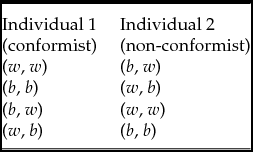
Suppose, by each following the maximin principle, individual 1 chooses b and individual 2 chooses w. Then, the social outcome becomes (b, w), and since each individual made her choice voluntarily, there is no sense in which a violation of individual rights has occurred. Gaertner et al.’s point was that, however, if we follow the social choice framework of individual rights and interpret individual rights as a preference-contingent power of rejection, we are forced to say that the social outcome (b, w) resulting from each individual's voluntary choice has violated individual 1’s rights. This is because, according to the social choice theoretic understanding of liberal rights, individual 1 should be decisive over the set {(w, w), (b, w)}, and given that she prefers (w, w) to (b, w), (b, w) should have been socially rejected (Gaertner et al. 1992: 165–6).
This problem does not occur under our current understanding of liberal rights in terms of Definition L, as we can see that, although individual 1 preferred (w, w) to (b, w), she did not prefer w to b unconditionally (as can be seen from the fact that she prefers (b, b) to (w, b)). So, under our Condition L, individual 1 could not have exercised her preference-contingent power of rejection to socially reject (b, w), and, hence, the social outcome (b, w) would not imply a violation of individual 1’s rights.
Until now, we have interpreted a violation of some individual's liberal rights as both a necessary as well as a sufficient condition for a given social alternative to be deleted from the social choice set. The main rationale for doing this, as I have explained, was to examine the internal consistency of our definition of liberal rights. We have seen that such an interpretation of liberal rights always allowed us to generate a non-empty social choice set as long as we kept perspectival diversity below RD (Restricted Perspectival Diversity). Now, what if we made the violation of some individual's liberal rights a sufficient but not a necessary condition for a given social alternative to be deleted from the social choice set? Let us redefine our definition of liberal rights to reflect this change.
Definition L’ (Liberal Rights under Perspectival Diversity): We say that individual i has a liberal right (in a world with perspectival diversity) if and only if for all social choice problems  ${\rm{\ }}( {F,\ R,\pi } ) \in \Im \times {\cal R} \times {\rm{\Pi }}$ and for all x, y ∈ F such that xi and yi are i-variants (i.e. xi − i = y − ii), y∉C(F, P*(F, R, π)) holds, if i prefers xii to yi i unconditionally, and either
(i) ∀j ∈ N, xi = xj and yi = yj or
(ii) ∀j ∈ N such that xi ≠ xj or yi ≠ yj, xjRjyj.
Condition L’ (Liberalism’): Each individual i ∈ N = {1, . . ., n} has a liberal right in the sense defined in Definition L’.
With this change, we may now delete a social alternative from the social choice set by applying, say, the strong Pareto principle that we have seen previously. Would Condition L’ and the strong Pareto principle together still guarantee a non-empty social choice set under Condition RD (Domain of Restricted Perspective Diversity)? The following theorem shows us another impossibility result.
THEOREM 4: Suppose |X| ⩾ 3 and n ⩾ 3. Then, there exists no social choice function that satisfies RD (Restricted Perspectival Diversity), L’ (Liberalism’), SP (Strong Pareto), and C (Non-Empty Social Choice).
Proof: Restrict our domain to RD. Suppose X 1 = X 2 = X 3 = {a, b, c}, and F = {x, y, z}⊆X = X 1 × X 2 × X 3. Suppose each individual perceives the three feasible alternatives in F as follows:
 $$\begin{equation*}
{x^k} = \left( {a,a,a} \right),{\rm{\ }}\forall k \in \{1,2,3\}
\end{equation*}$$
 $$\begin{equation*}
{y^k} = \left( {b,a,a} \right),\ \forall k \in \{1,2,3\}
\end{equation*}$$
 $$\begin{eqnarray*}
{z^2} &=& \left( {a,a,a} \right) \ne \left( {a,a,b} \right) = {z^k},\ \forall k \in \{1,3\}\\
x^k &=& y^k=z^k = (c,c,c), \forall k \in N\backslash \{1,2,3\}
\end{eqnarray*}$$
Let the profile of these individual perspectives be π. We can verify that individual perspectives satisfy condition RD. Suppose that each individual's preferences are as follows:

Call the profile of these individual preferences R.
Since x 1 and y 1 are 1-variants, individual 1 prefers a to b unconditionally, and all individuals share the same perspectives regarding the social alternatives x and y, by clause (i) of condition L’, we must have y∉C(F, P*(F, R, π)).
Since y 2P 2z 2 and y kRkzk ∀k ∈ N\{2}, by condition SP, we must have yP*(F, R)z, and, hence, z∉C(F, P*(F, R, π)).
Since z 3 and x 3 are 3-variants, individual 3 prefers b to a unconditionally, and individual 1 and 3 share the same perspectives regarding the social alternatives z and x, and z kRkxk, ∀k ∈ N\{1} by clause (ii) of condition L’, we must have x∉C(F, P*(F, R, π)).
Hence, we have C(F, P*(F, R, π)) = ϕ, an empty social choice set, violating condition C.■
6. CONCLUDING REMARKS
Liberalism breeds diversity and pluralism; in particular, it breeds what I have called ‘perspectival diversity’. This paper provided a formal analysis of the extent to which perspectival diversity can be compatible with a system of liberal rights. The formal results in this paper show that the problem of perspectival diversity can pose new challenges for the proper allocation and implementation of liberal rights in a liberal democratic society by generating irreconcilable disagreements about both the specific natures or ontology of social states as well as the very demarcation of each person's private sphere. We have seen that as long as we are able to restrict perspectival diversity so that everybody at the very least agrees on the public demarcation of private spheres, we are always able to reach a viable social choice while respecting each person's liberal rights. However, we have further seen that this solution, which has the flavour of John Rawls's political liberalism, is unsustainable once we try to incorporate the strong Pareto principle into the picture. I hope this paper can trigger a new line of future research that clarifies and tries to resolve the conflict between liberal rights and the strong Pareto principle under varying degrees of perspectival diversity.
ACKNOWLEDGEMENTS
I would like to thank John Duggan for his helpful comments on earlier drafts of this paper. I would also like to thank Sean Ingham for his helpful comments at the 2017 Midwest Political Science Association Annual Meeting. I also thank the editor and two anonymous reviewers for helpful suggestions.




