We report here on the journal's operations during the year from July 1, 2009, to June 30, 2010. As we did last year, we begin by expressing our thanks to the APSA: Presidents Katzenstein and Brady, the staff, Council, and the Publications Committee, both for wise counsel and for material support. We are particularly grateful to Henry Brady and Michael Brintnall for their tireless negotiations with UCLA, in its time of financial stringency, on the details of the transition arrangements. Members of our editorial board, this year as last, have helped us with their advice on more than a few submissions and have unfailingly served as “guest editors” on UCLA-connected submissions that might otherwise raise conflicts of interest.
Joseph Riser, our senior editor, has continued his able, prescient, and ever-diplomatic service; and our editorial assistants, Shahin Berenji, Meghan Gallagher, Diana Ichpekova, and Monideepa Talukdar, have achieved the seemingly impossible in whittling down our backlog to zero as of June 30, 2009, and our editorial office processing times (see following) to only a few days. As rotation on the panel of co-editors becomes the norm (we hope also for the future), we express our profound gratitude to departing editors Karen Orren, Daniel Treisman, and John Zaller, and our thanks (mingled with sympathy) to Gregory Caldeira, Jennifer Hochshild, and David Laitin, who have consented to join the group. As we did last year, we also thank the authors who submitted their papers for consideration and the referees who reviewed them: their scholarly interaction is the soul of our professional life.
Submissions and Processing
Number of Submissions
Total submissions (including revise-and-resubmits) rose this year by about 2%, to 770, and new submissions declined by about 3%, to 670 (see table 1). We extended 104 invitations to revise-and-resubmit this year, as against 64 in 2008–09, and received back 93 revised manuscripts. Three thousand three invitations to review these submissions were extended, and as usual, almost exactly three-quarters of these invitations (2,238) were accepted. The average referee reviewed 1.3 papers.
Submissions per Year

Turnaround Times
We achieved a substantial reduction this year in our time from receipt to first decision, from 87.8 to 69.6 days, or over 20% (see table 2). The major gains were from quicker vetting by the editorial assistants and more rapid assignment of referees by co-editors (processing times in each case decreased by 35%). Referees were also more prompt, completing their reviews on average 36 days after the invitation (last year: 40). Indeed, for the first time a majority of referees completed the review within the four weeks we request.
Elapsed Time (Average Number of Days) in Review Process, 2009–10

Mix of Submissions
Categorized by disciplinary subfield, the papers we received this year differed only slightly from those of previous years (see table 3a). Seeming increases in comparative politics and normative theory and the decrease in the “other” category were likely illusory; the EAs simply found in initially directing papers to co-editors that a fair number of the “other” papers were actually comparative or normative. The other year-on-year changes were insignificant, and all were well within historical bounds.
Distribution of Papers Submitted, 2009–10 (%)

The distribution of submissions by “approach” (see table 3b) changed hardly at all: in the current year, a total of 72% of the papers submitted were “formal,” “quantitative,” or some combination of the two, as opposed to 74% in the previous year. The percentage of small-n submissions held constant (and small), while that of “interpretive/conceptual” papers rose by 3 percentage points.
Distribution of Papers Submitted, 2006–10 (%)

Outcomes
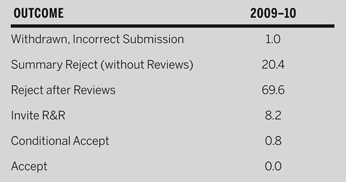
Encouraged by the Council, we have continued to expand our use of summary rejections (see table 4): 6% of all submissions in 2007–08, 16% in 2008–09, and 20% in the year just concluded were rejected without review (except, in doubtful cases, with advice from a member of the editorial board). This parallels what has been happening at other journals in the field and seems to have had the desired effects of relieving “reviewer fatigue” and allowing submissions that would almost surely be declined by APSR after the usual review process to be quickly redirected to a more appropriate outlet.
Outcome of First Round of the Review Process (%)

Our combined percentage of R&Rs and conditional accepts has remained about constant, at 9%. We continue, with rare exceptions, to follow the long-established APSR practice of granting R&Rs only where we estimate the probability of ultimate acceptance at 0.8 or better; in fact, as will appear below, some 87% of all R&Rs are ultimately accepted. Of the first-round revisions returned to us in 2009–10, 64% were accepted, either conditionally (35%) or unconditionally (29%); 12% were rejected; and in 25% of the cases, a further round of revisions was requested. Of the second-round revisions received back during the current year (a total of 22), 20 (91%) were accepted conditionally or unconditionally, one was rejected, and one (very unusually) was sent for a third round of revisions.
The array of papers accepted for publication in the current year is categorized by field and approach in tables 5a and 5b. As regards field (cf. table 3a), and in comparison with shares of papers submitted, comparative politics is overrepresented and formal theory and methods considerably underrepresented (together, 10% of all submissions, 3% of acceptances). With respect to approach (cf. table 3b), quantitative was overrepresented (about half of all submissions but two-thirds of acceptances), while both the interpretive/conceptual and the formal-and-quantitative areas were underrepresented: the former constituted about a quarter of all submissions but one-sixth of all acceptances; the latter, 12% of submissions but 8% of acceptances.
Distribution of Papers Accepted, by Field, 2009–10 (%)

Distribution of Papers Accepted, by Approach, 2009–10 (%)

Both the over- and the underrepresentation may well be only stochastic blips, but we offer at least impressionistic conjectures about the two cases of underrepresentation. We have had a fair number of formal-and-quantitative submissions in which it seemed to both referees and editors that the formal component broke no new ground and the quantitative contribution, taken by itself, did not seem important or convincing enough to pass our threshold. Equally, and for a variety of reasons (including, perhaps, the growing visibility of the Review to a wider audience; see following), the co-editors most heavily involved with interpretive/conceptual submissions have seen a marked rise in pieces that represent advocacy, commentary, or methodological exhortation (how political science should be done, rather than actually doing it) rather than original research. Hence the rate of summary rejections in this area has risen (about 40%, vs. 20% overall) and the “pool” from which acceptances could plausibly come has diminished.Footnote 1
The interpretive/conceptual category presumably encompasses most of, but is much broader than, qualitative work. As discussed at a previous Council meeting, our chief hurdle in publishing qualitative work seems to be a continuing, and indeed intensifying, paucity of submissions: of the total of 2,249 new papers submitted to the APSR during our whole tenure from July 1, 2007, to August 20, 2010, 43 (1.9%) were self-described by their authors as “qualitative”; the number is indicative, even if (as we suspect) it does not exhaust the category.Footnote 2 More strikingly, the number of such self-described submissions has been falling: 18 (2.3%) in 2007–08, 14 (2.0%) in 2008–09, and 8 (1.2%) in 2009–10.
So we again invite Council's attention and that of the broader APSA membership to the question of how we can more effectively emphasize the Review's openness to qualitative work. One co-editor (except in one year, the lead editor) has presented annually at the Institute for Qualitative and Multimethod Research (IQMR), now located at Syracuse University, specifically inviting such submissions. As part of our general quest for readability, we have pushed authors of quantitative work to include qualitative illustrations or robustness checks, and a significant and growing number of the articles that we publish in all fields could now reasonably be classified as “multi-method” (i.e., they combine quantitative or normative work with qualitative empirical research)—typically historical, biographical, juridical, or interview-based. Our May 2010 issue included a Forum in which the contrast (or complementarity) between qualitative and quantitative methods was vigorously debated with respect to a concrete issue—namely, what impelled many democracies to adopt (or to reject) proportional representation. But the submission numbers clearly indicate to us that we have not done enough, and we remain completely open to additional suggestions.
Visibility
While this may also be only a blip, it is gratifying to note that the long slide in the Review's Thompson-Reuters Impact Factor (IF),Footnote 3 which began in 2005, was reversed in 2009.Footnote 4 Indeed, the Review's absolute score rose in the single year of 2009 by over 85% (from 1.73 to 3.21) and almost equaled its previous decadal peak (2005: 3.23), bringing the Review from tenth to second-ranked journal in political science (exceeded only by Political Analysis). The Review's five-year impact factor, at 4.19, continued to exceed that of all other journals in political science (Political Analysis came in second by this measure, at 4.08).
The Review's contents have also reached a wider public, thanks (we believe) both to our own efforts to make things more readable and to Cambridge University Press' readiness to send out press releases. Articles on “MPs for Sale?”, the Second Chechen Rebellion, and U.S. responses to high- and low-skill immigration were widely cited, including a mention on the front page of the New York Times. In short, if it was ever true that the APSR interested only a narrow and highly technical slice of political scientists, it certainly is not now the case.Footnote 5 Both the public citations and our authors' mailbags suggest that the journal is being read by a wide range of the journalistic, public-policy, and intellectual public.
Change and Transition
That the state of California is broke is by now no longer headline news. The University of California has undergone painful budget cuts, with more to come. UCLA clearly will no longer be able to support the Review at its previous level but did agree to more modest support during a transition year (2011–12), during which the APSA (as agreed by President Brady, Executive Director Brintnall, and the Publications Committee) will conduct its normal search for a new editor or editorial team.
In any event, the “UCLA” editorial team, although maintaining its administrative offices and its lead editor at UCLA, has long included co-editors from other institutions. As of July 1, 2010, the current group consists of Jeff Lewis, Kirstie McClure, Ron Rogowski, and Arthur Stein (all UCLA), plus Greg Caldeira (Ohio State), Gary Cox (Stanford), Jennifer Hochschild (Harvard), and David Laitin (Stanford). We respectfully notify the Council of these changes and, should a ninth co-editor prove necessary (as we expect), will return to Council for ratification of a slate that, for the first time, would likely include a majority of editors from outside UCLA. Our aim throughout has been to maintain a group of undoubted scholarly excellence with openness to all approaches and a broad range of subdisciplinary expertise.
As regards the transition, our experience supports five conclusions. (a) Multiple editors are necessary to handle both the volume and the variety of submissions. (b) With modern technology, the multiple editors need not be from the same institution. (c) A lead editor is needed to provide coherence and continuity. (d) The co-editor model, in which the entire group considers papers before their final acceptance, pays large benefits in quality and readability, which in our view outweigh the concurrent costs of delay. (e) Most co-editors can handle the job's burdens for at most two to three years; hence, reasonable allowance and provision must be made for turnover among the group.
We frame these as recommendations about which the future search committee and the Council must reach its own conclusions. We are grateful for our continuing opportunity to be part of our discipline's ongoing conversation, and we welcome comments and suggestions on our ongoing work.