1. Introduction
Indonesia – Measures Concerning the Importation of Chicken Meat and Chicken Products (Indonesia–Chicken) is a dispute about imports of chicken from Brazil, which have de facto been banned from the Indonesian market. At face value, Indonesia–Chicken deals with plain import restrictions that were, quite obviously, not in conformity with WTO law. Accordingly, the Panel established to solve the dispute found most of the measures challenged by the complainant, Brazil, to be WTO-inconsistent (WTO, 2017a).
At the more fundamental level, the dispute touches upon the broader question of the relationship between WTO law and domestic food policy preferences, in particular policies that pursue food self-sufficiency. Even though the potential conflict between these aspects was only superficially touched upon in the Panel report (paras. 7.674 et seq.), it appears to be the actual cause of the dispute (and other WTO disputes related to Indonesia's food policies).
This dispute is not the only one concerning Indonesia's food policy. There are a number of parallel disputes in which Indonesia's food policies were, or are, challenged:
• In 2017, the Appellate Body ruled on cases brought by New Zealand and the United States against Indonesia's import licensing regime for horticultural products, animals, and animal products, and found that the Indonesian measures were inconsistent with WTO law (WTO, 2017b).Footnote 1
• In 2018, a Panel decided on the legality of anti-dumping duties imposed by the European Union against Indonesian biodiesel that allegedly benefited from certain export promotions for palm oil (i.e. the main raw material for Indonesian biodiesel) (WTO, 2018).
• There are ongoing consultations since 2016, between Indonesia and Brazil concerning import restrictions on Brazilian bovine meat (WTO, 2016).
This paper provides a legal and economic analysis of the Indonesia–Chicken dispute. In section 2, we provide some background on the markets, trade flows, and policies related to the dispute. In section 3, we present the Panel's findings and rulings on Brazil's claims. In section 4, we first discuss the motives behind Indonesia's measures and the economic effects of the import restrictions. We then present arguments for and against food self-sufficiency. Finally, we examine whether Indonesia could have attained its food self-sufficiency objective in a way that would be consistent with its WTO obligations. We conclude in section 5.
2. Economic and political context
2.1 Economic background
2.1.1 Indonesia's chicken market
Indonesia is the world's fourth most populous nation with a population of 261 million and a GDP per capita of US$3,603 in 2016 (World Bank, 2018), which makes it a highly attractive market.
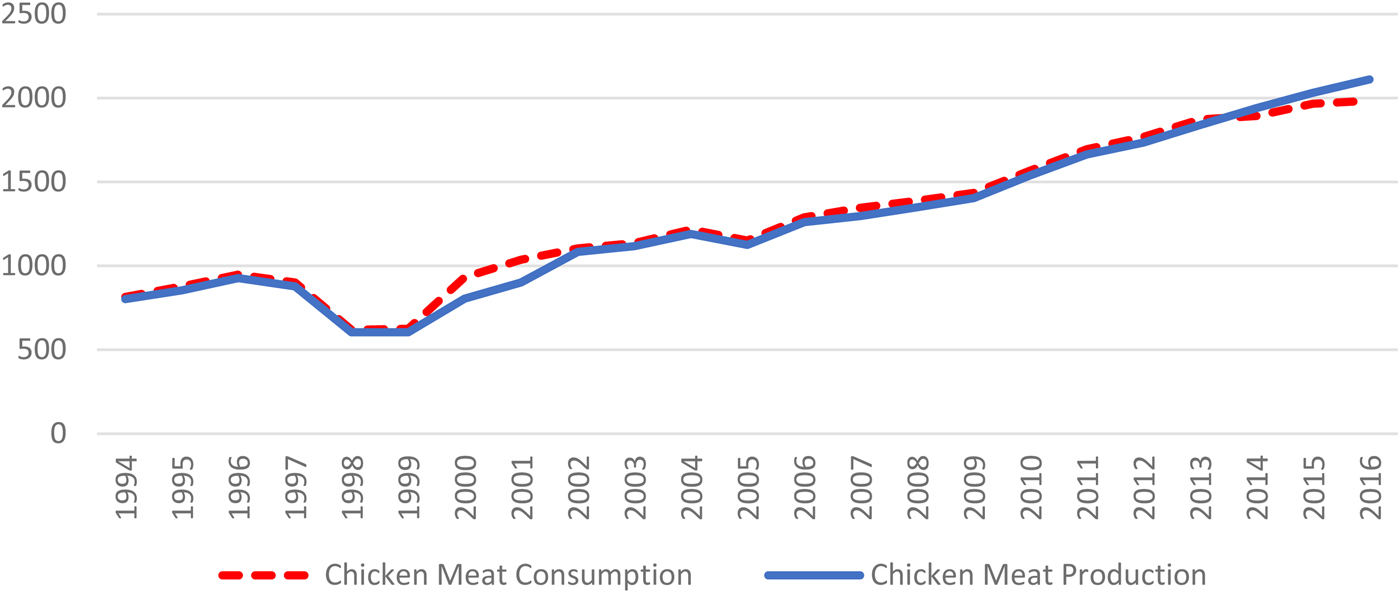
Figure 1 shows the growth in both Indonesian production and consumption of chicken meat over the last decades, along with an excess supply prevailing since 2013. Production was severely affected by the Asian crisis, and again in 2005 due to an outbreak of avian influenza. The subsequent excess supply resulted from an agenda promoted by the Ministry of Agriculture to double poultry meat consumption per capita between 2012 and 2017 and a growing economy, followed by a decrease in economic activity starting in 2012. This, coupled with a decreased demand after outbreaks of avian influenza, caused many farms to shut down (USDA, 2017).Footnote 2 Despite that, production continued to increase, and poultry meat represents approximately 87% of total meat consumption (Orissa International, 2017).
Indonesia's chicken meat consumption and production (in thousand tons)

The Indonesian poultry market is dominated by a few large firms, some of them with foreign parent companies. Indonesian consumers prefer to buy in wet markets, and the Indonesian demand for poultry meat is expected to continue rising, because of the growing purchasing power of the country's expanding middle class. Moreover, per capita poultry meat consumption is below the world average and also below those of neighbouring countries such as Thailand and Malaysia (Orissa International, 2017). Due to a largely Muslim population, Indonesians must eat halal certificated chicken.
2.1.2 Brazil's chicken production
Brazil is the world's second largest poultry producer (it surpassed China in 2015) after the US, and the world's largest exporter (OCSP, 2016). It is also the largest exporter of halal chicken, with about 40% of the world's halal chicken market. The US and Brazil dominate poultry exports due to their low input costs (they are exporters of corn and soybeans, for example), whereas Indonesia imports most of its feed ingredients and has much higher costs (USAID, 2013).
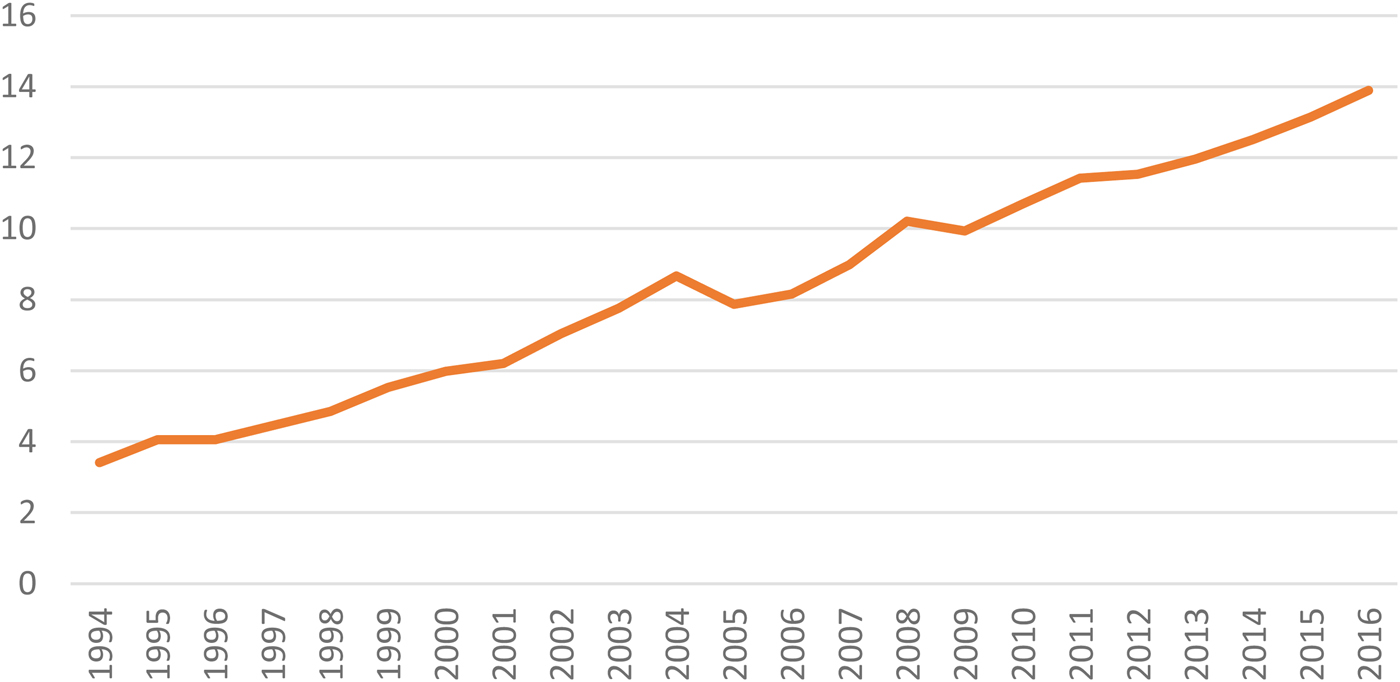
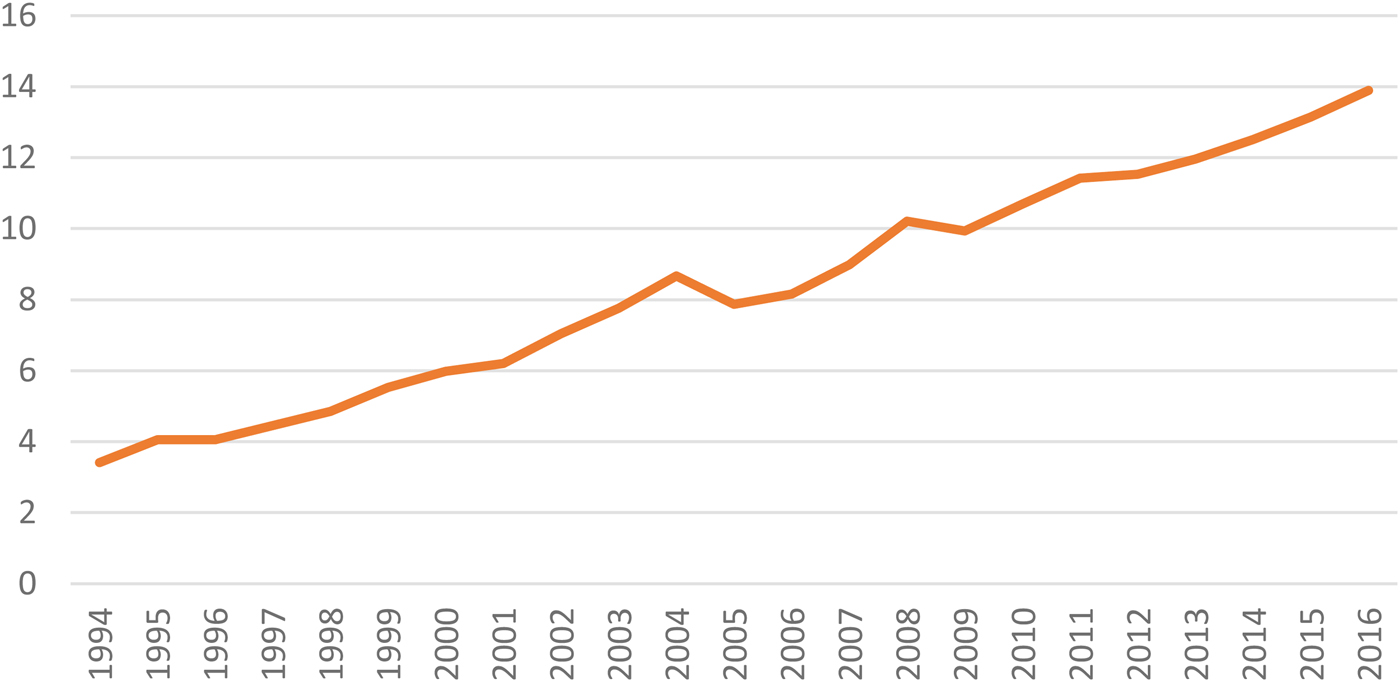
Brazil's chicken-meat production growth over time and recovery after the 2008–2009 global recession are shown in Figure 2. Its production is characterized by the presence of foreign investment, high technology use, low labour costs, ample feed availability, subsidized credit, large-scale production, and integration contracts. Brazil's large domestic market consumes about 72% of its production (Valdes, Hallahan, and Harvey, Reference Valdes, Hallahan and Harvey2015). Another advantage that Brazil has when it comes to exporting is that it is the only country in the world that has never had a case of avian influenza.Footnote 3 Brazil's production is also highly concentrated, since two Brazilian multinationals account for 70% of exports and 50% of the industry's output.
Brazil's chicken meat productiob (in million tons)
2.1.3 Trade flows – or their lack thereof
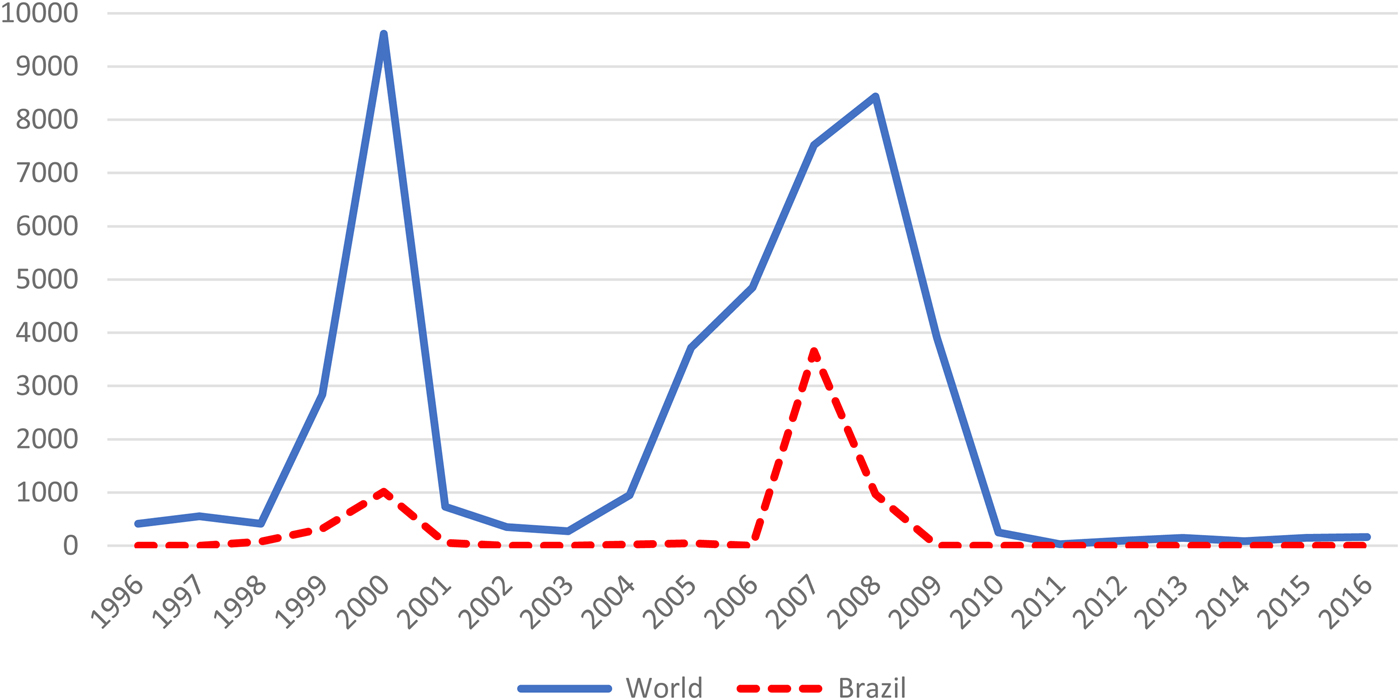
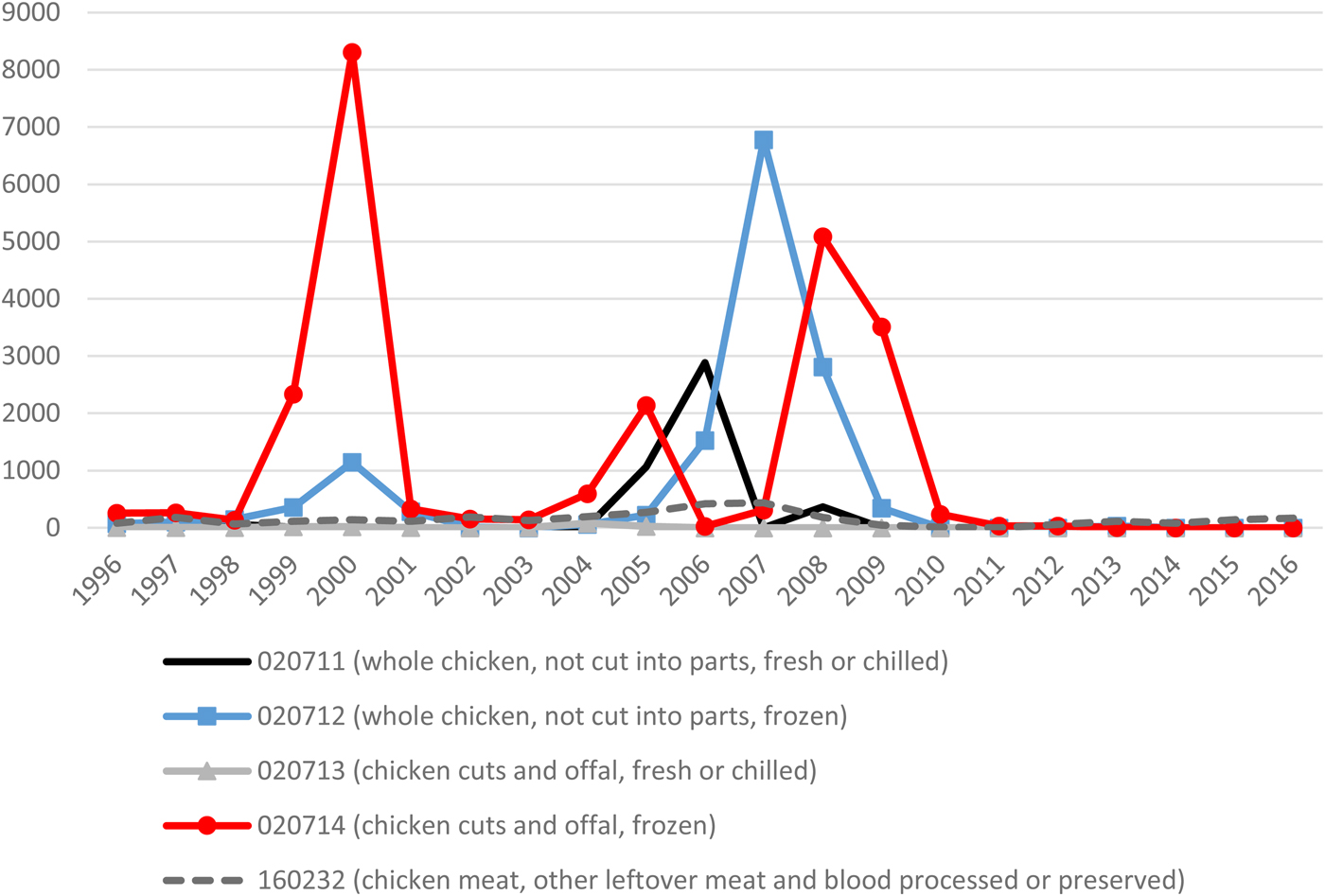
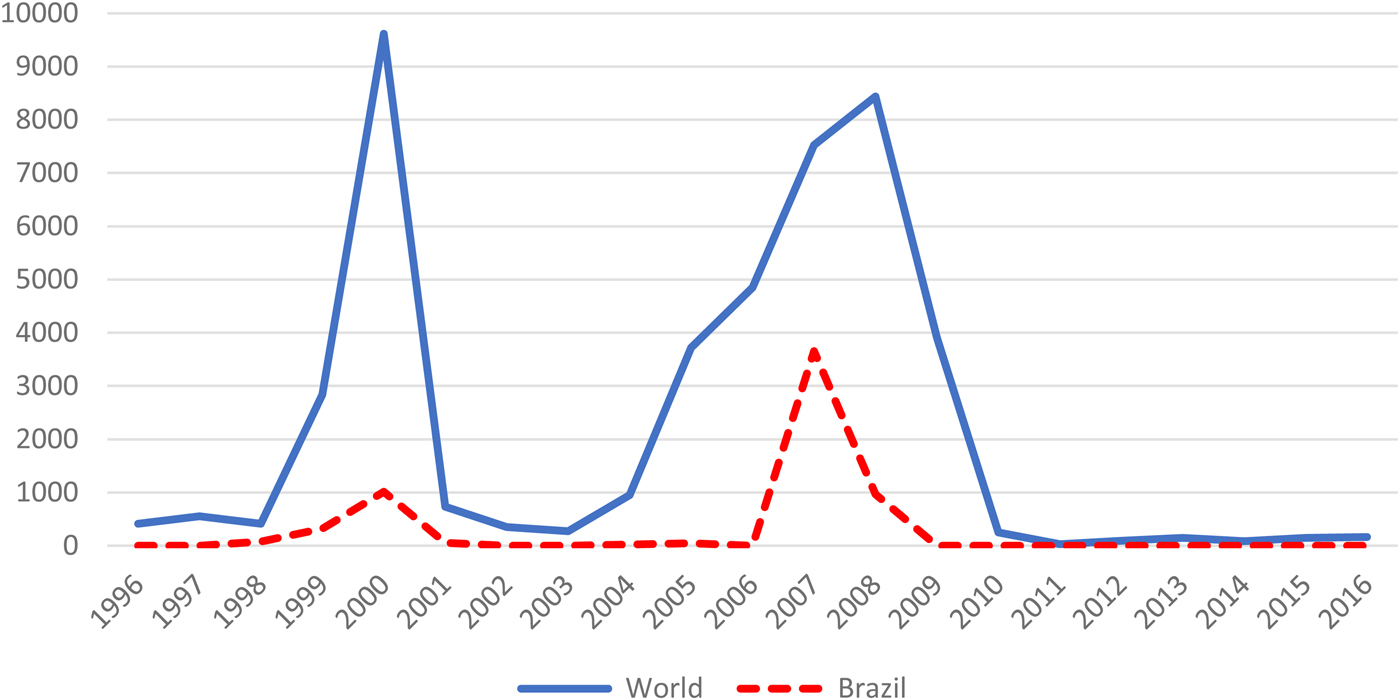
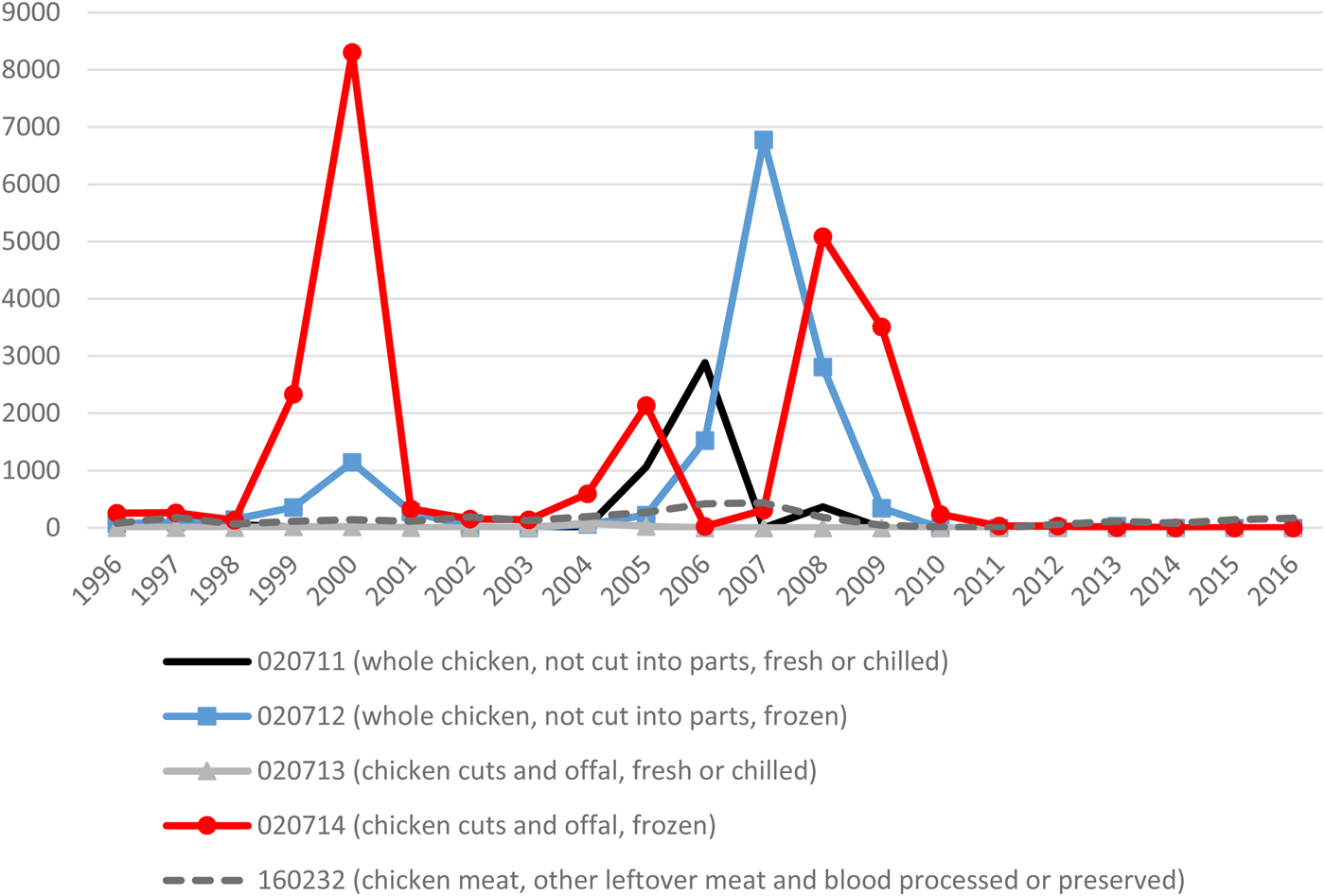
Figure 3 shows imports of chicken meat and chicken products by Indonesia from the world as well as from Brazil from 1996–2016.Footnote 4 Imports have been close to zero in most years. In Figure 4, we show imports of chicken meat and chicken products by Indonesia from the world disaggregated by product. Imports of whole chicken (HS codes 020711 and 020712) have been virtually zero since 2009. Although they are allowed in theory, the Indonesian government does not issue licenses, resulting in a de facto ban (USDA, 2017). There have been no imports of fresh or chilled chicken cuts (HS 020713) since 2006. There were some imports of frozen chicken cuts (HS 020714) and prepared chicken meat (HS 160232) during the period.
Imports of chicken meat and chicken products by Indonesia from the world and Brazil (in thousand US$)
Imports of chicken meat and chicken products by Indonesia (in thousand US$)
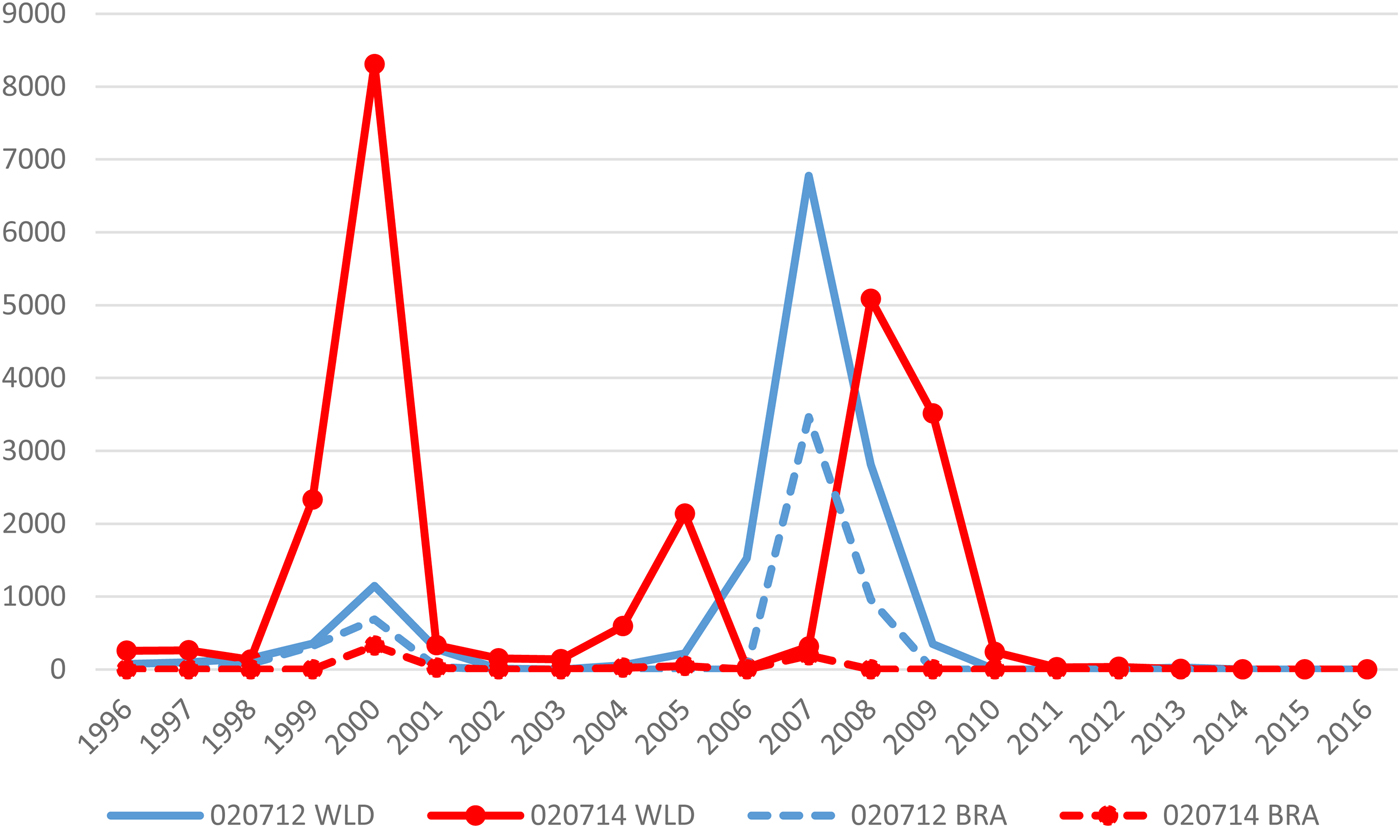
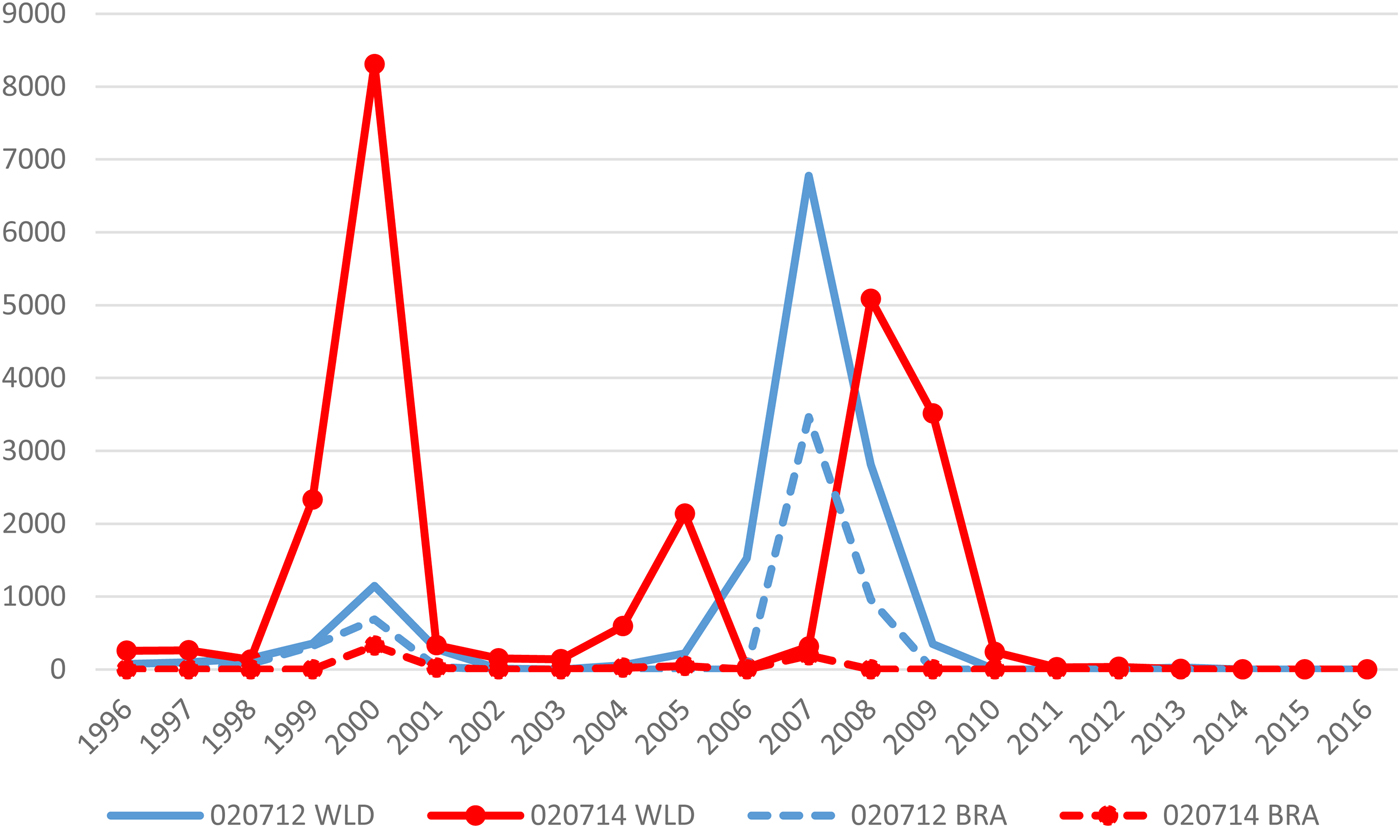
Considering total imports of chicken meat and chicken products, the main exporter to Indonesia during the period 1996–2016 was the US, followed by Singapore and Brazil. As shown in Figure 5, Brazil exported HS codes 020712 (whole chicken–frozen) and 020714 (chicken cuts–frozen) to Indonesia in some years before 2009. Brazil was the main exporter of whole chicken–frozen, and the third exporter of chicken cuts–frozen to Indonesia. However, Indonesia was not a significant destination for Brazil's exports of those products by any means, representing less than 0.01% of Brazil's exports in each case (the Middle East and Asia are the main markets for Brazil's chicken's exports). This suggests that Brazil's motivation behind its WTO complaint is based on its non-reached potential exports to the Indonesian market. The Ministry of Foreign Affairs of Brazil (2015) stated that the Brazilian poultry private industry has great interest in the Indonesian market, given its large population, and estimates an export potential of at least US$70 million.
Imports of frozen chicken and chicken cuts by Indonesia from the world and Brazil (in thousand US$)
2.2 Indonesia's food policy
Almost since its independence, Indonesia pursued a policy of food self-sufficiency, with the goal of achieving food security (Limenta and Chandra, Reference Limenta and Chandra2017). Already in 1948, the objective of food self-sufficiency was proclaimed under a three-year production plan of the Ministry of Food. In 1967, the Indonesian Bureau of Logistics (BULOG) was founded with the aim to stabilize prices for basic commodities and was granted a monopoly for the importation and exportation of certain commodities. Starting in the 1980s, the government redefined the concept of food self-sufficiency to include some estate crops and poultry. In the period thereafter, Indonesia to a certain extent followed a more liberal approach and, for instance, dismantled BULOG's monopoly rights except for rice and relaxed or removed a number of import and export barriers.
In the wake of the Asian financial crisis in 1998, Indonesia agreed towards the International Monetary Fund to further liberalize its trade policies and eliminate non-tariff barriers on agricultural products in return for loans (Limenta and Chandra, Reference Limenta and Chandra2017).
At the beginning of the 2000s, the Indonesian government sought to foster growth in the agricultural sector and to that end, reinstalled trade restrictive measures, in particular with respect to poultry and beef. Today, food self-sufficiency remains an agricultural policy objective of the government.
2.3 Indonesia's food-related trade policy
We have shown that Indonesia has pursued a long-standing policy of food self-sufficiency and that there have been virtually no imports of chicken meat and chicken products into Indonesia in recent years. In this section, we discuss the trade barriers that exist in Indonesia against imports of those products, using data from the World Integrated Trade Solution (WITS). Nonetheless, we should keep in mind that some potential trade barriers identified by Brazil in the dispute, such as the ‘intended use requirement’, the ‘cold storage requirement’, or the ‘temporal application windows’, would not be recorded in the database, as they are not included in WTO categories of barriers to imports.
Indonesia's average most-favoured nation (MFN) tariff was 7.9% in 2016. The MFN tariffs for the products involved in the dispute were 5% for HS codes 020711, 020712, and 020713 (whole chicken and fresh or chilled chicken cuts); 8% for HS 020714 (frozen chicken cuts); and 30% for HS 160232 (prepared chicken meat). Indonesia's WTO tariff bindings are much higher, however. Its average tariff binding in 2016 was 33.3%. The tariff bindings were 50% for HS codes 020711 and 020712, and 40% for HS codes 020713, 020714 and 160232. This suggests that, overall, Indonesia has relatively ample room to increase its applied tariffs and still be in compliance with its WTO commitments (except perhaps for prepared chicken meat).
Except for the 30% tariff on prepared chicken meat, applied tariffs on chicken meat and chicken products are relatively low. However, there are also non-tariff barriers affecting imports of those products. The Global Trade Alert listed Indonesia among the worst ‘offenders’ for rising trade protection following the global financial crisis of 2008–2009 (Evenett, Reference Evenett2014). According to Yan, Fernandez de Cordova, and Cadot (Reference Yan, de Cordova and Cadot2016), 65% of Indonesia's products (at the tariff line level) are affected by its non-tariff measures (NTMs). They are mainly technical measures, which include measures covered by the Sanitary and Phytosanitary (SPS) Measures Agreement, technical barriers to trade (TBT), and pre-shipment inspection and other formalities.
Moreover, almost 100% of the tariff lines in ‘animal and animal products’ (HS 01-05) and 99% of ‘foodstuffs’ (HS 16-24) (the two groups where the products involved in the WTO dispute belong) are subject to NTMs, and in most cases to three or more (simultaneous) NTMs (Yan et al., Reference Yan, de Cordova and Cadot2016).
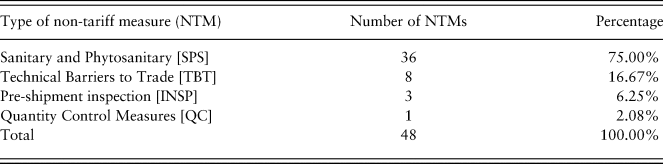
Focusing on the five products included in the WTO dispute, there is a total of 48 NTMs affecting their imports. As shown in Table 1, the most common type of NTM affecting those products was SPS (75%), followed by TBT (17%). Furthermore, Indonesia applies non-automatic import licensing for poultry. Importers must fulfil at least 80% of their approved imports each year and meet requirements related to packaging, labelling, and transportation. Some animal products are not listed in the import licensing regime and thus cannot be imported.
Indonesia's non-tariff measures on imports of chicken meat and chicken products

Source: Authors’ calculations using data from WITS.
Finally, there is an Indonesian law on food (Law 18/2012), which Brazil referred to in its WTO complaint in order to prove the existence of an alleged unwritten import ban. The law stipulates that food should be sourced from domestic food production or national food reserves, and imports can be used only when domestic sources are insufficient (Articles 14, 36). The law also requires the government to prioritize domestic food production to fulfil food consumption needs (Article 15). Furthermore, the government is obliged to regulate food trading with the intent of stabilizing food supply and prices, managing food reserves, and creating ‘a healthy food business climate’ (Article 51). Ways to implement such supply and price stabilization include using taxes or tariff policies, and regulating exports and imports of food, among others (Article 56).
3. The Panel decision
At the time relevant for this dispute, importation of chicken or parts thereof into Indonesia was, as just discussed, highly regulated. Indonesia had established an intricate import licensing regime that required pre-importation approval of both the country of origin as well as the individual business unit at which the product was supposed to be processed. Such approvals required the consecutive consent of two different authorities, first the Ministry of Agriculture, which needed to issue a recommendation, and then the Ministry of Trade, which, based on the recommendation, needed to grant an approval.
In addition, Indonesian law provided a plethora of other limitations on the importation and sale of chicken, such as:
• A ‘positive list requirement’ according to which only products explicitly listed in the relevant laws could obtain an import license.
• An ‘intended use requirement’ according to which imported chicken could only be sold at certain venues, such as hotels and restaurants, but not at the traditional markets.
• A ‘cold storage’ requirement that prescribed that imported frozen chicken may only be sold if a cold storage facility was in place.
• Temporal ‘application windows’ during which import approval applications needed to be made and which worked in tandem with limited validity periods of import recommendations.
• A requirement to obtain veterinary certificates.
• A halal-certification and surveillance scheme and a halal labelling requirement.
• Allegedly requiring direct transportation from the country of origin to the entry points in Indonesia.
Brazil challenged these individual measures. In Brazil's view the Indonesian regulations effectively banned the importation of or discriminated against imports of chicken from Brazil. In addition, Brazil challenged an (unwritten) general prohibition resulting from the combined operation of the different trade-restrictive measures. While Brazil succeeded with most of its complaints concerning individual measures, it failed to convince the Panel of the existence of the alleged unwritten measure.
3.1 The positive list requirement
Importation of chicken parts but not of whole chicken into Indonesia required such produce to be listed in the relevant Indonesian laws, which was not the case. Accordingly, chicken parts could not be imported into Indonesia. Without much ado, the Panel found that the ‘positive list requirement’ amounted to an import ban and therefore infringed Article XI:1 GATT (para. 7.118).
Indonesia sought to justify the import ban under Article XX(d) GATT. Indonesia argued the measure was necessary to ensure that chicken parts were not sourced from non-halal slaughtering houses and passed off as halal. The Panel was not convinced. In particular, the Panel considered Indonesia's explanation to be inconsistent, given that the ban applied only to chicken cuts, but not to whole chicken (para. 7.131). The key argument against Indonesia's justification, however, was that Indonesia itself had abandoned the positive list requirement after initiation of the dispute and instead implemented a more rigorous certification scheme. In the Panel's view, by abolishing the positive list, Indonesia itself admitted that the positive list requirement was not necessary within the meaning of Article XX GATT (para. 7.155).
3.2 The intended use requirement
Imported frozen chicken could only be sold to hotels, restaurants, catering, and industries. Processed products could only be sold to modern markets. These two limitations together constituted the so-called ‘intended use requirement’ (para. 7.176).
The Panel found that due to the lack of an equivalent domestic measure, Article III GATT was not applicable (para. 7.195). However, since due to the limitation in venues where imports could be sold, more than 70% of the market (i.e. the traditional markets) where de jure not accessible, it considered that exports to Indonesia were reduced from the outset. Accordingly, the intended use requirement was considered a quantitative restriction, inconsistent with Article XI:1 GATT (para. 7.202).
Indonesia attempted to justify the intended use requirement. It referred to potential health risks and consumer protection concerns, alleging potential risks arising from the thawing of frozen chicken in a tropical climate. Again, during the dispute Indonesia had amended the pertinent legislation and replaced the intended use requirement with a less restrictive measure, namely a requirement that a cold-storage facility must be in place for the sale of frozen chicken. Accordingly, there was a less trade restrictive measure ‘plainly before’ the Panel (para. 7.236), as a result whereof the intended use requirement could not be deemed necessary for purposes of Article XX GATT (para. 7.240).
3.3 ‘Cold storage’ requirement
Given that Indonesia had amended the intended use requirement during the dispute, Brazil also challenged the newly introduced measure, which consisted of a stipulation that imported frozen chicken may be sold anywhere where a cold storage facility was in place. The vast majority of the traditional markets (where 70% of all chicken was sold) did not provide any such facilities, however. Indonesia explained that the measure aimed at protecting consumers from confusing thawed chicken with fresh chicken and to address potential health risks from thawing chicken in a tropical climate.
The Panel scrutinized the cold storage requirement on the basis of the national treatment obligation (paras. 7.297 et seq.). It analysed two aspects: first, the cold storage requirement for the sale of imported frozen chicken and, second, the equivalence of the measure in terms of enforcement with respect to imported and to domestic chicken.
As to the first aspect, the Panel concluded that the initial threshold for the application was not met because frozen chicken could not be considered to be ‘like’ freshly slaughtered chicken (paras. 7.303 et seq.). Referring to EC–Asbestos, the Panel found that the different health risks posed by fresh and frozen chicken in a tropical climate are relevant for the assessment of the products’ physical properties and made them ‘unlike’ (para. 7.320). As to the second aspect, the enforcement of the measure, the Panel found that the threshold for the application of Article III GATT was met because the measure was applicable to all chicken, irrespective of its origin, but only enforced vis-à-vis imports. The Panel saw no basis for a justification of this distinction on the basis of Article XX GATT, given that the risk addressed was the same irrespective of the origin of the product (para. 7.335).
3.4 Temporal application windows, fixed licence terms, and undue delay in SPS approval procedures
For importing chicken and parts thereof, Indonesian law provided that an import license was required (paras. 7.343 et seq.). To obtain the import license, a would-be importer had to go through a two-stage procedure. First, she would need to obtain a recommendation from the Ministry of Agriculture. Second, there was the requirement to apply for an import approval, granted by the Ministry of Trade. An additional intricacy was that the import approval could only be applied for during certain time periods and was only valid for a limited period (120 days). Moreover, also applications for import recommendations were only possible during certain time periods. The different time periods were not synchronized, however. As a result of the joint operation of the import recommendation and the approval, imports were effectively blocked from the Indonesian market for a couple of weeks each year. The Panel considered the application windows and the fixed licence terms therefore to amount to a violation of Article XI:1 GATT that could not be justified under Article XX(d) GATT (paras. 7.383, 7.400, and 7.430).
Finally, the Panel found that Indonesia infringed Article 8 and Paragraph 1 of Annex C to the SPS Agreement by not processing a Brazilian request for the approval of a veterinary health certificate for chicken products – which was required to import chicken into Indonesia – over a period of more than eight years (paras. 7.535).
3.5 Halal labelling and certification requirement
All chicken meat sold in Indonesia irrespective of its origin must be ‘halal’, i.e. be slaughtered in accordance with certain religious standards. To ensure ‘halalness’ Indonesian law provides for a certification and labelling scheme (paras. 7.538). Before the Panel, Brazil did not contest the legality of the halal requirement as such, but only its enforcement. While imported chicken had to be labelled halal, there was no such requirement for fresh chicken sold in traditional markets in small quantities. The Panel, however, rejected Brazil's argument that the labelling requirement discriminated against imported products. In its view, less favourable treatment of Brazilian produces, if any, did not result from the exemption for chicken sold at traditional markets but from other Indonesian laws that required imported chicken to be packaged and labelled (para. 7.577). In other words, the source for the unfavourable treatment of imports was a different one than the one suggested by Brazil. According to the Panel, there was no genuine relationship between the contested exemption and the alleged detrimental impact and thus no violation of Article III GATT (para. 7.580).
3.6 Transport requirement
Brazil alleged that Indonesian law mandated that shipments shall be conducted directly from the country of origin to the port of discharge without any stop in transit (paras. 7.581 et seq). The Panel, however, concluded that Brazil's allegation was based on a misinterpretation of the relevant Indonesian laws and therefore dismissed this part of the complaint (para. 7.611).
3.7 ‘General unwritten ban on the importation of chicken’
In addition to the aforementioned restrictions, Brazil asserted the existence of an unwritten overarching measure that results from the combined interaction of several individual measures ‘conceived to implement an official trade policy based on the overriding objective of restricting imports to protect domestic production’ (para. 7.618). Brazil contended that Indonesia pursued a policy of import substitution, ‘founded on the premise that the importation of animal products should be made only if domestic animal production were insufficient to fulfil the needs for the people's consumption’ (para. 7,619). To prove the existence of the alleged unwritten import ban, Brazil referred to individual pieces of Indonesian trade and general legislation, including Indonesia's import licensing regime and provisions that expressly stipulated that food could only be imported if domestic production was insufficient. In addition, Brazil produced trade data and OECD/FAO reports that mentioned trade restrictive measures adopted by Indonesia.
Based on the evidence submitted, the Panel did not concur with Brazil's view that there existed a general unwritten measure. While the Panel did not question that Indonesia pursued a policy of food self-sufficiency, it did not recognize that there was a sufficiently strong interlinkage between the individual measures and other evidence to acknowledge the existence of an unwritten general measure that aimed at banning chicken imports. In this context, the Panel also highlighted that self-sufficiency itself is a legitimate policy object that as such does not give rise to a violation of WTO law:
We observe that self-sufficiency as a policy objective does not necessarily imply the adoption of trade-restrictive measures. In our view, a Member may well pursue goals of self-sufficiency through means that are not WTO-inconsistent. Thus, showing that a Member pursues the policy of self-sufficiency, in and of itself, is not enough to prove that this policy has been implemented through an unwritten measure that consists in adopting trade-restrictive measures (para. 7.679).
4. Trade liberalization v. domestic food policies?
At face value Indonesia–Chicken concerns a plain import ban, implemented through various substantive and procedural legal provisions. The majority of measures the Panel found to be in violation of Indonesia's GATT and SPS obligations were quite obviously so and even Indonesia defended them rather half-heartedly, if at all.
The question arises what motivated Indonesia to ban imports. We consider different explanations but shall eventually show that the motivation behind the Indonesian measures was most likely the aim of establishing food self-sufficiency with respect to the production of chicken. Against this background, we shall analyse the economic effects of the import restrictions and then explain the concept of food self-sufficiency and describe its current status under WTO law.
4.1 What was the motive behind the Indonesian measures?
According to mainstream economic theory, a first possible motive for Indonesia to ban chicken imports is a terms-of-trade motive, which at first glance does not seem unlikely given the size of the Indonesian market and the potential market power that might be exerted thereby. However, such a motive can be discarded in the Indonesia–Chicken case. Staiger and Sykes (Reference Staiger and Sykes2011) have shown that an import ban can never be motivated by a terms of trade motive, as if there is no exchange, there are also no revenues to be extracted from foreigners.
Another possible motivation for Indonesia's use of import restrictions on chicken (and other food products) is to keep domestic prices relatively stable in order to reduce poverty, in the framework of the food security and self-sufficiency goals. Some also argue that the self-sufficiency goal is an exercise of economic nationalism (e.g. Nunzio, Reference Nunzio2013).
Indonesia's use of trade restrictions on food can also be linked to political-economic motives. Some studies argue that the import restrictions have been imposed to protect farmers. For example, the OECD (2012) mentions that the move toward greater democracy led to an increase in the political power of farmers, which have become well organized and are engaged in active lobbying. Public and political party support for the agricultural sector is strong, and the poultry industry is politically powerful. It also mentions that halal certification has been used to protect domestic poultry producers as well. For example, in 2000, Indonesia banned imports of chicken leg quarters from the US, allegedly because the slaughter could not be assured to be halal. But the Ministry of Agriculture was also under pressure to protect domestic producers from cheaper imports from the US. As we showed, tariffs are already low but there has been an increasing use of NTBs. This is due to the fact that tariffs are under the control of the Ministry of Finance, which favours more open economic policies, while line ministries have more influence in the setting of NTBs. They are more protectionists and are influenced by special interest groups (OECD, 2012). Moreover, a government advisory Panel found that import quotas encourage bribes and price spikes, and recommended that they be replaced by import tariffs (Nunzio, Reference Nunzio2013).
The motivation to support domestic production can also be related to the Ministry of Agriculture's arguments that not all countries are applying their WTO commitments to eliminate trade barriers, and thus domestic farmers face the unfair competition of foreign farmers who are protected via tariffs, NTBs and subsidies (OECD, 2012).
The self-sufficiency target may also be seen as a desire to protect domestic farmers from the regional competition that would arise as a result of the ASEAN FTA's implementation in 2015 (Nunzio, Reference Nunzio2013).
Finally, we note that, according to the OECD (2012), with the introduction of a relatively effective VAT in the early 1980s, trade policy no longer has to take revenue considerations into account.
4.2 The economic effects of Indonesia's policies
As shown in section 2.3, Indonesia's applied tariffs on chicken are set well below its tariff bindings. Therefore, as noted by Limenta and Chandra (Reference Limenta and Chandra2017), NTBs are the main concern and are used in order to achieve the goal of self-sufficiency.
The fact that Indonesia's trade policy considers imports as a last resort has led to substantial price volatility for main food products, and could also lead to insufficient supply and high prices (Limenta and Chandra, Reference Limenta and Chandra2017). Food prices are very volatile, as they can be affected by changes in weather, outbreaks of plant or animal diseases, demand changes and speculative behaviour.Footnote 5 Moreover, the fact that demand and supply of food are price inelastic implies that the price increase due to a quantitative import restriction will be large (Warr, Reference Warr2011). Besides the standard economic efficiency losses that arise from trade restrictions, this also has important distributional effects.
The beneficiaries of high prices are the domestic producers. However, they affect consumers, especially the poor who spend a larger share of their income on food. In Indonesia, very poor households can spend up to 80% of their income on food. And if the price increases, they may be unable to satisfy their basic food consumption needs (Warr, Reference Warr2011). This also affects a majority of small farmers who are net buyers of food. The OECD (2012) mentions that the fact that meat consumption is very low in Indonesia is related to import restrictions resulting in high domestic prices.
Import restrictions on food can also hurt firms in the food industry that import raw materials such as soybeans, sugar, and feed products.Footnote 6 Furthermore, they could hurt foreign firms (including Brazilian chicken exporters) and spur WTO disputes. This is not unlikely given Indonesia's large market size, as the dispute initiated by Brazil on chicken exemplifies.
Finally, in addition to deadweight losses streaming from consumption, production, and rent seeking inefficiencies, the import restrictions may also affect competition and the industry's productivity. Moreover, the OECD (2012) mentions that the uncertainty created by the import restriction policies has discouraged trade with Indonesia. Studies have shown that trade policy uncertainty can substantially affect firms’ investment and entry into export markets (see, for example, Handley and Limão, Reference Handley and Limão2015). In the case of poultry, delays and uncertainty due to trade policies can have substantial effects due to perishability and spoilage.
4.3 Food self-sufficiency, food security, and international trade
The probably most widely accepted definition of ‘food self-sufficiency’ is provided by FAO as the ‘ability to meet consumption needs, particularly for staple foods, from a country's own domestic production rather than having to rely on importing or buying from non-domestic sources (minimizing dependence on international trade)’. ‘Food security’, by contrast, is mostly understood in terms of a definition provided at the 1996 World Food Summit. Food security is deemed to exist ‘when all people at all times have physical and economic access to sufficient, safe and nutritious food to meet their dietary needs and food preferences for an active and healthy life’ (FAO, 2006).
The concepts of food self-sufficiency and food security diverge on two fundamental issues: ‘(i) food self-sufficiency looks only at national production as the sole source of supply, while food security takes into account commercial imports and food aid as possible sources of commodity supply; (ii) food self-sufficiency refers only to domestically-produced food availability at the national level, food security brings in elements of stability of supply and access to food by the population’ (FAO, 1996). Thus, self-sufficiency may not necessarily be equated with food security, although the former, of course, may contribute to the latter, as the case may be. We consider the arguments for and against food self-sufficiency next.
4.3.1 The case against self-sufficiency
Indonesia has a food security goal and it has focused on promoting self-sufficiency in order to achieve food security. Thus, a first argument against self-sufficiency is that it could actually reduce food security, since it may make food more expensive and less accessible, decreasing food security for the poor. Some studies find a negative correlation between food self-sufficiency and food security and living standards in different countries (e.g. Ministry of Agriculture and Forests in Bhutan, 2010; Galero, So, and Tiongco, Reference Galero, So and Tiongco2014). They conclude that encouraging food self-sufficiency is not a good policy to achieve food security or to reduce poverty.Footnote 7 Clapp (Reference Clapp2017) mentions that self-sufficiency can reduce food security since it may lead to less efficiency, which can cause decreases in food production and higher prices. It may also hurt farmers who produce to export, which reduces their income and can affect their food security.
A second argument against self-sufficiency derives from the economic inefficiencies of the trade barriers that are used to attain it, which we discussed above. Gains based on comparative advantage are lost. The OECD (2012) argues that the focus on self-sufficiency in order to attain food security is misplaced. Import protection increases costs for consumers, and lowers competition and productivity growth. That hinders food access for poor consumers, including a majority of farmers who are net buyers of food. Moreover, the OECD (2016) finds that, as a consequence of import restrictions and agricultural interventions, Indonesians were ‘taxed’ the equivalent of US$98 billion between 2013 and 2015. The cost is equivalent to a per capita tax of US$1300, much higher than the EU's per capita tax of US$437 due to its agricultural policy. The World Bank (2016) reports that the prices of goods ranging from eggs and honey to chicken, carrots, mangoes, and oranges are between 25 and 50% higher in Jakarta than in Singapore, which imports nearly all its food. The level of total support to agriculture as a percentage of GDP was 1.9 in 2006–2010, twice the OECD average. Producer Single Commodity Transfers – the value of gross transfers to producers due to policies linked to the production of a specific commodity – as a share of commodity gross farm revenues in 2006–2010 were highest for poultry (OECD, 2012).
A third argument might be one related to Indonesia's geography and its implications for food distribution. Indonesia is an archipelago composed of 17,000 different islands, where Java is the main centre for agricultural production while more isolated parts of the country often face higher food prices due to distribution costs. Hence, Nunzio (Reference Nunzio2013) argues that food supply levels are actually more than sufficient to feed Indonesia's population, but inefficiencies in distribution systems across the archipelago make it difficult to fulfil demand at accessible prices. Therefore, one could argue that it is hard to see how trade restrictions would solve a national distribution system's inefficiency problem.
A fourth argument is that the self-sufficiency policies, insofar as they restrict trade, might lead to violations of Indonesia's WTO commitments and could bring about retaliation by Indonesia's trade partners.
Actually, international trade could be used to promote food security, along with poverty reduction, as some studies have argued. Trade can be used to stabilize supply disruptions that can generate severe shortages, such as those due to droughts or natural disasters (Clapp, Reference Clapp2017).
A final argument is potential environmental damage. Coxhead (Reference Coxhead2010) mentions that using trade restrictions and price supports to achieve self-sufficiency may lead to land degradation by promoting the expansion of relatively erosive crops and could reduce welfare. Clapp (Reference Clapp2017) also mentions that there can be environmental constraints to food self-sufficiency, since countries may lack the natural resources needed to produce all the food they consume.
4.3.2 The case for self-sufficiency
Some studies argue that, in a number of cases, increasing domestic production for domestic consumption may be beneficial from economic and political perspectives. Does being self-sufficient in food mean that the country has no international trade in food? It depends on how exactly food self-sufficiency is defined and how the government policy is implemented. An extreme definition involves producing all food requirements domestically and having autarky in the food sector. But, in reality, all countries import some food. Another definition means that a country produces a fraction of its food consumption close to or greater than 100%. This does not imply no trade, as the food products consumed domestically may differ from those produced domestically.
Historically, governments have focused on food self-sufficiency as a matter of national security. This is also related to the stability in food supply, and to avoiding supply limitations during a war, and supply disruptions and lack of availability in the international markets (FAO, 2016).
A second and related argument for food self-sufficiency is to avoid political vulnerability if the country depends on other countries for food supply and they threaten to limit it for political motives (e.g. a trade embargo).
A third argument has been to avoid price volatility in international markets. High and volatile food prices with the 2007–2008 food crisis led to a re-emergence of a focus on food self-sufficiency policies in several countries, including Indonesia (Clapp, Reference Clapp2017). However, as we mentioned in section 4.2, Indonesia's trade-restrictive policies have actually led to substantial price volatility for main food products.
A fourth argument in favour of self-sufficiency in food would be to protect the agricultural sectors and support economic activity and incomes in rural areas.
A final argument may be health and environmental concerns. Advocates of producing food locally seek to improve access to healthy, organic food, to strengthen the local economy and environmental sustainability, and foster community relationships (Roberts, Reference Roberts2017). Producing locally could ensure that agriculture is sustainable and does not harm the environment and respects workers and animals. Importing food generates a pollution cost from its transportation, mainly due to carbon dioxide emissions. It also generates more emissions because imported food requires layers of packaging, and perishable food also requires refrigeration (Rosenthal, Reference Rosenthal2008). Moreover, buying locally has the advantage that some food products lose nutrients during transportation, and over-processing for longevity lowers nutritional value (Pratt, Reference Pratt2016).
Although those may be well-intentioned concerns and arguments for self-sufficiency, it is important to stress that the use of trade policies to achieve those objectives is questionable, given that trade policies are only ‘second-best’ policies, as there are usually other policy instruments that are more efficient than a trade barrier.Footnote 8 Nonetheless, it might be the case that a government may be unable to use other (non-trade restrictive) policies to increase domestic production due to financial constraints, for example.
4.3.3 Conclusion
Food self-sufficiency should not be seen as the opposite of international trade in food. A not extreme definition of food self-sufficiency may make sense not only politically but also economically, in certain cases. However, we have shown that, in Indonesia's case, the food self-sufficiency objective is in fact attached to a legal requirement to use imports only as a last resource, which in turn has led to the imposition of a number of non-trade barriers.
First, ‘legitimate’ food security concerns should not be used to justify trade protection. Improperly used non-tariff measures become non-tariff barriers and can decrease food security. The APEC Business Advisory Council (2016) finds that APEC countries were more protectionist and imposed more non-tariff measures when food security was interpreted as food self-sufficiency, and it argues that self-sufficiency has been used to justify protecting inefficient agricultural sectors.
Moreover, becoming self-sufficient in products in which the country does not have – and will not have – a comparative advantage would be inefficient, and a strong emphasis on some sectors may discourage diversification toward higher value products. Nunzio (Reference Nunzio2013) mentions that an issue with the goal of self-sufficiency in Indonesia is lack of comparative advantage in some areas of agriculture. This is also the case for chicken meat and chicken products, as we discussed in section 2.1.
4.4 Food self-sufficiency and WTO law
As the Panel rightly observed, self-sufficiency as a policy objective is compatible with WTO law. Questions of food policy and self-sufficiency are as such not regulated by WTO law. WTO Members are free to choose any policy they deem fit for their respective societies. However, while WTO law does not constrain the policy objectives pursued, it undeniably constrains the means available to attain those objectives. WTO Members must not resort, for example, to tariffs above the bound level, discriminatory taxation/regulation, or trade distorting subsidies to implement their desired policy objectives. Therefore, if a policy objective can only be attained through those instruments, then, for all practical purposes, it cannot be attained at all in a WTO consistent fashion.
In this section, we discuss whether Indonesia could have attained the policy goal of food self-sufficiency in a WTO-compliant manner. For this purpose, we assume that Indonesia needed a means either to block imports or to support its domestic industry such that it could compete with imports.
4.4.1 Tariffs
It is not entirely clear why Indonesia did not resort to tariffs to restrict Brazilian chicken imports. In principle, Indonesia had substantial leeway in raising tariff barriers on chicken imports. While its applied tariffs on poultry are quite low at 5%, its bound tariffs are much higher and range from 40 to 50% (see supra at 2.3). Thus, the question arises why Indonesia did not simply increase duties up to the bound rate.
One possible explanation is that even at a 50% price mark up, Brazilian chicken would still have been cheaper than locally produced chicken. Thus, higher tariffs up to the bound rate would have missed Indonesia's policy goal. Even if this were the case, at least in theory Indonesia could have re-negotiated its bound tariff rates in accordance with Article XXVIII GATT, which provides a framework for tariff renegotiations. Yet, this venue was probably ‘less attractive’ than internal regulations with the same effect because such negotiations ‘may include provision for compensatory adjustments’ and the parties ‘shall endeavour to maintain a general level of reciprocal and mutually advantageous concessions not less favourable to trade’ (cf. Article XXVIII:(2) GATT).
Another possibility is that Indonesia intended to avoid reputational damage by openly increasing its applied tariff rates. To establish additional import barriers could have provoked counter-reactions by Indonesia's trading partners or elicited criticism from relevant international organizations. In addition, the risk of detection is probably the highest in the area of tariffs due to the many transparency obligations.
Finally, it is not unlikely that there were domestic political reasons why the Indonesian government preferred non-tariff measures over custom duties. As discussed supra (4.1) tariffs fell into the competence of the more liberal Ministry of Finance, whereas the more ‘protectionist’ Ministry of Agriculture could only adopt NTBs.
4.4.2 Subsidies
Theoretically, Indonesia could have resorted to subsidies to increase the competitiveness of its domestic chicken producers. However, Indonesia's leeway to subsidize its domestic industry is significantly curtailed by the Agreement on Agriculture (‘AgA’). Indonesia did not offer a commitment on the total value of its Aggregate Measurement of Support (AMS) (Article 3 AgA), and therefore could not provide product-specific domestic support above the de minimis threshold provided for developing countries in Article 6(4)(b) AgA. According to this provision, annual product-specific domestic support must not exceed 10% of a Member's total value of production of a basic agricultural product. Arguably, subsidies in conformity with this provision would not have sufficed to level the playing field between domestic and imported chicken produce.
Less targeted subsidies, on the other hand, which would escape the aforementioned constraints (‘green box’ or Annex 2 subsidies), such as additional investment in infrastructure or improving access to credit, would not necessarily attain Indonesia's objective of bolstering food self-sufficiency; in particular, because such subsidies must not provide price support to producers (Annex 2, para. 1(b) AgA). Thus, while such measures might have been WTO compliant, they would not necessarily contribute to the pursued policy goal. Finally, for developing countries, such as Indonesia, budget constraints might be a significant factor that in practice render subsidies unavailable.Footnote 9
4.4.3 Trade remedies
As there were no indications of dumping or subsidization of Brazilian chicken imports into Indonesia, the only trade remedy Indonesia could resort to were safeguards according to Article XIX GATT and the Agreement on Safeguards (‘SG’).Footnote 10 However, adopting safeguard measures would not only require the showing of a surge in imports and injury to the domestic industry, it would also require compensation for the adverse effects of the measure on the affected Members’ trade and the best endeavour to maintain a substantially equivalent level of concessions and other obligations (Article 8.1 SG). Hence, similarly to tariff renegotiations under Article XXVIII GATT, the withdrawal of market access would have entitled existing exporters to seek compensation and would thus come at a cost either in the form of increased competition for another sector of the domestic economy or less export opportunities.
Finally, safeguards are meant to be temporary safety valves, given that Members ‘shall apply safeguard measures only for such periods of time as may be necessary to prevent or remedy serious injury and to facilitate adjustment’ (Article 7.1 (1) SG). As a rule, safeguards must not be adopted for periods longer than four years (Article 7.1 (2) SG). In the case of the Indonesian chicken industry, it is, however, structural disadvantages relative to Brazil (see supra 2.1.2) that are the cause for the need for protection and for which no short-term remedy is available.
4.4.4 Exemptions
At least four possible exemptions come to mind that could justify import restrictions that serve to implement food self-sufficiency policies: Articles XI:2(c), XX, and XXI GATT and a ‘waiver’. However, the conditions set forth in Articles XI:2(c), XX, and XXI GATT are in practice rarely met, and to obtain a waiver from the WTO Membership might not be feasible.
(i) Article XI:2(c) GATT
Article XI:2(c) GATT is an exception to the prohibition on quantitative restrictions and could therefore be used to block imports to pursue self-sufficiency policies. The provision provides in relevant part that the prohibition on quantitative restrictions shall not apply to import restrictions on any agricultural product necessary to the enforcement of governmental measures which operate:
• to restrict the quantities permitted to be marketed or produced; or
• to remove a temporary surplus by making the surplus available to certain groups of domestic consumers free of charge or at prices below the current market level; or
• to restrict the quantities permitted to be produced of any animal product the production of which is directly dependent, wholly or mainly, on the imported commodity, if the domestic production of that commodity is relatively negligible.
However, in a recent ruling concerning Indonesia's import licensing system, the Appellate Body decided that the provisions of the AgA are lex specialis and render Article XI:2(c) GATT inapplicable (WTO, 2017b).
(ii) Articles XX:(a), (b) and XXI:(b)(iii) GATT
Similarly, it would be difficult to justify import bans to promote food self-sufficiency based on Article XX GATT, i.e. the ‘general exception’. In theory, it would be conceivable to justify self-sufficiency policies on the basis of the ‘public morals’ exception (Article XX:(a) GATT), arguing that self-sufficiency reflects domestic societal preferences. However, if WTO Members could indeed favour domestic over foreign produce solely on the ground that the former is locally produced while the latter stems from abroad, the very foundation of the WTO's enterprise would be called into question. Moreover, any delineation between ‘public morals’ and other public policy interests would become elusive. Under such a broad interpretation, basically any policy objective could be justified under the ‘public morals’ exception. In any event, product distinctions solely based on origin would not pass muster under the chapeau of Article XX GATT, which prohibits ‘discrimination between countries where the same conditions prevail’.
Another possible basis to restrict imports for food self-sufficiency purposes is Article XX(b) GATT, according to which WTO-inconsistent measures might be justified, if they are ‘necessary to protect human life or health’. Under normal circumstances, the conditions of this proviso are not met because healthy imported food usually does not pose a threat to human life or health. To the contrary, under standard assumptions one would assume that trade in food would lead to lower prices and increased quantities and thus rather promote human health. Nevertheless, there is a very limited number of scenarios under which it would, at least in theory, be conceivable to restrict food supplies to protect human life or health. If, for instance, a WTO Member could prove exceptional conditions under which a policy of food self-sufficiency is economically sound (see supra 4.3.2)), it should not be per se excluded that the measures to implement such policies should be considered to be WTO-consistent.
However, if circumstances are indeed as grave so as to necessitate the ban of food imports, probably also the requirements of the security exception under Article XXI(b)(iii) GATT (‘other emergency in international relations’) are met. Thus, in states of emergency both Article XX(b) and Article XXI(b)(iii) GATT may legalize the restriction or prohibition of imported food in order to achieve food self-sufficiency.
(iii) Waiver (Article XI:3 WTO-Agreement)
Finally, a WTO Member that requires relief from certain legal obligations in order to implement a policy of self-sufficiency, could request a so-called ‘waiver’. According to Article IX:3 of the WTO Agreement, in exceptional circumstances the Ministerial Conference may decide to waive an obligation imposed on a Member by the WTO Agreement, or any of the Multilateral Trade Agreements, provided that any such decision shall be taken by three fourths of the Members.
The wording of Article XI:3 WTO Agreement seems to indicate that waivers are meant to be adopted only in a very narrow set of circumstances. In this vein, the GATT and WTO judicial bodies have emphasized the exceptional nature of waiver decisions, referring in particular to the substantive requirement for there to be ‘exceptional circumstances’ (GATT, 1990; WTO, 1997). However, the actual waiver decision practice under the GATT and the WTO has been much broader and not confined to situations in which members were unable to comply with their GATT/WTO obligations.
Waivers can be a suitable solution to reconcile trade with other societal interests and values. Some commentators argue that waiver decisions would allow for more political and less legal debates in which not only economic interests count, but also other public interests and perspectives could be voiced (Feichtner, Reference Feichtner2009). Thus, waivers could be a versatile tool to solve conflicts between WTO obligations and other social values, such as, for instance, a state's intention to attain self-sufficiency. On the other hand, the biggest strength of ‘waivers’ is at the same time their biggest weakness. If politics trumps law, this inevitably means that only those concerns will be put on the agenda that have sufficient political support. The latter might not be the case for an individual member's food policy preferences.
4.4.5 Conclusion
In conclusion, the only WTO-compliant way for a WTO member, whose tariffs are constrained, to permanently implement a policy of food self-sufficiency would be to renegotiate its concessions pursuant to Article XXVIII GATT, save exceptional circumstance in which restrictive measures might be justified under Article XX:(b) or XXI:(b)(iii) GATT or a waiver is granted. Thus, once bound tariff rates are below the prohibitive level, there is no turning back, and any policy of self-sufficiency can only be implemented in a WTO consistent manner though multilateral negotiation. Given that reciprocity is a key value of the WTO, this does not come as a surprise from a trade law perspective. On the other hand, when viewed from a development or food policy perspective, this outcome might cause some discomfort. Many commentators are displeased with a (perceived) supremacy of trade law over food policy and are concerned that ‘excessive reliance’ on international trade will eventually compromise developing countries’ food security (De Schutter, Reference De Schutter2011). In their view, the trend in developing countries to specialize in exportable agricultural products, instead of securing food self-sufficiency, has left them vulnerable to the turmoil of international markets, as has been evidenced during the world food price crisis of 2007–2008. Others argue that the dominant trade narrative that market liberalization leads to increasing food stability, lower prices, and price stability rests on assumptions that do not hold in practice and are based on an outdated understanding of food security (Clapp, Reference Clapp2014). According to them, the problem of hunger may not be solved by international trade because the main problem is not general food availability (supply) but poor people's ability to access food (demand), which in turn depends on ‘their ability to obtain resources to produce it, buy it, or trade personal items for it’.
5. Conclusion
Food self-sufficiency may be a well-intentioned objective that does not necessarily imply no trade, as that depends on how precisely self-sufficiency is defined and how the government implements its policy. Indeed, the Panel stated that ‘self-sufficiency as a policy objective does not necessarily imply the adoption of trade-restrictive measures’; however, we have argued that Indonesia's import restrictions can be linked to protectionist political-economic motives and do respond to the self-sufficiency target, with its legal requirement to use imports only as a last resource.
Economically, the import ban affects not only potential exporters from Brazil and other countries, but also Indonesian consumers and small farmers who are net buyers of food. Import restrictions on food also hurt firms in the food industry that import certain raw materials such as feed products.
Moreover, past experiences with import substitution in various countries have shown that seeking to develop industries where a country does not and will not have a comparative advantage is inefficient. This indeed seems to be the case in Indonesia for certain food items, including chicken meat and chicken products.
Legally, countries are free to pursue self-sufficiency goals. The Panel stressed that self-sufficiency is a legitimate policy objective that can be pursued via non-WTO inconsistent ways. Nonetheless, the question arises as to how viable it is to implement a self-sufficiency goal resorting exclusively to WTO-compliant policy tools. The case of Indonesia leads to the question of whether, in practice, such policy objectives can be attained at all in a WTO-consistent fashion. Given that high and volatile food prices with the 2007–2008 and subsequent food crises have led to a re-emergence of a focus on food self-sufficiency policies in several countries, this issue is very likely to resurface again in the future.