It has been widely observed that native listeners can accurately identify native speakers (NSs) of their languages. However, there are exceptions: Some studies have shown that not all NSs receive NS ratings and that some nonnative speakers (NNSs) achieve NS ratings by native listeners (Bongaerts, 1999; Bongaerts, Planken, & Schils, 1995; Bongaerts, Van Summeren, Planken, & Schils, 1997; Ioup, Boustangui, El Tigi, & Moselle, 1994). The overall rating for degree of nativeness is often termed global foreign accent. Extensive research has demonstrated that global foreign accent is correlated with a number of linguistic phenomena, including segmentals (Bunta & Major, 2004; González-Bueno, 1997; Major, 1987, 2001; Munro, Derwing, & Flege, 1999; Riney, Takada, & Ota, 2000; Riney & Takagi, 1999), syllable structure (Magen, 1998), prosody (Anderson-Hsieh, Johnson, & Koehler, 1992; Jilka, 2000; Magen; Munro, 1995), and speaking rate (Munro & Derwing, 1998, 2001). Additionally, there are paralinguistic phonetic features that seem to be correlated with a native accent (Scovel, 1995), such as voice quality settings (Esling & Wong, 1982).
Global foreign accent has also been found to correlate with a number of nonlinguistic factors, such as age (Asher & García, 1969; Flege, 1988, 1991; Flege, Munro, & MacKay, 1995; Moyer, 1999; Munro, Flege, & MacKay, 1996; Olson & Samuels, 1973; Oyama, 1976; Piske, MacKay, & Flege, 2001; Scovel, 1969, 1988, 2000; Seliger, Krashen, & Ladefoged, 1975; Singleton & Lengyel, 1995; Snow & Hoefnagel-Höhle, 1977; Yeni-Komshian, Flege, & Liu, 2000), length of residence (Asher & García; Flege & Fletcher, 1992), formal instruction (Derwing & Rossiter, 2003; Moyer, 1999), experience (Moyer, 2004), comprehensibility (Derwing, Rossiter, Munro, & Thomson, 2004; Major, Fitzmaurice, Bunta, & Balasubramanian, 2002, 2005; Van Wijngaarden, Steeneken, & Houtgast, 2002), attitudes (Boyd, 2003; Dailey, Giles, & Jansma, 2005; Munro, 2003), identity (Findlay, Hoy, & Stockdale, 2004), self-perception of consequences of one's foreign accent (Derwing, 2003), automatic (computer) speech recognition (Goronzy, Rapp, & Kompe, 2004; He, 2004), and gender (Broeders, 1982; Frey, 1995; Gussenhoven, 1979; Hiang & Gupta, 1992; Major, 2004; Tahta, Wood, & Loewenthal, 1981; Weiss, 1970).
There is a long tradition in SLA research, indeed axiomatic, that the most reliable aural raters of nonnative speech are NSs of a language. This tradition is widespread, regardless of whether the units being evaluated are segmentals or longer stretches of speech. There is a tendency to question the use of NNSs as judges because the vast majority of NNSs do not achieve native competence in their second languages (L2s) and, therefore, it is assumed they could not be reliable judges. The use of native judges is considered important, regardless of whether judgments deal with accents or other levels of analysis, such as syntax, pragmatics, and sociocultural phenomena. However, even though the productions of NNSs usually differ from those of NSs, it is possible that their perceptions could be similar or identical. In fact, there are a handful of studies that have employed NNSs for foreign accent ratings. Elliott (1995) and Olson and Samuels (1973) used near-NSs for accent ratings. Three other studies found little difference in the ratings of foreign accents between native and nonnative listeners. Flege (1988) found the ratings of native Chinese listeners very similar to those of English NSs when rating Chinese speakers of English. MacKay, Flege, and Imai (2006) compared the ratings of native English listeners and native Arabic listeners living in Ottawa who rated English sentences produced by English NSs and NSs of Italian; they found a strong correlation between the ratings. Munro, Derwing, and Morton (2006) asked listeners whose native (or first) languages (L1s) were Cantonese, Japanese, Mandarin, and English to evaluate English utterances of NSs of Cantonese, Japanese, Polish, and Spanish. They found that the listeners showed moderate to high correlations on intelligibility, comprehensibility, and accent scores, regardless of L1 background. The fact that nonnative listeners showed few differences when compared to native listeners suggests that NNSs might be reliably used for valid foreign accent judgments. Further investigation of how native and nonnative listeners perceive speech is important because it is increasingly common for different groups of English as a second language (ESL) speakers to use English when they interact, and, undoubtedly, their perceptions of native and nonnative speech affect their interactions.
It should be noted that all of the cited studies employed nonnative listeners who were very familiar with the language they were hearing—English—and their language proficiency levels ranged from intermediate to near-NS. In general terms, these studies found that the ratings of experts (native listeners) and experienced listeners (NNSs very familiar with the language) were similar. However, there appear to be no published studies of judges rating foreign accents of unfamiliar languages1
In an unpublished presentation, Bond, Stockmal, and Markus (2003) reported on a study of nonnative listeners judging an unfamiliar language.
Foreign accent is a composite of many factors: segmental, prosodic, voice quality settings, speaking rate, and fluency, to name a few. Presumably there are a number of other unknown factors that determine nativeness. Yet, if nonnative listeners unfamiliar with a language are able to identify a foreign accent with equal facility as native listeners, this would suggest that there might be universal features of nonnative speech that are salient to listeners, regardless of the language spoken and regardless of the listener's familiarity with the native accent of that language. The present study does not attempt to uncover these possible features; rather, it attempts to address the possibility that such features exist; if they do, future research might be able to isolate them. This type of research is important to SLA because if such features can be identified, then future studies might be able to investigate how and to what extent they might or might not be overcome in the process of acquiring the pronunciation of a L2. Such research might also have implications for the critical period hypothesis (CPH) because if listeners unfamiliar with a language demonstrate nativelike perceptions, this would suggest that there is no critical or sensitive period for this ability.
The study therefore poses the research question: How do groups of native and nonnative listeners, some familiar with the language and some not, differ in their accent ratings of NSs and NNSs?
METHOD
Speakers
The 25 speaker participants were speakers of Brazilian Portuguese—5 NSs and 20 NNSs. The NSs were Brazilians from three different Brazilian states (Amazônia, Santa Catarina, and São Paulo), three females and two males aged 22–35 (M = 26.8). They had been living in the United States for an average of 1.8 years (range: 3 months to 5 years). The NNSs were NSs of American English from a wide variety of American states, 12 males and 8 females aged 19–45 (M = 25.2). They had all studied Brazilian Portuguese; none of the speakers had studied European Portuguese or visited Portugal. One speaker had lived in Brazil for 6 years and was an advanced speaker of Portuguese, having received her doctorate in Brazil. Of the other 20 speakers, 10 had visited or lived in Brazil for a period of time ranging from 1 week to 6 years (M = 0.75 years). They were enrolled in intermediate and advanced Portuguese classes. Both the NSs and NNSs were students at the author's institution.
Speech Materials
A short passage was chosen (see Appendix A). This passage was chosen because of its subject matter (carnival and samba, familiar topics to learners of Brazilian Portuguese and to Brazilians), basic vocabulary, and the occurrence of sounds that are traditionally difficult for English speakers (e.g., nasalized vowels and nasalized diphthongs).
Each speaker was asked to read the passage aloud once or twice at a comfortable pace for practice and then the speaker was recorded reading the passage. These recorded passages varied in duration from 18 to 29 s (M = 22, SD = 3.7581), with the NSs ranging from 16 to 18 s (M = 17, SD = 0.8367) and the NNSs ranging from 18 to 29 s (M = 23, SD = 2.9890). The resulting 25 speech samples were then randomly ordered so that the listening test consisted of the speech samples of the 25 speakers, with each listener hearing the speakers in the same order. This has the disadvantage of not controlling for order effect. Thus, it might be expected that a NNS would receive a lower rating if heard immediately after a NS than if heard after another NNS with an extremely heavy foreign accent. However, even if this were true, it would not be relevant for the purposes of this study because all listeners would be expected to show the same effect. Furthermore, the same order for all listeners cannot be considered a liability because the main purpose of this study was to determine differences in rating among the various groups of listeners, which might or might not include order effect. The purpose was not to arrive at a justifiable rating for the different speakers that could be used for other purposes, such as a L2 proficiency evaluation.
Listeners
Four groups of listeners participated in the experiment: NSs of Portuguese, NSs of English with Portuguese experience, NSs of English without Portuguese experience, and NSs of various languages without Portuguese experience. Group size ranged from 11 to 15.
The Portuguese listener (PL) group was made up of native listeners of Brazilian Portuguese (n = 11) from various Brazilian states who had been living in the United States from 6 weeks to 4 years (M = 1.8 years). There were 10 females and 1 male, ranging in age from 18 to 42 (M = 29.3).
Members of the English listeners with Portuguese experience (EPL) group (n = 15) were native listeners of American English from various American states. Eight males and seven females, with ages ranging from 20 to 49 (M = 29.6) made up this group. They had all studied Brazilian Portuguese but none of them had studied European Portuguese or visited Portugal. Twelve of the EPL listeners had visited or lived in Brazil for a period of time between 2 months and 2 years (M = 1.0 years); the other three had not been to Brazil.
The group of English listeners without Portuguese experience (EL) was made up of native listeners of American English from various American states (n = 15). There were seven males and eight females, with ages ranging from 18 to 47 (M = 27.7). None of the listeners had studied Portuguese or had been to Brazil or Portugal, and all of them claimed to have no or little familiarity with Portuguese (hearing or recognizing it).
The group of ESL listeners (ESLL) was composed of 15 listeners from eight different L1 backgrounds: Korean (7), Mandarin (3), Japanese (2), German (1), bilingual Taiwanese-Mandarin (1), bilingual Russian-Ukrainian (1). They had been living in the United States from 9 months to 4.5 years (M = 2.3 years) and were undergraduate and graduate students at the author's institution. There were 2 males and 13 females, with ages ranging from 23 to 55 (M = 32.9). None of these listeners had studied Portuguese or had been to Brazil or Portugal, and all of them claimed to have no or little familiarity with Portuguese.
Procedure
Recorded instructions for the listening test were played for each of the 56 listeners (see Appendix B). If a listener did not understand the instructions, they were explained to the listener until he or she understood them. The listening test, consisting of speech samples from the 25 speakers, was then presented to each listener. After hearing each speaker, the listener rated the speaker for degree of foreign accent on a 9-point scale, from 1 = no foreign accent to 9 = very strong foreign accent. A pause of 1–2 s occurred between speakers. A total of 1,400 foreign accent ratings were obtained (56 listeners, each hearing 25 speakers).
RESULTS
Comparison of Individual Speakers Across Groups
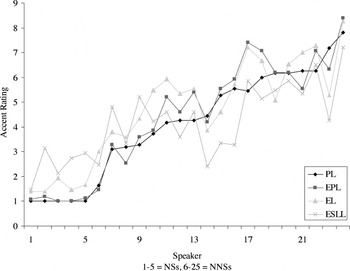
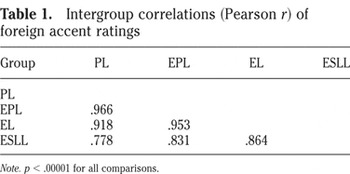
Figure 1 plots the mean accent ratings of all speakers. These mean scores were then used to determine correlations of the accent ratings among the four different groups. Table 1 shows the Pearson r values for the six possible pairings of the listener groups. All comparisons were highly correlated across groups, with correlations ranging from .778 to .966, all of which were highly significant, p < .0001.

Mean accent ratings of listener groups.
Intergroup correlations (Pearson r) of foreign accent ratings

Utterance Duration and Accent Ratings
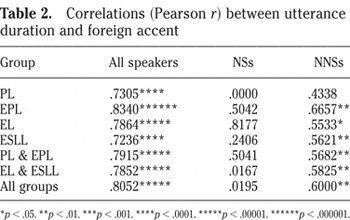
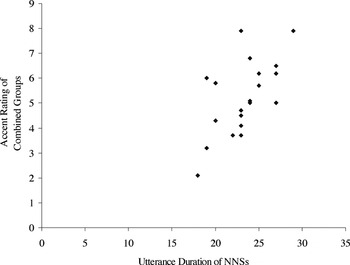
Many factors can influence foreign accent ratings, one of which might be duration: A longer utterance might be perceived as less fluent and, therefore, more accented. In order to test possible correlations between utterance duration and accent, Pearson r values were calculated. Table 2 shows that none of the correlations for the NSs were significant, whereas for the NNSs, all correlations were significant except one, meaning that the longer the duration, the higher the accent score; however, r values averaged only .56. Although these correlations are significant, there is considerable variation in this tendency in a number of individual speakers, as indicated in Figure 2, which presents a scatter plot of the utterance durations of the NNSs and the accent ratings assigned by all listening groups combined. For all speakers combined, the correlations were much higher. However, it should be noted that the durations of the NSs utterances ranged only from 16 to 18 s, in contrast to those of the NNSs, which ranged from 18 to 29 s; this would account for the larger r values.
Correlations (Pearson r) between utterance duration and foreign accent


Mean accent ratings of combined groups and utterance durations of NNSs.
Mean Accent Ratings for NSs and NNSs
Figure 3 illustrates the mean ratings of the various listening groups for the NSs and NNSs. All members of the PL group rated all of the NSs as native2
One anonymous SSLA reviewer, citing Sancier and Fowler (1997), suggested using monolinguals because of the possibility that the NSs spoke Portuguese with an American accent. The possibility of what we might call contamination occurs whenever nonmonolinguals are used: There is massive evidence in the literature that L2 influences L1. However, in this study this appears not to have affected the results, because all of the native listeners rated all of the NSs as having no foreign accent (of course, there is the further possibility that the native listeners also had an American accent and thus could not hear it in the NSs). Furthermore, on a more practical note, finding true monolinguals is very difficult for almost all SLA researchers and for this study in particular because all Brazilians who have been to school speak some English.

Mean accent ratings of NSs and NNSs.
A brief comment on one of the NNSs in the present study is warranted. One of the speakers was far more advanced in Portuguese than any of the other NNSs. She had lived for 6 years in Brazil, where she received her doctorate in linguistics, writing her dissertation in Portuguese. For the native listeners (PL), six out of the 11 PLs rated her as native and in fact she was the only NNS rated as native by the PLs. She was also the NNS most frequently rated as native in the other three groups (19 out of 45 ratings being 1). That this speaker was rated native by 6 of the 11 native listeners is reminiscent of the Ioup et al. (1994) study in which one participant, a NNS of Egyptian Arabic, was rated native by 8 out of 13 native listeners. However, in both the Ioup et al. study and the present study, all of the NSs were judged as native by the native listeners.
To compare the differences between the ratings of NSs and NNSs, two sets of scores were calculated: each listener's mean rating for each of the NSs and his or her rating for each of the NNSs. Thus, there were two sets of scores for each listener: scores for each of the NSs and scores for each of the NNSs. Because there was no variation in PL ratings for NSs (they were all 1s), these scores cannot be used in any parametric statistical test (although it seems obvious that the PLs made a clear distinction between the NSs and NNSs; M = 1.0 and 5.07, respectively). However, the PL scores for the NSs were used for the combined group comparisons (PL + EPL vs. EL + ESLL) because there was variation in the combined group of PL and EPL.
Comparison of Speaker Groups
To test whether the differences between the NSs and NNSs were significantly different for each listening group, t tests were employed (excluding the PL group, as noted). All three pairwise comparisons proved highly significant (Bonferroni adjusted, p < .0001): EPL, t = −21.137; EL, t = −16.011; ESLL: t = −6.442. Thus, the analysis clearly reveals that all groups of listeners were able to distinguish between the NSs and NNSs because all groups rated the NSs with significantly less accent than the NNSs.
Comparison of Listener Groups
Two one-way ANOVA analyses were employed to determine if there was significant variation across listener groups for ratings of the NSs and for ratings of the NNSs (omitting the PL ratings of the NSs, as explained). The analyses yielded a significant difference across groups for the NSs, F(2, 45) = 10.8061, p < .0001, and barely significant differences for NNSs, F(3, 56) = 2.7918, p < .05.
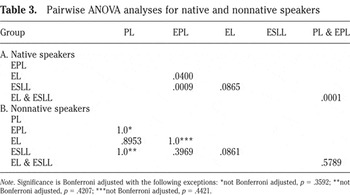
Pairwise comparisons were employed to determine possible significant differences between groups (PL ratings of NNSs vs. EPL ratings of NNSs, EL ratings of NSs vs. ESL ratings of NSs, etc.). The results of the pairwise comparisons suggest that language familiarity was a factor in the NS ratings but not in the NNS ratings. Table 3A shows that the four pairwise comparisons for the NSs yielded significant differences for (a) EPL versus EL, F(1, 30) = 7.6359, Bonferroni adjusted p < .05; (b) EPL versus ESLL, F(1, 30) = 17.9518, Bonferroni adjusted p < .001; and (c) PL and EPL versus EL and ESLL, F(1, 56) = 20.3103, Bonferroni adjusted p < .001. However, there was no significant difference for the ELs versus ESLLs, F(1, 30) = 5.9174, Bonferroni adjusted p = .065. In contrast, Table 3B indicates that none of the seven pairwise comparisons for the NNSs were significant: F-scores ranged from 0.0630 to 7.1680 and Bonferroni adjusted p-values ranged from .0861 to 1.0.
Pairwise ANOVA analyses for native and nonnative speakers

DISCUSSION
The focus of this study was to compare foreign accent ratings of the four different listener groups judging NSs and NNSs. The most striking results of this study were that, regardless of their L1s or familiarity with the L2, the listeners' ratings of the individuals speakers were highly correlated across groups (Figure 1) and listeners from all groups rated NSs differently than NNSs (Figure 3). Furthermore, even the mean ratings of the NSs by the listeners not familiar with Portuguese were very nativelike. The mean of the combined ratings of the NSs for the listeners familiar with Portuguese was 1.04 (PL and EPL), compared to 2.03 for those not familiar with the language (EL and ESLL, see Figure 3). In contrast, the mean for the NNSs was 5.24 for the experienced listeners and 5.20 for the inexperienced listeners (Figure 3). If one claims that NS identification and foreign accent ratings should be the exclusive province of native listeners, then the comparisons to nonnative listeners would be expected to show significant differences at all levels. Yet, this was not the case. Such similarities across groups were also found in the research of Flege (1988), MacKay et al. (2006), and Munro et al. (2006), which dealt with native and ESL listeners judging ESL speech, although an important difference in those studies is that they did not include listeners unfamiliar with the language.
Why, then, did the EL and ESLL groups, having no familiarity with Portuguese, perform very similarly to those listeners familiar with the language? One possibility is that utterance durations influenced the accent ratings. Several studies have found a correlation between accent ratings and utterance duration, speaking rate, or both. Munro and Derwing (1998) found that listeners (when hearing NNSs) rated passages read slowly as more accented and less comprehensible than normal-rate passages. In a related experiment, Munro and Derwing (2001) found that the highest ratings for nativeness and comprehensibility were for L2 speech that was somewhat faster than generally used by L2 users; however, both very fast and very slow speech were rated lower. In an unpublished presentation, Bond, Stockmal, and Markus (2003) also suggested that duration was a factor in foreign accent ratings when they reported on a study of Latvian produced by NSs and NNSs, with judgments by native listeners, nonnative listeners who spoke Latvian, and Americans who had never heard the language. All groups were successful in identifying foreign accented speech. The authors concluded that the Americans were focusing on fluency, which could be roughly estimated by utterance duration. In the present study, duration could also be a factor, given the positive correlations between accent ratings and duration for the NNSs (Table 2). However, the correlations are not strong, averaging less than .6, with considerable variation to this trend for the individual speakers (see Figure 2). In fact, 8 out of 20 NNSs had ratings and durations that were exceptions to this trend of a low accent score/short duration or high accent score/long duration; that is, either they exhibited (a) a duration below the mean coupled with an accent score above the mean or (b) a duration above the mean with an accent score below the mean. Thus, it would appear that duration differences alone probably do not account for the listeners' rating differences. In order to further investigate if duration affects accent ratings, research should be undertaken selecting speech samples with similar ranges of durations for both NSs and NNSs. Thus, it could be determined if duration per se were a factor or merely a concomitant factor of foreign accent ratings.
There is a second possible explanation for the similarity of accent ratings that takes into account well-established research on the role of transfer and a concept I will term displaced foreign accent detection. This concept is based on listeners' familiarity with the L1 of the NNSs (in this case, English), not on familiarity with the language being spoken (Portuguese). Presumably, a native listener is able to detect a foreign accent by perceiving whether and to what degree an utterance deviates from a native accent. It then seems plausible that a listener who is not familiar with the language being spoken, but who is familiar with the L1 of the speaker, is able to detect a foreign accent by perceiving how much the utterance has a native L1 accent in the L2. The focus of the listener in this type of foreign accent identification is thus displaced from the language spoken to the L1 of the speaker. A pure native L1 accent in the L2 would result in the listener rating the utterance as having a very heavy foreign accent. It could be likened to speaking the L1 with L2 loanwords (i.e., L1 phonology with L2 lexicon).
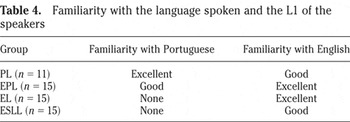
Furthermore, the difference in mean ratings between the EL and ESLL groups follows from this explanation (see Figure 3). The ELs had excellent familiarity with the L1 of the speakers—they shared the same L1; the ESLLs had good familiarity with the L1, but it was not their L1. Therefore, one would expect the ESLLs to have less success than the ELs in identifying a L1 American English accent in the speakers, thus not being quite as able to distinguish the NSs from the NNSs. Table 4 depicts the listeners' relative familiarity of the language spoken (Portuguese) and the L1 of the speakers (English and Portuguese). The profiles of the PL and EPL groups are parallel: Both have good and excellent familiarity with opposite languages. The other two groups have good or excellent familiarity with one language only. It would be predicted that the greater the familiarity, the more nativelike the ratings would be for the NSs. This was borne out by the ranking of the ratings for the four groups: PL < EPL < EL < ESLL (Figure 3). Thus, foreign accent detection seems to involve both familiarity with the language spoken and the L1 of the speaker: The greater the familiarity, the greater the accuracy.
Familiarity with the language spoken and the L1 of the speakers

Additionally, these rankings further suggest that familiarity with the language being spoken is somewhat more important than familiarity with the L1 of the L2 speakers: The PLs had excellent familiarity with Portuguese and good familiarity with English, but for the EPLs, the situation was reversed. Because Portuguese was the language being judged, it is not surprising that the PLs rated the NSs as having no accent at all (all 55 ratings receiving 1s), whereas the EPLs rated the speakers as having slightly more accent (out of 75 ratings there were 70 ratings of 1, 4 ratings of 2, and 1 rating of 3). To further investigate the role of language familiarity, it would be useful to include listeners who have had no familiarity with the L1 of the speakers. For example, a similar study could be conducted with L2 speakers of Xhosa, with L1s of Hausa, Sora, Amharic, Berber, and Guarani, judged by listeners with L1 Hmong.
A third explanation for the similarity of ratings is the possibility of the existence of salient universal perceptual factors that come into play in identifying a foreign accent, regardless of the language being heard. One can only speculate what these might be. For decades, research in perception has investigated a number of factors, but perhaps these factors give us insights into only a small portion of what human beings are able to perceive. Although there are studies of how acoustic information gives listeners clues to a speaker's age (Ptacek & Sander, 1966), gender (Coleman, 1971), and even whether the speaker is smiling (Tartter, 1980), there are a number of traits that human beings can determine from hearing a human voice that, to date, have been outside the scope of acoustic analysis. Perhaps some of these abilities come into play when detecting a foreign accent. For example, upon hearing a human voice, most human beings can successfully judge the speaker's attitude, sincerity, and confidence. One can often detect when a complete stranger is disguising his or her voice, using an unnatural voice, or using a less than familiar style. Oft-heard utterances such as “he's putting us on,” “he doesn't sound like he's using his natural voice,” or “she's trying to sound like someone she is not” suggest that human beings can recognize unnatural speech. It is curious that we can identify these characteristics even if we have never heard that person previously. Even though these abilities seem to be possessed by most human beings, they have not been researched in linguistics. It might therefore be reasonable to believe that there are heretofore unknown factors that enable human beings to detect when someone is not speaking naturally, even without a previous sample of that person's natural speech. In terms of this study, not speaking naturally means speaking in a language that is not completely natural or comfortable, thus producing a foreign accent.
In general terms, this study involved comparing the ratings of expert, experienced, and inexperienced listeners (PLs, EPLs, ELs, and ESLLs) who evaluated expert and experienced speakers (NSs and NNSs). It was found that the judgments given to the expert speakers (the NSs) by the expert and experienced listeners differed somewhat from those of the inexperienced listeners; however, the judgments given to the experienced speakers (the NNSs) by the expert, experienced, and inexperienced listeners did not differ significantly. These results have interesting parallels in other forms of general human behavior involving judgments. Consider an international athletic competition, such as an Olympic gymnastics competition. An expert judge should be able to distinguish between performances of 9.7 and 10 (10 being a perfect score); an experienced judge who is not an expert might have difficulty distinguishing between these two scores but might be able to distinguish between a 9.3 and 10; a judge altogether unfamiliar with gymnastics might not be able to distinguish between a 9.3 and 10. However, all three sets of judges (expert, experienced, and inexperienced) could probably easily distinguish between performances ranging from 0 to 6 and those ranging from 9.3 to 10. Thus, expert, experienced, and inexperienced judges are able to spot expert performers (9.3 to 10, with greater experience facilitating finer discrimination at the upper end of the scale); however, all three sets of judges would place the experienced but nonexpert (0 to 6) performers in the same category.
This study has implications for the CPH. The CPH claims that after a certain age, native or nativelike competence is unattainable. Without citing the considerable literature that reports apparent exceptions, additional factors, or both (see Birdsong, 1999, 2005; Moyer, 2004), suffice it to say that the present study seems to argue against the CPH—albeit indirectly: Part of nativelike competence is nativelike perception. Although in the present study the groups not familiar with Portuguese (EL and ESLL) showed some differences compared to the native listeners (PL), there were overwhelming similarities. The perceptual skills (which might or might not be specific to Portuguese) exhibited by the EL and ESLL groups could not have been acquired, simply because the listeners were unfamiliar with the accent. Thus, this possible exception to the CPH suggests that at least some perceptual abilities relevant to judging foreign accents are not acquired, but are perhaps innate.
CONCLUSION
This study has demonstrated that native and nonnative listeners with or without familiarity with the language rated NSs differently than NNSs. Furthermore, the ratings of the different listening groups for NSs were very similar, as were the ratings for the NNSs. Although listeners' familiarity with Portuguese was somewhat significant in the rating of the NSs, it was not significant in the rating of the NNSs. This implies that native and nonnative listeners have similar abilities in rating foreign accents and that their L1s and L2s do not dramatically affect the ratings. The study further suggests that rating foreign accents involves salient universal perceptual factors.
APPENDIX A: READING PASSAGE
A primeira escola de samba nasceu no Estácio—portanto no asfalto e não no morro—fez a sua primeira aparição oficial no desfile da Praça Onze. A tradição da brincadeira de rua já existia há muito tempo no Distrito Federal, mas sem nenhum tipo de organização musical.
APPENDIX B: DIRECTIONS TO LISTENERS
You will be hearing a short text of Portuguese read by Americans and Brazilians. Listen to each speaker and rate the speaker for degree of foreign accent, by placing an “X” in the appropriate box.
1 = No foreign accent
9 = Very strong foreign accent
Specifically, 1 means the speaker sounds like a native speaker of Brazilian Portuguese, and 9 sounds like a nonnative speaker of Portuguese with a very strong foreign accent.