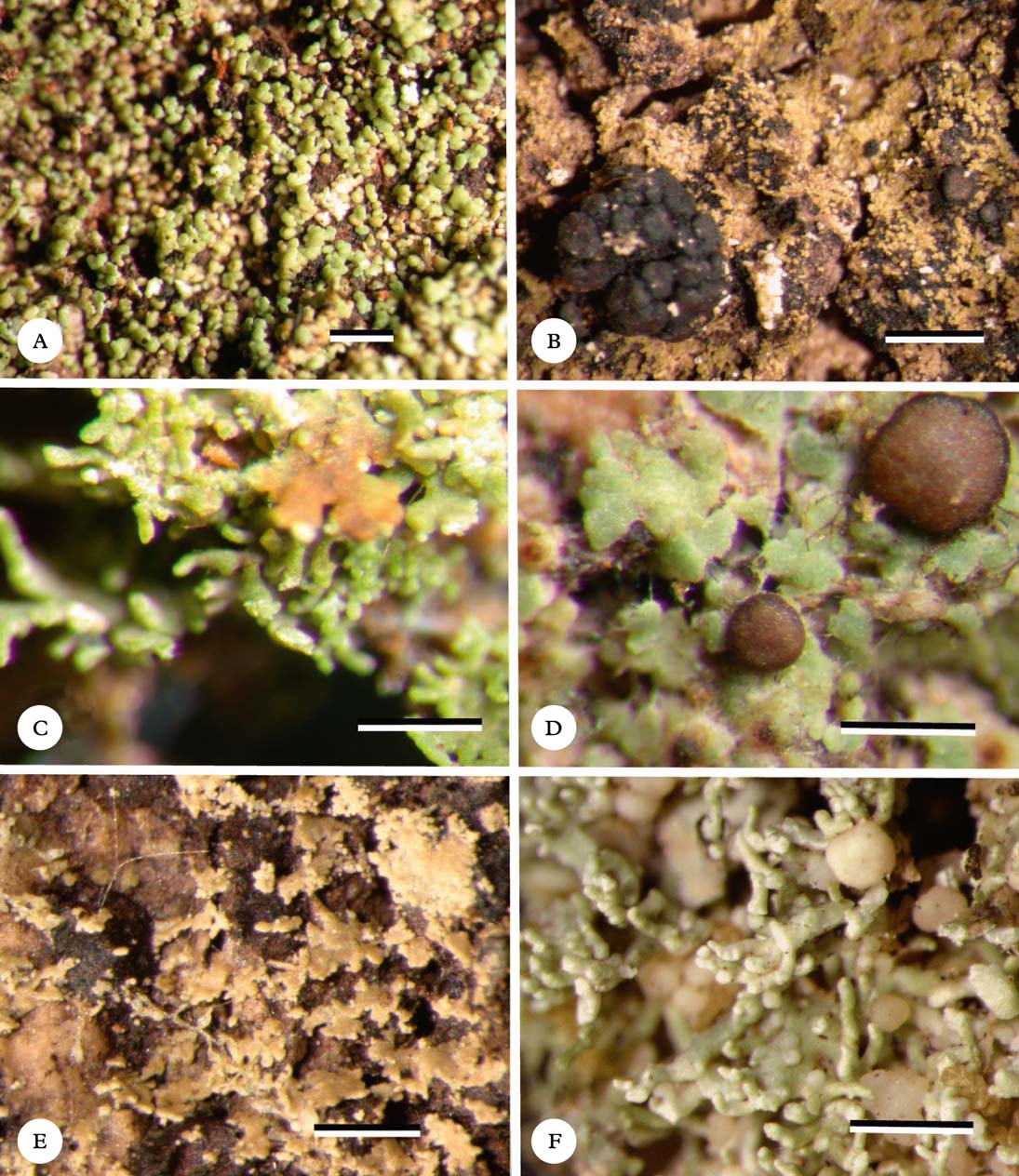
Introduction
The rainforests of Rondônia and adjacent Amazonas in the Amazon basin are lichenologically largely unknown. However, a project to survey the lichens in these still mostly primary forests has recently started and the first results show that the region is among the richest sites for lichen diversity in the world, with many still undescribed species which can be locally abundant (Aptroot et al. Reference Aptroot, Sipman and Cáceres2013; Aptroot & Cáceres Reference Aptroot and Cáceres2013, Reference Aptroot and Cáceres2014; Cáceres et al. Reference Cáceres, Aptroot, Parnmen, Lumbsch and Lücking2014a , Reference Cáceres, Aptroot and Ertz b ).
Crustose lichens are by far the most dominant in all habitats in Rondônia, and squamulose to microfoliose species are still more common than foliose lichens. No truly fruticose lichens were found, only some mainly squamulose Cladonia species.
This paper mainly treats the lowland squamulose and microfoliose lichens which are abundant and speciose in Rondônia but, in order to get a more complete coverage, the foliose species found are also keyed out, as well as some crustose lichens with chlorococcoid algae in related groups. These groups are surprisingly species-poor in this region; species with chlorococcoid algae constitute only a small minority of the lichen flora in tropical lowland regions.
Material and Methods
Identification and descriptive work was carried out at Universidade Federal de Sergipe in Itabaiana, using a Leica EZ4 stereomicroscope and a Leica DM500 compound microscope, and also in Soest using an Olympus SZX7 stereomicroscope and an Olympus BX50 compound microscope with interference contrast, connected to a Nikon Coolpix digital camera. Sections were mounted in tap water, in which all measurements were also taken. The specimens from this study are preserved in ISE and ABL. The chemistries of the type specimens were investigated by thin-layer chromatography (TLC) using solvent A (Orange et al. Reference Orange, James and White2001). Ascospore measurements are taken from released spores; values in brackets are unusually small measurements.
All specimens cited below were collected by M. E. S. Cáceres & A. Aptroot in Rondônia State, Brazil, at c. 100 m elevation, and are preserved in both ABL and ISE. Collection numbers in the 11000s refer to collections from March 2012, numbers in the 15000s refer to collections from November 2012. Unless otherwise stated, the collections are from tree bark in rainforest. Only one or two representative collections are cited. Full details are given only for the new species.
Short names and locality information for the main collecting sites:
- Buriti:
-
Sítio Ecológico Buriti on Lago Cujubim E of Porto Velho, c. 8°35′17″S, 63°40′40″W.
- Circuito:
-
Porto Velho, Parque Circuito, c. 8°43′54″S, 63°54′04″W.
- Cuniã:
-
Estação Ecológica de Cuniã, km 760 on road BR 319 N of Porto Velho, c. 8°02′44″S, 63°29′11″W.
- São Francisco:
-
Fazenda São Francisco off BR319, 30 km N of Porto Velho, c. 8°24′33″S, 63°58′56″W.
- Parque:
-
Porto Velho, Parque Natural Municipal de Porto Velho, c. 8°41′10″S, 63°52′05″W.
- Santo Antonio:
-
Porto Velho, Santo Antonio church, c. 8°48′27″S, 63°56′40″W.
- UNIR:
-
Porto Velho, UNIR Federal University campus S of city, c. 8°50′14″S, 63°56′25″W.
The Species
Calopadia granulosa Aptroot & M. Cáceres sp. nov.
MycoBank No.: MB 806108
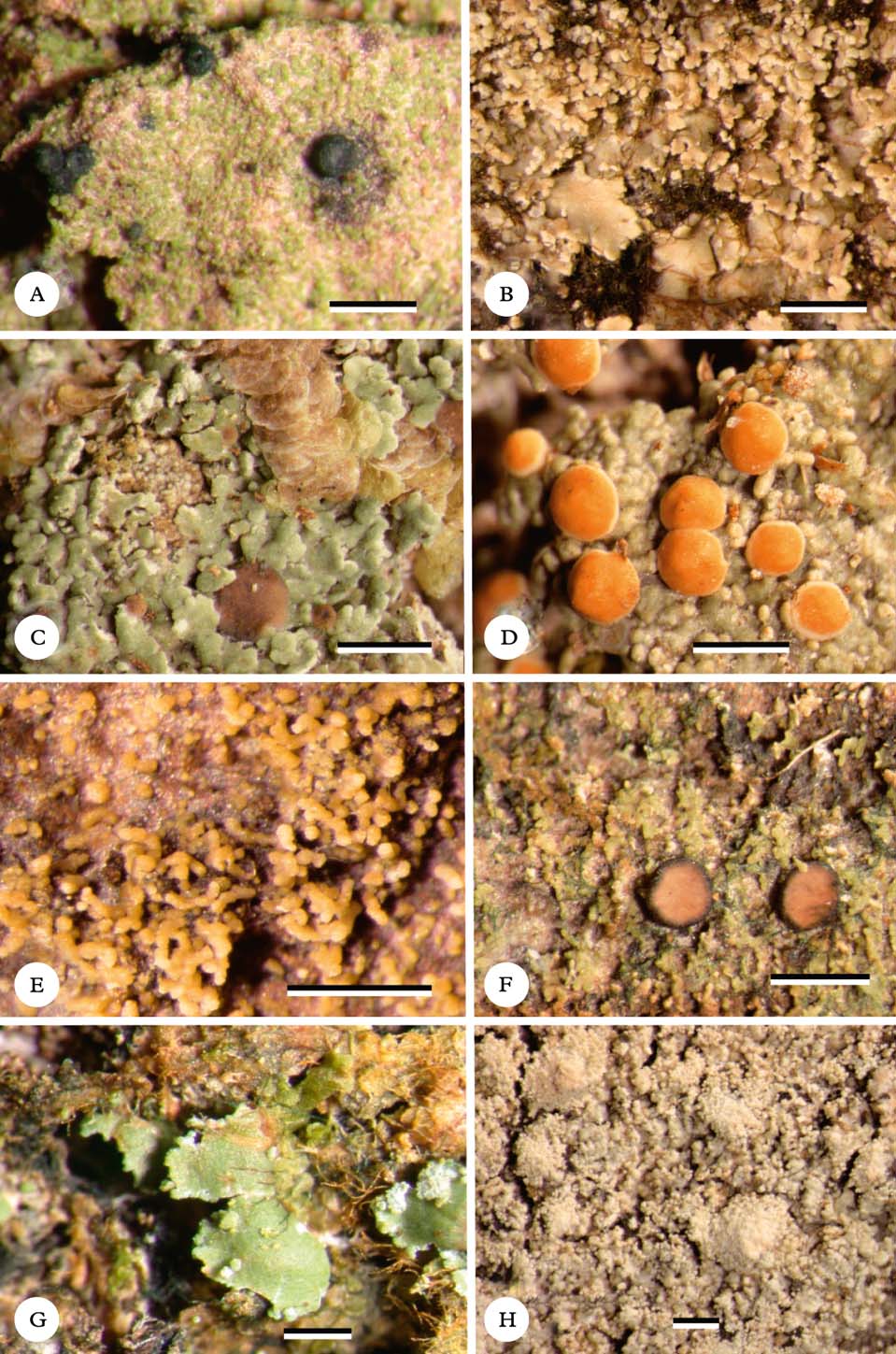
Corticolous Calopadia with a granular, corticate thallus and ascospores 1 per ascus, 33–38×10·5–13·0 µm.
Type: Brazil, Rondônia, Porto Velho, Parque Natural Municipal de Porto Velho, 8°41′10″S, 63°52′05″W, alt. c. 100 m, on tree bark in park near rainforest, 16 November 2012, M. Cáceres & A. Aptroot 15134 (ISE—holotype; ABL—isotype).
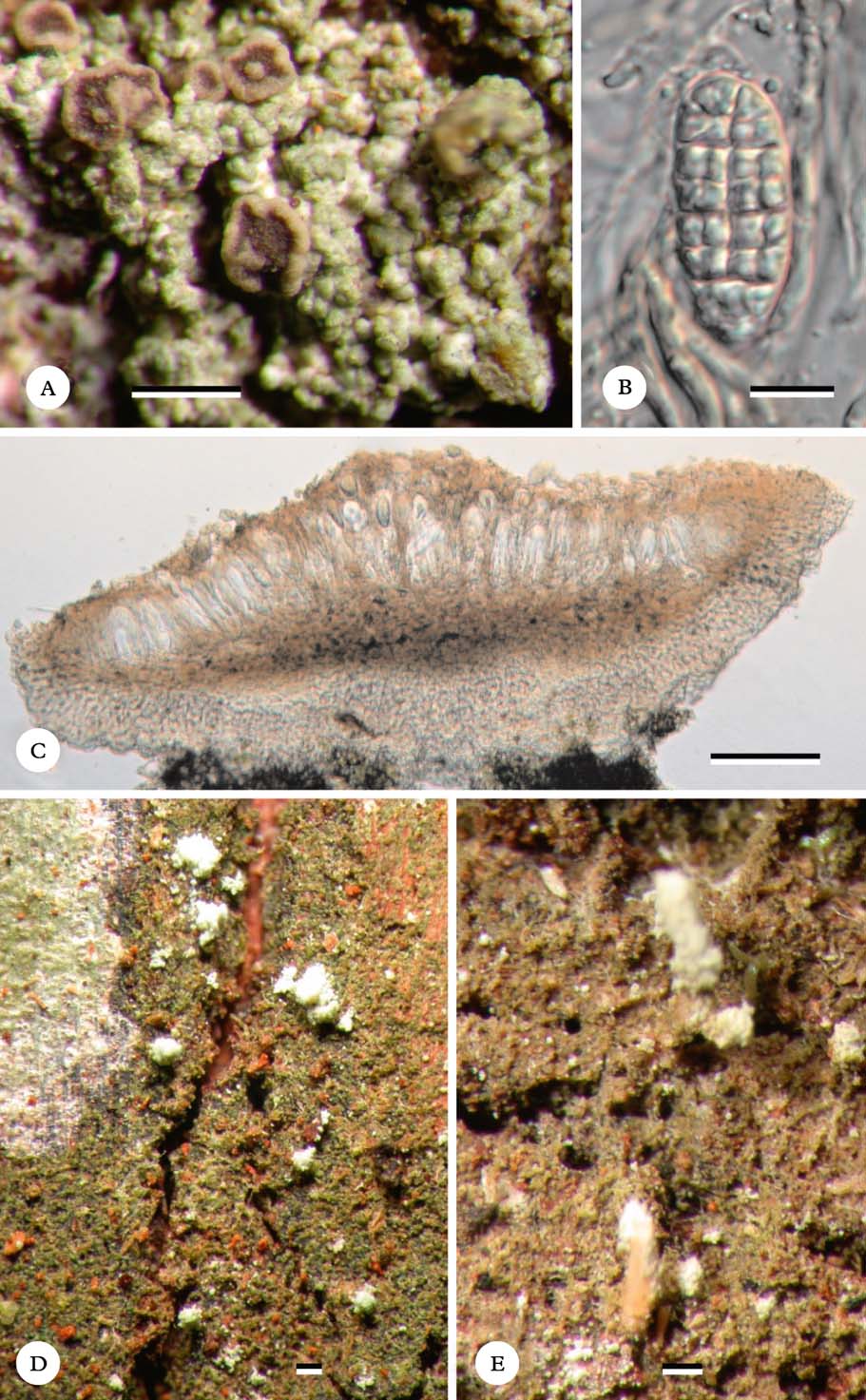
A–C, Calopadia granulosa (isotype). A, thallus with apothecia; B, ascospore; C, section through apothecium. D & E, Crustospathula amazonica, thallus with stalked soredia. D, isotype; E, a field picture of a Peruvian specimen. Scales: A, D & E=0·5 mm; B=10 µm; C=25 µm. In colour online
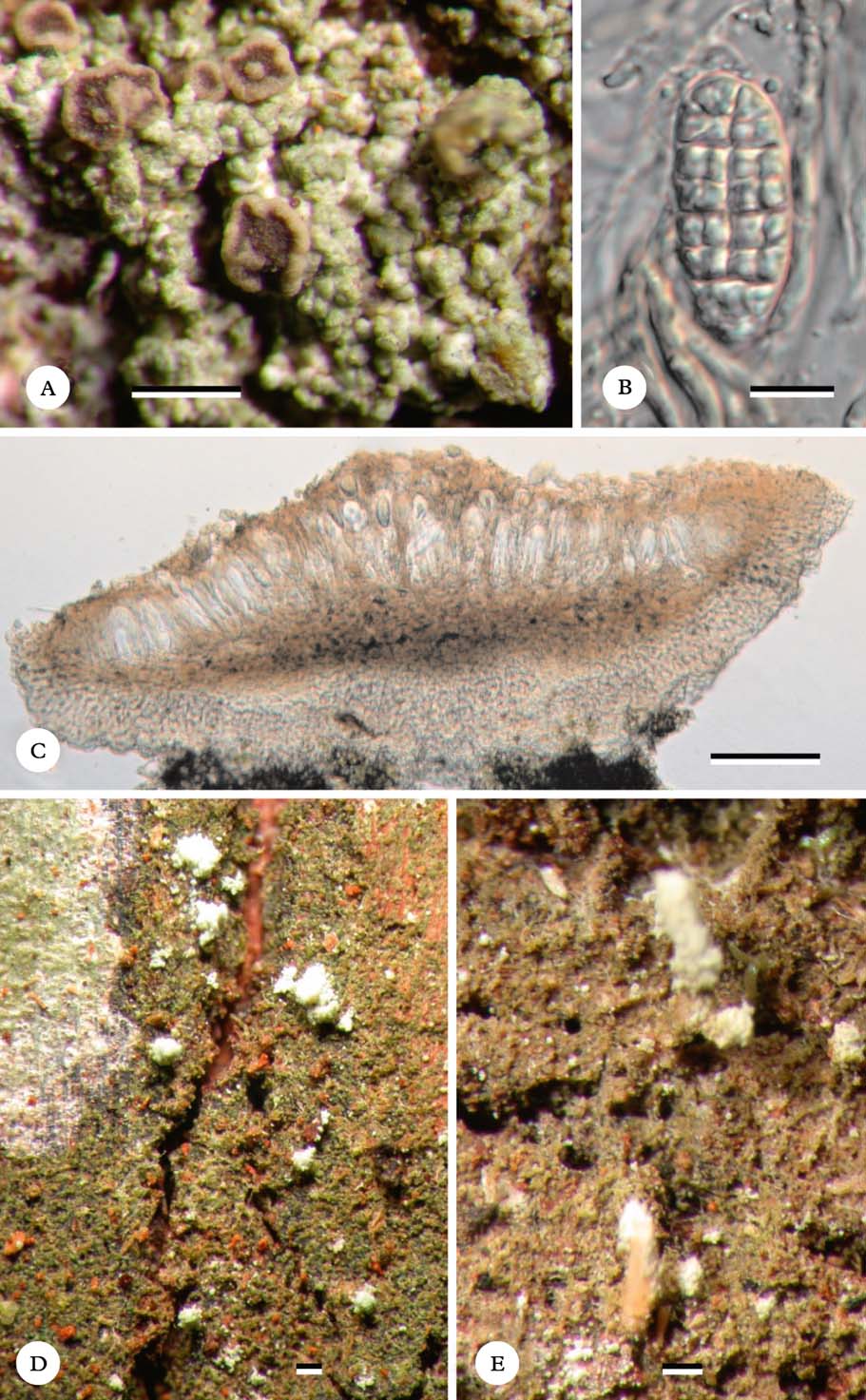
Thallus crustose, granular, corticate, dull, starting as isolated granules of c. 50 µm, soon aggregating to form an uneven, irregular, pale greenish grey crust, 0·1–0·3 mm thick, without prothallus. Alga chlorococcoid, c. 7 µm diam.
Apothecia sessile, solitary or often grouped, round to irregularly lobate-crenate, 0·2–0·8 mm diam.; disc flat, dull, medium to dark brown, not pruinose, biatorine, margin chamois-coloured, dull, c. 0·05–0·10 mm wide, persistent, slightly higher than the disc. Hymenium hyaline, but streaked with brown pigment of the same colour as the hypothecium, KOH−, IKI+ blue; paraphyses branched; hypothecium dark brown, KOH−; excipulum hyaline. Ascospores 1 per ascus, hyaline, ellipsoid, densely muriform, 33–38×10·5–13·0 µm.
Campylidia auriculate, pale greyish brown, up to 1 mm wide and up to 1·5 mm high, originating from a young stage of development, later overgrown with thallus and even bearing apothecia.
Chemistry
Thallus UV−, C−, K−, KC−, P−. No substances detected with TLC.
Ecology and distribution
On smooth bark of trees in park near rainforest, where it grows together with Canoparmelia amazonica (Nyl.) Elix. Known only from Brazil.
Discussion
Over 20 species are known in the genus (Lücking Reference Lücking2008), of which a third are strictly foliicolous, a third corticolous and a third occurring on various substrata including living leaves, bark and occasionally rock. Corticolous species have been treated by Cáceres (Reference Cáceres2007), Kalb & Vězda (Reference Kalb and Vězda1987), Lücking et al. (Reference Lücking, Seavey, Common, Beeching, Breuss, Buck, Crane, Hodges, Hodkinson and Lay2011) and Lumbsch et al. (Reference Lumbsch, Ahti, Altermann, Amo de Paz, Aptroot, Arup, Bárcenas Peña, Bawingan, Benatti and Betancourt2011).
Almost all species have an essentially smooth thallus, except for C. isidiosa Kalb & Vězda and C. psoromoides Kalb & Vězda (Kalb & Vězda Reference Kalb and Vězda1987), which have an isidiate and a squamulose thallus respectively. The new species differs from all previously known species by a roughly granulose thallus, and has among the smallest ascospores found in the genus; they are especially small for ascospores that are single in the ascus.
Crustospathula amazonica Aptroot, M. Cáceres & Timdal sp. nov.
MycoBank No.: MB 806109
Corticolous Crustospathula with irregularly capitate to nearly globose, c. 0·2–0·4 mm diam. soralia on cartilaginous stalks.
Type: Brazil, Rondônia, Porto Velho, Parque Natural Municipal de Porto Velho, 8°41′10″S, 63°52′05″W, alt. c. 100 m, on tree bark in primary rainforest, 9–12 March 2012, M. Cáceres & A. Aptroot 11596 (ISE—holotype; ABL—isotype).
(Fig. 1D & E; see also illustration in Aptroot & Schumm Reference Aptroot and Schumm2009: 68, fig. 9)
Thallus filmy, green, with finely agglutinating granules, algal cells c. 5 µm diam., hypothallus absent. Soredia whitish, globose, 15–20 µm diam., irregularly arranged at the tips of stalks. Soralia irregularly capitate to nearly globose, c. 0·2–0·4 mm diam. Stalks cartilaginous, flesh-coloured, up to 3 mm high but often much shorter, perpendicular to the bark, simple to repeatedly branched; in section round, solid, up to 0·5 mm thick at the base.
Apothecia unknown.
Conidiomata sessile, whitish. Conidia globose, hyaline, 0·1–0·2 µm diam.
Chemistry
Thallus UV−, C−, K−, KC−, P−. A terpenoid probably referable to zeorin was found with TLC in all collections where the chemistry was investigated (those from Brazil and French Guiana).
Ecology and distribution
On smooth bark of trees in primary forest, where it grows together with Porina spp. and thelotremoid Graphidaceae. Known from Brazil, French Guiana and Peru.
Discussion
The genus Crustospathula contains four described species so far (Aptroot Reference Aptroot1998; Aptroot & Schumm Reference Aptroot and Schumm2009; Kalb Reference Kalb2011; Kalb et al. Reference Kalb, Buaruang, Mongkolsuk and Boonpragob2012). This new species was already mentioned and illustrated by Aptroot & Schumm (Reference Aptroot and Schumm2009) but left undescribed because it was sterile and only known from a single collection from French Guiana. However, it was one of the first lichen species we collected in Rondônia, and this suggests that it is widespread in the Amazon basin and probably not rare. Even though fertile material has still not been found, it is described now. The newest material is chosen as type here in case phylogenetic study is forthcoming, as the position of the genus is not clear, and it may even turn out to be polyphyletic.
The new species most resembles Crustospathula cartilaginea Aptroot (Aptroot Reference Aptroot1998), but differs from this and the other described species by the much thinner stalks of the soralia, approaching a fruticose growth form, and the generally smaller and more irregular soralia.
Additional specimens seen. Brazil: Rondônia: same locality and date as the type, M. Cáceres & A. Aptroot 15739 (ISE, ABL).—French Guiana: Regina: S. shore of creek Arataye near confluence with river Approuague, 50–150 m, on base of thick trunk, 2003, H. Sipman 50765 (B, BR).—Peru: Loreto: Reserva Nacional Allpahuayo Mishana, within 2·3 km from Centro de Investigaciones Allpahuayo, N of the road, 3°58·59′S, 73°25·48′W, 120–150 m, on tree trunk in rainforest, “bosque de varillal seco”, 2006, E. Timdal 10320 (O-L-144690); Jenaro Herrera, within 3·6 km from the Research Center, N of the road, c. 4°53′S, 73°38′W, 120–150 m, on tree trunk in rainforest, 2006, E. Timdal 10355 (O-L-144725), 10366 (O-L-144736), 10368 (O-L-144738), 10378 (O-L-144748), 10393 (O-L-144763),10449 (O-L-144819).
Flavoparmelia plicata Aptroot & M. Cáceres sp. nov.
MycoBank No.: MB 806110
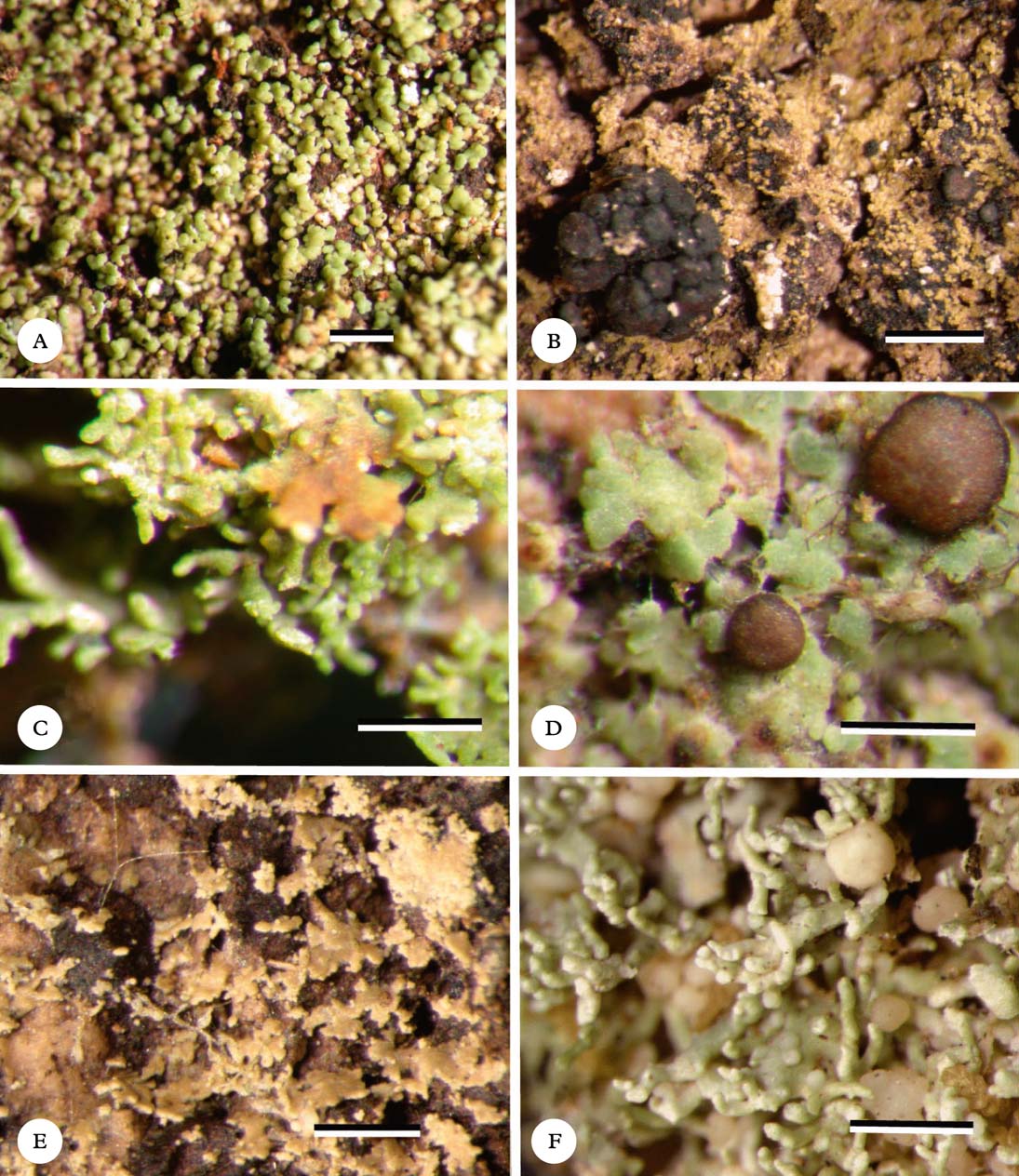
Corticolous Flavoparmelia with greyish green (usnic acid-colour) thallus containing usnic and protocetraric acids, with isidia same as thallus colour, laminal, irregular, globose to cylindrical to mostly branched towards the tips, often angular to lobate, hollow, in dense groups, 0·2–0·7 mm wide, 0·3–0·9 mm high, often easily abraded and showing the whitish medulla, but not sorediate or pustulate.
Type: Brazil, Rondônia, Porto Velho, Parque Natural Municipal de Porto Velho, 8°41′10″S, 63°52′05″W, alt. c. 100 m, on tree bark in park near rainforest, 16 November 2012, M. Cáceres & A. Aptroot 15244 (ISE—holotype; ABL—isotype).
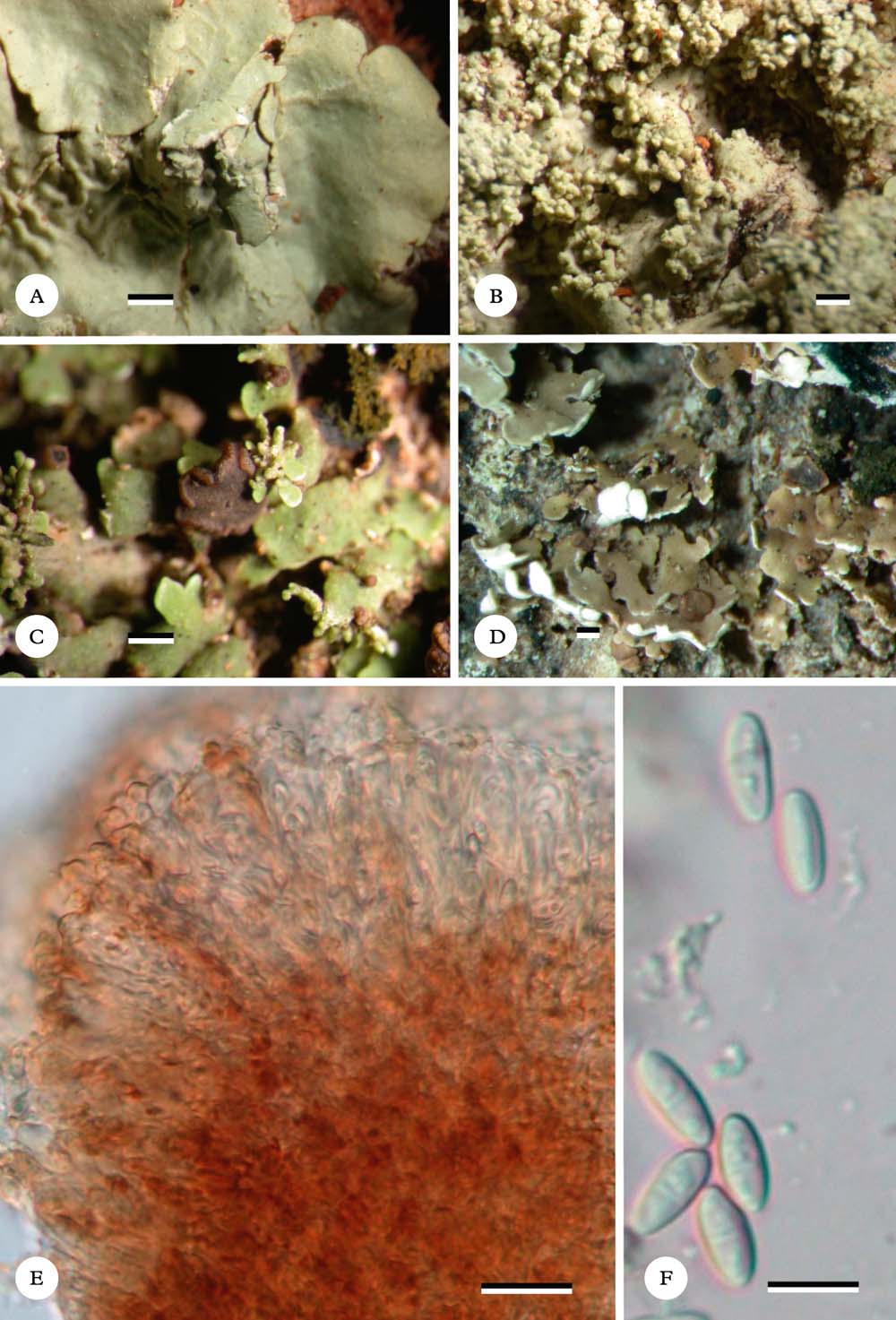
A & B, Flavoparmelia plicata (isotype). A, thallus margin; B, central part of thallus with isidia. C–F, Physcidia striata (isotype). C, thallus with apothecia and isidia; D, thallus with apothecia; E, section through apothecium margin; F, ascospores. Scales: A & B=0·5 mm; C & D=0·1 mm; E & F=10 µm. In colour online.
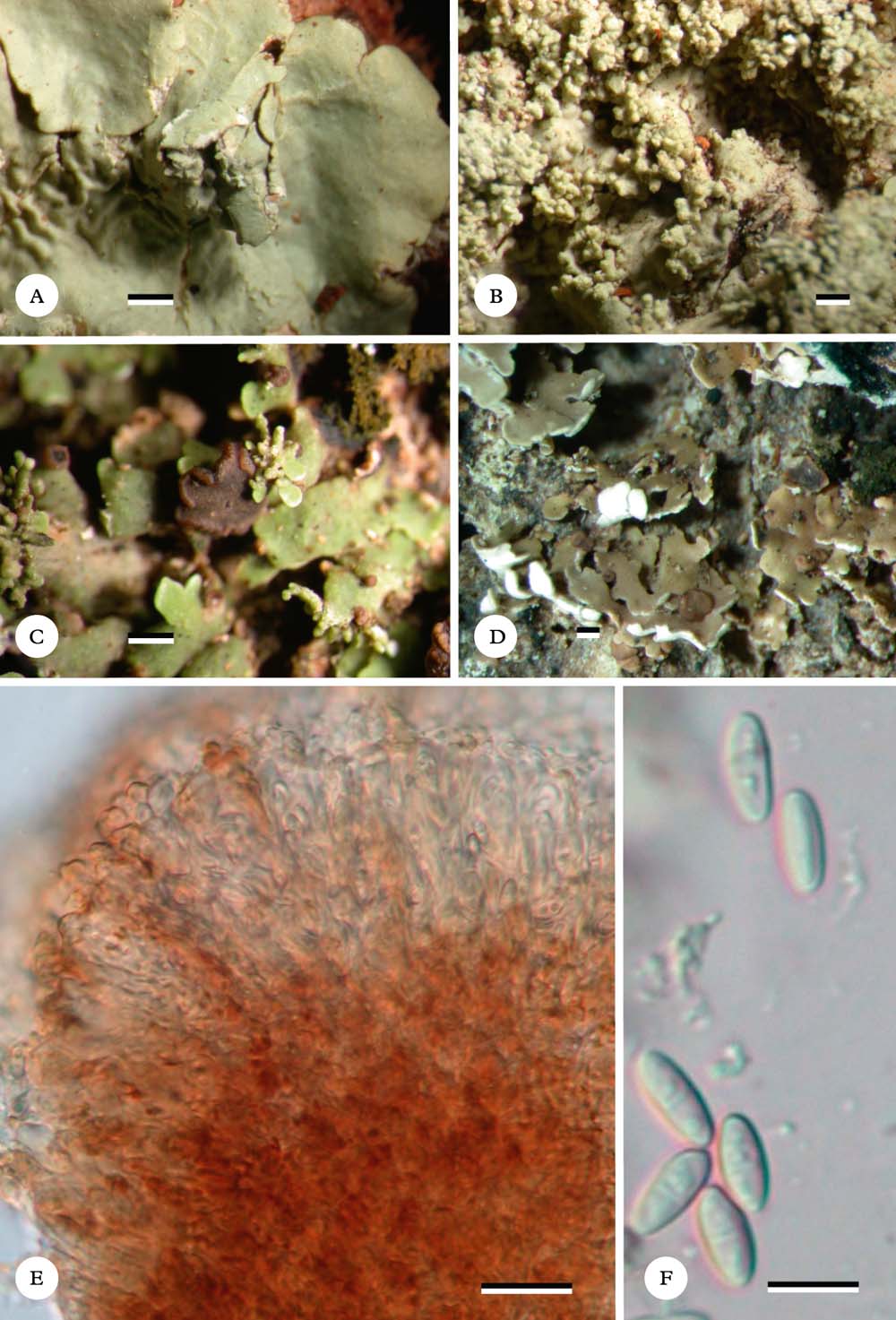
Thallus foliose, appressed except in the areas where lobes coalesce, somewhat folded and distinctly ridged toward the centre of the thallus, up to 10 cm diam., greyish green (usnic acid-colour). Lobes 4–7 mm wide, slightly crenately incised, with rather indistinct maculae on the tips, margins often downturned, without cilia. Lower surface black and with grey to black, short and dense rhizines, but pale brown and without rhizines in a broad (c. 1–3 mm) marginal zone. Isidia of thallus colour, laminal, only developed towards the centre of the thallus, irregular, globose to cylindrical to mostly branched towards the tips, often angular to lobate, hollow, in dense groups, 0·2–0·7 mm wide, 0·3–0·9 mm high, often easily abraded and showing the whitish medulla, but not sorediate or pustulate.
Apothecia unknown.
Conidiomata unknown.
Chemistry
Medulla UV+ pink, C−, K+ yellow, KC+ red, P+ orange. TLC: usnic and protocetraric acids.
Ecology and distribution
On tree bark in park near primary forest, where it grows together with Canoparmelia amazonica (Nyl.) Elix. Known only from Brazil.
Discussion
This species shares many characters with the cosmopolitan Flavoparmelia caperata (L.) Hale, such as the folded lobes, the appressed outer lobes with a rhizine-bare zone on the lower margin, and the colour and chemistry (Hale Reference Hale1976). It differs mainly by the irregular, branched and partly flattened hollow isidia, which easily become abraded without forming soredia. The isidia are somewhat similar to those in Flavoparmelia baltimorensis (Gyelnik & Fóriss) Hale, but that species has flatter, never plicate lobes with more distinct maculae and always grows on rock. It is somewhat surprising that one of the very few Parmeliaceae found in Rondônia seems to be undescribed. On the other hand, it is not just a depauperate flora in a poor area, but the presence of some species that evolved in the Amazon basin and adapted to that environment is likely. No other Flavoparmelia species are known from neotropical lowlands, although F. caperata occurs in tropical mountains and is known from subtropical and temperate regions.
Physcidia striata Aptroot, M. Cáceres & Timdal sp. nov.
MycoBank No.: MB 806111
Corticolous Physcidia with ascending squamules, without hypothallus, often with isidia which are of thallus colour, laminal in defined areas towards lobe tips of some, usually sterile lobes, cylindrical to rarely branched, constricted at the base, 0·3–0·7 mm long, 0·1–0·2 mm wide, often easily abraded and the abrasions exposing the whitish, contrasting medulla, and often with biatorine apothecia with ascospores simple to 1-septate, (6·2–)7·5–10·0×(2·5–)3·0–3·5 µm.
Type: Brazil, Rondônia, Estação Ecológica de Cuniã, km 760 on road BR 319 N of Porto Velho, 8°02′44″S, 63°29′11″W, alt. c. 100 m, on tree bark in primary rainforest, 13 March 2012, M. Cáceres & A. Aptroot 11640 (ISE—holotype; ABL—isotype).
Thallus microfoliose, consisting of a loose mat of ascending squamules, without hypothallus. Lobes 2–7 mm long, 0·5–1·5 mm wide, rather flat, considerable but roughly branched and incised. Upper surface corticated, smooth but not shiny, greyish green. Medulla white. Lower surface pale ochraceous to off-white, somewhat shiny and with faint longitudinal striations. Isidia of thallus colour, laminal in defined areas towards lobe tips of some, usually sterile lobes, cylindrical to rarely branched, constricted at the base, 0·3–0·7 mm long, 0·1–0·2 mm wide, often easily abraded and in the abrasions exposing the whitish, contrasting medulla.
Apothecia sessile, solitary or often grouped and sometimes in dense clusters of dissected apothecia, round to irregularly lobate-crenate, 0·2–1·6 mm diam.; disc flat, dull, medium to dark brown, not pruinose, biatorine, margin always medium brown, dull, c. 0·1–0·2 mm wide, persistent, not higher than the disc. Hymenium hyaline, but streaked with brown pigment of the same colour as the hypothecium, KOH−, IKI+ blue; paraphyses branched; hypothecium orange-brown, KOH−; excipulum hyaline. Ascospores 8 per ascus, hyaline, ellipsoid, simple to 1-septate, (6·2–)7·5–10·0× (2·5–)3·0–3·5 µm.
Pycnidia not observed.
Chemistry
Medulla UV+ white, C−, K−, KC−, P−. Divaricatic acid (TLC).
Ecology and distribution
On smooth bark of trees in primary forest. Known from Brazil and Peru.
Discussion
The genus Physcidia is a small tropical genus with seven described species (Kalb & Elix Reference Kalb and Elix1995). It is similar in many respects to Phyllopsora, but differs by the chemistry (depsides and benzyl esters rather than usually chloro-depsidones), and the generally larger lobes that range from several millimetres to several centimetres. Other differences mentioned by Kalb & Elix (Reference Kalb and Elix1995) are variable in one or both genera and thus not distinct. The species as accepted by Kalb & Elix (Reference Kalb and Elix1995) are inconstant and variable in chemistry (with three chemotypes accepted in two species, and two in one species) and noticeably also in the presence or absence of isidia. On the contrary, species of Phyllopsora as currently accepted (Timdal Reference Timdal2008, Reference Timdal2011) are established in the sense that they show no major variation in chemistry and are either isidiate or non-isidiate. This differs from earlier species concepts in Phyllopsora (Brako Reference Brako1991), in which many species were said to only occasionally have isidia, and a wide variation in chemistry was accepted within several species. In the absence of ample phylogenetic reconstructions, it cannot be judged which of the species concepts regarding chemical variation is closer to the truth, but it can easily be seen that species of Physcidia are variable with regard to isidia production: isidia are present in many collections, but mostly on well-developed lobes without apothecia. The new species described here is another example: one collection is isidiate and not fertile, the other collection is richly fertile but shows well-developed isidia on some of the larger lobes, even though they are fertile. As this is never observed in Phyllopsora, it is an additional difference between the two genera.
The above discussion goes into some detail about the difference between Phyllopsora and Physcidia, because it was not immediately clear in which of the two genera the new species should have to be described, as it somewhat deviates from the majority of Physcidia species. These are also the characters that are specific for the new species: the ascospores are shorter than any known in the genus, they are simple to 1-septate rather than 1–3-septate, the hypothecium is brown (hyaline in the species known so far; variable in Phyllopsora) and the lower surface is covered by a thin layer of prosoplectenchymatous hyphae giving a slightly striate and glossy surface. Furthermore, it shares the biatorine apothecia with all species of Phyllopsora and with only one out of seven known species of Physcidia. It is possible that the genus Physcidia will turn out to be an ingroup of Phyllopsora in the present wide sense of Timdal (Reference Timdal2008, Reference Timdal2011), or that Phyllopsora will even turn out to be polyphyletic, with some crustose species groups in between. Still, it is clear that the new species resembles Physcidia species more than Phyllopsora species.
Selected additional specimens seen. Brazil: Rondônia: same locality and date as the type, M. Cáceres & A. Aptroot 11671 (ISE, ABL).—Venezuela: Estado Amazonas: Alto Orinoco, c. 15 km W of La Esmeralda, plot tower crane on the W riverbank of Surumoni, c. 110 m, 3°10′23″N, 65°40′27″W, on bark of Goupia glabra in tropical rainforest, 1997, J. Hafellner & H. Komposch 909-2-31, 909-4-15, 991-3-25 (all GZU).
Key to the corticolous microfoliose, foliose and related crustose lichens from Rondônia
Note. This key treats all corticolous microfoliose, foliose and some related crustose lichens that are currently known from Rondônia, based primarily on collections from our expeditions. As far as we know, not a single corticolous lichen species has been reported before from Rondônia. The exploration of the lichen flora in this state is still in its initial stage, and more species are expected to be discovered in due cause. At this stage, the key can serve to briefly characterize the species found, and to show some of the characteristics of the lichen flora, such as the paucity of foliose lichens and those with cyanobacteria, and the comparatively rich flora of microsquamulose species. Some references are made to taxa that are not found in the area but are expected to occur there.
-
1 Thallus with a cyanobacteria ... 2
Thallus with a green algal photobiont ... 7
-
2(1) Thallus consisting of mostly unbranched squamules. Porto Velho (11766) ... Phyllopeltula corticola (Büdel & R. Sant.) Kalb
Thallus foliose, lobed or incised ... 3
-
3(2) Thallus without or with some isolated rhizines (more Leptogium species are likely to occur, also Physma byrsaeum and Collema species would key out here) ... 4
Thallus with a dense felt of rhizines below (more Coccocarpia species are likely to occur) ... 5
-
4(3) Thallus with isidia. Circuito (11483) ... Leptogium coralloideum (Meyen & Flotow) Vain.
Thallus without isidia. UNIR (11010) ... Leptogium phyllocarpum (Pers.) Mont.
-
5(3) Thallus with flattened isidia (Coccocarpia palmicola, not yet found in Rondônia, has cylindrical isidia). São Francisco (11838) ... Coccocarpia pellita (Ach.) Müll. Arg.
Thallus without isidia ... 6
-
6(5) Thallus with lobules, usually without pycnidia or apothecia. Parque (11271a) ... Coccocarpia imbricascens Nyl.
Thallus with pycnidia and/or apothecia, without lobules. Cuniã (15684) ... Coccocarpia erythroxyli (Spreng.) Swinscow & Krog
-
7(1) Thallus truly foliose, with many rhizines on the lower surface ... 8
Thallus foliose, placodioid, microfoliose or crustose, lower surface without or with a few rhizines ... 18
-
8(7) Lobes subirregular (Parmeliaceae), tips often rotund; ascospores if present hyaline and simple ... 9
Lobes sublinear (Physciaceae), tips often truncated; ascospores if present brown and septate (more Physcia and Pyxine species are likely to occur) ... 15
-
9(8) Thallus with greenish yellow pigment (usnic acid-colour) ... 10
Thallus grey, with atranorin (more Canoparmelia and Parmotrema species are likely to occur) ... 11
-
10(9) Marginal cilia with inflated basis. Parque (11252) ... Relicina abstrusa (Vain.) Hale
Margin without cilia. Parque ... Flavoparmelia plicata Aptroot & M. Cáceres (Fig. 2A & B)
-
11(9) Thallus without soredia, with isidia or pycnidia and/or apothecia ... 12
Thallus with soredia ... 14
-
12(11) Thallus without isidia. Parque (11255) ... Parmotrema overeemii (Zahlbr.) Elix
Thallus with isidia ... 13
-
13(12) Medulla K+ yellow turning red. Parque (15240) ... Canoparmelia cinerascens (Lynge) Elix & Hale
Medulla K−. São Francisco (11824) & Parque ... Canoparmelia amazonica (Nyl.) Elix & Hale
-
14(11) Medulla P+ red, K+ yellow, lobes often >1 cm wide. Cuniã (15688) ... Parmotrema dilatatum (Vain.) Hale
Medulla P−, K−, lobes never >1 cm wide. Porto Velho (11762) & Circuito ... Parmotrema praesorediosum (Nyl.) Hale
-
15(8) Thallus surface dull, lower surface not smooth but often partly striate ... 16
Thallus surface slightly glossy, lower surface smooth ... 17
-
16(15) Soredia laminal. Porto Velho (11767) ... Physcia krogiae Moberg
Soredia marginal. Porto Velho (11763), Circuito & UNIR ... Physcia atrostriata Moberg
-
17(15) Lower surface black. Porto Velho (11755) & Circuito ... Physcia sorediosa (Vain.) Lynge
Lower surface whitish. Porto Velho (11757) ... Physcia poncinsii Hue
-
18(7) Thallus foliose, placodioid or microfoliose ... 19
Thallus crustose ... 52
-
19(18) Thallus placodioid, closely appressed, often black below ... 20
Thallus foliose or microfoliose, not closely appressed, not black below ... 28
-
20(19) Thallus whitish or pale grey, K+ yellow or UV+ yellow ... 21
Thallus pale brownish or brownish grey, K− and UV− ... 26
-
21(20) Thallus without soredia, with isidia or pycnidia and/or apothecia ... 22
Thallus with soredia (in regular soralia or on irregular warts/pustules) ... 23
-
22(21) Thallus without isidia. Buriti (15345) ... Dirinaria purpurascens (Vain.) B. J. Moore
Thallus with isidia. Porto Velho (11753) ... Dirinaria papillulifera (Nyl.) D. D. Awasthi
-
23(21) Soralia regular, rounded ... 24
Soralia irregularly arranged or on irregular warts/pustules ... 25
-
24(23) Lobes confluent towards the centre of the thallus. Porto Velho (11761a) & Circuito ... Dirinaria applanata (Fée) D. D. Awasthi
Lobes remaining separate. Circuito (11459) ... Dirinaria picta (Sw.) Clem. & Shear
-
25(23) Thallus UV+ yellow, with patches of icy pruina, soralia irregularly arranged Circuito (11425) ... Pyxine cocoes (Sw.) Nyl.
Thallus UV−, not clearly pruinose, soredia originating on irregular warts/pustules. Circuito (11482) & UNIR ... Dirinaria aegialita (Afz. in Ach.) B. J. Moore
-
26(20) Medulla with orange pigments. UNIR (11032) ... Hyperphyscia pyrithrocardia (Müll. Arg.) Moberg & Aptroot
Medulla without pigments ... 27
-
27(26) Lobes confluent towards the centre of the thallus. Circuito (11456), Santo Antonio (15084) ... Hyperphyscia adglutinata (Flörke) H. Mayrhofer & Poelt
Lobes remaining separate. Porto Velho (11764) ... Hyperphyscia cochlearis Scutari
-
28(19) Thallus consisting of large, branching lobes of over 2 mm wide and over 3 mm long, with cilia along the margin. UNIR (11009) ... Heterodermia japonica (Satô) Swinscow & Krog
Thallus lobes smaller or much incised and divided ... 29
-
29(28) Thallus grey above, hollow vertical structures (podetia) often present, hypothallus always absent ... 30
Thallus grey to green, usually K−, podetia always absent, hypothallus often present ... 31
-
30(29) Thallus lobes with granular soredia, greenish grey below. Parque (15158) ... Cladonia polyscypha Ahti & L. Xavier
Thallus lobes with farinose soredia, white below. São Francisco (11815) & Parque (15108) ... Cladonia subradiata (Vain.) Sandst.
-
31(29) Upper cortex lacking, thallus cottony ... 32
Upper cortex present, thallus not cottony ... 33
-
32(31) Hypothallus blackish, apothecia dark, without thalline margin. Cuniã (11675), Buriti & Circuito ... Crocynia pyxinoides Nyl.
Hypothallus pale, apothecia pinkish brown, with thalline margin. Parque (15483) ... Crocynia gossypina (Sw.) A. Massal.
-
33(31) Cortex of a single cell layer, covering both upper and lower side and continuous over the margin ... 34
Upper cortex of several cell layers, lower cortex lacking ... 36
-
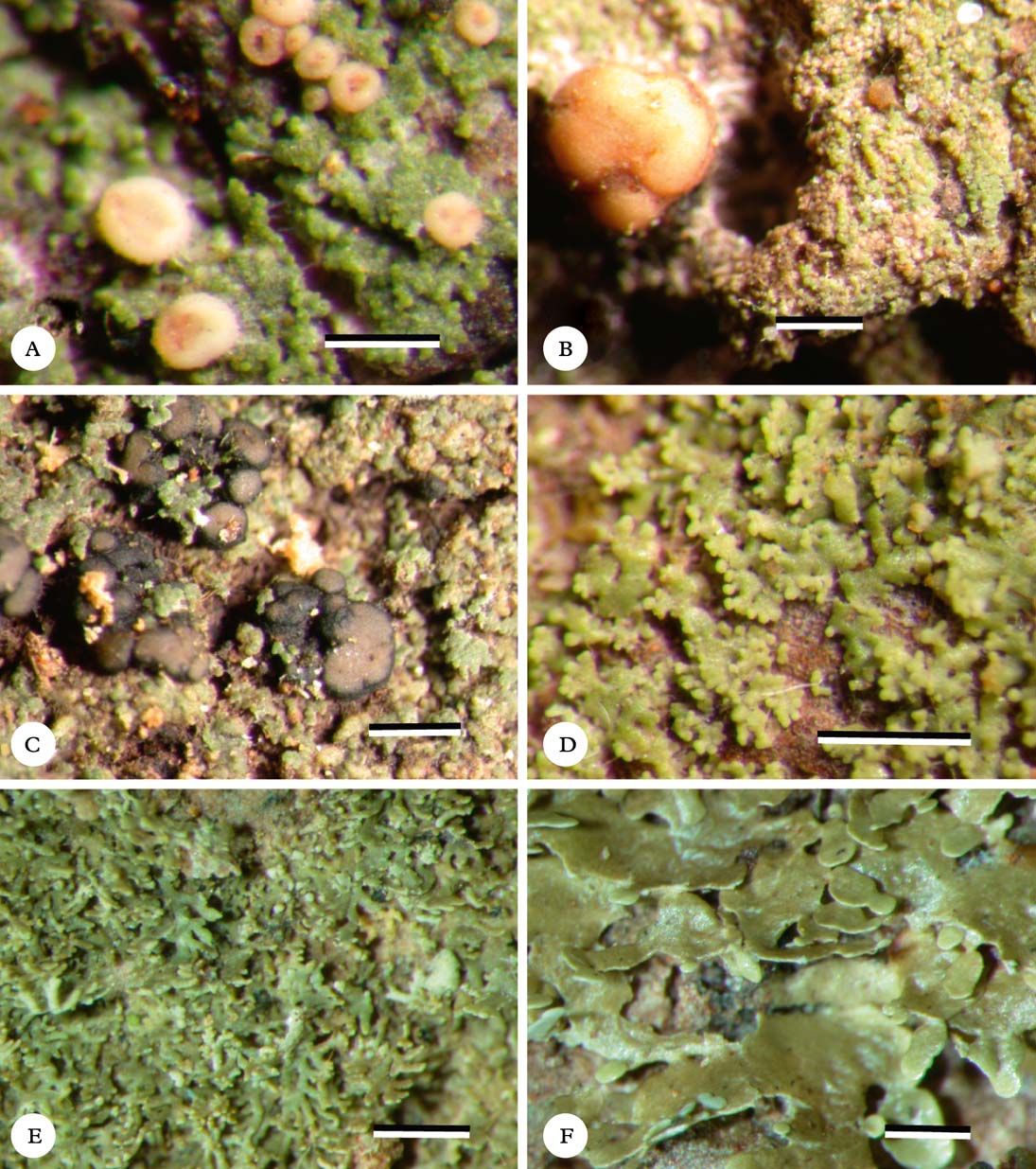
34(33) Thallus with lobes generally >1 mm wide. São Francisco (11845) & Parque (15321) ... Eschatogonia prolifera (Mont.) R. Sant. (Fig. 3F)
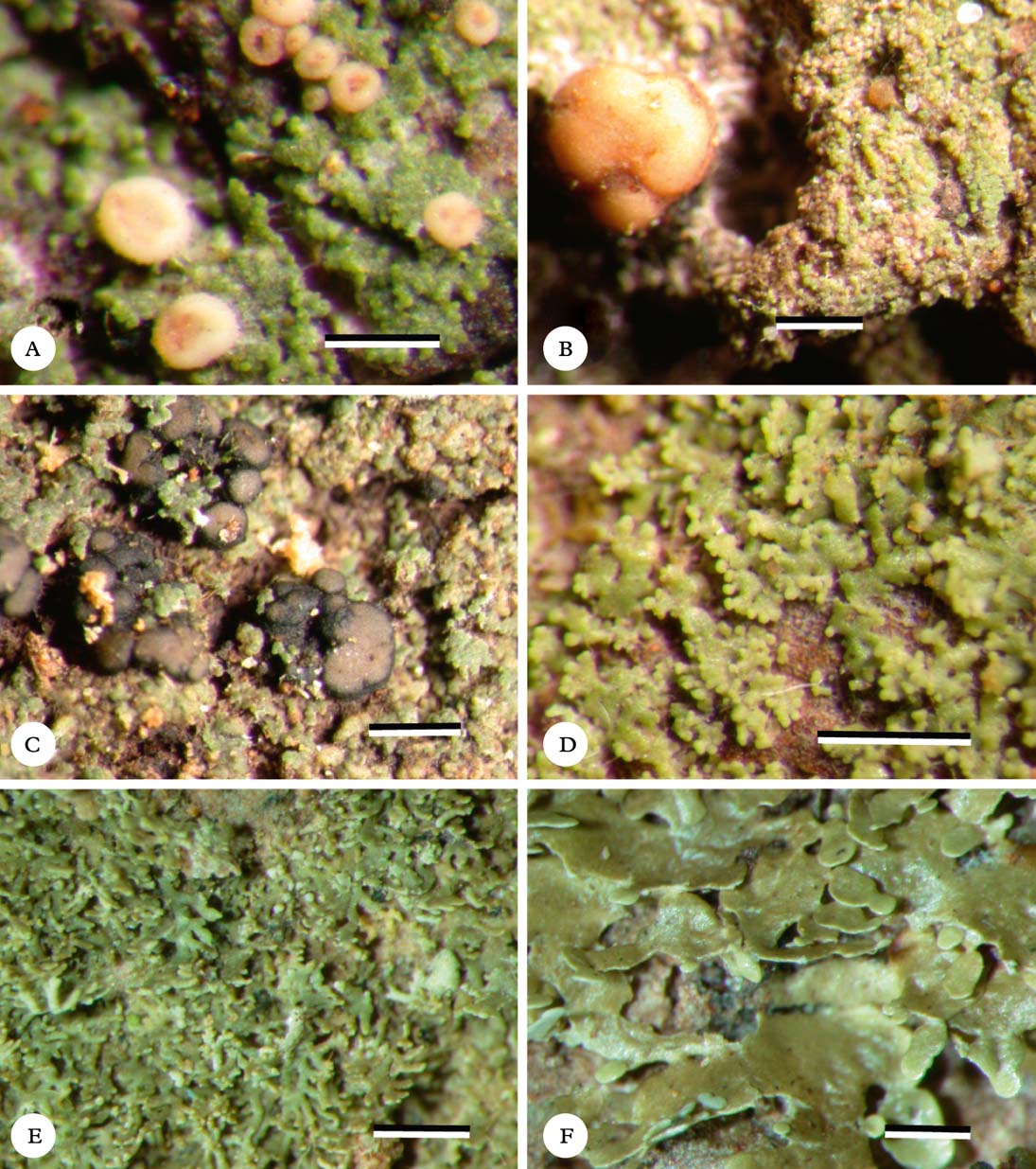
Fig. 3.A, Bacidiopsora microphyllina (Cáceres & Aptroot 15295); B, B. silvicola (Cáceres & Aptroot 15548); C, B. squamulosula (Cáceres & Aptroot 11810); D, Eschatogonia dissecta (Cáceres & Aptroot 11175); E, E. minuta (Cáceres & Aptroot 11270); F, E. prolifera (Cáceres & Aptroot 11388). Scales: A–F=0·5 mm. In colour online.

Thallus with lobes always <0·5 mm wide ... 35
-
35(34) Thallus lobes in outline wider than long. Cuniã (11626) & Parque (15459) ... Eschatogonia dissecta Timdal & R. Sant. (Fig. 3D)
Thallus lobes in outline longer than wide, partly coralloid isidioid. Cuniã (15829) & Parque ... Eschatogonia minuta Timdal & R. Sant. (Fig. 3E)
-
36(33) Thallus sorediate ... 37
Thallus not sorediate ... 39
-
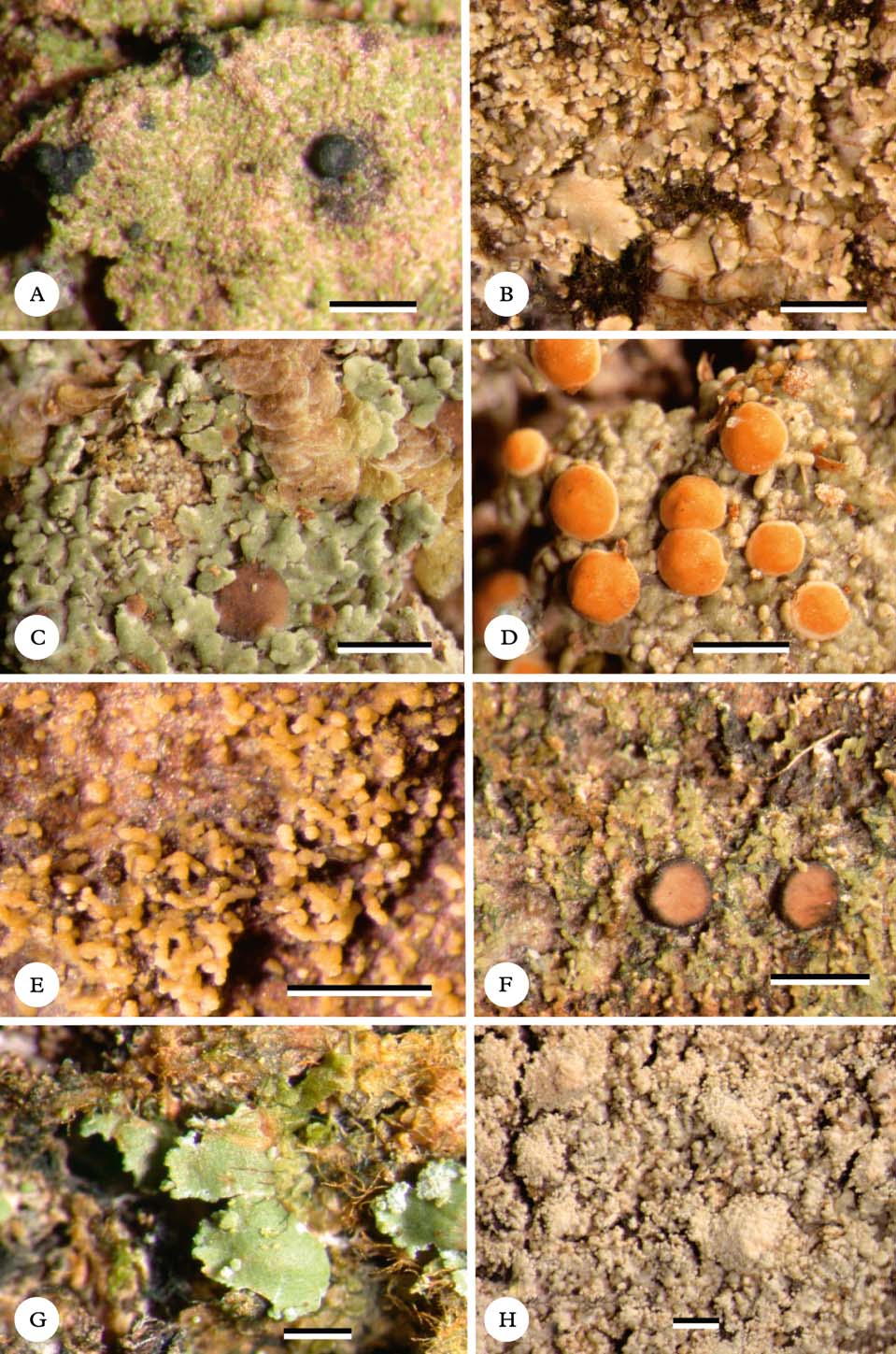
37(36) Soredia laminal, spreading over several lobes; thallus without lichen substances. São Francisco (11808) & Parque ... Phyllopsora soralifera Timdal (Fig. 5E)
Soredia originating at the tips of lobes ... 38
-
38(37) Soredia remaining apical; thallus with methyl barbatate. Cuniã (11625) & Parque ... Phyllopsora labriformis Timdal (Fig. 4G)
Fig. 4.A, Phyllopsora atrocarpa (Cáceres & Aptroot 11097); B, P. buettneri (Cáceres & Aptroot 11772); C, P. chlorophaea (Cáceres & Aptroot 15766); D, P. corallina (Cáceres & Aptroot 11984); E, P. furfuracea (Cáceres & Aptroot 11812); F, P. intermediella (Cáceres & Aptroot 15508); G, P. labriformis (Cáceres & Aptroot 11625); H, P. leucophyllina (Cáceres & Aptroot 15775). Scales: A–H=0·5 mm. In colour online.
Soredia becoming effuse; thallus with sekikaic and homosekikaic acids. Cuniã (15775) ... Phyllopsora leucophyllina (Nyl.) Timdal (Fig. 4H)
-
39(36) Thallus with cylindrical isidia ... 40
Thallus not isidiate ... 46
-
40(39) Isidia aggregated in defined areas near the lobe tips; thallus with divaricatic acid (UV+ white). Cuniã ... Physcidia striata Aptroot & M. Cáceres (Fig. 2C–F)
Isidia laminal or marginal, but not aggregated; thallus without divaricatic acid (UV− or UV+ white) ... 41
-
41(40) Ascospores bacilliform to acicular; thallus containing lobaric acid (UV+ white) and often fumarprotocetraric acid (PD+ orange), sometimes also a scarlet pigment. Cuniã (15699) & Circuito ... Triclinum cinchonarum Fée (Fig. 5F)
Fig. 5.A, Phyllopsora lividocarpa (Cáceres & Aptroot 11687); B, P. nigrocincta (Cáceres & Aptroot 15638); C, P. ochroxantha (Cáceres & Aptroot 15306); D, P. parvifoliella (Cáceres & Aptroot 15408); E, P. soralifera (Cáceres & Aptroot 11832); F, Triclinum cinchonarum (Cáceres & Aptroot 15699). Scales: A–F=0·5 mm. In colour online.
Ascospores broadly to narrowly ellipsoid; thallus not containing lobaric acid, fumarprotocetraric acid or pigments ... 42
-
42(41) Thallus PD+ orange (phyllopsorin and chlorophyllopsorin). Parque (15306) ... Phyllopsora ochroxantha (Nyl.) Zahlbr. (Fig. 5C)
Thallus PD− ... 43
-
43(42) Squamules/areoles poorly developed, sometimes lacking (thallus consisting of isidia only), containing furfuraceic acid; hypothecium dark reddish brown. São Francisco (11812), Cuniã & Parque ... Phyllopsora furfuracea Zahlbr. (Fig. 4E)
Squamules well developed, not containing furfuraceic acid; hypothecium pale to medium brown ... 44
-
44(43) Thallus containing parvifoliellin. Cuniã (15750) & Buriti (15408) ... Phyllopsora parvifoliella (Nyl.) Müll. Arg. (Fig. 5D)
Thallus not containing lichen substances ... 45
-
45(44) Squamules medium green to brownish green, often at least partly ascending; hypothallus white to reddish brown, often poorly developed. Santo Antonio (15078), São Francisco (11984) & Parque ... Phyllopsora corallina (Eschw.) Müll. Arg. (Fig. 4D)
Squamules grey to pale green, mostly adnate; hypothallus dark reddish brown, usually well developed. Parque (15508) ... Phyllopsora intermediella (Nyl.) Zahlbr. (Fig. 4F)
-
46(39) Thallus with flattened isidia (phyllidiate) or composed of deeply dissected, fragmenting lobes (lacinulate) ... 47
Thallus without vegetative dispersal units (apotheciate) ... 51
-
47(46) Thallus pruinose, with radiating marginal lobes, with phyllidia in central part, PD+ orange (pannarin or vicanicin). Buriti (15432) & Porto Velho, historical town centre (11772) ... Phyllopsora buettneri (Müll. Arg.) Zahlbr. (Fig. 4B)
Thallus not pruinose, not with radiating lobes, lacinulate, PD− or PD+ orange ... 48
-
48(47) Ascospores ellipsoid to fusiform; hypothecium dark reddish brown; thallus containing small amounts of atranorin or no lichen substances. Cuniã (15766) ... Phyllopsora chlorophaea (Müll. Arg.) Zahlbr. (Fig. 4C)
Ascospores acicular; hypothecium pale brown or grey ... 49
-
49(48) Ascospores distinctly septate, hypothecium pale brown; thallus containing homosekikaic acid. Parque (15295) ... Bacidiopsora microphyllina Kalb (Fig. 3A)
Ascospores simple or pseudoseptate, hypothecium medium to dark grey; thallus containing 2′-O-methylhyperlatolic acid and other compounds ... 50
-
50(49) Apothecia brownish black, lacking crystals; thallus with additional fumarprotocetraric acid (PD+ orange). UNIR (11097) ... Phyllopsora atrocarpa Timdal (Fig. 4A)
Apothecia pale brown to dark grey, containing crystals in the excipulum and hypothecium; thallus with additional fatty acid (PD−). Cuniã (11687) ... Phyllopsora lividocarpa Timdal (Fig. 5A)
-
51(46) Ascospores acicular, distinctly septate; thallus containing homosekikaic acid (PD−, K−). Cuniã (11603) & São Francisco ... Bacidiopsora squamulosula (Nyl.) Kalb (Fig. 3C)
Ascospores ellipsoid to fusiform, simple; thallus containing fumarprotocetraric acid (PD+ orange) and norsolorinic acid (K+ purple). São Francisco (11866), Cuniã & Parque (15309) ... Phyllopsora nigrocincta Timdal (Fig. 5B)
-
52(18) Thallus with soredia on cartilaginous stalks. Parque ... Crustospathula amazonica Aptroot, M. Cáceres & Timdal (Fig. 1D & E)
Thallus without soredia, or if with soralia, these not stalked (these sorediate species unidentifiable and include species of e.g. Bacidia, Fellhanera, Lecanora, and Trapeliopsis) ... 53
-
53(52) Thallus with isidia ... 54
Thallus without isidia ... 56
-
54(53) Thallus and isidia partly yellow. Porto Velho (11752) ... Caloplaca bassiae (Ach.) Zahlbr.
Thallus and isidia not yellow ... 55
-
55(54) Isidia grey. Buriti (15354) ... Caloplaca wrightii (Willey) Fink
Isidia greenish. São Francisco (11812), Cuniã & Parque ... Phyllopsora furfuracea Zahlbr. (Fig. 4E)
-
56(53) Thallus, medulla and/or apothecia with yellow, orange or red pigments ... 57
Thallus, medulla and/or apothecia without pigments ... 61
-
57(56) Thallus medulla with yellow, orange or red pigments ... 58
Apothecia with orange or red pigments ... 59
-
58(57) Thallus medulla with yellow, orange or red pigments, apothecia with hyaline, simple ascospores ... Malmidea spp. (to be treated elsewhere)
Thallus medulla with red pigment, apothecia with brown, 1-septate ascospores. Cuniã (15709), São Francisco (11956), Parque & UNIR ... Gassicurtia coccinea Fée
-
59(57) Apothecia with hyaline, simple ascospores. UNIR (11076) ... Ramboldia haematites (Fée) Kalb
Apothecia with muriform ascospores (more Letrouitia species are likely to occur) ... 60
-
60(59) Apothecia orange, at least the margin. Buriti (15410) ... Letrouitia vulpina (Tuck.) Hafellner & Bellem.
Apothecia dark bramble red, nearly black, but red in section. Parque (11574) ... Letrouitia subvulpina (Nyl.) Hafellner
-
61(56) Ascospores muriform, campylidia often present ... 62
Ascospores simple or transversely septate, campylidia absent ... 65
-
62(61) Thallus uneven, granulose but corticate. Parque ... Calopadia granulosa Aptroot & M. Cáceres (Fig. 1A–C)
Thallus even, smooth but generally dull ... 63
-
63(62) Ascospores mostly <80 µm long. Parque (15281) ... Calopadia fusca (Müll. Arg.) Vězda
Ascospores mostly >80 µm long ... 64
-
64(63) Apothecia dark brown, not pruinose. UNIR (11142) ... Calopadia subfusca Kalb & Vězda
Apothecia pale brown, pruinose. UNIR (11025) ... Calopadia perpallida (Nyl.) Vězda
-
65(61) Thallus with byssoid hypothallus ... 66
Thallus without byssoid hypothallus ... species of Bacidia s. lat., Micarea and Malmidea (to be treated elsewhere)
-
66(65) Apothecia brown, thallus P−. Cuniã (11729) & Parque (15548) ... Bacidiopsora silvicola (Malme) Kalb (Fig. 3B)
Apothecia black, thallus P+ orange. Cuniã (15638), Parque & São Francisco ... Phyllopsora nigrocincta Timdal (Fig. 5B)
Foliicolous Lecanorales in Rondônia
Foliicolous species were only collected extensively in the Parque Natural. Some of the species were also collected at Sítio Ecológico Buriti, Cuniã and/or São Francisco. In Buriti, many foliicolous species were also found on the smooth surface of old painted planking of a bridge. Numbers between brackets represent our collecting numbers with letters as extensions for the split-offs. For details about morphology and nomenclature, see Lücking (Reference Lücking2008).
The following species have been identified so far: Bacidina apiahica (Müll. Arg.) Vězda (11187v), Badimia galbinea (Kremp.) Vězda (11187w), B. pallidula (Kremp.) Vězda (15519a), Bapalmuia lineata Lücking & Kalb (15524), Brasilicia brasiliensis (Müll. Arg.) Lückinge et al. (11419ac), Byssolecania fumosonigricans (Müll. Arg.) R. Sant. (11187x), B. vezdae Kalb & Lücking (11419ad), Byssoloma chlorinum (Vain.) Zahlbr. (11187y), B. leucoblepharum (Nyl.) Vain. (11187aa), B. multipunctatum Lücking (11419ag), Calopadia fusca (Müll. Arg.) Vězda! (11799m), C. phyllogena (Müll. Arg.) Vězda (11187ae), Coccocarpia prostrata Lücking et al. (11419ap), Eschatogonia dissecta Timdal & R. Sant.! (11187aw), Eugeniella psychotriae (Müll. Arg.) Lücking et al. (11187ax), Fellhanera fuscatula (Müll. Arg.) Vězda (11187bc), F. cf. muhlei Lücking (11799r), F. parvula (Vězda) Vězda (11419dn), F. punctata Lücking (11187ba), F. rhaphidophylli (Rehm) Vězda (11799p), F. rubida (Müll. Arg.) Lücking (11799q), F. submicrommata (Vězda) Lücking & Kalb (11419bl), F. subternella (Nyl.) Vězda (11187bb), Fuscidea cf. fulva (Malme) Kalb (11419br), Loflammia epiphylla (Fée) Lücking & Vězda (11419ca), Malmidea trailiana (Müll. Arg.) Kalb et al. (11419aq), Phyllopsora cf. parvifoliella (Nyl.) Müll. Arg.! (11419c), Sporopodium aeruginescens Lücking & Lumbsch (11799ad), S. antonianum Elix et al. (11187cq), and S. xantholeucum (Müll. Arg.) Zahlbr. (11419z).
None of these species have been previously reported from Rondônia, and Sporopodium aeruginescens seems to be a new record for Brazil (Lücking Reference Lücking2008). There is some overlap with the corticolous species mentioned in the key; species that were also found corticolous are marked with (!).
Discussion
This is the fifth paper in a series describing the lichen biodiversity of Rondônia. Earlier papers treated the Graphidaceae (Cáceres et al. Reference Cáceres, Aptroot, Parnmen, Lumbsch and Lücking2014a ), Arthoniales (Cáceres et al. Reference Cáceres, Aptroot and Ertz2014b ), species on termite nests (Aptroot & Cáceres Reference Aptroot and Cáceres2014), and the pyrenocarps excluding the Trypetheliaceae (Aptroot & Cáceres Reference Aptroot and Cáceres2013). At least three more papers are planned, viz. a further one on Graphidaceae (M. E. S. Cáceres, A. Aptroot & R. Lücking, unpublished data), one reporting 100 further species in various groups including Malmidea (M. E. S. Cáceres & A. Aptroot, unpublished data) and one treating the Trypetheliaceae (A. Aptroot & M. E. S. Cáceres, unpublished data). Although many specimens are not yet identified/described, especially in the Arthoniales, some kind of synthesis can be made of some traits of the species encountered. This could serve as a characterization of the lichen flora of a lowland rainforest region. The following traits can be discerned:
Photobionts: cyanobacteria are present in only 6 (1%) out of the nearly 600 species. Chlorococcoid algae are present in c. 100 species (16%), 12 of which (2%) have myrmecioid algae (unidentified species of Micarea and Trapeliopsis). The remainder of the species, a staggering 83%, has trentepohlioid algae, including 6 (1%) with Phycopeltis.
Growth form: fruticose species are essentially absent, truly foliose species (with rhizines) amount to only 17 (2·7%), and there are 33 (5·5%) squamulose species including microfoliose and placodioid species. The remaining 91·8% are crustose.
In comparison with other areas, even elsewhere in Brazil, the area is very rich in Graphidaceae, Malmideaceae, Pyrenulaceae, and Trypetheliaceae. It is moderately rich in, for example, Physciaceae (mainly placodioid species), Ramalinaceae (mainly microfoliose species) and Arthoniales. In contrast, it is particularly poor in Teloschistales, Cladoniaceae and Parmeliaceae, and in foliose and fruticose lichens in general.
Obviously, every additional collecting trip will result in changes to the above percentages, but the order of magnitude will not be affected. It is safe to conclude that in neotropical lowland rainforest, the vast majority of the lichens are crustose and contain trentepohlioid algae, and that the Arthoniales, Graphidaceae and pyrenocarpous lichens are the main groups, each accounting for roughly a quarter of the lichen diversity.
The CNPq (Conselho Nacional de Desenvolvimento Científico e Tecnológico) is thanked for a research grant to MESC (Processo 311706/2012-6). The costs of the collecting expeditions to MESC were financed by CNPq (CNPq-Sisbiota Processo 563342/2010-2). Elton Bill Souza and Allyne Christina Gomes Silva are thanked for logistical support and organizing the collecting trips. Einar Timdal is warmly thanked for helping with the key and various further suggestions, including alerting us to additional specimens studied by him of some of the new species. We are grateful to the curator of GZU for sending some specimens. Leo Spier is thanked for performing thin-layer chromatography.