Introduction
Biotas exhibiting Burgess Shale-type (BST) preservation have been reported from the Cambrian and Ordovician of most continents and are critical for the understanding of the early evolution of life, because they conserve a greater diversity beyond typical shelly biotas (e.g., Briggs et al., Reference Briggs, Erwin and Collier1994; Edgecombe and Legg, Reference Edgecombe and Legg2013; Caron et al., Reference Caron, Gaines, Aria, Mángano and Streng2014). Not only do these important deposits open a window that does not exist under normal fossilization conditions, but the degree of complexity of the fossil lineages also suggests that evolution of several main branches of life was extremely rapid, but there is debate as to whether it began prior to or during the earliest Cambrian (e.g., Dohrmann et al., Reference Dohrmann, Vargas, Janussen, Collins and Wörheide2013; Erwin and Valentine, Reference Erwin and Valentine2013; Landing et al., Reference Landing, Geyer, Brasier and Bowring2013; Lee et al., Reference Lee, Soubrier and Edgecombe2013).
BST deposits pose several fundamental questions, as soft body preservation is exceptional in earth history but does seem to be more common in the early Paleozoic. The nature of the BST taphonomic phenomenon is still controversial and several ideas have been suggested (e.g., Allison, Reference Allison1988; Butterfield, Reference Butterfield1995; Butterfield et al., Reference Butterfield, Balthasar and Wilson2007; Gaines et al., Reference Gaines, Hammarlund, Hou, Qi, Gabbot, Zhao, Peng and Canfield2012). Another question is to what degree the different BST Lagerstätten represent a typical benthos of the early Paleozoic. Depending on the deposit the biota varies in composition, with only the Burgess Shale in the vicinity of Mount Field, its type area, exhibiting a truly high diversity (e.g., Briggs et al., Reference Briggs, Erwin and Collier1994; Lieberman, Reference Lieberman2003; Caron and Jackson, Reference Caron and Jackson2008; Edgecombe and Legg, Reference Edgecombe and Legg2013).
Here we present a new Lagerstätte in the Rockslide Formation of the Mackenzie Mountains of northwestern Canada. It is approximately the same age as the Wheeler and Marjum formations of Utah (Drumian stage, Bolaspidella Biozone) and, occurring in greenish mudstone, is similar in lithology to the ‘phyllopod bed’ of the Burgess Shale (Gabbott et al., 2010).
In addition to the hyoliths, linguliformean brachiopods, agnostoids and ptychoparioid trilobites, the soft-bodied fauna is dominated by bivalved arthropods along with priapulids and macrophytic algae, representing a biota similar to that of the Wheeler and Marjum formations. The purpose of this paper is to describe the hyoliths and soft-bodied components of the Rockslide Formation fauna and offer a comparison with similar Lagerstätten.
Geology and fossil locality
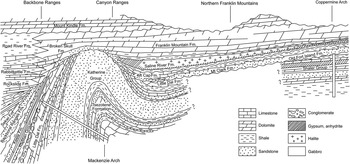
The Rockslide Formation is a regionally extensive, relatively deep-water middle Cambrian unit in the Mackenzie Mountains (Fig. 1; Fritz, Reference Fritz1979; Pratt, Reference Pratt1989). It ranges in age from the Plagiura–Poliella Biozone to late Bolaspidella or Lejopyge laevigata Biozone (Gabrielse et al., Reference Gabrielse, Blusson and Roddick1973). It was deposited on the west-facing continental slope flanking the Selwyn Basin and ultimately the Panthalassic Ocean (Fig. 2; Fritz et al., Reference Fritz, Cecile, Norford, Morrow and Geldsetzer1991). The slope was probably seaward of a carbonate platform that has since been planed off. On the other side of the Mackenzie Arch, in the eastern Mackenzie Mountains and Mackenzie River valley, the lower part of the Rockslide Formation is correlative with intrabasinal shales of the upper Mount Cap Formation. To the north, it grades into the Hess River Formation, a thick, deep-water package deposited in the Misty Creek embayment (Cecile, Reference Cecile1982; Chevrier and Turner, Reference Chevier and Turner2013).
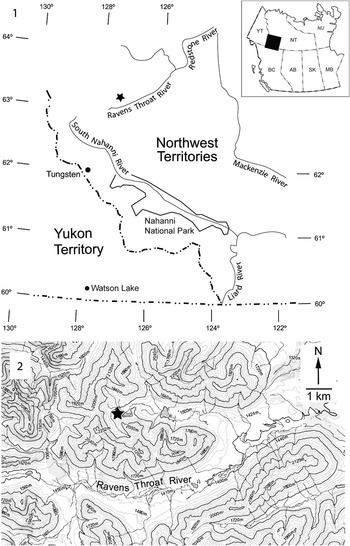
Location of the Ravens Throat River locality (asterix; 63º10’N, 127º 55’W), Mackenzie Mountains, northwest territories, Canada: (1), regional map; (2), topographic map.

Regional cross-section across the Mackenzie Mountains (modified from Aitken et al., Reference Aitken, Macqueen and Usher1973).

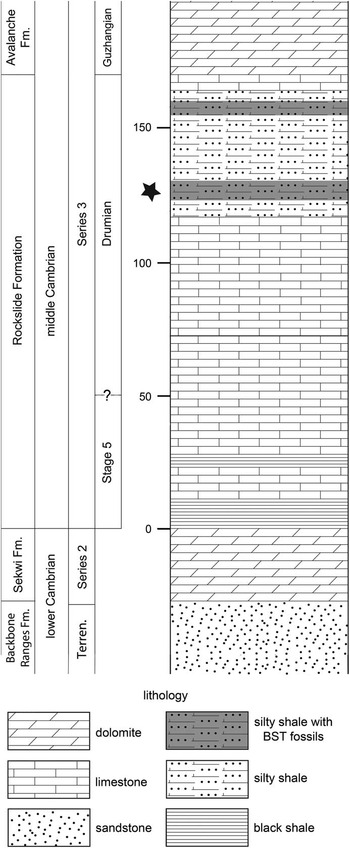
The new Lagerstätte is located near the headwaters of the Ravens Throat River and was discovered by BRP in 1983, and further collections were made in 1998 and 2004, and by JK in 2012. The Rockslide Formation in this area is about 175 m thick and is a succession of shales that grade upwards into interbedded shale and lime mudstone, and thence to thin-bedded lime mudstone (Fig. 3). It overlies a thin unit of shallow-subtidal limestone and dolomite belonging to the lower Cambrian Sekwi Formation, which in turn rests abruptly on shallow-marine sandstones of the Ediacaran to lower Cambrian (Terreneuvian) Backbone Ranges Formation. At this locality, the Rockslide Formation is gradationally overlain by shallower water dolomites belonging to the Avalanche Formation, which are succeeded by shallow-water limestones and dolomites of the upper Cambrian Broken Skull Formation (Gabrielse et al., Reference Gabrielse, Blusson and Roddick1973; Gordey and Anderson, Reference Gordey and Anderson1993). To the west, the Rockslide Formation is overlain by deep-water limestones of the Rabbit kettle Formation (Pratt, Reference Pratt1992; Gordey and Anderson, Reference Gordey and Anderson1993).
Generalized stratigraphy of the Rockslide Formation in the Ravens Throat river area (upper part of section and contact with overlying Avalanche Formation is not exposed). Star indicates main fossil bed.

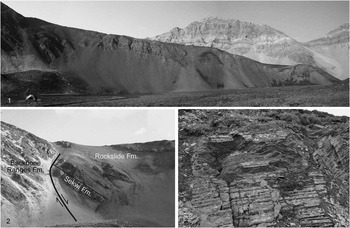
At the Ravens Throat River locality, the Rockslide Formation onlaps a syndepositional fault scarp cutting the Backbone Ranges Formation (Fig. 4.1). The thin unit belonging to the Sekwi Formation has dropped down and rotated on this normal fault. A change in dip at 19 m above the base of the Rockslide Formation suggests another phase of movement on the fault. The fault scarp is about 750 m north of the ridge that comprises section 19 of Gabrielse et al. (Reference Gabrielse, Blusson and Roddick1973) which is unfaulted (Pratt, pers. obs.). Faulting is also absent at the type section 50 km to the east (section 16 of Gabrielse et al., Reference Gabrielse, Blusson and Roddick1973). The fault can be traced to the mountainside across the valley to the north of the Lagerstätte locality. It is likely listric in nature (cf. Collom et al., Reference Collom, Johnston and Powell2009; K. Johnston et al., 2009) and it probably a localized feature, forming an inclined surface cut into the gentle slope and broadly U-shaped in plane view.
The outcrop area near the headwaters of the Ravens Throat River: (1), panorama looking west; (2), left side of outcrop showing the synsedimentary fault (black line; formations labeled; stratigraphic position of fossil-bearing unit shown by arrow); (3), close-up of the fossiliferous thin-bedded mudstone (hammer circled).

There are two approximately 1-m-thick units that exhibit the distinctive lithology containing soft-bodied preservation, 134 m and 162 m above the top of the Sekwi Formation respectively, with the lower one yielding virtually all of the fossils that were recovered during excavation. Agnostoids and trilobites indicate this interval belongs to the Bolaspidella Biozone (Series 3, Drumian). It is therefore younger than the Burgess Shale is but approximately correlative with the Marjum and Wheeler formations of the Great Basin of Utah. The Burgess Shale is of middle Cambrian (Series 3, Stage 5) age, within the Bathyuriscus–Elrathina Biozone. Robison and Babcock (Reference Robison and Babckock2011) placed Elrathina Resser, Reference Resser1937 in synonymy with Ptychoparella Poulsen, Reference Poulsen1927 but for the time being the traditional biozone name is retained.
Because the exposure is located on a steep cliff (Fig. 4.2), most specimens were collected systematically from the scree slope below it, comprising an area that covers about 1500 m2. The host facies is a laminated, light greenish-colored, slightly calcareous mudstone. X-ray diffraction analysis indicates that is composed of quartz, chlorite, calcite, and dolomite. There are interbedded lenses of lime mudstone; scour surfaces and cross-lamination are absent. This lithology has not been encountered at the type section of the Rockslide Formation to the east (Gabrielse et al., Reference Gabrielse, Blusson and Roddick1973; Pratt, pers. obs.) or in sections to the west and north (Pratt, pers. obs.). It appears to be localized perhaps in a depression that persisted long after movement of the synsedimentary fault.
Systematic paleontology
The fossils were photographed under water using a Nikon D80 camera with a 60 mm Nikkor macro lens. Latex casts were made of molds and dusted with ammonium chloride. Because the original specimens are mostly dark greenish-gray in color and similar to the host mudstone, photographic images were manipulated in Adobe Photoshop for optimal tone and contrast.
Specimens are housed in the paleontological collection of the Royal Tyrrell Museum, Drumheller, Alberta, Canada (TMP).
Kingdom Animalia Linnaeus, Reference Linnaeus1758
Phylum Arthropoda von Siebold, Reference von Siebold1848
Remarks
The name Arthropoda is correctly attributed to von Siebold (Hegna et al., Reference Hegna, Legg, Møller, Van Roy and Lerosey-Aubril2013). The higher-level taxonomy of Cambrian bivalved arthropods is problematic. Early views considered most species to be crustaceans, whereas studies that are more recent indicate that many belong to the most basal arthropod taxa (Stein, Reference Stein2010; Legg et al., 2012, Reference Legg, Sutton and Edgecombe2013; Legg and Caron, Reference Legg, Sutton, Edgecombe and Caron2014). For this reason, the higher-level affiliations of the arthropod genera in the Rockslide Formation are left open.
Class, Order, and Family uncertain
Genus Isoxys Walcott, Reference Walcott1890
Type species
Isoxys chilhoweanus Walcott, Reference Walcott1890, by original designation.
Other species
Isoxys acutangulus Walcott, 1908; I. carbonelli Richter and Richter, Reference Richter and Richter1927; I. longissimus Simonetta and Delle Cave, Reference Simonetta and Delle Cave1975; I. communis Glaessner, Reference Glaessner1979; I. auritus Jiang, 1982 (in Luo et al. Reference Luo, Jiang, Wu, Song and Liu1982); I. paradoxus Hou, Reference Hou1987; I. bispinatus Cui, 1991 (in Huo et al. Reference Huo, Shu and Cui1991); I. zhurensis Ivantsov, Reference Ivantsov1990; I. volucris Williams, Siveter and Peel, Reference Williams, Siveter and Peel1996; I. elongatus Luo and Hu, 1999 (in Luo et al. Reference Luo, Hu, Chen, Zhang and Tao1999); I. curvirostratus Vannier and Chen, Reference Vannier and Chen2000; I. wudingensis Luo and Hu, 2006 (in Luo et al. Reference Luo, Fu, Hu, Li, Chen, You and Liu2006); I. minor Luo et al., Reference Luo, Li, Hu, Fu, Hou, Liu, Chen, Li, Pang and Liu2008; I. glaessneri García-Bellido et al. Reference García-Bellido, Paterson, Edgecombe, Jago, Gehling and Lee2009; I. shandongensis Wang et al. Reference Wang, Huang and Lieberman2010; I. granulus Yuan, Peng and Zhao, Reference Yuan, Peng and Zhao2011; I. mackenziensis n. sp.
Diagnosis
See García-Bellido et al. (Reference García-Bellido, Paterson, Edgecombe, Jago, Gehling and Lee2009).
Occurrence
China, Australia, Siberia, Europe, Laurentia (including Greenland), lower and middle Cambrian, Series 2 and 3, Stages 3–5 and Drumian.
Remarks
Isoxys species are known from all major BST deposits of late early and early middle Cambrian age and some are known from their soft tissues in addition to the carapace (García-Bellido et al., Reference García-Bellido, Paterson, Edgecombe, Jago, Gehling and Lee2009). The different species have usually been distinguished based on carapace shape although in general individual valves are sub-oval in outline, tapering anteriorly, and vary in the relative widths of the posterior and anterior ends of the valve and in the length of the anterolateral and posterolateral spines. Intraspecific variation and sexual dimorphism, however, may be present (Fu et al., Reference Fu, Zhang, Budd, Liu and Pan2013). Despite widespread occurrence and soft-tissue detail, higher-level taxonomic relationships are still unclear (Legg and Vannier, Reference Legg and Vannier2013).
Isoxys mackenziensis new species
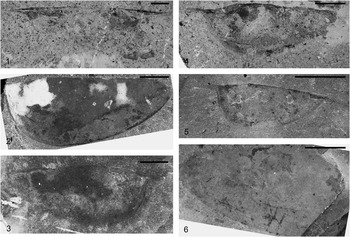
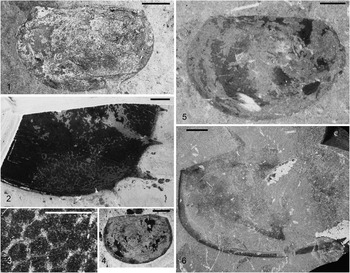
Isoxys mackenziensis n. sp. from the Rockslide Formation, middle Cambrian, Ravens Throat River area, Mackenzie Mountains: (1), lateral view of valve and holotype (TMP 2013.101.0038); (2), lateral view of valve (TMP 2013.101.0040); (3), lateral view of valve (TMP 2013.101.0042); (4), lateral view of valve (TMP 2013.101.0039); (5), lateral view of valve (TMP 2013.101.0041); (6), lateral view of valve (TMP 2013.101.0043; surface scratched). Scale bars represent 5 mm.

Holotype
One complete laterally compressed valve (TMP 2013.101.0038).
Material
Two complete and five partial valves in lateral view (TMP 2013.101.0030, 2013.101.0038–2013.101.0043).
Diagnosis
Isoxys with elongated carapace, anterior wider than posterior; ratio of length to maximum width about 1:4. Dorsal line with dorsally directed flexure; anterolateral and posterolateral spines short with respective spine to carapace length ratios of 1:7 and 1:10.5.
Description
The valve is elongate ovate in outline, the anterior wider than the posterior. The ratio of length to width about is 1:4. The largest specimen is 85 mm long and 22 mm wide, whereas the smallest is 30 mm long and 8 mm wide; maximum width occurs at about one-third the total length from the anterior end as measured along the dorsal hinge. The dorsal hinge is nearly straight but has a gentle, dorsally directed flexure at about one-third the length from the anterior end. Each valve has an anterolateral and posterolateral spine. The anterior spine is shorter, with the longest 10 mm in length and a maximum thickness of about 2 mm at the base. The posterior spine is longer, with the longest 15 mm in length and a maximum thickness of about 1.5 mm. The dorsal surface is smooth.
Etymology
After the Mackenzie Mountains.
Occurrence
Rockslide Formation, Ravens Throat River area, Mackenzie Mountains, Northwest Territories, middle Cambrian, Series 3, Drumian, Bolaspidella Biozone.
Remarks
The valve of Isoxys mackenziensis n. sp. differs from those of I. chilhoweanus, I. acutangulus, I. zhurensis, I. auritus, I. glaessneri, I. carbonelli, I. curvirostratus, I. communis, I. wudingaspis, I. minor, I. volucris and I. bispinatus by being more slender, in that it is narrower and more elongated. In contrast to these species, the posterior end is also narrower and the dorsal hinge has a dorsally directed flexure that is lacking in other species. It differs from I. longissimus and I. paradoxus by having shorter anterolateral and posterolateral spines. The valves of the new species are larger in comparison with the other described species but this is not taken as diagnostic at present. A fragmentary specimen belonging to Isoxys was recovered from older strata in the Mount Cap Formation exposed on the east side of the Mackenzie Arch (Butterfield and Nicholas, Reference Butterfield and Nicholas1996). It has a longer and stouter posterolateral spine.
Order Canadaspidida Novozhilov in Orlov, Reference Novozhilov1960
Family Perspicaridae Briggs, Reference Briggs1978
Genus Perspicaris Briggs, Reference Briggs1977
Type species
Canadaspis dictynna Simonetta and Delle Cave, Reference Simonetta and Delle Cave1975, by original designation.
Other species
Perspicaris recondita Briggs, Reference Briggs1977; P.? dilatus Robison and Richards, Reference Robison and Richards1981; P.? ellipsopelta Robison and Richards, Reference Robison and Richards1981.
Diagnosis
See Briggs (Reference Briggs1977).
Occurrence
Laurentia, middle Cambrian, Series 3, Stage 5 and Drumian.
Remarks
Most of the taxonomically important features used to differentiate Canadaspis and Perspicaris and their species are based on the soft tissues (Briggs, Reference Briggs1977; Lieberman, Reference Lieberman2003). Therefore, Perspicaris? dilatus and P.? ellipsopelta are questionably assigned to the genus because these species are based only on isolated carapaces. Perspicaris differs by possessing true, elongate lateral telson process–bearing spines, whereas Canadaspis has a pair of spinose projections on the ventrolateral margin of the telson. In addition, the eyes of Perspicaris are larger. However, the valves are closely similar and may well be indistinguishable. Lieberman (Reference Lieberman2003), however, suggested that in Perspicaris, the maximum width is further posterior, the anterior and posterior processes are larger, the muscle scar is more ventrally located, and the height-to-length ratio is smaller. Consequently, we assign most valves in the Rockslide Formation to Perspicaris? rather than Canadaspis.
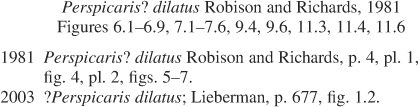
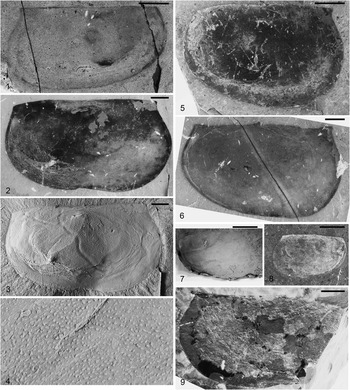
Perspicaris? dilatus from the Rockslide Formation, middle Cambrian, Ravens Throat River area, Mackenzie Mountains: (1), lateral view of valve (TMP 2013.101.0009; cut by two oblique fractures); (2), lateral view of valve (TMP 2013.101.0002; flipped horizontally); (3), lateral view of valve with burrows beneath (latex cast dusted with ammonium chloride; TMP 2013.101.0002); (4), close-up of 3, showing pustular ornament on valve exterior; (5), lateral view of valve (TMP 2013.101.0005; surface scratched); (6), lateral view of valve (TMP 2013.101.0006; cut by oblique fracture); (7), latex cast of 8 dusted with ammonium chloride; (8), lateral view of small valve (TMP 2013.101.0010); (9), lateral view of weathered partial valve (TMP 2013.101.0011). Scale bars represent 5 mm.

Material
24 valves in lateral view and one complete carapace in dorsal view (TMP 2013.101.0001–2013.101.0015).
Diagnosis
Perspicaris? with valve sub-ovate in outline, posterior process larger than anterior process.
Description
Valve is sub-ovate in outline; posterior portion moderately wider than anterior, with maximum width is about two-thirds along the length of the hinge line from the anterior margin. Maximum length is 65 mm and maximum width is 45 mm, with the smallest 11 mm in length and 8 mm in width. The posterior process is slightly larger than the anterior process, and exhibits an angle of about 100°. Hinge line is straight. The circular muscle scar is inconspicuous in larger valves; on one smaller specimen (Fig. 7.5, 7.6) it is located close to the anterior margin and three times its diameter from the hinge line.
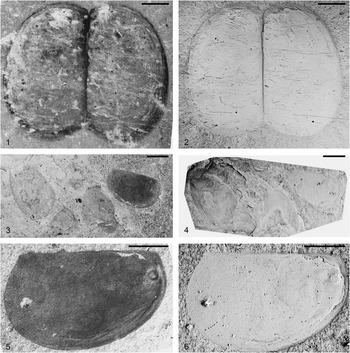
Perspicaris? dilatus from the Rockslide Formation, middle Cambrian, Ravens Throat River area, Mackenzie Mountains: (1), dorsal view of butterflied carapace (TMP 2013.101.0001; surface scratched); (2), same as 1 (dusted with ammonium chloride); (3), lateral views of three complete and one partial valves (TMP 2013.101.0004); (4), lateral views of one complete and two partial valves (latex cast dusted with ammonium chloride; TMP 2013.101.0004; flipped horizontally); (5), lateral interior view of complete valve, with muscle scar (TMP 2013.101.0008); (6), lateral interior view of complete valve, with muscle scar (latex cast dusted with ammonium chloride; TMP 2013.101.0008; flipped horizontally). Scale bars represent 5 mm.

Occurrence
Comet Shale Member, Pioche Formation, Nevada, middle Cambrian, Series 3, Stage 5, Eokochaspis nodosa Biozone; Wheeler Formation, Utah, middle Cambrian, Series 3, Drumian, Ptychagnostus atavus Biozone; Rockslide Formation, Ravens Throat River area, Mackenzie Mountains, Northwest Territories, middle Cambrian, Series 3, Drumian, Bolaspidella Biozone.
Remarks
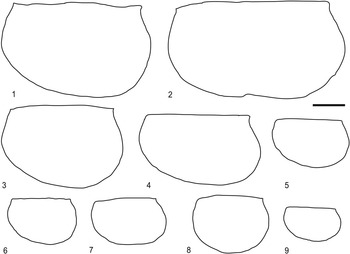
The specimens from the Ravens Throat River area are conspecific with P.? dilatus and not P.? ellipsopelta based on the outline of the valves (Fig. 8) with the maximum width being more posterior, the relatively larger posterior process, and the more anterior location of the muscle scar. However, these are rather small differences and it is possible that larger collections may show that P.? ellipsopelta is a junior synonym. Some isolated soft-tissue fragments (Fig. 8.2, 8.3) might represent P.? dilatus.
Variation in outline of Perspicaris? dilatus specimens from the Rockslide Formation, middle Cambrian, Ravens Throat River area, Mackenzie Mountains. (1), TMP 2013.101.0006; (2), TMP 2013.101.0002; (3), TMP 2013.101.0005; (4), TMP 2013.101.0009; (5), TMP 2013.101.0010; (6), TMP 2013.101.0001; (7), TMP 2013.101.0008; (8), TMP 2013.101.0007; (9), TMP 2013.101.0004. Specimens are drawn to scale and anterior is oriented to the left. Scale bar represents 10 mm.

One specimen (Fig. 6.3) shows some simple, seemingly non-branching burrows under the valve. These are preserved as grooves, indicating that they were originally empty tubes, probably from post-mortem bioturbation. They are similar to those described by Mángano et al. (Reference Mángano, Bromley, Harper, Nielsen, Smith and Vinther2012; see also Robison and Richards, Reference Robison and Richards1981, pl. 1, fig. 4; Chlupáč and Kordule, Reference Chlupáč and Kordule2002).
Order and Family uncertain
Genus Branchiocaris Briggs, Reference Briggs1976
Type species
Protocaris pretiosa Resser, Reference Resser1929, by original designation.
Diagnosis
See Briggs (Reference Briggs1976).
Occurrence
Laurentia and China, middle Cambrian, Series 3, Stage 5 and Drumian; possibly China, Series 2, Stage 4.
Remarks
Branchiocaris contains four species and an additional one with question: the type species from the Burgess Shale, three species from the Malong and Guanshan biotas (Honjingshao and Wulongqing formations respectively, lower Cambrian, Series 2, Stage 4), and B.? yunnanensis Hou, Reference Hou1987 from the Chengjiang biota (Yu’anshan Member, Helinpu Formation, China, lower Cambrian, Series 2, Stage 3). The last is known from the carapace only, hence the questionable assignment.
Branchiocaris? sp.
Arthropods from the Rockslide Formation, middle Cambrian, Ravens Throat River area, Mackenzie Mountains: (1), Branchiocaris? sp., lateral view of valve (TMP 2013.101.0045); (2), Tuzoia cf. T. guntheri, lateral view of partial valve (TMP 2013.101.0047); (3), Tuzoia cf. T. guntheri, close-up of 2 showing reticulate ornament on valve exterior surface (TMP 2013.101.0047); (4), small valve of Perspicaris? dilatus in lateral view (TMP 2013.101.0007); (5), Branchiocaris? sp., lateral view of valve (TMP 2013.101.0046); (6), Perspicaris? dilatus, lateral view of partial valve with broken hinge, possibly two valves overlying each other (TMP 2013.101.0048). Scale bars represent 5 mm.

Material
One carapace in dorsal view (TMP 2013.101.0022) and four valves in lateral view (TMP 2013.101.21a, b, TMP 2013.101.0045, TMP 2013.101.0046).
Description
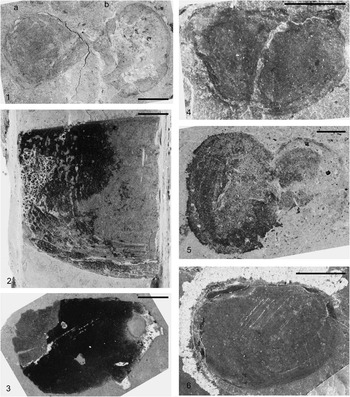
The valve is semicircular in outline; maximum length is 25 mm and maximum width is 13 mm. The anterior process is slightly smaller than the posterior process, and both are relatively small. The anterior muscle scar is indistinct in one specimen (Fig. 9.1) and is located close to anterior margin.
Occurrence
Rockslide Formation, Ravens Throat River area, Mackenzie Mountains, Northwest Territories, middle Cambrian, Series 3, Drumian, Bolaspidella Biozone.
Remarks
Six valves are placed in Branchiocaris? because of their semicircular outline, but the absence of soft-tissue attributes necessitates open nomenclature. In the better-preserved valves, the anterior and posterior processes are smaller than in previously described specimens of B. pretiosa, which occurs in strata of about the same age (Briggs, Reference Briggs1976; Briggs and Robison, 1984, fig. 9.1–9.4).
Order Tuzoida Simonetta and Delle Cave, Reference Simonetta and Delle Cave1975
Family Tuzoiidae Raymond, Reference Raymond1935
Genus Tuzoia Walcott, Reference Walcott1912
Type species
Tuzoia retifera Walcott, Reference Walcott1912, by original designation.
Other species
Tuzoia burgessensis Reeser, Reference Resser1929; T. canadensis Resser, Reference Resser1929; T. polleni Resser, Reference Resser1929; T. dunbari Resser, Reference Resser1929; T. praemorsa Resser, Reference Resser1929; T. manchuriensis Resser and Endo in Endo and Resser, Reference Endo and Resser1937; T. nitida Resser and Howell, Reference Resser and Howell1938; T. australis Glaessner, Reference Glaessner1979; T. guntheri Robison and Richards, Reference Robison and Richards1981; T. bispinosa Yuan and Zhao, Reference Yuan and Zhao1999; and questionably T.? parva Walcott, Reference Walcott1912; T.? peterseni Robison and Richards, Reference Robison and Richards1981.
Diagnosis
See Vannier et al. (Reference Vannier, Caron, Yuan, Briggs, Collins, Zhao and Zhu2007).
Occurrence
Laurentia, China and South Australia, lower and middle Cambrian, Series 2 and 3, Stages 3–5 and Drumian.
Remarks
Species belonging or possibly belonging to Tuzoia are reported from all major BST deposits and is the largest bivalved arthropod known from the Cambrian, with a length up to 180 mm. Only a few specimens with soft body preservation are known (Vannier et al., Reference Vannier, Caron, Yuan, Briggs, Collins, Zhao and Zhu2007) and the carapace outline, the arrangement of the spines and spacing in between them, and the valve convexity are used to differentiate species.
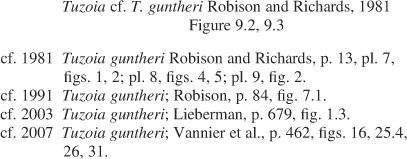
Material
One partial valve in lateral view (TMP 2013.101.0047).
Diagnosis
See Vannier et al. (Reference Vannier, Caron, Yuan, Briggs, Collins, Zhao and Zhu2007).
Description
The specimen is 60 mm long, representing a fragment of an ovate valve about 75 mm long. It has four spines on the posterior margin; the most dorsal is 4 mm long, the mid-posterior spine is 6 mm long, the posteroventral spine is 17 mm long, and the ventral spine is 2 mm long. Exterior surface is covered by somewhat irregular reticulate pattern of fine grooves surrounding slightly convex interiors. The diameter of the cells is between 0.5 to 2 mm, with the smaller ones towards the periphery.
Occurrence
Comet Shale Member, Pioche Formation, Eokochaspis nodosa Biozone, middle Cambrian, Series 3, Stage 5, Nevada; Marjum Formation, Utah, middle Cambrian, Series 3, Drumian, Bolaspidella Biozone; Rockslide Formation, Ravens Throat River area, Mackenzie Mountains, Northwest Territories, middle Cambrian, Series 3, Drumian, Bolaspidella Biozone.
Remarks
Tuzoia cf. T. guntheri from the Ravens Throat River area has a posterior arrangement of four spines of short to moderate length, which fits the holotype from the Marjum Formation. As the fragment does not preserve the hinge, dorsal spine, and anterior or posterior processes, the assignment is tentative.
Order Bradoriida Raymond, Reference Raymond1935
Family uncertain
bradoriid genus and species indet. 1
Material
One carapace (TMP 2013.101.0044).
Description
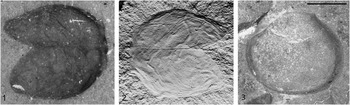
Carapace postplete; valve elongate ovate in outline, 16 mm long and 10 mm wide. Possible anterodorsal node present. The anterior margin is transverse. Narrow marginal ridge extends from anterior end of hinge around at least to posterolateral margin and possibly to posterior end of hinge. Exterior surface probably smooth.
Occurrence
Rockslide Formation, Ravens Throat River area, Mackenzie Mountains, Northwest Territories, middle Cambrian, Series 3, Drumian, Bolaspidella Biozone.
Remarks
The specimen is flattened and the left valve is slightly dorsoventrally compressed. The outline, presence of narrow marginal ridge, simple convexity and large size of the valve show similarities with species of Anabarochilina Abushik, Reference Abushik1960, such as material from the Marjum and Week formations of Utah assigned to A. cf. A. australis Hinz-Schallreuter, Reference Hinz-Schallreuter1993 (Siveter and Williams, Reference Sieveter and Williams1997). It is possible that the Rockslide specimen has a similar anterodorsal node but this cannot be determined with certainty.
bradoriid genus and species indet. 2
Material
One valve (TMP 2013.101.0024).
Description
Valve almost semicircular in outline, 10 mm long and 8 mm wide. Hinge is probably short. Anterior process is short; posterior process unknown. Narrow marginal ridge extends from anterior end of hinge around posterolateral margin and possibly to posterior end of hinge. Exterior surface probably smooth.
Occurrence
Rockslide Formation, Ravens Throat River area, Mackenzie Mountains, Northwest Territories, middle Cambrian, Series 3, Drumian, Bolaspidella Biozone.
Remarks
The semicircular outline, absence of anterodorsal node, and narrow marginal ridge are similar to Liangshanella burgessensis Siveter and Williams, Reference Sieveter and Williams1997 from the Burgess Shale, but the Rockslide valve is some three times larger.
Class, Order, and Family uncertain
arthropod genus and species indet. 1
Material
Two telsons, one preserved in dorsoventral view (TMP 2013.101.0036) and the other in lateral view with abdominal segments (TMP 2013.101.0035).
Description
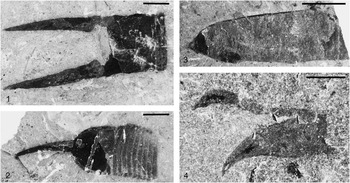
In dorsoventral view (Fig. 12.1), telson (and possible short abdominal somite) is 26 mm long and 9 mm wide. It consists of a pair of posteriorly directed, nearly straight to slightly inward-curving pair of lateral telson processes 20 mm in length, Base of the lateral telson process narrow then expanding abruptly, becoming elongated blade-like in outline.
In lateral view (Fig. 12.2), the telson and nine abdominal segments is 37 mm long and 13 mm wide. Abdominal segments are uniformly about 1 mm in length, transverse in outline, and terminate laterally to short, backward-curving spines. Lateral telson process projects from a rounded surface and is 13 mm long and slightly curved.
Occurrence
Rockslide Formation, Ravens Throat River area, Mackenzie Mountains, Northwest Territories, middle Cambrian, Series 3, Drumian, Bolaspidella Biozone.
Remarks
The two specimens are considered to belong to the same taxon but represent different views. The telson of Perspicaris dictynna from the Burgess Shale has two wider lateral telson processes and there is a row of short marginal secondary spines (Briggs, Reference Briggs1977). By contrast, the telson of Canadaspis perfecta consists of a fringe of spines (Briggs, Reference Briggs1978, fig, 162; Lieberman, Reference Lieberman2003). No telson belonging to Tuzoia has been described (Vannier et al., Reference Vannier, Caron, Yuan, Briggs, Collins, Zhao and Zhu2007). One small specimen from the Burgess Shale possesses a pair of narrow spines (Briggs, Reference Briggs1977, pl. 72, fig. 8). However, it is not clear if that specimen is a juvenile or belongs to a different arthropod group such as the Bradoriidae (Vannier et al., Reference Vannier, Caron, Yuan, Briggs, Collins, Zhao and Zhu2007). No soft tissues are known for P? dilatus but it is also possible that these specimens could belong to that species. On the other hand, the lateral telson processes are distinctly narrower than the lateral telson process of arthropod genus and species indet. 2 (Fig. 12.3). Another possibility is that it belongs to Branchiocaris, B. pretiosa from the Wheeler Formation is similar (Briggs et al., Reference Briggs, Lieberman, Hendricks, Halgedahl and Jarrard2008), as are some specimens from the Burgess Shale (D. A. Legg, pers. obs.).
arthropod genus and species indet. 2
Material
One fragmentary telson preserving one lateral telson process (TMP 2013.101.0034).
Description
The lateral telson process is a 20 mm long and 5 mm wide at its maximum. For most of its length it tapers gently posteriorly, until close to it terminus where it tapers sharply to a blunt point.
Occurrence
Rockslide Formation, Ravens Throat River area, Mackenzie Mountains, Northwest Territories, middle Cambrian, Series 3, Drumian, Bolaspidella Biozone.
Remarks
This lateral telson process differs from the narrower forms that have been assigned to Canadaspis perfecta, but it resembles those of Perspicaris dictynna Briggs, Reference Briggs1977 while lacking the marginal spines present in that species. Given the co-occurring carapaces, this lateral telson process could belong to either P.? dilatus or Branchiocaris? sp.
arthropod genus and species indet. 3
Material
One fragment of a possible biramous appendage (TMP 2013.101.0037).
Description
A slender ‘anterior ramus’ (exopod?) appears to be joined to a wider ‘posterior ramus’ (endopod?) forming an angle of about 30°. The former is straight and uniform in thickness, possibly segmented, terminating in a slightly wider, backward-curving ‘claw’; it is 11 mm long and 1.5 mm at its widest point. The latter consists of a wide backward curving ‘claw,’ 10 mm long and 3 mm at its widest point. Broken lateral margin of the specimen is more or less transverse.
Occurrence
Rockslide Formation, Ravens Throat River area, Mackenzie Mountains, Northwest Territories, middle Cambrian, Series 3, Drumian, Bolaspidella Biozone.
Remarks
The isolated specimen appears to be biramous but this could be coincidental overlapping of two separate objects. It resembles biramous appendages lacking the gills of trilobites, for example.
Phylum Mollusca Cuvier, Reference Cuvier1797
Class Hyolitha Marek, Reference Marek1963
Order Hyolithida Matthew, Reference Matthew1899
Family Hyolithidae Nicholson, Reference Nicholson1872
Genus Haplophrentis Matthew, Reference Matthew1899
Type species
Haplophrentis carinatus Matthew, Reference Matthew1899, by original designation.
Other species
Haplophrentis reesei Babcock and Robison, Reference Babcock and Robison1988.
Diagnosis
Hyolithid with weak, longitudinal, dorsomedial septum in conch. Lateral longitudinal sulci singly paired on dorsum and venter. One pair of curved helens. (Modified from Babcock and Robison, 1981).
Occurrence
Laurentia, middle Cambrian, Series 3, Stage 5 and Drumian.
Remarks
Haplophrentis broadly resembles Hyolithes, d’Eichwald (Reference D’Eichwald1840) and Linevitus Syssoiev, Reference [Sysoev1958, but differs from these and other hyolithids in having an inner dorsomedial septum and longitudinal sulci on the dorsum and venter (Babcock and Robison, Reference Babcock and Robison1988).

Material
66 specimens, some with associated operculum and helens (TMP 2013.101.0056–TMP 2013.101.0121).
Description
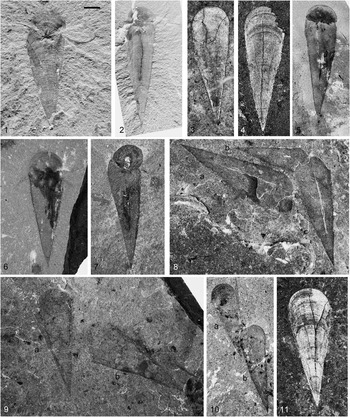
Conch conical exhibits an apical angle about 25º. Average length without the ligula is 12.4 mm, the smallest being 6 mm and the longest 20 mm. Average width is 4.8 mm, the smallest being 2.5 mm and the largest 7 mm. The conical shield of the opercula has an apical angle of about 125°. Cardinal processes are 0.5–0.8 mm in length. Conch with fine, straight transverse growth lines; these are arcuate in the ligula and opercula. Line spacing varies: they are closer together near the apex, and the distance becomes uniform after about one-third the length of the conch. Helens are curved.
Occurrence
Burgess Shale, southern British Columbia, middle Cambrian, Series 3, Stage 5, Bathyuriscus–Elrathina Biozone; Marjum and Wheeler formations, Utah, middle Cambrian, Series 3, Drumian, Bolaspidella Biozone; Rockslide Formation, Ravens Throat River area, Mackenzie Mountains, Northwest Territories, middle Cambrian, Series 3, Drumian, Bolaspidella Biozone.
Remarks
Hyoliths are the most abundant elements in the fossiliferous beds, but most specimens are preserved as isolated conches. The specimens are assigned to H. carinatus based on the apical angle of the conch and the conical shield of the operculum. This species differs from H. reesei by its wider conch, larger apical angle, presence of faint longitudinal grooves on the dorsum, and stronger rugae on the operculum (Babcock and Robison, Reference Babcock and Robison1988).
Phylum Priapulida Théel, Reference Théel1906
priapulid genus and species indet. 1
Material
3 specimens (TMP 2013.101.0051–TMP 2013.101.0053).
Description
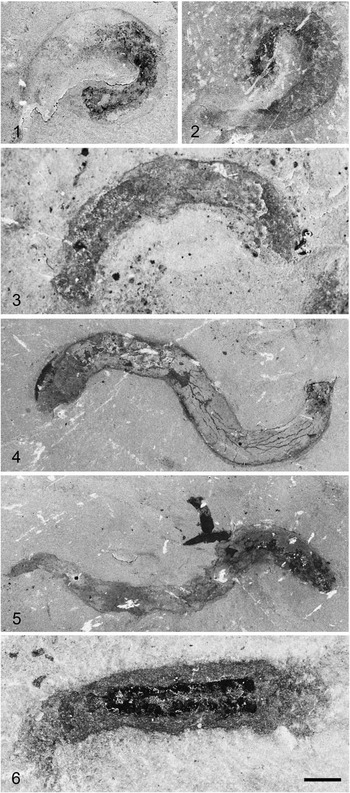
Shape is curved or coiled into a single whorl; anterior portion is narrower than posterior. The longest specimen is 65 mm long and 6 mm at its widest point. Poorly preserved proboscis is partially extended in one specimen (Fig. 14.1).
Occurrence
Burgess Shale, southern British Columbia, middle Cambrian, Series 3, Stage 5, Bathyuriscus–Elrathina Biozone; Marjum and Wheeler formations, Utah, middle Cambrian, Series 3, Drumian, Bolaspidella Biozone; Rockslide Formation, Ravens Throat River area, Mackenzie Mountains, Northwest Territories, middle Cambrian, Series 3, Drumian, Bolaspidella Biozone.
Remarks
These specimens resemble Ottoia prolifica because they show the enlarged posterior region and the curved to coiled shape which is characteristic of this species when contracted. However, the preservation is such that other features are not discernible, especially the trunk annulation and details of the proboscis. Black carbonaceous films in the specimens may be remains of gut contents or residues from the soft tissues. The fossiliferous beds yield many poorly preserved, elongate objects visible as patchy dark films. These most likely belong to Margaretia dorus or worms, but identification is impossible.
priapulid genus and species indet. 2
Material
3 specimens in lateral view (TMP 2013.101.0054–TMP 2013.101.0056).
Occurrence
Rockslide Formation, Ravens Throat River area, Mackenzie Mountains, Northwest Territories, middle Cambrian, Series 3, Drumian, Bolaspidella Biozone.
Remarks
Poorly preserved specimens vary in width along the length of the trunk somewhat as in Ottoia prolifica, but although they are similar in size and two are sinuous in attitude, they are not coiled.
Kingdom Plantae Haeckel, Reference Haeckel1866
Division Chlorophyta Reichenbach, Reference Reichenbach1834
Class Chlorophyceae Wille in Warming, Reference Warming1884
Family Caulerpaceae Kützing, 1843
Genus Margaretia Walcott, Reference Walcott1931
Type species
Margaretia dorus Walcott, Reference Walcott1931, by original designation.
Other species
Margaretia chamblessi Waggoner and Hagadorn, Reference Waggoner and Hagadorn2004.
Diagnosis
See Waggoner and Hagadorn (Reference Waggoner and Hagadorn2004).
Occurrence
Laurentia, middle Cambrian Series 3, stage 5 and Drumian.
Remarks
Margaretia dorus and M. chamblessi differ in that the former exhibits more frequent anastomosis of the longitudinal fibers in the cortex, and the papillae are sparser in M. chamblessi.

Material
74 partial specimens (TMP 2013.101.0130–TMP 2013.101.0203).
Diagnosis
See Conway Morris and Robison (Reference Conway Morris and Robison1988).
Description
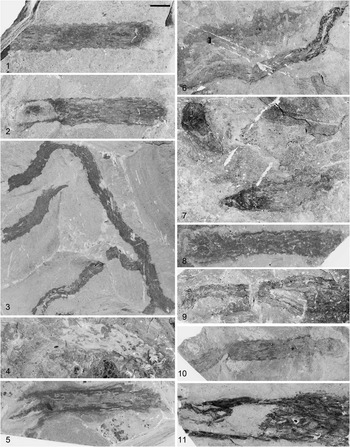
Thallus is large, branching, and more or less uniform in branch width. Average width is 7.8 mm, the smallest being 4 mm and the largest 15 mm. Branches extend from the trunk at right angles; branch shape varies from straight to tightly curved (equivalent to one branch width). Papillae are parallel to the axis in rows; they vary from elongate to oval to nearly circular. Most specimens are carbonaceous films but some preserve marked relief.
Occurrence
Burgess Shale, southern British Columbia, middle Cambrian, Series 3, Stage 5, Bathyuriscus–Elrathina Biozone; Spence Shale member of the Langston Formation, Utah, middle Cambrian, Series 3, Stage 5, Ptychagnostus praecurrens Biozone; Marjum and Wheeler formations, Utah, middle Cambrian, Series 3, Drumian, Bolaspidella Biozone; Rockslide Formation, Ravens Throat River area, Mackenzie Mountains, Northwest Territories, middle Cambrian, Series 3, Drumian, Bolaspidella Biozone.
Remarks
Margaretia dorus is the only macrophytic alga present. It occurs in the lower fossiliferous unit and in thin beds up to 0.5 m above it, as well as being the only fossil recovered from the upper bed with soft-bodied preservation. The many poorly preserved elongate objects in the fossiliferous beds, if they belong to Margaretia, would indicate a greater abundance of these algae.
Discussion
The BST fossil-bearing greenish mudstones of the Rockslide Formation are interpreted to have been deposited below storm wavebase, because of their fine-grained composition and absence of erosional features and cross-lamination. The restriction of the fossils to two thin units in a succession of shales and lime mudstones suggests special, localized geochemical and sedimentological circumstances on the sea floor and maybe also in the water column at the time of deposition. It is at present uncertain if the taphonomic factors that led to soft-bodied preservation are comparable to those proposed for other Lagerstätten (e.g., Butterfield, Reference Butterfield1995; Gaines et al., Reference Gaines, Hammarlund, Hou, Qi, Gabbot, Zhao, Peng and Canfield2012). However, the quality of preservation does not match that in the Burgess Shale and some of the other Cambrian Lagerstätten. The soft tissues of the arthropods are not preserved and the priapulids show advanced decay. This suggests that biodegradation proceeded more or less normally on the sea floor or under shallow burial before ceasing.
The environmental setting of the Rockslide Formation at the Ravens Throat River locality bears some similarities to that of the Burgess Shale (e.g., Johnston et al., 2009), the lower Cambrian (Series 2, Stage 4) Sirius Passet locality in northern Greenland (Peel and Ineson, Reference Peel and Ineson2011) and the Wheeler and Marjum formations of Utah (Rees, Reference Rees1986) because all are associated with syndepositional block faulting. The significance of this relationship is unclear in terms of its effect on the benthic ecology or the taphonomy of the soft-bodied components. Rare BST fossils have also been reported from strata coeval with and older than the Rockslide Formation that crop out in the Mackenzie River Valley to the east of the Mackenzie Arch (Butterfield, Reference Butterfield1994; Butterfield and Nicholas, Reference Butterfield and Nicholas1996; Harvey and Butterfield, Reference Harvey and Butterfield2011). These rocks were deposited in a shallow, intra-shelf basin (Dixon and Stasiuk, Reference Dixon and Stasiuk1998). Chancelloriids exhibiting BST preservation also occur in the lower Cambrian Sekwi Formation (Randell et al., Reference Randell, Lieberman, Hasiotis and Pope2005).
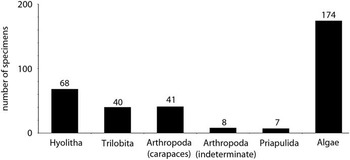
Arthropods, namely carapace-bearing taxa, are represented by the highest diversity of forms. The most common species is Perspicaris? dilatus. So far, the carapaces have not been associated with soft-bodied parts, but isolated fragments likely belong to that species. Priapulids and macrophytic algae are also present, along with typical members of the shelly fauna of this age. Simple burrows are observed under some of the arthropod valves. In terms of simple relative abundance, the fauna is dominated by hyoliths (Fig. 16). These early molluscs often occur with their operculum and helens. The biota may represent a fairly typical benthic community of middle Cambrian age in the deeper water ramp or slope region of marginal Laurentia. However, there is an apparent absence of siliceous sponges, which are variably common elsewhere.
The Ravens Throat River Lagerstätte is similar to the BST deposits from the Great Basin. Not only is it of about the same age as the Wheeler and Marjum formations, but it also has several taxa in common with these units, as well as with the older Burgess Shale and Pioche Shale Lagerstätten (Table 1; e.g., Robison and Richards, Reference Robison and Richards1981; Robison, Reference Robison1991; Briggs et al., Reference Briggs, Erwin and Collier1994, Reference Briggs, Lieberman, Hendricks, Halgedahl and Jarrard2008; Lieberman, Reference Lieberman2003). The dominance of arthropods over other groups is also observed in the Burgess Shale (e.g., Briggs et al., Reference Briggs, Erwin and Collier1994; Caron and Jackson, Reference Caron and Jackson2008), the Chengjiang biota (Hou et al., Reference Hou, Aldridge, Bergström, Siveter, Siveter and Feng2004), and the Kaili biota (Zhao et al., Reference Zhao, Zhu, Babcock, Yuan, Parsley, Peng, Yang and Wang2005, 2011).
Occurrence of Ravens Throat River taxa in other western Laurentian Lagerstätten: Pioche Formation (series 3, stage 5); Burgess Shale (series 3, stage 5); Marjum Formation (series 3, Drumian); Wheeler Formation (series 3, Drumian).

√=represented, x=not represented.
Conclusions
The new middle Cambrian Lagerstätte in the Rockslide Formation of the Mackenzie Mountains of northwestern Canada carries a shelly fauna consisting of common hyoliths, agnostoid arthropods and polymeroid trilobites, and scarce linguliformean brachiopods. It yields a soft-bodied fauna that includes a number of bivalved and other arthropods, especially species belonging to Isoxys, Perspicaris?, Tuzoia, Branchiocaris? and bradoriids, along with the macrophytic alga Margaretia and rare priapulids. Overall, the biota is similar in composition to the known Laurentian BST deposits of similar age in the Great Basin of southwestern U.S.A. Like the Burgess Shale and some other comparable Cambrian Lagerstätten, it is similarly associated with synsedimentary faulting in a deeper water depositional setting. One difference lies in the heterogeneity of the facies that comprise the Ravens Throat River section and the preservation of only the more robust components of its biotic elements restricted to two thin units. This locality affirms that the propensity for BST preservation was more widespread in Laurentia than hitherto understood.
Bradoriids from the Rockslide Formation, middle Cambrian, Ravens Throat River area, Mackenzie Mountains: (1), bradoriid genus and species indet. 1, complete carapace in dorsal view (TMP 2013.101.0044); (2), latex cast of 1 dusted with ammonium chloride; (3), bradoriid genus and species indet. 2, valve in lateral view (TMP 2013.101.0024). Scale bar represents 5 mm.

Fragmentary arthropods from the Rockslide Formation, middle Cambrian, Ravens Throat River area, Mackenzie Mountains: (1), Branchiocaris? sp. lateral views of two disarticulated valves (TMP 2013.101.0021); (2), Tuzoia sp. lateral view of partial valve with ornament of cuspate ridges along margin (TMP 2013.101.0018); (3), Perspicaris? dilatus lateral view of valve (TMP 2013.101.0019); (4), Perspicaris? dilatus lateral view of valve (TMP 2013.101.0017); (5), Branchiocaris? sp. butterflied carapace (TMP 2013.101.0022); (6), lateral view of valve, possibly Perspicaris? dilatus (TMP 2013.101.0016). Scale bars represent 5 mm.

Arthropod fragments from the Rockslide Formation, middle Cambrian, Ravens Throat River area, Mackenzie Mountains: (1,2), arthropod genus and species indet. 1: (1), posterior portion of thorax with lateral telson process consisting of two processes in dorsal view (TMP 2013.101.0036); (2), posterior portion of thorax with lateral telson process in lateral view (TMP 2013.101.0035); (3), arthropod genus and species indet. 2, isolated lateral telson process (TMP 2013.101.0034); (4), arthropod genus and species indet. 3, possible biramous appendage consisting of endopod(?) and exopod(?) (TMP 2013.101.0037). Scale bars are 5 mm.

Haplophrentis carinatus from the Rockslide Formation, middle Cambrian, Ravens Throat River area, Mackenzie Mountains: (1), conch with operculum and helens (TMP 2013.101.0058); (2), conch with operculum and one helen (TMP 2013.101.0059); (3), conch (TMP 2013.101.0063); (4), conch (TMP 2013.101.0064); (5), conch with operculum and one helen (TMP 2013.101.0065); (6), conch with operculum (TMP 2013.101.0066); (7), conch with operculum and partial helen (TMP 2013.101.0067); (8), three conches (TMP 2013.101.0068a, b, c); (9), two conches, one possible juvenile specimen (TMP 2013.101.0070a, b); (10), two juxtaposed conches (TMP 2013.101.0071a, b); (11), conch (TMP 2013.101.0072). Scale bar represents 2 mm.

Priapulids from the Rockslide Formation, middle Cambrian, Ravens Throat River area, Mackenzie Mountains. Possible gut contents or residual soft tissues appear as dark patches. (1–3), priapulid genus and species indet. 1: (1), curved specimen, with partially extended proboscis to left (TMP 2013.101.0051); (2), coiled specimen, with anterior end at bottom (TMP 2013.101.0052); (3), coiled specimen, with anterior end at bottom (TMP 2013.101.0053); (4–6), priapulid genus and species indet. 2: (4), sinuous specimen, anterior to the right (TMP 2013.101.054); (5), sinuous specimen, anterior and posterior ends unknown (TMP 2013.101.0055); (6), Elongated specimen (TMP 2013.101.0056). Scale bar is 5 mm.

Margaretia dorus from the Rockslide Formation, middle Cambrian, Ravens Throat River area, Mackenzie Mountains: (1), partial branch (TMP 2013.101.0130); (2), partial branch (TMP 2013.101.0131); (3), branching specimen (TMP 2013.101.0132); (4), partial branch (TMP 2013.101.0133); (5), partial branch (TMP 2013.101.0134); (6), partial branch (TMP 2013.101.0135); (7), two partial branches (TMP 2013.101.0136); (8), partial branch (TMP 2013.101.0137); (9), partial branch (TMP 2013.101.0138); (10), partial branch (TMP 2013.101.0139); (11), partial branch (TMP 2013.101.0140). Scale bar is 10 mm.

Relative abundance of specimens of metazoan taxa in all samples collected from the fossilifereous unit of the Rockslide formation (both in situ and from the scree slope), middle Cambrian, Ravens Throat River area, Mackenzie Mountains.

Acknowledgments
We thank C. West, K. Gerein, and B. Uzelman for their assistance in the field, and the referees D.A. Legg and J. Vannier, associate editor B.S. Lieberman, and editor S.J. Hageman for comments to the manuscript. Specimens have been collected under Aurora Institute Research Licenses issued to BRP. The expeditions to the Mackenzie Mountains were possible thanks to funding from Natural Sciences and Engineering Research Council of Canada Discovery Grants and a Lithoprobe grant to BRP. BRP discovered the locality during fieldwork for his doctoral research, funded mainly by a Natural Sciences and Engineering Research Council Operating Grant to R. Ludvigsen. This paper is part of J.K.’s doctoral research.