INTRODUCTION
Legal reform is often framed as a path to standardization and control. Yet, as socio-legal scholarship increasingly shows, codification may stage legality not through constraint, but through recalibrated discretion (Noonan et al. Reference Noonan, Sabel and Simon2009; Spires Reference Spires2020). This study theorizes China’s Charity Law not as a linear compliance regime, but as a staged legality structure, in which legitimacy budgeting redistributes discretion to preserve symbolic order and orchestrate reputational exposure across institutional layers.
While the revised Charity Law articulates highly specific provisions concerning financial transparency, administrative cost ceilings, and grassroots regulation, it does not produce consistent enforcement outcomes (Luova Reference Luova2017; Jing Reference Jing2021). Instead, it embeds ambiguity into the very structure of obligation, rendering full compliance structurally unachievable. Under these conditions, legality becomes both a moving target and a relational performance—governed less by fixed rules than by anticipation, caution, and symbolic alignment (Howell et al. Reference Howell2020; Wang Reference Wang2023).
This study does not focus on how actors circumvent law, but on how law itself is designed to necessitate negotiated discretion. Legal ambiguity is not treated here as a byproduct of weak enforcement or bureaucratic incapacity, but as an instrumentally embedded feature that accomplishes a dual function: projecting centralized authority while enabling localized discretion. In this way, the law operates as an interface—a symbolic infrastructure that choreographs visibility, mediates recognition, and distributes institutional risk across scalar contexts (McCarthy Reference McCarthy2013; Farid and Song Reference Farid and Song2020).
Based on comparative ethnographic fieldwork in Shanghai and Chongqing (2021–2023), this study traces how legality is activated and suspended across relational settings. Drawing on 62 interviews, 260 internal and public documents, and 45 field observations, it examines how regulatory tightening around Article 36 (donor asset legality), Article 61 (administrative cost ratios), and Article 96 (community-level registration) has produced a condition of universal technical violability. In this environment, legitimacy is not a stable legal status but a contingent performance—negotiated through narrative tone, bureaucratic atmospheres, and affective cues (Dobbin and Sutton Reference Dobbin and Sutton1998; Nassar and Stel Reference Nassar and Stel2019). NGOs engage legality through symbolic compliance; officials govern not despite legal precision, but through it.
This study theorizes staged legality as the core logic of China’s Charity Law. It advances a three-part argument: (1) that the Charity Law constructs legality as a symbolic infrastructure of legitimacy budgeting, organizing control through narrative alignment and reputational pacing; (2) that this system functions through triadic discretion—an operational dynamic that modulates compliance across central, local, and organizational layers; and (3) that the discretionary regime forged through practice after the 2016 law was subsequently codified as structured unfulfillability in the 2024 revision, embedding incompletion as a legal form to sustain symbolic governance.
LITERATURE REVIEW
From Interface to Infrastructure: Law as Symbolic Design
Emerging socio-legal research emphasizes that law operates not only through command and constraint, but through symbolic governance—producing visibility, pacing recognition, and staging legality as a performative structure that enables discretionary calibration (Pires Reference Pires2011; Messner Reference Messner2012; McCarthy Reference McCarthy2013). In regulatory regimes marked by practical fragmentation, uneven capacity, and reputational exposure, law often functions not as a mechanism of behavioral discipline, but as a semiotic apparatus—generating legitimacy through visibility, calibration, and deferred enforceability (Zhang Reference Zhang2025). Legal form, under such conditions, may operate less as an adjudicative endpoint than as an aestheticized infrastructure for staging compliance.
This analytic approach has particular relevance in governance fields where the state operates through layered intermediaries or where formal rules exceed institutional absorptive capacity. Studies on education reform (Ansari et al. Reference Ansari, Reinecke and Spaan2014), sovereign fund ethics (Hachigian Reference Hachigian2015), or sustainability reporting (Maguire and Hardy Reference Maguire and Hardy2013) all suggest that legal regimes may intentionally preserve ambiguity—not to invite circumvention, but to enable flexibility under symbolic constraint. This study extends this literature by theorizing staged legality as a mode of legitimacy budgeting: a structural design in which ambiguity, discretion, and codification interact to choreograph symbolic governance across relational interfaces.
Since its promulgation in 2016, the Charity Law (Central People’s Government 2016) has been widely described as a milestone in institutionalizing the philanthropic sector through codified standards, especially around financial transparency, board governance, and public disclosure (Han Reference Han2018; Spires Reference Spires2020). Yet the law’s rigid proceduralism—such as standardized reporting formats, fixed administrative cost ratios, and real-name donor tracking—has generated chronic compliance frictions in a sector long governed by relational trust and negotiated improvisation (Deng Reference Deng2010; Ni and Zhan Reference Ni and Zhan2017; Tao and Jasper Reference Tao and Jasper2022).
The 2023 revision, rather than alleviating these tensions, reaffirmed and intensified many of the earlier requirements, despite a more consultative drafting process (Central People’s Government 2024). This paradox—increased procedural precision amid acknowledged overreach—cannot be explained through political intention alone. Instead, it invites a structural question: how does law generate discretion not in spite of codification, but through it?
Existing accounts often treat legal ambiguity as a residual effect of political caution (Cui and Wu Reference Cui and Wu2024), decentralized implementation (Luova Reference Luova2017), or local discretion under resource constraints (Zhou and Han Reference Zhou and Le Han2019; Luo et al. Reference Luo, Zheng and Long2023). While these explanations help contextualize variability, they tend to locate ambiguity in post-enactment improvisation rather than in legal design itself. Building on theories of formal-symbolic decoupling (Ansari et al. Reference Ansari, Reinecke and Spaan2014), this study suggests that ambiguity is an infrastructural property of law, intentionally embedded to preserve symbolic coherence in contexts where enforcement cannot be reliably institutionalized.
Proposition 1 (Institutional Logic): Legality as Symbolic Infrastructure for Legitimacy Budgeting
Rather than functioning solely as a conduit between state and society, China’s Charity Law operates as a symbolic infrastructure that enables legitimacy budgeting—a system in which codified legal form orchestrates visibility, absorbs institutional risk, and embeds reputational suspense. Legal rules—particularly those concerning donor asset provenance, administrative cost ceilings, and NGO accreditation—do not primarily regulate behavior through categorical enforcement. Instead, they structure a zone of anticipatory legality, where compliance is performed through reputational alignment and narrative restraint (Gray and Silbey Reference Gray and Silbey2014; Farid and Song Reference Farid and Song2020).
This configuration renders legal ambiguity not as a defect to be corrected but as a designed feature—a mode of affective governance that sustains symbolic control by deferring closure (Goffman Reference Goffman1959; Wang Reference Wang2023; Zhang Reference Zhang2025). In this institutional logic, law governs not through definitive boundaries, but by enabling atmospheric modulation: what matters is not what the law prohibits, but how its invocation is affectively anticipated.
This institutional logic, however, does not function in abstraction. To understand how legitimacy budgeting operates as more than a symbolic gesture, we must trace how this legal infrastructure is modulated through concrete regulatory interactions. The following section turns from the structural level of legal meaning to its operationalization through governance practice. Here, the architecture of staged legality is not only symbolically inscribed, but rhythmically enacted—distributed across institutional positions that absorb, translate, and recalibrate the law’s affective charge.
Triadic Discretion: Legal Precision as a Mechanism of Modulated Control
If legality functions as a symbolic infrastructure—organizing visibility, anticipation, and reputational exposure—then the question becomes how this infrastructure is operationalized across regulatory layers. Legal discretion does not simply emerge in response to implementation constraints; it is actively structured through the way legal form is distributed across central authorship, local interpretation, and organizational performance (Zhang and Guo Reference Zhang and Guo2021; Zhu and Jun Reference Zhu and Jun2022; Zhu et al. Reference Zhu, Qiu and Liu2023). This study conceptualizes this distribution as triadic discretion: a governance configuration in which legal precision paradoxically enhances symbolic control by enabling discretion to be absorbed and rearticulated across levels.
At the central level, China’s Charity Law increasingly codifies behavioral expectations through quantified ratios, activity thresholds, and documentation regimes (Central People’s Government 2016, 2024; Jing Reference Jing2021). Yet the granularity of these standards often renders them technically violable in practice (Zimmerman and Zeitz Reference Zimmerman and Zeitz2002; Fu and Yan Reference Fu and Yan2024). Legal clauses such as the 10 percent administrative expense cap or fundraising disclosure obligations appear unambiguous, but their rigidity produces selective enforceability, allowing the state to reserve legal activation as a discretionary power rather than a universal requirement (Wilson Reference Wilson2015; Tian and Chuang Reference Tian and Chuang2022; Zhu and Jun Reference Zhu and Jun2022). As Charbonneau et al. (Reference Charbonneau, Boisvert and Bégin2023) argue, the discretionary invocation of rules can become a routine mode of symbolic discipline under conditions of regulatory uncertainty.
This precision-driven ambiguity cascades downward. Local authorities are not merely passive implementers; they become discretional absorbers, operating within a framework that emphasizes NGO transparency but offers limited procedural guidance on enforcement (Snape Reference Snape2015; Luova Reference Luova2017; Spires Reference Spires2020; Tao and Jasper Reference Tao and Jasper2022). Discretion is not simply tolerated; it is institutionalized as part of the legal ecology. As Pires (Reference Pires2011) notes, in such regimes, street-level discretion becomes a functional substitute for the formal tools of coordination and insulation. Bureaucrats are expected to manage risk exposure through narrative curation, mood interpretation, and affective calibration (Benney Reference Benney2016; Cohen and Cohen Reference Cohen and Cohen2023; Wang Reference Wang2023), rather than through direct rule enforcement.
At the organizational level, NGOs must navigate this interpretive field by cultivating durational legality—a status that is not definitively achieved, but continuously negotiated (Turner et al. Reference Turner, Feinerman and Kent Guy2000; Holbig and Lang Reference Holbig and Lang2022). Rather than aiming at stable compliance, organizations engage in symbolic rehearsal: adjusting project design, reframing administrative categories, or delaying visibility in anticipation of changing political atmospheres (Gray and Silbey Reference Gray and Silbey2014; Gåsemyr Reference Gåsemyr2017; Farid and Song Reference Farid and Song2020). In practice, rule-following gives way to legibility management, where being recognized as trustworthy, modest, and procedurally aligned matters more than fulfilling precise statutory criteria (Pfeffer and Salancik Reference Pfeffer and Salancik2015; van der Kamp Reference der Kamp and Sienli2024).
Building upon the infrastructural logic of legitimacy budgeting, the Charity Law is operationalized through triadic discretion—a governance modality in which central codification, local interpretation, and organizational performance form an interactive field of symbolic calibration. Legal precision does not eliminate arbitrariness; rather, it redistributes interpretive agency across regulatory strata, producing a tightening governance coil that modulates exposure and affective legibility (Zhang and Guo Reference Zhang and Guo2021; Zhu and Jun Reference Zhu and Jun2022).
Proposition 2 (Governance Modality): Triadic Discretion as a System of Relational Calibration
Central authorities articulate increasingly granular mandates—such as fixed expense ratios and standardized disclosure—but local regulators absorb their ambiguity through discretionary hesitation, narrative buffering, and affective reading (Pires Reference Pires2011; Benney Reference Benney2016; Wang Reference Wang2023). Meanwhile, NGOs engage in durational legality—a continuous negotiation of tone, posture, and visibility designed to signal procedural modesty while navigating unstable interpretive climates (Gray and Silbey Reference Gray and Silbey2014; Pfeffer and Salancik Reference Pfeffer and Salancik2015). In this system, discretion is not a byproduct of institutional weakness; it is an embedded technique for managing symbolic volatility through relational rhythm (McCarthy Reference McCarthy2013; Maguire and Hardy Reference Maguire and Hardy2013; Amsler Reference Amsler2016).
While triadic discretion explains how the system governs in motion, it remains incomplete without attention to the codified form in which this governance is ultimately preserved. The relational choreography between central authorship, local modulation, and organizational performance finds its legal consolidation in the statutory logic of impossibility. The next section analyzes how this discretionary ecology, cultivated through practice after the 2016 law, becomes formalized in legal text through a distinctive technique: structured unfulfillability.
Structured Unfulfillability: Designing Compliance as Symbolic Risk
If legality operates as symbolic infrastructure and is distributed through triadic discretion, a third condition completes the architecture: the systemic design of unfulfillable legal expectations. In this configuration, legal thresholds are crafted with such precision and formal rigor that full compliance becomes structurally elusive. This is not a failure of implementation. Rather, it is a regulatory strategy through which the appearance of order is sustained while control remains selectively mobilizable.
In classical regulatory theory, legal ambiguity is often treated as an accidental outcome—something to be corrected through clarification, capacity-building, or procedural refinement (Farnsworth Reference Farnsworth, Guzior and Malani2010; Barnum and Nagin Reference Barnum and Nagin2021). Yet a growing body of work suggests that such ambiguity can serve a productive role in governance: not as institutional breakdown, but as an instrument of symbolic management (Hachigian Reference Hachigian2015; Cordery and Deguchi Reference Cordery and Deguchi2018; Howell et al. Reference Howell2020).
This study develops the concept of structured unfulfillability to capture how law may encode compliance thresholds that are simultaneously hyper-specific and practically unreachable, exhibiting caution, restraint, and narrative discipline. This design enables legal systems to invoke certainty in form while embedding discretion in function (Zhang Reference Zhang2025). Statutory clauses such as administrative cost ceilings, disclosure cycles, or evaluation metrics create a formal grammar of transparency and accountability, but their operational enactment remains deeply contingent—dependent on mood, timing, and relational distance (Teets Reference Teets2018; Tian and Chuang Reference Tian and Chuang2022; Luo et al. Reference Luo, Zheng and Long2023; Wang Reference Wang2023; Zhu et al. Reference Zhu, Qiu and Liu2023).
Such conditions give rise to legitimacy budgeting (DiMaggio and Powell Reference DiMaggio and Powell1983; Dobbin and Sutton Reference Dobbin and Sutton1998): the strategic allocation of legal vulnerability and symbolic recognition across organizations. NGOs do not comply in a binary sense, but are positioned along a reputational spectrum, where anticipation, deference, and narrative containment become markers of legal intelligibility (Tsai Reference Tsai2015; Gray and Silbey Reference Gray and Silbey2014). This form of legality works not through universal enforcement, but through stored discretion—a reserve of potential activation that can be mobilized to reward alignment or penalize misrecognition (Charbonneau et al. Reference Charbonneau, Boisvert and Bégin2023; Zhang Reference Zhang2025).
Legal exposure under structured unfulfillability is not a matter of procedural deviance, but of positional legibility. Organizations become governable not by fulfilling rules, but by appearing governable: that is, by displaying austerity, restraint, and moral legibility that aligns with the state’s performative cues (Goffman Reference Goffman1959; Maguire and Hardy Reference Maguire and Hardy2013; Wang Reference Wang2023). This is not legal evasion—it is staging legality, in which actors navigate enforcement risk through staged anticipation and symbolic modesty (Versluis Reference Versluis2007; Pires Reference Pires2011).
Proposition 3 (Legal Codification): Structured Unfulfillability as the Formalization of Staged Legality
The relational dynamics of legitimacy budgeting and triadic discretion are ultimately codified through what this study terms structured unfulfillability—a statutory design in which compliance thresholds are hyper-specific yet practically unreachable. Legal provisions such as Article 61’s administrative cost cap or Article 96’s procedural requirements are drafted with formal clarity but assume infrastructural conditions beyond the reach of most grassroots organizations (Dobbin and Sutton Reference Dobbin and Sutton1998; Hachigian Reference Hachigian2015).
Rather than correcting these gaps, the Charity Law institutionalizes them as symbolic filters, enabling selective activation based on affective alignment, not categorical violation. In doing so, the law transforms an emergent logic of discretionary governance into a codified architecture of staged legality—a legal form that disciplines not through enforcement, but through reputational suspense, narrative pacing, and moral anticipation (Teets Reference Teets2018; Luo et al. Reference Luo, Zheng and Long2023; Zhang Reference Zhang2025). Structured unfulfillability thus marks the formal closure of the system: a statutory mechanism that preserves symbolic control through strategic incompletion.
Together, these three propositions articulate a sequenced legal architecture: from symbolic infrastructure that stages legitimacy budgeting, to triadic discretion that choreographs its relational circulation, and finally to codified unfulfillability that consolidates this discretionary system into statutory form. What follows is an empirical inquiry into how these theoretical components are activated, suspended, and interpreted in practice—across bureaucratic, organizational, and discursive sites of legal interaction.
METHODS
Research Strategy: Tracing Interface Activation through a Structured Deductive–Inductive Framework
This study adopts a structured deductive–inductive research strategy to trace how China’s Charity Law is not simply implemented or circumvented, but selectively activated, suspended, or modulated through patterned relational conditions. The goal is not to evaluate enforcement outcomes, but to understand the conditions under which codified law—though textually precise—becomes socially consequential, atmospherically delayed, or symbolically withheld. To this end, the study conceptualizes legality not as a static institutional artifact, but as an interface: a discretionary zone where textual clarity intersects with relational ambiguity and affective signaling.
This framework was operationalized through a two-phase research process, spanning 2021–2023 and grounded in comparative fieldwork in two structurally comparable but relationally distinct municipalities: Shanghai and Chongqing. The deductive phase began with three working hypotheses, rooted in prior scholarship on symbolic governance and regulatory performativity (Pires Reference Pires2011; Messner Reference Messner2012; Ince Keller et al. Reference Keller, Irem and Ruegg2024). These hypotheses structured initial data collection instruments, including interview protocols, policy mapping, and observational focus areas. While deductively anchored, the approach remained open to reinterpretation as fieldwork revealed incongruities between legal codification and everyday organizational behavior.
Early field encounters introduced analytical friction. In Shanghai, NGOs curtailed activities preemptively, not because of direct legal injunction, but due to ambient shifts in political tone and the interpretive mood of intermediary actors. In Chongqing, by contrast, certain community-based initiatives operated under symbolic invisibility, persisting quietly despite apparent violation of formal thresholds. These cases prompted an inductive recalibration, revealing a fourth mechanism—regulatory hesitation—where discretionary non-activation became a strategy for preserving interface stability while avoiding political liability.
This iterative tension between theoretical proposition and empirical encounter shaped the study’s abductive core. In line with Tavory and Timmermans’ (Reference Tavory and Timmermans2014) logic of analytically structured resonance, the study did not treat field data as validation or falsification tools, but as interpretive material through which theoretical categories—such as interface legality, symbolic compliance, or discretionary exposure—could be refined. Attention shifted from “compliance behavior” to affective modulation: how actors read tone, timed their disclosures, and adjusted visibility in response to perceived legal risk or bureaucratic hesitation.
Throughout both phases, the unit of analysis remained not the organization itself, but its shifting position within the legal interface—a dynamic, relational status shaped by trust, narrative calibration, and proximity to activation triggers. Legal salience was understood as contingent and situational: the same clause could be dormant, euphemized, or suddenly invoked depending on timing, mood, or leadership transition. It operationalizes the study’s central argument: that legality is not merely practiced, but staged—structured through legitimacy budgeting.
Case Selection: Most-Similar-Systems Design for Analyzing Interface Activation
To examine how legality is differentially activated through relational choreography, this study employs a most-similar-systems design with embedded variation. Shanghai and Chongqing were selected for their institutional comparability—both are centrally administered municipalities subject to the same version of the Charity Law (Central People’s Government 2016, 2024), unified funding regimes, and shared policy directives—yet they exhibit contrasting interface ecologies and symbolic activation rhythms.
The logic of comparison rests on a core premise: while legal codification is national, its interpretive life is patterned by local atmospheres of discretion, exposure, and institutional mood. Shanghai exemplifies anticipatory legality—a deferred interface where NGOs operate through tacit readability, interpretive patience, and reputational buffering. Law is not explicitly activated but staged through calibrated silence, strategic ambiguity, and under-signaling.
By contrast, Chongqing reflects a strategy of interface minimization. Here, legality is preserved at the textual level but distanced in practice. Regulatory exposure is concentrated among a handful of politically aligned NGOs, while others occupy zones of tolerated invisibility. During the 2023 Charity Law consultation, municipal officials proposed inflating procedural thresholds not to enhance governance, but to preempt symbolic entanglement.
Despite these divergences, both cases reveal climate-dependent legality—a condition where legal activation shifts with political tone, leadership transition, or discursive volatility. NGOs in both sites recounted sudden changes in legal status linked not to statutory change, but to mood shifts in local bureaucracy or center-driven messaging. Legality, in this sense, emerges less from textual clarity than from narrative alignment and affective coherence.
Despite this divergence, the sites share a core feature: climate-dependent legality. In both cities, NGO leaders reported that leadership transitions—whether district-level reshuffling or shifts in central messaging—instantly altered their legal standing, often without procedural explanation. These accounts support the premise that legality is temporally orchestrated and relationally coded.
To avoid reductionism, the study introduced intra-city heterogeneity. In Shanghai, NGOs were selected from districts with varying “trust-density” profiles (Zhou and Han Reference Zhou and Le Han2019; Luo et al. Reference Luo, Zheng and Long2023); in Chongqing, the sample included both state-recognized foundations and low-visibility actors embedded in informal bureaucratic relationships. This ensured variation in how the legal interface is interpreted, buffered, or withheld across organizational types and bureaucratic proximities.
Data Collection: Capturing Ambiguity, Discretion, and Symbolic Activation
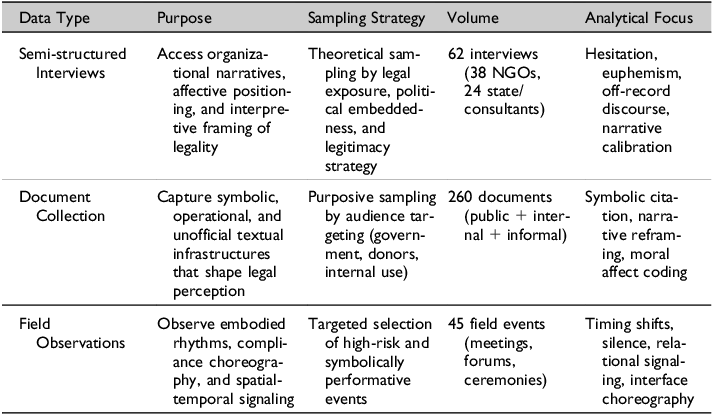
Fieldwork (see Table 1) was conducted between 2021 and 2023. It followed a framework of relational correspondence, where interviews, documents, and observations were selected and interpreted to capture distinct modes of symbolic activation: narrative delay, interpretive ambiguity, and bureaucratic mood. Legal meaning was traced not through rule adherence, but through affective positioning and atmospheric readability across bureaucratic–organizational interfaces.
Data collection design

Organizational Sampling and Typological Design
To capture relational variation in legal activation, thirty NGOs (fifteen per city) were selected through theoretical sampling (Glaser and Strauss Reference Glaser and Strauss2017), based on three dimensions: regulatory exposure, political embeddedness, and legitimacy strategy. Exposure was coded as high (≥1 audit/year, cross-district activity, ≥3 state/media references), moderate (1–2 mentions, no audits), or low (zero audits, neighborhood scale). Embeddedness was measured via a 3-point index: state-affiliated leadership, receipt of public funding, and prior involvement in Party-linked initiatives (3 = high, 1–2 = medium, 0 = low). Legitimacy strategy was assessed through public materials: NGOs with ≥3 patriotic or alignment expressions were classified as symbolic performers; those emphasizing internal rules but avoiding publicity as legal technicians; and those minimizing both visibility and procedural signaling as quiet operators.
This sampling design generated a full matrix of nine interface types (e.g., low exposure/high embeddedness/symbolic performer), enabling comparative analysis across regulatory positions. Organizational scale was also recorded—associations (30–100 members; ¥500k–2m/year), foundations (¥30–150m/year; 3–10 staff), and social service agencies (¥1–5m/year; ≥70% public funding)—to trace how legal pressure is unevenly distributed not only across cities, but within structurally similar categories under the same legal regime.
Interviews: Relational Positioning and Anticipatory Interpretation
A total of sixty-two semi-structured interviews were conducted—thirty-eight with NGO staff and twenty-four with officials, advisors, or hybrid actors (e.g., retired cadres managing intermediary platforms). Interviews, conducted in Mandarin (45–90 minutes), were transcribed verbatim and selectively translated. Participants were selected based on their proximity to legal interface moments—such as leading compliance reviews, receiving inspection notices, or preparing sensitive grants—ensuring coverage of both “policy insiders” and “threshold navigators.”
Interview protocols were organized around four thematic domains: (1) Anticipation—how actors gauge the imminence or dormancy of legal activation; (2) Interpretation—how they decode shifts in leadership or political tone; (3) Adjustment—how they recalibrate organizational conduct in response to perceived scrutiny; and (4) Performance—how legality is enacted affectively, narratively, and institutionally. Particular analytic attention was paid to off-the-record speech, euphemism (e.g., “depends on the big boss”), hesitancy, and tonal inflection—treated not as noise, but as indicators of relational positioning within a symbolic regulatory environment.
Documents: Symbolic Infrastructure of Compliance
A total of 260 documents were collected to examine how legality is rendered visible, obscured, or strategically reframed through institutional text. Materials were grouped into three categories: (1) Public-facing artifacts—newsletters, activity reports, and “alignment declarations” submitted for recognition; (2) Internal compliance tools—inspection forms, risk matrices, and reporting manuals; and (3) Unofficial communications—WeChat exchanges, annotated approval slips, and pre-cleared template language. Selection criteria emphasized documents that (a) attempted to make law symbolically legible, and (b) were tailored to a specific audience—bureaucratic, donor-facing, or intra-organizational.
Narrative coding focused on how legal authority was evoked, cited, or displaced. For example, one NGO’s internal manual contained no statutory references but included “emotional risk phrases” such as “main ideological tone has shifted,” signaling the use of moral heuristics over legal categories. Other materials emphasized Party loyalty not for compliance, but to signal affective alignment. These patterns reveal how legal expectations are translated into affective cues and discursive codes, forming the symbolic infrastructure through which organizations navigate compliance atmospherics.
Field Observations: Embodied Interface Choreography
To capture legality as practice rather than discourse, forty-five field events were observed in situ, including NGO briefings, trainings, award ceremonies, and intersectoral meetings. Observations focused on temporal choreography—who spoke when legal references emerged, when silence replaced legal language, and how participation shifted following leadership transitions.
Events were coded using a three-phase interpretive schema: (1) Latency—law is present but unspoken, embedded in spatial or tonal arrangements; (2) Activation—law is explicitly cited following symbolic or relational cues; (3) Displacement—legal references are avoided or reframed through euphemism, moral appeal, or ritualized gesture. These were not anomalies but expressions of legality’s performative mode—where law governs through timing, hesitation, and atmosphere rather than directive command.
Data Analysis: Mapping Interface Legality through Abductive Thematic Strategies
This study adopts an abductive analytic strategy that integrates deductive theoretical scaffolding with inductive discovery to trace how legality is interpreted, staged, and suspended within China’s nonprofit governance ecology. Drawing from 62 interviews, 260 documents, and 45 field observations, legality is treated not as a procedural endpoint, but as a relational process—activated through atmospheres of trust, anticipation, and affective modulation rather than categorical enforcement.
Analysis proceeded through iterative thematic coding (Clarke and Brown Reference Clarke and Braun2017), with emphasis on latent symbolic cues across data types. Coding categories included anticipatory hesitation, symbolic overperformance, bureaucratic buffering, and narrative displacement. For instance, when references to Article 13 disappeared from internal documents, were euphemized in interviews, and surfaced only indirectly in event observations, this pattern was coded as strategic latency—a technique of controlled visibility in atmospheres of potential risk.
Three analytic constructs were developed to systematize the findings:
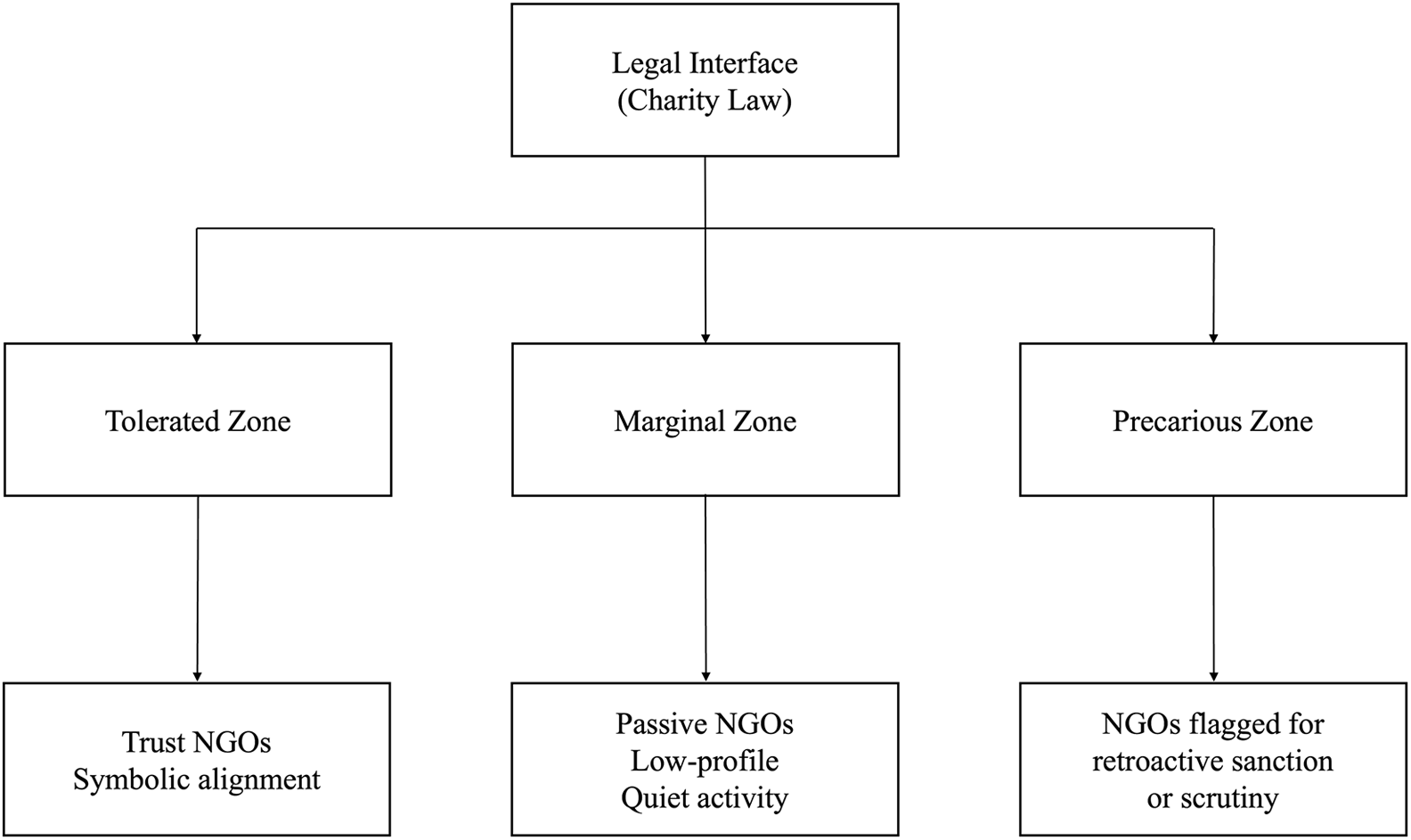
The first construct is the Legal Interface Positioning Map (Figure 1), which reclassifies NGO status not by formal compliance levels but by their affective and relational location within regulatory climates. NGOs were categorized into: (1) Tolerated Zone—informally accepted, narratively useful, and buffered by affective trust; (2) Marginal Zone—granted procedural space but exposed to ambient risk; (3) Precarious Zone—selectively flagged or suspended due to shifts in political tone or institutional memory. Shifts between zones—often triggered by leadership turnover or reputational tremors—were treated as indicators of symbolic volatility, not legal nonconformity.
Legal interface positioning map

The second analytic construct traces interface clause displacement (Figure 2), observing how specific legal provisions shift in interpretive weight without textual change. Clauses like Article 36 (donor asset provenance) and Article 61 (overhead ceilings) emerged, receded, and re-emerged in response to events such as national audit campaigns or NGO scandals. Patterns included (1) sudden citation of dormant clauses following inspection notices; (2) informal retraction of reporting practices after bureau reshuffles; and (3) ceremonial suspension of legal thresholds during state-sponsored campaign periods. These shifts reflect the law’s activation as a socially indexed phenomenon.
Interpretive framework of interface legality

The third analytic layer conceptualizes legality as choreographed sequencing—a performative rhythm of invocation, withdrawal, and symbolic rehearsal. Across all data types, themes such as “compliance anticipation,” “posture recalibration,” and “non-submission strategy” appeared repeatedly. NGOs were observed preparing audit-ready documents that were never submitted, rehearsing donor-language templates before bureaucratic meetings, and invoking legality only after narrative cues signaled safe activation. These actions were interpreted not as circumvention but as modes of legality-in-waiting—responsive to timing, tone, and political atmospherics.
What is analyzed here, then, is not whether law is followed, but how legality is circulated, when it is deferred, and who becomes the object of its selective invocation. Through this analytic lens, legality is revealed not as a neutral constraint, but as an emotionally resonant and temporally staged field of institutional meaning-making.
FINDINGS
Symbolic Projection: Article 36 and the Choreography of Legal Visibility
Central Mandates, Local Calculus, and NGO Self-Positioning
When China promulgated its 2024 revision to the Charity Law, public and scholarly attention converged on what appeared to be new and ideologically intensified. Article 4 codified the political primacy of the Communist Party over all charitable activities. Article 6 delegated the duty of “coordination and guidance” to local governments, formalizing a logic of downward accountability. Articles 101 and 106 established a centralized credit system that tracks the behavior, reputation, and moral standing of charitable organizations.
Amid these expansions, Article 36 remained untouched—textually identical to its 2016 formulation:
Donated property must be the lawful property of the donor and must be legally disposable. Donations may include money, goods, real estate, securities, shares, intellectual property, and other tangible or intangible assets. Donated goods must be usable and meet safety, hygiene, and environmental standards. Donors donating their own enterprise’s products must bear legal responsibility for quality.
No amendments or interpretive notes. Yet this textual stillness amplifies Article 36’s symbolic power. It is a fixed semiotic anchor, refracting governance imperatives without altering form. Its interpretive clarity and regulatory silence render it a legal placeholder—an infrastructural element that quietly redistributes the symbolic excess generated by newer, more explicit clauses (Wang Reference Wang2024).
Through this symbolic projection (Messner Reference Messner2012), Article 36 becomes a mirror for other legal expectations: ideological loyalty (Article 4), administrative responsibilization (Article 6), and reputational memory (Articles 101 and 106). It does not direct conduct in a rule-based sense (Fuller Reference Fuller1969); rather, it operates as legal latency—a clause whose unchanged wording permits it to become a vector for anticipatory interpretation and relational governance.
The issue isn’t whether you broke the law, explained Ms. Liao, a program officer at a foundation. It’s whether someone might feel you didn’t uphold Party leadership enough. And that’s the problem—there’s no clear standard. What does it even mean to ‘uphold leadership’ in a donation? Does it mean you posted the right slogan? That you didn’t look too independent? That you didn’t act too confident?
In this climate, legality is not merely about procedural correctness, but optical compliance: the ability to appear deferential, restrained, and aligned with Party ethos. As Ms. Liao continued, what had changed was not the law, but the chain of consequence: “Even if the donation is perfectly legal, we have to ask: how will this look? Will someone say we were too bold? Too visible? Once something goes wrong, it’s not just our organization that takes the hit—it reflects on the local government too.”
In effect, Article 36 becomes the site where vertical governance is delegated without command. Central authorities demand ideological loyalty and reputational hygiene; local authorities, fearing accountability for failure, respond not with prohibition but with cautious delay. NGOs, caught in suspended certainty, decode risk through emotion, not legal text.
This is not just diffusion of responsibility, but a reconfiguration of agency under anticipatory governance. Legal meaning is suspended; what remains is the choreography of avoidance: “Honestly, our relationship with the foundation has always been pretty good, said an official in a county government. But charity, especially with big donations, is just really sensitive these days. If something goes viral online, our personal trust doesn’t protect anyone.”
Trust, he clarified, cannot shield actors from a shift in political weather:
Sometimes we can turn a blind eye, let something pass quietly. But that depends on what the leaders are thinking at that moment. If the mood shifts—or if someone higher up starts paying attention—even a small thing can blow up. So we’d rather be cautious upfront than scramble later.
This affective discretion produces a system of symbolic projection without formal responsibility. As Zhang (Reference Zhang2025) notes, such clauses operate not to enforce behavior, but to store potential activation. Article 36 is not dead weight—it is a narrative anchor enabling movement around it. It holds its place precisely so that discretion, delay, and projection can circulate freely. In this light, the clause becomes an infrastructural interface: inert in form, mobile in function, and indispensable for the maintenance of relational legality in a saturated regulatory environment.
Legal Latency and the Staging of Anticipatory Compliance
While Article 36 remains untouched in the statutory text, its interpretive power has deepened—not through judicial elaboration, but through ambient uncertainty. NGOs do not experience it as a directive but as a suspended instrument of reputational judgement. Its authority lies not in direct enforcement but in its potential invocation—delayed, reframed, and often triggered by atmospherics rather than infraction. In this regime, legality is not a guarantee of institutional protection but a precarious promise, permanently subject to relational recalibration.
We did everything—due diligence, family interviews, notarized statements, recounted Ms. Lin, a foundation director, describing a large donation from an older supporter.
But once his son went online and accused us of manipulation, all our documentation was immediately rendered meaningless. No one cared about the paperwork. The law? That was the last thing anyone mentioned.
This incident is not an anomaly. It marks the shift from textual legality to legal latency—a form of contingent precarity, where codified law exists as a suspended frame, ready to be retrofitted to moral panic, digital virality, or sudden institutional embarrassment. Article 36 becomes a performative backdrop, legally inert until activated by bureaucratic mood or reputational crisis. It is not proactively interpreted, but post hoc weaponized—its stability granting it the credibility to function as a normative trigger once mobilized.
Another foundation director described declining a perfectly legal donation—an apartment from a widow—due to reputational risk: “It wasn’t about the law. That was fine. But if things go wrong, no one will protect us. We don’t have the political connections. And once it becomes an issue, it’s no longer about compliance—it’s about optics, and about whether we embarrassed the wrong person.”
This is a classic instance of anticipatory compliance without formal obligation (Tsai Reference Tsai2015; Wang Reference Wang2024). The legal provision, while technically permissive, generates organizational paralysis through reputational volatility. It is not the law’s demands but its unknowable invocation that governs behavior. In such cases, legal restraint is not enforced—it is rehearsed as a posture of affective deference, projected in anticipation of judgment. “To be honest, admitted Mr. Zhang, a district-level official, the pressure on us to supervise NGOs is already enormous. Especially donations—valuation, reviews, compliance. We don’t have the staff. We don’t have the expertise. We’re stretched thin.”
When asked if this institutional incapacity translated into greater NGO autonomy, Zhang hesitated: “Technically, yes. But realistically? If the law doesn’t say ‘you must,’ we treat it as ‘you better not.’ That’s just how it works.”
This inversion—where absence of prohibition becomes implicit restriction—reveals a logic governed by fear, not discretion. It illustrates anticipatory immobility: the withholding of action not due to prohibition, but due to the unpredictability of future reinterpretation (Turner et al. Reference Turner, Feinerman and Kent Guy2000). Under such conditions, legality is not a license but a terrain to navigate cautiously.
When I posed the classic liberal axiom—that which is not forbidden is permitted—Zhang replied with weary irony: “That’s not how it works here. You know that.”
Beyond law, a secondary structure of institutional intimacy emerges. Certain NGOs are trusted not because they follow the law more rigorously, but because they are embedded in bureaucratic norms, fluent in political cues, and inhabited by personnel who know how to “speak the language.”
We trust the big ones, Zhang continued. Some of their staff are retired officials. They know how to talk to us. But these small, grassroots organizations—half of them don’t even understand how to engage with the government. If you don’t know the rules of interaction, how can we trust that you’ll manage the risks?
Zhang’s final remarks gestured toward an aspirational future—one where clarity replaces vagueness, and institutional burden is more evenly distributed:
Honestly, I hope future revisions will be stricter, clearer. Right now, everything’s too vague. The Civil Affairs Bureau is already overloaded. We shouldn’t be managing all of this. Once the new Department of Social Work is fully up and running, I hope they take over NGO oversight. They’ll be more professional.
For now, however, mood is the method. In the absence of structural adjudication, legality becomes what Goffman (Reference Goffman1959) called interactional performance—calculated, situational, affective. This creates what Charbonneau et al. (Reference Charbonneau, Boisvert and Bégin2023) describe as ambient risk governance: a system where rules are less important than impressions, and where anticipation displaces certainty as the core mechanism of control.
What emerges, then, is a form of governance by latency: law that is most effective when not spoken, most consequential when not applied, and most feared precisely because it appears benign. Under this regime, legality is not a shield nor a sword—it is a mirror, held up just long enough for actors to reflect on how they will be judged once the scene is retrospectively assembled. And in this scene, as in so many others, the law remains in the background—silent, still, always symbolically available.
Public Scrutiny and Ideological Activation
After the 2024 Charity Law revision, Article 36 no longer adjudicates legality—it performs ideology. It has been reconstituted as a symbolic clause, one that activates not through textual interpretation but through moral outrage, digitally mediated suspicion, and atmospherics of ideological discipline. As NGOs navigate reputational terrain shaped by anticorruption narratives, redistributive rhetoric, and class resentment, Article 36 becomes less about regulating property origin and more about choreographing affective modesty. It governs not compliance, but comportment. “You took a vacation? You bought a nice bag? said Ms Gu, a media officer. “It doesn’t matter if your work is clean. People think you’re spending donation money.”
This resonance is intensified by state-valorized reporting culture, which transforms everyday spectators into moral deputies (Zhu and Jun Reference Zhu and Jun2022). Digital platforms have become legal atmospheres—activating symbolic law through viral loops. What might once have been resolved as rumor now becomes evidence for reputational damage. As Messner (Reference Messner2012) argues, law in such symbolic economies governs not by direct application but through social resonance.
The Children’s Charity Association scandal, cited in multiple interviews, was emblematic. As one NGO director recounted: “They had famous professors on their board. It didn’t matter. Once the public got angry, no one could save them. Not even central-level connections. That’s the reality now—when the internet explodes, even Beijing won’t back you.”
NGOs without political embedding—no Party ties, no retired cadres—become soft targets. For them, legal correctness is insufficient. What matters is the affective choreography of humility: delayed announcements, muted language, modest optics (Wang Reference Wang2024). The deeper force here is not law, but a convergence of class resentment, moral fatigue, and political nervousness (Han Reference Han2018). In digital forums, critiques like “why should they get a villa?” bleed into suspicions like “are they laundering foreign money?” Charity success, when it lacks narrative humility, becomes suspect by default.
Importantly, this symbolic pressure loops back into formal authority. Under Article 106, local officials compile reputational records that increasingly rely on viral content, not audits. Digital outrage becomes bureaucratic rationale. Officials freeze donations, delay approvals, or reopen reviews—not because of legal violations, but to neutralize risk to themselves. “If you’re not red-tagged,” said Mr. Wen of a grassroots NGO, “you have no shield. Visibility will destroy you.”
In this way, Article 36 achieves maximum activation through minimal application. It governs not through legality, but through affective excess and ideological anticipation. In the eyes of the public, state, and sector alike, it is less a rule than a refrain—a performative utterance that encodes judgment without the burden of procedure. And in this space of narrative overload, legality becomes indistinguishable from mood.
Discretionary Absorption: Article 61 and the State’s Architecture of Unworkability
From Fiscal Norm to Industry Stratification
At face value, China’s 2024 Charity Law preserves the fiscal boundaries codified in its 2016 predecessor. Article 61 stipulates:
Charitable organizations shall follow the principle of necessity in administrative costs and fundraising expenses, practice thrift, and make full and efficient use of charitable property. Foundations with public fundraising qualifications must spend at least 70% of annual income on charitable activities and cap administrative costs at 10%. Exceptions must be reported to civil affairs departments and disclosed publicly. Standards shall be issued by the Ministry of Civil Affairs together with financial, tax, and supervisory agencies.
In practice, Article 61 sets a hidden threshold, transforming charity into a structurally segmented industry. This hidden stratification is not accidental—it is infrastructural. In the name of transparency and fiscal discipline, Article 61 institutionalizes a threshold that only the already-wealthy or politically connected can cross. As one interviewee put it:
It’s a soft barrier. If you have money, you don’t care about the admin ratio. You set up a foundation, hire a team, build [a] reputation. But if you actually need a salary to survive, 10% admin kills you before you start. So charity becomes a thing that only the rich can afford to do.”
This stratification has become colloquially known as the charity industry chain. At the apex sit legally registered foundations—typically linked to Party-affiliated industry associations, high-net-worth individuals, or quasi-governmental platforms. These elite actors rarely implement services directly. Instead, they subcontract execution to smaller, local NGOs that shoulder the burden of frontline delivery under tight timelines, minimal margins, and unpredictable review procedures. “Chambers of commerce and industry groups don’t do charity themselves, explained Ms. Hu, a former foundation program officer. They just set up foundations. Those foundations then buy project services from local NGOs. That’s the chain. We execute; they present.”
In this vertical arrangement, moral visibility accumulates at the top, while discretionary pressure, underpayment, and exposure concentrate at the bottom. Symbolic capital flows upward; compliance labor flows downward (Zhang Reference Zhang2025). “We don’t just compete for funding,” said Mr. Liu, head of a regional NGO. “We compete to be allowed to serve. The foundations have the name. We just provide the body.”
This bifurcation is not incidental. As Pires (Reference Pires2011) observed, bureaucracies often maintain the appearance of universal norms to mask differential access. Uniform fiscal standards, when applied across highly unequal organizational landscapes, translate thrift into moral virtue and constraint into stratified legitimacy (Charbonneau et al. Reference Charbonneau, Boisvert and Bégin2023). As a result, actors unable to internalize loss—through unpaid labor, deferred salaries, or invisible subcontracting—become discursively illegible to the regulatory field. “The 10% rule isn’t just a rule,” said Mr. Tang, a former NGO accountant. “It’s a message: if you can’t afford to underpay yourself, you shouldn’t be here.”
In this light, Article 61 thereby operates not as a budgetary safeguard, but as a gatekeeping mechanism that quietly recasts capacity as virtue and structural inequality as personal unfitness. Under the guise of uniform thrift, the state builds an industry of stratified inclusion, governed not by law’s universality, but by its capacity to allocate legibility.
Institutionalized Impossibility as a Governance Technique
Among the foundations I interviewed, it was widely acknowledged that salary compliance was the most strategically managed domain. Given the 10 per cent administrative cost cap, few foundations could legally support full-time staff through conventional payroll. Instead, “detour strategies” proliferated.
Some placed employees on the books of affiliated companies (in the case of enterprise foundations), where they received corporate salaries. Others paid core staff as project-based consultants, subcontracted service providers, or “external technical partners.” In all cases, the numbers were made to balance.
Whether these strategies were tolerated depended entirely on political proximity. Two cases illustrate this divergence.
The first, Jingyi Foundation, was embedded in a well-established governance alliance. Its director was a retired deputy bureau head, long known for “supporting the Party’s work” and “maintaining alignment.” The foundation routinely took on semi-official tasks—consultations, white papers, even helping draft local policy pilots. Its institutional patron, the local official, had direct ties to central ministries. “When they say close, they mean old comrades,” said a former government staffer.
No one checks their numbers—not because they’re perfect, but because they’re trusted.
Jingyi paid staff through its parent enterprise group. Job titles were corporate; project tasks were philanthropic. Salaries exceeded sector norms, but were formally invisible in charity budgets.
By contrast, the Qinlin Foundation had no such protection. After a district-level corruption purge in early 2023, leadership changed. The former official—known for his informal alliances with local NGOs—was removed. The new appointee brought a mandate for visible clean-up, not subtle continuity. “It was a regime change,” said Qinlin’s deputy director. “Same rules. Completely different climate.”
Qinlin’s wage structure was not fundamentally different from Jingyi’s. Staff were project-labeled, cross-invoiced through partner agencies, or temporarily “borrowed” from sister organizations. For years, this was uncontroversial—until leadership shifted.
Though the audit found no wrongdoing, the message was clear: the foundation’s operational immunity had expired. In the aftermath, Qinlin was instructed—unofficially—to assist with several government-led initiatives. They organized a rural mental health pilot, staffed a district innovation forum, and co-hosted a volunteer recognition campaign. “We weren’t punished,” said one senior staffer. “But we were claimed. We owed the new director a favor. Now we’re paying it back.”
Institutional impossibility becomes a sorting device; legality means constant exposure to negotiation. NGOs that are trusted are permitted to bend the rule; those that lose protection are not punished outright but “re-aligned” into politically scripted performances. The law thereby functions not as a coercive ceiling, but as a symbolic algorithm: organizations are not judged solely by what they do, but by whether their discretion remains politically legible. “It’s not that we pass or fail,” said one director. “It’s that we prove, again and again, that we can be trusted to play the role.”
The paradox is systemic. The more impossible the rule, the more flexible the discretion it enables. Article 61 is not enforced uniformly because it was never designed for uniformity. Its very unworkability produces leverage. Foundations pass inspection not by adhering to the law, but by demonstrating their capacity to perform reliability under scrutiny. Regulatory actors preserve legitimacy through ambient obligation more than formal sanction.
Delegated Ambiguity: The Central–Local Cascade of Interpretive Risk
Rather than functioning as a tool of doctrinal standardization, Article 61 institutionalizes delegated ambiguity—a governance architecture in which the center sets fiscal constraints while systematically refusing to specify implementation thresholds. Officially, local authorities are encouraged to “adjust based on actual conditions,” but the center retains symbolic authorship, avoiding direct responsibility for enforcement failures while preserving its prerogative to retroactively adjudicate legitimacy.
This is not administrative incoherence, but strategic insulation. The ambiguity is not an error to be clarified—it is a deliberate deferral mechanism that maintains plausible deniability at the top while offloading discretionary burdens to frontline actors. For NGOs and regulators alike, the result is a condition of anticipatory uncertainty, where compliance is not defined by rule adherence but by atmospheric attunement. “When a leader changes,” noted a district-level compliance officer, “the atmosphere changes. And when the atmosphere changes, everything changes.”
Legal meaning is thus rendered positional: the same accounting technique, staffing arrangement, or donor partnership may be interpreted as compliant or subversive depending not on the text of the law, but on the actor’s relational alignment with current political currents. “The law is never the issue,” said a foundation manager. “It’s who reads the law, and what they think of you.”
In this ecology, alignment functions as both safeguard and liability. NGOs embedded in relational proximity to sitting officials may benefit from informal approvals, tacit exemption from audit scrutiny, or leniency in reporting deadlines. But these protections are contingent assets. When a patron retires, is reassigned, or falls from favor, those privileges vanish without appeal. “You don’t get punished for what you did,” remarked a legal advisor to several national foundations. “You get punished because you stood too close to someone who fell.”
Thus, Article 61 acts not as a consistent regulatory threshold, but as a deferred exposure device. So long as trust endures, administrative improvisation is permitted—not because it is formally defensible, but because it is narratively coherent within a known network of discretion. When political winds shift, however, those same practices become newly legible as violations. The rules remain unchanged, but the index of interpretation is reset (Teets Reference Teets2018; Zhou and Han Reference Zhou and Le Han2019; Tian and Chuang Reference Tian and Chuang2022).
One illustrative case involved a well-regarded NGO that had long operated under the patronage of a municipal vice-mayor. After the official’s removal in a broader anti-corruption campaign, the organization’s status transformed overnight. Applications stalled, meetings were rescheduled indefinitely, and project approvals were “under review” for months without explanation. No penalties were imposed. Yet functionally, the NGO was frozen—silently removed from circulation within the bureaucratic field.
This erasure shows how delegated ambiguity enables symbolic forgetting and retroactive recalibration. It enables regulatory actors to reframe prior tolerance as oversight, to punish without confession, and to sustain the fiction of procedural neutrality even as decisions are driven by shifting alliances and reputational contagion.
As Luo et al. (Reference Luo, Zheng and Long2023) observe in their study of accreditation politics, relational trust is both performative and perishable. It is neither rooted in legal merit nor protected by policy precedent. It must be re-earned at each bureaucratic turn, often through informal signaling, emotional fluency, and reputational choreography. NGO leaders are acutely aware of this temporality. “We do what we can while we still have backing,” a program director told me. “You don’t wait. You use the space while it’s warm. Because when it’s gone, it’s gone.”
The result is governance through positional exposure, not rule enforcement. In a system governed by what one respondent called “each emperor brings his own court”, legality becomes not an entitlement but a favor, temporarily bestowed and quickly revoked. “The law won’t save you,” the director added. “Only people can. And if those people are gone, the law is waiting.”
In this system, compliance is not an institutional achievement—it is a relational accomplishment contingent on ongoing attunement to mood, memory, and timing. NGOs do not simply manage their finances; they manage their narrative proximity to risk, their performance of modesty, and their withdrawal strategies in times of uncertainty. Delegated ambiguity, far from undermining the law, sustains its symbolic efficacy by staging discretion as neutrality and volatility as governance.
Moral Orchestration: Article 96 and the Bureaucratic Contradictions of Community Charity
The Silent Archive of Mutuality
Article 96 of the 2024 Charity Law declares: “The state encourages qualified localities to establish community-level charitable organizations, strengthen community volunteer teams, and develop grassroots charitable initiatives.”
Though framed as encouragement, this clause performs a deeper symbolic function: it seeks to convert relational solidarity into institutional legibility. Before codification, grassroots mutuality—WeChat groups, elder circles, gifting networks—operated beneath bureaucratic vision. These were not NGOs in the formal sense, but affective constellations built on familiarity, trust, and spatial intimacy (Deng Reference Deng2010; Han Reference Han2018). Their strength lay precisely in their vagueness: organizational ambiguity protected them from becoming administrative objects.
As Tian and Chuang (Reference Tian and Chuang2022) argue, this ambiguity historically served as a strategic buffer—shielding local actors from the burdens of audit, registration, or political visibility. Article 96 subtly reverses this affordance. What appears inclusive is, in practice, a mechanism of governance absorption: incorporating informal care into formalized state–society alignment. It anchors these practices within China’s “Five-Actor Synergy” framework, where community action is only legitimate when choreographed across state, market, family, and officially recognized social organizations (Benney Reference Benney2016; Teets Reference Teets2018).
However, entry into visibility is also entry into liability. Once registered, community organizations face the same procedural burdens as larger NGOs—compliance thresholds under Article 61, reputational tracking under Article 106, and local oversight under vertical audit responsibility. Under the principle of “whoever authorizes is held responsible,” recognition is no longer a reward—it is a bureaucratic wager. Local officials become directly accountable for the behavior of groups they license. As one township cadre put it: “If we give support to a group we don’t know,” one district staffer explained, “and they post something too bold or attract the wrong kind of attention, that’s not just their problem—it’s ours.”
In this climate, discretion manifests as cautious selection, not regulatory engagement. Officials, faced with reputational exposure and scarce resources, prefer low-risk actors: retired Party cadres, long-standing volunteers, or leaders with established histories of political deference. These individuals are seen not only as trustworthy, but narratively explainable—familiar to the institutional ear and fluent in bureaucratic timing. The logic is not inclusion but narrative containment. As one district official explained: “It’s not about whether they’re doing good. It’s about whether we can explain it when something goes wrong.”
This produces a subtle gatekeeping regime: groups that are too vocal, too dynamic, or too innovative are quietly excluded. What emerges is a semiotic hierarchy of governable care, where the moral value of grassroots efforts is subordinated to their readability within official discourse. Ambiguity, once protective, becomes disqualifying. As one community organizer described: “We were told to slow down—be less active online, use softer language, delay publishing reports. They said it’s safer for everyone that way.” “If we register, we don’t get more help. We just get more pressure. We have to act as they expected.”
Thus, legality becomes a mode of orchestration, not recognition. In this reconfiguration, Article 96 reveals a deeper contradiction: the state seeks to govern intimacy without absorbing its relational ethic. It recruits mutual aid into its formal grid not to empower it, but to prevent its ungoverned visibility. Legal encouragement, then, is not a strategy of support—it is a staging device through which community care becomes conditionally intelligible, selectively representable, and structurally contingent.
The Structural Contradictions of Participation
Community foundations, as endorsed in Article 96, are officially framed as participatory instruments of grassroots governance—nodes where local knowledge, neighborhood resources, and civic voice converge into co-productive synergy. They are framed as platforms for citizen-led problem-solving and co-steering. Yet behind this participatory ideal lies a structural incongruity: the more the state encourages horizontal participation, the more vertical accountability mechanisms constrain it.
Foundations are expected to manage trust, funds, and legitimacy—yet these capacities lack institutional support. The policy imagination casts local actors as initiators and stewards, but the material infrastructure of support remains thin, inconsistent, or absent. As with many discretionary governance tools, what is rhetorically enabled is not procedurally insured (Pires Reference Pires2011; Howell et al. Reference Howell2020).
Street-level officials tasked with implementing Article 96 face an asymmetrical burden: they are instructed to facilitate flexible, community-driven initiatives, but are held to rigid standards of fiscal and reputational control. As one community cadre noted: “If it works, someone else takes credit. If it fails, we’re held responsible.”
This dynamic transforms participation into an affective liability structure. Officials become wary enablers, performing openness while internalizing the risk of narrative rupture. Emotional labor becomes governance currency (Zhang Reference Zhang2025): workers “listen” and “absorb” not to solve problems, but to avert symbolic fallout. One neighborhood worker explained: “Sometimes I just sit with them and chat,” said a community worker. “Not because I have solutions. But because if I don’t show up, they’ll feel ignored. And then it gets harder to manage.”
The paradox deepens when these foundations become symbolically valuable but operationally fragile. They expand bureaucratic exposure—more meetings, data, visibility—but without institutional buffering. Officials thus manage not substantive outcomes, but the symbolic stability of participatory space. Innovation is discouraged unless pre-scripted. Political imagination is tolerated only in controlled doses. “If they want to do something new,” one official sighed, “I say let’s try something small first—something we can manage.”
At its core, this is not a failure of policy design, but a constitutive contradiction: the logic of community co-production collides with a vertically layered regime of hierarchical risk management. Article 96 signals dialogic governance, but delivers bureaucratic filtration. It invites civic initiative, yet disciplines excess visibility. Participation is sanitized, framed as “safe experimentation” and “model-building” (Han Reference Han2018; Teets Reference Teets2018). As one neighborhood director reflected: “They say we should build local brands, but who gets blamed when the brand collapses?”
In this system, community foundations are not simply tools of policy execution. They are sites of ambivalent facilitation, where state actors manage the distance between symbolic responsiveness and institutional risk. Legality, in this configuration, becomes not a promise of participatory inclusion, but a conditional stage—where participation is only as viable as its alignment with narrative manageability and reputational insulation.
Discretional Outsourcing and Symbolic Buffering
While Article 96 ostensibly promotes grassroots philanthropy, its real institutional function lies in orchestrating a delegated interface—one that allows discretion, exposure, and blame to be redistributed across central, local, and quasi-civil actors. Rather than flattening governance through participation, Article 96 choreographs a multi-scalar system of symbolic buffering, where emotional labor and legal ambiguity are outsourced to contracted NGOs through the apparatus of government procurement.
In both Shanghai and Chongqing, subdistrict offices avoid direct entanglement with fragile or unruly community groups. Instead, they contract “qualified” NGOs to backstop community participation. These NGOs handle not only logistics—budgets, forms, reports—but also absorb affective volatility. They are expected to accompany older volunteers, front community campaigns, and deliver policy-themed narratives, but remain institutionally invisible when things go wrong. “It’s not that we don’t trust Auntie Zhang,” a subdistrict officer explained. “But she doesn’t know how to write a budget or fill out an invoice. If we push her to register and she messes up, we’ll be the ones who get called in.”
This outsourcing is not simply administrative pragmatism—it is a structured mode of bureaucratic discretion. As Pires (Reference Pires2011) notes, discretion is not always exercised directly; it can be embedded through organizational architecture. In this case, NGOs are positioned as “contractual temp workers”—authorized to perform presence, yet peripheral enough to absorb failure without disrupting political stability. As Zhang (Reference Zhang2025) argues, in affective governance regimes, symbolic liability is routinely displaced downward, onto quasi-formal actors whose moral legibility exceeds their legal protection.
This arrangement constitutes a triadic economy of legitimacy. Community actors supply emotional authenticity—care, commitment, and performative sincerity. NGOs supply institutional legibility—templates, timelines, and metrics. The state claims authorship—presenting this curated participation as bureaucratic achievement. “We want the project to be theirs,” one subdistrict director said, gesturing toward a freshly branded “community charity workstation.” “But it’s still our work. It counts toward our performance evaluation.”
This role division is not accidental—it is affectively calibrated. NGOs, though structurally independent, function as auxiliary bureaucrats embedded in the discretional rhythms of local governance. “We don’t push too hard,” said one NGO director, “because we need to be invited back. And without that invitation, there’s no funding.” The threat of exclusion enforces deference more effectively than a formal sanction.
These dynamics exemplify institutional isomorphism (DiMaggio and Powell Reference DiMaggio and Powell1983). NGOs align their language, formats, and visual styles to bureaucratic expectations. Proposals mirror official discourse. Activities are scheduled to match seasonal policy rhythms. Community representatives are coached in performative neutrality. Flexibility, while valued, is ultimately calibrated to fit into a communicable governance script.
In this sense, Article 96 enacts an affective bureaucratic interface: a regulatory mode in which participation is made administratively visible through staged interaction and relational filtering. NGOs do not simply implement policy—they mediate tone, absorb ambiguity, and manage symbolic rhythm. Rather than undermining state authority, this form of outsourcing enables a carefully modulated expansion of governance—one that integrates community affect while preserving institutional discretion.
DISCUSSION
The three propositions—legality as legitimacy infrastructure, discretion as triadic modulation, and structured unfulfillability—together constitute the core logic of staged legality. They explain how symbolic governance under China’s Charity Law is not only practiced, but codified through the layered mechanism of legitimacy budgeting. Yet for analytical clarity, the discussion proceeds from institutional structure (how legality is symbolically coded), to governance mechanics (how legality is operationalized), and finally to legal codification (how impossibility becomes law). This sequence clarifies how staged legality is not only practiced, but also legislated.
Legitimacy Infrastructure: Temporal Choreography of Staged Legality
The contemporary governance of Chinese charity organizations is not founded on legal certainty, but on legal suspense. At its core, the 2016 Charity Law and its 2024 revision do not aim to delineate enforceable behavioral norms. Rather, they construct a symbolic infrastructure for orchestrating temporal deferral, reputational pacing, and interpretive anticipation. The first proposition of this study asserts that legality in this system functions as legitimacy infrastructure—not as a binary of rule and violation, but as a temporal terrain of exposure modulation, wherein compliance is less a status than a rhythm.
This infrastructure operates through preemptive uncertainty, embedded in formally specific but operationally suspended clauses—particularly Articles 36, 61, and 96. These provisions are not implemented evenly or predictably. Instead, they circulate as semantic cues—available for retroactive invocation, reputational staging, or moral exemplification. As Cordery and Deguchi (Reference Cordery and Deguchi2018) observe in their analysis of charity regulation, such laws often serve as transparency signals—providing the appearance of order, while enabling discretionary activation. Their function is expressive, not adjudicatory.
Under this condition, law is not applied; it is reserved—held in symbolic suspension, ready to be mobilized not when rules are broken, but when the narrative demands alignment. Legal compliance becomes less about fulfilling normative thresholds than about performing reputational prudence. As McCarthy (Reference McCarthy2013) and Han (Reference Han2018) argue, legality in China’s third sector is not enforced through legalistic review, but staged through moral economy and emotional containment. The appearance of caution becomes a more powerful form of legality than any checklist of compliance.
This produces a distinct mode of legal temporality. Rather than governing through directive application, law governs through what Wang (Reference Wang2024) terms reputational suspense: the ambient tension that one’s visibility may trigger interpretive activation at any time. In this sense, legal provisions function as storage devices—accumulating potential force through their procedural dormancy. As Lipsky (Reference Lipsky2010) and Pires (Reference Pires2011) have shown in other regulatory contexts, this stored legality enhances discretion precisely by decoupling law from predictability.
What emerges is a regime of legitimacy budgeting, where NGOs must continuously manage their symbolic positioning—through restrained programming, cautious rhetoric, and anticipatory documentation. This is not a matter of “compliance” in the conventional sense. Rather, as Gray and Silbey (Reference Gray and Silbey2014) describe, it is a regime of compliance prefiguration: organizations align their outputs with expected moods, not fixed rules. Visibility is calculated not in terms of legal admissibility, but in terms of interpretive risk.
In this system, opacity is not a failure of governance—it is its technique. NGOs navigate legal terrain not by knowing what is permitted, but by knowing how to appear governable. Deviation is rarely sanctioned through legal challenge. Instead, narrative misalignment becomes the site of disciplinary activation. The goal is not to comply, but to appear narratively compatible with prevailing expectations of loyalty, modesty, and deference (Zhang Reference Zhang2025).
This symbolic formatting is often organized through temporal deferral. Legal clauses are “activated” not when rules are broken, but when organizational tempo becomes too fast, too expansive, or too audibly ambitious. Article 36, for instance, is legally static but politically kinetic—cited during donation scandals, donor investigations, and media events to reassert the moral authority of the state (Holbig and Lang Reference Holbig and Lang2022; Han and Zhu Reference Zhu and Jun2022). It is a trapdoor clause: always present, but selectively invoked to manage reputational rhythm.
This choreography of legal latency creates what Tsai (Reference Tsai2015) calls constructive noncompliance: a condition in which actors do not challenge law outright, but navigate it through affective reading. Compliance is not verified through audits, but through tacit performativity. Organizations survive not by following law per se, but by intuiting how law might be read later—and preparing their tone accordingly.
The metaphor of the tightening coil captures this logic. Like the headband given to the Monkey King in Journey to the West (one of Chinese Four Great Classical Novels), the Charity Law does not restrain constantly. It tightens only when recited—when narrative rhythm breaks, or political attention is drawn. Its strength lies in selective constriction, tailored to reinforce symbolic alignment rather than punish disobedience.
As such, this regime does not dismantle legal order—it reconstitutes it through calibrated incompletion. Legal norms become moral promissory notes, saved for when the optics require reaffirmation. Organizations are not punished for doing wrong, but for becoming narratively inconvenient. Law is not a shield or sword—it is a mirror, reflecting what tone, pace, and posture are deemed acceptable.
This proposition extends sociolegal theory by reconceptualizing legality as semiotic infrastructure—a system that governs through signaling, not sanction; through atmospheric calibration, not categorical certainty. It resonates with work on symbolic governance (Dobbin and Sutton Reference Dobbin and Sutton1998; Howell et al. Reference Howell2020), legitimacy ecology (DiMaggio and Powell Reference DiMaggio and Powell1983), and relational trust (Farid and Song Reference Farid and Song2020). In doing so, it invites a shift from studying law as a coercive device to studying it as a narrative horizon of affective governability.
What emerges is a legal regime that governs less by rules than by rhythms. Its most powerful techniques are not enforcement or exclusion, but timing and tone. The result is not regulatory breakdown, but a system of institutional suspense—one in which law performs most effectively when left partially unread, and always potentially returnable.
Triadic Governance: Rhythmic Choreography of Staged Legality
If legitimacy infrastructure provides the symbolic density upon which China’s Charity Law builds its affective authority, then triadic governance explains how this symbolic legality is operationalized—not through clear mandates or linear implementation, but through a distributed system of interpretive discretion. This is the regulatory middle: where codified moral clarity is translated into lived ambiguity, and where law functions not as a fixed script, but as a rotating choreography of timing, tone, and reputational rhythm. Legality, in this sense, is not an endpoint—it is a practice of navigating visibility across relational positions.
This second proposition situates law not as an abstract textual boundary, but as a performative regime composed of three relational nodes: central legal authorship, local bureaucratic discretion, and organizational calibration. These three positions do not simply carry out the law’s mandates. They co-constitute its performative circulation—each absorbing, deflecting, or amplifying symbolic risk. Governance here does not proceed through rules, but through alignment—not through clarity, but through interpretive convergence over time.
At the first node, central legislators script moral authority through formally precise yet symbolically overloaded provisions. Articles 36, 61, and 96 are not instructive rules; they are reputational markers, inscribed with expectations of thrift, propriety, and local embeddedness. Their detail is not functional, but affective. As Fuller (Reference Fuller1969) observed, law’s “internal morality” is contingent not only on clarity, but on institutional conditions for interpretive translation. These conditions are outsourced to lower levels, where law is absorbed as affect, not adjudication.
The second node—the local state—is where legal rhythm is modulated. Street-level regulators work not within a legal code, but within an ecology of exposure, navigating shifting quotas, intermittent audits, and interpersonal obligations. Their discretion is neither exceptional nor illicit—it is structured into the regulatory design. As Lipsky (Reference Lipsky2010) and Pires (Reference Pires2011) have shown, discretion under bureaucratic strain becomes a modality of governance, not a deviation from it. In this regime, officials do not apply law universally; they calibrate legal latency, deferring judgment until political atmospheres align or reputational balance requires recalibration (Teets Reference Teets2018; Cui and Wu Reference Cui and Wu2024; van der Kamp Reference der Kamp and Sienli2024).
This discretionary governance also has a temporal signature. As Benney (Reference Benney2016) notes in his study of grassroots Weiwen (stability maintenance) actors, front-line regulators are not rule-enforcers but narrative gatekeepers—tasked with managing political emotion rather than legal consistency. Their role is not to close the interpretive gap, but to sustain it until the right moment. They operate in what Maguire and Hardy (Reference Maguire and Hardy2013) call risk atmospheres—where rules do not constrain behavior, but provide scripts for discretionary activation under uncertainty.
At the third node lie NGOs, who must constantly read, interpret, and anticipate this discretionary rhythm. Law, for them, is not a static code but a narrative expectation—a relational script to be rehearsed without ever being completed. Drawing on Gray and Silbey’s (Reference Gray and Silbey2014) concept of “compliance prefiguration,” NGOs cultivate procedural modesty and reputational humility not to satisfy standards, but to appear safely unreadable. They align their outputs not with rules, but with affective cues, such as bureaucratic silence, policy absence, or shifts in donor language (Farid and Song Reference Farid and Song2020; Zhou and Han Reference Zhou and Le Han2019).
This process is both tactical and affective. As Cohen and Cohen (Reference Cohen and Cohen2023) show in their study of discretionary collaboration, compliance is often relationally staged to appear reasonable, not rule-bound. In the Chinese nonprofit sector, this means knowing when to slow disbursement, delay visibility, or narrate frugality, even if program impact must be sacrificed. Performance becomes legality—not in form, but in tempo.
What emerges from these three nodes is a semiotic economy of legality. The center provides textual surplus; the local state filters for narrative fit; and NGOs posture to defer suspicion. Article 36, for instance, is textually unchanged since 2016, but constantly re-signified across donor scandals, government campaigns, and periodic clean-ups. It is neither enforced nor dismissed—it is floated, its invocation suspended until narratively expedient (Holbig and Lang Reference Holbig and Lang2022; Han and Zhu Reference Zhu and Jun2022).
Thus, triadic governance functions as the kinetic dimension of staged legality. It binds the symbolic weight of codified law with the relational demands of structured unfulfillability. Legal authority is neither imposed nor abandoned; it is curated through rhythm—a choreography of visibility that governs not by punishing disobedience, but by scripting the conditions of safe recognition. NGOs do not face the law directly; they orbit it—seeking to be legible enough to survive, but illegible enough to defer activation.
This proposition contributes to sociolegal scholarship by showing that law in high-discretion regimes is not necessarily weak or manipulable—it is precisely functional in its incompletion. It governs through asymmetry: central abstraction, localized hesitation, and organizational staging. It extends existing critiques of authoritarian legalism by demonstrating that discretion is not the opposite of law—it is the circulation of its potential (Wilson Reference Wilson2015; Spires Reference Spires2020; Luo et al. Reference Luo, Zheng and Long2023).
By rethinking governance as a system of asynchronous legibility, this framework encourages scholars to ask not when law is applied, but how long it is suspended while still regulating behavior. It also opens avenues for studying law as a genre of affective modulation—activated not when violated, but when tone, timing, and symbolic resonance align. In this system, the rule exists not to constrain action, but to ensure that discretion always has something to refer back to. As such, the triadic regime becomes not a workaround, but a regulatory technology in its own right.
Structured Unfulfillability: Spatial Choreography of Staged Legality
If legitimacy infrastructure configures legality as a temporal choreography of anticipation, and triadic governance renders that choreography operational through relational rhythm, then structured unfulfillability marks the spatial architecture through which this logic is encoded into law itself. It is here that the tightening coil of legality completes its loop—not by applying constraint, but by scripting impossibility. This third proposition foregrounds how China’s Charity Law institutionalizes impossibility through codified thresholds designed not for behavioral regulation, but for performative saturation and selective exposure.
Unlike legal ambiguity, which tolerates interpretive openness, structured unfulfillability operates through strategic over-specification. Legal clauses such as Article 61’s 10 percent administrative cost ceiling or Article 96’s multi-tiered registration thresholds appear technically clear. Yet their practical attainability is structurally out of reach for most NGOs operating under fragmented funding, fluctuating recognition, and uncertain political license. As Dobbin and Sutton (Reference Dobbin and Sutton1998) and Hachigian (Reference Hachigian2015) suggest, such thresholds do not reflect implementation failure—they reflect an institutional strategy for preserving symbolic authority while delegating selective activation.
The Charity Law thus does not merely articulate standards—it encodes narrative expectations. It formalizes what was already tacit: that transparency must be affectively displayed, thrift must be moralized, and deviation must remain narratively redeemable. As Gray and Silbey (Reference Gray and Silbey2014) observe in their study of organizational compliance, rule systems that are structurally unmeetable shift the burden from rule-following to exposure avoidance. What matters is not whether the threshold has been met, but whether the narrative around the threshold can be preemptively managed.
This symbolic design constitutes a legal environment saturated with what Maguire and Hardy (Reference Maguire and Hardy2013) call risk atmospheres—spaces where the density of rule-making exceeds the capacity for rule-fulfilling, producing perpetual interpretive vulnerability. NGOs operate in a condition where every clause could be activated, but none routinely are. Article 36, for instance, with its donor asset provisions, remains dormant for years, only to resurface in media exposés or targeted investigations, re-signified not through legal enforcement but through moral reactivation (Han and Zhu Reference Zhu and Jun2022; Holbig and Lang Reference Holbig and Lang2022).
What makes this mechanism effective is its selective impossibility. Structured unfulfillability distributes symbolic risk across the field without distributing actual enforcement (Zhang Reference Zhang2025). In doing so, it maintains a regime in which no actor is fully compliant, and no actor is ever fully illegitimate. NGOs live in a space of perpetual symbolic legibility—always potentially violable, always narratively recalibrated. This echoes Tsai’s (Reference Tsai2015) concept of constructive noncompliance, where actors survive not by resolving legal uncertainty, but by outperforming others in moral caution.
This regime is not a breakdown of legality—it is its refunctionalization. By embedding structured unfulfillability into legal text, the state achieves what Pires (Reference Pires2011) describes as institutionalized discretion without institutional responsibility. Legal authority is retained centrally through textual force, but its operational invocation is delegated downward—to local officials, auditors, or crisis actors, who then activate rules not by mandate, but by discretion shaped through political mood, media visibility, or reputational calculus (Teets Reference Teets2018; Cui and Wu Reference Cui and Wu2024; van der Kamp Reference der Kamp and Sienli2024).
The 2016 enactment of China’s Charity Law marked not a shift from informality to formal rule, but a formalization of uncompletability. Clauses such as the 70 percent disbursement rule or the multi-channel branding requirements are drafted with metric clarity, yet they assume a baseline of resource, trust, and infrastructural support that many local organizations lack. As Zhou and Han (Reference Zhou and Le Han2019) demonstrate, this gap does not render NGOs obsolete—it keeps them governable. They are never fully inside or outside the law; they are maintained in productive liminality.
The spatial effect of this legal design is a universalized exposure condition. Every organization becomes technically accountable, but only selectively adjudicated. As Farid and Song (Reference Farid and Song2020) note, such organizations internalize risk management not through legal fidelity, but through performance of restraint. Article 61’s cost ceiling, for example, becomes a cue for organizations to publicly highlight thrift, reduce staff visibility, or de-escalate donor recruitment during sensitive cycles. The clause functions not to discipline expenditure, but to perform moral governance.
This codified unfulfillability produces a spatial choreography in which legal presence is absolute, but its execution is ambient. As Lipsky (Reference Lipsky2010) and Wilson (Reference Wilson2015) argue, the diffusion of symbolic accountability without procedural certainty amplifies discretion while protecting systemic coherence. What appears as legal incoherence is in fact a layered technology of suspense—rules are too detailed to follow, too central to ignore, and too symbolic to contest.
Crucially, this logic is not China-specific. Structured unfulfillability offers a translatable analytic for understanding regulatory regimes in which legal authority must maintain symbolic consistency amid institutional fragmentation. In such systems, law functions best not when obeyed, but when anticipated, deferred, and ambiguously performed. It reframes law as a medium of affective tension, rather than procedural closure (Messner Reference Messner2012; Ince Keller et al. Reference Keller, Irem and Ruegg2024).
In this way, the three propositions developed across this article articulate a nonlinear model of legality: legitimacy infrastructure stages symbolic density; triadic governance choreographs interpretive rhythm; and structured unfulfillability encodes reputational volatility into the text itself. These do not function in isolation—they form an integrated architecture of staged legality, wherein law operates less as a regulatory endpoint than as an apparatus for semiotic governance. In this tightening coil, control is not achieved by applying rules—it is achieved by preserving their possibility. NGOs are not governed through violation, but through the knowledge that compliance may never be enough, and misalignment may always return.
CONCLUSION
This study demonstrates that China’s Charity Law does not regulate through closure but through the strategic staging of legality. It advances a three-part argument to explain this institutional architecture. First, legality is constructed as a symbolic infrastructure of legitimacy budgeting—a foundational logic that organizes control through deferred enforcement and reputational alignment. Second, this infrastructure operates through triadic discretion, wherein law’s operational rhythm is modulated relationally across central codifiers, local interpreters, and organizational performers. Third, this discretionary governance, emerging through post-2016 practice, was codified in the 2024 revision as structured unfulfillability—a statutory design that sustains symbolic authority by embedding unachievable thresholds into legal text. This sequential architecture reflects a scalar layering: the normative logic of legitimacy budgeting, the operational modulation of triadic discretion, and the legal encoding of structured incompletion.
Together, these interlocking mechanisms describe a regulatory system that sustains symbolic governance not through closure, but through affective modulation and spatial deferral. The law’s authority lies less in its enforceability than in its interpretive latency—its capacity to be invoked, reframed, and suspended in response to shifting narrative cues. This is not a breakdown of legality, but its reconfiguration into a temporally choreographed economy of compliance, wherein anticipation substitutes for adjudication.
This conceptualization of staged legality contributes to sociolegal theory in three ways. First, it reframes codified law as a reservoir of anticipatory exposure rather than a mechanism of behavioral constraint—Articles 36 and 61, for example, regulate by potential invocation rather than routine enforcement. Second, it reconceptualizes discretion as institutional rhythm: law is not just variably applied, but strategically choreographed through relational timing and symbolic readability. Third, it positions unfulfillability as a legal design principle: statutory thresholds are made unattainable not to fail enforcement, but to preserve centralized symbolic authority while enabling flexible local adaptation.
In this light, the Charity Law does not merely formalize legality—it stages it. Through the legal architecture of legitimacy budgeting, it allocates symbolic visibility, distributes reputational risk, and constructs compliance not as a fixed achievement, but as a narratively managed condition. Staged legality, then, is not a deviation from rule-of-law ideals—it is a governance logic premised on unreadable form, relational discretion, and designed incompletion.
Limitations and Future Research
While this study has mapped the structural logic of staged legality in China’s Charity Law regime, its analytical reach is shaped by the very dynamics it seeks to theorize. Just as law in this context governs not by closure but by latency, this analysis remains deliberately open-ended. Its conclusions emerge from a focused institutional setting, and its propositions are designed not as a typological closure, but as a generative framework for future inquiry.
Empirically, this study draws from comparative ethnographic fieldwork in Shanghai and Chongqing—jurisdictions that represent mature, bureaucratically articulated environments within China’s philanthropic ecosystem. These sites were selected not to maximize institutional divergence, but to trace how discretionary legality operates under conditions of policy density, administrative coherence, and reputational visibility. However, this design necessarily limits the generalizability of the model to regions where regulatory infrastructures are thinner, symbolic signaling is more fragmented, or the discretion of local officials is shaped by entirely different social compacts.
To deepen the utility of the staged legality framework, future research could extend the analysis to resource-constrained or politically peripheral localities, where compliance is not deferred but dissolved, and where law may not produce a choreography of delay, but a vacuum of guidance. Such settings could illuminate how staged legality scales down—or fails to scale at all—in contexts where symbolic capital is scarce and relational calibration becomes improvisational or inconsistent.
Equally important is the fluid institutional mobility of legal actors in this field. Many of the most effective mediators of legality—consultants, advisors, auditors, NGO staff with state backgrounds—operate across formal boundaries, carrying regulatory narratives and tacit expectations between organizations. Future research might explore how this mobility functions not merely as role-switching, but as a distributed ecology of interpretive labor, in which legality is maintained less by institutional authority than by the circulation of shared narrative idioms.
Finally, while this study centers on the Chinese regulatory field, the theoretical apparatus it develops is not geographically fixed. In governance systems across diverse regimes—particularly where enforcement is selective, capacity uneven, and legitimacy contested—law may function as a performative architecture rather than a binding constraint. The concept of staged legality offers an analytic vocabulary for studying how legal saturation, procedural overdesign, and reputational suspense coalesce into modes of control that depend not on resolution, but on perpetual incompletion.
This framework invites scholars to move beyond the dichotomy of law as either applied or ignored. Instead, it encourages attention to how legal meaning is sustained across absences, performed through delay, and made actionable through calibrated affect. In that spirit, this study offers not a definitive account, but an invitation to rethink what it means for law to govern when enforcement is optional, discretion is relational, and compliance is always almost—but never entirely—possible.
Author contributions
Yujie Zhang independently completed study conceptualizations, data acquisition, methodology, data analysis, draft writing, and data interpretation.
Declaration of conflicting interests
The author declares no potential conflicts of interest with respect to the research, authorship, and/or publication of this article.
Funding
None.
Ethics approval and consent to participate
This research was conducted following general ethical guidelines in psychology and guided by the Declaration of Helsinki’s standards. This project received full ethical approval from the Science and Technology Ethics Committee of Shanghai Jiao Tong University (H20240523I). Informed consent was obtained from the participants.