Introduction
Depression is common in old age. Although accurate prevalence estimates of depression in the elderly population are difficult to ascertain, several studies have reported that the prevalence of major depression in persons aged 65 and over ranges between 0.9% and 9.4% in community-dwelling elderly, between 14% and 42% among institutionalized elderly, and between 1% and 16% among elderly living in private households or in institutions (Djerner, Reference Djerner2006).
Depression in older people is associated with serious adverse consequences at the societal and individual level. At the society level, depression in old age is associated with increased health care costs mainly as a consequence of being a condition which is frequently unrecognized or undertreated (Koenig and Blazer, Reference Koenig, Blazer, Blazer, Steffens and Busse2004; Tse and Bond, Reference Tse and Bond2004; Luppa et al., Reference Luppa, Heinrich, Angermeyer, Konig and Riedel-Heller2008). At the individual level, it is associated with chronic illness, disability, poor prognosis (Kivelä and Pahkala, Reference Kivelä and Pahkala2001; Papadopoulos et al., Reference Papadopoulos2005), decreased cognitive functioning (Luchsinger et al., Reference Luchsinger, Honig, Tang and Devanand2008) and even with increased mortality (Mehta et al., Reference Mehta, Yaffe, Langa, Sand, Whooley and Corinsky2003). Moreover, depression in older people was found to increase suffering and decrease quality of life (Unützer et al., Reference Unützer, Patrick, Diehr, Simon, Grembowski and Katon2000; Doraiswamy et al., Reference Doraiswamy, Khan, Donahue and Richard2002). Depression is also associated with stigma that has negative consequences at the individual level, such as decreased self-esteem and treatment adherence (Fung et al., Reference Fung, Tsang, Corrigan, Lam and Cheung2007). Indeed, recent research studies have shown that many of the negative consequences of depression at the individual level are a result of the self-stigma associated with the disorder (Yen et al., Reference Yen, Chen, Lee, Tang, Ko and Yen2009).
Research on the stigma of mental health disorders has differentiated between public stigma and self-stigma. Public stigma refers to the reactions of lay persons towards a stigmatized group with a mental disorder, whereas self-stigma refers to the internalization of ideas and the reaction of those affected by a stigma (Rush et al., Reference Rush, Angermeyer and Corrigan2005). While an extensive amount of research attention has been devoted to examining public stigma, self-stigma in persons with depression has received far less attention. Moreover, the few studies that have addressed the topic were conducted on relatively young samples (Yen et al., Reference Yen, Chen, Lee, Tang, Yen and Ko2005; Barney et al., Reference Barney, Griffiths, Jorm and Christensen2006; Tsang et al., Reference Tsang, Fung and Corrigan2006; Fung et al., Reference Fung, Tsang, Corrigan, Lam and Cheung2007; Kanter et al., Reference Kanter, Rusch and Brondino2008; Rusch et al., Reference Rusch, Kanter, Manos and Weeks2008), and to date, little is known about self-stigma in depressed older people and its correlates. This is the aim of the present study. Its significance stems from several important issues.
First, as already stated, depression in older adults is not only a considerable public health problem but it has been demonstrated that is characterized by distinct etiologies, symptom profiles, prognoses and treatment implications than depression in younger populations (Baldwin, Reference Baldwin, Jacoby and Oppenheimer2002; Alexopoulos, Reference Alexopoulos, Sadavoy, Jarvik, Grossberg and Meyers2004). Therefore, in an effort to reduce self-stigma, the unique characteristics of self-stigma on samples of older people should be examined. Second, studies have consistently shown that self-stigma about mental disorders is associated with barriers to treatment adherence (Tsang et al., Reference Tsang, Fung and Corrigan2006; Fung et al., Reference Fung, Tsang, Corrigan, Lam and Cheung2007). Since non-adherence problems are very common among depressed older people (Schlenk et al., Reference Schlenk, Dumbar-Jacob and Engberg2004; Mackin and Arean, Reference Mackin and Arean2007), there is need to extend the body of knowledge about self-stigma to depressed older people in order to gain a deeper understanding of this phenomenon over the life span.
Methods
Participants
The names of 113 persons with a diagnosis of major depression attending an outpatient psychiatric clinic in the central area of Israel were obtained. Inclusion criteria included a clinical diagnosis of Major Depressive Disorder according to the DSM-IV (American Psychiatric Association, 1994), aged 55 years and over, and the ability to communicate in Hebrew. The age of 55 and over was selected as the inclusion criteria because it is the age usually used in other studies of depression in older people (Ladin, Reference Ladin2008; Licht-Strunk et al., Reference Licht-Strunk, van Marwijk, Hoekstra, Twisk, Haan and Beekman2009).
Sixteen of the 113 potential participants were unable to participate in the interview due to medical reasons (such as hearing problems and being ill) or because of denying having a diagnosis of depression (one potential participant). Of the remaining 97 potential participants, 43 refused to participate in the study (mainly because they did not want to talk about the topic), rendering a response rate of 55.7%.
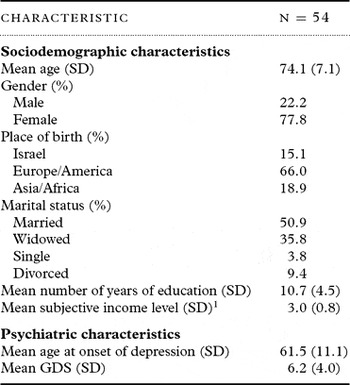
The characteristics of the 54 participants are presented in Table 1. As can be observed the majority were female, born in Europe/America and married. The mean age was 74 (range = 60–90) and they had an average of 11 years of education. Participants were, on average, 61 years old when diagnosed with depression.
Participants’ sociodemographic and health characteristics

11 = very bad, 5 = very good.
GDS = Geriatric Depression Scale.
Measures
Self-stigma, referring to the subjective stigma reported by the participants, was assessed using an adapted version of the Internalized Stigma of Mental Health (ISMI) scale (Ritsher et al., Reference Ritsher, Otilingam and Grajales2003). This scale contains 29 items rated on a four-point Likert-type scale, ranging from 1 = strongly disagree to 4 = strongly agree. The scale was translated back and forth to Hebrew by two independent translators, and the term mental illness in the original version was replaced by the term depression. This instrument was used in a previous study among older adults with schizophrenia and showed high internal consistency (Cronbach's α = 0.82) (Werner et al., Reference Werner, Aviv and Barak2008).
The ISMI contains five subscales: alienation, stereotype endorsement, discrimination experience, social withdrawal, and stigma resistance. The alienation subscale measures the subjective experience of being less than a full member of society. It contains six items, and its internal consistency in this study was good (Cronbach's α = 0.73). The stereotype endorsement subscale (Cronbach's α = 0.57) includes seven items and examines the extent to which the participant endorses stereotypes about persons with depression. The discrimination experience subscale includes five items and assesses participants’ experiences regarding how others treat them (Cronbach's α = 0.82). The social withdrawal subscale contains six items and describes the social feelings of the participants (Cronbach's α = 0.79). The stigma resistance subscale contains six items assessing the effects of the disease on participants’ lives, and its internal consistency in this sample was poor (Cronbach's α = 0.15). Consequently, its items were not included in the correlates analysis. The overall internal consistency for the ISMI scale without these items was high (Cronbach's α = 0.90).
Symptoms of depression were assessed using the short form of the Geriatric Depression Scale (GDS; Yesevage et al., Reference Yesevage1983). The scale consists of 15 items, rated as yes or no. Scores of 0–4 are considered normal, 5–8 indicate mild depression; 9–11 indicate moderate depression; and 12–15 indicate severe depression. The scale is a valid and reliable measure which has been used extensively also in Israel (Werner, Reference Werner and Levav2009).
Self-esteem was measured using Rosenberg's Self Esteem Scale (Rosenberg, Reference Rosenberg1979). This scale includes 10 items rated on a four-point Likert-type scale, ranging from strongly disagree to strongly agree, and is commonly used for measuring the self-esteem of patients with severe mental disorders (Kunikata et al., Reference Kunikata, Mino and Nakajima2005).
The Rosenberg Self Esteem scale was translated and validated in Hebrew (Schmitt and Allik, Reference Schmitt and Allik2005), and its internal consistency in the current study was excellent (Cronbach's α = 0.82).
Sociodemographic characteristics included gender, age, number of years of education, place of birth (Israel, Asia/Africa, or Europe/America), and family status (married, widowed, single, or divorced).
Psychiatric characteristics were age at onset of depression and mean number of years with the disease.
Ethical considerations
The study was conducted with the approval of the Helsinki Committee of the medical institutions from which the participants were recruited. After providing the participants with information about the aims of the study, they were asked to sign an informed consent form.
Procedure
Following informed written consent, phone interviews were conducted by trained interviewers who administered the ISMI, GDS and self-esteem scales. Psychiatric diagnoses and other clinical characteristics (such as age at onset) were obtained from the psychiatrist in charge of the participants’ treatment.
Statistical analysis
Descriptive analyses (percentages, means, standard deviations) were used to describe the sample and the main variables. χ2 analyses were used to assess differences in categorical variables and t-tests in interval variables.
Results
Self-stigma in depressed older people
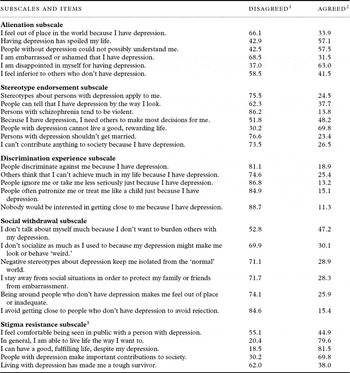
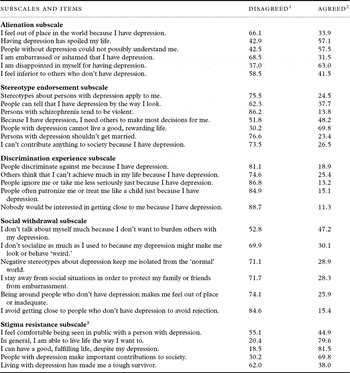
Table 2 presents the distribution of the items in the revised ISMI scale. What quickly becomes evident is the moderate extent of self-stigma reported by the participants. In only six out of the 29 items in the scale did more than 50% of the participants report stigmatizing perceptions. The items reflecting the highest stigmatic perceptions were “People with depression cannot live a good rewarding life” and “I'm disappointed in myself for having depression”. In four additional items, at least a third of the participants agreed with the statements reflecting self-stigma.
Distribution of self-stigma items
11+2 in Likert scale 23+4 in Likert scale 3 Reverse coded items.
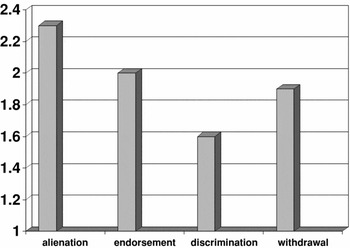
The relatively moderate levels of self-stigma in this sample are also reflected in the overall mean scores of the different subscales (see Figure 1). The mean score in all subscales was below the midpoint of the possible range (2.5 on a 1–4 scale). Two-fifths of the participants (40.7%) reported experiencing high levels of self-stigma (defined as having an average score above the midpoint of the possible range – i.e. 2.5 on a 1–4 scale) in the alienation subscale. Even lower percentages were found in the remaining subscales: 26.7%, 11.3% and 18.5% in the endorsement, discrimination and withdrawal subscales respectively. Statistically significant differences (at the p < 0.01 level) were found between all the subscales with the exception of the endorsement and withdrawal subscales.
Overall mean scores in the revised ISMI subscales.

Correlates of self-stigma in depressed older people
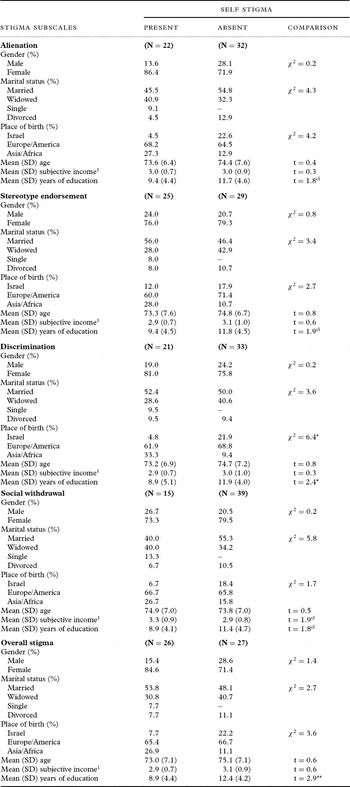
The demographic variables of the group that reported high levels of self-stigma (i.e. above the midpoint of the range) were compared with the group that reported the lowest levels of self-stigma (Table 3). The main socioeconomic variables (income and education) were consistently lower in patients reporting high levels of stigmatization, although statistical significance was reached only for the stereotype endorsement and discrimination subscales. In the stereotype endorsement subscale, we found a higher percentage of single participants (22%) among those reporting higher levels of self-stigma than in those reporting low self-stigma (0%) and a lower percentage of participants being born in Israel (0% and 18% respectively).
Comparison of the demographic variables of groups with and without reported stigmatization

1 1 = very bad, 5 = very good. cl p = 0.06.
*p < 0.05; **p < 0.01.
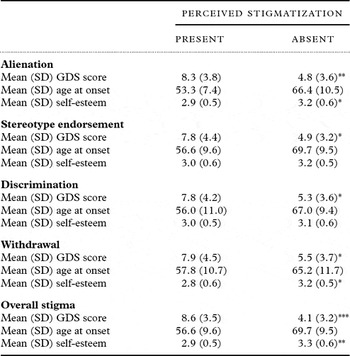
As shown in Table 4, GDS scores were consistently higher in participants reporting stigmatization compared to those with little self-stigma, although the comparison was not statistically significant for the stereotype endorsement subscale. Self-esteem scores were consistently lower in the group reporting stigmatization, although statistical significance was approached only for the withdrawal subscale. Finally, although no statistically significant differences were found between the groups in their age at onset of the disease, those reporting higher levels of self-stigma were consistently younger than those not reporting.
Comparison of the clinical and psychological characteristics of groups with and without reported stigmatization

*p < 0.05; ** p < 0.01.
Discussion
With the prospect of longer lifespans and larger proportions of older individuals worldwide (United Nations, 2007), the number of older adults with mental disorders in general and depression in particular is expected to increase sharply (de Mendoca Lima, Reference de Mendoca Lima2004). Therefore, the need to gain a better understanding of the consequences of depression in the older adult population is becoming more urgent. One of the main gaps of knowledge in this field relates to the perceptions of self-stigma in depressed older people.
The results of the present study showed that in a convenience sample of participants with major depression that presented relatively late in life and on average of a mild severity, self-stigma was moderate, with 10% to 20% of the participants reporting self-stigma. Studies examining self-stigma in younger depressed patients reported higher levels of self-stigmatization (Pyne et al., Reference Pyne, Kue, Schroeder, Fortney, Edlund and Sullivan2004; Yen et al., Reference Yen, Chen, Lee, Tang, Yen and Ko2005; Rusch et al., Reference Rusch, Kanter, Manos and Weeks2008; Kanter et al., Reference Kanter, Rusch and Brondino2008). This finding challenges the common belief that older people with mental disorders are subject to a “double stigma” (de Mendoca Lima et al., Reference de Mendoca Lima, Levav, Jacobsson and Rutz2003). Overall, however, the reality of increased self-stigma with age has been difficult to substantiate as there is a paucity of stigma-related research that includes older adults with mental disorders at all, let alone those with depression in particular. Indeed, the few studies including older adults found that older participants reported lower levels of self-stigma than younger participants (Sirey et al., Reference Sirey2001; Werner et al., Reference Werner, Aviv and Barak2008).
The highest level of self-stigma in the present study was found in the alienation subscale. This dimension of self-stigma reflects perceptions of being devalued as a member of society and was the highest dimension also in other studies of self-stigma in persons with schizophrenia (Lysaker et al., Reference Lysaker, Tsai, Yanos and Roe2008; Werner et al., Reference Werner, Aviv and Barak2008).
Regarding the relationship between perceptions of self-stigma and sociodemographic variables we found that participants who reported feeling stigmatized had a consistently lower level of income and/or education than those who did not. Several explanations can be provided for this association. First, persons with higher socioeconomic status might have better access to educational materials and therefore a better knowledge about the disease. Indeed, previous studies have reported that depression literacy was associated with lower levels of self-stigma (Griffiths et al., Reference Griffiths, Christensen and Jorm2008) although the notion that other variables are also involved is stressed. Indeed, because it has been shown that educational interventions alone do not reduce stigma (Pyne et al., Reference Pyne, Kue, Schroeder, Fortney, Edlund and Sullivan2004), it is suggested that the relationship between self-stigma and education might alternatively be related to the capacity of insight of patients with mental disorders. Studies in the area of schizophrenia have shown that low levels of insight about the disease are associated with lower levels of education (Cernovsky et al., Reference Cernovsky, Landmark, Merskey and Husni2004) and since a study examining correlates of insight about depression in outpatients with depressive disorders found higher levels of stigmatization in participants with diminished insight (Yen et al., Reference Yen, Chen, Lee, Tang, Yen and Ko2005), we can assume that the relationship between education and self-stigma might be attributed to the level of insight of the participants.
Participants who reported stigmatization scored consistently higher in the GDS and lower in the self-esteem scale than those without stigmatization. Although other studies have also reported similar findings regarding the symptoms of depression (Pyne et al., Reference Pyne, Kue, Schroeder, Fortney, Edlund and Sullivan2004; Yen et al., Reference Yen, Chen, Lee, Tang, Yen and Ko2005), the cross-sectional nature of these studies prevents us from concluding about the direction of the association.
Consistent with the increasing number of studies since the seminal study by Link et al. (Reference Link, Struening, Neese-Todd, Asmussen and Phelan2001) about the associations between self stigma and self-esteem in persons with mental disorders (Blankertz, Reference Blankertz2001; Berge and Ranney, Reference Berge and Ranney2005; Kahng and Mowbray, Reference Kahng and Mowbray2005; Werner et al., Reference Werner, Aviv and Barak2008), the findings of the present study showed a relatively strong association among elder persons with depression as well. This finding is especially important since it has been shown in the area of schizophrenia that low self-esteem is strongly associated with treatment non-adherence problems (Fung et al., Reference Fung, Tsang and Corrigan2008). Given the high rates of non-adherence reported for older depressed people (Bosworth et al., Reference Bosworth, Voils, Potter and Steffens2008), future studies should try to expand our knowledge about the relationships between self-stigmatization, self-esteem and adherence problems in depressed elderly people.
It should be noted that the present study has several limitations. First, the sample is of a modest size and was recruited from one facility. Second, the participants’ cognitive status was not assessed. Since cognitive symptoms are prevalent in depression in old age (Lyketsos et al., Reference Lyketsos, Steinberg and Tschanz2000), future studies should include this as one of the variables to be assessed. Third, the group of patients who refused to answer the questions might represent a group at major risk of self-stigma. Future studies should attempt to examine in depth those who avoid talking about their disease. Fourth, several considerations about the instrument used to assess self-stigma (the ISMI) should be noted. The ISMI was not specifically designed to assess older patients. The instrument assesses patients’ perceptions not only about self-stigma but also about perceived stigma. Furthermore, although the adapted version of the ISMI showed good validity in four of its five factors, the internal reliability of the stigma resistance subscale was poor. Since similar findings were found in the study developing and validating the original scale (Ritsher et al., Reference Ritsher, Otilingam and Grajales2003), future studies should examine the theoretical relevance of this factor for self-stigma in persons with mental illnesses. Moreover, the fact that the items in this factor were removed from the overall score used in the multivariate analyses in the present study compromises the ability to compare our findings with those of other studies. Finally, the correlational nature of this study precludes the drawing of any causal connections.
Despite these limitations this study represents a novel effort to examine the correlates of self-stigma in depressed older people. Future studies should extend this line of research in order to decrease the suffering of many older adults affected by this severe disease, and in order to elaborate knowledge regarding persons who are at major risk of self-stigma. Extended knowledge about the factors associated with increased stigmatization in older adults might help clinicians to develop stigma reduction intervention programs that are specifically tailored to the needs and characteristics of the elderly population. These programs might, in time, help to overcome the serious problems relating to non-adherence to treatment programs.
Conflict of interest
None.
Description of authors' roles
Perla Werner designed the study, supervised data collection, analyzed the data and wrote the paper. Ifat Stein-Shvachman contributed to the preparation of the manuscript. Jeremia Heinik contributed to the collection of the data. All three authors evaluated the paper, revised it critically and approved the final version.