Major depression is highly prevalent in Western countries, showing a lifetime prevalence rate of 17% in the United States (Kessler et al., Reference Kessler, McGonagle, Zhao, Nelson, Hughes and Eshleman1994, Reference Kessler, Berglund, Demler, Jin, Merikangas and Walters2005). Although our knowledge of this disorder has grown dramatically, it has become evident that further advances will require more complex models that integrate multiple levels of human functioning (Clark & Beck, Reference Clark and Beck2010). Decades of research has established that depressed persons tend to have a history of adversity that has given rise to a pessimistic cognitive bias that colors the way they process and orient to everyday events (Beck, Reference Beck2008; Gonzalol, Kleim, Donaldson, Moorey, & Ehlers, Reference Gonzalo, Kleim, Donaldson, Moorey and Ehlers2012; Liu & Bates, Reference Liu and Bates2014; Romens, Abramson, & Alloy, Reference Romens, Abramson and Alloy2009). A profusion of studies has also shown that psychotherapeutic interventions that target these negative cognitions are an effective treatment for depression (Bulter, Chapman, Forman, & Beck, Reference Butler, Chapman, Forman and Beck2006; Hollon, Steward, & Strunk, Reference Hollon, Stewart and Strunk2006).
Researchers have documented the neurobiological concomitants of these pessimistic schemas more recently. These studies show that pessimistic cognitive styles tend to be associated with rather distinct neurological patterns (Clark & Beck, 2010; Disner, Beevers, Haigh, & Beck, Reference Disner, Beevers, Haigh and Beck2011; Herwig et al., Reference Herwig, Bruhl, Kaffenberger, Baumgartner, Boeker and Jancke2010) and that these patterns become more similar to those manifested by nondepressed individuals following psychotherapeutic treatment of these cognitive biases (Beauregard, Reference Beauregard2014; Thomaes et al., Reference Thomaes, Dorrepaal, Draijer, Jansma, Veltman and van Balkom2014). Biologically, changes in neurological patterns may be influenced by shifts in epigenetic regulation (Kandel, Reference Kandel2006; Molfese, Reference Molfese2011).
Epigenetic regulation entails biochemical mechanisms that influence the genome to express (upregulate or downregulate) particular genes (Carey, Reference Carey2012; Haig, Reference Haig2012). Epigenetic factors appear to be an important mechanism whereby life experiences become biologically embedded and provide the physiological underpinnings for cognitive, emotional, and behavioral traits tailored for adaptation to environmental demands circumstances (Landecker & Panofsky, Reference Landecker and Panofsky2013; Meaney & Szyf, Reference Meaney and Szyf2005; Meloni, Reference Meloni2014). Building on this idea, the current study investigates the extent to which the impact of environmental adversity on the development of a pessimistic cognitive style is mediated by epigenetic regulation of the oxytocin system. This idea is developed in the sections to follow. We then test our hypotheses using structural equation modeling and longitudinal data from a sample of middle-aged African American women.
Cognitive Schemas and Depression
The most empirically supported theories of depression emphasize the role of pessimistic cognitive schemas. Aaron Beck (Reference Beck1967, Reference Beck2008) popularized this perspective in the late 1960s with his contention that depressed persons suffer from a negative cognitive triad consisting of a pessimistic view of themselves, their environment, and the future. Later, Abramson, Seligman, and Teasdale (Reference Abramson, Seligman and Teasdale1978) and Abramson, Metalsky, and Alloy (Reference Abramson, Metalsky and Alloy1989) gave impetus to this approach by recasting it using attribution theory. Although these two traditions differ in some respects, they agree that a negative cognitive bias leads individuals to process the vicissitudes of everyday life in a manner that leads to depression. Both camps also agree that these pessimistic schemas usually develop in response to chronic exposure to adverse circumstances, especially those occurring during childhood. Consistent with this general paradigm, a number of studies have confirmed associations between adversity, pessimistic cognitions, and depression (Alloy et al., Reference Alloy, Abramson, Whitehouse, Hogan, Panzaerella and Rose2006; Clark & Beck, 2010; Gibb et al., Reference Gibb, Alloy, Abramson, Rose, Whitehouse and Donovan2001). There is also strong evidence that these cognitive biases can be changed. Hundreds of studies have shown that psychotherapeutic interventions can modify these cognitive styles with the result being a lifting of depression (Butler et al., Reference Butler, Chapman, Forman and Beck2006; Hollon et al., Reference Hollon, Stewart and Strunk2006).
Several studies have recently investigated the neurological patterns associated with depression. Consistent with the idea that depression is rooted in a pessimistic orientation, Herwig et al. (2010) found that depressed persons show a neurological response to neutral stimuli that resembles the neurological pattern that both they and nondepressed individuals demonstrate in response to stimuli with a negative valence. In general, neurological studies have found that depressed individuals manifest neurological patterns (especially in limbic and prefrontal cortex structures) that are consistent with a pessimistic bias (Disner et al., Reference Disner, Beevers, Haigh and Beck2011). Further, a variety of investigations have reported that psychotherapeutic interventions that target patients’ negative cognitions tend to result in both a lifting of depression and a normalization of neurological patterns (Beauregard, Reference Beauregard2014; DeRubeis, Webb, Tang, & Beck, Reference DeRubeis, Webb, Tang, Beck and Dobson2010).
Overall, this set of findings is consistent with a model of depression where adversity fosters a pessimistic orientation that is sustained by particular underlying neurological mechanisms. This change in biological and cognitive structure, in turn, increases the chances of depression. However, new experiences (including psychotherapy) can change this negative cognitive schema and its supporting neurological pattern, with the result being a reduced risk for depression.
The present paper elaborates on this general model by adding epigenetics. Although most gene regulation is a response to the immediate demands of the environment, epigenetics focuses on changes in gene expression that last for months, years, or even a lifetime (Carey, Reference Carey2012; Francis, Reference Frances2011). Epigenetic regulation entails biochemical mechanisms that influence the genome to express (upregulate or downregulate) particular genes. This occurs when a methyl group attaches to a CpG segment of DNA (Carey, Reference Carey2012; Francis, Reference Frances2011). The effect of methylation, especially when it occurs in the promoter region of a gene, is to inhibit gene expression. For our purposes, there is rapidly accumulating evidence regarding the role of epigenetic factors in neural development. Studies have shown, for example, that epigenetic modification (e.g., methylation) of particular genes influences perception, emotion, memory, cognition, learning, and neural plasticity (Kandel, Reference Kandel2006; Molfese, Reference Molfese2011). In other words, there is reason to believe that epigenetic changes are part of the process whereby adverse experiences and a pessimistic cognitive structure become biologically embedded. In the following section, we argue that these epigenetic changes likely include DNA methylation of the oxytocin receptor gene (OXTR).
The OXTR Gene
The neuropeptide oxytocin is a peripheral hormone and central neuromodulator that has been shown to influence a number of social and affective responses. For our purposes, studies indicate that intranasally administered oxytocin tends to increase optimism, trust, generosity, and empathy (Baumgartner, Heinrichs, Vonlanthen, Fishbacker, & Fehr, Reference Baumgartner, Heinrichs, Vonlanthen, Fischbacker and Fehr2008; Kosfeld, Heinrichs, Zak, Fischbacker, & Fehr, Reference Kosfeld, Heinrichs, Zak, Fischbacker and Fehr2005; MacDonald & MacDonald, Reference MacDonald and MacDonald2010; Zak, Reference Zak2012). Further, it reduces anxiety while enhancing emotional control and the probability that threatening situations will be perceived as challenges rather than as stressors (Kubzansky, Mendes, Appleton, Block, & Adler, Reference Kubzansky, Mendes, Appleton, Block and Adler2012). Research suggests that these cognitive and emotional responses are supported biologically by reducing cortisol, decreasing activation of the amygdala, and augmenting connectivity between the amygdala and brain structures supporting affective control (Cardoso, Ellenbogen, Orlando, Bacon, & Joober, Reference Cardoso, Ellenbogen, Orlando, Bacon and Joober2012; Gamer, Zurowski, & Buchel, Reference Gamer, Zurowski and Burchel2010, Kirsch et al., Reference Kirsch, Esslinger, Qiang, Mier, Lis and Siddhanti2005; Puglia, Lillard, Morris, & Connelly, Reference Puglia, Lillard, Morris and Connelly2015).
These findings suggest that oxytocin fosters a cognitive and emotional orientation that is the obverse of the pessimistic, distrusting cognitive schemas displayed by depressed individuals. In addition, the biological consequences of administering oxytocin largely appear to be counter to the biological concomitants of depression. These observations support the hypothesis that depressed persons suffer from low levels of oxytocin and that oxytocin might be administered to treat their disorder. Contrary to this idea, however, research investigating the link between plasma oxytocin levels and various social and emotional responses has produced mixed results (McCullough, Churchland, & Mendez, Reference McCullough, Churchland and Mendez2013). Further, when oxytocin is administered to individuals who experienced love withdrawal or rejection as children, they do not demonstrate the prosocial changes (e.g., trust, empathy, and generosity) described above (Huffmeijer et al., Reference Huffmeijer, Alink, Tops, Grewen, Light and Bakermans-Kranenburg2013; Olff et al., Reference Olff, Frijing, Kubzansky, Bradley, Ellenbogen and Cardoso2013). Similarly, intranasal administration of oxytocin often produces little effect when given to psychiatric patients (Bertsch, Schmidinger, Neumann, & Herpertz, Reference Bertsch, Schmidinger, Neumann and Herpertz2012; Olff et al., Reference Olff, Frijing, Kubzansky, Bradley, Ellenbogen and Cardoso2013).
However, it is quite possible that these puzzling findings are explained by epigenetic markers within the oxytocin system that regulate the impact of exogenously administered oxytocin (Kumsta, Hummel, Chen, & Heinrichs, Reference Kumsta, Hummel, Chen and Heinrichs2013; Puglia et al., Reference Puglia, Lillard, Morris and Connelly2015). To achieve its effect, the oxytocin molecule must be able to bind to the OXTR gene. To the extent that this gene is highly methylated (turned off), it becomes increasingly difficult for circulating oxytocin to bind, with the result that increased levels of oxytocin will have little downstream effect. Building upon research showing that environmental context can influence epigenetic effects (Beach, Lei, Brody, Dogan, & Philibert, Reference Beach, Lei, Brody, Dogan and Philibert2016, Reference Beach, Lei, Brody, Dogan and Philibertin press; Simons et al., Reference Simons, Lei, Beach, Philibert, Cutrona and Gibbons2016), we expect that chronic exposure to adversity fosters methylation of OXTR. This would reduce responsiveness to oxytocin, thereby fostering a cold, guarded orientation when interacting with others (supported biologically by increased cortisol production, greater activation of the amygdala, etc.). Such calibration of OXTR would be functional from an evolutionary perspective because it prepares the individual for a hostile, unpredictable environment where others are not trustworthy (Simons & Klopack, Reference Simons and Klopack2015). Cognitively, this orientation would be similar to the negative cognitive schemas that place a person at risk for depression.
Methylation of OXTR
The extent to which a gene is expressed is controlled in large measure by its promoter region. The promoter region is usually located on the gene's first exon and is a segment of DNA that initiates transcription of the gene. DNA methylation of the promoter region of OXTR varies within the population (Jack, Connelly, & Morris, Reference Jack, Connelly and Morris2012), and this variation has been linked to reduced transcription of the gene (Gregory et al., Reference Gregory, Connelly, Towers, Johnson, Biscocho and Markunas2009; Kusui et al., Reference Kusui, Kimura, Ogita, Nakamura, Matsumura and Koyama2001). High methylation of the OXTR promoter has been linked to particular neurological patterns (Jack et al., Reference Jack, Connelly and Morris2012). A functional magnetic resonance imaging study by Puglia, Lillard, Morris, and Connelly, (Reference Puglia, Lillard, Morris and Connelly2015), for example, found that methylation in the promoter region of OXTR is associated with greater responsiveness to negative stimuli in several brain regions crucial for social and emotional processing (e.g., amygdala, fusiform, lateral occipital cortex, and insular cortex). These individuals also showed less amygdala coupling, a pattern associated with reduced habituation and emotion regulation.
Further, methylation of various sites in the OXTR promoter have been associated with behavioral phenotypes such as callous–unemotional traits (Cecil et al., Reference Cecil, Lysenko, Jaffee, Pingault, Smith and Relton2014; Dadds et al., Reference Dadds, Moul, Cauchi, Dobbson-Stone, Hawes and Brennan2014), autism (Gregory et al., Reference Gregory, Connelly, Towers, Johnson, Biscocho and Markunas2009), and anorexia nervosa (Kim, Kim, Kim, & Treasure, Reference Kim, Kim, Kim and Treasure2014). Although these phenotypes have in common characteristics suggestive of a compromised oxytocin system (e.g., low empathy, distrust, and estrangement from others), they also entail quite different forms of psychopathology and problem behavior. However, while most of these studies have focused on methylation within the OXTR promoter, the specific sites found to be significant vary across phenotypes. The sites found to be significant for callous–unemotional traits (Cecil et al., Reference Cecil, Lysenko, Jaffee, Pingault, Smith and Relton2014), for example, differ from those that have been linked to autism (Gregory et al., Reference Gregory, Connelly, Towers, Johnson, Biscocho and Markunas2009). It is possible that these sites of OXTR that vary independently perform somewhat different functions and so may be implicated in different disorders. At a minimum, it appears that methylation patterns in this region reflect several different orthogonal processes. In the present study, we investigate the extent to which there are methylated sites within the OXTR promoter that are related to the pessimistic and distrustful schemas that place a person at risk for depression. We expect that these methylated sites likely differ somewhat from those that prior research has linked to phenotypes such as autism or calloused–unemotional traits.
The Model to Be Tested
Based on the arguments presented in the previous sections, we test the general model shown in Figure 1. Our measure of adult adversity is a composite that focuses on two chronically stressful conditions (financial pressure and living in a high-crime area) assessed over a 4-year period. Past research (see Thoits, Reference Thoits2010) has provided strong evidence that such conditions predict depression. Further, given the profusion of studies linking negative cognitions to depression (Alloy et al., Reference Alloy, Abramson, Whitehouse, Hogan, Panzaerella and Rose2006; Beck, Reference Beck2008; Clark & Beck, 2010; Gibb et al., Reference Gibb, Alloy, Abramson, Rose, Whitehouse and Donovan2001), we expect that much of the effect of adult adversity on depression is explained by development of a more negative cognitive style. Given the hundreds of studies reporting that relatively brief psychotherapeutic interventions can temper a negative cognitive bias, we expect that persistent exposure to adversity likely augments commitment to such an orientation. We include two types of negative cognitions: pessimism (a negative schema regarding the future) and distrust (a negative schema regarding others). We expect that the each of these schemas will mediate a portion of the effect of adversity on depression. Because of its strong overlap with depression, and its more tenuous connection with oxytocin, we did not include a negative view of self among the hypothesized mediators. However, the really unique aspect of our model is the prediction that much of the effect of adversity on cognitive change is indirect and can be explained by methylation of OXTR. Note that we do not expect OXTR to directly impact depression. Rather, in our view, methylation of the oxytocin promoter provides biological support for distrusting and pessimistic schemas. It is these schemas that in turn elevate the probability of negative mood and depression.
The general model.

Overall, our model indicates several mediating effects. Specifically, it predicts (a) a significant indirect effect of adversity on pessimism and distrust through methylation of OXTR; (b) a significant indirect effect of OXTR on depression through pessimism and distrust; and (c) a significant indirect effect of adversity on depression through methylation of OXTR and the two negative schemas: pessimism and distrust. To strengthen the test of the causal arguments assumed by our general model, we use longitudinal data that allows us to assess change in our two hypothesized cognitive mediators as well as change in depression. Unfortunately, OXTR methylation was assessed at only one time point.
Method
Participants
We tested our hypotheses using data from Waves 2, 3, 4, and 5 for 100 of the primary caregivers in the Family and Community Health Study (FACHS). FACHS is a longitudinal study of several hundred African American families that was initiated in 1997. Using a stratified random sampling procedure, the sampling strategy was intentionally designed to generate families representing a range of socioeconomic statuses and neighborhood settings. The details regarding recruitment are described by Gibbons, Gerrard, Cleveland, Wills, and Brody (Reference Gibbons, Gerrard, Cleveland, Wills and Brody2004) and Simons and colleagues (Reference Simons, Lei, Beach, Brody, Philibert and Gibbons2011). The first wave of FACHS data was collected in 1997–1998 from 889 African American children and their primary caregivers (PCs; 829 women, 60 men). At study inception, about half of the sample resided in Georgia (n = 467) and the other half in Iowa (n = 422). All of the children were in the fifth grade at the beginning of the study. At Wave 1, 36% of the families were below the poverty line, and 51% of the PCs identified as single parents. The third, fourth, and fifth waves of data were collected from 2001 to 2002, 2004 to 2005, and 2007 to 2008, respectively. Of the 889 PCs interviewed at Wave 1, 693 were interviewed again at Wave 5 (77.26% of the original sample).
At Wave 5, 100 African American women were randomly selected from the roster of PCs to participate in an epigenetic assessment. Costs associated with the blood draws and epigenetic assays necessitated the drawing of a subsample. Mean chronological age for the group was 48.52 years (SD = 9.30), 18% had less than a 12th-grade education, and 25% were married. The majority (68.5%) lived in the inner city, 12.2% lived in the suburbs, and 19.3 lived in rural areas. All 100 respondents are of African ancestry. Comparisons with participants who did not provide methylation status or complete all study measures did not reveal any significant differences on demographic variables and outcome.
Procedures
At each wave, computer-assisted interviews were administered in the respondent's home and took on average about 2 hr to complete. The instruments were presented on laptop computers. Questions appeared in sequence on the screen, which both the researcher and the participant could see. The researcher read each question aloud, and the participant entered an anonymous response using a separate keypad. In addition, participants were also asked to provide a blood sample at Wave 5. A certified phlebotomist drew four tubes of blood (30 ml) from each participant and shipped the sample the same day to a laboratory at the University of Iowa for preparation. Typical DNA yield for each pellet was between 10 and 15 mg of DNA.
Measures
Distrust
We assessed distrust at Waves 4 and 5 using seven items adapted from the scale Experiences in Close Relationships—Revised (Fraley, Waller, & Brennan, Reference Fraley, Waller and Brennan2000). The instrument asks respondents to report the extent to which they agree (1 = strongly disagree, 7 = strongly agree) with items such as “I do not like people getting too close to me” and “I find it difficult to trust others.” Scores were summed across items to form a composite measure of distrust. The coefficient α was 0.70 at both waves. The correlation between waves was .41.
Pessimism
Pessimism was assessed with the five-item short form of the Life Orientation Test (Scheier & Carver, Reference Scheier and Carver1985). The instrument consists of items such as “If something can go wrong for me, it will,” “I am always pessimistic about the future,” and “I rarely count on good things happening to me.” Respondents indicated their degree of agreement using a 4-point scale (1 = strongly disagree; 4 = strongly agree). The coefficient α was about 0.65 at both waves. The correlation between waves was .34.
Depression
At Waves 4 and 5, respondents completed five items from the Mini-Mood and Anxiety Symptom Questionnaire (Clark & Watson, Reference Clark and Watson1997). This scale asks respondents to indicate how much of the time during the past week they had felt depressed, discouraged, hopeless, like a failure, and worthless. Potential responses range from 1 (not at all) to 3 (extremely). The cronbach α was 0.82 at both waves. The correlation between waves was .50.
Adult adversity
This construct was assessed at Waves 2, 3, and 4 using a composite measure consisting of two components: unmet material needs and neighborhood disorder. The four-item Unmet Material Needs Scale was developed by Conger and Elder (Reference Conger and Elder1994) and focuses on the extent to which respondents were unable during the preceding year to afford the basic necessities of life such as food, clothing, housing, and medical care. Response format for these items ranged from 1 (strongly disagree) to 5 (strongly agree). The coefficient α for this instrument was roughly 0.86 at each wave. Neighborhood crime was assessed with a revised version of the community deviance scale developed for the Project on Human Development in Chicago Neighborhoods (Sampson, Raudenbush, & Earls, Reference Sampson, Raudenbush and Earls1997). The four-item measure is concerned with how often various criminal acts occur within the respondent's community. It includes behaviors such as drinking in public, selling or using drugs, groups of teenagers hanging out on the street, and gang violence. The coefficient α ranged from 0.86 to 0.88. Scores were standardized and then summed across the two subscales to form a composite measure of adult adversity for each wave. We averaged the scores across waves.
OXTR methylation
A certified phlebotomist drew four tubes of blood (30 ml) from each participant and shipped it the same day to a laboratory at the University of Iowa for preparation. Typical DNA yield for each pellet was between 10 and 15 mg of DNA. The Illumina (San Diego, CA) 450K Human Methylation Beadchip was used to assess genome-wide DNA methylation. Samples were randomly assigned to 12 slides with groups of 8 slides being bisulfite converted in a single batch. There was no technical variability (chip/batch effects) in the current study. Four replicates of the same DNA sample were also included to monitor for slide to slide and batch bisulfite conversion variability with the average correlation coefficient between the replicate samples being .99. The resulting data were inspected for complete bisulfite conversion and average beta values for each targeted CpG residue determined using the Illumina Genome Studio Methylation Module, Version 3.2. The manufacturer recommended approach for determination of betas at each CpG site is beta value = M/(M + U + 100), where M and U are raw methylated and unmethylated signal intensities, respectively. Details regarding processing and preparation of the methylation data are described by Dogan and colleagues (Reference Dogan, Shields, Cutrona, Gao, Gibbons and Simons2014). Most research on methylation of OXTR has focused on a CpG island on chromosome 3 located between 8808961 and 8811280. The Illumina 450K Human Methylation Beadchip includes 12 sites from this area. The means and ranges obtained for these 12 probes are presented as online-only Supplementary materials (Table S.1).
Control variables
To avoid overestimated results, we controlled for age (mean age = 44 years), relationship status (single = 1, married or cohabitating = 0), and childhood trauma. The latter variable was assessed at Wave 1 using five retrospective items from Kessler, Davis, and Kendler (Reference Kessler, Davis and Kendler1997). Respondents reported whether they had experienced various stressful events (e.g., parental divorce or family violence) when they were growing up. Sixty-nine percent of respondents reported they had experienced at least one of these stressful events when they were growing up. The Spearman–Brown coefficient for this scale was 0.70.
Further, in addition to childhood adversity, age, and relationship status, our models controlled for average level of methylation. Adversity has been shown to increase the methylation of various genes (Beach et al., Reference Beach, Lei, Brody, Dogan and Philibert2016, Reference Beach, Lei, Brody, Dogan and Philibertin press). By controlling for average level of methylation, we addressed the possibility that adversity had fostered a general increase in methylation among our respondents and that any association between adversity and methylation of OXTR in our data was merely a reflection of this general increase.
Finally, our models controlled for individual differences in cell type. Ficoll purified peripheral mononuclear cell DNA pellets of the sort used in the current investigation comprised several different cell types (CD4, CD8, CD14, CD19, and CD56; Reinius et al., Reference Reinius, Acevedo, Joerink, Pershagen, Dahlén and Greco2012), leading to potentially misleading observations if individual differences in predictors are also associated with individual differences in mixture of cell types. Therefore, to account for individual differences in cell types, we utilized the regression calibration approach developed by Houseman et al. (Reference Houseman, Accomando, Koestler, Christensen, Marsit and Nelson2012). This involved identifying highly informative CpG sites by contrasting the methylation profiles associated with our five purified cell types (CD4+ T cells, CD8+ T cells, CD14+ monocytes, CD19+ B cells, and CD56+ natural killer cells). Data characterizing the full 450K methylation profile for each of the purified cell types was contributed by Reinius et al. (2012; GEO database under accession number GSE35069), and loci differentiating cell types were identified using regression in MethLAB, Version 1.5 (Kilaru, Barfild, Schroeder, Smith, & Conneely, Reference Kilaru, Barfield, Schroeder, Smith and Conneely2012). The top 100 sites identified in this manner were selected for further analysis. These sites were the ones that were most highly differentially methylated with respect to cell type, and observations for these 100 loci from our current data set of African American women were imported into SPSS version 22 (IBM, 2012) for factor analysis. Because one of the loci was on the x chromosome, it was dropped from further consideration, and we performed a principal components analysis on the remaining 99 loci to identify factors that would characterize individual differences in cell type in the most parsimonious manner. Based on the Scree plot of this principal components analysis, the first four factors were retained and included as controls in our structural equation modeling (SEM) analyses.
Analytic strategy
SEM using Mplus 7.11 (Muthén and Muthén, Reference Muthén and Muthén1998–2012) was employed to test our mediation hypotheses. In order to provide a stronger test of causal priorities, our SEM models include controls for earlier assessments of distrust, pessimism, and depression. This allows us to examine the impact of adversity and OXTR methylation on change in these variables. To assess the goodness of fit of our models, we used the chi-square test, the comparative fit index, and the Steiger root mean square error of approximation (RMSEA; Browne & Cudeck, Reference Browne and Cudeck1992). The comparative fit index was truncated to the range of 0 to 1, and values close to 1 indicate a very good fit (Bentler, Reference Bentler1990). An RMSEA smaller than 0.05 indicates a close fit, whereas RMSEAs between 0.05 and 0.08 suggest a reasonable fit (Browne & Cudeck, Reference Browne and Cudeck1992). The significance of mediation or indirect effects was tested using the bootstrapping option in Mplus. This approach uses 1,000 resamples of the data with bias corrected 95% confidence intervals (see Mallinckrodt, Abraham, Wei, & Russell, Reference Mallinckrodt, Abraham, Wei and Russell2006).
Results
Preliminary analysis
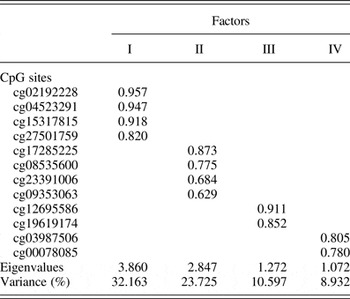
Following the example of others (Cecil et al., Reference Cecil, Lysenko, Jaffee, Pingault, Smith and Relton2014; Dadds et al., Reference Dadds, Moul, Cauchi, Dobbson-Stone, Hawes and Brennan2014), factor analysis was used to reduce the 12 probes (available in the Illumina 450K Human Methylation Beadchip) in our region of interest into a smaller set of factors. As shown in Table 1, this analysis identified four factors. Follow-up analysis (see online-only supplementary Table S.2) showed that Factor 2 was significantly related to adult adversity (0.262, p > .01), distrust (0.213, p > .05), and pessimism (0.225, p > .05), a pattern consonant with our study hypothesis, whereas Factors 1 and 3 were not related to any of the study variables and Factor 4 was only associated with distrust. Thus, our analysis proceeded using Factor 2 as our measure of OXTR methylation. This factor contained four CpG sites (cg08535600, cg09353063, cg17285225, and cg23391006).
Summary of exploratory factor analysis results for the OXTR CpG sites (N = 100)

Note: Principal component analysis with varimax rotation was used. Kaiser–Meyer–Olkin (KMO) = 0.742; Bartlett's test of sphericity: χ2 = 705.743, df = 66, p < .0001.
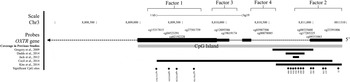
Figure 2 shows the location on OXTR of this factor, as well as the other three factors identified in our analysis. The figure also depicts the areas investigated in various prior studies of OXTR methylation. Using the approach of Cecil et al. (Reference Cecil, Lysenko, Jaffee, Pingault, Smith and Relton2014), black rectangles indicate the area of the CpG island investigated by each study, and significant CpG sites identified by these studies are shown as black circles. Studies focusing on callous–unemotional traits have found effects for sites located in our Factor 4 (Cecil et al., Reference Cecil, Lysenko, Jaffee, Pingault, Smith and Relton2014) and in locations between our Factor 4 and our Factor 2 (Dadds et al., Reference Dadds, Moul, Cauchi, Dobbson-Stone, Hawes and Brennan2014); sites associated with autism have been located still further upstream from those included in our Factor 2 (Gregory et al., Reference Gregory, Connelly, Towers, Johnson, Biscocho and Markunas2009); and sites correlated with anorexia nervosa (Kim et al., Reference Kim, Kim, Kim and Treasure2014) have been identified in the same general location as the four sites in our Factor 2.
Location of oxytocin receptor gene (OXTR) methylation probes within the CpG island (hg19; chr3:8808962–8811280) included in the study, and the grouping of these CpGs into factors shown in the top of the figure. Black rectangles indicate the area of the OXTR CpG island investigated by previous research on DNA methylation. Significant CpG sites identified in those studies are shown as black circles.

Model testing
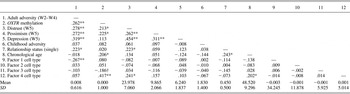
The correlation matrix for the study variables is presented in Table 2. The pattern of associations is in keeping with the mediation model to be tested. Adult adversity is significantly correlated with depression (.319) and both distrust (.278) and pessimism (.272). Distrust and pessimism in turn show significant associations with depression (0.454 and 0.311, respectively). Further, adult adversity is correlated .262 with OXTR methylation, and OXTR methylation is associated 0.213 and 0.225 with distrust and pessimism, respectively. With the exception of childhood adversity, all of the control variables show significant associations with at least some of the study variables, underscoring the importance of including them in our SEM.
Correlations, means, and standard deviations among study variables (N = 100)

Note: Factors 1 to 4 are the four principle components reflecting cell-type variation in the current data. W2–5, Waves 2–5.
Before testing our full SEM model including OXTR methylation, we tested a baseline model that assessed the indirect effects of adult adversity on change in depression as mediated through changes in distrust and pessimism. Controlling for childhood trauma, age, and relationship status, adult adversity predicted both increased distrust (β = 0.277, p = .001) and increased pessimism (β = 0.272, p = .003) that in turn predicted increased depression (distrust → depression: β = 0.365, p < .001; pessimism → depression: β = 0.178, p = .026). These indirect effects were significant, supporting the hypothesis that the adverse circumstances disproportionally suffered by African Americans promote cognitive schemas that increase the probability of depression.
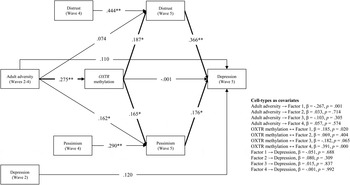
Figure 3 shows the results of our full SEM including oxytocin Factor 2. Note that the model includes prior assessments of distrust, pessimism, and depression. Thus, the model focuses upon the extent to which adult adversity and methylation of OXTR predict changes in the cognitive schemas and depression, thereby providing a more stringent test of the assumed causal priorities. The model controls for childhood trauma, age, and relationship status. The four cell-type factors are included as covariates. The model fit indices indicate that the model provides a good fit to the data. Further, these findings remain unchanged when the average genome-wide methylation score for each respondent is included as a covariate (see online-only supplementary Figure S.2).
Oxytocin receptor gene (OXTR) methylation as a mediator of the effect of stressful environment on depression. N = 100. χ2 = 64.500, df = 54, p = .103. Values presented are standardized parameter estimates. Childhood trauma, chronological age, and relationship status are controlled. The bold words indicate that the test of indirect effect is significant. †p < .10, *p ≤ .05, **p ≤ .01 (two-tailed tests).

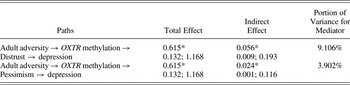
Consistent with the study hypotheses, the effect of adult adversity on distrust and pessimism is largely mediated by methylation of OXTR. In addition, the effect of OXTR methylation on depression is fully mediated by its association with distrust and pessimism. Table 3 summarizes the results using the bootstrapping method in MPlus with 1,000 replications to test the significance of these various indirect effects. The table shows that all of these indirect pathways are significant. This includes the path adult adversity → mOXTR → distrust → depression, as well as the path adult adversity → mOXTR2 → pessimism → depression. Overall, the results provide support for the hypothesized model.
Summary of indirect effects

Note: The values presented are unstandardized parameters. Bootstrapping with 1,000 replications.
*p ≤ .05 (two-tailed test).
Discussion
Epigenetic factors such as methylation appear to be one important mechanism whereby life experiences become biologically embedded and can serve as the physiological underpinnings for cognitive, emotional, and behavioral traits tailored for adaptation to environmental demands (Landecker & Panofsky, Reference Landecker and Panofsky2013; Meloni, Reference Meloni2014; Simons & Klopack, Reference Simons and Klopack2015). Building on this idea, the current study investigated the extent to which individuals might adapt to environmental adversity by downregulating the OXTR gene. Several studies have shown that oxytocin is involved in social skills and cognition relating to empathy, trust, and optimism (Baumgartner et al., Reference Baumgartner, Heinrichs, Vonlanthen, Fischbacker and Fehr2008; Kosfeld et al., Reference Kosfeld, Heinrichs, Zak, Fischbacker and Fehr2005; MacDonald & MacDonald, Reference MacDonald and MacDonald2010; Zak, Reference Zak2012). Hence increased methylation (i.e., downregulation) of the promoter region of the receptor gene might be seen as providing the biological underpinnings for a vigilant, distrusting orientation. This negative cognitive set might be viewed as a functional adaptation given the person's past experience. However, it would also place the individual at risk for depression. A profusion of studies have linked a negative cognitive style to development of depressive disorder (Alloy et al., Reference Alloy, Abramson, Whitehouse, Hogan, Panzaerella and Rose2006; Beck, Reference Beck2008; Clark & Beck, 2010; Gibb et al., Reference Gibb, Alloy, Abramson, Rose, Whitehouse and Donovan2001). Based upon this idea, we posited that methylation of the OXTR gene would mediate the effect of adult adversity (financial pressure or high-crime neighborhood) on increased commitment to negative schemas (pessimism and distrust) and, in turn, the development of depression. Our results provided support for this model.
The Illumina 450K Human Methylation Beadchip provides probes for 12 sites located within or near the promoter region of OXTR. Factor analysis condensed these 12 sites into four factors. One of these factors (which consists of four sites) showed significant correlations with all of our study variables, whereas the other three factors were unrelated to the study variables. Using this factor as an indicator of OXTR methylation, our SEM analyses corroborated the hypothesized model: OXTR methylation mediated the effect of adult adversity on increases in pessimism and distrust, and the effect of OXTR methylation on increased depression was mediated by the effects of pessimism and distrust. These findings have several implications.
First, our findings suggest a link between adult adversity and methylation patterns. Past research has emphasized the way that childhood environments may calibrate various biological systems (Miller, Chen, & Parker, Reference Miller, Chen and Parker2011). The present study shows that adult stress has an association with methylation of the oxytocin receptor that is independent of childhood effects. These results suggest that calibration of various biological systems may continue throughout the life course. Future research needs to go beyond examination of childhood effects to investigate the extent to which biological systems remain plastic during the adult years. Establishing that this is the case would have important public health consequences.
Second, past research has focused on epigenetic changes related to biological processes such as inflammation and the immune system (e.g., Beach et al., Reference Beach, Lei, Brody, Dogan and Philibert2016, Reference Beach, Lei, Brody, Dogan and Philibertin press; Romens, McDonald, Svaren, & Pollak, Reference Romens, McDonald, Svaren and Pollak2014; Simons et al., Reference Simons, Lei, Beach, Philibert, Cutrona and Gibbons2016). As far as we are aware, ours is the first study to show that epigenetic processes are associated with various self-reported, negative cognitive styles of the sort commonly linked to depression. Our results suggest that everyday attitudes and schemas may become biologically embedded through epigenetic processes such as DNA methylation. In large part, this may be the reason they are often so difficult to change. Changing biologically embedded cognitive patterns would require persistent, compelling evidence that the world is different from what one had thought to be the case.
Third, recently there has been much enthusiasm regarding the therapeutic use of oxytocin with psychiatric patients (Bartz & Hollander, Reference Bartz and Hollander2006; Cochran, Fallon, Hill, & Frazier, Reference Cochran, Fallon, Hill and Frazier2013; McDonald & McDonald, Reference MacDonald and MacDonald2010). This enthusiasm is based in large measure on the many studies showing that intranasal administration of oxytocin is associated with increased social skills, trust, empathy, and optimism, attitudes and emotions that are contrary to those associated with most psychiatric disorders. Unfortunately, research on the use of oxytocin with psychiatric patients has produced few positive effects (Oliff et al., Reference Olff, Frijing, Kubzansky, Bradley, Ellenbogen and Cardoso2013). This lack of therapeutic effects may well be a consequence of methylation of the OXTR gene. Downregulation of this gene limits the ability of an organism to respond to oxytocin. In addition, our results suggest that persistent exposure to adversity, a condition experienced by many if not most psychiatric patients, tends to methylate the OXTR gene, potentially decreasing the impact of exogenously administered oxytocin.
The present study included several strengths. The data set consisted of longitudinal assessments of several of the variables in our model and contained the data necessary to incorporate important controls such as age, childhood trauma, and cell type. However, the study suffered from certain limitations. For example, like virtually every other methylation study, our assessment of OXTR methylation was limited to a single point in time. Although adult adversity was related to methylation of OXTR after controlling for variables such as childhood trauma, the conclusion that adult adversity affects OXTR methylation requires demonstration that adult stress predicts change in OXTR methylation. Further, the percent of total variance in depression accounted for by the full biologically embedded pathway from chronic stress to depression was modest, suggesting potential for other avenues of influence from stress to depression.
There are also weaknesses relating to the sample. Given the cost of blood draws and methylation assays, our sample size is small. Further, our sample is limited to middle-aged African American woman. One might argue that this group is particularly appropriate given the model being tested because women are at greater risk of depression than men and African Americans experience substantially more exposure than other groups to adverse conditions such as financial pressure and neighborhood crime. Still, our results clearly need to be replicated with samples more heterogeneous with regard to sex and ethnicity. Finally, although we posited that methylation within the promoter region of OXTR would mediate the effect of adversity on negative cognitions, we made no predictions regarding the specific sites that were likely to be important. Future studies need to replicate our finding that these particular sites serve as mediators of the impact of adverse circumstances on distrust and pessimism.
In summary, our results suggest that the negative cognitions associated with depression may be rooted in, or be an adaption to, persistent adversity. Further, contrary to what is often assumed, our findings suggest that this adversity is not limited to childhood experiences. In the present study, adult adversity predicted increased commitment to negative cognitive schemas, whereas childhood trauma had little effect. The major contribution of our study, however, was the finding that methylation of the OXTR gene mediated the effect of adult adversity on negative cognitions. This suggests that the oxytocin system may play an important role in the development of depression by serving as one of the mechanisms whereby negative cognitions become biologically embedded.
However, we do not want to oversimplify or overstate the case. It is biologically implausible that OXTR is regulated in isolation of other related genes. Given the vast array of social behaviors with deep biological significance that are linked to oxytocin, OXTR gene expression is undoubtedly tied to and interacts with the regulation of a wide variety of genetic systems and processes. Although methylation of the OXTR promoter appears to be involved in a broad spectrum of psychopathological phenotypes involving low empathy and lack of connection to others, the specific combination of methylated sites and the biological processes that they set in motion likely vary between these different forms of psychopathology (e.g., autism, callus–unemotional trait, attachment disorders, and depression). We hope that future studies that employ much larger samples will be able to identify the particular constellation of OXTR sites implicated in each of these disorders and the broader set of epigenetic systems that they signal and with which they participate.
Supplementary Material
To view the supplementary material for this article, please visit http://dx.doi.org/10.1017/S0954579416000420.