Introduction
The dissociative adsorption of water molecules on MgO surfaces has been a case study for years. Despite the apparent simplicity of the system, many issues have not been solved yet. The expected full dissociation of isolated water molecules on low-coordinated sites is one of the pending questions. At partial pressure ≤10−5 mbar, water vapor only dissociates on low-coordinated sites of MgO surfaces [Reference Henderson1], including steps, corners, and vacancies. In such conditions, the hydroxyl coverage determined on the defective (100) face of cleaved crystals was estimated to a few percent [Reference Liu, Kendelewicz, Brown and Parks2]. Flat MgO(100) terraces do not dissociate isolated H2O molecules, even in the case of thin supported films [Reference Altieri, Contri and Valeri3], provided they are stoichiometric [Reference Ferrari, Casassa and Pisani4, Reference Cabailh, Lazzari, Jupille, Savio, Smerieri, Orzelli, Vattuone and Rocca5], but at pressures >10−5 mbar, the (100) terraces progressively hydroxylate [Reference Liu, Kendelewicz, Brown and Parks2, Reference Abriou and Jupille6, Reference Newberg, Starr, Yamamoto, Kaya, Kendelewicz, Mysak, Soeren Porsgaard, Salmeron, Brown, Nilsson and Bluhm7]. Consistently, microgravimetric analyses performed on MgO powders obtained by thermal decomposition of the hydroxide have evidenced a full monolayer OH coverage of the oxide by exposure to saturated vapor pressure at room temperature [Reference Coluccia, Lavagnino and Marchese8]. The dissociative adsorption of H2O on monoatomic 〈010〉 MgO steps was previously studied by vibrational spectroscopy on exposure of MgO smoke and MgO films to water vapor [Reference Finocchi, Hacquart, Naud and Jupille9, Reference Savio, Smerieri, Orzelli, Vattuone, Rocca, Finocchi and Jupille10]. Water splitting at 3-fold coordinated sites, 3C, such as kinks and surface vacancies at monatomic and diatomic steps, has been the objective of a theoretical study [Reference Chizallet, Costentin, Che, Delbecq and Sautet11]. However, little is known on the relative proportion of those sites when the preparation conditions of the powders vary.
The previous findings indicate that a fine analysis of the reactivity of defective MgO surfaces and nanopowders with respect to water vapor imperatively requires ultra–high vacuum (UHV) conditions. Exposure to water vapor at pressure higher than 10−5 mbar can indeed induce profound restructuring of the MgO surfaces [Reference Abriou and Jupille6, Reference Duriez, Chapon, Henry and Rickard12, Reference Hacquart, Krafft, Costentin and Jupille13, Reference Ončák, Włodarczyk and Sauer14] and may cause mass transport [Reference Thomele, Gheisi, Niedermaier, Elsässer, Bernardi, Grönbeck and Diwald15]. Furthermore, the marginal fraction of the surface occupied by defects suggests to study their hydroxylation on powders by infrared (IR) spectroscopy in transmission, in such way that the high specific surface area of the samples should compensate for the scarcity of the sites under study. Two types of powders hold the attention. MgO smokes are collections of cubic nanocrystals that are terminated by (100) facets, which involve well-defined 〈010〉 steps and exhibit a rather modest surface specific area of the order of 10 m2/g [Reference Hacquart, Krafft, Costentin and Jupille13, Reference Hacquart and Jupille16]. In contrast, a much higher value of ∼350 m2/g characterizes particles that are prepared through chemical vapor synthesis (CVS) [Reference Knözinger, Jacob, Singh and Hofmann17, Reference Haque, Finocchi, Chenot, Jupille and Stankic18]. We anticipate that CVS particles, with sizes of a few nanometers, involve a much higher density of low-coordinated sites than smokes. Indeed, examination of the reactivity of oxide powders in UHV conditions by IR spectroscopy reveals sites that are not observed by analyses that are commonly operated under high vacuum, as exemplified by the study of hydrogen adsorption on CVS MgO [Reference Haque, Finocchi, Chenot, Jupille and Stankic18] and Mg1–xZnxO powders [Reference Stankic, Sternig, Finocchi, Bernardi and Diwald21] and water adsorption on ZnO smokes [Reference Haque, Chenot, Viñes, Illas, Stankic and Jupille19]. As regards the interaction of MgO with water vapor, such a study is lacking, since, to date, related experiments were only performed in high-vacuum conditions [Reference Finocchi, Hacquart, Naud and Jupille9, Reference Hacquart and Jupille16, Reference Knözinger, Jacob, Singh and Hofmann17, Reference Diwald, Sterrer and Knözinger20].
The present work aims at exploring the adsorption of water on defective MgO surfaces by IR spectroscopy performed in UHV on both smokes and CVS MgO powders. We then compare the vibrational measurements with numerical simulations to unravel the contributions of the main kinds of low-coordinated MgO sites in the hydroxylation process and to determine the nature of the hydroxyl groups. In the following, we focus on water adsorption at low (10−8 to 10−5 mbar) or medium (10−5 to 10−3 mbar) partial pressures. At the lowest pressures, all of the previous theoretical investigations agree on the fact that the dissociative adsorption of water on flat MgO(100) terraces only occurs for water clusters and monolayers [Reference Giordano, Goniakowski and Suzanne22, Reference Odelius23, Reference Delle Site, Alavi and Lynden-Bell24, Reference Alvim, Borges, Costa and Leitao25], while isolated water molecules adsorb in a molecular form. In that pressure range, the main contributions to the IR spectra on small MgO nanopowders essentially come from dissociated water at defects [Reference Costa, Chizallet, Ealet, Goniakowski and Finocchi26]. As for the theoretical models, we therefore considered surfaces with point defects, such as O vacancies and MgO divacancies, and mono- and diatomic steps, either straight or with kinks [Reference Haque, Finocchi, Chenot, Jupille and Stankic18], that spontaneously dissociate a water molecule.
Results
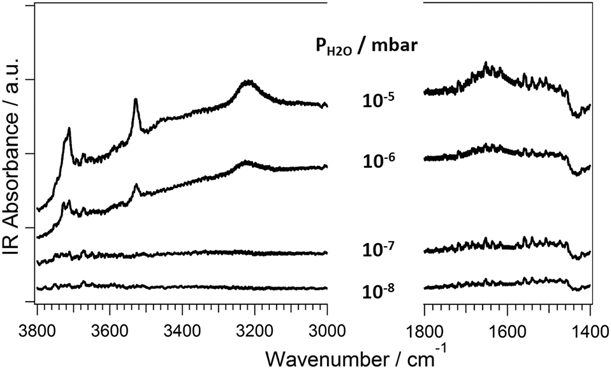
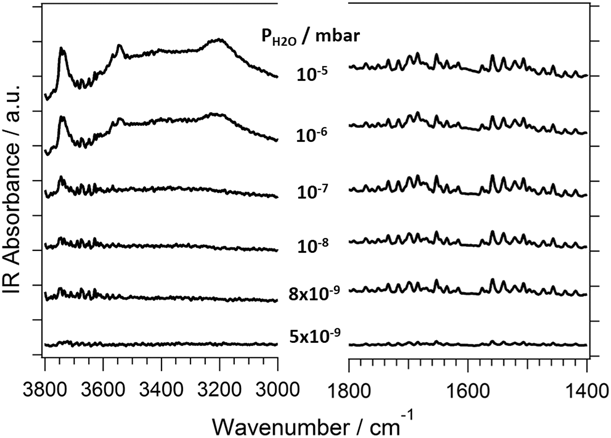
Transmission Electron Microscope (TEM) images and particle size distribution diagrams of the three studied MgO samples (20/80, 60/40, and CVS) are shown in Fig. 1. CVS MgO powder involves much smaller particles (typical size around 5 nm) than cubic smoke particles that are almost two orders of magnitude larger on average. Fourier Transform InfraRed (FTIR) transmission experiments have been performed upon exposures at water vapor partial pressures  $\left( {{P_{{{\rm{H}}_{\rm{2}}}{\rm{O}}}}} \right)$ ranging between 5 × 10⁻⁹ mbar and 1 × 10⁻⁵ mbar. On MgO smoke prepared in a 20% O2 and 80% Ar mixture, spectra involve rather sharp bands at 3710–3730 and 3530 cm−1 and broader bands at 3440 and 3220 cm−1, which are all associated with OH stretching frequencies (Fig. 2). Moreover, a band at 1635 cm−1 is clearly seen at H2O partial pressures of 1 × 10⁻⁶ mbar and above. On CVS powders, the corresponding frequencies are recorded at 3730–3745, 3550, 3450, and 3200–3220 cm−1, while that at 1635 cm−1 is hardly observed (Fig. 3). Bands recorded on CVS powders are broader (Fig. 3) than those collected on smokes (Fig. 2), a fact which likely stems from the higher complexity of the surface provided by the CVS powders. Another important point is the quasi-absence of the band at 1635 cm−1, which unambiguously characterizes molecular water, on the CVS spectra. The abundance of molecular water is consistent with the reactive behavior of powders. At
 ${P_{{{\rm{H}}_{\rm{2}}}{\rm{O}}}}$ ≥ 10−6 mbar, the outer parts of the smoke samples are overexposed, which likely favors molecular water adsorption on some highly hydroxylated configurations. Conversely, at
 ${P_{{{\rm{H}}_{\rm{2}}}{\rm{O}}}}$ = 10−6 to 10−5 mbar, the CVS powder is far from being fully hydroxylated and molecular adsorption is marginally observed. More importantly, the observation demonstrates that the bands at 3710–3745, 3530–3550, 3440–3450, and 3200–3220 cm−1 are not related to molecular water but rather to dissociated water molecules.
TEM images and particle size distribution diagrams of the three studied MgO samples.

FTIR spectra recorded during exposures of MgO smoke prepared in a 20% O2 and 80% Ar mixture to water vapor at different pressures.

FTIR spectra recorded during exposures of CVS powder to water vapor at different pressures.

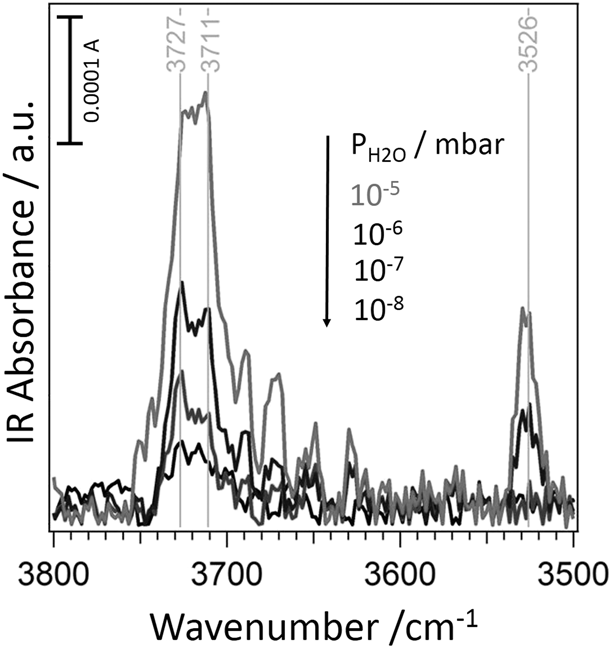
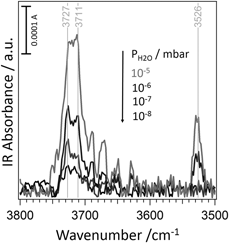
At pressures ranging between 5 × 10⁻⁹ mbar and 10−7 mbar, the bands at 3710–3745 cm−1 are the unique features that we observed in FTIR spectra recorded on both CVS powders and smokes (Figs. 2–4). Features at 3530–3550, 3440–3450, and 3200–3220 cm−1 appear at  ${P_{{{\rm{H}}_{\rm{2}}}{\rm{O}}}}$ ≥ 10−6 mbar (Fig. 4). Recorded at 3730–3745 cm−1 on the CVS powder, the highest frequencies on smokes are in the 3710–3730 cm−1 range (Figs. 2 and 3). Therefore, we carried out measurements on MgO smokes prepared in a 60% O2 and 40% Ar mixture. They consist of MgO nanocubes smaller than the smokes that were synthesized in the 20% O2 and 80% Ar mixture [Reference Stankic, Cottura, Demaille, Noguera and Jupille29] and are expected to show a higher concentration of low-coordinated sites. Remarkably, the high-frequency band observed after exposing the 60:40 smoke to water at
 ${P_{{{\rm{H}}_{\rm{2}}}{\rm{O}}}}$ = 10−7 mbar is rather close to that found in the CVS spectra (Fig. 5).
High-frequency region of the FTIR spectra shown in Fig. 2 (exposures of MgO smoke prepared in a 20% O2 and 80% Ar mixture).

Comparison of the high-frequency features that appear at the onset of the exposure of MgO smoke prepared in a 20% O2 and 80% Ar mixture, CVS powders, and MgO smoke prepared in a 60% O2 and 40% Ar mixture (from top to bottom) to water vapor.

Discussion
Water dissociation on steps at MgO(100) surfaces is spontaneous, irrespectively of water coverage [Reference Costa, Chizallet, Ealet, Goniakowski and Finocchi26, Reference Langel and Parrinello30]. This finding can be explained by the higher reactivity of ions with lower coordination number than at flat surfaces (3C at corners and 4C at step edges with respect to 5C on terraces). Another fact driving the dissociation is the reinforcement of the atomic-scale electric field on surfaces such as MgO close to step edges and, even more, at corners [Reference D’Ercole and Pisani31]. These two factors are linked to each other. As a general and well-documented rule, the stronger the H bond, the longer the ionic–covalent OH bond and the smaller the OH stretching frequencies. This empirical finding is supported by many calculations [Reference Chizallet, Costentin, Che, Delbecq and Sautet11, Reference Costa, Chizallet, Ealet, Goniakowski and Finocchi26] and can be explained through simple theories of the chemical bond. This is at the root of the interpretation of different values of the OH stretching frequencies νOH: values around 3700 cm−1 are usually referred to as “free OH groups,” meaning that the hydroxyls are not hydrogen bond donors. Smaller values, typically in the range 3400–3600 cm−1, are commonly interpreted as signatures of H-bonded hydroxyls. The smaller values, from 3200 down to 3000 cm−1, have been seldom investigated. In the spectra, they are usually weaker than other signals and, in view of the previous arguments, could correspond to dilated OH bonds because of strong hydrogen bonds. In the following, examples of those abnormally long OH bonds resulting from water dissociation at diatomic steps are discussed.
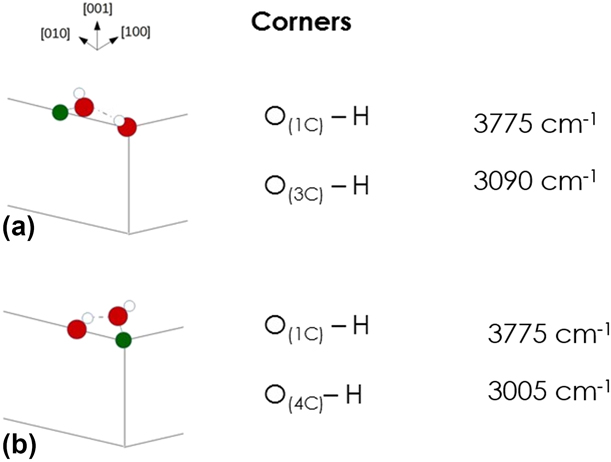
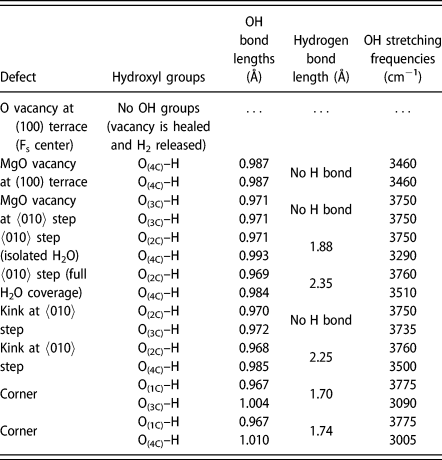
The strategy that we followed to analyze the measurements using the calculations was to focus on the most frequently mentioned sites. They include (i) three-coordinated corner atoms, O(3C) and Mg(3C) (Fig. 6); (ii) monoatomic 〈010〉 step with O(4C) and Mg(4C) sites, a type of defect whose occurrence was shown to be very likely at the surface of the (100) facets of MgO smokes [Reference Coluccia, Lavagnino and Marchese8, Reference Chizallet, Costentin, Che, Delbecq and Sautet11]; and (iii) kinks at 〈010〉 monoatomic steps with either O(3C) or Mg(3C) corner atoms (Fig. 7). All the calculated frequencies are shown in Table I, together with the OH bond lengths and the hydrogen bond lengths. All the configurations that are presented (Table I) are calculated to be stable in the pressure range under study.
Configurations of a dissociated water molecule at a corner. (a) O(1C)–H and O(3C)–H and (b) O(1C)–H and O(4C)–H groups. The corresponding stretching frequencies are reported.

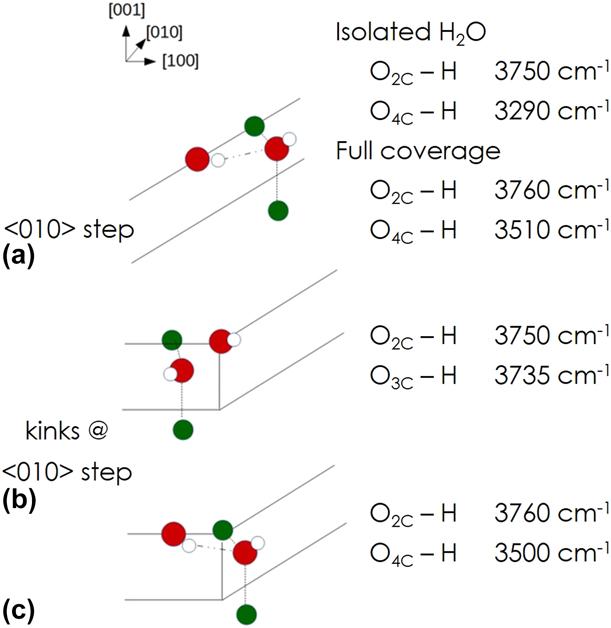
Configurations of a dissociated water molecule at a monoatomic 〈010〉 step. (a) Straight step with O(2C)–H and O(4C)–H groups and (b) kink with O(2C)–H and O(3C)–H or (c) O(2C)–H and O(4C)–H groups. The corresponding stretching frequencies are reported.

Computed characteristics of the hydroxyl groups on several defects at MgO(100) surfaces: O coordination number, OH bond lengths, hydrogen bond lengths, and OH stretching frequencies.

MgO vacancies on steps and terraces are also included in Table I. Indeed, they are very reactive toward H2O and form stable OH complexes on flat MgO(100) terraces [Reference Ealet, Goniakowski and Finocchi32]. Because of the intense local electric field, MgO vacancies are able to dissociate even the hydrogen molecule with no activation barrier [Reference D’Ercole and Pisani31]. The reaction of a water molecule with a MgO vacancy at a terrace yields two O(4C)–H groups with 0.987 Å bond length, which can be considered as “free” (not hydrogen-bonded). They vibrate at around 3460 cm−1. When the MgO vacancy is on monoatomic steps, the reaction produces two O(3C)–H groups [see Fig. 5(b)] with 0.971 Å bond length, which vibrate at 3750 cm−1. Neutral oxygen vacancies (Fs centers) can also dissociate water [Reference Finocchi and Goniakowski33, Reference Alvim, Borges and Leitao34] and restore the local ideal stoichiometry. They could also exist in charged states at the surface [Reference Richter, Sicolo, Levchenko, Sauer and Scheffler35], that is, Fs+ and Fs++, which are likely stable for highly p-doped MgO. In those cases, the reaction with water is different from the neutral case. However, charged vacancies will not be considered herein.
Involving particles of around 5 nm size, CVS powders likely exhibit a relatively high concentration of three-coordinated corner sites. Those sites are expected to react first since they are by far more active than four-coordinated sites for water dissociation [Reference Henderson1]. Close to corners, which we simulate by a kink at a diatomic step, a water molecule can split in two ways: an H-bonded O(1C)–H (acceptor) either with O(3C)–H or with O(4C)–H (donor) groups [Figs. 6(a) and 6(b), respectively]. In both cases, the O(1C)–H (acceptor) has a high stretching frequency (3775 cm−1), while those of the O(3C)–H and O(4C)–H (donor) hydroxyls are much lower, about 3090 and 3005 cm−1, respectively (Table I). Interestingly, and somehow against the intuition, O(3C)–H groups at corners between diatomic steps also vibrate at rather low frequencies; here, the formation of strong H bonds with the O(1C)–H acceptor is the main factor determining the expansion of the covalent bond and the corresponding stretching mode red shift of the donor hydroxyls. These configurations are associated with the band at 3730–3745 cm−1 observed by exposure of the CVS powder to  ${P_{{{\rm{H}}_{\rm{2}}}{\rm{O}}}}$ = 5 × 10⁻⁹ to 10−7 mbar. As for the calculated bands at 3005–3090 cm−1, which are due to the O(3C)–H or O(4C)–H (Table I), they do not clearly appear in the IR spectra. Indeed, the strong H-bonded character of those groups, as indicated by the short H-bond lengths associated with them (Table I), leads to a very broad band that might be compatible with the faint bump seen in the spectra in the 3000–3100 cm−1 frequency range (Fig. 3).
In the same pressure range (5 × 10⁻⁹ to 10−7 mbar), the high-frequency bands are slightly red-shifted on the MgO smoke (3710–3730 cm−1; Figs. 2 and 5) with respect to CVS powders. With an average particle size close to 200 nm [Reference Hacquart and Jupille16], the proportion of corner sites is very small (for a given volume of powder, the proportion of corner sites goes roughly as the inverse cube of the particle size). Indeed, as steps dominate the defective landscape, vacancies and kinks on steps might provide very reactive 3C sites. Possibilities come from MgO vacancies and kinks on 〈010〉 steps. According to calculations, a unique νOH frequency of 3750 cm−1 is associated with the former (Table I). As kinks are concerned, the O(3C) corner atom is energetically more favorable than the Mg(3C) corner, for the simple reason that two hydroxylated configurations have in common an O(2C)–H group bonded to two Mg atoms, while the remaining hydroxyl is either O(3C)–H, as in Fig. 7(b), or O(4C)–H, as in Fig. 7(c). The water dissociation on O(3C) is predicted to correspond to νOH frequencies of 3760 and 3735 cm−1. Therefore, MgO vacancies and kinks on monoatomic steps lead to frequencies in the 3735–3760 cm−1 range, thus slightly lower than that at 3775 cm−1, which is associated with corner sites on the CVS sample. The predicted frequencies (3735–3750 cm−1; Table I) reproduce well the experimental values (3710–3730 cm−1 in Figs. 2 and 3). The assignment of the 3710–3730 cm−1 band to hydroxyls on kinks at monoatomic steps is supported by the similarity of the higher frequency recorded on the 60:40 (O2:Ar) smoke to that of the CVS powder (Fig. 5), since the 60:40 (O2:Ar) smoke likely has less defects and it is closer to stoichiometry than the 20:80 (O2:Ar) smoke. Moreover, owing to the size of the particles it involves, the 60:40 smoke is expected to exhibit quite many corner sites [Reference Stankic, Cottura, Demaille, Noguera and Jupille29]. Similar νOH frequencies (3710 and 3750 cm−1) to those found herein (3730–3745 cm−1 and 3710–3730 cm−1) were attributed by Knözinger and coworkers to bonded hydroxyls to an Mg(3C) corner and, by comparison with hydrogen adsorption, to an H bonded to an oxygen atom lying at a step edge [Reference Knözinger, Jacob, Singh and Hofmann17], in full agreement with the configurations described herein.
At straight edges, an isolated water molecule splits into two nonequivalent O(4C)–H and O(2C)–H hydroxyls. They are tightly H-bonded, as indicated by the quite short H–O(2C) bond length (1.88 Å). As a consequence, the covalent bond in the donor O(4C)–H group stretches to 0.993 Å, while the computed covalent bond length in the acceptor O(2C)–H group is 0.971 Å. At full water coverage, the characteristics of the O(4C)–H and O(2C)–H groups change with respect to the case of the isolated ones, as the computed bond lengths are 0.984 and 0.969 Å, respectively. Especially the O(4C)–H bond is impacted, which contracts by ≈ −0.1 Å when passing from the dissociation of the isolated molecule to the full-decorated hydroxyl-covered step. This is due to a progressive weakening of the hydrogen bond between the two hydroxyl groups: the H–O(2C) bond passes from 1.88 Å for the isolated dissociated molecule to 2.35 Å at full water coverage. The corresponding stretching frequencies of the O(2C)–H groups are around 3750–3760 cm−1, depending on the coverage, while those of the H-bond donors O(4C)–H vary from 3510 cm−1 at full coverage down to 3290 cm−1 for the isolated case. In passing, we note that the very important shift of the stretching frequency of the donor hydroxyls with coverage might explain the previous observation of a smaller frequency (3480 cm−1) for the same configuration [Reference Finocchi, Hacquart, Naud and Jupille9, Reference Savio, Smerieri, Orzelli, Vattuone, Rocca, Finocchi and Jupille10]. When kinks are present at monoatomic steps, two cases could happen (Fig. 7): either the formation of O(3C)–H and O(2C)–H, which has been retained to partly explain the highest frequency that is observed on smoke, or the formation of O(4C)–H and O(2C)–H. In the latter case, O(4C)–H donates a weak hydrogen bond to O(2C)–H; the corresponding stretching frequencies are well distinct (3500 and 3760 cm−1, respectively). The two lower bunches of frequencies that are related to water splitting (either at its onset or at full hydroxyl coverage) on the monoatomic 〈010〉 steps and on kinks at those steps nicely account for the bands at 3530–3550 cm−1 and 3200–3220 cm−1 that are observed in the IR spectra of powders exposed to  ${P_{{{\rm{H}}_{\rm{2}}}{\rm{O}}}}$ partial pressures of 10−6 to 10−5 mbar (Figs. 2 and 3). This is also consistent with previous observations that monoatomic steps are the most common defects at MgO nanopowders [Reference Finocchi, Hacquart, Naud and Jupille9]. Finally, dissociative adsorption on MgO vacancies on terraces, with expected νOH frequency at 3460 cm−1, is neither supported nor discarded since the faint feature observed in spectra at that frequency (Figs. 2 and 3) already corresponds to several above-discussed configurations.
Conclusions
We have studied water dissociation on low-coordinated sites of MgO in UHV conditions on both powders prepared by CVS and smokes. We have exposed the powders to water progressively, starting from partial pressures as low as 5 × 10⁻⁹ mbar up to 10−5 mbar, to avoid the hydroxylation of (100) terraces and eventual mass transport that can occur at higher pressures. We have also faced the problem of exposing a sample of large specific surface area to reactive gases. In this respect, the rather low specific surface area of MgO smokes, which contrasts with the very high specific surface area of CVS powders, offers the possibility to study samples that can be fully exposed at UHV pressures while obtaining an appreciable signal-to-noise ratio in the IR measurements.
By combining FTIR in transmission with ab initio calculations, we have identified several significant hydroxyls at corners, monoatomic 〈010〉 steps, kinks, and MgO vacancies on monoatomic steps, which reproduce the experimental outcome qualitatively and quantitatively. This study demonstrates the necessity of experiments performed in UHV conditions on oxide powders to understand the reactive behavior of surface defects. This is particularly relevant when, as in the present case for MgO, the oxide is hygroscopic and can undergo deep restructuring after exposure at a pressure beyond a material-specific threshold [Reference Ončák, Włodarczyk and Sauer14].
Methods
Experiments
Experiments have been performed in an already described UHV apparatus involving a preparation chamber and a main chamber, both with working pressure in the 10−10 mbar range [Reference Haque, Chenot, Viñes, Illas, Stankic and Jupille19]. Fourier transform infrared spectroscopy (FTIR) measurements are operated in the main chamber by means of a Bruker (Karlsruhe, Germany) Vertex 70 FTIR spectrometer equipped with a Mercure Cadmium Telluride (MCT) detector. Spectra are recorded through ZnSe windows. As a starting material to prepare powders, high-purity Mg pieces (>99.98%) supplied by Goodfellow (London, UK) have been used. MgO smokes have been obtained by burning Mg ribbons within a glove box filled with dry Ar–O2 mixtures at the normal pressure. The direct collection of the smoke on a silicon wafer allows for IR analysis in transmission mode since silicon is transparent to IR in the frequency range under study [Reference Finocchi, Hacquart, Naud and Jupille9, Reference Savio, Smerieri, Orzelli, Vattuone, Rocca, Finocchi and Jupille10]. The CVS MgO powder was prepared in line with the procedure described in Ref. Reference Hacquart and Jupille16 and pressed into pellets with applied pressure less than five bars to avoid any change in specific surface area. The wafers and pellets were then mounted on a molybdenum plate for insertion and transfer into the UHV apparatus.
The use of MgO smokes raises the question of exposure of powders to gases in UHV conditions. The purpose of UHV experiments is to keep under control the progressive coverage of initially clean flat surfaces by reactive gases. In a different way, powders are used to obtain sizable signals. By using, say, CVS powder whose surface specific area is ∼350 m2/g, an MgO pellet of a few tens of milligrams has a total surface area of about 10 m2, although the area of the pellet itself, of the order of a cm2, is 10−5 lower. In these conditions, the exposure of the whole surface of the material that constitutes the pellet to a gas at a pressure of 10−6 mbar would ideally require about a day. Indeed, such estimate is a lower limit that does not take into account the diffusion through the pellet or the reaction of dissociation of the water molecules, which would involve a sticking coefficient. An additional concern is the heavy interaction with the reacting gases of some parts of the outer surfaces and the exposure to the residual. Therefore, uncovering the whole surface of a CVS powder in UHV is impossible to achieve in controlled conditions. The present use of MgO smokes leads to a very different situation. By weighting, we estimated that the deposited smoke covers the supporting wafer with 1 mg/cm−2. Assuming that the specific surface area of the smoke is 10 m2/g [Reference Hacquart, Krafft, Costentin and Jupille13, Reference Hacquart and Jupille16], this corresponds to 100 cm2 of smoke per cm2 of wafer. According to the kinetic theory of gas, this means that about 100 s are required at the partial pressure of 10−6 mbar of water vapor to fully expose the smoke sample [Reference Hacquart, Krafft, Costentin and Jupille13, Reference Hacquart and Jupille16]. As the exposure time is systematically 10 min, the surface of the smoke could fully interact with water even at pressures as low as 10−7 mbar. The smoke samples offer, therefore, a reasonable solution to the problem of the analysis of the reactivity of powders in UHV and controlled conditions.
Before being transferred to the main analysis chamber, MgO powders have been degassed at 1170 K in UHV for one hour in the preparation chamber. The applied annealing treatment ensures adsorbate-free MgO surfaces, as confirmed by the absence of any adsorbed impurity in the initial IR spectrum of the bare MgO powders. We collected reference spectra on the degassed MgO samples in UHV, which we then used for the subtraction. We recorded FTIR spectra with a resolution of 4 cm−1 by averaging 250 interferogram scans to obtain a reasonable signal-to-noise ratio. The deionized liquid water that was used for adsorption was stored in a reservoir in which it had been purified by freeze–thaw cycles.
Theory
We simulated several adsorption configurations and computed the corresponding O–H vibrations in the OH stretching mode frequency domain via density functional theory and density functional perturbation theory (DFPT). We carried out the calculations by using the open-source Quantum Espresso package [Reference Giannozzi, Baroni, Bonini, Calandra, Car, Cavazzoni, Ceresoli, Chiarotti, Cococcioni, Dabo, Dal Corso, Fabris, Fratesi, de Gironcoli, Gebauer, Gerstmann, Gougoussis, Kokalj, Lazzeri, Martin-Samos, Marzari, Mauri, Mazzarello, Paolini, Pasquarello, Paulatto, Sbraccia, Scandolo, Sclauzero, Seitsonen, Smogunov, Umari and Wentzcovitch27], within the generalized gradient approximation by Perdew, Burke and Ernzerhof (PBE) [Reference Perdew, Burke and Ernzerhof28]. We accounted for the interaction between the ionic cores and the valence electrons by ultra-soft O, Mg, and H pseudopotentials, as included in the Quantum Espresso package. We checked that plane-wave cutoffs as large as 40 Ryd on the Kohn–Sham wave functions and four times larger on the electron density and effective potential ensure convergent results. We also chose the k-point sampling, the size of the slab, and the void space to avoid finite-size effects and obtain unbiased harmonic frequencies.
We then optimized the geometry of all configurations and determined the main characteristics (O–H bond lengths, presence of hydrogen bonds, and vibrational frequencies) of the adsorbed hydroxyl groups separately for point defects—O vacancies and MgO vacancies—and extended defects—mono- and diatomic steps at MgO(100). We determined the O-H bending and stretching modes via DFPT. As the computed harmonic stretching frequencies are slightly overestimated for the isolated water molecule with respect to the experimental values, we rescaled them by a 0.97 factor, thus allowing a better comparison with the measured IR spectra on hydrated MgO nanopowders. All the reported values for the computed frequencies were rescaled by such a factor.
Supplementary material
To view supplementary material for this article, please visit https://doi.org/10.1557/jmr.2018.461.