Introduction
North American and many other developed countries are currently witnessing both the ageing of the population as well as increasing ethnic and cultural diversity due to changing immigration patterns. The immigrant population is also ageing, and in some areas, is older than the non-immigrant population. According to the 2006 Census of Canada, for example, approximately 6.2 million people or 19.8 per cent of the Canadian population were immigrants (Statistics Canada 2007a). About 19.6 per cent of all immigrants were aged 65 and over compared to 11.5 per cent of non-immigrants (Statistics Canada 2011). Most (63.7%) were from European countries; 22.8 per cent were from Asian and Middle Eastern countries (Statistics Canada 2011).
The rapid demographic growth of an increasingly diverse older adult population raises important questions about their current and future wellbeing (Shemirani and O'Connor Reference Shemirani and O'Connor2006). Together, older age and immigration have been linked to a number of negative outcomes, including social isolation, disruptions to social support and consequent loneliness (Ajrouch Reference Ajrouch2008; Dykstra, van Tilburg and de Jong Gierveld Reference Dykstra, van Tilburg and de Jong Gierveld2005; Perlman Reference Perlman2004; Treas and Batalova Reference Treas, Batalova and Uhlenberg2009; Victor et al. Reference Victor, Scambler, Bowling and Bond2005). Loneliness tends to be considered an unpleasant feeling or dissatisfaction that arises when one's network of social relations is considered deficient, either in terms of quantity or quality (Perlman Reference Perlman2004) and has been said to require attention both on its own and as a component of other conditions (Ponizovsky and Ritsner Reference Ponizovsky and Ritsner2004). It is also considered one of the main indicators of individual wellbeing or quality of life (Dong et al. Reference Dong, Chang, Wong and Simon2012). As noted by de Jong Gierveld (Reference de Jong Gierveld1998: 73), ‘(t)he social integration and participation of older adults in society are seen as indicators of productive aging, and the alleviation of loneliness forms part of policies aimed at achieving the goal of “successful aging”’. In addition, a substantial body of literature documents associations between loneliness and psychological distress and depression (Paul, Ayis and Ebrahim Reference Paul, Ayis and Ebrahim2006), increased morbidity (Hawkley et al. Reference Hawkley, Thisted, Masi and Cacioppo2010), institutionalisation (Russell et al. Reference Russell, Cutrona, de la Mora and Wallace1997) and, in some instances, mortality (Holt-Lunstad, Smith and Layton Reference Holt-Lunstad, Smith and Layton2010; Routasalo and Pitkala Reference Routasalo and Pitkala2003; Stek et al. Reference Stek, Vinkers, Gussekloo, Beekman, van der Mast and Westendorp2005) in later life.
Despite the need to enhance our knowledge regarding the implications of immigration, limited research attention has been paid to this issue (Ajrouch Reference Ajrouch2008; Dong et al. Reference Dong, Chang, Wong and Simon2012). This includes a lack of national studies as well as of research comparing immigrants and non-immigrants. Most studies focus on immigrants only. In addition, the homogeneity of immigrant groups is often assumed, with little research addressing the implications of sources of within-group diversity (e.g. late-life versus earlier-life immigrants, first versus subsequent generations, racial/ethnic differences). Whether and how such factors operate differently in conjunction with age is also unclear. Yet, theoretically and empirically, there is reason to expect that such factors may well have an influence and that their impact may vary depending on age.
This study addresses these gaps in our knowledge, focusing on the implications of immigrant status as well as of the diversities attributable to generational status, length of residence and racial/ethnic background for experiences with loneliness in later life. Attention is directed to both the general and age/cohort-specific effects of immigrant experience on loneliness.
Immigration and loneliness: empirical evidence
Prior research suggests that immigration serves as a risk factor for loneliness, particularly in the later years of life (Ponizovsky and Ritsner Reference Ponizovsky and Ritsner2004; Treas and Batalova Reference Treas, Batalova and Uhlenberg2009). To date, however, empirical evidence supporting assertions regarding the greater loneliness of older immigrants comes primarily from qualitative studies of specific groups. This includes studies of elderly women from India who immigrated to Canada (Choudhry Reference Choudhry2001), older Korean (Lee Reference Lee2007) and Chinese (Dong et al. Reference Dong, Chang, Wong and Simon2012) immigrants living in the United States of America (USA; Chicago), as well as older women from Asian, Caribbean and Polish backgrounds living in Great Britain (Afshar et al. Reference Afshar, Franks, Maynard and Wray2002).
Direct comparative studies, including comparisons of immigrants and non-immigrants, are limited (Ajrouch Reference Ajrouch2008 is an exception), especially those drawing on large nationally representative study samples. More frequently, comparisons are based on prevalence estimates drawn from separate studies focusing on specific immigrant groups (e.g. Moghari Reference Moghari2000; Victor, Burholt and Martin Reference Victor, Burholt and Martin2012). Nevertheless, these too suggest greater loneliness among older immigrants than older non-immigrants. For example, Victor, Burholt and Martin (Reference Victor, Burholt and Martin2012) report finding much higher rates of loneliness among older immigrants (ranging from 24 to 50% among those from China, Africa, the Caribbean, Pakistan and Bangladesh, with lower rates evident among those from India) when compared to normative standards evident among older adults in Britain (i.e. 8–10%). The same researchers note that in the USA, prevalence rates of 79 per cent for the Vietnamese population, 31 per cent for Chinese, 28 per cent for Japanese, 14 per cent for Indian and Korean elders, and 2 per cent for Filipino elders have been reported for feeling often/always lonely (Asian American Federation of New York 2003). In comparison, the Association of Retired Persons of America (AARP 2010) has reported that about one-quarter of those aged 70 and over in the population as a whole reported experiencing higher levels of loneliness (Victor, Burholt and Martin Reference Victor, Burholt and Martin2012: 67).
Explaining immigrant loneliness
In contrast with traditional assimilation theories which have been widely critiqued for emphasising the beneficial implications of immigration (Greenman and Xie Reference Greenman and Xie2008), in more recent years, the high rates of loneliness said to be experienced in conjunction with immigration tend to be conceptualised within psycho-social stress process (stress and coping) models (see e.g. Acharya and Northcott Reference Acharya and Northcott2007; Diwan, Jonnalagadda and Balaswamy Reference Diwan, Jonnalagadda and Balaswamy2004; Krause and Goldenhar Reference Krause and Goldenhar1992; Lee Reference Lee2007). Here, loneliness is attributed to the stresses associated with immigration together with the lack of resources (e.g. social and cultural capital) often available to facilitate effective coping. Major stressors include cultural dislocation and acculturative processes (e.g. acculturative stress – Berry and Kim Reference Berry, Kim, Dasen, Berry and Sartorius1988; Krishnan and Berry Reference Krishnan and Berry1992; Williams and Berry Reference Williams and Berry1991) such as learning a new language and contending with the contradictions between cultural values emphasising familism that are prominent within selected groups and the structural constraints influencing family life in modern Western societies (Treas and Mazumdar Reference Treas and Mazumdar2002). They also include greater exposure and/or vulnerability to discrimination and its implications (Yoo, Gee and Takeuchi Reference Yoo, Gee and Takeuchi2009) as well as other structural, social and economic difficulties that may result during this transition (Ponizovsky and Ritsner Reference Ponizovsky and Ritsner2004). While traditional cultural values are often seen as facilitating effective coping, Treas (Reference Treas2009: 43) suggests that the view that ‘the warm embrace of family life affords special protection to older immigrants is a myth’ and that ‘cultural expectations for family togetherness are difficult to achieve in American society’.
However, while stress process models emphasise the potentially adverse implications of immigrant transitions, a lifecourse perspective draws attention to the timing and duration of the transitions and suggests that these are likely to influence the implications of exposure to immigration or other experiences. As a framework for understanding the dynamics of the ageing process and the relationship between lifecourse events and life outcomes (Fuller-Iglesias, Smith and Antonucci Reference Fuller-Iglesias, Smith and Antonucci2009), the lifecourse perspective conceptualises ageing as a consequence of social and temporal processes that differentiate individuals within and between cohorts (Elder Reference Elder1994). More specifically, it suggests that the historical circumstances encountered earlier in life shape the life experiences of different groups, and may do so differently by age. As noted by Jasso (Reference Jasso, Mortimer and Shanahan2003: 331) with respect to immigration specifically: ‘All the processes associated with migration are rooted in time. They occur in particular historical eras and bear the imprints of those eras. They occur at different ages and bear the imprints of those ages. How difficult it was to migrate, how successful the migration, how permanent the move – all these depend jointly on the historical context and the migrant's age.’
In recent years, researchers have noted the ‘paradigmatic alliance’ between stress process and lifecourse perspectives (Bierman and Statland Reference Bierman and Statland2010; Pearlin et al. Reference Pearlin, Schieman, Fazio and Meersman2005; Pearlin and Skaff Reference Pearlin and Skaff1996), suggesting that together, the two can be used to understand the implications of immigration and other potentially stressful life experiences. Accordingly, their effects are considered to be dependent not only on exposure to such lifecourse transitions, but also, on factors such as when it occurred, the duration of residence within the host country (Clark, Glick and Bures Reference Clark, Glick and Bures2009) and the migrant's pre- and post-immigration cultural experiences.
The importance of generational status in influencing immigration-related experiences has been widely noted, albeit primarily within demographic literature rather than literature dealing with immigration and loneliness in later life. Over time, not only first- but also, subsequent generations are said to face the implications of such experiences (see e.g. Angel et al. Reference Angel, Angel, Venegas and Bonazzo2010; Clark et al. Reference Clark, Glick and Bures2009). Reflecting this view, a significant body of sociological research attests to the differences between first-generation immigrants as well as second-generation (i.e. children of immigrants), third- and higher-generation citizens (Portes and Rumbaut Reference Portes and Rumbaut2001; Rumbaut Reference Rumbaut2004). In addition, immigrants who arrived as young children have been referred to as the 1.5 generation (Rumbaut Reference Rumbaut, Ahearn and Athey1991, Reference Rumbaut2004), based on the argument that their experiences and outcomes differ greatly from those of first-generation adult immigrants. For example, it has been suggested that first-generation immigrants – those born in and socialised in another country – will likely be disadvantaged relative to the native-born population because they have had to overcome barriers such as discrimination, a new culture and a new language. In comparison, 1.5-generation immigrants and second-generation Canadians will have been socialised to the culture and language of the host country and are likely to be less disadvantaged while third-generation Canadians (i.e. native-born children of native-born parents and immigrant grandparents) are thought to differ little from the majority native population.
Length of residence within the host country is also considered important both as a determinant of and proxy for social integration and/or acculturation processes (Ajrouch Reference Ajrouch2008). The longer the immigrant spends in the host country, the less likely s/he is said to participate in immigrant cultural activities and the more likely s/he is to acquire language skills, norms and behaviours of the host country (Singh and Siahpush Reference Singh and Siahpush2001) as well as relationships beyond those of the immediate family (Ajrouch Reference Ajrouch2008). Thus, it appears that social isolation from one's ethnic community may increase at the same time that isolation from one's host country decreases, both of which may influence subsequent loneliness.
In addition, although some researchers consider the experience of immigration to be particularly stressful when experienced in childhood (e.g. Mossakowski Reference Mossakowski2007), gerontological literature suggests that those who immigrate in later life are particularly vulnerable (Durst Reference Durst2005; Shemirani and O'Connor Reference Shemirani and O'Connor2006; Treas Reference Treas2008; Treas and Mazumdar Reference Treas and Mazumdar2002). For example, Durst (Reference Durst2005: 266) notes that they may well have sold their businesses as well as their homes and immigrated as financial dependents on their children, often providing care for their grandchildren and living under their own children's care. Such arrangements often prove highly traumatic for those involved. In addition, unlike younger immigrants as well as older immigrants who arrived either as children or younger adults, older immigrants who immigrate in later life have been characterised as ‘too old for the socialising influences of the school and the workplace where younger immigrants make new friends, become acquainted with the culture and learn a new language. As a consequence, their adaptation and acculturation is slower and more problematic’ (Treas and Batalova Reference Treas, Batalova and Uhlenberg2009: 16). Overall, they are said to face greater challenges with more limited resources, resulting in higher rates of loneliness as well as depression and psychological distress (Treas and Batalova Reference Treas, Batalova and Uhlenberg2009).
Finally, ethnic, racial and cultural circumstances are also likely to be important, influencing loneliness at various stages of the lifecourse (Hossen Reference Hossen2012; Perlman Reference Perlman2004; Rokach and Neto Reference Rokach and Neto2005) in both pre- and post-immigration contexts (Bhattacharya and Shibusawa Reference Bhattacharya and Shibusawa2009). Cross-cultural comparative studies have reported differences in the prevalence and intensity of loneliness (Fokkema, de Jong Gierveld and Dykstra Reference Fokkema, de Jong Gierveld and Dykstra2012; Routasalo and Pitkala Reference Routasalo and Pitkala2003) and in associations between loneliness and other factors (e.g. Perlman Reference Perlman2004) among older adults across cultures (Cohen-Mansfield, Shmotkin and Goldberg Reference Cohen-Mansfield, Shmotkin and Goldberg2009). Thus, as noted above, Victor, Burholt and Martin (Reference Victor, Burholt and Martin2012) found much higher rates of loneliness among older immigrants from China, Africa, the Caribbean, Pakistan and Bangladesh when compared to normative standards evident among older adults in Britain, with considerably lower rates evident among older immigrants from India. However, their comparison of these rates to those reported in other studies conducted within these same countries indicated that they were generally similar to the rates reported for older adults in their countries of origin, thereby suggesting that immigration-related experiences may not be centrally important.
Conversely, others report finding that adjustment difficulties tend to be more problematic for some immigrant groups than others, depending on factors such as the extent of structural discrimination evident against racialised minority immigrants (Han Reference Han2011) as well as how different (linguistically, culturally) the host country is (e.g. Lee Reference Lee2007). For example, older Korean (Kim Reference Kim1999; Lee Reference Lee2007) and Chinese (Dong et al. Reference Dong, Chang, Wong and Simon2012) immigrants have been reported to be especially vulnerable to loneliness, with social isolation and dissatisfaction with family life among the unique psycho-social stressors faced by older Asian American immigrants. The study by Dong et al. (Reference Dong, Chang, Wong and Simon2012) of Chinese elders in Chicago's Chinatown indicated that loneliness was common (50% reported) and that it was tied to the perceived absence of satisfying intergenerational relationships with family. According to these authors, the importance attributed to such relationships may be informed by traditional family values, resulting in loneliness and emotional distress when expectations regarding family support were not met. Similarly, Treas and Mazumdar (Reference Treas and Mazumdar2002: 243) note that the problematic adjustment of older immigrants suggests the limitations of family support: ‘a cultural ideology of family interdependence not only gives much to older immigrants, but it also demands much from them. Collectivist ideologies reinforce subordination of individual interest to that of the group. Older people, being relatively powerless in their families, are unlikely to assert their preferences.’
Finally, drawing on a joint stress process–lifecourse perspective, the impact of both stressors and temporal factors can be expected to vary across current age groups/cohorts. The direction of these relationships is not yet clear, however. Some researchers have suggested that specific life events are likely to have a greater impact on oldest-old age cohorts. For example, Umberson et al. (Reference Umberson, Williams, Powers, Liu and Needham2006) note that marital strain is likely to become more important in influencing health-related outcomes as people age, given the greater salience of the marital relationship later in life. Yet, others have shown that various other stressors, including major negative life events (e.g. deaths of loved ones) tend to be less consequential within advanced old age (see e.g. Dunkle, Roberts and Haug Reference Dunkle, Roberts and Haug2001; Jeon and Dunkle Reference Jeon and Dunkle2009). For example, Jang et al. (Reference Jang, Chiriboga, Kim and Phillips2008) report that although health constraints often have negative mental health implications, ‘those who are “young old” … exhibit greater depressive symptomatology in the presence of health problems' than their older counterparts. Explanations for these differences include suggestions that the oldest-old may have become desensitised to (Bierman and Statland Reference Bierman and Statland2010; Jang, Poon and Martin Reference Jang, Poon and Martin2004) and normalise negative life events (Jeon and Dunkle Reference Jeon and Dunkle2009) given the greater likelihood of many such events occurring in the latter years of life (Mehata et al. Reference Mehata, Whyte, Lenze, Hardy, Roumani, Subashan, Huang and Studenski2008). They also include references to the greater resilience of the oldest-old (Jang et al. Reference Jang, Chiriboga, Kim and Phillips2008), their enhanced coping skills (Chou and Chi Reference Chou and Chi2002), their greater apathy and disengagement (Mehata et al. Reference Mehata, Whyte, Lenze, Hardy, Roumani, Subashan, Huang and Studenski2008) as well as potential cohort differences (Jang et al. Reference Jang, Chiriboga, Kim and Phillips2008).
The present study
The above-noted review suggests a need to focus attention on the implications of immigration for the experience of loneliness in the later years of life. Existing studies suggest that loneliness may well be an issue for older immigrants; yet it is difficult to draw general conclusions based almost exclusively on studies of small, non-representative and selected samples of immigrants only (Victor, Burholt and Martin Reference Victor, Burholt and Martin2012). There is also a need to go beyond a simple dichotomy (immigrant versus non-immigrant) based on nativity when it comes to addressing the implications of immigration for loneliness, and to acknowledge immigrant heterogeneity as well as the likely complexity of immigrant experiences.
To address these issues, this study drew on national survey data to examine the effects of immigrant status, immigrant generation, years of residence and racial/ethnic background on loneliness. We began by assessing their impact on loneliness among older adults in general. Next, we asked whether their impact differs across age groups within the older adult population. That is, does immigration (whether defined in terms of generational status, years of immigration or country of origin) have similar or different implications for loneliness depending on age? To address these questions, we constructed models for both the combined population as well as age-specific populations, estimating the general and age-specific effects of immigrant experience on loneliness. Based on the preceding review of the literature, five hypotheses were addressed:
• Hypothesis 1: Older immigrants will have higher levels of loneliness than older non-immigrants.
• Hypothesis 2: Levels of loneliness will decline with generational status such that first-generation Canadians (followed by 1.5- and second-generation Canadians) will have higher levels of loneliness than third- or higher-generation Canadians.
• Hypothesis 3: Older immigrants with a shorter length of residence in Canada will have higher levels of loneliness than those with a longer length of residence.
• Hypothesis 4: Racial/ethnic grouping will have an effect on loneliness. In particular, older immigrants from visible minority groups will tend to report greater loneliness than older immigrants from non-visible minority groups.
• Hypothesis 5: The effects of immigrant generation and years of residence in influencing feelings of loneliness are likely to differ between older and younger elderly age groups. The direction of these differences is unclear, however.
Throughout the analyses we controlled for demographic factors (i.e. age, gender, marital status, number of children ever raised by the respondent, dwelling type, living arrangement), socio-economic indicators (educational attainment, employment status, household income, household size) and health status measures (self-reported health, activity limitations, chronic illness) known to influence loneliness. Previous literature suggests that older elderly individuals, women, those who are not married, and those who are living alone or without children living close by (Adams, Sanders and Auth Reference Adams, Sanders and Auth2004; Dykstra, van Tilburg and de Jong Gierveld Reference Dykstra, van Tilburg and de Jong Gierveld2005; McDonald Reference McDonald2011; Ponizovsky and Ritsner Reference Ponizovsky and Ritsner2004; Tijhuis et al. Reference Tijhuis, de Jong-Gierveld, Feskens and Kromhout1999; Victor, Burholt and Martin Reference Victor, Burholt and Martin2012; Wenger and Burholt Reference Wenger and Burholt2004) often report greater loneliness. Lower socio-economic status (Savikko et al. Reference Savikko, Routasalo, Tilvis, Standberg and Pitkälä2005) and poorer health (including perceived health, chronic conditions and low levels of functional ability; Dykstra, van Tilburg and de Jong Gierveld Reference Dykstra, van Tilburg and de Jong Gierveld2005; Savikko et al. Reference Savikko, Routasalo, Tilvis, Standberg and Pitkälä2005; Theeke Reference Theeke2009; Tijhuis et al. Reference Tijhuis, de Jong-Gierveld, Feskens and Kromhout1999; Victor et al. Reference Victor, Scambler, Bowling and Bond2005) also appear problematic.
Data and methods
Data source
The study used data from the 2007 General Social Survey, Cycle 21 (GSS-21), conducted by Statistics Canada. The GSS programme is an annual national (cross-sectional) survey that gathers individual- and household-level data to monitor changes in the social conditions and wellbeing of Canadians (Statistics Canada 2009). In addition to collecting common demographic, social and economic data, each cycle of the GSS focuses on one thematic area. The GSS-21 focused on social support and ageing.
The target population of the GSS-21 included Canadians aged 45 and over living in Canada's ten provinces. Individuals living in the northern territories (remote areas) and full-time residents of institutions were excluded. Random digit dialling techniques were used to generate a list of phone numbers which were then utilised to reach households. For selected (eligible) households, one respondent aged 45 and over was randomly selected for a telephone interview. Although households without telephones were excluded, they represented 0.9 per cent of the target population (Statistics Canada 2009). Households with cellular phone service only (6.4% of the target population) were also excluded. The exclusion of cellular phone-only households is a limitation of this study. Nevertheless, given our study population, it is unlikely that this exclusion significantly biased our regression estimates on the effects of immigration. Moreover, our regression estimates were adjusted using weights to represent all persons in the target population with or without landline service and thus reduced this potential coverage bias (see Statistics Canada 2009 for details).
The GSS-21 includes a nationally representative sample of 23,404 Canadians aged 45 and over, with an overall response rate of 57.7 per cent. To focus on older Canadians, we further limited our target population to Canadians aged 60 and over. After removing cases with missing values on the response variables (see below), our final study sample included 2,012 respondents born outside Canada (immigrants) and 8,541 respondents who were Canadian-born (N=10,553). The interview was conducted in either of Canada's two official languages: English and French. Respondents who did not speak either language were interviewed via proxy respondents. There were only two proxy respondents in the study sample, which made no differences in our regression analyses (results not shown).
Measures
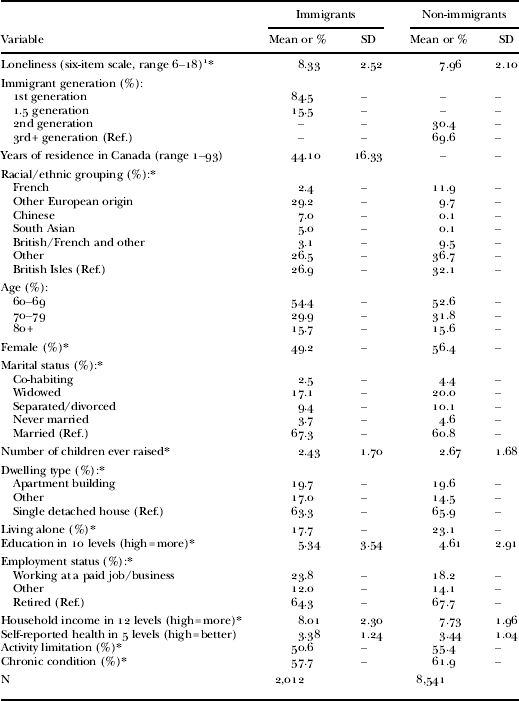
Our dependent variable was loneliness, measured using the six-item de Jong Gierveld–van Tilburg Loneliness Scale (de Jong Gierveld and van Tilburg Reference de Jong Gierveld and van Tilburg2006). The scale is a shortened version of the 11-item de Jong Gierveld Loneliness Scale (de Jong Gierveld and Kamphuis Reference de Jong Gierveld and Kamphuis1985) for overall, emotional and social loneliness, which has been widely used in the literature. The scale has two interrelated dimensions: emotional loneliness (experiencing a general sense of emptiness, missing having people around or feeling rejected) and social loneliness (not having many people one can rely on, trust or feel close to), and can also be used as a unidimensional scale, ranging from 6 (not lonely) to 18 (extremely lonely). Originally developed and validated for use in the Netherlands (de Jong Gierveld and van Tilburg Reference de Jong Gierveld and van Tilburg2006, Reference de Jong Gierveld and van Tilburg2010), the overall scale has been found to be reliable and valid (Dykstra and de Jong Gierveld Reference Dykstra and de Jong Gierveld2004), and appropriate for use in several countries, including Canada (van Tilburg, Havens and de Jong Gierveld Reference van Tilburg, Havens and de Jong Gierveld2004). Translations of its shortened version, also originally validated for use in the Netherlands (de Jong Gierveld and van Tilburg Reference de Jong Gierveld and van Tilburg2006), have also been tested among older adult populations in several other countries including France, Germany, Russia, Bulgaria, Georgia and Japan (de Jong Gierveld and van Tilburg Reference de Jong Gierveld and van Tilburg2010), and Hong Kong (Leung, de Jong Gierveld and Lam Reference Leung, de Jong Gierveld and Lam2008). For our sample data, the scale showed acceptable reliability (Cronbach's alpha=0.68). Table 1 shows that the mean value of the loneliness scale was higher for the foreign-born population (8.33) than for the Canadian-born population (7.96, p<0.05).
Descriptive statistics of the variables used in the regression models: elderly Canadians (age 60+), 2007

Notes: Weighted percentages, unweighted N. SD: standard deviation. Ref.: reference category. 1. See text for details.
Source: The 2007 Canadian General Social Survey.
Significance level: * p<0.05 for a chi-square test or t-test of statistical independence between immigrant and non-immigrant groups.
We used three indicators to measure immigrant experience. The first was immigrant generation. Immigrant generation was measured in four levels: (a) first-generation, (b) 1.5-generation, (c) second-generation, and (d) third- (or higher) generation Canadians. The first generation refers to people who immigrated to Canada at age 13 or older (adult immigrants). The 1.5 generation refers to immigrants who came to Canada at age 12 or younger (‘child immigrants’). This reflects previous usage by immigration scholars (see e.g. Portes and Rumbaut Reference Portes and Rumbaut2001; Portes and Zhou Reference Portes and Zhou1993; Rumbaut Reference Rumbaut1994) who commonly distinguish between those who arrived before adolescence (about age 12) and were socialised primarily in the host country (the 1.5 generation) and those who arrived at older ages and were socialised primarily in their country of origin (the 1.0 generation). The second generation includes native-born Canadians with at least one foreign-born parent. Third-generation Canadians are native-born Canadians whose parents are both Canadian-born. Table 1 shows that 85 per cent of the foreign-born population were ‘adult immigrants’ and 16 per cent were ‘child immigrants’. Among native-born Canadians, 30 per cent were second-generation Canadians, and 70 per cent were third- or higher-generation Canadians.
Related to immigrant generation, the second independent variable was length of residence in Canada (coded in years). The mean length of residence for the immigrant population was 44 years. In the regression analysis, years of residence was centred with zero mean (zero-mean normalisation); and native-born respondents were also coded as zero to incorporate them as the comparison (reference) group in the analyses.
Our third independent variable was racial/ethnic grouping. As noted, immigrants are much more likely to belong to a racial minority group than non-immigrants. Ethnic or cultural origin is also an important aspect of immigrant experience (Acharya Reference Acharya1998; Rokach Reference Rokach1999). Race and ethnicity are distinct theoretical concepts, but, for practical reasons as noted below, we were unable to address them separately in the study. Although 30 main racial/ethnic origins were recorded in the survey, the cell counts obtained for many groupings were too small to generate reliable statistical inferences. For confidentiality reasons, the detailed measures of ethnic origin were not released for public use. Given the available data, we measured race/ethnicity in seven groupings: French, Other European (e.g. German, Italian, Dutch, Polish, Ukrainian, Jewish and Portuguese), Chinese (including those from Hong Kong and Taiwan), South Asian (e.g. East Indian, Sri Lankan, Pakistani and Punjabi), British/French and other (British and French, British and other origin, or French and other origin), British Isles origins (English, Scottish, Irish or any combination of the three – reference group) and Other. Table 1 shows that among foreign-born elderly Canadians, 7 per cent were Chinese and 5 per cent were South Asians, the only two racial minorities that could be identified in the study. Corresponding figures in the native-born population were 0.13 and 0.5 per cent, respectively.
We considered six demographic control variables. Age was measured in three discrete levels: 60–69, 70–79 and 80+. Gender was measured as a dummy variable. There was a higher proportion of elderly women in the native-born population than in the immigrant population (p<0.05). Marital status was measured in five categories: co-habiting, widowed, separated or divorced, never married and married (reference group). The proportion of married persons was higher in the foreign-born population than in the native-born population, and the converse was true for widowed persons. The number of children ever raised was a continuous measure. For the foreign-born population, the mean number of children was 2.4; the comparable figure for the native-born population was 2.7 (p<0.05). Dwelling type was measured in three levels: apartment building, single detached house and other type (e.g. semi-detached, garden/town/row house, duplex, trailer or mobile home). The foreign-born population (63.3%) was somewhat less likely than the native-born population (65.9%) to live in single detached houses. Finally, living arrangement was measured as a dummy variable, indicating whether the respondent was living alone. Approximately 18 per cent of the foreign-born Canadians were living alone at the time of the survey compared to 23 per cent of the native-born population.
We included three socio-economic control variables. Education is an ordinal variable with ten levels, ranging from elementary schooling or less to some post-graduate education or higher. The mean level of education was 5.3 (some post-secondary education) for the foreign-born population, and 4.6 for the native-born population. Employment status has three categories: working at a paid job or business, retired and other employment situations (e.g. looking for work, caring for children and household work). Household income is an ordinal variable in 12 levels, ranging from 1 (no income) to 12 ($100,000 or more). The mean household income was slightly higher for the foreign-born population than the native-born population (p<0.05).
Finally, we considered three health indicators as control variables. Self-reported health is a five-level ordinal variable, ranging from 1 (poor) to 5 (excellent). Table 1 shows that the two study populations had similar levels of self-reported health (p>0.05). Activity limitation was a dummy variable indicating whether the respondent was limited in the amount (kind) of daily activities due to a physical or a mental condition or a health problem. Chronic condition was also a dummy variable for presence of any chronic conditions. The prevalence of both health conditions was higher for the native-born population than the foreign-born population (p<0.05), which is consistent with the so-called healthy migrant hypothesis (e.g. Lu Reference Lu2008).
Almost all large-scale national sample surveys have missing data on one or more variables. The GSS-21 is no exception. In preliminary analyses, we found that 8.7 per cent of those in the study sample had missing values on one or more items used to construct the loneliness scale. We also found that respondents who had missing data on the scale were more likely to be immigrants (13.2% versus 7.5%), Chinese or South Asians, and had a shorter length of residence in Canada (44 years versus 45.3 years) relative to those who had no missing data on the scale. We removed these cases from the study sample. Thus, caution is called for when interpreting the results of the study. Because immigrant Chinese and South Asians tend to have elevated levels of loneliness (see Table 4), the level of loneliness for these minority groups could be underestimated if those who were missing on the loneliness scale also tended to have higher levels of loneliness. In other words, the true effects of being Chinese and South Asian immigrants could be stronger than those reported in the study. As for the covariates, missing data were negligible with the exception of household income (where 27.2% of the data were missing). In unreported analyses, we added a dummy variable indicating those who had missing values on household income. The dummy variable was not significant in all regression models reported. The effect of household income remained unchanged with or without the dummy variable included (not shown). We decided to drop the dummy indicator and replaced missing values with mean household income. The missing values on the other covariates made no substantive difference in the regression results (not shown), and were also replaced with mean values.
Statistical methods
As noted, the objective of our study was to assess the implications of immigrant status for loneliness in the later years of life as well as to ‘decompose’ the immigrant experience, going beyond a simple dichotomy when it comes to examining loneliness in the immigrant population. Specifically, we looked at the effects of immigrant generation, length of residence in Canada and race/ethnicity. Due to high levels of collinearity among them, we constructed three sets of models, estimating the effects of each at the bivariate level (Model 1) and then net of socio-demographic (Model 2), socio-economic (Model 3) and health factors (Model 4) previously shown to influence loneliness. Moreover, following Garfein and Herzog (Reference Garfein and Herzog1995), we classified older Canadians into three broadly defined age groups: the young-old (age 60–69), middle-old (age 70–79) and oldest-old (age 80 and over). Where possible, we also constructed models for the combined population as well as the three age-specific populations, estimating both the general and age-specific effects of immigrant experience on loneliness.
Because our dependent variable was a continuous variable, we used ordinary least squares (OLS) regression models for data analysis. We carefully evaluated the OLS assumptions of our analytical models, particularly the issue of multicollinearity (e.g. Belsley, Kuh and Welsch Reference Belsley, Kuh and Welsch1980). In unreported analysis, we found that variance inflation factors (VIFs) were generally low for our covariates. Only a few VIFs had a value greater than 2; three VIFs had a value greater than 3 in all reported regression models; and none was greater than 4. Moreover, we found no evidence of violation of other OLS assumptions for any of the regression models.
Results
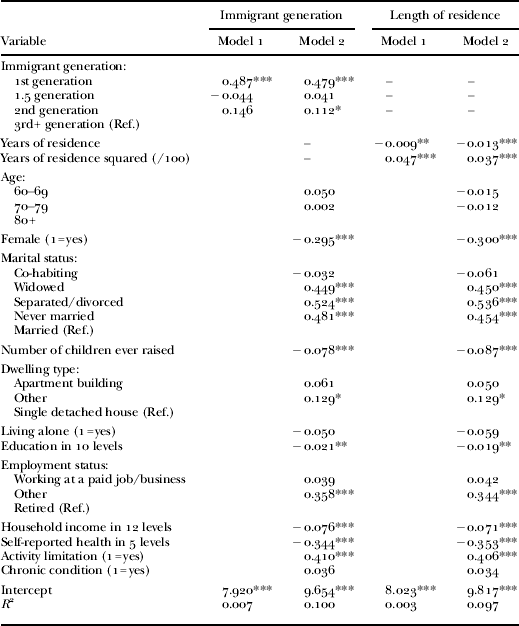
Table 2 presents unstandardised regression estimates for the first and final models regressing loneliness on immigrant generation (columns 1 and 2) and length of residence (columns 3 and 4), using the combined sample. The results show that first-generation immigrants had a significantly higher level of loneliness than third-generation Canadians, thereby supporting Hypothesis 1. However, the differences between both the 1.5 and second generations when compared to third-generation Canadians were not significant. In unreported analysis, we found that first-generation Canadians had the highest levels of loneliness, followed by 1.5- and second-generation Canadians. Model 2 suggests that the positive impact of first-generation immigrant status on loneliness persisted despite the introduction of socio-demographic, socio-economic and health controls. Interestingly, however, in this model, second-generation Canadians also revealed greater loneliness than third- or higher-generation Canadians. This is consistent with the expectations of Hypothesis 2. Overall, the amount of variance in loneliness cumulatively accounted for by these factors was 10 per cent.
Ordinary least squares regressions of loneliness on immigrant generation or length of residence in Canada and other selected characteristics: elderly Canadians (age 60+), 2007
Note: Ref.: reference category.
Source: The 2007 Canadian General Social Survey.
Significance levels: * p<0.05, ** p<0.01, *** p<0.001 (two-tailed test).
With regard to the effects of the control variables, we found that age group did not have a significant effect. We experimented with modelling age as a linear function (continuous variable) or as a quadratic function (adding a quadratic term). In either specification, the effect of age was not significant at the 0.05 level. We also found that older women had lower levels of loneliness than older men. Marital status was also a significant predictor of loneliness. Compared to the married, those who were widowed, separated or divorced, or never married all had higher degrees of loneliness, although the differences between the latter groupings were not statistically significant (not shown). There was also no significant difference between married and co-habiting persons. The level of loneliness declined with the number of children an older person had ever raised. Older persons living in apartment buildings or other than single detached types of housing had higher levels of loneliness than those living in single detached housing. While dwelling type was an important predictor of loneliness, the living arrangements of older persons did not appear to have an effect. However, it is important to note that the effect of living alone shown in the table is the net effect, that is, a difference in loneliness between those who lived alone and those who lived with someone else after removing the effects of all other (confounding) covariates in the analysis, particularly marital status. In unreported analysis, we re-estimated the results without marital status. We found that the effect of living alone was positive and highly significant (p<0.001), suggesting that older persons who lived alone had an elevated level of loneliness.
Turning to socio-economic indicators, our findings revealed that increases in education and household income reduced the level of loneliness observed. Older persons who either participated in the labour market or who were retired had lower levels of loneliness than those who were in other labour market situations (i.e. looking for work, caring for children or engaged in household work).
Health declines with age in later life. Table 2 shows that declines in health also increased the level of loneliness. Specifically, we found that a decline in general health and the presence of activity limitations raised the level of loneliness, although the presence of chronic conditions was not significant. Insofar as health indicators tend to be correlated with one another, when general health and activity limitation are removed from Model 3, the effect of chronic condition becomes positive and highly significant (results not shown).
Table 2 (columns 3 and 4) also presents the results of similar analyses conducted with years of residence in Canada included in the models. We began the analysis with years of residence as a linear term in the regression models. We found that the impact of years of residence was negative and highly significant in all four model specifications, thereby lending strong support to Hypothesis 3 (results not shown). To test whether the effect of years of residence may be nonlinear, we also added a quadratic term for years of residence. Here, we found a significant curvilinear effect (U-shaped) with loneliness first decreasing and then increasing with years of residence in Canada. Thus, loneliness levels may decrease with years of residence for those with a shorter length of residence in Canada; while the converse appears to be true for those with a longer length of residence. An elevated level of loneliness was also observed among the oldest-old age group compared to those aged 60–69, but only in Models 2 and 3 (results not shown in Table 2). With the introduction of socio-economic (Model 3) and then health controls (Model 4) into the equation, the age group difference declined and subsequently disappeared. All other control variables had similar relationships to loneliness as evident in the previous analyses. Overall, our findings provide support for Hypothesis 3.
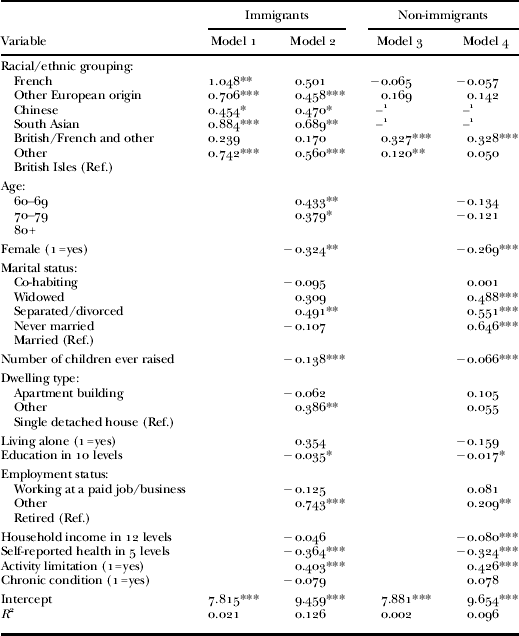
The effect of racial/ethnic grouping on loneliness among both immigrants and non-immigrants is reported in Table 3. Among immigrants, our findings revealed greater loneliness among almost all racial/ethnic groups (including French, Other European, Chinese, South Asian and Other) when compared to those identified as British. Only those who identified themselves as British or French plus another group did not differ from those who identified themselves as British. The negative impact of French ethnic origin disappeared once socio-economic controls were introduced, suggesting that the lower socio-economic status of the French was primarily responsible for their greater loneliness (results not shown). Among non-immigrants, in contrast, race/ethnicity was associated with considerably fewer differences. In fact, the only significant contrasts involved those who classified themselves as ‘British/French and other’ or ‘Other’ race/ethnicity (see Model 3). These individuals reported greater loneliness than those in the reference category (British Isles). Introducing control variables into the model had little impact on the greater loneliness of the former group; however, the greater loneliness of the latter group disappeared, suggesting it was attributable to one or more of the other factors considered. These findings also support Hypothesis 4.
Ordinary least squares regressions of loneliness on race/ethnicity and other selected characteristics: elderly Canadians (age 60+), 2007
Notes: Ref.: reference category. 1. Native-born Chinese and South Asian are included in the ‘Other’ group due to small cell counts.
Source: The 2007 Canadian General Social Survey.
Significance levels: * p<0.05, ** p<0.01, *** p<0.001 (two-tailed test).
In contrast with the results reported in Table 2, age effects were significant among immigrants, with those aged 60–69 and 70–79 reporting greater loneliness than those aged 80 and over. Age was not significant among non-immigrants, suggesting that the effects of age interact with immigrant status. To confirm this hypothesis, using the combined (whole) sample, we reran the analyses with two interaction terms involving age (60–69 and 70–79) and immigrant status. Both interaction terms were highly significant (results available from the authors). As was evident in the previous analyses, gender effects were once again significant in both models: men experienced a higher level of loneliness than women regardless of age and other confounding factors considered in the analysis. The effects of marital status also differed, with married or co-habiting persons having lower levels of loneliness than persons in other marital statuses but only among non-immigrants. For immigrants, only the separated or divorced appeared to experience elevated levels of loneliness compared to the married. The effect of fertility remained strong and invariant across all models: the more children an older person had, the lower the level of loneliness he/she experienced.
Type of dwelling also had an impact, but only among immigrants. Living in apartment buildings or single detached houses was associated with lower levels of loneliness. Consistent with Table 2, we once again found that living alone was not significant. However, the beneficial effect of education was similar among immigrants and non-immigrants. The favourable effects of labour force participation and retirement were also consistent. However, household income failed to emerge as significantly related to loneliness among immigrants. Finally, consistent with the previous analyses, we once again observed the favourable effects of perceived (good) health and the detrimental effects of activity limitation in all models.
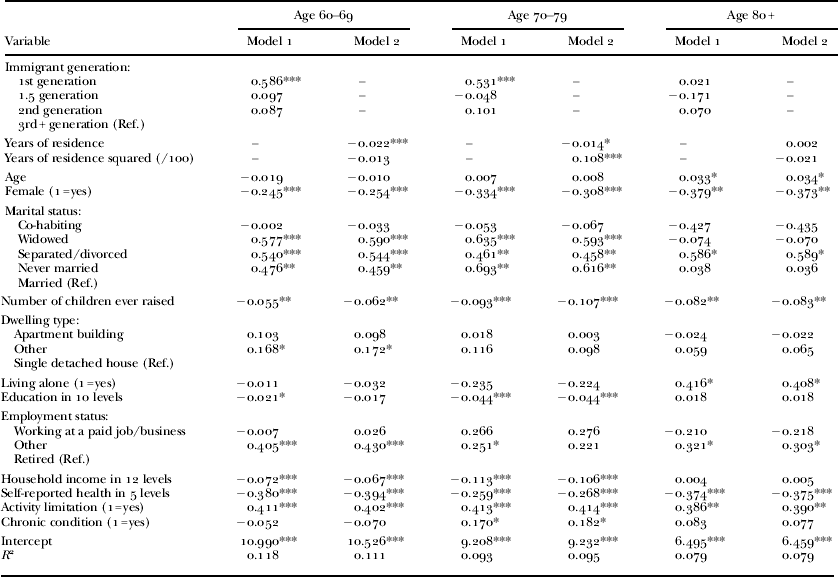
Table 4 reports analyses comparing the impact of immigrant generation (Model 1) and years of residence (Model 2) as well as the various control variables on loneliness levels across three older adult age groups. The findings revealed that the negative impact of first-generation immigrant status on loneliness was confined to the two younger elderly age groups (i.e. those aged 60–69 and 70–79) relative to those aged 80 and over. In addition, our findings revealed differences in the significance of various control variables in influencing loneliness across selected age groups. For example, increasing age was associated with increased loneliness but only within the 80 and over age group. In addition, although the finding that women reported less loneliness than men was evident within all three age groups, we also found that the impact of marital status differed. Once again, there was no significant difference between married and co-habiting persons. However, compared to the married, those who were widowed, separated or divorced, or never married all had higher levels of loneliness, but only among those in the two younger cohorts. Among those aged 80 and over, being separated/divorced was associated with somewhat greater loneliness but this was not the case when comparing those who were widowed or never married to those who were married.
Ordinary least squares regressions of loneliness on immigrant generation or length of residence and other selected characteristics by selected age groups: elderly Canadians (age 60+), 2007
Note: Ref.: reference category.
Source: The 2007 Canadian General Social Survey.
Significance levels: * p<0.05, ** p<0.01, *** p<0.001 (two-tailed test).
In all three age groups, the level of loneliness declined with the number of children an older person had ever raised. Although older persons living in other than single detached types of housing appeared to have higher levels of loneliness than those living in apartment buildings or single detached housing, this was confined to those aged 60–69. Dwelling type was not a significant determinant of loneliness among those in the two older age groups. In contrast, living alone was not a significant influence among those in the two younger age groups but was positively associated with loneliness among those aged 80 and over. Turning to socio-economic indicators, our findings revealed that increases in education and household income levels reduced the level of loneliness observed but only among younger elderly age groups (60–69, 70–79). Education and income levels did not make a difference among those aged 80 and older. However, regardless of age group, older persons who either participated in the labour market or who were retired had lower levels of loneliness than those who were in other labour market situations (i.e. looking for work, caring for children or engaged in household work). The same pattern was evident with regard to health concerns: poorer health increased the level of loneliness in all three age groups studied.
In general, a similar pattern of results was obtained when the impact of years of residence (Model 2) as well as the various control variables was assessed across the three age groups. The findings revealed that the decline in loneliness associated with increasing years of residence was confined to the youngest age groups (i.e. those aged 60–69). For those aged 70–79, the effect was once again U-shaped. The patterns involving the control variables differed very little from those evident when immigrant generation rather than years of residence was included in the analyses. Overall, the results of these age-based analyses support Hypothesis 5.
Discussion and conclusions
This paper set out to examine the general and age-specific effects of immigrant experience on loneliness in later life, comparing the impact of immigrant generation and length of residence within and across young-old, middle-old and oldest-old age groups. The impact of race/ethnicity on immigrant and non-immigrant loneliness was also assessed. In line with previous studies and consistent with our hypotheses, the current study confirmed that first- and second-generation Canadians have elevated levels of loneliness relative to third-generation (or higher) Canadians aged 60 and over but that there is little difference between the 1.5 generation and the third generation; that loneliness declines with increasing years of residence for those who had a shorter length of residence in Canada, but increases with years of residence for those who had a longer length of residence; that race/ethnicity influences loneliness particularly among immigrants; and finally, that the impact of immigration-related factors (immigrant generation, length of residence) differs across age groups and that such factors tend to be less important as determinants of loneliness among those aged 80 and over than among younger elderly age groups.
To our knowledge, this is the first study to confirm a positive relationship between immigration and loneliness using data drawn from a large nationally representative survey sample. These findings support previously reported findings, drawn primarily from qualitative and small-sample non-comparative studies, indicating that immigrants as a group report greater loneliness than native-born Canadians and that this is not attributable to demographic, socio-economic and health factors. In doing so, however, they appear to counter findings expected from related research into the epidemiological paradox that suggests that racial/ethnic minority immigrants tend to have better physical (e.g. De Maio and Kemp Reference De Maio and Kemp2009; McDonald and Kennedy Reference McDonald and Kennedy2004; Newbold and Danforth Reference Newbold and Danforth2003; Ng et al. Reference Ng, Wilkins, Gendron and Berthelot2005; Perez Reference Perez2002; Wilkins et al. Reference Wilkins, Tjepkema, Mustard and Choinére2008) as well as mental (e.g. Ali Reference Ali2002; Bergeron, Auger and Hamel Reference Bergeron, Auger and Hamel2009; Lou and Beaujot Reference Lou and Beaujot2005; Wu and Schimmele Reference Wu and Schimmele2005) health than their non-immigrant counterparts, particularly during the early years following immigration (healthy immigrant effect) and that this appears to dissipate shortly following arrival, with health status levels eventually converging with those of the native-born population. It is less clear whether this pattern holds in later life (see e.g. Gee, Kobayashi and Prus Reference Gee, Kobayashi and Prus2004; Newbold and Filice Reference Newbold and Filice2006). However, insofar as loneliness is sometimes conceptualised as a component of mental health (e.g. depression), it is important to note that when it comes to loneliness, the pattern appears reversed: older immigrants do worse than non-immigrants during the early years of residence but this disadvantage declines over time.
However, findings indicating that, for the sample as a whole, immigrant generation (i.e. lifecourse factors) also has a significant impact on loneliness suggest that immigrants are not a homogeneous group. Thus, the findings appear to support the need to extend our theoretical and empirical focus beyond a simple immigrant versus non-immigrant dichotomy/dualism and to include lifecourse differentials. The finding that those who immigrated later in the lifecourse (and thus had fewer years of residence in Canada) experienced greater loneliness than those who immigrated earlier may signify the greater difficulties (including lack of opportunities) that such individuals may face in integrating and developing close personal attachments as they age. Similarly, the finding that not only first- but also second-generation Canadians reported greater loneliness than third-generation Canadians suggests that the implications of immigration may well extend across generations. Perhaps first-generation immigrant parents' feelings of not belonging in the host society are communicated to and internalised by their children as well. Overall, these results seem to suggest that the more temporally proximate the immigration experience is, the higher the level of loneliness reported. Conversely, the finding that those in the 1.5 generation did not differ from those in the third or higher generation would seem to suggest the significance of age at immigration, even among first-generation immigrants. Why this is not reflected in lower loneliness levels among second-generation Canadians is unclear, however, and warrants further research.
Findings indicating that race/ethnicity also influenced loneliness particularly among first-generation immigrants suggests that such sources of diversity also need to be considered. Does the greater loneliness of Chinese, South Asian, non-British and non-French European immigrants, and Other immigrants reflect pre-existing cultural differences embedded within these particular ethnic/racial groups? Alternatively, does it reflect the implications of post-immigration discrimination and/or fear of it, lack of integration within the host society, and/or the perceived absence of satisfying relationships within one's family or specific racial/ethnic community? Unfortunately, we were unable to assess whether pre- and/or post-immigration experiences were responsible for these results. Nor were we able to include relevant measures such as perceived discrimination within our analyses. Future research should attempt to unpack these various sources of influence.
One of the main findings of this study was that immigration-related factors (immigrant generation, length of residence) differed in their impact across older age groups (cohorts). Specifically, our findings revealed that while these aspects of the immigrant experience had a significant impact on loneliness among the young-old and/or middle-old, they had virtually no impact among the oldest-old. One possible explanation for these findings is that, at this stage, the influence of immigrant status is being overridden by other factors that matter more for loneliness. That is, the implications of being an immigrant (or of immigrant generation) may cease to be as relevant to loneliness by the time people are 80 or older. Interestingly, marital status, type of dwelling, education and income also appeared less relevant to loneliness among those in the oldest-old age group. Conversely, living alone mattered more. Other significant predictors among the oldest-old included gender, number of children, employment and health status indicators, which also tended to be important to those in younger age groups. This suggests that the factors that influence loneliness in the latest life stages may reflect the more restricted physical and social life space that often occurs at this point in the lifecourse. In other words, at a time in life when social interactions are likely to be much more circumscribed (confined to the home environment and one's most proximate social ties), what matters are day-to-day health concerns and having someone close by rather than broader economic considerations or factors that denote access to broader social relationships outside the household.
Another possible explanation involves selection effects, given evidence linking loneliness to mortality (Routasalo and Pitkala Reference Routasalo and Pitkala2003; Stek et al. Reference Stek, Vinkers, Gussekloo, Beekman, van der Mast and Westendorp2005). It may be that by the time that individuals reach the age of 80 or older, relatively few individuals are still married and many of those with poorer socio-economic conditions and so forth will have died or been institutionalised. Also, given that people tend to immigrate in their twenties or thirties, these very elderly immigrants have been around for a long time, and therefore can be expected to be more fully integrated into the society. Thus, overall, our sample of oldest-old individuals living independently in the community may be reflective of survivors – those with better health, including mental health.
Interestingly, for the sample as a whole, age group itself did not emerge as a significant predictor of loneliness once other socio-demographic, socio-economic and health factors were controlled for. This contradicts previous cross-sectional and longitudinal analyses suggesting that older adults face an elevated risk of loneliness as they age (Dykstra, van Tilburg and de Jong Gierveld Reference Dykstra, van Tilburg and de Jong Gierveld2005; Jylhä Reference Jylhä2004; Wenger and Burholt Reference Wenger and Burholt2004), at least from middle-old to old-old age (Pinquart and Sorensen Reference Pinquart and Sorensen2001). Instead, it seems that various correlates of age (rather than age itself) are responsible for the association between age and increased levels of loneliness. The effects of most other control variables were consistent with previous literature. This included findings pointing to the greater loneliness associated with being widowed, divorced or separated, or never married (Ajrouch Reference Ajrouch2008), having fewer children (Koropeckyj-Cox Reference Koropeckyj-Cox1998), having lower levels of education and/or income (Pinquart and Sorensen Reference Pinquart and Sorensen2001; Warner and Kelley-Moore Reference Warner and Kelley-Moore2012) and poorer health (Ajrouch Reference Ajrouch2008; Korporaal, Broese van Groenou and van Tilburg Reference Korporaal, Broese van Groenou and van Tilburg2008; Savikko et al. Reference Savikko, Routasalo, Tilvis, Standberg and Pitkälä2005; Warner and Kelley-Moore Reference Warner and Kelley-Moore2012). In contrast, however, our finding that men were consistently lonelier than women contradicts selected findings suggesting that older women report greater loneliness than older men (see e.g. Pinquart and Sorensen Reference Pinquart and Sorensen2001). Yet, this may depend on measures of loneliness used. Findings on gender and loneliness are often contradictory (Perlman Reference Perlman2004). Importantly, Pinquart and Sorensen's (Reference Pinquart and Sorensen2001) meta-analysis notes that although gender differences tend to emerge in studies based on the UCLA or single-item loneliness indicators, this is not evident when the de Jong Gierveld Scale is used, as was the case here.
Several limitations should be noted when interpreting the results of this study. These include its reliance on cross-sectional data. For example, although we found that age did not have a significant impact on loneliness, without longitudinal data, we could not separate the effects of age and (birth) cohort. Thus, it was impossible to pinpoint the exact nature of ‘age effects’ in this study. We were also unable to differentiate the effects of pre- and post-immigration influences on loneliness. In addition, given the age range of the study sample, its immigrant composition will reflect the ethnic and racial origins of those who arrived in Canada in earlier years – thus, more heavily dominated by European immigrants. Yet, recent immigrants are much more likely to be racial (visible) minorities from Asian and other countries. Over 75 per cent of immigrant seniors who have arrived in Canada since 1991 belong to a visible minority group compared to only 3 per cent of those who came before 1961 (Statistics Canada 2007b). Thus, the applicability of the findings to future immigrant populations is unclear. In addition, our sample was limited to older individuals living in the community – yet loneliness may be a greater problem among institutionalised elders (Tijhuis et al. Reference Tijhuis, de Jong-Gierveld, Feskens and Kromhout1999). Along similar lines, the effects of out-migration are not known. It may be that as age increases, we are increasingly confronted with a sample of immigration survivors. Thus, the differences in the results obtained between young- and middle- versus oldest-old age groups may reflect the increasing out-migration over time of those who were the loneliest. Finally, limitations on the availability of appropriate measures also restricted our analyses: these included, for example, lack of access to measures of perceived discrimination. Although prior research suggests that racial discrimination may also have an effect on loneliness (e.g. Lee and Turney Reference Lee and Turney2012), unfortunately, our dataset did not contain any measures of discrimination.
To conclude, the findings of this study attest to the significance of immigrant status for an understanding of loneliness in later life but suggest a need to acknowledge the diversity of immigrant experiences associated with such lifecourse factors as immigrant generation, length of residence and racial/ethnic background. The impact of these and other determinants of loneliness is also likely to differ depending on the age group or cohort within which individuals are currently situated. While the strength of these findings derives from the fact that they are drawn from a large representative national survey, there is a need for future research to confirm these findings in different immigrant-receiving contexts and using different measures of loneliness. Future research should also further examine the similarities and differences evident across young-old, middle-old and oldest-old cohorts. Findings such as these will have important implications as researchers, policy makers and practitioners seek to respond to the loneliness and other challenges posed by the increasing ethnic and racial diversity of a growing elderly population.