Sailor Town the world over is a realm apart. Under whatever flag it may happen to be – to whatever temporal sovereign it may owe its external allegiance – in spirit it is of the Kingdom of Neptune: a shoregoing Neptune, it is true, stretching his legs in a pub and having a gay time among the girls – but Neptune just the same.Footnote 1
When, in the 1920s, Cicely Fox Smith observed that sailortown was a place apart from the rest of a town or, indeed, the nation, she was re-affirming a long-held assumption that ports fostered an ‘Otherness’ which flouted conventional moral and civic norms. The eighteenth-century magistrate John Fielding noted of London's sailortown district of Wapping that ‘a man would be apt to suspect himself in another country. Their [the sailors] manner of living, speaking, acting, dressing and behaving are so peculiar to themselves.’Footnote 2 Sailortowns were the districts of merchant and naval ports where sailors visited, often lived and were entertained. It was a distinct area characterized by its public houses, brothels and low entertainment that employed significant numbers of working people. However, while historians have made significant strides in exploring sailors in merchant ports, naval sailortowns have largely been overlooked. In contrast to merchant harbours, naval ports managed a lower level of marine traffic and the sporadic nature of a naval ship's return to harbour was a significant spectacle and a cause for celebration for both those on board ship and ashore. It was also a time of business for the myriad of lodging and beer houses, prostitutes and money lenders.Footnote 3
It will be argued here that in the English naval towns of Portsmouth and Plymouth, sailortown culture displayed carnivalesque features and a sense of ‘Otherness’, which, like other forms of traditional urban leisure, was shunned by civic leaders and exiled to the margins of civic life by the 1850s. Sailortown also exhibited a sense of ‘Otherness’ that was accentuated by the militarized structure of naval port towns. Contemporaries complained that those dwelling within these fortified towns often drew from traditional maritime superstitions to make sense of their waterfront environment. Much to the frustration of civic and religious leaders, the sailors and residents of sailortown looked seaward rather than to their civic fathers for guidance in negotiating their way through port town life. Moreover, as we shall discover, naval sailortowns were resilient against attempts at civic and moral reform as their culture remained meaningful for those who lived in this distinctive intersection between maritime and urban space. It is worth noting that the concept of resilience has been employed to analyse a range of urban phenomena from environmental disasters and physical regeneration to social and political change. For example, Lawrence Vale and Thomas Campanella suggest that the notion that the city remained ‘resilient’ after a major disaster was a ‘rhetorical device’ to help reinstate order and a municipal authority's legitimacy.Footnote 4 This article, however, will focus on a subaltern resilience to the cultural hegemony of civic progress and modernity during the second half of the nineteenth century. Those living in naval sailortowns were physically and culturally marginalized from the centres of economic and political power, and their relationship with the civic and naval authorities was one which varied between compromise and resistance. Indeed, Mervyn Busteed has recently argued that the Irish community in Manchester were equally resilient against the vigorous civic culture that threatened to compromise their Irishness in the late nineteenth century. He concludes that Irish migrants were adept at ‘using the local customs and institutions of the hegemonic society to express their subaltern view’.Footnote 5
In reviewing the literature on port towns, Isaac Land has recently noted that ‘urban history – for all its sophisticated debates about the meaning of theatres, towers, and temples – has offered surprisingly few insights into the forest of masts in the harbour’.Footnote 6 Instead, historians have tended to explore ports through tracking their urban and commercial development. Indeed, ports present an opportunity to analyse global business and trade networks and the importance of imperial systems. This approach is encapsulated in Gordon Jackson's authoritative survey of the historiography of ports between 1700 and 1840. Jackson identifies the development of port facilities, port-based industries, trade, labour and urban elites as the key areas that historians have focused upon.Footnote 7 More recently, ports have taken a greater prominence in imperial, Atlantic and global histories. For example, Sheryllynne Haggerty et al.'s recent edited volume on Liverpool argues that the city's important connection with the colonies in trade, business, commerce and culture has been consistently underplayed. This significant collection of essays demonstrates how the city's port placed Liverpool at the heart of an international imperial system.Footnote 8 The significant breadth of literature on merchant ports has provided the context to the few studies that have focused on sailortowns. Some forty-five years ago, Stan Hugill, a former sailor, explored merchant sailortowns from across the world through a part-historical and part-memoir perspective. He noted that ‘Sailortown was a world in, but not of, that of the landsman. It was a world of sordid pleasure, unlimited vice, and lashings of booze, but a dangerous place too.’Footnote 9 More recently, Valerie Burton has advanced a more sophisticated account of sailortown through contextualizing it within changing economic and industrial relations. She explains how, during the nineteenth century, merchant ports became an important centre of industrial disciplining and labour reorganization as the British empire expanded and commercial interests grew overseas. Burton notes that for the transient sailor and casually employed dockyard worker, the ideals of the liberal classical economy, with its associated values of individualism, prudence and respectability, had little to commend it. Burton argues that for these people, ‘there were other means of getting by when the future was one of uncertainty’.Footnote 10 Thus, the commercial activities of lodging houses, crimps and brothels, while on the margins of legitimate trade, ‘were important in the circulation of the products of capital’.Footnote 11
Historians, then, have largely explored sailortown through the context of a merchant port as there has been the widespread assumption that naval sailors’ influence in port towns was minimal. Jackson argues that since ‘sailors were only drafted into the navy during wartime there was no proportionally large band of them within dockyard populations’. He notes that the mutinies at Spithead in Portsmouth and the Nore in Chatham implied that, for the authorities, the ‘less sailors fraternised with landsmen – or each other – the better’.Footnote 12 Moreover, urban and maritime historians have tended to leave naval history largely in the hands of naval historians whose research interests invariably lie in the organization and mobilization of military personnel. In addition, there has been some resistance from naval historians to new approaches to analysing the navy that go beyond rather fixed ideas on what constitutes its social and cultural history.Footnote 13 Instead, the historiography of the navy has traditionally been dominated by military histories that overlook the rich social and cultural impact of the navy within a civilian urban setting. Social histories of the navy have usually confined themselves to issues such as social mobility within the service or the existence of a unique maritime ship-based culture.Footnote 14 However, a new historiography is beginning to emerge as Mary Conley and Jan Rüger have explored the nature of naval authority, the ritual and pageantry of ship building and the creation of the naval sailor as a late nineteenth-century imperial icon.Footnote 15 In addition, Land has highlighted the importance of a naval sailor's sub-culture that exhibited distinctive clothing, swaggering walk and sailor-language that was comparable to the youth movements of the late twentieth century. He argues that to avoid the press gang or Customs Officers, sailors developed ‘opaque systems of communication to swap advice about sympathetic tavern owners, little-known detours through the countryside, and safe houses’.Footnote 16 Significantly, Land departs from the notion that this was an Atlantic maritime culture that was transported by ship from coast-to-coast, but rather that sailortown culture was very much a product of the eighteenth-century urban environment.Footnote 17 Drawing from a number of English ports, Land's research offers a tantalizing glimpse of the character and meaning that underpinned the eighteenth- and early nineteenth-century sailortown districts.Footnote 18 Despite these new developments, few historians have undertaken research on the sailor's wider relationship with civilian society and charted the ebb and flow of sailortown culture within the context of a naval port town.Footnote 19
The spectacle and ritual of naval sailortown
A significant obstacle in examining naval sailortown was its transient and rather nebulous culture, which operated in the dense network of ‘low’ beershops, boarding houses and brothels on the harbour's edge. Sailors were the lifeblood of sailortown and their presence had a transformative effect on the urban culture of the port. In merchant ports, the constant arrival and departure of ships and seafarers gave sailortown a consistent vibrancy. In contrast, naval ports co-ordinated a lower level of marine traffic and sailors could accumulate several years of pay before returning to their naval base. Thus, unlike merchant ports, naval sailortown culture was sporadic and only visibly permeated the streets once a ship had docked. A fruitful approach to understanding the nature of naval sailortown is to draw insights from other traditional transient forms of urban leisure that underwent change in the middle decades of the nineteenth century. Indeed, sailortown shared many characteristics of the traditional urban carnival.Footnote 20 Mikhail Bakhtin's seminal work suggested that the carnivalesque fostered an environment free from officialdom and was an event that was ‘lived’ as outsiders were not passive, but ‘everyone participates because its very idea embraces the people’.Footnote 21 As David Chaney has noted, ‘carnival is a zone of both space and time, within which excess is licensed and the spectacle consists in a parodic transgression of the presuppositions of conventional order’.Footnote 22 The docking of a naval ship and the subsequent mass of sailors ashore ensured that the streets of sailortown were transformed into raucous carnivalesque scenes in a distinct urban space and time. Georgian and early Victorian sailortown, then, hosted festivities that encouraged an unrestrained mixing of social orders, from the plebeian ranks to aristocratic libertines. For example, Pierce Egan's experiences of ‘slumming’ in sailortown were fictionalized in his work Tom and Jerry, and these provide an insight into how ‘well connected socialites’ integrated effortlessly in the plebeian crowd.Footnote 23 Until the 1850s, the sailortown spectacle usually occupied the most important urban spaces of the town and was patronized by the civic and naval authorities along with a wide cross-section of society. Moreover, akin to the history of the nineteenth-century carnival, sailortown was increasingly criticized for its immorality and irrational attachment to maritime superstition. Civic elites and the Admiralty led the assault on the traditions of sailortown as they were keen to redefine urban culture and sanitize behaviour in public spaces.Footnote 24 However, where the carnival analogy departs from sailortown is the sense that the sailortown-spectacle represented a suspension of conventional moral order. It will be argued here that the canivalesque scenes witnessed when a ship was in port were merely an expression of the unconventional culture embedded in the institutions of sailortown. This underlying alternative culture was perhaps more worrying for the authorities than the periodic carnival as it proved a resilient and stubborn obstacle to urban and naval modernity.
Until the 1850s, cartoonists and social observers placed sailortown at the centre of Portsmouth's and Plymouth's commercial districts where a network of lodging houses, public houses and brothels had come to dominate and envelop Jack Tar ashore. Perhaps the most well-known etching of sailortown is Thomas Rowlandson's ‘Portsmouth Point’ (1811) (Figure 1), which vividly depicted the chaotic scenes that ensued when sailors stepped ashore to be greeted by prostitutes, crimps and money lenders. Portsmouth Point was a few yards from the town's commercial district and was the eastern side of the narrow entrance to Portsmouth harbour. From the eighteenth century, it became Portsmouth's sailortown as it was a convenient destination for sailors whose ships were moored at nearby Spithead. With the arrival of a ship in port, the gregarious culture of sailortown came to the fore. The streets of the docks were crowded with sailors, soldiers, prostitutes and crimps who were all an integral part of a dramatic ritual tolerated by the local authorities. Like the carnival, sailortown had become a form of entertainment for wealthy libertines who were attracted to the rough ‘Otherness’ of the spectacle. In Plymouth during the early nineteenth century, the celebrated painter Benjamin Haydon invited his friend David Wilkie to visit sailortown where they would encounter ‘sailors and their lasses, drunk and sober; bearded Jews, salesmen and soldiers’.Footnote 25 They visited Plymouth's North Corner which Haydon described as a ‘bustling and dissipated land place’.Footnote 26 Indeed, if Wilkie and Haydon had visited when the sailors were receiving their pay, they would have witnessed a theatrical ceremony involving residents and those working on the margins of the ‘legitimate’ economy. When men were being paid-off, ships were boarded by families, money lenders, prostitutes and traders. However, tradition dictated that they were not allowed to board until ‘business was in full swing’ as sentries warned off boats that had strayed too close to the vessel. One history of Plymouth recalled Captain Marryat's impressions of the scene in the early nineteenth century:
Thomas Rowlandson, ‘Portsmouth Point’, 1811. Courtesy of the National Maritime Museum, Greenwich, London.

At eleven o’clock the dockyard launch pulled alongside with the cashier in charge of the chest of gold, and his staff were shown to the cabin, where in the captain's presence, the men were called in one by one, and as rapidly paid. As they passed out with the cash in their caps, the suitors swarmed up the sides, the deck was soon invaded, and smuggled spirits were distributed. All was confusion and uproar, with ‘sharks’ selling clothes or obtaining the discharge of debts; bumboat men and women pleading for payment of long arrears, and tradesmen for the settlement of small debts; wives and sweethearts shrewishly challenging every item of extortion, and a monstrous babel of ‘bawling, threatening, laughing and crying’.Footnote 27
Almost identical scenes were recorded in Portsmouth at this time; one sailor recalled that ‘the ship was scarcely anchored at Spithead when she was surrounded by numerous wherries filled with people who endeavoured to make their way on board. Jew jostled Christian, and Christian jostled Jew.’Footnote 28 These chaotic scenes of ‘squabbling, skylarking and drunkenness’, however, masked a well-rehearsed and accepted routine recognized by all on board. Marryat recalled that at 5.00pm the order went out to clear the decks and ‘disputes were separated by marines, visitors were dismissed over the side, the intoxicated were put to bed, and peace prevailed to the relief of all on board’.Footnote 29
This form of theatrical ritual continued once the sailors had recovered from their on-board ordeal and those who still had money to spend headed for the sailortown districts. Land's research on sailortown sub-culture has shown that sailors adopted their own uniform dress well before the professionalization of the navy in the latter nineteenth century. It was noted in Plymouth that sailors, using their pay-off, created an informal uniform using ‘the finest broadcloths’, scarlet velvet, lace and ‘perforated guineas were sewn on as buttons, and white trousers were trimmed with gold fringe’.Footnote 30 As Land has noted, this was an inversion of the popular male dress of the early nineteenth century that lay emphasis on sober, dark and subdued colours.Footnote 31 Early nineteenth-century sailortown, then, provided an alternative urban environment in which sailors could flout society's fashion and behavioural norms. In naval towns, this sub-culture ignited once a ship docked and the immediate streets and thoroughfares surrounding the port were appropriated into the spectacle. One sailor described the scenes in Portsmouth once the sailors had been paid:
The men were now free – some hundreds of them at liberty to roam where they pleased – their pockets loaded with several years’ pay, and the streets of Portsmouth were speedily filled with riot, intoxication, and disgusting revelry; fiddles playing, men and women dancing from morning until night, and from night until morning; the whole street from Point to Sally Port in a state of uproar, and such disgraceful scenes taking place more than enough to shock the ears of the uninitiated.Footnote 32
For the ‘initiated’, however, sailortown also offered, for a limited period, the opportunity to assume different identities and lifestyles that would have been difficult to accomplish in more conventional urban settings. A number of factors, such as the transient nature of the sailor, the toleration of excess and sailors with large sums of money in their pocket, combined to foster an urban space in which identities could be negotiated and assumed. One account of a sailor who embarked on a spree in Plymouth revealed that, not only did he enjoy a short period of hedonism; he did so in the guise of a ‘gentleman’. On leaving the battleship with £3,000 he had accumulated from one voyage he
engaged rooms at the chief hotel, and was fitted out with rich suits of kerseymere, lined with satin and trimmed with gold braid. His hair was dressed and powdered every morning, he drove about in a carriage and four, reserved a stage box at the theatre, invited tradesmen to dine with him before attending the play, and passed several nights in revelries. Tiring of this amusement, he hired a sloop and ran to Portsmouth with a deck crowded with companions of both sexes.Footnote 33
Unfortunately, this highlife damaged both his pocket and health. On returning to Plymouth, he was penniless and, due to his ‘dying state’, was carried off to a hospital in Stonehouse.Footnote 34 This story reveals some interesting features of early nineteenth-century sailortown. The sailor's relative ease in assuming the identity of a gentleman and entertaining affluent tradesmen prior to the theatre suggests that he was successful in mixing in the circles of social elites and was not merely ‘aping’ them. While there was a certain social mixing between libertine gentlemen and the plebeian orders in Georgian England, there was a strong sense that sailortown encouraged and sanctioned this behaviour.Footnote 35 Indeed, in a more socially and culturally stable town his elaborate charade may well have been unmasked or rejected by the urban elites. Thus, it is perhaps no coincidence that after tiring with Plymouth he headed for Portsmouth, the only other naval town on England's south coast. Here, he could continue his revelries in a sailortown that shared a familiarity with excess and the rather fluid identities that this environment tended to cultivate.Footnote 36
Early nineteenth-century sailortown was a crucible where identities and affiliations were crossed and mediated in a period when class formation was in its infancy. The ‘Otherness’ of sailortown continued to feature in accounts of Portsmouth and Plymouth into the mid-nineteenth century.Footnote 37 However, the Victorian social observers and urban elites of these port towns began to adopt a less tolerant tone to sailortown, which, they deemed, was isolated from the ‘civilizing’ influences of land-locked towns and cities. As Henk Driessen has noted, the sea had traditionally been represented ‘as a world of danger’ and ports viewed as a threat to social order. Indeed, this was accentuated in the Victorian period when urban elites and social explorers ‘constructed a moral geography’ of sailortowns that juxtaposed the safe and loyal civic centre with the primitive and vice-laden port that was open to dangerous foreign influences.Footnote 38
Victorian sailortown: mapping moral geographies
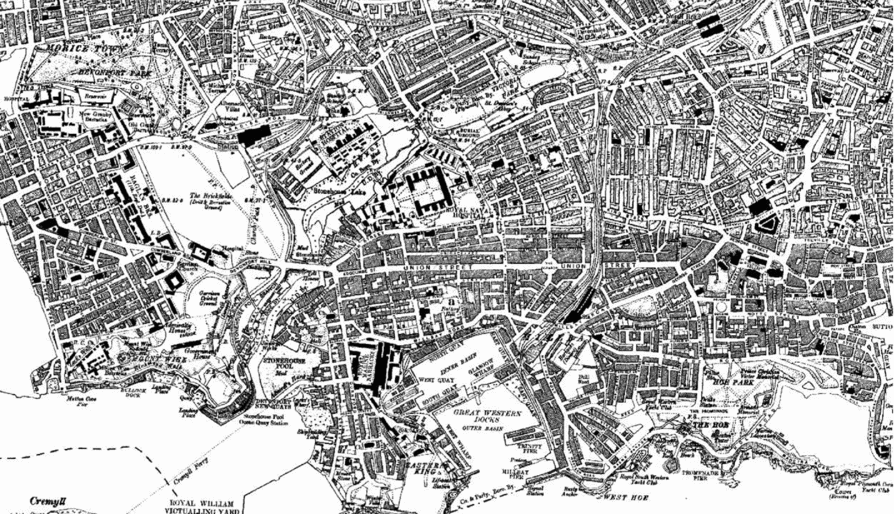
The location of sailortown in both Portsmouth and Plymouth shifted from the central civic areas towards the margins of urban life from the middle of the nineteenth century. This relocation was augmented by new technology and changes to naval recruitment, which fostered new urban spaces of naval activity. With the advent of steam during the early nineteenth century, ships were no longer required to moor off Spithead and, instead, could dock in Portsmouth's main harbour in Portsea.Footnote 39 Similarly, the move from sail to steam had a notable impact on Plymouth's sailortown. By the mid-nineteenth century, the navy's Devonport dockyard expanded to open three docks in a bid to meet the nation's demand for steam power vessels.Footnote 40 Moreover, in 1853, the navy introduced continuous service for ratings.Footnote 41 This significant step in the professionalization of the navy had the effect of removing crimps and also enabled sailors to be housed in hulks in both Portsmouth and Plymouth ports. In addition, Royal naval barracks were built in Devonport in the 1880s, a move which further confirmed sailortown's migration from Plymouth's centre to Union Street. Although sailortown became relocated within only one mile of its traditional home, the transition reflected the increasing importance of the naval base's redevelopment as Union Street was the thoroughfare that connected Plymouth with Devonport (Figure 2). Although the street was constructed for middle-class residence in 1815, the enlargement of the dockyard and the changes in the sailor accommodation led to Union Street becoming the most notorious street in Devonshire.Footnote 42 Indeed, by the mid-nineteenth century, the topography and residential patterns of both ports further isolated sailortown from civic leaders and the middle classes. In Plymouth, the commercial and naval docks lined the shore while the tall fortifications that surrounded Devonport reinforced this physical separation of sea and town. The ridge of high ground that formed the Hoe further ensured that the sea was not visible to those living in the town.Footnote 43 In addition, the residential areas of the middle classes in eighteenth- and nineteenth-century Plymouth were situated on the landward border of the town that faced away from the naval and industrial shoreline.Footnote 44 Similarly, Portsmouth saw distinct districts develop that segregated the garrison and naval districts of Old Portsmouth and Portsea from the middle-class enclave of Southsea. The topography of Portsmouth meant that, unlike Plymouth, the Southsea middle class could embrace the shoreline without encountering hordes of Jack Tars disembarking from ships located on the western side of the coast in Portsea.Footnote 45
Plymouth and Devonport, c. 1900. Union Street was the connecting street between the two districts. © Crown Copyright and Landmark Information Group Limited (2014). All rights reserved. Map of Plymouth 1900.
The fortified harbours of Portsmouth Point and Portsea, c. 1800. Public domain: http://porttowns.port.ac.uk/mapping-waterfront.
The segregation of the middle-class from the working-class and naval districts meant that both Portsmouth and Plymouth had clearly identifiable boundaries to their sailortowns. These areas accommodated the naval dockyard and bases – Portsea in Portsmouth and Devonport in Plymouth – and were, until the mid-nineteenth century, encased by garrison walls. On entering Portsea, the traveller was confronted with commanding fortifications where ‘a sheet of water, called the Mill-pond, intervenes between Portsmouth fortifications and those of Portsea’. Indeed, Portsea's physical separation from the rest of Portsmouth was confirmed to contemporaries by its very different appearance. Standing at the entrance to Portsea, one traveller wrote that surrounding the outside of the walls were green fields and an earthen terrace that is ‘gravelled on the top, and has in many parts rows of fine elms, which contribute eminently to its beauty as a promenade’. This beautiful promenade provided a sharp contrast to the congestion of Portsea. Noting his view at the entrance to Portsea, the observer wrote ‘the interior and exterior are certainly widely different. . .for while the former presents a mass of streets, cooped up within limits incapable of expansion, the latter presents much liveliness and openness of view’ (Figure 3).Footnote 46 Similarly, the naval dockyard in Devonport was surrounded by a garrison wall of up to 40 feet high and encircled by a wide band of grasslands that arched around the whole town. These open expanses were kept free from development by the navy for defensive purposes and were known locally as the ‘killing area’. For many years, the only access to Devonport was via a drawbridge, which further isolated Devonport from the rest of Plymouth and entrenched a spatial ‘Otherness’ about the place.Footnote 47
The fortifications that surrounded naval sailortowns provided a convenient mental map on which Victorian social explorers could impose clear civilizing boundaries and moral geographies. The physical ‘Otherness’ of Portsea and Devonport was exemplified by a sailortown culture, which, to nineteenth-century ‘slum’ explorers, was an alien, primitive and heathen phenomenon. The standard narrative of the ‘slum traveller’ was cast by the social explorers of nineteenth-century London. In London, the West–East fissure, the crisis of civic leadership and urban neglect in the East End escalated into a national debate that triggered similar explorations in Manchester, Glasgow and Leeds.Footnote 48 Sailortown investigations differed subtly from the prolific explorations of London's slums that foretold of misery, death, disease and the lack of civic leadership. Unlike the East End, Portsmouth and Plymouth boasted proud civic traditions that incorporated the Royal Navy's imperial grandeur into the histories of civic development in their respective towns.Footnote 49 If civic leadership was not found wanting, the local authorities concluded that the immorality of sailortown was not merely the result of neglect but was systemic – sustained and driven by the traditions and networks of sailors and civilians.
Operating in clearly defined districts, sailortown institutions such as lodging houses, public houses, brothels and traders facilitated an alternative economic infrastructure and a dynamic sub-culture that was separate and cut adrift from the rest of civilized society. This ‘netherworld’ of vice and excess would rise from the rookeries and courts taking possession of the ‘civilized’ main thoroughfares once a ship had docked, eliciting calls from civic leaders for a moral crusade in the ‘worst’ parts of the port. Footnote 50 One social reformer in Portsmouth challenged landlords and trades people of sailortown to ‘reform the Portsea slums into respectable places so that working-people might live there’. Campaigners hoped to awaken Portsea's ‘civic conscience’ and wanted ‘a healthy patriotism aroused and true civic spirit’.Footnote 51 Indeed, civic leaders were not slow to highlight the irony that behind the dockyard fortifications, which protected Britain's premier military service, there existed working-class and sailor communities that actively flouted middle-class moral conventions and civic improvement. In 1858, one observer noted of the Hard in Portsea:
The scenes which are witnessed here are of the most revolting description. They cannot fail to excite feelings of astonishment and disgust in the minds of those who may occasionally pass by. . .When a ship happens to be paid off in the port, these evils are increased tenfold: The Hard then presents a scene of drunkenness and profligacy which baffles description.Footnote 52
Sailortown seemed a throwback to an earlier age and contravened the municipal schemes in civic enlightenment and citizenship that were the hallmark of towns such as Birmingham, Manchester and Leeds.Footnote 53 For Portsmouth and Devonport, the General Board of Health enquiries in 1851 and 1854 respectively brought matters to a head and sparked a lively debate among the civic elite about what should be done.Footnote 54 Both towns were deemed to be amongst the unhealthiest in Britain and had long suffered from over-crowding, insanitary conditions and outbreaks of cholera in the 1830s and 1840s.Footnote 55 In Portsmouth, deaths from smallpox between 1848 and 1854 were twice as high as Bristol and almost three times higher than Liverpool.Footnote 56 In Plymouth and Devonport between 1841 and 1850, the death rate averaged 25 per thousand, a figure that exceeded the worst industrial towns in Britain.Footnote 57 Indeed, the strategic importance for the nation of both Portsmouth and Devonport was not lost on Robert Rawlinson, the celebrated engineering inspector, who conducted both enquiries. He noted that
Devonport, with the adjoining towns of Plymouth and Stonehouse, are second to no place in the empire in importance. Good sanitary works and regulations become, in this district, of national importance. Soldiers, sailors, and artizans in Her Majesty's establishments are all involved. The strength of a nation consists in the health of the people. It is, therefore, of the utmost importance the ‘three towns’ should be as healthy as human means can make them.Footnote 58
In both Portsmouth and Plymouth, Rawlinson identified the local public bodies as obstacles to sanitary reform and partly to blame for the towns’ high death rates. Not surprisingly, a substantial body of the urban elites in both towns were hostile to the interference of central government and feared the prospect of losing political control over their respective towns.Footnote 59 The civic leaders who rejected Rawlinson's findings believed that a moral crusade against a pernicious sailortown culture would remedy the worst evils in the town. Thus, in Portsea, the poor were lectured to spend ‘less on beer and other drinks and spend more on flannel and coals’ in order that they avoid disease.Footnote 60 In the 1860s, magistrates, clergymen and councillors met in Portsmouth's town hall to discuss how ‘the moral and spiritual condition of the borough may be improved’. Military personnel were seen as the main problem and the meeting called upon the government to establish educational and leisure institutions that would lure men away from the public house and brothel. However, a sceptical Hampshire Telegraph noted that this solution to the problem had been tried and failed ‘some years earlier’.Footnote 61 The civic and military authorities of Portsea and Devonport were keen to improve the moral tone of their towns and explicitly linked the civic cleansing of their communities with the Admiralty's modernization of the navy that had begun in the mid-nineteenth century. Thus, while philanthropists sought to civilize and evangelize these estranged communities, the Admiralty and naval charities sought to save sailors from temptation through new payment systems and the establishment of sailor accommodation and rest homes.Footnote 62
Urban-maritime culture and popular resilience to reform, c. 1850–1900
On entering either Portsea or Devonport, social explorers or religious missionaries were struck by the existence of a peculiar land-based maritime culture that remained steeped in superstition during the second half of the nineteenth century. For these enlightened explorers, the port was vulnerable to the irrational folklore of the sea, which had the propensity to submerge civic progress under a wave of ungodly superstition. One historian of Devonport, writing in 1900, noted that ‘there survived a respectful affection for creepy legends, and ready desire to accept as gospel weird reports of unnatural appearances’.Footnote 63 Similarly, writing in 1911, D.H. Moutray believed that ‘you will find as many ghosts in hustling Portsmouth as in the remotest village’.Footnote 64 Undoubtedly, superstition and the supernatural had traditionally been important in sailors’ lives as they have been described as ‘perhaps the most superstitious order of workmen in world’.Footnote 65 It also played a significant role in providing sailors with a degree of reassurance in what was a dangerous occupation. For example, in 1876, the bishop of Exeter noted of Plymouth sailors:
there were very many who were very bad men, there were a great number who seemed to show not the slightest signs of religion, and perhaps the only time when they manifested any feeling of the sort was at some moment of terrible danger, when one could hardly tell whether it was superstition or religion that really prompted their fears and short, awe-stricken prayers.Footnote 66
Karl Bell has noted that ‘maritime superstitions were ingrained in the mentality of sailors and their families who remained ashore for they served to assuage anxieties relating to the hazards attendant upon life at sea and in naval warfare’.Footnote 67 Moreover, as Land has shown, the eighteenth-century popular conviction that maritime traditions were ‘an inversion of land-bound moral norms’ could be employed by sailors as ‘insubordinate dialogue with a dominant political and cultural system’.Footnote 68
In nineteenth-century contexts, superstition indicated a degree of independence and non-compliance with the civic-religiosity that abounded in municipal authorities. A port town associated with superstition was a potential obstacle in the civic authorities’ and Admiralty's efforts to project a modern town and a professional and empire-building navy. For example, memories of brutal naval discipline survived in Plymouth throughout the nineteenth century with the re-telling of a ghost story related to the notorious Admiral Duckworth, a feared disciplinarian. A few nights after Duckworth's death in the early nineteenth century, a guard in Plymouth fired his gun at what he claimed was the ghost of the admiral who was being ‘hurried away by a dark figure’. It was reported that ‘the explanation that Admiral Duckworth had been fetched by the devil was seriously accepted in the town, and the story was handed down from father to son’.Footnote 69 Reports of ghosts and hauntings in Portsea and Devonport would sometimes result in large impromptu gatherings in streets, which made thoroughfares temporarily impassable. What was described as the hardiest ghost story in Plymouth, due to its consistent reappearance throughout the nineteenth century, was the apparition of ‘Screeching Dolly’. The spectre reportedly haunted an attic room in the town's High Street, where the ‘irrational movements and cries of a figure in white attracted nightly crowds’.Footnote 70 Similar street scenes were witnessed in Portsmouth when, in 1854, reports of a large phantom bird with ‘tremendous horns’ and ‘glaring eyes’ brought people on to the streets and provided a ‘collective form of entertainment’ that was far removed from the rational forms of recreation prescribed by urban elites.Footnote 71 This popular fusion of maritime and urban superstition was recognized by Brickwood Brewery, which, as late as 1881, named a public house after Mother Shipton of Yorkshire, an infamous soothsayer of the early modern period.Footnote 72
The sense that the superstition that thrived in port towns was an impediment to social progress was shared by James Hannay, a sailor-turned-novelist. Writing in 1848, he praised the beauty of the countryside surrounding Plymouth, noting
But morally considered, the society is disagreeable, and there is more vice among the lower orders than in most other towns. To this fact the bishop of the diocese has recently added his testimony. It is a curious circumstance too, that in Plymouth, as in other seaports, the most extravagant sects seem to flourish wonderfully. Portsmouth still boasts some believers in Joanna Southcote, who are greeted on leaving the dockyard, occasionly, by gee-up, shiloh! from the boys. ‘The lethargy of the English Church’ (says Bulwer) ‘is the life of dissent’.Footnote 73
However, in the second half of the nineenth century, there was no lethargy among the religious missionaries visiting sailortowns. In 1862, the Devonport Town Mission was established to extend the knowledge of the gospel to Devonport's poor. On the one hand, Devonport's fortifications had proved a barrier to the dissemination of the gospel's message, while, on the other, the port itself was open to the inward flow of dangerous maritime ideas and superstitions. The Mission reported that it had uncovered a community that preferred to rely on alternative spiritual guidance to that offered by the established church. For families anxious about their seafaring relatives, a spiritualist or white witch could offer more reassurance than the platitudes of a local preist. In 1876, the Mission reported that the heart of sailortown harboured a ‘formidable evil’.Footnote 74 In a later report, it elaborated on this evil:
Some still believe in witchcraft or ‘evil wishing’ as it is called. On visiting a woman in G.S. and finding her room empty I enquired of her neighbours what had become of her. They said she had left ‘and a very good thing it is she is gone, for a very bad woman she is’. Upon asking why they spoke thus ill of their neighbour, they declared she was ‘ill wished’, and would never allow her door to stand open lest anyone should look in upon her. She was in the habit of burning candles with pins stuck into them, and sitting up late at night to keep the evil-wishers down. A man from Stonehouse, known as the white-witch, would frequently call to give her instructions in the art of witchcraft. Another woman whom I visited, and who died a wretched death in M.S was also declared to be a witch, and to have injured families. In all cases I pointed to Him who came to destroy the works of the Devil.Footnote 75
The deep-rooted reliance on alternative belief systems in seafaring communities continued into the twentieth century. Indeed, war-time censorship only accentuated the thirst for information about loved-ones at sea. Portsmouth hosted a thriving spritiualist community in the years that covered the Boer War and World War I, while the Portsmouth spritiutalist Helen Duncan was subjected to the last witchcraft trial in England during World War II.Footnote 76
Religious missions in Portsmouth also provide an insight into sailors’ defiant sub-cultural displays in sailortown and their relations with working-class communities. Sailortowns were often dangerous places where sailors flaunted their signs of difference visually and audibly through their dress and ‘Jackspeak’, a maritime slang cultivated at sea that helped forge sailor identity and courted interest from onlookers on the street.Footnote 77 Aspects of this culture were captured by the missionary, Father Robert Dolling. On entering Portsmouth, he noted that, ‘I recognized that the sailors would be our chief difficulty, our source of danger.’Footnote 78 Sailors and the working-class denizens of the neighbourhood participated in activities that brazenly challenged the Victorian social mores of the day. Dolling recounted that, on his first Sunday afternoon stroll through the district, he witnessed what he termed ‘a Landport Dance’:
Two girls, their only clothing a pair of sailors’ trousers each, and two sailor lads, their only clothing the girls’ petticoats, were dancing a kind of breakdown up and down the street, all the neighbours looked on amused but unastonished, until one couple, the worse for drink toppled over. I stepped forward to help them up, but my endeavour was evidently looked upon from a hostile point of view, for the parish voice was translated into a shower of stones.Footnote 79
Dolling soon learned that the sailortown neighbourhood was accustomed to street revelry and any attempt by the authorities to break up the entertainment would be met with a hostile response. Dolling began work at Portsmouth's St Agatha's Mission in 1885 and established a missionary centre for young sailors, complete with chapel, gymnasium and dormitories. Significantly, he also lived on the premises, got to know the sailors and witnessed their defiant sub-culture at close quarters. Dolling recognized the young sailors’ ‘special desire to play the man’ and parade their maritime identity in port.Footnote 80 Sailor bravado was fused with their enthusiasm for re-telling maritime stories gathered from foreign lands that intentionally breached land-based morals. Dolling was aghast and clearly taken in by his sailor boys’ tales and worried that in Portsea ‘it is no uncommon thing to find one who eats raw meat and drinks blood’.Footnote 81 This sub-culture was fuelled by the sailors’ transitory experience and it was a trait that sailors were keen to exhibit. Although many of the young sailors returned to use the house, Dolling complained that they never kept in contact and thrived on their random and unannounced appearances. In addition, he wrote that sailors were likely to enter the house with ‘some impossible gifts – “curios” they would call them – sometimes a monkey, sometimes a bird’, adding that they would often astonish him by entering his study with stories of their sins.Footnote 82 Thus, not only clothes and language marked out a sailor's maritime identity on land, but their ‘curios’ gave their sub-culture a visible sense of the exotic on the streets of sailortown. The young sailors’ casual discussion of ‘their sins’ also indicates that they had formed a very different moral framework to traditional middle-class and working-class communities.
It was perhaps the issue of prostitution that most clearly marked the unconventional moral boundaries between those who lived in sailortown and those who resided in its urban hinterland. In traditional working-class communities, women were often barred from the public house and women who openly engaged in prostitution were often shunned by their neighbourhood.Footnote 83 However, sailortown fostered a moral framework in which the visibility of women on the streets and in the public houses was the convention. Margaret Hunt has shown that naval wives grouped together publicly to confront the Admiralty over pay, exercising a public freedom that was denied their husbands. Indeed, she argues that the sailors’ long absence from home and erratic lifestyle gave an ‘especially strong incentive for women to develop independent sources of income’.Footnote 84 The ubiquity of women on the streets and in the public houses inevitably drew comments from social commentators. Dolling noted that ‘girls sinned because their mothers had sinned before them, often their grandmothers too, unconscious of any shame in it, regarding it as a necessary circumstance of life.’Footnote 85 The normalization of women drinking in public and prostitution prompted Dolling to complain that when ashore, sailors often returned to the same prostitute. He noted that, ‘sometimes I have known sailors to marry those whom they knew had been bad characters’.Footnote 86 Sailors would often get to know prostitutes and cite their ‘kindness’ as they were ‘always willing to help you’, with one sailor countering the popular perceptions of prostitutes by insisting they were ‘good women’.Footnote 87 When Dolling asked the sailors why they had married ‘fallen women’, they replied, ‘“Oh! The girl was unhappy; I thought I would make a home for her” or “I was afraid she might go wrong” or “even I wanted someone to leave my half-pay with”.’Footnote 88 Henry Mayhew found similar arrangements in London's sailortown as one prostitute told him that ‘I know very many sailors – six, eight, then oh! More than that. They are my husbands. I am not married, of course not, but they do think me their wife whilst they are on shore.’ She added that she looked after their money as ‘It [is] very bad for [a] sailor to keep his money himself; he will fall into bad hands.’Footnote 89
Both the sailors and the civilians who lived and worked in sailortown shared a vested interest in challenging any attempts to reform the district. One sailor recalling his time in Portsmouth in the early 1900s observed that, ‘we got on very well with the people of Portsmouth. Before I was married I would rarely go back aboard, I would always stay out ’till 6 in the morning.’Footnote 90 This relatively close relationship between civilian and sailor would also explain why working-class naval communities were some of the strongest opponents to the Contagious Diseases Acts of the 1860s.
The attempt by the state and civic authorities to reform sailortown through measures such as the 1864 Contagious Diseases Act was met with stubborn resistance locally. Significantly, in both Portsmouth and Devonport, councillors, the Admiralty and the local press strongly supported the Act. For example, the Portsmouth News proclaimed that ‘we have not the slightest hesitation in affirming that the Act is an unmixed good’.Footnote 91 In Plymouth, it was reported that the magistrates ‘were unanimously in favour of the Acts’, while the Reverend C.T. Wilkinson, vicar of Plymouth, believed that ‘the Acts have reclaimed many women, and the influence of the hospitals is good’.Footnote 92 They were supported by the management committee of the Royal Albert, a lock ward hospital, which stated that they could ‘see no reason whatever to alter their original opinion as to the general beneficial tendency of these acts’.Footnote 93 However, in a meeting convened to oppose the Act in Portsea in 1870, the Hampshire Telegraph described a large attendance, ‘which was, for the most part, of the working class and was composed almost entirely of males’ who were ‘eager for the fray’. Speakers criticized the authorities’ interference within sailortown on the grounds that the law was ‘one-sided tyrannical and iniquitous’ which ‘infringed liberty’. The mood of the meeting was captured by the Reverend J. Osborne of Southampton who, playing to the audience, declared that ‘this was a class legislation’ and that ‘the police was principally directed to dressmakers and the wives and daughters of working men who were compelled to be out late (cries of “Shame”)’. He added that poverty was the chief cause of prostitution and that women, if they could, ‘would gladly leave such a life’.Footnote 94 One contributor who spoke in favour of the law was ridiculed for his middle-class background and naivety regarding port-town life. It was reported that: ‘Mr Smith said in his travels through the town – (cries of “sit down” “Take the plum out of your mouth” &c.) he had been through some of the darkest alleys of the town (a voice: “What for?”), and he believed much of the prostitution of the town was connected to drink (Cheers).’Footnote 95 Mr Smith's contribution encapsulated the audience's view that the authors of the Act had no understanding of the social relations of sailortown and how poverty and sailortown life created grey areas between prostitution and working-class respectability. In addition, prostitutes in the sailortown districts of Portsea protested ‘riotously’ and paraded against the Act in the main thoroughfares of the town on a number of occasions.Footnote 96 In Plymouth, Lucy Ball, the matron of the Royal Albert Hospital, noted how women subverted the intentions of the Act, transforming the humiliating and intrusive examination procedure into a defiant public performance.Footnote 97 Observing their behaviour on entering the examination rooms, Ball noted that:
The women are not nearly so well behaved as formerly, and are less amenable to discipline. . .They often drive up in cabs accompanied by ‘respectable men’, who wait outside for the women. The women often go off shouting and singing. They assume rights, as if protected by the Acts, and call themselves ‘Queen's women’. The number reclaimed is much smaller than it was under the voluntary system.Footnote 98
Since the women were usually accompanied by ‘respectable man’, it would suggest that these women were part of an organized form of prostitution that was endemic in sailortown. However, while the Contagious Diseases Act cast prostitution as a fixed profession, the reality for many women was that prostitution was a temporary and transitory experience. As Catherine Lee has noted, prostitutes were drawn from the ‘labouring poor who lived on their wits, employing opportunistic and often self-directed strategies for self-preservation’.Footnote 99 The Act had the potential severely to disrupt women's survival strategies and sailortown's economic infrastructure, which was composed of public houses, music halls, lodging houses and brothels.Footnote 100 These institutions afforded the reciprocal civilian and sailor relationship. An important financial nexus and a considerable amount of interdependency were forged between civilians and sailors in these key institutions, which were concealed from the gaze of the authorities. Thus, sailors who had fallen into trouble or had deserted from the service relied on the secrecy of public houses or lodging houses to plan their escape. For example, in 1867, three sailors, Charles Forrett, Charles Silvester and Benjamin Johnson from Portsea, relied upon the landlord of the ‘Who’d Have Thought It’ public house, a well-known and ‘low’ establishment, and a number of prostitutes to facilitate their flight from Portsea. Aided by Kate Millet, Ester McCarthy and Eliza Burningham, the three women promised to sell their sailor uniforms and provide replacement civilian clothes. It was reported that: ‘The three lads took off their clothes, which were new, and worth it was said, about 2l and 1s a suit. The lads were taken to an upstairs room, where every article of clothing was taken from them, and they were wrapped in blankets and detained until nine in the evening.’Footnote 101 In the meantime, Millet, McCarthy and Burningham made some considerable profit by pledging or selling the sailors’ clothes in local pawn and clothes shops. Although the men successfully left Portsea in disguise, they were apprehended in nearby Petersfield. Millet, McCarthy and Burningham were fined between £6 and £10 each and sentenced to between three and four months of hard labour.Footnote 102
The civilian and sailor interdependency was also put at risk by ‘outsiders’ to sailortown who were ignorant of its land-based maritime culture or actively hostile to it. For example, in naval and garrison towns such as Portsmouth and Devonport, tensions could rise between sailors and soldiers that not only damaged the reputation of the town, but also disrupted the reciprocal relationship between sailors and civilian residents in sailortown. In 1850, Portsea endured three days of rioting when sailors from the HMS Fox and soldiers from the 50th regiment clashed in the main thoroughfare of Queen Street. It was reported that: ‘The soldiers had got possession of the town, attacking every sailor they met, and beating them most cruelly. A large number of windows of public houses frequented by the two parties, have been demolished by their respective enemies.’Footnote 103 Over 100 men took part in the rioting, which only ceased when the soldiers were ordered to stay away from Portsea and sailors on the Fox were detained on their vessel. However, the Hampshire Telegraph reported that, the following evening, ‘about 200 seamen, of different ships, came ashore. . .armed with boats’ stretchers and other weapons, and at one time there were 2000 people in Queen Street’.Footnote 104 Gangs, armed with heavy bludgeons, ‘searched the different beer-houses for the men of the 50th regiment but as they had been prevented from coming into Portsea very few were found’.Footnote 105 Due to the absence of soldiers, there was no further rioting, although, of the five people arrested for obstructing the police, two were sailors, and three others were civilians; that is, two labourers and one man deemed ‘respectable’. While such an incident was an embarrassment for the civic and military authorities, the Portsea riots indicate that the 200 sailors and almost 2,000 Portsea residents joined forces to challenge the soldiers’ right to enter the district. The rioting had clearly interrupted the business of sailortown to the detriment of both the sailors and Portsea residents. Indeed, the incident illuminates the interdependency and understanding that existed between sailors and residents of sailortown.
Conclusion
Naval towns such as Portsmouth and Plymouth were constructed both to function as a military base and to symbolize the power and authority of the navy. The fortifications that dominated the naval districts and the ‘killing’ ground that separated the naval area from the rest of the town gave visitors an impression of a town shaped by military discipline. This is one reason why historians have tended to exclude naval towns from their analysis of sailortowns in Britain. However, if one were to peer beyond these battlements, a very different picture emerges. At the heart of Portsmouth and Plymouth during the early nineteenth century, a coarse and excessive sailortown culture flourished. This sailortown culture cultivated an alternative moral framework, was a spectacle in its own right and was tolerated by the civic and naval authorities in the first half of the nineteenth century. Sailortown emerged once a ship had docked, submerging from view once the sailors had departed for sea. Indeed, like the traditional carnivalesque leisure of the early nineteenth century, sailortown was subject to the Victorian moral gaze and eventually migrated to the margins of urban life. However, while the traditional carnival represented a temporary suspension of moral norms, sailortown spectacles were a public insight into alternative conventions of the district. By the 1850s, sailortowns in both Portsmouth and Plymouth fostered an urban-maritime culture that was shared and recognized in other naval towns. Thus, sailors who stepped ashore in either Portsmouth or Plymouth continued to recognize and negotiate their way through the spectacles, traditions and services that sailortown districts had to offer throughout the nineteenth century and beyond.
The resilience of sailortown was sustained into the twentieth century with Plymouth's Union Street continuing its tradition as the most notorious street in Devonshire, while Portsmouth's sailortown gravitated towards the Commercial Road district of the town. In the 1890s, Portsmouth had developed a new civic square complete with town hall and civic buildings. By the early 1900s, new naval barracks were established in nearby Queen Street and entertainment venues began to open near the town hall. In an ironic twist, sailortown had spilled out from its nineteenth-century confines into the heart of the civic centre. By day, the town hall square was the symbolic starting point for civic parades. By night, the civic buildings were consumed by sailortown and the civic parades were replaced by the infamous ‘prostitutes’ parade’.Footnote 106 Such was the resilience and appropriation of sailortown.