Introduction
Preimplantation genetic testing for aneuploidies (PGT-A) is a technique used to identify aneuploidy in embryos and has been demonstrated to improve pregnancy rates for the following indications: (i) advanced maternal age; (ii) repeated IVF failure; (iii) recurrent miscarriage; and (iv) testicular sperm extraction (Kang et al., Reference Kang, Hsiao, Chen and Wu2018). Recently, protocols using next-generation sequencing (NGS) (Xie et al., Reference Xie, Tan, Li, Lin, Jiang, Chen, Zhang, Gong, Pan, Chen, Lu, Wang and Zhang2013; Wells et al., Reference Wells, Kaur, Grifo, Glassner, Taylor, Fragouli and Munne2014) have been developed for single cell analysis and applied to single blastomeres biopsied from IVF embryos. PGT-A facilitates embryo selection for transfer, thereby reducing recurrent miscarriage rates (Yang et al., Reference Yang, Liu, Collins, Salem, Liu, Lyle, Peck, Sills and Salem2012; Ikuma et al., Reference Ikuma, Sato, Sugiura-Ogasawara, Nagayoshi, Tanaka and Takeda2015), whilst increasing implantation and pregnancy rates (Scott et al., Reference Scott, Upham, Forman, Hong, Scott, Taylor, Tao and Treff2013; Forman et al., Reference Forman, Hong, Franasiak and Scott2014). However, other factors related to embryo physiology affect substantially the post-transfer success of euploid embryos (Dang et al., Reference Dang, Vuong, Ho, Ha, Nguyen, Truong, Pham, Wang, Norman and Mol2019). Embryo metabolism is essentially governed by mitochondria that provide the needed energy for development and division (Dumollard et al., Reference Dumollard, Duchen and Carroll2007). As mitochondrial replication does not occur until after implantation, mature oocytes, zygotes, and early cleavage stage embryos are dependent on the function of the mitochondrial pool present at ovulation (Spikings et al., Reference Spikings, Alderson and St John2006). Good quality oocytes contain optimal mitochondrial numbers and sufficient levels of ATP (van Blerkom et al., 1995) and produce higher quality blastocysts after fertilization (Lin et al., Reference Lin, Huang, Wu, Cheng, Chen and Lee2004). The number of mitochondria within cells is often an indication of their activity. The more active the mitochondria, the more ATP is generated and the healthier are the oocytes and embryos (Larsson, Reference Larsson2010). As mitochondria produce ATP they release reactive oxygen species (ROS) locally that must be detoxified as ROS can induce oxidative damage to mitochondrial DNA (mtDNA). This damage results in mutations and deletions in mtDNA. The relative absence of repair enzymes for mtDNA may explain its sensitivity to oxidative stress-induced damage (Yesodi et al., Reference Yesodi, Yaron, Lessing, Amit and Ben-Yosef2002). An accumulation of mutations in mtDNA may limit energy production (Zakharova et al., Reference Zakharova, Zaletova and Krivokharchenko2014). As a result, the cell has a decreased capacity to support all cellular events. Assessment, in each embryo, of its mtDNA content and quality could be a useful indicator of that embryo’s potential to implant. To the best of our knowledge, this report is the first application of mitochondrial genome quantification in euploid blastomeres biopsied 80–85 h post ICSI. Our data demonstrate a positive correlation between mtDNA quantity and pregnancy rate, therefore providing a biochemical means of stratifying embryos according to mitochondrial status and the likelihood of establishing pregnancy.
Materials and Methods
Study group
In total, 265 embryos from 53 patients who had an average age of 35 years old, and who underwent ovarian hyperstimulation and IVF treatment by fresh embryo transfer at the Women’s Health Fertility Centre, Jeddah, Kingdom of Saudi Arabia, were selected for this study. Embryos were biopsied for PGT-A using NGS. Biopsy was performed at the 16 cell-stage to the compaction stage of preimplantation development, estimated to be between 80 and 85 h post ICSI (Zakharova et al., Reference Zakharova, Zaletova and Krivokharchenko2014). Euploid embryos were transferred on day 5. Patients were classified as ‘Pregnant’ or ‘Non-pregnant’, from this point forwards called Group I and Group II, respectively, according to whether a viable pregnancy was confirmed ultrasonographically by the demonstration of fetal heart beats. Men with normal semen parameters, according to WHO 2010, in their fresh ejaculates were included in the study. Patients with subnormal or abnormal parameters or testicular extracted spermatozoa were excluded from both study groups to minimize any variation in implantation failure factors that might interfere with the results.
Clinical protocol
Controlled ovarian stimulation (COS) was achieved for both groups of patients using recombinant follicle-stimulating hormone (rFSH)/human FSH or highly purified (HP)-hFSH/rFSH + human menopausal gonadotropin (hMG) in various flexible protocols.
In the luteal phase long gonadotrophin-releasing hormone agonist (GnRH-a) protocol, patients were administered a daily injection of 0.1 mg triptorelin for 14 days or a single 1.3/1.8 mg triptorelin injection during the midterm-luteal phase of the previous menstrual period, followed by rFSH (GONAL-f; Merck Serono, Geneva, Switzerland/Purigon; Organon, Oss, The Netherlands)/human FSH (Fostimon®, HP-hFSH, IBSA Pharmaceuticals, Italy) with or without hMG (Merional®, HP-hMG, IBSA Pharmaceuticals, Italy).
In the follicular phase long gonadotrophin-releasing hormone agonist (GnRH-a) protocol, patients underwent pituitary downregulation and were given 3.75-mg of triptorelin acetate or leuprorelin acetate on the first day of the cycle, followed by rFSH/HP-FSH or in combination with hMG 28–35 days later. In the short protocol cycle, patients received GnRH-a from the second day of the menstrual cycle onwards, then rFSH/HP-FSH alone or in combination with HMG on the third day. Patients started with rFSH/HP-FSH treatment on the second day of the cycle by a once daily injection in the antagonist protocol, and follicle development was monitored by vaginal ultrasound.
After 4–5 days of stimulation, the antagonist (cetrorelix acetate or ganirelix acetate) was administered once daily. The rFSH/HP-FSH dose was adjusted according to the individual’s ovarian response, with a limitation for maximum dose of 225 IU daily; patients who were given higher doses were excluded from both groups, and were assessed by daily ultrasound examinations. The antagonist administration continued up to and including the day of human chorionic gonadotropin (hCG) administration. In the antagonist stimulation protocol, on days 2–6 of the cycle patients were administered a rFSH/HP-FSH/hMG (150–225 IU/day) injection once daily.
Follicle development was monitored by vaginal ultrasound on day 8 of the cycle. An antagonist (cetrorelix acetate or ganirelix acetate) was administered once daily. The rFSH/HP-FSH/hMG dose was adjusted according to the ovarian response, which was assessed by daily ultrasound examination. In all treatment protocols, when at least two leading follicles reached 18 mm in size, ovulation was triggered by administering 250 μg of r-hCG (Merck Serono S.p.A) or 5000 IU IM of hCG (Choriomon® IBSA Pharmaceuticals, Italy); ovum pickup (OPU) was subsequently performed 36–40 h later. Luteal phase support was started on the same OPU day with 100 mg progesterone vaginal suppositories twice daily up to at least 15 weeks of gestation.
Embryo culture and transfer were carried out post OPU within 5 min; a 30-s exposure to a dilution of 20 IU/ml hyaluronidase® (ART, 4007-A Origio-Sage medium, Cooper Surgical, Trumbull, CT, USA) was given to each collected oocyte and denudation was performed, starting with a 170-µm stripper until most granulosa cells had been removed and the polar body became distinguishable. ICSI Cumulase® Origio (Origio Specialty Pharma, Denmark) was used in all patients to reduce the traumatic effect that may have been generated during decumulation (Metwalley et al., Reference Metwalley, Brasha, Esteves, Fawzy, Brasha, Hellani, el Hamshary and Khamiss2020).
The collected oocytes were transferred to a new pre-equilibrated cleavage medium-containing dish (Origio® Sequential Cleave™, with phenol red) to maintain the denuded oocytes until ICSI procedure. The husband’s semen was prepared using the density gradient technique (Mortimer, Reference Mortimer1991). The injected oocytes were incubated individually in microdrops of pre-equilibrated cleavage medium (Cooper Surgical, Trumbull, CT, USA) covered with prewashed culture oil. At 18 h post ICSI, oocytes were checked for the presence of two pronuclei, confirming a normal fertilization. A continuous culture was sustained for 4 days, with a single embryo per drop.
Once the morula had started to form, within 80–90 h post ICSI, embryos were biopsied in Ca2+/Mg2+ free medium (Biopsy Medium, 10620010, Origio®) with the aid of a laser beam. Post biopsy, embryos were shifted to new culture dishes containing blastocyst culture medium (Origio® Sequential Blast™). Euploid embryos were transferred at the blastocyst stage on day 5 using a Labotect embryo transfer catheter (Labotect Embryo Transfer Catheter Set, Ref. 320201; Labotect GmbH, Labor, Technik, Göttingen, Germany).
At 12 days after embryo transfer, serum hCG was evaluated. Six weeks later, implantation was confirmed by a positive fetal heartbeat detected via an abdominal or transvaginal ultrasound. The day 5 embryos were scored according to ESHRE guidelines, and the transfer was only carried out for the high-grade embryos either AA, AB or BA for inner cell mass and trophoectoderm, respectively (Alpha Scientists In Reproductive Medicine and ESHRE Special Interest Group Embryology: Balaban et al., Reference Balaban, Brison, Calderon, Catt, Conaghan, Cowan, Ebner, Gardner, Hardarson, Lundin and Magli2011a, b).
Sampling and blastomeres tubing
After biopsy, blastomeres were kept in the same dish that had a label for each drop that represented the embryo ID. Using safe-lock micro-Eppendorf 0.2-ml tubes (EP0030124359-960EA Eppendorf® PCR tubes), containing 3.0 microns of phosphate-buffered saline (PBS), each cell was washed with cleavage medium then loaded into the prelabelled microtubes to be sent to a genetics laboratory for further processing.
Multiple Displacement Amplification (MDA) protocol
One blastomere per embryo was collected in a 0.2-ml PCR tube containing 5 µl of PBS. A separate tube containing only PBS served as a negative control to monitor any potential contamination. Here, 3 μl of alkaline buffer (ALB; 200 mM NaOH, 50 mM DDT) (Lin et al., Reference Lin, Huang, Wu, Cheng, Chen and Lee2004) were added to each sample, including the negative control. After incubation (15 min at 4°C), 3 µl of neutralization buffer (3 µl: 900 mmol/l Tris–HCl, 300 mmol/l KCl, 200 mmol/l HCl) were added. Total cell lysates were subjected to whole genome amplification (WGA) using MDA technology as per the manufacturer’s instructions (Repli-G, Qiagen, Germany). The amplification mixture was incubated at 31ºC for 2 h and MDA yields were quantified using the Qubit dsDNA HS Assay Kit (Life Technologies, USA).
Next-generation sequencing (NGS)
Aneuploidy testing
For the preparation of multiplexed libraries, 1 ng of each sample was used to generate dual-indexed libraries using the VeriSeq PGT-A Library Preparation Kit (Illumina, USA) and sequenced on a MiSeq system with 50 single-read cycles. Raw sequence data were analyzed using the Illumina MiSeq Reporter. The generated BAM files were subsequently processed using Blue Fuse Multi Analysis Software (Illumina) to produce a karyotype report.
mtV score
The relative quantity of mtDNA was determined from the BAM files subjected to the web-based genome-analysis tool Galaxy (Blankenberg et al., Reference Blankenberg, Von Kuster, Coraor, Ananda, Lazarus, Mangan, Nekrutenko and Taylor2010; Goecks et al., Reference Goecks, Nekrutenko, Taylor, Afgan, Ananda, Baker, Blankenberg, Chakrabarty, Coraor, Goecks, von Kuster, Lazarus, Li, Taylor and Vincent2010), independently validated for mitochondrial DNA investigations (Goto et al., Reference Goto, Dickins, Afgan, Paul, Taylor, Makova and Nekrutenko2011; Zhidkov et al., Reference Zhidkov, Nagar, Mishmar and Rubin2011; Weissensteiner et al., Reference Weissensteiner, Forer, Fuchsberger, Schöpf, Kloss-Brandstätter, Specht, Kronenberg and Schönherr2016). In brief, using hg19 from the rCRS database (revised Cambridge Reference Sequence) as the reference genome, the total number of mapped sequence reads was extracted using SAMtools Flagstat. SAMtools Idxstats was used to determine the number of mapped reads per chromosome. To calculate the relative abundance of mitochondrial DNA or mitochondrial viability ratio (mtV), we applied the following equation:
 $$1000 \times \left( {{\rm{mtDNA \;reads}}} \right)/\left( {{\rm{total \;reads}}} \right)$$
(mtDNA-Server_next-generation sequencing data analysis of human mitochondrial DNA in the cloud_Enhanced Reader, n.d.). Equation (1) gives the mtV ratio, which is the formula used to calculate the abundance of mtDNA relative to the total number of genomic reads.
All mtV ratios were expressed as multiple of mean (MoM) values by dividing each mtV ratio by the mean mtV value. Statistical analyses were performed using Microsoft Excel v.14.0 and IBM SPSS Statistics V22.
Results
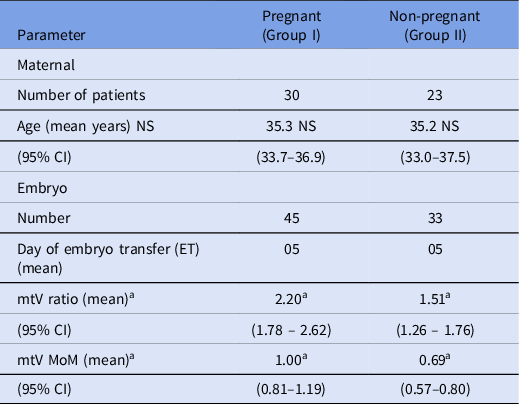
Fifty-three patients underwent IVF treatment for management of infertility (Table 1) followed by PGT-A. In total, 78 out of 265 embryos were chromosomally euploid and transferred at the blastocyst stage. Of these, 45 (51.3%) embryos resulted in establishment of pregnancy in 30 (56.6%) women. Conversely, 43.3% of women failed to conceive after transfer of euploid embryos. After transfer of a single embryo, a singleton pregnancy was successfully established in 18 women (60.0% of all pregnancies). Transfer of two embryos resulted in 11 women (36.7%) with twins and transfer of three embryos resulted in one woman (3.3%) with triplets. There was no significant difference in mtV ratios between embryos that resulted in a singleton or multi-fetal pregnancies. Therefore, for women who conceived after embryo transfer, mtV ratios for all embryos transferred were pooled and treated as a single ‘Pregnant’ group (Group I). Similarly, for women who failed to conceive, mtV ratios for all transferred embryos were pooled for statistical analysis into the ‘non-pregnant’ group (Group II; Table 1).
Demographics for patients and embryos included in mtV study

Non-pregnant, transferred embryos which failed to establish pregnancy. Pregnant, pregnancy established after embryo transfer. NS, not significant.
a P < 0.001.
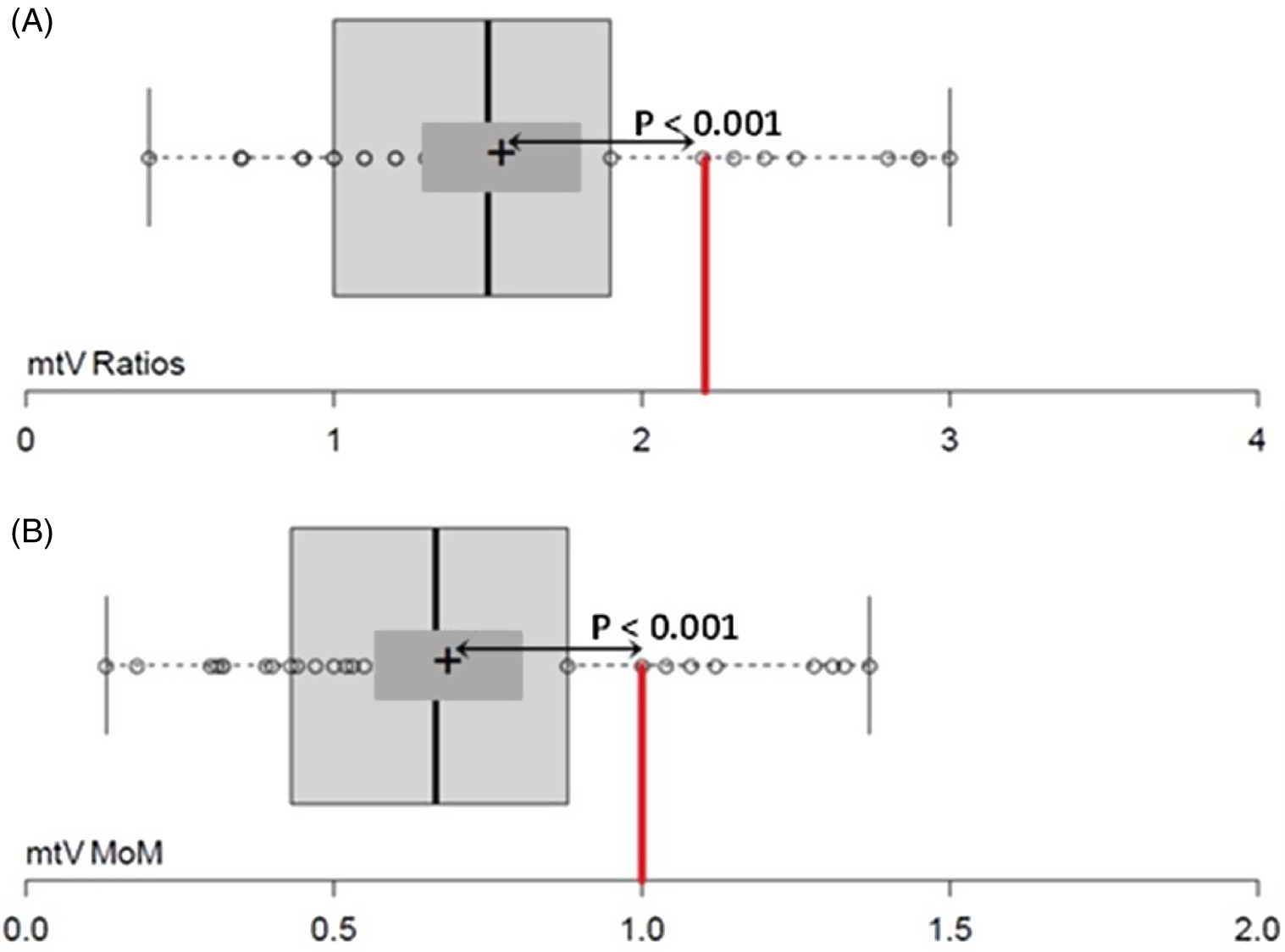
Mean mtV values for Group II (1.51; 1.26–1.76 95% CI) were significantly lower than the mean mtV values for Group I (2.20; 1.78–2.62 95% CI). Similarly, mtV MoM values were significantly lower (P < 0.001) in blastomeres biopsied from embryos that failed to establish a pregnancy compared with blastomeres derived from embryos that established a pregnancy (Figure 1).
Box plots (median ± quartiles) comparison of mtV ratios (A) and mtV MoM values (B) for embryos which failed to establish pregnancy against respective mean values (red line) for embryos which succeeded to establish pregnancies. + = Mean and Shaded (box about +) = 95% CI for mean.

mtV ratios and MoM values of Group II embryos were significantly (P < 0.001) decreased when compared with respective values for embryos from Group I (Figure 1). As demonstrated by the distribution of embryos that failed to establish pregnancy (Figure 1B), 76.5% had mtV MoM values below 1.0 MoM (mean for embryos that proceeded to implant and establish pregnancy).
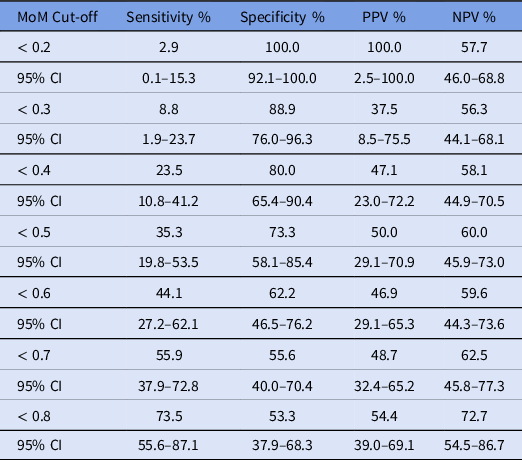
At various MoM cut-offs, clinical performance of mtV MoM estimation was demonstrated (Table 2). As mtV MoM cut-off increased, the clinical performance (sensitivity) was improved, as seen as the greater proportion of embryos that failed to establish a pregnancy. However, the increased detection rate came at a cost, that is, a fall-off in specificity. As the mtV MoM cut-off increased from 0.3 to 0.8 MoM, the positive predictive value (PPV) increased by 45.1% and negative predictive value (NPV) also increased by 29.1%. The selection of action limits is a balance between true detection and false-positive rate (or specificity).
Clinical performance of mtV MoM values in outcome prediction after embryo transfer

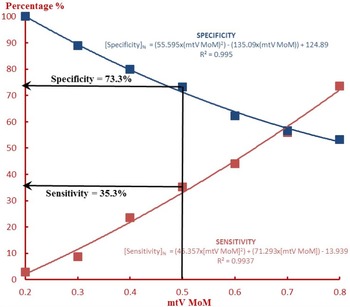
At a cut-off of 0.5 MoM (Figure 2), the sensitivity (or detection rate) was 35.3%, that is 35.3% of embryos that failed to establish a pregnancy would be correctly identified. The PPV at 0.5 MoM cut-off was 50.0%, that is, for a transferred embryo with mtV MoM < 0.5 MoM, there is a chance of one in two of failing to establish a pregnancy. Conversely, for mtV > 0.5 MoM, this embryo had a 60% chance of establishing a pregnancy.
Clinical (sensitivity, specificity) parameters of mtV analysis expressed as multiple of mean (MoM).

Figure 2 summarizes the inverse relationship between clinical sensitivity and specificity, at various mtV MoM action limits. As with many screening programmes, a common cut-off is often established at 0.5 MoM. For Group II embryos (non-pregnant), 35.3% would have been correctly identified. Of all the embryos with mtV values < 0.5 MoM, 50.0% of them failed to establish a pregnancy after transfer. Conversely, for embryos with mtV values > 0.5 MoM, 60% established pregnancies after transfer.
Discussion
These data demonstrated the potential of mtDNA assessment as an additional prognostic marker to improve the embryo evaluation process for patients undergoing IVF. Quantification of mtDNA was obtained by embryo biopsy at 80–85 h after ICSI and analyzed by NGS after MDA showed a positive association between post embryo transfer outcome and mtDNA scores. Low mtDNA levels were associated with poor outcomes after embryo transfer. Recent publications on the regulatory approval for ‘three-person’ embryos (Reardon, Reference Reardon2016; Vence, Reference Vence2016) has cast the spotlight on the role of mitochondria in ART treatment for infertility and mitochondrial diseases. However, published data on mtDNA and oocyte and embryo quality are confusing and contradictory. Decreased (van Blerkom et al., 1995; Dumollard et al., Reference Dumollard, Duchen and Carroll2007; Cree et al., Reference Cree, Samuels, de Sousa Lopes, Rajasimha, Wonnapinij, Mann, Dahl and Chinnery2008) and increased (Diez-Juan et al., Reference Diez-Juan, Rubio, Marin, Martinez, Al-Asmar, Riboldi, Díaz-Gimeno, Valbuena and Simón2015) levels of mtDNA have been associated with compromised embryo development and the reduced likelihood of establishing a pregnancy. Other studies have reported a nonsignificant effect of mtDNA levels on neither embryo quality nor pregnancy outcomes of ART cycles (Diez-Juan et al., Reference Diez-Juan, Rubio, Marin, Martinez, Al-Asmar, Riboldi, Díaz-Gimeno, Valbuena and Simón2015; Victor et al., Reference Victor, Brake, Tyndall, Griffin, Zouves, Barnes and Viotti2017; El-Damen et al., Reference El-Damen, Elkhatib and Fatemi2021). This contradiction is partly attributable to different molecular methodologies and/or study designs (Lin et al., Reference Lin, Huang, Wu, Cheng, Chen and Lee2004). Confounding factors, such as viable fetal number less than the number of embryos transferred, were excluded from this dataset. However, because the focus of study was mtV DNA and embryo physiology, the study group was not stratified according to causes of female infertility. Therefore, the failure to implant and establish pregnancy was not solely due to embryo genetic and metabolism abnormalities, but should also include maternal factors, such as a non-receptive endometrium (Enciso et al., Reference Enciso, Aizpurua, Rodríguez-Estrada, Jurado, Ferrández-Rives, Rodríguez, Pérez-Larrea, Climent, Marron and Sarasa2021). An assessment of endometrium receptivity, in conjunction with mtV score, would provide a more comprehensive prognostic assessment of the likelihood of establishing a pregnancy for patients undergoing ART plus PGT-A.
A potential physiological explanation maybe heteroplasmy, that is the presence of two or more variants of mtDNA within the same cell. An example of heteroplasmy is the presence of healthy intact (deletion free) mtDNA, as confirmed by MDA/NGS and mtDNA with deletions. Analysis by qPCR amplifies all the populations present in heteroplasmy with a resultant interpretation of being a function of relative abundance of wild : mutant mtDNA (Goto et al., Reference Goto, Dickins, Afgan, Paul, Taylor, Makova and Nekrutenko2011; Zhidkov et al., Reference Zhidkov, Nagar, Mishmar and Rubin2011). We furthermore speculated that quantification of the mtDNA by MDA takes into consideration the entire, rather than targeted, sequences of the mitochondrial genome. Consequently, only mtDNA free of deletions was detected by MDA and NGS in which the mixed pool was amplified by real-time PCR or SurePlex. Our unreported data demonstrated a limited inverse relationship between the common deleted area in the mitochondrial genome (ΔmtDNA4977) and pregnancy rate after the transfer of euploid embryos.
Our data did not show any statistically significant correlation between mtDNA and maternal age. We attributed this to either internal oocyte physiology and the regimen of ovarian controlled hyperstimulation and/or a limitation of low number in the patient cohort. Current results support the tenet that more viable mitochondria are conducive to better outcomes after embryo transfer. Our findings are consistent with the concept that healthy mitochondria, as determined by mtV MoM values, are potential prognosticators of post-transfer outcomes (Oktay et al., Reference Oktay, Bedoschi, Pacheco, Turan and Emirdar2016). As indicated previously, mitochondrial replacement therapy (MRT) was recently approved by some regulatory bodies (Vence, Reference Vence2016). Although MRT is intended to be provided to women with mitochondrial disorders, it does support our results in which more mitochondria, especially healthy homoplastic ones with mtV DNA > 0.5 MoM, are beneficial to the embryos (Claiborne et al., Reference Claiborne, English and Kahn2016). Current pregnancy rates for ART patients undergoing embryo biopsy for PGT-A ranged from 31.6% and 40.8% (Lee et al., Reference Lee, Chow, Lau, Yeung, Ho and Ng2015; Enciso et al., Reference Enciso, Aizpurua, Rodríguez-Estrada, Jurado, Ferrández-Rives, Rodríguez, Pérez-Larrea, Climent, Marron and Sarasa2021). In this small study, 57.7% of biopsied embryos tested by PGT-A analysis led to established pregnancies. This study was designed to clarify the relationship between mtV levels and embryo quality, as determined by the establishment of a clinical pregnancy. In conclusion, although the sample size in the current study is limited, our results unambiguously demonstrated that whole genome analysis of mtDNA by NGS could statistically discriminate between embryos that established, and those embryos that failed to establish, pregnancies. By normalizing raw mtV values against the mean mtV value for embryos that established pregnancies, we have developed a means of assessing the chances of a biopsied euploid embryo establishing a pregnancy after transfer. At an mtV MoM cut-off < 0.5 MoM, our post-test chance of correctly identifying embryos with poor mitochondria and that were unlikely to establish pregnancy was increased by 20%. Conversely, at the same mtV cut-off of > 0.5 MoM, post-test chance of an embryo to implant and establish a pregnancy had increased to 60%. This percentage could be substantially improved if patients were further evaluated for maternal factors implicated in implantation failure.
Ethics statement
The studies involving human cells and embryos were reviewed and approved by Ethics Committee of Eed Clinic and Women’s Health ART unit, Jeddah -KSA. The patients/couples provided their written informed consent to participate in this study. Written informed consent was obtained from the individual(s) for the publication of any potentially identifiable images or data included in this article.
Author contributions
There is no conflict of interest to declare.
Funding
This work was not supported by any organization or any company. All analyses were completed under the supervision of Dr Hellani, Viafet, Sydney, Australia. Trial Registration Number: N/A.