With more than 300 insurgencies fought since 1800, the current “face” of battle in Iraq and Afghanistan is a familiar one. Despite the recent burst of research investigating civil war onset and dynamics, however, less attention has been devoted to explaining conflict outcomes.Footnote 1 Yet patterns of outcomes in conflicts where insurgents have resorted to guerrilla warfare against states (or “incumbents”) have changed significantly since Napoleon's regulars clashed with guerrillas in Spain in 1808–14.Footnote 2 While the majority of nineteenth-century wars were decided in favor of the incumbent, this trend reversed itself in the early twentieth century, with states increasingly unable to avoid conceding defeat or proffering concessions to weaker insurgent forces after World War I. As such, this article asks: Why do we observe this change in the pattern of outcomes?
We argue that this shift can be ascribed to the increased reliance of states on mechanized forces as the cornerstone of their militaries in the post–World War I era. Nineteenth-century militaries were organized around “foraging” principles in which soldiers extensively interacted with local populations to acquire supplies in the conflict zone. The collision of industrialization and World War I forged a new “modern” system of military organization, one premised on the substitution of machines for soldiers to increase mobility and survivability on contemporary battlefields. Built for direct battle, mechanized forces struggle to solve the “identification problem”Footnote 3—separating insurgents from noncombatants selectively—because their structural design inhibits information-gathering among conflict-zone populations. Faced with “information starvation,” mechanized forces often inadvertently fuel, rather than suppress, insurgencies.
This argument is tested using a mixed-methods approach that draws on a new data set of 286 insurgencies (1800–2005) and a microlevel paired comparison. The article is organized as follows. The first section outlines the puzzle and data. The second section details our argument linking increased mechanization to declining incumbent performance in counterinsurgency (COIN) wars. The third section examines five alternative explanations for this trend in outcomes. The fourth section introduces variables and controls. Next, we test the argument statistically across and within the foraging and mechanized eras, with special attention paid to the post–World War I era, and conduct robustness checks. The penultimate section offers a plausibility probe of the argument's “information starvation” mechanism by comparing the intelligence collection capabilities of two U.S. Army divisions with disparate mechanization levels in northern Iraq (2003–2004). A final section concludes.
The Puzzle and Our Data
Figure 1 outlines the puzzle of this study: Why has the pattern of outcomes in COIN warfare shifted so precipitously? Even a cursory examination of this trend line suggests a stark disparity in outcomes between the nineteenth and twentieth century. From an apex in the 1850–75 era, outcomes that once favored states in COIN warfare have now reversed as insurgent organizations increasingly appear capable of extracting concessions from, or even defeating politically, their much stronger adversaries. Nor is this trend simply confined to weaker postcolonial states arising in the wake of the world wars. Great Powers defeated their insurgent foes in nearly 81 percent of pre–World War I cases but in only 40 percent of the post–World War I cases.Footnote 4 Non-Great Powers recorded nearly identical outcomes, defeating insurgents in 80 percent of pre–World War I cases but in only 33 percent of post-1918 wars.Footnote 5
The puzzle: Percentage of conflicts won by incumbent, 1800–2005

These results were obtained using a new data set of 286 insurgencies. Given that this is a new data collection effort, we devote this section to outlining these data. An insurgency is defined here as a protracted violent struggle by nonstate actors to obtain their political objectives—often independence, greater autonomy, or subversion of existing authorities—against the current political authority (the incumbent). Two rules for defining a case were chosen. First, we imposed a minimum 1,000 battle death inclusion rule, with at least 100 casualties suffered on each side. Second, the nonstate actor must have adopted a guerrilla warfare strategy. Here, guerrilla warfare is defined as a strategy of armed resistance that (1) uses small, mobile groups to inflict punishment on the incumbent through hit-and-run strikes while avoiding direct battle when possible and (2) seeks to win the allegiance of at least some portion of the noncombatant population. An insurgency is therefore not synonymous with “civil war” since civil wars can be fought conventionally (that is, with direct battles between opposing armies), with guerrilla tactics, or through nonviolence.Footnote 6
We began our efforts to construct an appropriate sample by drawing cases from four data sets: the Correlates of War (COW) Intra-State War Dataset (Version 3.0); the Fearon-Laitin civil war data set (2003); the Uppsala Conflict Data Program (UCDP) Uppsala Armed Conflict Dataset (Version 3); and the Political Instability Task Force's (PITF) Internal Wars Dataset.Footnote 7 Since all but one of these data sets (COW) focus on the post-1945 era, we coded cases from several military encyclopedia that covered the pre-1945 period.Footnote 8 All cases not meeting our inclusion rules were dropped. In addition, conflicts that were unresolved by 1 January 2006 were excluded.Footnote 9
While the post-1945 period has received extensive attention, this is not the case for the nineteenth century. Identifying and coding cases therefore presents a special challenge. Though 105 pre-1900 cases were eventually recorded, this is surely an undercount, especially if insurgent groups (and their societies) were destroyed entirely by incumbents.Footnote 10 Moreover, we only included cases where the historical record is clear on the type of warfare and the number of casualties. Confidence in our cases was thus purchased at the cost of dropping observations where data were missing or too contradictory to reconcile.
Yet are nineteenth and twentieth century wars comparable? We believe that there are no strong a priori reasons that prohibit comparison across time because our population is uniform in its use of guerrilla warfare. Given that the adoption of guerrilla warfare is not conditional on specific technology or time-dependent process—some trace its lineage back to the Persian king Darius and Scythian irregularsFootnote 11—we believe these cases are comparable. We are careful, however, to test our argument both across and within historical eras when assessing different explanations.
By selecting cases according to how the conflict was fought, we avoid pooling together disparate types of conflict that may not represent a homogenous population in which outcomes can be explained by a single causal process. By contrast, existing data sets on civil wars typically combine disparate conflict types that are fought by different types of strategy. Fearon and Laitin, for example, pool guerrilla wars with coup attempts and conventional wars. They are not alone: Arreguín-Toft's “asymmetric conflict” list draws on four types of conflict, as does the UCDP-Uppsala data set.Footnote 12 Similarly, the Political Instability Task Force pooled ethnic wars, revolutionary wars, genocides and politicides, and adverse regime changes together as “internal wars.” To be sure, this pooling may make sense for some research purposes. Yet treating these types of wars as functionally equivalent is problematic if the determinants of outcomes vary systematically by conflict type and time period.Footnote 13
Our dependent variable, outcome, is coded from the incumbent's viewpoint. Following standard practice in studies of war, we operationalize outcome as a threefold variable (win, draw, loss). A win occurs when the insurgency is militarily defeated and its organization destroyed, or the war ends without any political concessions granted to insurgent forces. Examples include Argentina's defeat of the ERP (1973–77), the second Boer War (1899–1902), and the crushing of the Huk rebellion in the Philippines (1946–51).
A draw occurs when an incumbent is forced to concede to some, but not all, insurgent demands, and neither side obtains its maximal aims. Typical examples of concessions include the voluntary disarmament of insurgents in exchange for greater participation in the state's political affairs (that is, as a political party or as members of a power-sharing government) or the granting of greater regional autonomy (but not independence). The political settlement reached between Colombia's government and the M-19 insurgent group, in which M-19 voluntarily demobilized in exchange for its participation as a political party, is one example of a draw. Similarly, Djibouti's government struck a deal with its secessionist Afar rebels (FRUD) that traded FRUD's demobilization for two of its leaders becoming cabinet members, thus ending the Afar insurgency (1991–94).
We define a loss as a situation in which the incumbent unilaterally concedes to all, or nearly all, insurgent demands, including the granting of independence or the deposition of current leaders. Examples include the United States in Vietnam, the USSR in Afghanistan, the United Kingdom against nationalist insurgents in Aden (1963–67), and the Chinese Nationalist government against PLA insurgents (1945–49).
Note that we do not rely on military indicators of success such as incumbent/insurgent loss-exchange ratios in battle or the pace of rebel recruitment. This is due partly to the difficulties in obtaining accurate information but mostly to the fact that guerrilla warfare privileges influencing populations rather than success in direct battle. Incumbents may in fact win all, or most, direct military engagements and yet still lose the conflict if insurgents can outlast the incumbent or if the credible threat of continued (future) uprisings still lingers, forcing concessions to a “defeated” rebel organization. Militarily ineffectual rebels can nonetheless still win politically if they are able to influence the incumbent's domestic scene, as the FLN did in France, or retain broad support among the population itself. A too-narrow focus on military performance overlooks the fact that outcomes in COIN wars are shaped by political processes—particularly, the battle to win the support, if only passive, of a population—rather than success in direct battle with insurgents. Our codings therefore reflect the political, rather than military, outcome of a given war.
The Argument: The Perils of Mechanization
We argue that this trend can be best explained by the force structures of post–World War I militaries. Force structure refers to the specific mixture of materiel and personnel that compromises a military's war-making capabilities. The product of prior decisions about how a state should organize its military, force structures are important because they shape and constrain the type and amount of military power that states can generate.Footnote 14
Unlike existing cross-national studies of war, we follow the lead of historians in dividing our 1800–2005 time period into two distinct eras according to prevailing patterns of warfare. Until World War I, armies consisted mostly of infantry and were organized around the principle of “foraging,” in which the bulk of their supplies were obtained, usually coercively, from local populations. World War I ushered in a new era of “machine war” marked by the replacement of manpower with motorized vehicles (that is, tanks, trucks, and aircraft) to increase the mobility and survivability of military forces on industrial-age battlefields of unprecedented lethality.
The advent of mechanization would have deleterious consequences for a military's ability to wage COIN.Footnote 15 Foraging armies, often quite rudimentary in their level of technological sophistication, were forced to interact extensively with local populations to acquire their provisions (mostly food, water, and fodder). Frequent soldier-population interaction generated high volumes of information that enabled foraging armies to be more selective in their application of rewards and punishments. Highly complex modern armies, by contrast, are isolated from local populations since conflict zones cannot provide either the type or quantity of needed supplies. Mechanized militaries therefore suffer a kind of “information starvation” that inhibits their ability to solve the identification problem.
From Foraging to Machine War
To understand how mechanization represents a radical break from past practices, we need to take a step back to examine prior patterns of war-fighting and logistics. As Van Creveld's seminal Supplying War details, all leading armies were organized around the principal of “foraging” until World War I.Footnote 16 Foraging involved the use of monetary payments, forced requisition, and simple looting to acquire provisions from populations located in or near the conflict zone rather than from the national homeland.Footnote 17
This practice had two advantages in counterinsurgency wars. First, the need to procure supplies constantly meant that these armies were forced to privilege information collection among local populations. This structural necessity in turn meant that foraging armies had excellent awareness of local-level power relations, cleavages, and languages. Second, these premodern militaries generally possessed a much higher percentage of infantry among their ranks than contemporary armies. Given their modest technological sophistication, foraging militaries were not forced to divert substantial numbers to operating, maintaining, and supplying the advanced equipment of a modern military. The bulk of their forces could therefore be devoted to maintaining a direct and sizable presence in contested areas.
As a result, foraging armies possessed sufficient information about local populations to ensure that their application of rewards and punishment was selective.Footnote 18 Their local knowledge, coupled with their networks within these populations, rendered such actions credible in the eyes of locals. While these foraging armies were often brutal, they were also capable of identifying potential collaborators and of skillfully dividing insurgent ranks: witness, for example, the widespread practice of creating proxy forces staffed by locals.Footnote 19
Foraging remained largely unchanged until the 1870s, when leading European powers, seeking to apply the lessons of the recent Austro-Prussian (1866) and Franco-Prussian (1870–71) wars, began introducing railways as a means of supplying soldiers in distant wars.Footnote 20 When integrated with steamship routes, railways allowed armies to create depots in occupied lands, reducing, though not eliminating, their dependence on local populations. In addition, the rising technological sophistication of new weapons such as the breechloading rifle meant that fewer supplies could be obtained in the conflict area. While armies still foraged once they moved away from their depots, these thin ribbons of steel nonetheless presaged a march toward a more industrialized form of warfare.
Railways would, however, only undercut incumbent capabilities in COIN wars. By lowering the density of interaction between soldiers and the population, railways inadvertently contributed to an erosion in the information-gathering capabilities of these armies. Moreover, these long supply lines were vulnerable to disruption, forcing armies to divert substantial portions of their ranks to protecting and servicing them.Footnote 21
This decline in incumbent fortunes is reflected in Figure 1. Beginning with France's 1871 suppression of restive Kabylie in Algeria, where the newly completed Algiers-Constantine railway played a supporting role, several European nations moved toward a “foraging plus railway” model between the 1880s and World War I. In total, railways were used in 22 of 119 foraging-era wars. A simple t-test reveals that the difference in mean outcome between foraging armies (1.68) and “foraging plus railway” armies (1.41) is significant.Footnote 22 We should not exaggerate this difference unduly, however, for even “foraging plus railway” armies still performed at a high level in both absolute terms and relative to their post–World War I mechanized counterparts.
Indeed, scholars agree that World War I shattered the foraging model and replaced it with “machine war.”Footnote 23 This radical break was the product of a confluence of Fordist-style mass production, surging lethality in weapons systems, and the introduction of the internal combustion engine to the battlefield that forced armies to redesign their force structures. More specifically, we follow historians' assessments that the birth of this modern mechanized era occurred in November 1917 at the battle of Cambrai, where British forces first marshalled tanks, aircraft, and artillery in a combined effort to crack German lines.Footnote 24
“By 1918,” Biddle maintains, “a process of convergent evolution under harsh wartime conditions had produced a stable and essentially transnational body of ideas on how to operate effectively in the face of radically lethal modern weapons.”Footnote 25 This system was centered around destroying the largest enemy force over the largest area with the fewest men (and casualties) in the least possible time. Lashing together motorized vehicles, aircraft, and communications technology, the modern system emphasized mobility as the key to ensuring that soldiers survived long enough on the battlefield to destroy their foes in direct battle.Footnote 26
As such, this system demanded a high degree of mechanization: armored vehicles could both protect soldiers while dispensing with the need for large numbers of men since these mechanized forces could cover larger areas than previously possible by foraging armies. Self-supply, however, would be relegated to the past since conflict zones could provide neither increasingly specialized supplies, such as fuel and spare parts, nor the sheer quantities required to sustain large modern armies. As such, they became “tied to umbilical cords of supply”Footnote 27 and thus isolated from their environment.
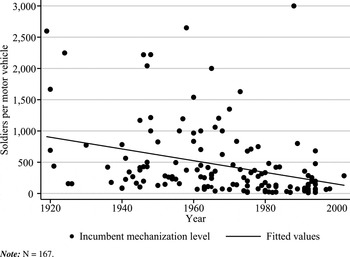
Mechanization was not a one-time shock, however. Rather, the lessons learned by the Great Powers in World War I were codified in World War II and then gradually diffused throughout the international system during the Cold War. In particular, the practice of modeling client states' militaries in their patrons' image ensured that the modern system was emulated throughout Africa, Latin America, Asia, and the Middle East. The art of foraging was lost as state militaries became increasingly mechanized and as the number of mechanized militaries climbed (see Figure 2). As a result, the rate of incumbent success in COIN efforts plummeted after World War I and has continued to decline in lock-step with the increasing rate of mechanization within and across militaries.
Incumbent mechanization over time

Information Starvation
Why do mechanized forces perform counterinsurgency so poorly? Put simply, the force structure of modern post–World War I militaries inhibit the collection and vetting of the context-specific information required to wield power discriminately. While lethal in direct battle, mechanized militaries struggle to sift insurgents from noncombatants because they do not interact with local populations on the same scale as their foraging predecessors. Built to ensure that soldiers can move and survive on high-intensity battlefields, the modern military's force structure privileges survivability and thus inhibits soldiers from assuming the same risks that fence-sitting populations face daily. It therefore becomes harder to recruit reliable collaborators among local populations, further compounding information starvation. The result is a counterinsurgent that fuels, rather than deters, insurgent recruitment.
Scholars and practitioners largely agree that successful COIN efforts hinge not on the physical destruction of insurgent organizations but rather on the incumbent's ability to win over local populations.Footnote 28 Mechanized militaries thus already begin at a disadvantage since their direct battle mission may be secondary, and even counterproductive, to the determinants of success. Instead, the key to success lies in the efficient collection of reliable information on population characteristics, including its grievances, cleavages, power structures, views of the counterinsurgent, and the nature of the insurgents themselves. Acquiring this information in turn requires a high rate of interaction between counterinsurgent and population so that the requisite skills—including language and cultural awareness—are obtained and connections forged.
Yet since mechanized armies decide the tradeoff between manpower and mobility in favor of the latter, they possess fewer infantry than their foraging peers. As the number of machines in a given military increase, the number of personnel devoted to their operation and maintenance must necessarily rise. Modern militaries therefore possess comparatively few infantrymen, reducing the rate of interaction simply because fewer soldiers are available for such tasks. The fact that mechanized forces are ill-suited for certain types of terrain and are tied to available roads only magnifies these problems. Rather than exercising control, mechanized forces are actually providing only “presence” since their greatest asset, mobility, allows them to cover more ground without having to embed in a particular location. This asset is nonetheless a liability: with fewer soldiers, mechanized forces must sacrifice depth for breadth.
The complexity of the modern war machine also dictates an extremely long supply train to deliver goods that can only be acquired from specialized industries outside the war zone. Unable to forage, mechanized armies forego the opportunity to forge mutual interdependencies with locals. The accumulation of social capital and trust is therefore stunted, heightening the risks that acquired information will be partial or misleading while eroding the ability of these forces to discern credible information. This self-induced dilemma has reached new heights in Iraq today, where the U.S. Army now imports even its fast food.Footnote 29
To minimize these logistical complexities, mechanized forces are garrisoned on large, isolated bases. Without a shared sense of risk with locals, however, this posture underscores the incumbent's preoccupation with its security. Potential fence-sitters must weigh the costs and benefits of collaboration and may decide to forego cooperation if the incumbent cannot credibly protect these individuals or if it appears indifferent to their fate. Without a sustained and substantial presence in terms of time and force size, mechanized units are less able to win the population's trust. If popular allegiance is endogenous to the degree of control exercised by a military, then control itself is a function of the frequency and nature of these interactions.Footnote 30 In Vietnam, for example, hamlets protected by light infantry (marines) were routinely judged more politically reliable than similar hamlets protected by (army) mechanized forces because the marines were constantly present.Footnote 31
This information starvation has important consequences for the effectiveness of COIN efforts. If incumbent forces cannot wield their power selectively, then they will ease insurgent recruitment by collapsing the distinction between combatants and noncombatants. With the innocent and guilty equally likely to be punished, rational individuals will seek security and predictability with insurgent groups. At worst, incumbents will lose control over their strategies. For example, insurgents may deliberately provoke incumbent overreaction in areas still outside rebel control in a bid to create new grievances that will tip these fence-sitters into the insurgency's ranks.Footnote 32
Information starvation also undercuts learning by delaying the receipt of reliable information that would trigger an update of the incumbent's strategy and tactics. By the time an incumbent has determined that its approach is counterproductive, an insurgency may already be established. Indeed, initial encounters between incumbent and insurgent forces are likely to have a disproportionate impact on insurgent recruitment than later ones.Footnote 33 Historical cases from conflicts as diverse as Algeria, Vietnam, and Chechnya suggest that mechanized armies have belatedly recognized their deficiencies but proved unable to surmount them.Footnote 34 Without either curtailing their use of vehicles or sharply increasing the number of infantry available, mechanized forces will remain constrained in their ability to solve the identification problem.Footnote 35
Why No Self-Correction?
This discussion raises a second puzzle, however: Why have states not learned and adjusted their force structures? Indeed, as Figure 2 demonstrates, the ranks of mechanized powers have swelled since World War I and, far from self-correcting, have accelerated this process.
One possible explanation lies in the bureaucratic culture of the military itself. Militaries built around modern war develop norms and rules that may inhibit change by deliberately viewing COIN as “secondary” and by ensuring promotion is based around satisfying modern, rather than COIN, missions. This argument is often invoked to explain the U.S. Army's apparent failure to reject its modern war mentality during the Vietnam War, for example.Footnote 36 More generally, the cultural norms and associated cognitive beliefs of military institutions may stunt learning by discarding nonconfirmatory information and by perpetuating prior decisions on weapons acquisition.Footnote 37
Yet the crossnational nature of this trend toward greater mechanization, along with the remarkable similarity of contemporary force structures, suggest that its causes are found at the systemic-level. Supporting this claim is the fact that mechanization levels are not correlated with regime type or with the COW's cumulative measure of state power.Footnote 38 In other words, all states, regardless of their regime type or national capabilities, are being pulled toward ever-higher levels of mechanization. Bureaucratic culture may be a symptom of this process, but it is unlikely to be its cause.
Neorealists would argue that the competitive nature of the international system drives states to either adopt prevailing practices or risk being “selected out.” In this view, fear of defeat (or worse) is the mechanism by which states are socialized to emulate one another's mode of war-fighting.Footnote 39 Yet, as Fazal has argued, the post-1945 era was marked by a shift away from violent state death as states institutionalized norms against conquest and annexation.Footnote 40 Mechanization was therefore accelerating at precisely the moment when states faced the lowest prospect of violent “exit” in the past two hundred years.Footnote 41
Instead, we view increasing mechanization as a reflection of a shared set of norms that govern state beliefs about what constitutes the most appropriate means of military organization. The origins of this normative standard lie in another macrohistorical trend, namely industrialization, which rendered it possible for early adopters in Europe (and the United States) to apply emerging methods of industrial organization to warfare.Footnote 42 In fact, the modern system was at root an application of Fordist-style principles of mass production, automation, standardization, and cost efficiency to the problem of survivability on World War I battlefields. Validated as successful in two world wars, the modern system became increasingly difficult to abandon because its industrial underpinnings created a logic of their own. Each new industrial innovation promised ever-higher levels of lethality and survivability on the battlefield at the price of creating additional sunk costs that reinforced the state's commitment to mechanized warfare. Early adopters therefore locked themselves into highly lethal, and highly capital-intensive, force structures that meshed with their industrial societies.
Yet industrialization alone cannot explain the embrace of machine war by late adopters. Once established, the modern system emerged as a shared standard of appropriateness because early movers had set the stage for what constituted a “modern” military organization. Indeed, every historical era has prescribed a specific set of practices of war-fighting that been used to define the boundaries of international society.Footnote 43 It is telling, then, that these leaders outlawed guerrilla warfare in the Geneva Convention (1949) as an acceptable form of warfare for “modern” states.
In some cases, this pressure to conform was overt: both the United States and the Soviet Union remade Cold War client militaries in their own image. In other cases, however, postcolonial states viewed their highly mechanized forces as a symbol of their membership within the broader international community. Mechanization was, in some senses, a ticket to international legitimacy.Footnote 44 These socialization pressures are most clearly observed in underdeveloped states that faced internal threats and lacked industrial resources but still chose to pursue mechanization. Some of the largest tank fleets and highest levels of mechanization are found among the least industrialized countries of the world, including Afghanistan, Angola, Algeria, and Yemen. Shockingly, these states possess equal or higher mechanization levels than militaries that initially sparked the move to mechanized forces, including Russia, Britain, Germany, and the United States.
What has emerged is, in effect, a monoculture in which substantial advantages can be obtained by nonstate actors if they abandon the modern system and return to more “primitive” methods. Modern militaries cannot easily follow suit: the combination of industrial lock-in and a belief that modern states fight along mechanized lines conspire to trap incumbents. Change may require more than episodic defeats at the hands of weaker rebels; it may, in fact, require a change in the industrial bases of society within leading states and the emulation of these new force structures by laggard states.
Alternative Explanations
Five alternative explanations might also explain this marked shift in outcomes.
First, Arreguín-Toft's study of 197 “asymmetric conflicts” since 1816—conflicts in which one side enjoyed a 10:1 advantage in military power—provides clear evidence that stronger actors have become increasingly vulnerable to defeat by weaker actors.Footnote 45 Noting that this trend has accelerated since 1950, Arreguín-Toft argues that its root can be found in the nature of the strategies adopted by combatants. European states, along with the United States and the Soviet Union, embraced “direct” strategies of warfare after World War II aimed at the destruction of a peer enemy's armed forces. Asian states, by contrast, derived different lessons from its World War II experiences, and instead adopted guerrilla warfare to offset the technological advantage of their potential opponents. Indirect strategies typically trump direct ones because they tend to produce protracted conflicts that generate domestic pressures in the stronger states to quit the war.Footnote 46
Given that Arreguín-Toft's study is the most extensive to date, we should take care to distinguish our explanation from his “strategic interaction” approach. First, we seek to explain outcomes in counterinsurgency wars only. By contrast, Arreguín-Toft pools data from four different types of conflicts, including conventional wars, urban revolts, and guerrilla wars. The 10:1 power ratio for inclusion into the data set also strikes us as arbitrary and risks introducing unwanted selection bias. Second, force structure cannot be reduced to a type of strategy. Mechanized forces can adopt “direct” strategies (offensive, defensive, and annihilation, among others) as well as indirect; so, too, can nonmechanized forces.Footnote 47
Moreover, while it can be difficult to collapse evolving wartime strategies down to a single type, mechanization levels can be measured ex ante—unlike strategies—and can be utilized to capture variation across and within countries over time at a more fine-grained level. Finally, Arreguín-Toft's initial test relies on cross-tabulations that cannot control for potentially confounding variables such as regime type, terrain, or even different power ratios between strong and weak actors. It is unclear, then, whether strategy is a function of an actor's attributes rather than an independent variable in its own right.
Second, the sharp decrease in the likelihood of an incumbent's win appears to track closely with global patterns of democratization. For example, MeromFootnote 48 has argued that the combination of an educated middle class and voting rights undercuts military effectiveness by rendering democratic publics averse to the casualties and moral compromises necessary to conduct COIN successfully. Impatient for success, and unwilling to shoulder the required sacrifices of blood and treasure, democracies are more likely to offer concessions or concede defeat than autocratic states that can safely ignore their publics.Footnote 49
Democracies may be especially hamstrung in COIN contexts by their commitment to international norms and laws governing the use of military force.Footnote 50 Unlike autocrats, democratic leaders are thought to be unwilling to incur the reputation costs associated with violating these laws, particularly widely shared treaties such as the Geneva Convention. Indeed, the prospect of suffering audience costs at home and abroad has emerged as a reality in the post-1945 era of global media that transmits both information on compliance with treaty obligations and on insurgent attacks aimed at disillusioning their democratic audience. “Beware the scripted enemy,” Kilcullen writes, “who plays to a global audience and seeks to defeat you in the court of global public opinion.”Footnote 51 We should therefore expect divergent outcomes across regime types as the ranks of democracies swell over time and as global media brings the reality of war home to democratic publics.
Third, both quantitative and qualitative studies of civil war routinely cite an insurgent's external support as a key factor that determines outcomes. Two types of external assistance—safe havens in neighboring states and the provision of military or economic aid—have been deemed especially crucial for insurgent success. One byproduct of the Westphalian system's diffusion through colonialism may be the creation of greater opportunities for insurgents to seek sanctuary in neighboring states, thereby hiding behind the shield of sovereignty that prevents incumbents from crossing national borders. In turn, the profusion of states over time may well have increased the incentives for neighbors or patron states to fight proxy wars through the provision of cheap arms to insurgents in the hopes of destabilizing an enemy from within.Footnote 52
Fourth, the trend may be a function of state strength rather than insurgent attributes. The two great waves of state creation after the post–World War I and World War II imperial collapses may have populated our data set with weak states that are more likely to experience insurgent challenges precisely because they are unable to defeat them. Two important studies have noted that states with low gross domestic product (GDP) per capita incomesFootnote 53 or high (around 33 percent) share of GDP derived from primary commodity exportsFootnote 54 record the highest levels of civil war onset. If this view is correct, we should observe a correlation between state weakness and insurgent success in the post–World War I era.
Finally, the declining rate of incumbent victory parallels the spread of nationalism and the idea of self-determination.Footnote 55 Mack has argued that nationalist-inspired insurgencies typically have longer time horizons and less political liabilities than their opponents since they are fighting to establish a homeland, if not for survival itself.Footnote 56 An important strand of research in comparative politics has similarly demonstrated that ethnic identities can overcome the collective action dilemma facing all insurgent organizations by creating a sense of group solidarity around shared purposes.Footnote 57 Foreign occupiers should therefore possess a lower likelihood of victory, while all states should experience declining probabilities of victory as nationalism spreads.
All of these theories offer plausible reasons for the marked decline in the ability of incumbents to defeat insurgents over time. As such, we are not claiming that these explanations are inherently flawed. Nor do we exclude the possibility that multiple causes may be at work; war outcomes, after all, are products of complex, and sometimes contingent, processes. Indeed, to anticipate our results, we find support for some, though not all, of these alternative explanations. Their explicit inclusion also raises the bar for our explanation by ensuring that any correlation we uncover between mechanization and war outcomes is not spurious or accounted for by these leading alternatives.
Research Design
We adopt a mixed-method research design to test the proposed linkage between mechanization and counterinsurgency outcomes. We begin with a statistical analysis of 286 insurgencies (1800–2005) to examine whether (1) foraging armies are more proficient at COIN than modern mechanized forces. and (2) increasing mechanization within the post-1917 era is also associated with declining performance. The use of statistical methods also enables us to test our argument against alternative explanations while holding other variables such as terrain and distance constant. We then subject the argument to various robustness checks.
To highlight the proposed information starvation mechanism more directly, we complement our statistical analysis with an out-of-sample paired comparison of two U.S. Army divisions in Iraq. Using a mix of declassified internal memoranda and interviews, we contrast the comparative information-gathering capabilities of the highly mechanized 4th Infantry Division (ID) with the lightly mechanized 101st Air Assault Division. If our argument is correct, we should observe a divergence in their intelligence-gathering capabilities as well as variance in their COIN effectiveness given their varying abilities to address the identification problem.
Explanatory Variables
We operationalize our principal explanatory variable, force structure, in several ways. First, we use a binary variable (modern) to capture whether an incumbent's military was organized around foraging or machine war practices. Consistent with our discussion above, we code the machine era's dawn at 1917.Footnote 58 To measure the intra-foraging era variation noted above, we created railway, which denotes whether an incumbent used railways to supplement its foraging practices during 1871–1917.
We directly measure an incumbent's mechanization level using a scaled index that records the prewar soldier-to-mechanized vehicle ratio in the state's military (mech). More specifically, the size of the country's military was drawn from the COW data set and then divided by the number of mechanized vehicles in the country's arsenal.Footnote 59 Data for mechanization values were obtained from numerous sources.Footnote 60 To avoid endogeneity with war dynamics, both observations are lagged a year prior to the conflict. There are 167 observations for mech.
These values were then collapsed into a fourfold ordinal variable with cutpoints at the 25 percent quartiles. On this scale, 1 represents the lowest level of mechanization (>834 soldiers per vehicle), 2 (288 to 833 per vehicle) and 3 (109 to 287 per vehicle) the midway points, and 4 the highest level (11 to 108 soldiers per vehicle). This produces a scaled variable that has minimal skewness (0.08) and kurtosis (1.62) and that weights mechanization values by the size of the country's military personnel. Treating mech as an ordinal variable is also appropriate since it reduces sensitivity to data inaccuracies that inevitably arise from state secrecy.
Finally, we supplement mech with a battlefield-level indicator—heli—which records whether an incumbent deployed ≥25 helicopters during a particular war. Beginning with France's fielding of a substantial helicopter force in Algeria in the 1950s, the use of rotary-wing aircraft in combat and support roles has come to be viewed as an integral element of modern warfare. As such, heli provides additional evidence of an incumbent's commitment to a mechanized pattern of warfare.
To test the explanatory strength of regime type explanations, we code each country's regime (regime) using Polity2 values from the PolityIV data set. Polity2 is a 21-point scaled composite index of regime type that ranges from highly autocratic (−10) to highly democratic (+10).Footnote 61 Values are lagged one year prior to the conflict (1800–2005).
A regime's sensitivity to international pressure arising from normative commitments may also hinder an incumbent by removing more effective COIN strategies from the realm of the politically possible. While it can be difficult to measure normative pressure directly, we use the natural log of a country's share of GDP that is derived from imports and exports as an indicator of a state's vulnerability to external pressures (trade).Footnote 62 The greater the state's exposure to trade flows, the more vulnerable it will be to reputational and economic costs for contravening existing norms. Trade data are drawn from the International Monetary Fund (IMF) Direction of Trade data set,Footnote 63 while GDP is taken from the Banks Cross-National Time Series Dataset for the 1946–2005 era.Footnote 64
External support for an insurgency (support) is a scaled variable that measures whether insurgents received two critical types of assistance: material economic and military aid, and the ability to use a neighboring country as a sanctuary. We assign a value of 2, if the insurgent group received both types of assistance; 1, if only one type was granted; and 0, if neither aid nor sanctuary was received by a particular state.Footnote 65
We assess an incumbent's capacity using two indictors. First, we estimate an incumbent's power using COW's Composite Index of National Capabilities (CINC) data.Footnote 66 CINC values, a staple of COW studies of interstate war, measures a country's share of global military (army size, military spending) and economic (iron production, energy consumption, and population) power. We also use a country's per capita energy consumption as a proxy for state capacity (energy). This has the advantage of extending across a longer time period than the standard measure of capacity—GDP per capita—and is more tied to a country's ability to sustain military power. Both variables are logged; values are taken one year prior to conflict (1800–2005). Higher power and energy scores should therefore be associated with a higher probability of incumbent victory.
Finally, while recognizing that nationalist sentiment is partly endogenous to the nature of the conflict itself, we estimate the depth of ex ante nationalist sentiment with a binary variable that denotes whether the incumbent was an external occupier (occupy). Existing studies contend that nationalist sentiment is likely to be higher when insurgents face a foreign occupier rather than the home government. Occupier status should therefore be associated with a decreased probability of state victory in COIN warfare. The variable is coded for the entire 1800–2005 era.
Controls
We also include several control variables. For example, quantitative and qualitative studies converge on the finding that rough terrain, specifically mountains and deep forests, increase the likelihood of insurgent victory by providing refuge from incumbent power (terrain).Footnote 67 We estimate the roughness of terrain by taking the average of five altitude measures (in meters) of the conflict area itself (1800–2005).
We might also anticipate that as the distance between the incumbent's capital and the conflict area increases, the probability of incumbent victory decreases as logistical difficulties multiply. We therefore measure distance in kilometers (logged) between the incumbent's capital and the principal conflict area. Wars that are primarily fought in or near a capital city are assigned a nominal one kilometer in distance (1800–2005).
It is also possible that the diversity of a conflict area's population will effect the incumbent's ability to defeat an insurgency. In particular, the greater the number of languages spoken within the conflict area, the more difficulty an incumbent may have in acquiring the contextual information necessary to use its resources discriminately. We therefore adopt Fearon and Laitin's (Reference Fearon and Laitin2003) data on languages spoken (language) but reset the values for the conflict area (that is, Nagaland) rather than national level (that is, India) for 1945–2005.
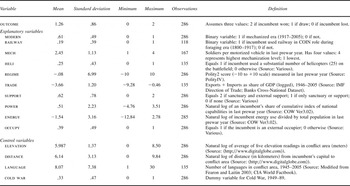
Finally, scholars have argued that the Cold War possessed unique dynamics—including a heightened willingness to intervene in other states to fight proxy wars—not found in other eras.Footnote 68 We therefore include a cold war dummy variable for the 1949–89 period. Summary statistics are reported in Table 1.
Summary statistics

Empirical Analysis: Foraging and Mechanized Eras
We begin by comparing the determinants of COIN outcomes across the foraging and machine war eras. We then explore whether explanatory variables carry the same weight within each era.
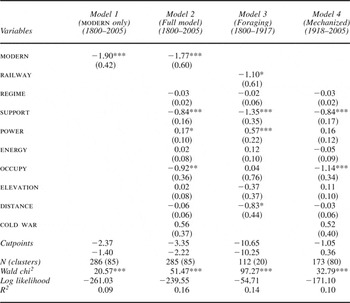
Table 2 presents the results of four ordered logistic regression models. Several findings are especially noteworthy. First, modern is highly significant and negatively correlated with incumbent victory when considered alone (Model 1) and when nested within the full model (Model 2). Though a crude measure, the shift from the foraging to the mechanized era of war-fighting is highly correlated with incumbent defeat. Similarly, railway, a more direct measure of actual practices, is also negatively correlated with incumbent victory in the foraging era (Model 3).
Foraging and mechanized era of warfare: A comparison

Notes: Robust standard errors clustered on country in parentheses. * significant at 10%; ** significant at 5%; *** significant at 1%.
Using Clarify, we can assess the substantive effect of shifting between foraging and mechanized eras as well as the impact of the use of railways on the expected probability of incumbent victory.Footnote 69 For example, the shift from foraging to machine war is associated with an −89 percent change in the expected probability of a state victory (with a 95 percent confidence interval at −155 to −33 percent). As predicted, reliance on railways in COIN contexts also had a negative impact on the expected probability of incumbent victory, with an estimated −18 percent change (95 precent confidence interval at −45 to 2 percent).
Insurgent support is also highly significant and negatively correlated with incumbent victory in the full model as well as within the foraging (Model 3) and mechanized (Model 4) eras. The contention that an occupying state should experience a more difficult struggle due to nationalism also receives support, albeit indirect. occupy is significant and negatively correlated with incumbent victory (Model 4) in the mechanized era but not the foraging one. This is consistent with the argument that nationalist-inspired insurgents are a product of twentieth-century processes such as mass literacy, development, and decolonization.
State capacity also yields unexpected results. While energy is not significant in any model, power is significant and positively correlated with incumbent victory in both the full model and the foraging era but not in the mechanized era. The relationship between material power, at least as captured by COW's CINC measure, appears to be severed once we reach the industrial era of machine war. Notably, power's period-specific effects would be missed had we not divided the 1800–2005 to reflect changing patterns of warfare.
Finally, none of the other variables are significant. Surprisingly, regime type does not reach statistical significance, suggesting that a country's level of democracy may be uncorrelated with war outcomes. In addition, the fact that elevation is not negatively correlated with incumbent victory is particularly surprising given the emphasis placed on mountainous terrain as a key factor in insurgent victory. This result may stem in part from the conflict-level measure of elevation that differs sharply from national-level indicators used in existing studies.
The Mechanized Era
In this section we offer a more fine-grained test of the proposed argument by examining whether increasing levels of mechanization within state militaries is associated with worsening COIN outcomes in the post-1917 era.
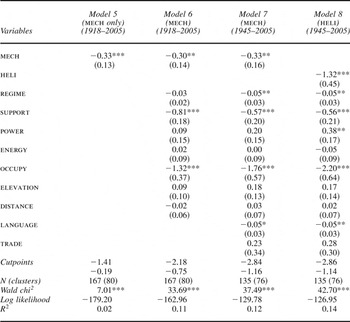
The results presented in Table 3 support our claim that mechanization is negatively associated with incumbent victory. mech is negative and statistically significant when tested alone (Model 5) as well as in the 1918–2005 (Model 6) and 1945–2005 (Model 7) eras. In substantive terms, shifting from the least mechanized military (1) to the most mechanized (4) is associated with a −50 percent change in the expected probability of an incumbent victory in the 1918–2005 era (with a 95 percent confidence interval of −89 percent to −7 percent), all else being equal. This dramatic effect is obvious in Figure 3, which plots the conditional effects of mechanization levels on the expected probability that incumbents will defeat their insurgent foes. We obtain a similar −61 percent reduction in the expected probability of incumbent victory when shifting from the least to most mechanized military in the post-1945 era (95 percent confidence interval of −116 to −3 percent), all else equal.
The perils of mechanization

Notes: Robust standard errors clustered on country in parentheses. * significant at 10%; ** significant at 5%; *** significant at 1%.
Conditional effect of mechanization on probability of incumbent win, 1918–2005

External support for insurgent organizations is also associated with a decrease in the likelihood of state victory. Indeed, the expected probability of an incumbent's victory diminishes by −87 percent when facing an insurgency with substantial external support (2) compared to an insurgency without patrons or a safe refuge (95 percent confidence interval at −119 percent to −52 percent). Interestingly, the impact of support is itself reduced if we restrict our analysis to the post-1945 period. Here, the likelihood of an incumbent win decreases by −68 percent when we shift the nature of insurgent support from none to substantial (95 percent confidence interval at −111 percent to −22 percent).
We also find evidence that foreign occupiers are at a special disadvantage when fighting COIN wars. A shift in an incumbent's occupier status from a 0 to a 1 results in an estimated −59 percent reduction in the likelihood of victory, all else equal (95 percent confidence interval at −86 percent to −27 percent). A reasonable, if somewhat crude, proxy for nationalist sentiment, occupy suggests that at least some insurgencies are not simply driven by greed or opportunities but are instead rooted in identity-based grievances sparked by foreign intervention.Footnote 70
Interestingly, regime only reaches statistical significance in the post-1945 era (Model 7) and is negatively associated with incumbent victory, suggesting that as states become more democratic their vulnerability to defeat increases. This at once supports and qualifies existing arguments about presumed ineffectiveness of democratic states in COIN wars. To be sure, it suggests that as political systems become more open, the likelihood of defeat is also increased. Yet these shifts in regime type could occur at lower ends of the 21-point Polity2 values—that is, a shift from −5 to a 0—and therefore one should not conclude that stable democracies are especially vulnerable.Footnote 71 Moreover, the time-dependent nature of this effect is at least partially inconsistent with claims that audience costs or educated middle classes are hobbling democratic war efforts. Indeed, neither mechanism is exclusive to democracies, nor is it clear why their effects should only be observed after 1945.
Note, too, that trade is also not significant, a finding that points away from the vulnerability of integrated states to reputation costs. Indeed, many of the key variables cited in the civil war literature—notably, terrain, distance, and power—are not significantly correlated with outcomes. The one exception is language, which is significant and negatively correlated with incumbent victory, underscoring the importance of the “human terrain” in which states wield their power.
Finally, Model 8 reports findings using heli to estimate the relationship between mechanization and war outcomes. The results are stark. States that employed helicopters won only 12.5 percent of their conflicts (4/32), while states without helicopters won nearly 40 percent (41/103).Footnote 72 Substantively, the shift from no helicopters to their use is associated with a −58 percent change in the expected probability of incumbent's win, all else equal (95 percent confidence interval at −92 percent to −22 percent). This measure provides direct battlefield-level evidence that higher rates of mechanization are negatively correlated with incumbent victory.
These results demonstrate that mechanization reduces the likelihood of incumbent victory even when accounting for other variables thought to affect COIN outcomes. However, several of the alternative explanations detailed above—notably, the globalization of media and rising nationalism—are not directly captured by any variables here and may only appear as time effects.
As a result, we re-estimated our models in Table 3 with fixed-time effects for each post-1917 decade (minus one) to assess the importance of mechanization relative to other, perhaps unmeasured, variables that may have changed over time. We also used dummy variables to capture possible period effects in the mechanized era associated with the post-1945 and post-1989 eras. The inclusion of these decade fixed effects did not alter our results, and none of the decade dummies are statistically significant.Footnote 73 This is an important finding, for it suggests (1) that more mechanized militaries fare worse than their less mechanized counterparts even within the same decade, and that (2) mechanization's effects are independent rather than simply running parallel to some unidentified temporal trend.
Robustness Tests
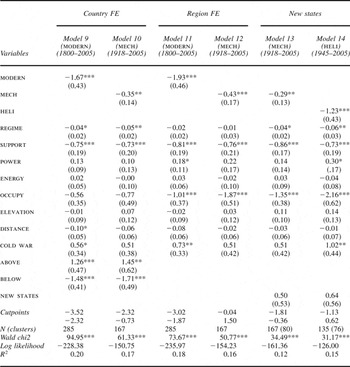
It is reasonable to wonder, however, whether these results are being driven by the characteristics of particular countries or regions. Similarly, we might imagine that mechanization simply coincides with other temporal dynamics, such as decolonization, that are really responsible for the observed shift in war outcomes. We therefore subject our findings to several robustness checks in this section (see Table 4).
Robustness checks

Notes: Robust standard errors (Models 9 to 12) and robust standard errors clustered on country (Models 13 to 14). * significant at 10%; **significant at 5%; ***significant at 1%.
We begin with country fixed effects to test whether stable but unobserved differences in the performance of specific outliers are driving our results. Dummy variables were created for incumbents with more than one observation whose mean outcome was either significantly above or below the mean outcome (1.26) for all incumbents.Footnote 74 We defined “significantly” as 0.5 standard deviations above or below mean outcome. Model 9 reports estimates for modern, while Model 10 provides estimates for mech. Our indices of mechanization remain significant and in the predicted direction.
Models 11 and 12 include dummy variables for six different regions—Eastern Europe, Latin America, Sub-Saharan Africa, North Africa and the Middle East, Asia, and North America—to control for the possibility that outcomes cluster in particular regions. Western Europe was the reference category and was thus dropped from the analysis. Model 11 reports results from the entire time period, while Model 12 focuses solely on the mechanized era. Again, our measures of mechanization remain significant.Footnote 75
Following Fearon and Laitin Reference Fearon and Laitin2003, we also re-estimated our models with a variable (new state) denoting whether war onset occurred during the first two years of a new state's postcolonial existence. It is likely that the combination of colonialism's delegitimization in the 1950s and surging nationalism rendered wavering colonial states and weak successor governments especially likely to be challenged and to suffer defeat (particularly in Africa). Models 13 and 14 report regression estimates with new states included. Once again, our mech and heli estimates are unchanged, and new states itself is not significant.
Three additional robustness tests were also conducted.Footnote 76
First, we omitted World War II observations from Germany and Japan since their multiple losses can plausibly be tied to defeat by third parties. Next, we reran our models with a dummy variable for the United Kingdom. The United Kingdom not only accounts for the largest number of observations (N = 43) but also has been routinely cited as possessing an especially proficient COIN force.Footnote 77 Our results remain unchanged.
Finally, we recoded outcome as a binary variable to test whether our results are an artifact of our decision to use an ordered dependent variable. While a win/draw/loss ordinal coding retains greater information about outcomes, it also assumes that there is one underlying dimension onto which discrete outcomes are mapped and that the effect of any variable is uniform regardless of where the observation lies on this continuum. As a result, it does not permit a variable to increase the likelihood of middle outcomes (that is, draws) at the expense of more extreme outcomes (win, defeat). We therefore recast outcome using two different binary variables: win/no win, and defeat/no defeat. Once again, our results are consistent with those presented above.
Microlevel Evidence: A Tale of Two Divisions
While our large-N statistical analysis allows us to examine trends over time, it cannot directly test the argument's proposed mechanism of information starvation. As a result, in this section we turn to an out-of-sample comparison as an initial plausibility probe of how mechanization shapes information-gathering. We exploit intramilitary variation in mechanization rates by comparing two U.S. divisions—the 4th Infantry Division and the 101st Air Assault Division—deployed in Iraq during 2003–2004.
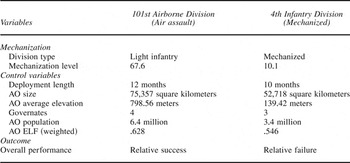
Despite its name, 4th ID was the most heavily mechanized unit in the entire U.S. Army, with 1,690 M1A2 tanks and armored vehicles for its 17,000 soldiers (or ten soldiers per vehicle). The 101st, by contrast, was one of the least mechanized units, with only 296 vehicles, principally unarmored HMMWVs (“Humvees”), for its 20,000 soldiers (or nearly sixty-eight soldiers per vehicle).Footnote 78 The difference between these division's mechanization rates represents roughly a move from 1 to 2 in our mech variable (that is, from the 1 percent to the 20 percent percentile).
If the proposed argument is correct, we should observe clear differences in the ability of these divisions' soldiers to acquire reliable information. Moreover, division personnel should ascribe their information-gathering abilities to the advantages and limits of their particular force structure. In light of their divergent force structures, these divisions should adopt different strategies given their divergent intelligence capabilities. In this case, 4th ID should be relatively ineffective in COIN operations given its “modern” emphasis on direct battle and, above all, its lack of soldiers available for dismounted (that is, on foot) patrolling. Trading men for machines, 4th ID not only possessed fewer soldiers but could not undertake large numbers of dismounted patrols since so many of their soldiers were required to simply maintain and operate their vehicles.Footnote 79
Comparing two divisions drawn from the same military and war helps control for a number of confounding variables, including war aims, regime type, national power, and occupier status. Moreover, each division's area of operations (AO) in northern Iraq was similar (Table 5). Controlling adjacent AOs with similar ethnolinguistic fractionalization values, the divisions were stationed in Iraq for tours of nearly equal length that began at roughly the same time. Each division faced the challenge of addressing substantial populations of demobilized soldiers within their AOs. Tikrit, Saddam Hussein's birthplace and home to many Iraqi generals, fell within 4th ID's responsibilities, which also partially straddled Iraq's Sunni-Shia fault line. The 101st also faced some 110,000 demobilized soldiers while also inheriting 70,000 Kurdish peshmerga and a bitter intra-Kurdish rivalry. It should be noted, though, that the 101st's AO was substantially larger, more rugged, and densely populated. Though the 101st only had 3,000 more soldiers than 4th ID, it was tasked with overseeing 3 million more Iraqis.
A tale of two divisions: Northern Iraq, 2003–2004

Notes: Mechanization level is number of soldiers divided by motorized vehicles in division. AO = area of operations. AO ELF = average of each governate weighted by population.
We draw on unique data to compare these divisions' performance. These include one author's combat tour in Iraq as Divisional Chief of Plans; declassified internal documents on the intelligence-gathering activities of the 101st; and a small Web-based survey of twenty-five soldiers and marines who served in these divisions during 2003–2004 as well as those currently in Iraq serving in comparable divisions. Interviewees range in rank from captain to colonel, and all but one have at least one, and in many cases two, combat tours in Iraq. (The lone exception had two tours in Afghanistan). We acknowledge that there are severe data and other limitations inherent in conducting research during an ongoing war. The case study should be viewed as suggestive, not definitive. Nonetheless, these data support the contention that as mechanization increases, the quality and quantity of information diminishes, undercutting COIN effectiveness.
Comparative Information-Gathering Capabilities
Force structure's impact made itself immediately apparent in the type and frequency of patrols each division conducted. After a brief delay, the 101st made daily patrols by small groups of dismounted soldiers the centerpiece of its intelligence-gathering. This decision was a product of its force structure: lacking armored vehicles but possessing an above-average complement of soldiers, the 101st moved toward a police-style model of “walking beats.” Internal records indicate that the 101st conducted an average of 200 to 250 patrols daily, the vast majority dismounted. Some forty to ninety of these daily patrols were joint with Iraqi forces, allowing the 101st to tap their language and cultural skills to gather information.Footnote 80
4th ID's patrol rate compares unfavorably. Task Force Iron Horse (35,000 soldiers), which included 4th ID, recorded an average of 169 daily patrols, or about 68–85 percent of the 101st's average despite possessing 75 percent more soldiers.Footnote 81 Crucially, the bulk of 4th ID's patrols were not dismounted but instead were mechanized, meaning that soldiers typically did not leave their vehicles to engage in face-to-face contact. Instead, the division sought to intimidate the local population and flush out insurgents by projecting “presence” through armored shows of force. “We came in very hard,”Footnote 82 Lt. General Raymond Odierno, 4th ID's commanding officer, remarked.
The importance of dismounted patrolling as the best, and often only, means for acquiring information—often referred to as “atmospherics”—about local populations was a consistent theme in our interviews. “The fewer the soldiers that interact with the environment,” one Major noted, “the less information gleaned from it.”Footnote 83 The following excerpts illustrate this relationship.
Before we left, my Soldiers knew their sector inside and out. They knew the locations of IED [Improvised Explosive Device] hot spots, trigger positions, sniper positions, drive-by alleys, short cuts, abandoned buildings, manhole covers. They also knew the stores, storeowners, chiefs, schools, mosques, Imams, and all the other key figures. We knew the ethnic backgrounds of neighborhoods, status of electricity and water, everything you need to know in order to conduct proper COIN. You can't get that kind of situation awareness without living and patrolling in assigned sectors.Footnote 84
My company was very good at gaining intelligence because of the number of patrols I conducted and the amount of time I spent talking with locals, police, sheiks, etc. I generally found that you got out what you put in and the key was giving platoons specific tasks and intelligence requirements on patrols … instead of simply driving around. Our ability improved over time because of the improved understanding I had of the area. Over time I gained greater credibility and could speak intelligently about the area (history, geography, personalities) which gave [inhabitants] greater confidence to talk to me.Footnote 85
Two points emerge from these interviews. First, these soldiers are privileging types of information that are sharply opposed to the types required by the dictates of modern battle (principally, the location of enemy formations). There are no technological shortcuts that can substitute for the acquisition of these context-specific and time-sensitive “atmospherics” and, as such, divisions built around direct battle are ill-equipped to acquire them. Second, divisions such as 4th ID will struggle because their force structures impinge on their collection abilities. Local information cannot be acquired via presence patrols that do not interact with the local population. As one 101st soldier wryly observed, “it's impossible to conduct ‘eye/hand’ contact at 20–30 miles an hour.”Footnote 86
The 101st, commanded by then Major General David Petraeus, moved to institutionalize the collection and vetting of this information. A “Tribal Engagement Plan” was adopted, binding together division and influential tribal leaders (mukhtars) in a complex web of formal associations, employment programs, and informal meetings. An anonymous telephone tip line was also established; soldiers distributed its number on their daily patrols. Recognizing the need to depart from traditional measures of success—namely, insurgent casualties—the 101st reorganized itself. It created an Integrated Effects Working Group (IEWG) that meshed together once-separate intelligence and planning aspects of the division.Footnote 87 This coordination facilitated the rapid sharing of an ever-increasing volume of information obtained from active collaborators and dismounted patrols.
By contrast, 4th ID was constrained by a force structure that privileged a more direct approach to exerting control. The most technologically advanced division in the U.S. Army, 4th ID continued to define its performance in terms of traditional metrics such as enemy casualties or the number of firefights. This stance left the division largely unaware of the subterranean insurgency that was slowly gathering steam during summer 2003. Rather than reorienting toward this invisible opponent, the division's patrols were designed to demonstrate its wasta (influence) in the public's eyes through highly visible shows of force. The division's armored vehicles, one 4th ID officer argued, provided “shock effect value” by deterring Iraqis from joining or supporting insurgent groups.Footnote 88
Our interviewees also stressed that reliable information flowed more freely because dismounted patrolling convinced locals that U.S. forces were willing to share the same risks. “The center of gravity lies with the population,” one marine argued, “and you have to be among them to win them over.”Footnote 89 The 101st's force structure aided this task: its lack of armor, for example, relieved it of the need to be isolated on a massive Forward Operating Base (like 4th ID), while its lack of tentage in the initial months meant it was forced to hunker down in abandoned buildings. Interestingly, 101st officers, along with soldiers from “light” units, noticed that the volume of information they received diminished near the end of their deployments. Iraqis, anticipating the withdrawal of these units, cut their ties to avoid their exposure since they did not (yet) trust the replacement division.
Surveying the performance of other more mechanized Divisions, one 101st officer concluded:
Units that succeeded in gaining information from the local population often lived (i.e. actively patrolled dismounted) in an area. Commands that identified this early often saw increased capability to identify the insurgents within their AO. Commands that did not identify this practice early often struggled with information gathering and had trouble identifying insurgents.Footnote 90
The disparity in intelligence gathering between 4th ID and the 101st support this proposition. Internal records from the 101st track sizable increases in the average volume of weekly tips provided by local collaborators from none in May 2003 to about 150 by September 2003 and 370 by January 2004. The reliability of these tips also dramatically improved: by September, the 101st was routinely conducting selective raids to secure weapons caches or capture high-value individuals identified by locals.Footnote 91
On the other hand, 4th ID's intelligence-gathering efforts were criticized by other divisions and its commanders. “Few of the raids … executed by [4th ID] have resulted in the capture of any anti-coalition members or the seizures of illegal weapons,”Footnote 92 noted one of 4th ID's officers, a sign that the appropriate information was not being collected. Indeed, even if we assume that mechanized and dismounted patrols gather and vet information equally—a dubious distinction given the sharply different skill sets required by these force structures—the disparity in patrol rates alone ensured that 4th ID would acquire relatively less information. During the 4th ID's ten-month tour, the 101st conducted between 9,300 and 24,300 more patrols, a staggering difference given that the 101st possessed only 3,000 more soldiers.
The Impact of Information Starvation
Reliance on mechanized patrols not only contributed to 4th ID's information starvation but also proved counterproductive since their effects were anything but selective. Interviews and data suggest that these “presence” patrols only stirred up resentment, a fact even acknowledged by those generally supportive of such patrols.Footnote 93 Advocates of dismounted patrols were especially dismissive of presence patrols—“brain surgery with a hammer,”Footnote 94 in the words of one soldier—since without accurate information their effects would be indiscriminate.
The following interview excerpts illustrate the connection between force structure, poor information, and heightened Iraqi resentment.
Many of our mounted patrols, especially in crowded urban areas or on congested roads, did not provide security or gain intelligence. Instead, they usually only left the Iraqis more frustrated with our presence since our troops in their mounted/armored patrols often “bullied” their way through congested areas.Footnote 95
Armored patrols are impersonal and send a loud nonverbal message of repression and occupation. Iraqis must pull their vehicles over or get out of the road when a U.S. vehicle passes by for security reasons. They see weapons being directed at them, they see angry American faces, and they hear horns blaring to get people's attention. All of these actions send a message to the Iraqis that they have fewer freedoms than the occupiers do. This breeds resentment.Footnote 96
Drive-by patrolling in armored vehicles is probably the least effective means of patrolling. You are doing absolutely nothing except trolling for IEDs. You are making yourself and the people more of a target. In addition, if you make contact [with insurgents] … you will cause too much collateral damage. If you're patrolling dismounted, you have situational awareness, [allowing] for precision engagement.Footnote 97
The disparate ability to acquire relevant information, and its subsequent impact on Iraqi public opinion, is perhaps best seen in the varying arrest records of each division. Armed with usable information, the 101st was able to target insurgents much more selectively with raids that minimized inconveniences to the general populace. Internal records reveal that the 101st arrested eleven individuals on average each day in its AO on suspicion of insurgent activity.Footnote 98 By contrast, 4th ID arrested thirty-three each day, and nearly 10,000 over the course of its tour in Iraq. This was the highest total of any division in Iraq. Yet the division struggled to separate insurgents from the noncombatant population and often detained large numbers of innocent people. The Army Inspector General concluded that 4th ID was “grabbing whole villages because combat soldiers were unable to figure out who was of value and who was not.”Footnote 99
To close this information gap, 4th ID turned to more dubious methods, including hostage-taking among the families of putative insurgents. Frustration among the division's soldiers also gave way to prisoner abuse: the division was frequently cited as the most likely to inflict abuse on its prisoners.Footnote 100
Polling data of sufficient reliability and subnational level is unfortunately not available to track public opinion toward these two divisions during the war's initial phase. The example of Sharqat, a small city some 270 kilometers northwest of Baghdad, does offer a window into elite estimates of their effectiveness, however. By dint of geography, the city is bisected north-south by a river, leaving its eastern half in the 101st's AO and its western half under 4th ID's purview. Sharqat's western half was visited only sporadically and briefly by 4th ID's mechanized “presence” patrols. The city's eastern environs, however, were routinely patrolled by dismounted infantry from the 101st. Growing lawlessness and insurgent activity in western Sharqat persuaded its mayor, Muhsin Khalaf, to petition coalition and 101st leaders to have the entire city moved under the 101st's aegis. Despite repeated entreaties, the request to gerrymander the 101st's AO was denied by the Coalition Provisional Authority because it would set a bad precedent.Footnote 101
Perhaps unsurprisingly, each division recorded different patterns of insurgent violence despite being neighbors. Data from the 101st indicate that it experienced an average of five daily attacks by insurgent and unknown forces. By comparison, the average level of daily attacks by insurgent and unknown forces for all U.S. Army divisions in Iraq during 2003–2004 was approximately twenty-five. 4th ID recorded the highest-known rate of daily attacks of any U.S. Army division. “From June 2003 to January 2004,” Odierno noted, “we had three times more than the combined number of attacks in the rest of the Iraqi theater.”Footnote 102 Moreover, while the 101st's data suggest that attacks diminished over time, the opposite was true of 4th ID, where attacks accelerated sharply after summer 2003.Footnote 103 In short, it is difficult to avoid drawing the conclusion that 4th ID fueled, rather than suppressed, the insurgency in its AO.
This initial test, while limited, does reinforce the central conclusion from our large-N analysis: increased levels of mechanization heighten the difficulties faced by counterinsurgents. Force structure can place severe restrictions on the ability of mechanized forces to acquire, process, and act upon the types of information necessary to render a counterinsurgent efforts discriminate. This is not to suggest that technological determinism is at work. Not all heavily mechanized armies lose COIN efforts, nor do all lightly mechanized forces defeat insurgent forces. Yet it is clear that force structures do constrain reform efforts, and fairly drastic actions may be necessary if mechanized forces are to become successful counterinsurgents.
It also bears emphasizing that the 101st's relative success in counterinsurgency was purchased at the price of suffering higher casualties. The 101st lost eighty-four soldiers during its tour; the 4th ID lost thirty-four. The same force structure that proved flexible enough to enable the 101st to build its information networks through dismounted patrolling also left its soldiers more vulnerable than their mechanized counterparts. This suggests the existence of a bitter tradeoff: minimizing soldiers' risk lowers the volume and accuracy of information obtained, thus lowering the probability of defeating an insurgency. Perversely, a higher casualty total—which in modern war terms is viewed as evidence of failure—is often evidence that the counterinsurgent has anchored itself astride the information networks that will ultimately improve its effectiveness.
Conclusion
This article addresses a simple puzzle: why have states have proven increasingly unable to defeat weaker insurgent organizations over time? We contend that the increasing mechanization of state militaries has steadily undercut their effectiveness by truncating their ability to collect local information. Beginning with the introduction of railways in the 1870s, and accelerating sharply after World War I, the mechanization of military force structures has led to (1) reduced numbers of infantry in modern militaries; (2) less interaction with local populations; and (3) increased dependence on long, vulnerable, logistical ties to their homelands that only reinforce their isolation from local information networks. The result is often a mechanized military unable to apply its coercive and noncoercive power in a selective manner due to information starvation. The proposed negative relationship between mechanization and war outcomes received significant support in our statistical analysis of 286 insurgencies, the largest data set yet assembled. Suggestive evidence of the plausibility of the argument's causal mechanism was also provided through a microlevel study of two U.S. Army divisions in Iraq.
At a broader level, these results indicate that conflict scholars should heed two methodological concerns. First, it is important that our sample populations are composed of uniform cases—combining various types of warfare under the same “civil war” rubric risks mistaken inferences since it is unlikely that these disparate forms of violence share a uniform causal process. Second, the article's findings suggest that without due attention to periodization, we also risk drawing improper conclusions about the generalizability of particular arguments. For example, key independent variables, notably power, occupy, and regime, are only significant in certain eras, an important finding that is obscured if the entire 1800–2005 period is treated as an undifferentiated historical era.
These findings also suggest several profitable avenues for future research. We still lack, for example, a large-N study of how different regime types perform in COIN wars. Our sample of wars could also be further categorized by the type of demands made by rebel groups, since it is plausible that outcomes vary according to the extent and nature of group demands. There may be variation, for example, in the types of concessions made by incumbents as well as their success in resolving the underlying conditions that sparked the insurgency. Similarly, the number of insurgent groups active in a conflict likely affects the difficulties an incumbent faces. Advances could also be made by exploring “draws,” which represents a growing share of outcomes since the 1960s.Footnote 104
The process of mechanization itself also deserves further study. Time-series data on rates of mechanization for all states, not simply combatants, would be invaluable. These data would enable scholars to test the determinants of mechanization, including the important question of whether (and which) country-specific factors inhibit or accelerate its embrace. Future research could also be extended to the battlefield itself. Variation in force structures across militaries, or within different units of the same military, may help explain the location, intensity, and nature of insurgent violence. Finally, additional spatial measures of mechanization, including the length of supply lines or the distance between bases in a conflict area, could also be adopted.
From a policy perspective, the evidence presented here suggests that modern armies will be chronically unprepared to defeat insurgencies that may arise after military interventions. Paradoxically, the mechanized force structures of modern militaries may contribute not just to the rise of insurgent opposition but may actually embolden it. Insurgents, now thoroughly versed in the limits of mechanized forces, have incentives to adopt “primitive” strategies that pit the strengths of the modern state against itself. The result may be greater disorder in postintervention environments and, as a consequence, a decrease in the rate of success associated with efforts to achieve policy objectives such as democratization through military intervention.
Policymakers may be tempted to draw the conclusion that interventions are doomed to fail. Indeed, one consequence of increased mechanization may be a decreased willingness to contemplate intervention at all, leading to missed opportunities to staunch the implosion of failed states or avert human rights disasters such as genocide. Insofar as policymakers remain convinced of the merits of intervention, however, substantial changes will need to be made to current force structures if their vulnerabilities are to be reduced and the odds of success against insurgents improved. This is not an antitechnology brief for returning to the “foraging” era of warfare. Instead, decision makers contemplating future interventions should (1) increase the number of infantry in their forces; (2) invest in the human capital of their soldiers, including language and area skills; and (3) reduce logistical dependencies on the homeland by forging local interdependencies and adopting decentralized base postures that heighten interaction with locals. Such actions may be politically unpalatable since they increase the risks that soldiers face. Without a willingness to consider reforms, however, states will continue to prepare for the wrong type of war—with potentially disastrous consequences.