Introduction
Background
The eponym “Charles Bonnet syndrome” (CBS) was introduced by a Genevan neurologist, Georges de Morsier, in a paper discussing the nature of visual hallucinations (de Morsier, Reference de Morsier1936). It was initially held to describe the occurrence of visual hallucinations in older adults with intact cognition and no demonstrable mental disorder. The name chosen was a reference to his fellow Genevan, the natural philosopher Charles Bonnet, who in 1760 published an account of the hallucinations experienced by his grandfather, Thomas Lullin. Following procedures to remove cataracts from both eyes, Lullin experienced visual hallucinations of people, carriages, birds and entire landscapes. The hallucinations persisted for around six months, but ceased when his vision deteriorated further. Despite the presence of a condition causing visual impairment in the case described by Bonnet, de Morsier did not consider loss of vision to be integral to the syndrome, stressing the role of an undetermined abnormality of the brain in generating the symptoms.
Around 20 years later, Hecaen and Garcia Badaracco (Reference Hecaen and Badaracco1956) reviewed the condition, and proposed a change in its definition. They promoted a relationship to eye disease as being fundamental to the development of the syndrome. In response, de Morsier returned to the subject of CBS, presenting a review of 18 patients (de Morsier, Reference de Morsier1967). He noted that in five of the patients vision was recorded as being normal, or nearly normal. In his conclusion he stated that “there exists no correlation between visual hallucinations and lesions of the ocular globe.” He denied that impairment in visual afferents could lead to hallucinations, claiming that they are always caused by pathology of the brain, and suggesting the pulvino-cortical pathways may be the site of the lesion. This observation, that CBS can occur in the presence of normal visual functioning, remains the key evidence against it occurring purely as the consequence of reduced visual functioning.
The relationship between CBS and cognitive impairment has also been a matter of debate through most of the history of the condition. de Morsier was clear that significant cognitive impairment excluded the diagnosis, stating that the diagnosis called for “complete integrity of other cerebral functions.” When Burgermeister et al. (Reference Burgermeister, Tissot and de Ajuriaguerra1965) presented a series of 11 patients suffering from visual hallucinations in an influential paper, de Morsier noted that all their patients suffered from dementia, and stated “by definition, none of these cases had Charles Bonnet syndrome, contrary to what the authors think” (de Morsier, Reference de Morsier1967).
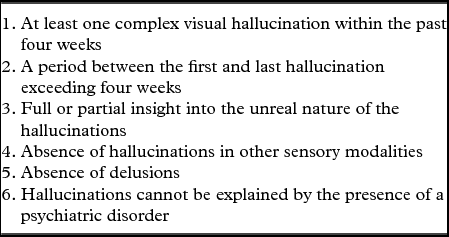
In the English language literature, while there are reports of people experiencing visual hallucinations in the absence of psychiatric morbidity dating back as far as the 19th century (Abell, Reference Abell1845; Ormond, Reference Ormond1925; Bartlett, Reference Bartlett1951; White, Reference White1980), the term “Charles Bonnet syndrome” was not used until 1982. In that year Damas-Mora et al. reviewed the existing literature and suggested a number of criteria they regarded as central characteristics of the syndrome. These criteria were modified by Gold and Rabins (Reference Gold and Rabins1989) and again by Teunisse et al. (Reference Teunisse1996), to arrive at an operationalized set of diagnostic criteria for the condition. The Teunisse criteria are set out in Table 1 above.
The Teunisse diagnostic criteria for Charles Bonnet syndrome
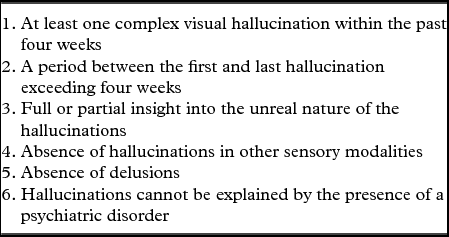
From the point of its introduction to the English language literature, diagnostic criteria have explicitly set out to avoid the issue of aetiology, due to the controversies outlined above, and the lack of empirical evidence to allow their resolution. As a result, CBS is a diagnosis still made at a syndromal level, with the pathological processes that lead to its occurrence, and its relationship with other conditions which feature visual hallucinations, remaining uncertain.
Insight and cognition
This requirement for there to be insight into the nature of the experiences has been incorporated into diagnostic criteria ever since those of Damas-Mora et al. (Reference Damas-Mora, Skelton-Robinson and Jenner1982). The Gold and Rabins (Reference Gold and Rabins1989) criteria softened the stance a little, allowing for insight to be “fully or partially retained,” and this acceptance of “partial” insight was retained by Teunisse et al. (Reference Teunisse, Cruysberg, Verbeek and Zitman1996). Related to insight is cognitive impairment. As the use of the term “Charles Bonnet syndrome” broadened, some authors departed from the criteria set out by de Morsier and included patients with a diagnosis of dementia (Burgermeister et al., Reference Burgermeister, Tissot and de Ajuriaguerra1965; Berrios and Brook, Reference Berrios and Brook1982; Cole, Reference Cole1992). However, most authors agree that a diagnosis of CBS should not be made in the presence of dementia, or other conditions known to cause visual hallucinations (Podoll, 1990; Teunisse et al., Reference Teunisse1996; Hedges, Reference Hedges2007).
So, while dementia would preclude a diagnosis of CBS, the prevalence and significance of milder degrees of cognitive impairment is less certain. Much of the research on CBS has been carried out by ophthalmologists, who are less familiar with the clinical presentation of mild cognitive impairment, or the tools to detect it. Moreover, the Mini-Mental State Examination (MMSE; Folstein et al., Reference Folstein, Folstein and McHugh1975) is the most frequent instrument used to quantify cognitive impairment in CBS research, and this is known to be poor at detecting both mild cognitive impairment, and the patterns of impairment seen in Lewy body dementia (Bak, Reference Bak2006).
This uncertainty should be a source of concern. Many authors recommend that reassurance be given to patients with CBS that their symptoms are benign and not an indication of developing mental health problems (Norton-Willson and Munir, Reference Norton-Willson and Munir1987; Teunisse et al., Reference Teunisse1996; Menon et al., Reference Menon, Rahman, Menon and Dutton2003; Hedges, Reference Hedges2007; Crumbliss et al., Reference Crumbliss, Taussig and Jay2008). However, concerns have been raised that, for some patients, CBS may actually be the first indication of the development of dementia (Holroyd et al., Reference Holroyd, Rabins, Finkelstein and Lavrisha1994; Pliskin et al., Reference Pliskin1996; Terao, Reference Terao2001; Menon et al., Reference Menon, Rahman, Menon and Dutton2003; Schadlu et al., Reference Schadlu, Schadlu and Shepherd2009). This is a particular concern with Lewy body dementia, where visual hallucinations may appear early and dominate the clinical picture (Terao and Collinson, Reference Terao and Collinson2000). This raises the possibility that some people presenting with visual hallucinations may be given a diagnosis of CBS and reassured, when in fact they are developing a serious neurodegenerative condition for which there is treatment potentially available.
To date, no review has set out to systematically examine the relationship between CBS and cognitive impairment. Given the potential significance of such a relationship, this is a significant gap in the literature. It is the intention of this review to systematically assess the existing literature on CBS to determine if there is evidence for such a relationship.
Methods
We conducted a systematic review using the search engine Ovid and searched the databases Medline, PsychINFO, and Embase. The multi-field option was selected, and searches using the following terms were executed: Charles Bonnet$ AND dementia; Charles Bonnet$ AND cognitive impairment; Charles Bonnet$ AND Alzheimer$; Charles Bonnet$ AND Lewy body.
The abstracts were reviewed and papers satisfying the following criteria were obtained for further review:
-
1. The paper described the results of an observational study of good methodological quality.
-
2. CBS was confirmed using recognized diagnostic criteria.
-
3. Examination of the relationship between CBS and cognitive impairment was a significant part of the study design.
Despite the large numbers of papers identified by the search strategy, none met all the criteria for inclusion. However, most of the papers published on CBS were in the form of case reports and therefore not eligible for inclusion in this review. These reports sometimes made mention of the results of a cognitive examination, and some described changes in cognitive functioning over time. There were also descriptive studies where some of the inclusion criteria were met.
We were also aware from the reference lists of the papers identified that there were topics that our search strategy had failed to identify, but which seemed no less relevant than those that were found. We therefore revised the search strategy and sought to review all studies and case reports relating to people with CBS. We used the same databases and search engine, but used the search term “Charles Bonnet$,” initially using the multi-field function. The search dates included were from the start of the period covered by the database to January 2012. A brief review of the results indicated that a high proportion of them were of no relevance. The search was repeated with “Charles Bonnet$” in the title field. The results seemed to be much more relevant to the purpose of the review. The abstract for each was reviewed and the paper obtained if it was either a case report, or an observational study, on a patient or patients reported as having CBS. Rigorous application of diagnostic criteria was not possible as there was often insufficient information. However, where the information provided was in direct conflict with the Teunisse criteria the paper was excluded. Papers in languages other than English or Spanish were also excluded.
Results
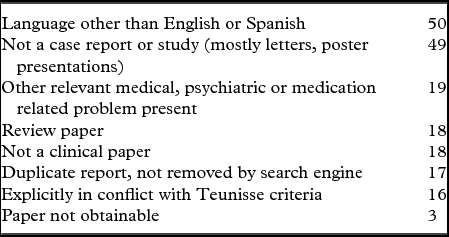
After duplicates were removed our search identified 316 papers. One hundred and ninety papers were excluded, and Table 2 summarizes the reasons for exclusion.
Reasons for excluding papers identified by second search

One hundred and twenty six papers were included in the review consisting of 26 observational studies and 100 case reports or case series. The references of the papers obtained were scrutinized and the abstract of any other paper which looked like it might be relevant was obtained; the paper was included if it met the above criteria. The search also identified review papers. The reference lists of these were searched for any relevant papers not found by the other methods. A further 55 relevant papers were identified by this method (19 observational studies and 36 case reports), making 45 studies and 136 case reports/series, in total. These are discussed in the results section below.
Observational studies
Schultz and Melzack (Reference Schultz and Melzack1993) carried out psychometric testing on 14 patients with CBS over a period of up to 12 months. The tests used included the Minnesota multiphasic personality inventory, the Beck depression inventory, the trait form of the state-trait anxiety inventory, and the MMSE. They found no evidence of abnormalities in cognitive function in this group and concluded that they had “ruled out the hypothesis that the hallucinations were caused by dementia.” The study was the first to administer a range of psychometric instruments to people with CBS. It did have a number of weaknesses however. The criteria by which CBS was diagnosed were not made clear; and, although there was contact with participants at two points, testing was only carried out at one of these, so change in cognition with time could not be assessed. The instrument used to assess cognition was the MMSE, which is known to be poor at detecting early dementia; and the sample size was small. Given these limitations, the evidence does not seem to support the robust conclusion the authors reach.
These findings contrast with Pliskin et al. (Reference Pliskin1996), who described cognitive abnormalities in 14 of 15 patients with CBS. They used measures including the Wechsler Adult Intelligence Scale-Revised, the Dementia Rating scale, the MMSE, and the Wechsler Memory Scale. They proposed that CBS can be an indication of the early stages of dementia. They used the Gold and Rabins criteria for making the diagnosis of CBS. However, their study was criticized by Teunisse (Reference Teunisse1997) for including a substantial number of patients (8/15) who did not have insight, contrary to these criteria. The authors responded by noting that even among those who did have insight, 6/7 had cognitive abnormalities, and that the one patient with normal cognition was found to have developed dementia 16 months later.
The instruments used in this study did seem more appropriate for detecting potential cognitive impairment than those in Schultz and Melzack (Reference Schultz and Melzack1993). However, the inclusion of people lacking insight, and even suffering from delusions, is a weakness, as most clinicians would not consider these people had CBS. There was no longitudinal component to the study to determine if the abnormalities found were progressive, and the sample size (in effect only seven) was too small.
Holroyd and Rabins (Reference Holroyd and Rabins1996) described findings in 13 patients reporting symptoms consistent with CBS who were contacted by telephone 39 months after their participation in a cross-sectional study (Holroyd et al., Reference Holroyd, Rabins, Finkelstein and Lavrisha1994). Only 10 of the 13 could be contacted. The telephone interview for cognitive status (TICS) was administered, and scores compared to TICS scores at baseline. There was no significant change in the scores on the TICS over the study period. The authors conclude that this should be reassuring information for patients with macular degeneration who experience visual hallucinations. However, there were a number of limitations of the study; it was again very small, and the loss of 3/13 to follow up could be significant. There are also limitations in the breadth of a cognitive assessment delivered by telephone. While the authors cite data suggesting good correlation with the MMSE, a telephone test must be limited in its coverage of visuo-spatial items.
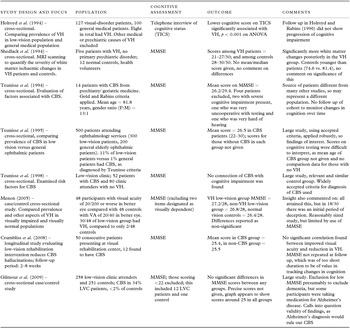
In addition to the papers described above, there were eight studies where cognitive functioning was described as one of the study parameters, though it was not the main focus of the study. These are described in Table 3. A number of these are large studies. Four included 30 or more people experiencing complex visual hallucinations. All of them assessed cognitive functioning using a validated instrument, the MMSE in seven and the TICS in the other. All but one of these studies reported no significant relationship between cognitive impairment and CBS. Only Holroyd et al. (Reference Holroyd, Rabins, Finkelstein and Lavrisha1994) found an association with a lower score on the TICS; but the participants they reported on were the same cohort who were described in the later study discussed above (Holroyd and Rabins, Reference Holroyd and Rabins1996), and where no deterioration in cognitive performance was reported over time.
Observational studies

ANOVA = analysis of variance; MMSE = Mini-Mental State Examination; CBS = Charles Bonnet syndrome; VH = visual hallucinations; VA = visual acuity; LVC = low-vision clinic.
However, there are some concerns over these findings. The studies were generally samples of convenience, mostly being consecutive attenders at out-patient clinics. Only Teunisse et al. (Reference Teunisse, Cruysberg, Verbeek and Zitman1995) and Gilmour et al. (Reference Gilmour, Schreiber and Ewing2009) provided data on the number of potential participants who declined to participate, and no study gave information on whether those that did agree to participate were different from those who declined. This limits confidence in how applicable these results are to other populations.
Moreover, only the three studies authored by Teunisse and colleagues (Teunisse et al., Reference Teunisse, Zitman and Raes1994; Teunisse et al., Reference Teunisse, Cruysberg, Verbeek and Zitman1995; Teunisse et al., Reference Teunisse1998) confirmed the diagnosis of CBS with reference to broadly accepted criteria. In three further studies (Menon, Reference Menon2005; Crumbliss et al., Reference Crumbliss, Taussig and Jay2008; Gilmour et al., Reference Gilmour, Schreiber and Ewing2009) there was no psychiatric history or mental state examination undertaken by a psychiatrist. This is of particular importance given the cognitive test used was the MMSE in all but one study. The lack of a significant difference in the scores found cannot therefore be taken as having excluded significant impairments in cognitive functioning. The milder abnormalities reported in MMSE scores in some studies (Shedlack et al., Reference Shedlack, McDonald, Laskowitz and Ranga Rama Krishnan1994; Teunisse et al., Reference Teunisse, Cruysberg, Verbeek and Zitman1995) could be consistent with clinically relevant deficits in functioning.
Indeed, Gilmour et al. (Reference Gilmour, Schreiber and Ewing2009) explicitly mention that people taking medication for Alzheimer's disease were included in the study, but do not provide further details of how many people this applied to or what group they were in. It is likely that some of the participants labeled as having CBS in Gilmour et al. (Reference Gilmour, Schreiber and Ewing2009) had mental disorders accounting for their visual hallucinations, invalidating the CBS diagnosis.
Of the studies described, Teunisse et al. (Reference Teunisse, Cruysberg, Verbeek and Zitman1995; 1998) appear the most robust. Large numbers of participants were recruited, accepted CBS criteria applied, an examination by a psychiatrist was part of the protocol and the control group was relevant. The finding of no impairment in cognitive functioning is therefore of interest. However, even these studies relied on the MMSE, and so were unable to rule out the presence of mild but important deficits in cognitive functioning.
Case reports
The 136 papers where patients consistent with CBS were described were reviewed to determine whether a comment was made on the patients’ cognitive functioning, and whether any follow up observations were made in regard to this. These papers reported details of 225 patients where the information provided was not explicitly in conflict with the Teunisse criteria, though it should be noted that in many cases the information provided was very limited. Information regarding these case reports is available from the authors, on request.
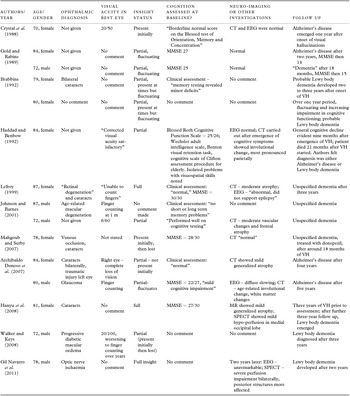
A total of 16 papers describe 22 cases where cognitive functioning was described at baseline and follow up. Of these, 11 papers detail 15 cases where dementia was reported as developing after a period of follow up. These were published between 1988 and 2011, and are summarized in Table 4. Six of the cases were in males and nine in females. Ages ranged from 70 to 87 years at the time of diagnosis of CBS, with a mean age of 79.2 years. A range of ophthalmic diagnoses were involved, though this information was frequently not given in the case report.
Details of case reports of patients with CBS who went on to develop dementia

CBS = Charles Bonnet syndrome; MMSE = Mini-Mental State Examination; CT = computed tomography; EEG = electroencephalography; MR = magnetic resonance; SPECT = single-photon emission computed tomography; VH = visual hallucinations.
In 11/14 patients insight was reported as being partial or fluctuating; this was a much higher rate of partial insight than in reported cases of CBS as a whole.
The period of time that visual hallucinations were present before diagnosis of dementia was made varied. It was less than one year in 3/15 patients, one to three years in 7/15 patients, and over three years in 5/15 patients. The type of dementia was recorded as Lewy body dementia in 5/15 patients and Alzheimer's disease in 4/15 patients. In the remaining six patients, a specific dementia type was not reported.
Among the patients where dementia did not develop (Levine, Reference Levine1980; Sadananda Unni, Reference Sadananda Unni1994; Ukai et al., Reference Ukai, Yamamoto, Tanaka and Takeda2004; Bourgeois et al., Reference Bourgeois2010; Hartney et al., Reference Hartney, Catalano and Catalano2011), there were four males and three females. The periods of follow up ranged from one to six years. The mean age of this group was younger, at 67.3 years, and more of the group had full insight at the time of diagnosis (5/6 where insight status was reported).
Discussion
Review findings
This review establishes a number of points. The recording of insight and cognitive ability in the literature relating to CBS has generally been limited in completeness and quality. There are no well-constructed, adequately powered studies which describe the rates or patterns of cognitive impairment in this condition, or which establish the rates of emergence of dementia. The three studies that directly address this question are too small, have methodological weaknesses, and come to contradictory conclusions. All are now over 17 years old.
The other cross-sectional study data add little to this. Few studies have assessed cognitive functioning at all, and none have done so with instruments of sufficient sensitivity to reliably detect mild but clinically relevant deficits. While in general the studies do not provide evidence of cognitive impairment being present in CBS, the larger studies all had limitations which prevent this being taken as a robust finding. This is not unexpected, as these studies were not designed primarily to investigate the relationship between CBS and cognition.
The case report literature does contain a number of cases where CBS appears to have been a pre-dementia state. The commonest dementia type diagnosed in this group was Lewy body dementia. However, although this confirms that dementia does develop in CBS, this finding does little to clarify what the relationship between the conditions is, as these patients reported may not be representative of CBS patients as a whole. Information in the case reports was often patchy, and recognized diagnostic criteria were commonly not referred to.
The finding that dementia did develop in 15 cases (16 including the case described in Pliskin et al., Reference Pliskin1996) is therefore hard to interpret. The mean age of this group was nearly 80 years, and the baseline incidence of dementia in this age group would be expected to be around 2% per annum (Riedel-Heller et al., Reference Riedel-Heller, Busse, Aurich, Matschinger and Angermeyer2001). It would therefore be expected that some of the patients described in the case reports would develop dementia anyway, and that the presence of CBS would be coincidental. Nonetheless, this finding lends some weight to the clinical impression that dementia developing in patients who have been diagnosed with CBS is an outcome which occurs frequently enough to be of clinical relevance.
Implications for aetiology of CBS
CBS has been defined in terms that avoid reference to aetiology throughout its existence in English-language literature. However, advances in cognitive science and neuro-imaging have allowed some progress to be made in relating the syndrome to underlying disturbances in brain structure and functioning. Three studies have used a range of neuro-imaging modalities to investigate CBS and found abnormalities were present in those with the condition. Shedlack et al. (Reference Shedlack, McDonald, Laskowitz and Ranga Rama Krishnan1994) found excess posterior white matter ischemic changes; Ffytche et al. (Reference Ffytche1998) found increased activation in the fusiform gyrus; and Adachi et al. (Reference Adachi, Watanabe, Matsuda and Onuma2000) used a combination of magnetic resonance (MR) and single-photon emission computed tomography (SPECT), reporting occipital atrophy, and hyperperfusion in the temporal lobe, striatum and thalamus. In addition to these studies, there have been numerous case reports, mostly using SPECT, but a consistent picture of where abnormalities are located has failed to emerge.
Another approach has been to try to develop an over-arching theory of how visual hallucinations are generated and to locate CBS within this framework. Significant contributions in this area have been made by Collerton et al. (Reference Collerton, Perry and McKeith2005) and Ffytche (Reference Ffytche2007). Collerton et al. (Reference Collerton, Perry and McKeith2005) introduced a “perception/attention deficit” model of visual hallucinations, in which afferent stimuli are “compared” to proto-objects present in the visual accessory cortex, with the “best fit” being experienced as the conscious percept. In states of reduced afferent information, or impaired attention, errors in selecting the proto-object are more likely to occur, which may be experienced as a hallucination. In the Collerton model, the content of the hallucinations is held to be similar whatever the underlying cause. The association with impaired visual acuity in CBS fits with the “perception” part of the Collerton model; but as discussed above, this is not sufficient to explain why most people with poor vision do not experience hallucinations, suggesting that a co-existing abnormality leading to reduced attention may also be present in the condition.
Ffytche (Reference Ffytche2007) made an attempt to distinguish the aetiology of different visual hallucinatory syndromes on phenomenological grounds. He described three separate syndromes related to deafferentation, acetylcholine deficits in the midbrain, and excess serotonin, which he suggested differed in the content of hallucinations experienced. In this framework, CBS is the prototypical deafferentation syndrome, and the symptoms emerge as a result of abnormalities in the retinogeniculocalcarine syndrome.
Neither of these models has yet been supported by conclusive empirical evidence in relation to CBS, but they offer frameworks which are testable and which should help shape future research in the area; and they offer the prospect of both moving CBS onto a clear aetiological footing, and defining its relationship to other visual hallucinatory disorders.
The findings of this review are unable to offer much new evidence to support either of the models described. The patients that developed dementia would be classified in a different category in the Ffytche (Reference Ffytche2007) framework, and would potentially have differences in the content of the hallucinations experienced. However, the descriptions of the hallucinations provided in the reports lacked sufficient detail to allow this theory to be tested.
The findings of the review in relation to insight are of interest in relation to the perception/attention deficit model of Collerton et al. (Reference Collerton, Perry and McKeith2005). In patients in whom a period of follow-up was described, partially impaired insight was more likely to be associated with the development of dementia than full insight. It is possible that the subgroup of CBS patients who show partial insight may be different from those where insight is preserved, and that this group may be at a higher risk of going on to develop dementia. In the Collerton model, the cases where dementia develops would be likely to form a group where the “attention deficit” component of the model is of greater importance than the “perception” component. They would potentially be indistinguishable on the content of the hallucinations, but the presence of impaired or fluctuating insight early in the course of the syndrome could alert clinicians to the possibility of a different aetiology.
Implications for clinicians
This review establishes that the relationship between CBS and cognitive impairment is at present unclear, but that there appear to be a sub-group of people who meet diagnostic criteria for the syndrome who are at risk of subsequently developing dementia. The evidence does not allow any estimate of the frequency of this outcome to be made, which makes it hard to provide guidance to clinicians who see patients with the condition. Conditions causing visual impairment are common in the population at risk of dementia, and CBS is common in visual impairment; so a recommendation that all patients presenting with CBS should have neuroimaging and referral to specialist memory services would have major resource implications. Referral to a memory clinic also has the potential to cause significant levels of anxiety in large numbers of people who have no underlying cognitive disorder.
A pragmatic solution would be to recommend that everyone diagnosed with CBS, and an informant who knows them well, should be asked some basic questions about whether their memory has worsened over the previous 12 months. Where there are concerns identified in this area obtaining neuro-imaging and referral to a memory service would be appropriate. Partial or fluctuating impairment at diagnosis of CBS would also warrant further investigations for underlying cognitive disorders. Where no problems with memory or insight are noted, the patient's primary care physician could be alerted about the diagnosis of CBS, and the potential for dementia to develop. This would allow ongoing monitoring for the possible emergence of cognitive impairment to be undertaken.
Conclusion
Many authors still advise that CBS is a benign, self-limiting condition, with no relationship to serious mental disorder. However, reports of severe and progressive cognitive impairment occurring in patients with CBS have occurred with sufficient frequency to suggest that CBS may on some occasions represent the first signs of an emerging dementia. This offers the possibility of a new pathway to early diagnosis and treatment.
Conditions causing visual impairment are common in the elderly population at risk of dementia. For example, Owen et al. (Reference Owen2012) report prevalence rates of age related macular degeneration among those aged over 80 to be around 12%. Epidemiological studies indicate that the prevalence of CBS in the elderly population with significant visual impairment may be as high as 63% (Menon, Reference Menon2005); so there are potentially large numbers of people who could be identified as being higher risk of dementia. If this relationship was confirmed it could lead to closer working between ophthalmology departments and memory assessment services, and could offer another way to help meet the Prime Minister's challenge of increasing rates of timely diagnosis of dementia (UK Department of Health, 2012).
Moreover, progress in the understanding of the neurological basis of CBS is likely to lead to a better understanding of visual hallucinations as a whole. Explanatory frameworks have been developed that offer the prospect of more clearly defining the relationship between CBS and other disorders which cause visual hallucinations. The case for carrying out well designed, adequately powered studies to investigate the rates of dementia in CBS, the factors which predict development of dementia, and the neurological abnormalities which underlay the condition, is now compelling.
Conflict of interest
None.
Description of author's roles
G. Russell identified the topic for the research, designed the search strategies, collected the data and wrote the paper. A. Burns advised on the research design and assisted in writing the paper.
Acknowledgments
We would like to thank staff at the University of Manchester library, Dr Harry Allen, Professor Robert Baldwin, Patricia Smith, and Kate Hutchings for their assistance in carrying out this work.