


Introduction
Individuals with alcohol use disorders are greatly influenced by their close family members and friends. Social network members can have a positive or negative impact on a drinker's recovery process (e.g. Beattie and Longabaugh, Reference Beattie and Longabaugh1999; Hunter-Reel, McCrady, Hildebrandt and Epstein, Reference Hunter-Reel, McCrady, Hildebrandt and Epstein2010). For instance, significant others (SOs) have been cited as the impetus for treatment-seeking among males with alcohol use disorders (Steinberg, Epstein, McCrady and Hirsch, Reference Steinberg, Epstein, McCrady and Hirsch1997). In addition, SOs or concerned loved ones have demonstrated their ability to engage treatment-refusing substance users into treatment, as in the case of the community reinforcement and family training approach (Roozen, de Waart and van der Kroft, Reference Roozen, de Waart and van der Kroft2010). Social support for abstinence has also been associated with improved treatment outcomes (Beattie and Longabaugh, Reference Beattie and Longabaugh1999; Longabaugh, Wirtz, Beattie, Noel and Stout, Reference Longabaugh, Wirtz, Beattie, Noel and Stout1995). Conversely, social networks may exacerbate an individual's alcohol use, alcohol-related problems, and his or her treatment outcomes, particularly when current drinkers are heavily represented in an individual's social network (Manuel, McCrady, Epstein, Cook and Tonigan, Reference Manuel, McCrady, Epstein, Cook and Tonigan2007; Mohr, Averna, Kenny and Del Boca, Reference Mohr, Averna, Kenny and Boca2001).
Inclusion of SOs in the treatment process
The evidence for the influence of social networks has generated an interest in engaging family members in substance abuse treatments. The empirical evidence for couples or family-based interventions indicates that substance abuse treatment, combined systematically with family or marital therapy, is more effective than individual approaches to treating substance abuse problems (McCrady, Epstein, Cook, Jensen and Hildebrandt, Reference McCrady, Epstein, Cook, Jensen and Hildebrandt2009; Powers, Vedel and Emmelkamp, Reference Powers, Vedel and Emmelkamp2008). It is less clear what influence SOs can exert on substance abuse treatment when the marital relationship is not directly addressed as a component of therapy, as in Projects MATCH, COMBINE, and the UKATT trial (Anton et al., Reference Anton, O'Malley, Ciraulo, Cisler, Couper and Donovan2007; Project MATCH Research Group, 1997, 1998; UKATT Research Team, 2005). For example, the Project MATCH protocol encouraged clients in the Motivational Enhancement Therapy (MET) condition to bring a close friend or family member to one or two treatment sessions (Miller, Zweben, DiClemente and Rychtarik, Reference Miller1994). In Project COMBINE, detailed procedures were incorporated within the Combined Behavioral Intervention (CBI) to recruit and include SOs whenever possible (Miller, Reference Miller2004). In both Projects MATCH and COMBINE, the relationship was not specifically addressed as part of the treatment intervention; instead, the SOs were included as a generic source of social support and an adjunct to treatment. In the United Kingdom Alcohol Treatment Trial, (UKATT), Social Behavior and Network Therapy (SBNT) was compared and found to be equally effective, with MET in a sample of clients with alcohol problems (UKATT Research Team, 2005). SBNT is based upon the belief that a supportive social network is the key component in the successful treatment of alcohol disorders. In SBNT, supportive network members (e.g. family members, co-workers, and friends) are identified and invited to participate in treatment sessions. Although the relationship is not directly addressed, aspects of the relationship, such as communication, responses to alcohol use, and participation in enjoyable non-alcohol related activities, are components of the intervention (Williamson, Smith, Orford, Copello and Day, Reference Williamson, Smith, Orford, Copello and Day2007).
Despite evidence suggesting that SOs play a beneficial role when substance abusers attempt to make a change in their drinking or drug use, the mechanism behind this is still a mystery. Clinicians wishing to take advantage of SO participation in substance abuse treatment sessions would be hard-pressed to know exactly how to do so. Unless the SO fits the relatively restricted definition used in Behavioral Couples Therapy treatment protocols (O'Farrell and Fals-Stewart, Reference O'Farrell and Fals-Stewart2006), clinicians must guess what contributions SOs can and should make in treatment sessions. This dilemma is especially apparent in the case of motivational treatments that focus on increasing the client's self-statements about their desire and need for change (referred to as change talk). Should SOs be encouraged to express their honest doubts when a heavy drinker expresses an intention to quit drinking? Should SOs be asked to provide examples of high-risk situations where the client has repeatedly failed in order to lend a more realistic tone to planning? Should SOs be asked to set aside concerns, doubts, and worries about a client's desire for a change in order to maximize the opportunity for change talk to be strengthened by the clinician? What happens when the clinician is intent upon building change talk strength but the SO is skeptical?
One way to learn more about the relationship between SO contributions and client outcomes during treatment sessions involves examining the content of treatment sessions via an objective behavioral coding system to characterize the nature of the interactions and their relationship to outcomes. Examining the relationship between what SOs say during treatment sessions and how clients respond, as well as what relationship these exchanges have on substance use outcomes, will better inform the criteria for both the selection and preparation of supportive SOs during substance abuse treatments.
Within session language in motivational interviewing sessions
Although the specific influence of SO language in treatment sessions has yet to be explored, examination of client language has provided insight into the unique processes underlying motivational interviewing (MI) treatment sessions. A critical component of MI, an empirically-based treatment for substance use disorders (Hettema, Steele and Miller, Reference Hettema, Steele and Miller2005), is a deliberate therapist focus on client “change talk”, or client language toward making a behavior change (e.g. expressing a desire to quit drinking, reasons to quit drinking). Skilled MI therapists treating clients with alcohol use disorders will specifically attempt to elicit client language that favors making a change in their drinking. “Sustain talk”, or client language against making a behavior change or in maintaining the status quo (e.g. reasons to continue drinking), is intentionally minimized in MI sessions. This focus on change talk is based on the idea that their own language during MI treatment sessions will influence clients who are ambivalent about change (Miller and Rollnick, Reference Miller and Rollnick2002; Miller and Rose, Reference Miller and Rose2009). Aided by coding systems that clearly operationalize language categories, studies focused on client and therapist language in MI sessions have indicated that specific MI-consistent therapist behaviors (e.g. reflections, open questions, affirmations) are linked to increased client change talk, which subsequently predicts improved treatment outcomes (Moyers, Martin, Houck, Christopher and Tonigan, Reference Moyers, Martin, Houck, Christopher and Tonigan2009). Thus, MI therapists can and should intentionally direct sessions toward increased client change talk.
The addition of a SO in MI or MET sessions creates a unique opportunity to evaluate a previously unstudied influence on the exchanges between a clinician and client. While it is clear that MI therapists can influence treatment sessions to elicit client change talk, it is unclear what role SOs should play in this intensely interpersonal shaping of client language during MI treatment sessions. Furthermore, it is unclear if SO language functions similarly to therapist language. Do SO verbalizations of support, reasons to change and confidence that the client can change have a similar effect on client language? Is the presence of SOs in treatment sessions viewed differently by clients and do clients react to seemingly supportive and encouraging behaviors with resistance, as recognized by client sustain talk? This is the first study to objectively examine SO contributions in substance abuse treatment sessions and on subsequent client drinking outcomes.
Current study
This study represents a secondary analysis of therapy sessions from a national multi-site treatment study in which a SO was recruited to participate in alcohol treatment for an index client. MET sessions from Project MATCH were analyzed to test hypotheses about specific SO language, and its relationship to markers of client drinking, both within the treatment session and during the follow-up period. MET is an adaptation of MI. It is a structured therapy intervention in which therapists provide feedback to clients about their drinking and possible risks due to drinking, in a manner consistent with the MI approach.
A behavioral coding system, Motivational Interviewing with Significant Others (MISO coding system) was developed and used to evaluate general characteristics of SO behaviors during the MET session (Apodaca, Manuel, Moyers and Amrhein, Reference Apodaca, Manuel, Moyers and Amrhein2007). We hypothesized that SO support would be associated with higher levels of client change talk in the MET taped sessions. Further, we hypothesized that SO statements of their own desire and need for the client to change his or her drinking (SO change talk) would be positively associated with improved post-treatment client drinking outcomes.
Method
Sample
All procedures for this study were approved and overseen by the Institutional Review Board of the University of New Mexico. The sessions described in this report were drawn from the larger Project MATCH (Matching Alcoholism Treatments to Client Heterogeneity) study, a randomized clinical trial assessing the effectiveness of matching clients to therapy modalities based upon client characteristics (Project MATCH Research Group, 1998). Project MATCH included three therapy modalities: Twelve Step Facilitation (TSF), Cognitive Behavioral Therapy (CBT), and Motivational Enhancement Therapy (MET), all of which were provided to clients in both inpatient and aftercare settings. As part of a therapy process study, Session 1 MET sessions (N = 225) were obtained from the Project MATCH archives (Moyers et al., Reference Moyers, Martin, Houck, Christopher and Tonigan2009). These tapes represented all available taped MET sessions that were approved for secondary analyses by Institutional Review Boards at each site. Thirty-two of these sessions were unusable in the aforementioned study because the clients’ SOs were present in the therapy session, thereby presenting a variable (SO language) that could not be accounted for and measured using the Sequential Code for Process Exchanges (SCOPE: Martin, Moyers, Houck, Christopher and Miller, Reference Martin, Moyers, Houck, Christopher and Miller2005) behavioral coding system. As a result, this sample of sequestered sessions (n = 32) were selected for review in the present report, which focuses specifically on SO language. Five of these tapes were inaudible, incorrectly labeled or incomplete, leaving 27 tapes representing 27 clients and 9 therapists across 5 sites.
Participants
Clients in the MET condition of Project MATCH received a total of four therapy sessions in the first, second, sixth, and twelfth weeks following randomization; clients could also receive up to two emergency sessions to deal with crisis situations. MET clients were strongly encouraged to bring a significant other, spouse, family member, or friend (referred to as SO for study purposes), to the first two treatment sessions (Miller et al., Reference Miller, Zweben, DiClemente and Rychtarik1994). While it was expected that many SOs would be spouses or intimate partners, the goal of involving the SO in treatment was to discuss how the SO could support the client during treatment, rather than to provide marital or family therapy.
The purpose of involving a SO in MET treatment sessions was both to raise the SO's overall awareness of the client's drinking-related problems and to involve the SO in the treatment process. The SO was asked to directly support the client and to provide feedback about the client's behavior, including the client's past, current and future drinking. The MET manual detailed benefits of SO participation in treatment, including an increased awareness of the client's drinking and the opportunity for the SO to comment on the client's treatment goals (Miller et al., Reference Miller, Zweben, DiClemente and Rychtarik1994). Furthermore, SOs and clients were able to identify and problem-solve potential barriers to the client's treatment goals. The MET manual laid out specific strategies and tactics for therapists to use when working with SOs, as well as methods of dealing with disruptive SOs.
Measures
Motivational Interviewing with Significant Others (MISO). The MISO was developed to code the language and behavior of SOs during MI treatment sessions. The MISO is based on marital interaction research and MI process research (Gottman and Notarius, Reference Gottman and Notarius2002; Moyers and Martin, Reference Moyers and Martin2006; Moyers et al., Reference Moyers, Martin, Christopher, Houck, Tonigan and Amrhein2007). While marital coding interactions systems exist (e.g. RMICS: Heyman and Vivian, Reference Heyman and Vivian1993), they do not capture SO contributions relative to the underlying theory and principles of MI and are also specific to the verbal exchanges of romantic couples. Thus, the MISO was developed specifically to measure SO behaviors and language in conjunction with other MI coding systems (e.g. MISC 2.1) that measure client language (Miller, Moyers, Ernst and Amrhein, Reference Miller, Moyers, Ernst and Amrhein2007). To our knowledge, this is the first published study reporting on the reliability ratings of the MISO coding system.
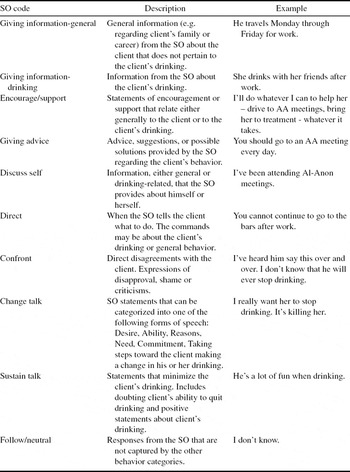
The MISO coding system includes three global ratings: Support, Collaboration, and Contemptuousness. Global ratings measure the overall tenor of the interactions between the SO, therapist, and client. They are designed to capture the Gestalt of these interactions in a session, in contrast to behavior counts, which measure particular SO statements and categorize them based on their content. The Support global rating assesses the SO's investment in and assistance to the client and the client's treatment goals, as verbalized in the session. Collaboration captures how well the SO and client work together in the session. Collaboration also measures the SO's investment and engagement in the session. SO Contemptuousness measures the degree to which the SO displays resentment, discouragement, criticism, or disgust for the client. The MISO also includes 10 behavior counts that measure specific SO utterances. One behavior code is assigned to each SO utterance. The behavior codes, along with explanations and examples, are presented in Table 1.
MISO behavior codes

Motivational Interviewing Skills Code Version 2.1 (MISC 2.1). The MISC 2.1 was developed to measure the processes that occur during MI treatment sessions (Miller et al., Reference Miller, Moyers, Ernst and Amrhein2007). While the MISC 2.1 measures both client and therapist language, we report only on client language in the current study. The MISC measures client change talk and sustain talk for each of the following categories: Desire to change, Ability, Reasons, Need, Taking steps, Commitment, and Other. An example of a Desire change talk statement is: “I really want to stop drinking”, while: “I drink to fall asleep at night – if I don't drink, I can't sleep” is an example of a Reasons sustain talk statement. Previous studies have collapsed client language into “change talk” and “sustain talk” categories and found that these categories demonstrate reliability ratings in the good to excellent range (e.g. Campbell, Adamson and Carter, Reference Campbell, Adamson and Carter2010; Gaume, Bertholet, Faouzi, Gmel and Daeppen, Reference Gaume, Bertholet, Faouzi, Gmel and Daeppen2010).
Training and coding
The first two authors (JKM and JMH) performed all coding. Both coders had extensive experience using the MISC 2.1 coding system as well as other MI coding systems. In order to achieve competence using the MISO, coders both independently and jointly reviewed sessions from another project, discussing and resolving points of discrepancy in their coding. None of the sessions that comprised the current data set was used in training. Following training, coders began independent coding of tapes from Project MATCH. All tapes were evaluated using both the MISC 2.1 and the MISO scales. Coders reviewed all tapes over a 6-month period.
Drinking outcomes
We obtained data on drinking outcomes for the clients represented in these sessions from the Project MATCH dataset. Drinking outcomes included percent days abstinent (PDA) and drinks per drinking day (DDD), both of which are derived from the Form 90 (Miller, Reference Miller1994; Miller and Del Boca, Reference Miller and Del Boca1994). PDA is the self-reported percent days abstinent from alcohol and illicit drugs in the previous 90 days, while DDD is the self-reported number of drinks per drinking days in the previous 90 days. These outcomes are summarized in the Project MATCH dataset as 12 weekly variables for the treatment period and 12 monthly variables for the year following treatment (months 4 to 15 following randomization). The proximal measure of each of these outcomes represents mean drinking behavior for months 4 to 9 following randomization. To adjust for non-normality, PDA was arcsine transformed and DDD was square-root transformed (Project MATCH Research Group, 1997).
SO drinking status
Significant other drinking status was obtained from the Important People and Activities Instrument (IPA; Clifford and Longabaugh, Reference Clifford and Longabaugh1991). The IPA is a structured interview, administered to all participants in Project MATCH. Participants were asked about the individuals in their social network with whom they had been in contact within the previous 6 months. They were asked to report on their social network members’ drinking status and the support they had received for treatment.
Results
Sample characteristics
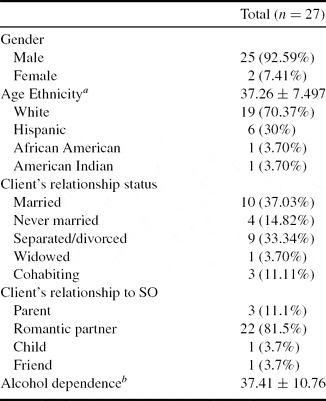
Client characteristics. Table 2 describes the characteristics of the clients. As in the main Project MATCH trial, the majority of the sample (92.59%) was comprised of male clients. In general, this subset of clients was fairly consistent with the full MATCH sample.
Client demographics

a aWill not total to 100% due to multiple responses;
b bMeasured by the SCID for the 90 days prior to enrollment
Therapist characteristics. Our subsample included nine therapists, or 37.5% of the MET therapists from Project MATCH who completed at least one session of MET. On average these therapists were over 40 years of age (mean = 42.0), mostly female (62.5%), and primarily white (87.5%). In general, the characteristics of our MET therapists were consistent with those of the full sample of MET therapists in Project MATCH (Project MATCH Research Group, 1998).
Significant other participation in Project MATCH. SOs participated in 15.28% of all MET sessions, with a slightly higher percentage in the outpatient arm (17.04%) than in the aftercare arm (13.0%). Overall, 34.73% of MET clients brought a SO to at least one therapy session, again with a higher percentage in the outpatient arm (38%) than in the aftercare arm (30.5%) (Carroll et al., Reference Carroll, Connors, Cooney, DiClemente, Donovan and Kadden1998). The sessions described in this report represent all available recordings of MET sessions attended by a SO, incorporating approximately 20.93% of all MET sessions attended by a SO.
Significant others. In order to characterize the SOs who participated in the treatment sessions, SO drinking status and support for treatment was derived from the IPA. In most instances (N = 22), we were able to match the SO who participated in treatment to the social network members listed on the IPA. In cases in which the SO was not listed or unable to be clearly identified (N = 5), IPA data were excluded from analyses. SO participants were primarily female (91%, n = 20) and had known the client an average of 14.15 years (SD = 11.90; range 1–38 years). Almost all (96%, n = 21) of the SOs and clients had daily contact with each other, with the remaining client reporting contact once or twice a week. Client participants described the SOs as in recovery 9% (n = 2), alcohol abstainers 50% (n = 11) and light drinkers 41% (n = 9). More than half (63.6%) of the participants reported that the SOs had not consumed alcohol in the past 6 months. The remaining participants reported that their SO drank alcohol once in the past 6 months (4.5%), less than once a month (4.5%), about once a month (13.6%), one or two times a week (9.1%), and daily (4.5%). Finally, participants indicated that SOs consume 1–2 drinks (22.7%), 3–5 drinks (18.2%) at most on a given day, while 59.1% said that their SO does not drink.
Coding reliability
A sample of 20% of the available sessions (n = 6) was randomly selected for double-coding. Several measures were used to estimate inter-rater reliability. We computed intra-class correlations (ICCs), Cronbach's alpha, and Pearson product moment correlations for each global ratings and behavior counts (Shrout and Fleiss, Reference Shrout and Fleiss1979). Estimates of the reliability of the MISO global ratings ranged from fair to poor, possibly due to our small sample size and the restricted range within the global measures (Cicchetti and Sparrow, Reference Cicchetti and Sparrow1981). The reliability estimates indicated fair reliability for Support (.585), and poor reliability for Collaboration (.328) and Contemptuousness (.346). Due to low reliability ratings for global behaviors, these measures have been excluded from all further analyses.
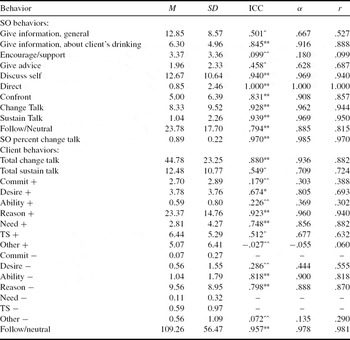
Estimates of inter-rater reliability for the SO behavior counts (Table 3) were quite good, with excellent reliability for 7 of the 10 behaviors, fair reliability for Giving information – General (.501) and for Giving advice (.458), and poor reliability for Encourage/support (.099). Although Encourage/support had the lowest reliability, it was also one of the least frequently observed behaviors (f = 91). Analyses based on this behavior should be interpreted with caution.
Characteristics of MISO and MISC 2.1 behavior counts

Note. Mean and standard deviation reported for full sample (n = 27); reliability information reported for reliability sample (n = 6). ICC = Single measures intraclass correlation; α = Standardized item alpha. ICC interpretation: ^^ = poor (0 – .40) ^ = fair (.40 – .59) * = good (.60 – .74) ** = excellent (.75 – 1.0)
Reliabilities of the MISC 2.1 client behavior counts (see Table 3) were by and large acceptable, with fair to excellent reliability seen for seven measures of client language and poor reliability for five measures of client language. Due to extremely low frequencies, reliability estimates could not be computed for three measures. The summary measures of change talk and sustain talk, which are the focus of our analyses, were respectively excellent and fair.
Does SO language predict client language?
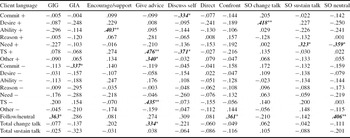
The correlations between SO language and client language are presented in Table 4. The results indicate that some measures of SO language (Encourage/support, Giving advice, SO change talk and SO sustain talk) were significantly and positively correlated with client change talk. SO statements about themselves (Discuss self) were negatively correlated with client change talk. Furthermore, the SO language category of Giving information – alcohol related was negatively correlated with client sustain talk. No significant relationship was detected between the summary category of client total change talk and SO change talk (r = .062, p = .758), or between client total sustain talk and SO sustain talk (r = −.088, p = .664).
Correlations between SO behavior and client change language categories

Notes: Numbers in bold are significant; * p < .05, ** p < .025
Is there a relationship between SO language and client drinking outcomes?
We used hierarchical regression analyses to test our hypothesis that SO language would predict client drinking outcomes. As these hypotheses were generated a priori, no adjustment for multiple comparisons was performed. We regressed proximal PDA and proximal DDD separately on SO sustain talk, with baseline drinking entered as a covariate in the first step. Results suggest that SO sustain talk predicts proximal DDD beyond the effects of baseline drinking (F(2,24) = 3.504, β = −.479, p = .046), accounting for an additional 22.5% of the variance in outcome. There was no evidence of a relationship between SO sustain talk and proximal PDA (F(2,24) = 1.527, p = .238). To examine the relationship between SO change talk and client outcomes, we regressed proximal PDA and proximal DDD separately on SO change talk. We found that SO change talk did not predict client proximal DDD (F(2, 24) = .022, p = .979) nor did it predict client proximal PDA (F(2, 24) = .599, p = .557).
Discussion
A key component of MI is its intense focus on client change talk; based on key findings that client change talk predicts improved treatment outcomes (Gaume et al., Reference Gaume, Bertholet, Faouzi, Gmel and Daeppen2010; Moyers et al., Reference Moyers, Martin, Houck, Christopher and Tonigan2009; Vader, Walters, Prabhu, Houck and Field, Reference Vader, Walters, Prabhu, Houck and Field2010). We know that specific therapist behaviors (reflections, open questions, and affirmations) predict client change talk whereas others (confronting, shaming) predict increased sustain talk. Our current findings suggest that when SOs participate in treatment sessions their behaviors and language, as well as that of the therapist, may contribute to subsequent treatment outcomes.
The goal of the current study was to examine the impact of SO on client within-session language. We hypothesized that overall SO supportiveness would be associated with greater change on the part of the client during MET sessions. We also hypothesized that SO change talk would be positively associated with client drinking outcomes. In simpler terms, we believed that supportive SOs, who stated explicitly in treatment sessions that they believed and wanted clients to quit drinking, would be associated with clients who said they intended to do just that.
SO and client within session behaviors
Some interesting relationships between SO and client within-session language were evident in the current study. We found that SO Encourage/support statements were positively correlated with client change talk as measured by Ability statements. Thus SO encouragement and support were related to client statements such as “I know that I can quit drinking if I try”. Furthermore, SO change talk was positively correlated with client change talk statements of Desire. We can infer that SO discussions of the benefits of client abstinence were associated with clients verbalizing their desire to quit drinking (“I want to be sober”) within the session. In sum, based on these findings, we see that SO statements of support and change are associated with increased client change talk. Hence, there is a relationship between SO and client language within treatment sessions that bears examination in future research.
Our findings offered information regarding SO behaviors that therapists may want to suppress or minimize within sessions. We found that SO Discuss self was negatively correlated with client change talk as measured by statements of clients’ commitment to change their drinking and steps that the clients had taken to reduce their drinking. The Discuss self category included SO statements ranging from “I work at the grocery store” and “I quit drinking 6 years ago” to “I am so fed up with this. I just don't know what else to do”. Regardless of the nature of the statements, they are negatively related to change talk and our data suggest that they should be minimized in treatment sessions. This may be difficult for SOs to understand or comply with in treatment sessions. SOs often suffer tremendous consequences as a result of their loved one's substance use so it is not surprising that they may be inclined to talk about their personal experiences or frustrations in the session (Orford et al., Reference Orford, Rigby, Miller, Tod, Bennett and Velleman1992). Therapists may want to selectively screen SOs before they participate in treatment. A SO who is frustrated and suffering from his or her own problems may not be as helpful in sessions as a SO who can set aside his or her own personal feelings in order to maximize the client's treatment. In the UKATT trial, SO involvement was viewed as both the most helpful aspect of sessions by 77% of therapists and as the least helpful aspect of the session by 53% of therapists (Orford et al., Reference Orford, Hodgson, Copello, Krishnan, de Madariaga and Coulton2009). Williamson et al. (Reference Williamson, Smith, Orford, Copello and Day2007) noted that SBNT therapists reported difficulty with SOs who were ill suited for therapy; “network members who attended sessions had been invited inappropriately, and sometimes the interactions that ensued were difficult for the therapist to deal with” pp.177–178. It seems as if the careful selection of SOs is an important consideration when involving them in the treatment process.
SO Advice-giving was positively correlated with both client change talk and sustain talk. This is an important result and should be further studied in larger studies. These findings suggest that when the SO is offering potential solutions to the client (“You should go to AA”) these may be met with resistance (“I went to AA and hated it. I stopped going last week”) or may be met with agreement (“I'll try AA out tomorrow”). It suggests that client and SO discussions surrounding treatment strategies may be a delicate balance, perhaps requiring the SO to be coached to recognize client resistance, or that this may be a pivotal time for the therapist to guide the discussion.
SO language and client drinking outcomes
Results indicate that SO language did predict post-treatment client drinking on some outcome measures. We found that SO change talk did not predict client drinking quantity or frequency. However, SO sustain talk did significantly predict proximal drinks per drinking day, but did not predict client percent days abstinent.
While statements of sustain talk were infrequent for SOs (mean = 1.04; SD = 2.26), these statements were still predictive of worse client drinking outcomes. It may be that SO statements against making a change or in maintaining the status quo supersede their own change talk statements. Moreover, it was interesting that SO change talk was associated with client drinks per drinking day rather than client percent days abstinent. That is, sustain talk is correlated with the intensity, rather than the frequency, of post-treatment drinking. This finding is inconsistent with previous research findings in which social support and social relationships had a greater impact on clients’ frequency of drinking than the intensity of the clients’ drinking (Manuel et al., Reference Manuel, McCrady, Epstein, Cook and Tonigan2007; Mohr et al., Reference Mohr, Averna, Kenny and Boca2001). The strength of SO change talk and sustain talk statements are not coded in the current coding system, thereby limiting our ability to measure the magnitude of SO language. Thus, the following statement “He cannot live without drinking” would receive the same sustain talk code as “It might be better if he cut back a bit”. Closer examination of SO and client statements may provide insight into the driving force of sustain talk.
Limitations and future directions
There are a number of potential limitations to the current study. First, although the sessions used in this study represent one-fifth of all SO sessions in Project MATCH, this study is limited by its small sample size and was possibly underpowered to detect significant findings. Thus, the study findings should be interpreted with caution and replicated using a larger sample. In addition, SOs coded in the current study included not only romantic partners but also parents, friends, and family members, who were selected by the client and who agreed to participate in the client's treatment. Therefore, the findings in this study are not generalizable to all SOs and may not be applicable to SOs who play a less central role in the therapy process or who do not support the client's sobriety. Furthermore, in the Project MATCH protocol SO participation was requested as a way of supporting the client in the treatment; however, SOs were not directly asked to be supportive, nor were they asked to verbalize their perceptions of why the SO should change their drinking behavior. Thus, the current findings are limited by the SOs’ lack of direction on how to behave in treatment sessions. It may be that SOs, if coached and guided, could successfully verbalize their support and confidence in their loved one's ability to refrain from drinking. In addition, the data coded in the current study were from a single session of a four-session protocol. This design does not allow for a longitudinal examination of the influence of SOs. SOs, like clients, may present for treatment with an initial resistance or reluctance that abates over time. Finally, this study is a secondary analysis of Project MATCH data, a study that was not designed to test the influence of SO in MET sessions. Future research should examine the influence of SOs over the course of treatment and possibly assess whether SO language changes over the course of treatment and whether SOs can be utilized to a greater extent in the treatment process.
The results of this study are consistent with the hypothesis that SOs can exert unique influence on treatment sessions. The findings suggest that arguing against the client's ability or desire to change is more powerful than arguing for it and is linked to client drinking intensity rather than frequency. Future research should continue to examine the role of SOs in treatment sessions, with a particular focus on SO language and its relationship with client language and client outcomes.
Acknowledgments
Preparation of this manuscript was supported by Grant R01AA13696–01 from the National Institute on Alcohol Abuse and Alcoholism. Jennifer Manuel is currently supported by a National Institute on Drug Abuse training grant T32 DA007250. Portions of this manuscript were presented at the 2008 Motivational Interviewing Network of Trainers Meeting, Albuquerque, NM and at the 2008 Annual Meeting of the Research Society on Alcoholism, San Diego, CA.



Comments
No Comments have been published for this article.