Introduction
The etiology of Alzheimer's disease (AD) remains unknown, and its natural history is heterogeneous across patients. Mutations of three genes have been identified as linked to early-onset familial AD, amyloid precursor protein (APP), presenilin 1 (PSEN1), and presenilin 2 (PSEN2), but the inheritance of the disease as a Mendelian trait arises in only 2% of all cases (Pericak-Vance et al., Reference Pericak-Vance, Grubber, Bailey, Hedges, West, Kemmerer and Haines2000). In sporadic AD genetic factors make a significant contribution to etiology, but are not the main determining factor. Most forms of AD have a complex etiology and the putative environmental and genetic factors which contribute to causation appear to be necessary but not independently sufficient for the development of the disease. The apolipoprotein E (APOE) ε4 gene on chromosome 19 has been identified as a major risk factor for sporadic late-onset cases of AD. In established AD, the APOE ε4 mutation is present in up to 50% to 60% of patients. Compared with those with no copies of the ε4 allele, individuals with one copy of this allele have a three to four time higher risk of developing AD. Two copies of the ε4 allele mean a 10-fold increase in the risk of developing the disease (Corder et al., Reference Corder, Saunders, Strittmatter, Schmechel, Gaskell, Small and Pericak-Vance1993). AD related APOE variants consistently correlate with neurophysiologic features, neurocognitive functions and biological markers including serum β-amyloid and APOE level, lymphocyte apoptosis, brain bioelectrical activity, memory function, cerebrovascular hemodynamics, blood pressure and cholesterol level (Cacabelos, Reference Cacabelos2003).
It seems reasonable, therefore, to look for possible endophenotypes in individuals whose genetic profile may indicate a hereditary risk for developing AD. These might include the linguistic changes found in the early phase of AD, for example verbal fluency problems (Alberca, Salas, Perez-Gil, Lozano, & Gil-Neciga, Reference Alberca, Salas, Perez-Gil, Lozano and Gil-Neciga1999), degradation of vocabulary (Forbes-McKay & Venneri, Reference Forbes-McKay and Venneri2005; Snowdon, Greiner, & Markesbery, Reference Snowdon, Greiner and Markesbery2000) and simplification of grammatical structure (Forbes-McKay & Venneri, Reference Forbes-McKay and Venneri2005). Variants of the category fluency task have frequently been used to characterize the earliest linguistic alterations in AD (Clark et al., Reference Clark, Gatz, Zheng, Chen, McCleary and Mack2009). Whilst simple and brief to administer, category fluency tasks generate potentially rich and salient data. Apart from distinguishing control from patient performance (as controls consistently generate significantly more words than patients), category and letter fluency tasks have also been used to discriminate between patients with semantic dementia, primary progressive aphasia and AD (Marczinski & Kertez, 2006). More detailed analysis of the characteristics of the words produced in a category fluency task may allow more sophisticated dissociations between patients with AD, patients with other dementias and healthy controls to emerge. For instance, a measure of the age of acquisition of the words produced in a semantic fluency task appears to be a sensitive parameter for the early detection of AD and its differentiation from other neurodegenerative syndromes and normal ageing (Forbes-McKay, Ellis, Shanks, & Venneri, Reference Forbes-McKay, Ellis, Shanks and Venneri2005; Venneri et al., Reference Venneri, McGeown, Hietanen, Guerrini, Ellis and Shanks2008). In addition, naming and spontaneous speech experiments have shown that patients with AD, even at an early stage, generate words that are acquired earlier in life, are shorter, higher in frequency, refer to items that are easier to imagine and that are more typical exemplars of their semantic category than the words generated by healthy controls (Silveri, Cappa, Mariotti, & Puopolo, Reference Silveri, Cappa, Mariotti and Puopolo2002). These studies demonstrate that measures of the lexical characteristics of the words produced by patients with AD might be useful predictors of the disease.
Some studies have examined verbal fluency in the preclinical phase of AD and have also found significant deficits in category fluency (Clark et al., Reference Clark, Gatz, Zheng, Chen, McCleary and Mack2009). In amnestic MCI, category fluency impairments are now seen as a core feature of the syndrome in those who later transit to AD dementia (Hodges, Erzinclioglu, & Patterson, Reference Hodges, Erzinclioglu and Patterson2006). The detection of subtle changes in semantic memory and naming in MCI subjects, therefore, further supports the sensitivity of category fluency as a measure of early semantic impairment (Hodges et al., Reference Hodges, Erzinclioglu and Patterson2006). The MCI population, however, is very heterogeneous and data collected in people at this stage are in most cases contaminated by the presence in the sample of a large proportion of people who will not develop the disease. To characterize the symptomatic profile in the preclinical phase of the disease and to increase homogeneity in the sample, an appropriate strategy might be to identify in the study population of MCI subjects those who are carriers of the APOE ε4 mutation. It will then be possible to see whether subtle distinctive lexical semantic deterioration occurs before the clinical onset of the dementia syndrome, and whether there is any parameter reliably altered in ε4 carriers that might be a prognostic indicator in the MCI population.
Several studies have investigated the effects of the APOE ε4 genotype on brain structure and function before and after the clinical onset of AD (Bookheimer et al., Reference Bookheimer, Strojwas, Cohen, Saunders, Pericak-Vance, Mazziotta and Small2000; Jack et al., Reference Jack, Petersen, Xu, O'Brien, Waring, Tangalos and Kokmen1998). Young carriers of the APOE ε4 mutation showed decreased cerebral metabolism in the areas characteristically affected in older patients with AD (Reiman et al., Reference Reiman, Chen, Alexander, Caselli, Bandy, Osborne and Hardy2004). In addition, despite identical performance to non carriers, asymptomatic APOEε4 carriers showed decreased fMRI activation in bilateral and posterior inferior temporal regions, and increased parietal activation during naming and fluency tasks (Smith et al., Reference Smith, Andersen, Kryscio, Schmitt, Kindy, Blonder and Avison2002). Carriers of this genetic mutation had resting metabolism and brain blood flow abnormalities which were detectable several decades before the onset of the dementia syndrome. MRI based neuroanatomical studies have yielded less clear cut findings. Several studies have reported volumetric differences in the hippocampus between cognitive intact APOE ε4 carriers and noncarriers, which, however, have not reached statistical significance (Jack et al., Reference Jack, Petersen, Xu, O'Brien, Waring, Tangalos and Kokmen1998). Others have found either significant reductions in hippocampal volume (Plassman et al., Reference Plassman, Welsh-Bohmer, Bigler, Johnson, Anderson, Helms and Breitner1997) or significant differences in cortical thickness of hippocampal subregions (in entorhinal cortex and subiculum, but not in the main hippocampus body and in perirhinal cortex) in cognitively normal ε4 carriers (Burggren et al., Reference Burggren, Zeineh, Ekstrom, Braskie, Thompson, Small and Bookheimer2008).
In summary, in addition to the established independent influence of gene mutation and lexical semantic deficits on AD risk, the analysis of ε4 carrier cognitive endophenotypes might reveal factors of prognostic value in mild cognitive impairment. More specifically the study of the lexical semantic profile in a genetically enriched sample might help to refine the set of behavioral measures that best differentiate normal and abnormal ageing. The aim of this study, therefore, was to determine whether the APOE ε4 mutation was associated with poorer lexical semantic skills in MCI participants. Competency was assessed by determining the lexical attributes (i.e., age of acquisition, typicality, familiarity) of words produced in a category fluency task.
Methods
Participants
Thirty consecutive participants with amnestic MCI were recruited from a large pool of referrals to the specialist referral unit for memory and other cognitive disorders at the University of Parma, Italy. There were 14 males and 16 females in the group. Twenty-three age- and education-matched controls (5 males and 18 females) were also tested. Control participants were community dwelling individuals recruited from the general public with no verified history of any neurological, psychiatric, or other significant systemic pathology. A diagnosis of amnestic MCI was reached based on published criteria (Petersen, Reference Petersen2004; Petersen et al., Reference Petersen, Doody, Kurz, Mohs, Morris, Rabins and Winblad2001). All MCI subjects had a full clinical assessment including neurological examination and extensive neuropsychological screening. They met the criteria for mild cognitive impairment (MCI) of amnestic type (Petersen, Reference Petersen2004; Petersen et al., Reference Petersen, Doody, Kurz, Mohs, Morris, Rabins and Winblad2001) as they all performed above published cutoff scores on all neuropsychological tests except for tests of long-term memory. None had any difficulties in activities of daily living and/or instrumental activities of daily living at time of referral. To exclude the presence of dementia, all individuals had comprehensive clinical and neuropsychological examinations (including assessment of activities of daily living), and did not meet the international published guidelines for the diagnosis of different types of dementia (Brun et al., Reference Brun, Englund, Gustafson, Passant, Mann, Neary and Snowden1994; McKeith et al., Reference McKeith, Galasko, Kosaka, Perry, Dickson, Hansen and Perry1996; McKhann et al., Reference McKhann, Drachman, Folstein, Katzman, Price and Stadlan1984; Roman et al., Reference Roman, Tatemichi, Erkinjuntti, Cummings, Masdeu, Garcia and Scheinberg1993). Individuals were included only if there was no neuroimaging evidence of cortical or subcortical vascular lesions on CT or MRI scan and if there was no history of hypertension, diabetes mellitus, transient ischemic attacks, or cardiovascular problems. Additional exclusion criteria included the presence of significant symptoms of depression, a history of psychiatric disorders and treatment with antipsychotic or psychoactive medication at the time of investigation. A blood sample was also collected to determine the APOE status of both MCI and control participants. On the basis of their genetic profile the MCI sample was divided into a ε4 carrier subgroup including 18 subjects (8 males and 10 females), all heterozygous for the APOE ε4 allele (ε3ε4) and a non ε4 carrier subgroup including 12 subjects (6 males and 6 females) homozygous and heterozygous for the APOE ε3 allele (ε3ε3/ε3ε2). Genotyping revealed that one male in the control sample was heterozygous for the APOE ε4 allele (ε3ε4). His data were, therefore, excluded from the study to avoid any potential contamination of data, with a final sample size in the control group of 22 non ε4 carriers participants. MCI ε4 carriers had a mean Mini Mental State Examination (MMSE) score of 26.61 (SD 2.22), a mean age of 70.61 (SD 9.61) and a mean education of 10.94 (SD 5.17). MCI non ε4 carriers had a mean MMSE score of 27.58 (SD 1.56), a mean age of 72.50 (SD 9.11) and a mean education of 7.83 (SD 4.20). The control group had a mean MMSE score of 28.95 (SD 0.84), a mean age of 66.59 (SD 9.23), and a mean education of 10.05 (SD 4.41). The same exclusion criteria used in the recruitment of the MCI sample were adopted for the healthy older adult sample. The same international guidelines used to exclude the presence of a dementia syndrome or to ascertain the presence of mild cognitive impairment in the MCI sample were also used in the recruitment of the healthy older adult sample. The study received local ethics committee approval and all MCI and control participants gave informed consent to their participation in the study.
Neuropsychological Assessment
All MCI subjects completed a comprehensive neuropsychological test battery. The neuropsychological test battery included the Italian version of the Mini Mental State Examination (Measso et al., Reference Measso, Cavarzeran, Zappalà, Lebowitz, Crook, Pirozzolo and Grigoletto1993), tests of language comprehension (De Renzi & Faglioni, Reference De Renzi and Faglioni1978) and naming by confrontation, tests of category and letter fluency (Novelli et al., Reference Novelli, Papagno, Capitani, Laiacona, Cappa and Vallar1986b), tests of short and long term memory (verbal and nonverbal) (Caffarra, Vezzadini, Dieci, Zonato, & Venneri, Reference Caffarra, Vezzadini, Dieci, Zonato and Venneri2002a; Novelli et al., Reference Novelli, Papagno, Capitani, Laiacona, Cappa and Vallar1986a; Spinnler & Tognoni, Reference Spinnler and Tognoni1987), a test of abstract reasoning (Basso, Capitani, & Laiacona, Reference Basso, Capitani and Laiacona1987), and tests of attention (Caffarra, Vezzadini, Dieci, Zonato, & Venneri, Reference Caffarra, Vezzadini, Dieci, Zonato and Venneri2002b; Spinnler & Tognoni, Reference Spinnler and Tognoni1987). All but one (i.e., confrontation naming) of the tests included in the neuropsychology battery have norms and cutoffs available for the Italian population. Activities of daily living (ADL) and instrumental activities of daily living (IADL) were also assessed with formal scales (Lawton & Brody, Reference Lawton and Brody1969). Mental status in controls was assessed using the MMSE as a screening test and only those scoring more than 27/30 were recruited to participate in the study.
Experimental Procedure
A category fluency task including the categories of fruits and animals was used. Performance was evaluated by collating the total number of words produced for these two categories and by determining the lexical attributes (length, typicality, familiarity and age of acquisition) for each acceptable word. Patients and controls performed two 60-s trials (one for animals and one for fruits) during which they were requested to orally produce as many exemplars belonging to the target category as possible. Each of the items produced for this task was then scored in terms of lexical attributes (see below). The data included in the analyses were the mean attributional values of the words produced by each person.
Word Lexical Semantic Attributes
Age of acquisition
Age of acquisition (AoA) values for words were obtained by asking a sample of 46 healthy older adults [25 females, 21 males, mean age 68.87 (7.68), mean education 9.76 (SD 5.09), mean MMSE 28.69 (1.03)] to rate the AoA of 289 words (66 fruit and 223 animal words) produced by all MCI and control participants in this study following the procedure reported in the study by Forbes-McKay et al. (Reference Forbes-McKay, Ellis, Shanks and Venneri2005). Each participant was presented with a random list of all 289 items and asked to estimate the age (in years) at which they had learned a given word and its meaning in spoken or written form. Harmonic mean AoA ratings for each item were calculated and used in the analyses. These raters were from a similar geographical and socio-cultural background, age and education as the participants enrolled in this study. Ratings acquired in this way have been shown to correlate highly with objective measures of AoA and, therefore, have good validity (Morrison, Chappell, & Ellis, Reference Morrison, Chappell and Ellis1997).
Typicality
Numerous studies have shown that access to semantic knowledge (e.g., picture identification and naming) is influenced by the typicality of category exemplars (Holmes, Jane Fitch, & Ellis, Reference Holmes, Jane Fitch and Ellis2006). Typical exemplars which share similar features to one another (e.g., fox and lion) and the category prototype (animal) are named faster than those atypical examples (e.g., kangaroo and snake). Raters (the same as above) were given a list of all items split into two categories (animal and fruit). They were requested to rate the typicality of each item by using a 7-point Likert type rating scale, from 7 (most typical) to 1 (least typical).
Based on the instructions given by Larochelle, Richard, and Soulieres (Reference Larochelle, Richard and Soulieres2000), they were asked to rate how well each exemplar (e.g., apple) represented its specific category (e.g., fruit). To control for order effects, the exemplars were shown in random order to raters (Forbes-McKay et al., Reference Forbes-McKay, Ellis, Shanks and Venneri2005).
Familiarity
Raters (the same as above) were given a list of items split in two categories (animals and fruit). They were given a 7-point rating scale, from 7 (very familiar) to 1 (least familiar). They were asked to rate how familiar they were with a particular item. To control for order effects, the exemplars were shown in random order to raters.
Length
Length was measured in terms of the number of letters in each word instead of number of phonemes.
Results
There was no significant difference in age (F(1,50) = 3.37, not significant, n.s.) nor in education (F(1,50) = 0.07, n.s.) between the MCI sample and the controls. No significant differences were found between the two MCI ε4 carriers/non ε4 carriers subgroups and the controls for age (F(2,49) = 1.81, n.s.) and education (F(2,49) = 1.65, n.s.).
Neuropsychological Assessment
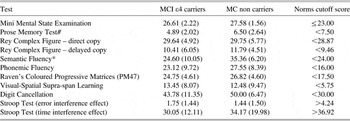
The means and standard deviations of each MCI subgroup's score on the tests included in the standard neuropsychological battery are shown in Table 1.
Mean (and Standard Deviation) scores of MCI APOE ε4 carrier and non carriers on the screening neuropsychological tests

Scores below cutoff.
*Significant group difference p < 0.01.
Although the MMSE score for each individual in the MCI group remained well above cutoff on this screening test, there was an overall statistically significant difference between the mean MMSE score of the MCI group and that of the control group (F(1,50) = 18.23; p < .001). A comparison between MMSE scores in MCI ε4 carriers, MCI non ε4 carriers and controls revealed that there was a significant difference between the MCI subgroups and controls (F(2,49) = 10.74; p < .001), but only the mean MMSE score of the MCI ε4 carrier subgroup was significantly different from controls (p < .001), while that of MCI non ε4 carriers was not. When directly compared, the scores of the two MCI subgroups (ε4 carrier/non ε4 carrier subgroups) did not differ significantly, however. Lost points were mostly in the memory component of this screening test.
The scores of MCI ε4 carriers and MCI non ε4 carriers on each test in the neuropsychological assessment were compared with ANOVA. There were no significant differences between the two genetically defined subgroups in any of the tests included in the battery, except for scores on the category fluency task (F(1,28) = 10.22; p < .01). Individual scores of MCI APOE ε4 carriers/non ε4 carriers on the prose memory test fell below the cutoff established in the norms for the Italian population, while scores on all other tests in the neuropsychological battery were in the normal range and above the cutoffs established by the norms for the Italian population.
Lexical–Semantic Assessment
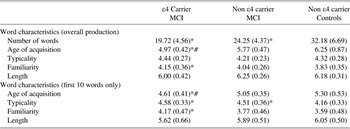
Table 2 shows the mean number of words and mean lexical values for the words produced by the two MCI subgroups and by the control group in the category fluency task.
There was a significant difference between the MCI subgroups and the control group in the mean number of words produced in the two 60 second trials of the category fluency task (F(2,49) = 25.83; p < .001). Post hoc analysis showed that both MCI subgroups were significantly different from controls (p < .001 for both comparisons), but they did not differ from each other. Mean word length of both the MCI subgroups and the controls did not differ (F(2,49) = 2.24, n.s.), nor did mean word typicality (F(2,49) = 2.72, n.s.). A significant difference between MCI ε4 carriers/non ε4 carriers and controls was found for word familiarity (F(2,49) = 4.55, p < .02). Post hoc analysis with the Scheffe’ test showed that the mean word familiarity of MCI ε4 carriers differed significantly from that of controls (p < .02), but there was no significant difference between MCI non ε4 carriers and controls or between the MCI ε4 carrier/non ε4 carrier subgroups. Mean AoA values of the MCI subgroups and controls were significantly different (F(2,49) = 18.56; p < .001). Post hoc analysis, however, showed that the mean AoA values of words produced by MCI ε4 carriers were significantly lower than those of both MCI non ε4 carriers (p < .005) and controls (p < .001). No significant differences were found between MCI non ε4 carriers and controls. Multiple analyses of covariance were also carried out to rule out any possible spurious influence of age, education, gender or MMSE score difference on the number of words and on the lexical parameters of the words produced in the category fluency task. Demographic variables and MMSE scores were all included as covariates in the analyses. Significant group differences remained for number of words (F(2,45) = 13.31; p < .001), age of acquisition (F(2,45) = 9.08; p = .001) and for familiarity (F(2,45) = 3.91; p < .05), but no significant group difference was found for word length (F(2,45) = 0.84, n.s.) or typicality (F(2,45) = 2.99, n.s.).
To verify whether any of the observed differences between MCI subgroups and controls were driven by controls generating a larger number of words produced toward the end of the allocated time, further analyses were carried out by calculating the mean lexical semantic values using only 10 words per participant (the first five items produced in each of the two category fluency trials). The mean lexical values derived from this reduced number of words are also shown in Table 2.
Mean (SD) number of words and characteristics of all words produced by the MCI APOE ε4 carriers, non ε4 carriers, and controls on the category fluency task

*Significantly different from controls.
Significantly different from non carriers.
Mean word length of both the MCI subgroups and the controls did not differ (F(2,49) = 2.93, n.s.). A significant difference between MCI ε4 carriers/non ε4 carriers and controls was found for mean word typicality (F(2,49) = 8.83; p < .001) and mean word familiarity (F(2,49) = 7.71; p < .01). Post hoc analysis with the Scheffe’ test showed that the word typicality of both MCI subgroups was significantly different from controls (p < .001 and p < .02 for MCI ε4 carriers/controls and MCI non ε4 carriers/controls, respectively). Post hoc analysis on familiarity values showed that the mean of the MCI ε4 carrier subgroup differed significantly from that of controls (p < .001), but there was no significant difference between MCI non ε4 carriers and controls or between the MCI ε4 carrier/non ε4 carrier subgroups. Mean AoA values of the MCI subgroups and controls were significantly different (F(2,49) = 11.38; p < .0001). Post hoc analysis, however, showed that the mean AoA values of words produced by MCI ε4 carriers were significantly lower than those of both MCI non ε4 carriers (p < .05) and controls (p < .0001). No significant differences were found between MCI non ε4 carriers and controls.
Discussion
Several studies have examined the independent effects of APOE ε4 genotype on AD risk and cognitive performance in healthy subjects, but the present investigation has examined the effect of this genetic mutation on those lexical–semantic deficits which have been shown to usefully discriminate between normal and abnormal cognitive decline (Forbes-McKay et al., Reference Forbes-McKay, Ellis, Shanks and Venneri2005). The type of output generated by MCI ε4 carriers in the category fluency task was very much impoverished compared with healthy controls and was characterized by significant lexical effects. There were a significantly smaller number of words produced and a significant difference in the lexical characteristics of their residual word production. MCI APOE ε4 carriers generated words which were earlier acquired, more familiar and more typical of the semantic category than the words generated by healthy controls. The age of acquisition value and the number of words produced were the parameters showing the strongest effect, even when accounting for any residual variance in MMSE and/or demographic variables between the MCI ε4 carriers/non carriers and controls. Words produced by MCI ε4 carriers were significantly earlier acquired than those produced by controls, but also significantly earlier acquired than those produced by MCI non ε4 carriers. For all other parameters, the performance of the two MCI subgroups was significantly worse than that of controls but no significant difference between the two genetically defined MCI subgroups was found. There is evidence that a reduction in verbal fluency output appears of little value in differentiating performance of patients with AD and that of patients with other forms of dementia (Hietanen et al., Reference Hietanen, McGeown, Guerrini, Shanks, Ellis and Venneri2006; Marczinski & Kertesz, Reference Marczinski and Kertesz2006), and if the number of words generated by AD and controls is taken into account when trying to discriminate patients and controls, the inclusion of this variable in the analysis did not significantly contribute to increasing the discriminatory power of the AoA word attribute (Forbes-McKay et al., Reference Forbes-McKay, Ellis, Shanks and Venneri2005). It appears, therefore, that lexical attributes such as age of acquisition have a higher sensitivity power, even at a minimal level of neuropathological deficit. It might be argued that this significant effect might have been substantially driven by controls producing a larger number of words and especially by those words produced toward the end of the allocated time for each trial. To rule out this potential confound, additional analyses included only the first five words produced in each of the two trials (10 words in total) by each participant (patient or control). Once number of words in the output was equated and lexical semantic parameters recalculated based on this reduced output the pattern of indices did not change substantially. There was still no significant difference in length, but words produced by MCI ε4 carriers remained significantly earlier acquired than those produced by controls, but also significantly earlier acquired than those produced by MCI non ε4 carriers. Both MCI subgroups began their word production with words which were significantly more typical of their category than those of controls, and items produced by MCI ε4 carriers were also more familiar than those of controls, while those of MCI non ε4 carriers were not, although no significant difference between the two genetically defined subgroups were found.
Overall the pattern of findings, from both the analyses on the whole output and those on the reduced output, provides some insight into the nature of word retrieval impairments at the MCI stage. Data from experimental psychology studies (in normal subjects) have supported a view that the locus of the age of acquisition effect is most likely at post-semantic aspects of speech production, especially at the level of phonological mapping, and, therefore, more readily observable in naming tasks than other speech production tasks since the mapping between conceptual and phonological knowledge in this type of task is very arbitrary (Lambon Ralph & Ehsana, Reference Lambon Ralph and Ehsana2006). Category fluency tasks would also have an arbitrary mapping between conceptual and phonological representations and on this basis would be more susceptible to AoA effects. An AoA effect in MCI and AD is, however, less likely to be the manifestation of a weakened lexicon, but might be the symptomatic expression of an impoverished semantic system. In this respect, other experimental psychology studies have offered an alternative theoretical account of the AoA effect to the post-semantic phonological retrieval explanation. The interpretation of these studies would favor a semantic hypothesis for age of acquisition effects, whereby early acquired concepts have richer interconnections with a large number of other concepts and are thus more accessible. Later acquired concepts would be less interlinked with other concepts and would be less readily accessible and easier to lose than the earlier more firmly interconnected ones (see Ellis, in press for a recent review). The data from several recent studies of AoA effects in dementia and other neurological conditions such as aphasia seem to support this earlier experimental psychology work. Evidence from neuroimaging studies would also support a semantic theory of AoA effects (Hernandez & Li, Reference Hernandez and Li2007). The analysis of the reduced output clearly shows a strong typicality effect in both MCI subgroups revealing semantic impairments even at this early stage of cognitive decline. At this stage, however, semantic deficits are still modest, and are even more so in MCI non ε4 carriers. This suggests that there might be sufficient residual neural capacity which, although unable to support episodic memory retrieval (by the time an individual is symptomatic, extensive damage to the hippocampus and adjacent structures has already occurred) can still support relatively efficient retrieval from long term semantic memory, if given sufficient time. MCI ε4 carriers, however, have more substantial deficits, which might be the behavioral reflection of a more substantial breakdown of connections between those limbic structures responsible for retrieval from long term episodic/semantic memory and those temporal neocortical association regions where more established semantic representations are stored and later acquired words are represented (Ellis, Burani, Izura, Bromiley, & Venneri, Reference Ellis, Burani, Izura, Bromiley and Venneri2006; Venneri et al., Reference Venneri, McGeown, Hietanen, Guerrini, Ellis and Shanks2008). This hypothesis is supported by other studies which have highlighted APOE-related differences in cerebral structure, brain blood flow and metabolism, and cerebral activation in the medial temporal structures (including hippocampus, cingulate areas, etc.), even in young healthy ε4 carriers (Kukolja, Thiel, Eggermann, Zerres, & Fink, Reference Kukolja, Thiel, Eggermann, Zerres and Fink2010; Luckhaus et al., Reference Luckhaus, Cohnen, Fluss, Janner, Grass-Kapanke, Teipel and Wittsack2010). In a recent neuroimaging study, a genotype by lexical–semantic ability (expressed by AoA values) interaction was found in predominantly left mediotemporal and anterior temporal pole regions in MCI APOE ε4 carriers/non carriers (Venneri et al., Reference Venneri, McGeown, Biundo, Mion, Nichelli and Shanks2010). Limbic structures and especially parts of the hippocampal complex are, of course, the areas which have been found severely atrophic in MRI studies of AD patients, with high levels of atrophy detectable years before a formal diagnosis is made (Fox & Schott, Reference Fox and Schott2004), and spreading to temporal neocortical regions also occurs very early in the course of the disease (Braak & Braak, Reference Braak and Braak1991). There is evidence that grey matter loss in medial temporal structures, especially perirhinal and parahippocampal cortex, as well as neocortical regions in the anterior temporal pole would result in degraded semantic outputs in patients in the early stage of AD. Such outputs are characterized by strong lexical effects (age of acquisition and typicality effect especially) (Venneri et al., Reference Venneri, McGeown, Hietanen, Guerrini, Ellis and Shanks2008). It is, therefore, possible that MCI ε4 carriers might have more selective damage to the perirhinal cortex and other components of the semantic memory retrieval system, with consequent breakdown in connectivity between limbic and association cortex. The more degraded semantic production with stronger lexical effects (age of acquisition especially) which is seen in the output of MCI ε4 carriers appears a good cognitive endophenotype of AD. The higher conversion rate in the MCI subgroups (11/13 of the traceable MCI ε4 carriers versus 4/9 of the traceable MCI non ε4 carriers) provides good support to the validity of the finding. An alternative explanation might be that the neuroanatomical substrate supporting retrieval from long term semantic memory is selectively sensitive to the earliest effects of APOE ε4 burden and its apparent interaction with AD pathology during the life course. This latter hypothesis finds some support in the evidence of lower metabolic activity in regions of the parietal and temporal cortex strongly associated with semantic representations in asymptomatic carriers of the APOE ε4 mutation (Reiman et al., Reference Reiman, Chen, Alexander, Caselli, Bandy, Osborne and Hardy2004).
Finally, the significant association between the APOE ε4 mutation and an accentuated lexical–semantic deficit in MCI subjects might be of some clinical relevance in this at risk population. A more sophisticated analysis of cognitive performance using tests like the category fluency task may provide clinically relevant early indicators of pathological brain ageing in individuals at greater risk of AD and trigger more detailed neuropsychological investigations in those subjects with poorer performance.
Acknowledgments
This study was supported by the Marie Curie Research Training Network on Language and Brain funded by the European Commission under Framework 6 of which R.B., P.C., and A.V. were members. The authors thank the associate editor and the reviewers for their helpful comments which have significantly enhanced the quality of the manuscript. Conflict of interest: None