1. INTRODUCTION
With the rapid development of satellite navigation systems, better service performance is the key to attracting users for Global Navigation Satellite Systems (GNSSs). At the same time, the compatibility, interoperability and service performance of GNSSs have become important criteria for system construction and user requirements (Zhao et al., Reference Zhao, Chen, Hu, Wang, Zhang, Liu and Zhao2016). At present, there is no uniform standard for performance evaluation, such as performance identification, representation and indication ranges for the Global Positioning System (GPS), Galileo, Globalnaya Navigazionnaya Sputnikovaya Sistema (GLONASS), and BeiDou Navigation Satellite System (BDS); they are different for each system. Although the range of assessment criteria for each satellite navigation system varies slightly, the common required performance indicators for GNSS include accuracy, integrity, continuity and availability (Civil Aviation Authority, 2004), which have been adopted as standards in the official documents of many satellite navigation systems (United States (US) Department of Defense (DoD), 2008; US Department of Transportation, 2009; European Commission, 2009; European GNSS Service Centre, 2009; China Satellite Navigation Office (CSNO), 2013). For GPS, since 1993, based on the GPS Standard Positioning Service Performance Standard (GPS SPS PS), GPS and its augmentation system (Wide Area Augmentation System, WAAS) have been monitored by the Federal Aviation Administration (FAA), and the corresponding results have been released in quarterly performance analysis reports. The status and failure information of GPS satellites are also included in these reports (FAA, 2016). Among the above criteria, the GPS SPS PS is widely used to evaluate satellite navigation systems (Anton et al., Reference Anton, Hessin, Sapp and Conley2001).
When applied to civil aviation and other navigation applications, Signal-In-Space (SIS) continuity and availability of GNSS are important indicators for system performance evaluation. The continuity of a navigation system refers to its ability to continue to provide services over a period of time without unscheduled interruptions, which is primarily a measure to characterise the probability of unscheduled interruptions. Continuity can be divided into SIS and service continuities (US DoD, 2008). The availability of a navigation system refers to the overall percentage of the navigation system that provides available services to users within the service area, thus characterising the service capabilities of the satellite navigation system (US DoD, 2008). As one of the four basic service performance criteria, availability has become a key performance indicator for civil aviation applications and an important basis for judging the reliability of a navigation system (Zhao and Sun, Reference Zhao and Sun2014). Availability is also divided into SIS and service availabilities (SPS service availability and Position Dilution of Precision (PDOP) availability); SIS availability consists of per-satellite and constellation availabilities (US DoD, 2008), which are garnering more attention (Walter et al., Reference Walter, Blanch and Enge2010). Ochieng et al. (Reference Ochieng, Sheridan, Sauer and Han2002) studied an evaluation model for per-satellite availability and calculated the instantaneous availability based on failure rate and reliability but did not consider the on-orbit recovery performance. In practice, most satellite failures can be resolved through ground control segment recovery or backup satellite replacement. Previously studied constellation availability models (Clifford, Reference Clifford1999; Wu et al., Reference Wu, Pandya, Lewellen and Angus1999) mainly considered the constellation of a specified number of satellites, not including the backup satellites distributed in the constellation. Constellation availability is based on the per-satellite availability, and the Mean Time Between Failure (MTBF) and Mean Time To Repair (MTTR) of interruptions for different satellites directly affect constellation availability in different regions. The US DoD (2008) has stated that constellation availability is based on a binomial probability distribution. To some extent, this distribution reflects constellation availability under different failure conditions, but ignores the impact of satellite recovery and availability of backup satellites for constellations. Therefore, based on the above evaluation model, Wang et al. (Reference Wang, Zhang, Tong, Qu and Pang2017) provided per-satellite availability considering satellite failure and recovery, and a constellation availability assessment model considering satellite state and backup strategy, which is based on the Markov chain and reflects the overall availability of the satellite. The per-satellite and constellation availabilities of GPS SIS are assessed in the performance analysis reports released by the FAA (FAA, 2015), whereas the per-satellite availability for BeiDou was assessed only by broadcast ephemeris health status indicators.
BDS officially commenced operation in the Asia-Pacific region on 27 November 2012 (CSNO, 2013). The BeiDou-3 basic system had been completed and provided service from 27 December 2018 and is expected to provide a global comprehensive service by 2020. At present, the navigation, positioning and timing service performance of BeiDou has achieved the expected performance requirements (Yang et al., Reference Yang, Li, Wang, Xu, He, Guo, Shen and Dai2014; Shi et al., Reference Shi, Zhao, Hu and Liu2013). In December 2013, the BDS open service performance standard version 1.0 (BDS-OS-PS-1.0) (CSNO, 2013) was released, and the open service performance index was provided, including the SIS and service performance. However, the corresponding performance evaluation methods are not defined at present, and the monitoring report of the satellites was not released by the relevant agencies. Thus, it is uncertain whether the system meets the basic performance requirements. Existing research in the field of satellite communications do not consider the impact of actual satellite failures on performance. The BeiDou satellite constellation consists of various Geosynchronous Earth Orbit (GEO), Inclined Geosynchronous Earth Orbit (IGSO), and Medium Earth Orbit (MEO) satellites. Among these, the GEO or IGSO satellites often have satellite orbit manoeuvres, and the relevant information is not provided to users in advance. Furthermore, occasional anomalies are inevitable in satellites. These two forms of failures cause loss of SIS continuity and availability.
Based on the relevant type of failure, the failure classification of BDS satellites is first summarised. Next, based on the failure classification, the satellite orbit manoeuvre and anomaly are detected by the broadcast and precise ephemeris incidents from 2015–2016, and the MTBF and MTTR for different failures are obtained. Finally, the SIS continuity and availability of BeiDou are evaluated for the individual and equivalent failures to provide an effective reference scheme for system performance improvement.
2. METHODS
The continuity and availability assessment models based on the reliability principle are as follows.
2.1. Continuity evaluation model
From the principle of reliability, if the probability of a system failure within a certain period of time can be determined, the probability that the system will operate reliably within any given hour can be expressed by Equation (1), assuming that the system works normally at the beginning within a given hour, and no scheduled interruptions occur during this period:
 $${\rm P}\left( No faults/hour \right)=e^{-\left( 1 / {MTBF} \right)}$$
Here, MTBF is the average interval between failures in units of hour.
Equation (1) gives the probability that no loss occurs in system continuity per unit time (hour). Therefore, as long as the MTBF of the continuous failure is obtained, the continuity probability P con can be obtained using Equation (2):
 $$P_{con}=e^{-\lpar 1 / {MTBF} \rpar }$$
It is seen from Equation (2) that the smaller the MTBF, the more frequent is the failure occurrence, corresponding to a smaller continuity and higher continuity risk, the higher the continuity, the smaller the continuity risk.
2.2. Availability evaluation model
For GNSS, the SIS is mainly with reference to the satellite constellation. The SIS availability is mainly composed of the satellite's own availability (per-satellite availability) and constellation availability of a single satellite. However, BDS-OS-PS-1.0 (CSNO, 2013) indicates that the SIS availability of BeiDou is expressed using per-satellite availability. Therefore, this work only provides the per-satellite availability evaluation model based on a Markov chain.
The per-satellite availability can be calculated using the Markov chain evaluation model, which takes into account the satellite failure and repair rates and can reflect the reliability of the satellite comprehensively (Clifford, Reference Clifford1999; Slattery and Kovach, Reference Slattery and Kovach1999). Currently, exponential distribution models are often used to describe the reliabilities of satellites (Zheng and Ren, Reference Zheng and Ren2009; Wang et al., Reference Wang, Zhang, Tong, Qu and Pang2017; Zhou et al., Reference Zhou, Jiao and Sun2014; Lu et al., Reference Lu, Peng, Miller, Zhao and Johnson2015).
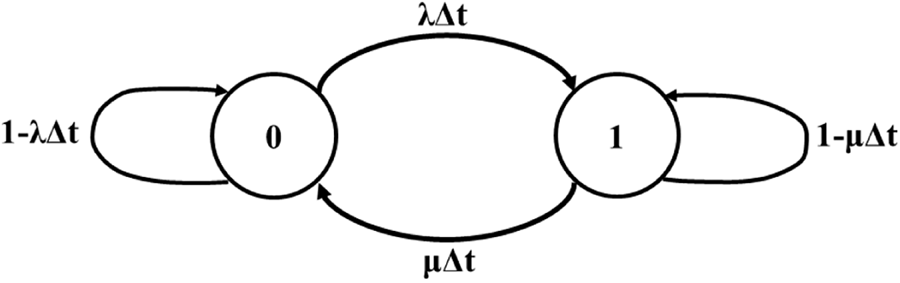
Assuming that the satellite's failure rate obeys an exponential distribution, the Markov state transition process of a single satellite is as shown in Figure 1.
Markov state transition process for the per-satellite case.

In Figure 1, ‘0’ indicates that the satellite is in a normal state, and ‘1’ indicates that the satellite is in a fault state. λ represents the failure rate of the satellite, which is the reciprocal of the MTBF or λ = 1/MTBF; μ is the repair rate of the satellite, which is the reciprocal of the MTTR or μ = 1/MTTR and Δ t is the time interval of the state transition.
According to reliability theory, the instantaneous availability A(t) of a single satellite can be obtained by the Markov state transition process, as shown by Equation (3):
 $${\rm A}\lpar {\rm t} \rpar =\frac{\mu }{\lambda +\mu }+\frac{\lambda }{\lambda +\mu }e^{-\lpar \lambda +\mu \rpar t}$$
It is seen from Equation (3) that, when t → ∞, the probability of availability A of a single satellite in the steady state is given by Equation (4):
 $${\rm A}=\frac{\mu }{\lambda +\mu }=\frac{MTBF}{MTBF+MTTR}$$
From Equation (4), when μ is much larger than λ, the availability of the satellite is close to 100%; when λ is much larger than μ, the availability of the satellite is the lowest or almost zero.
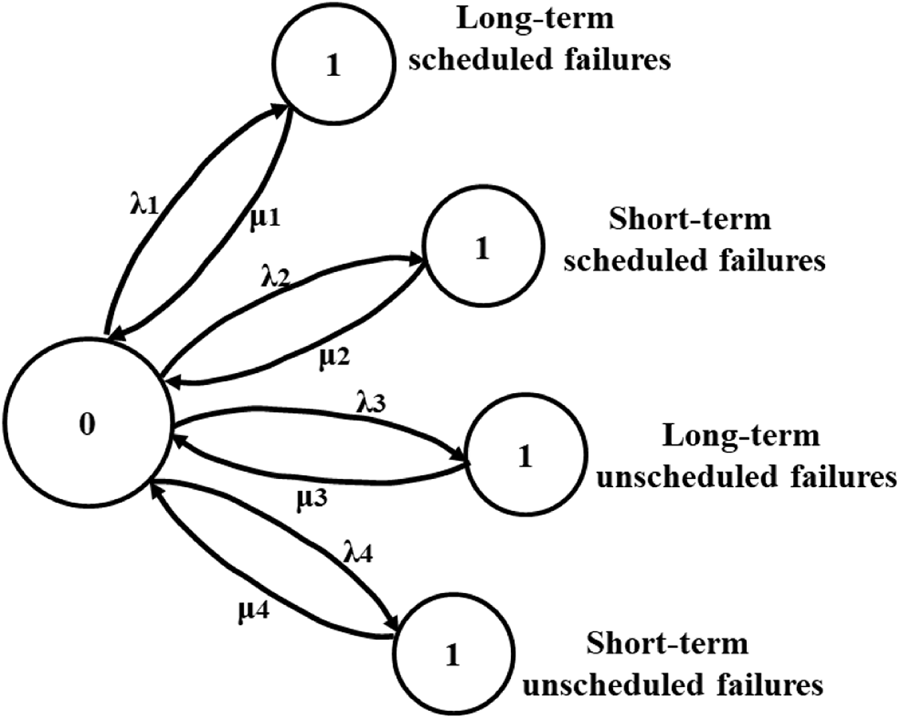
At present, the failure of SIS availability is mainly affected by four types of failures (US DoD, 2008). Owing to the different expectations of MTBF and MTTR for various failures, their impact on satellite availability varies greatly. Therefore, following on from Figure 1, the Markov state transition process of a single satellite for different failure types is as shown in Figure 2.
Markov state transition process of a single satellite for different failure types.

In Figure 2, the different failure types are independent of each other. λi(i = 1, 2, 3, 4) and u i(i = 1, 2, 3, 4) respectively indicate the failure and repair rates of certain types of failures. For the synthesis of various types of failures, the relation between satellite failure rate λ and repair rate μ in Equation (4) can be expressed as Equation (5):
 $$\begin{cases} \lambda =\lambda_{1}+\lambda_{2}+\lambda_{3}+\lambda_{4} \\ \mu =\lambda \ast \lpar \lambda_1/\mu_1+\lambda_2/\mu_2+\lambda_3/\mu_3+\lambda_4/\mu_4\rpar ^{-1} \end{cases}$$
It can be seen from Equation (5) that if the failure and repair rates of various types of failures are known, the comprehensive failure rate and repair rate of the satellite can be obtained, and the comprehensive availability is thus obtained.
2.3. Index of SIS continuity in BDS-OS-PS-1.0
According to BDS-OS-PS-1.0, the SIS continuity of BeiDou refers to the probability that a healthy Open Service Signal In Space (OS SIS) will continue working without unscheduled interruptions over a specified time interval. Thus, SIS continuity is closely correlated to unscheduled interruptions, and the SIS continuity index is as shown in Table 1.
BDS OS SIS Continuity Standards.

2.4. Index of SIS availability in BDS-OS-PS-1.0
The SIS availability of BeiDou is described by the per-slot availability, which is defined as the probability that a specific slot in the BDS constellation will be occupied by a BDS satellite transmitting a healthy open service signal in space. The SIS availability indicators are as shown in Table 2.
BDS OS SIS Availability Standards.

3. RESULTS AND ASSESSMENT
According to the actual operating states of the BeiDou satellites, failure classification is analysed and summarised, and the MTBF and MTTR of each type of failure are obtained. Then, the impact of various failures on SIS continuity and availability are evaluated and compared with the corresponding standards.
3.1. Failure classification of BeiDou satellites
Affected by the satellite itself or the external environment, the malfunctions of a satellite may cause the provided navigation information to be ‘unavailable’. Some failures are unscheduled and unpredictable, such as the failure of the atomic clock during orbit, the single ion flipping phenomenon caused by electromagnetic equipment and the radiation environment, carrier leakage, and so on. A part of these failures were ‘scheduled’, such as satellite orbit manoeuvres, satellite clock switching, and temporary maintenance of equipment. GPS SPS PS (US DoD, 2008) states that for scheduled interruptions (such as scheduled satellite maintenance), the ground operations control segment should notify the US Coast Guard Information Center and FAA (Notice to Airmen, NOTAM) at least 48 hours in advance. Interruption means that the satellite's signal does not meet the criteria defined in the SPS PS. A scheduled interruption notice provided 48 hours in advance does not result in a loss of SIS continuity. Unscheduled interruptions primarily refer to system failures or maintenance operations that occur outside of the scheduled maintenance periods.
Descriptions of the failure classifications are not currently provided for BeiDou. The BeiDou constellation is composed of three types of satellites, which include GEO, IGSO, and MEO. GEO and IGSO inevitably have satellite orbit manoeuvres. Although these manoeuvres belong to scheduled maintenance, the relevant information is not provided to users in advance. Therefore, to the end user, it is still an unscheduled interruption, so its impact on the performance evaluation is considered in this work; this is classified as ‘maintenance failure’. At the same time, the three types of satellites also have occasional SIS anomalies caused by satellite orbit and clock errors; these anomalies are also unscheduled, but they are often repairable, so they are classified as ‘short-term failures’. In addition, the satellite is also affected by its length of service and will eventually need to be replaced by a new satellite for continued service. This long-term update period is a ‘long-term failure’. Therefore, combining the definition of interruption for GNSS and the actual operation state of BeiDou, the failure classifications of BeiDou are summarised in Table 3.
Failure classifications of BeiDou satellites.

In Table 3, the equivalent failure represents the failure caused by a combination of the three other failures. Since the long-term failure is only related to the service life of the satellite, this work divides the equivalent failure into two types, where the equivalent failure of ‘1’ represents the comprehensive failure that does not consider the long-term failure, and the equivalent failure of ‘0’ represents the comprehensive failure that considers the three failures. The SIS continuity and availability of the BeiDou satellites will then be evaluated based on the above failure classifications.
The continuity and availability of satellites are primarily related to the on-orbit maintenance strategy and response time of the ground control segment to the anomaly. When one or more satellites are in failure, the availability of a single satellite or even the entire constellation is bound to be affected. The impact of various types of failures on the performance of continuity and availability are not the same. From Equation (2), the continuity of the satellite is mainly related to the MTBF; from Equations (3) and (4), the availability of the satellite is mainly related to the MTBF and MTTR. Therefore, the calculation of MTBF and MTTR parameters is the key in assessing the SIS continuity and availability.
Usually, the MTBF of long-term failure is determined by the average service life of the satellite. Currently, the service life of a BeiDou satellite is approximately 10–12 years. This work sets the average service life of each GEO satellite to 10 years and the life of IGSO and MEO to 11 years each; the launch period of a new satellite is set to two months, and the MTBF and MTTR of long-term failure can be obtained.
3.2. Data Sources
The broadcast and precise ephemerides of BeiDou from 2015–2016 are selected in this work, and the broadcast ephemerides were provided by the International GNSS Continuous Monitoring and Assessment System (iGMAS) and the Multi-GNSS Experiment (MGEX) of the International GNSS Service (IGS). The precise ephemerides were provided by the Helmholtz-Centre Potsdam-German Research Centre for Geosciences (GFZ). For maintenance failure caused by orbit manoeuvres, the ROOTA (square root of semi-major axis for satellite orbit) and health flag from the broadcast ephemerides were used for detection. For a short-term failure, the SIS anomalies were detected through the comparison of broadcast and precise ephemerides. Then, the MTBFs and MTTRs for maintenance and short-term failures were obtained; accordingly, the MTBF and MTTR for equivalent failure are calculated based on Equation (5). Thus, the SIS continuity and availability of BeiDou for the four types of failures were calculated. Since the C13 satellite only has a small amount of data for 2016 and is not representative, the evaluation results are given in the subsequent figures, but they are not discussed.
3.3. Assessment of SIS continuity
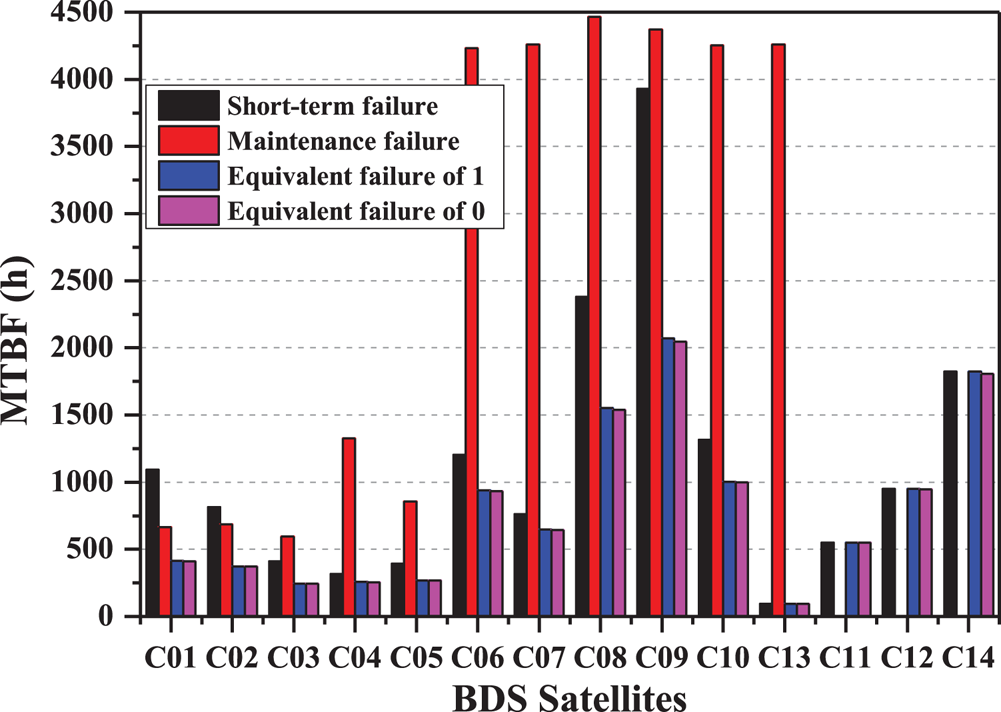
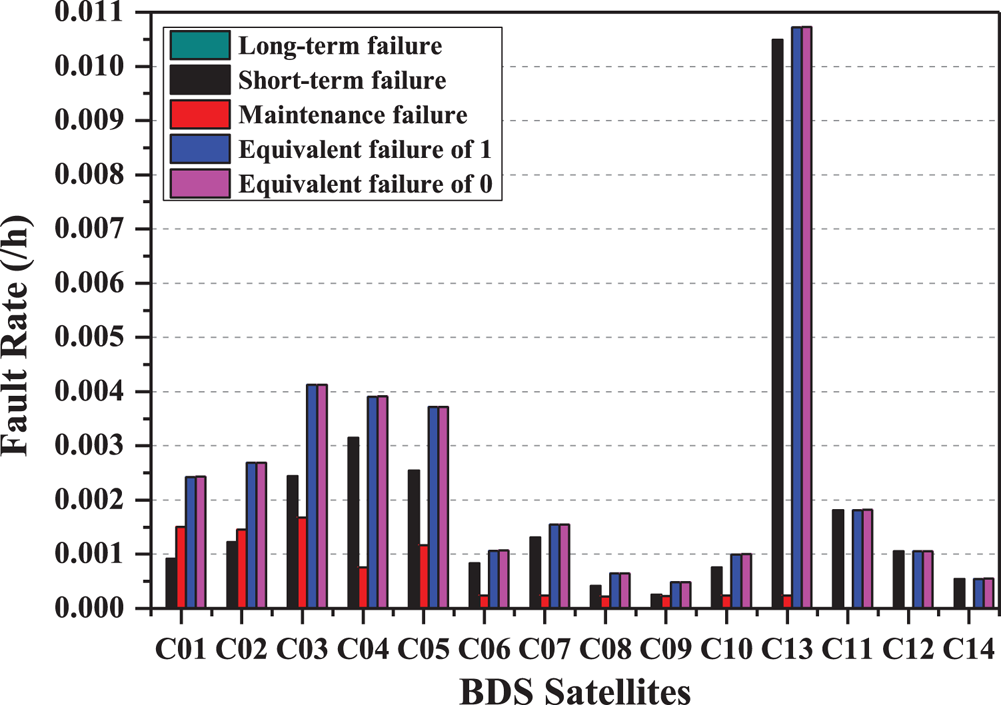
Based on the above classification and detection results in Sections 3.1 and 3.2, the SIS continuities under different failures are calculated. First, the MTBF and failure rate (λ) of each BeiDou satellite for the three individual and equivalent failures are shown in Figure 3 and Figure 4, respectively. Since the MTBF of the long-term failure is much larger than the rest of the failures, it is omitted in Figure 3, but the average failure rate is given in Figure 4.
Mean time between failure (MTBF) for each failure type for BeiDou satellites.

Average failure rate (λ) for each failure type for BeiDou satellites.

Figure 3 shows that for a maintenance failure, the MTBF of IGSO is larger than that of the GEO, which means that the orbit manoeuvre of GEO is more frequent than IGSO; for a short-term failure, the IGSO is also larger than GEO and MEO, which means that the detected occasional anomalies of IGSO satellite are less than for the other satellites; for the equivalent failure, the MTBF of IGSO and MEO are larger than GEO because GEO is affected by orbit manoeuvres. A larger MTBF means fewer failures.
As shown in Figure 4, the failure rate is the inverse of MTBF, so a smaller failure rate means less failure. Overall, GEO has more failures than the other satellites. Short-term failures frequently occur for each satellite, resulting in the increase of equivalent failure.
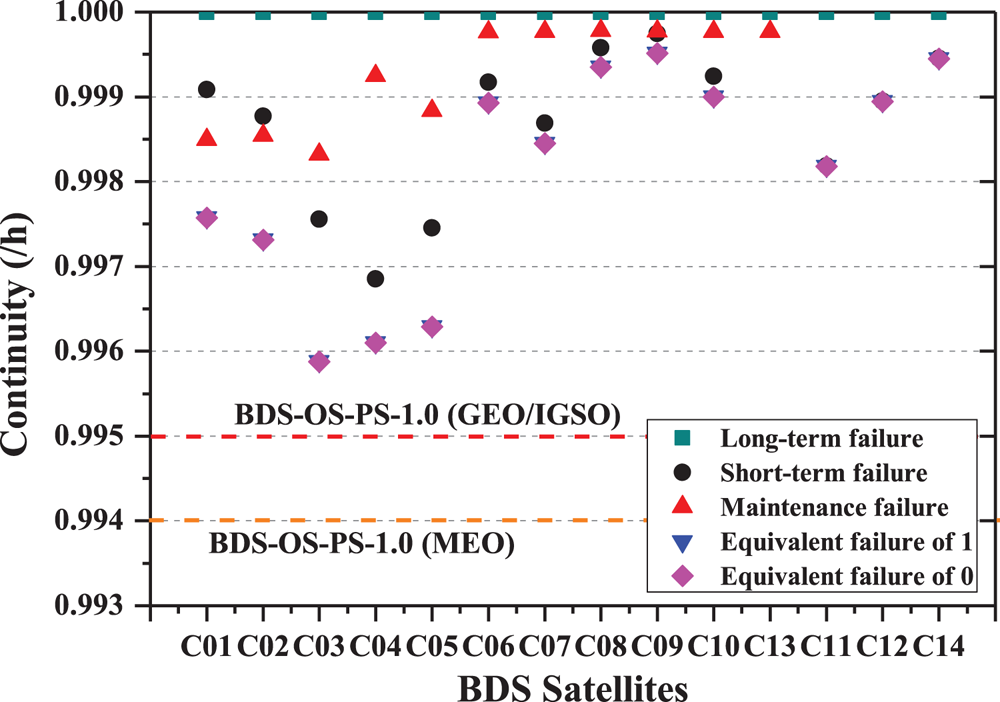
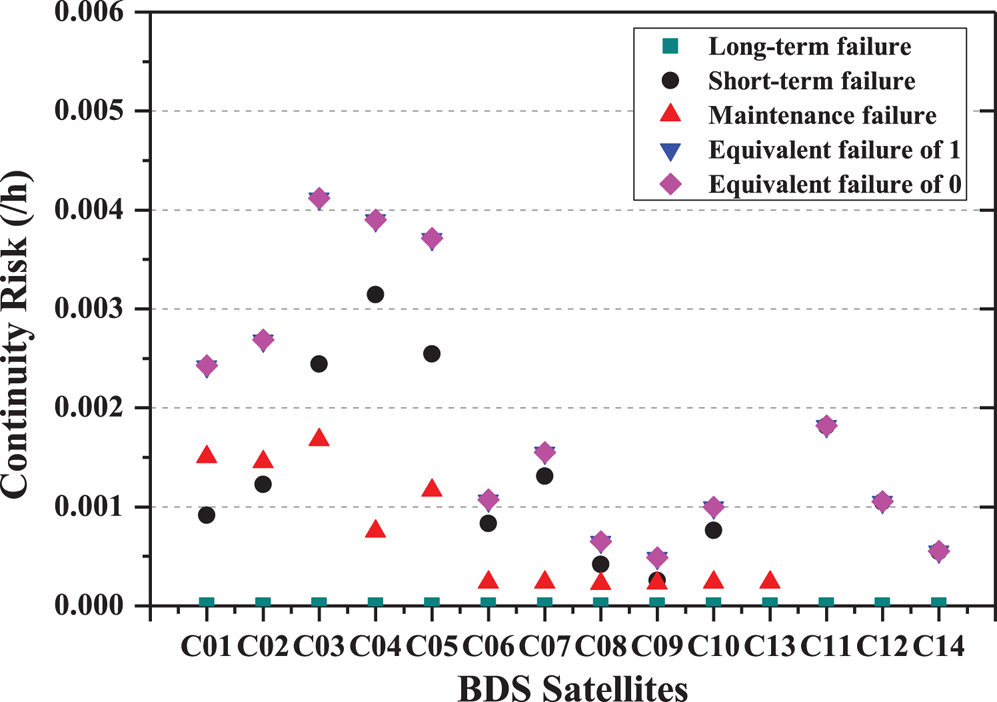
According to MTBF calculated by the detected results, the SIS continuity and continuity risk of each satellite are computed, as shown in Figure 5 and Figure 6 respectively.
SIS continuity of BeiDou satellite for each failure type.

SIS continuity risk of BeiDou satellite for each failure type.

It can be seen from Figure 5 that the continuity of each satellite for long-term failure is almost the same because of the nearly equal service time and launch cycle; for a short-term failure, the continuity of GEO satellites C03–C05 is lower than 0·998/h (per hour), and the others are larger than 0·998/h. Among them, the IGSO is higher. For maintenance failure, the continuity of IGSO is more consistent at approximately 0·9995/h, whereas GEO is not consistent; the IGSO is thus better than GEO. With the maintenance and short-term failures, the equivalent failures of IGSO and MEO are >0·998/h each, the C01–C02 is >0·997/h, and the C03–C05 is ~ 0·996/h. Compared with standard indices given by BDS-OS-PS-1.0, the SIS continuity of BeiDou meets the requirement for individual or equivalent failures.
In Figure 6, the corresponding SIS continuity risk probability is higher for GEO C03–C05 for short-term faults, greater than 0·002/h, and those of the remaining satellites are all below 0·002/h. Under equivalent failure, the continuity risk probability of GEO is higher than those of IGSO and MEO, mainly because of the frequency of satellite orbit manoeuvring, resulting in the decline of SIS continuity.
For the SIS continuity of the BeiDou satellite, as the maintenance failure of orbit manoeuvre is inevitable, improvements could be made by increasing the MTBF of the short-term failure, that is, reducing the number of short-term failures. With the stable operation of the system, the SIS continuity of BeiDou has the potential to improve.
3.4. Assessment of per-satellite availability
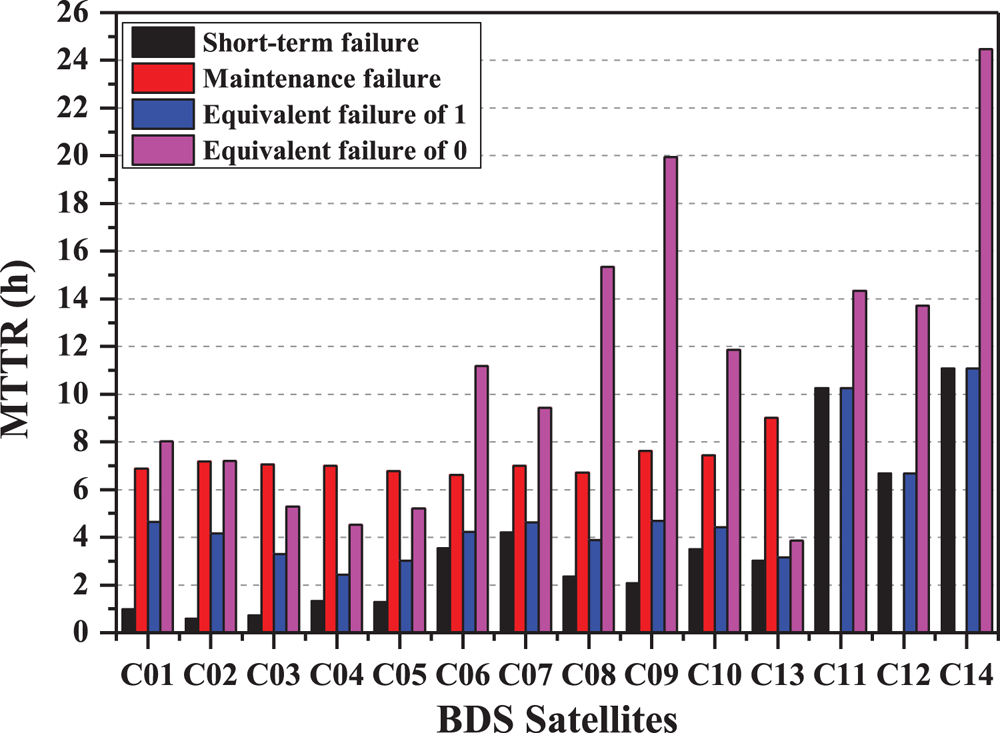
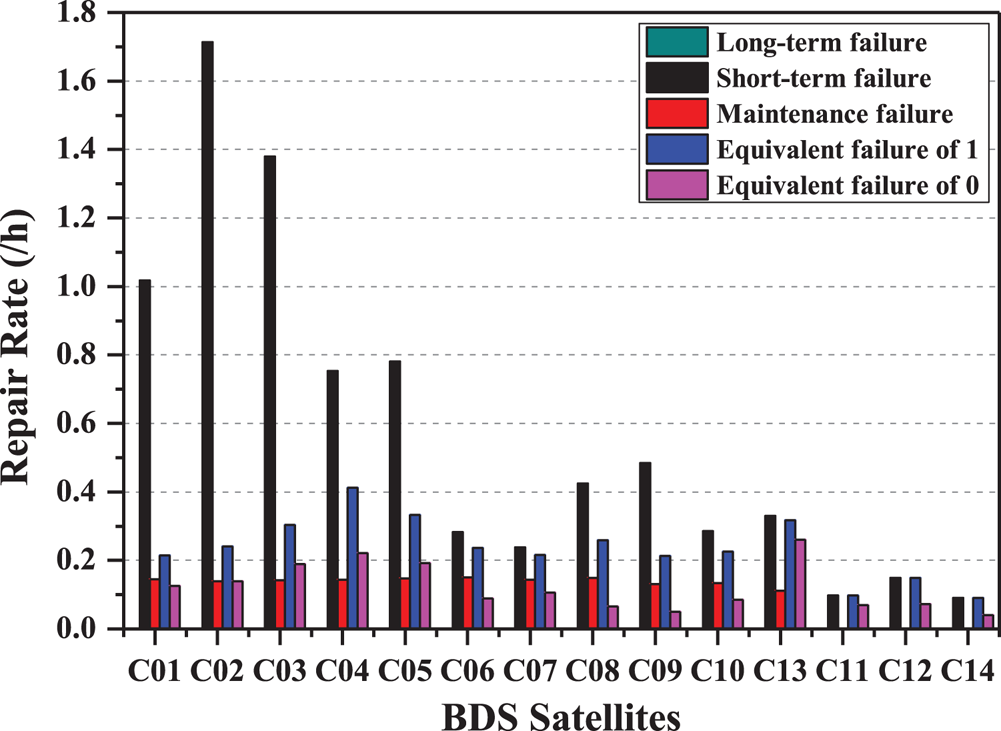
The MTBF and failure rate of each BeiDou satellite for different failures are shown in Figures 3 and 4, respectively. The MTTR and repair rate for each BeiDou satellite are shown in Figures 7 and 8, respectively.
Mean time to repair (MTTR) for each failure type for BeiDou satellite.

Average repair rate (μ) for each failure type for BeiDou satellite.

Figures 7 and 8 show that for the detected short-term failures, the MTTR of a GEO satellite is approximately 1–2 h, IGSO is 3–4 h, and for an MEO satellite is 6–12 h; for the corresponding average repair rates, GEO is the highest, IGSO is moderate and MEO is the lowest. Under an equivalent failure of 1, the MTTR of GEO and IGSO are approximately 4 h each, whereas that of MEO is approximately 8 h; the corresponding repair rates of GEO and IGSO are higher than MEO. Under the equivalent failure of 0, the MTTR of GEO is the lowest, IGSO and MEO are both similar, so the repair rate of GEO is higher than that of IGSO or MEO.
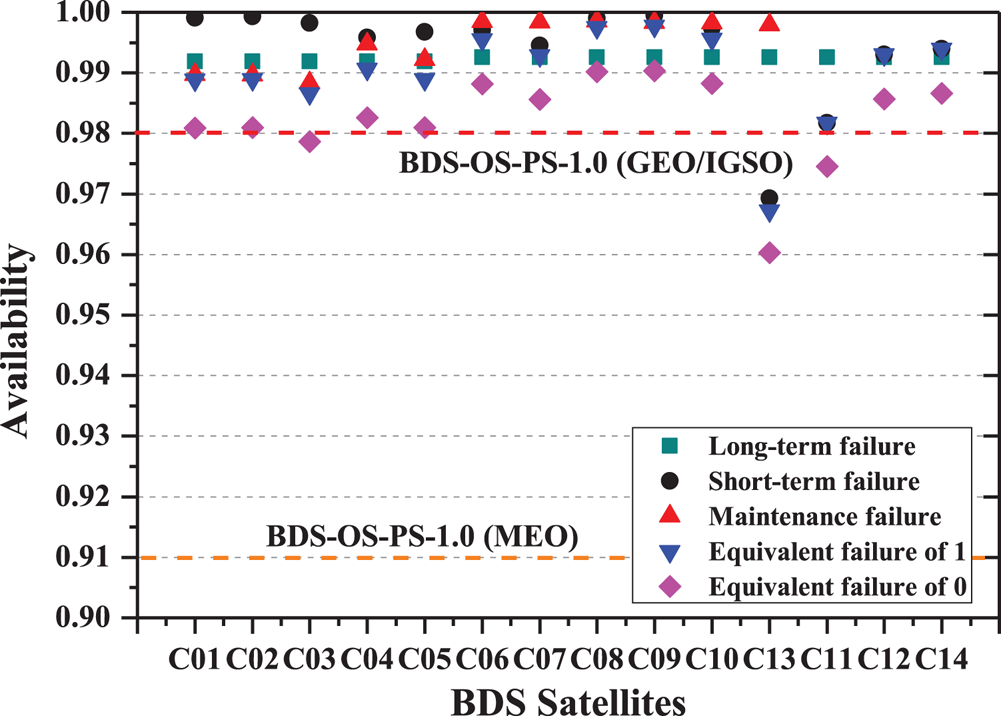
According to the failure and repair rates, the per-satellite availability of BeiDou is calculated via Equation (5), and the results are shown in Figure 9.
Per-satellite availability of BeiDou for different failure types.

Figure 9 shows that for a short-term failure, the per-satellite availability is greater than 0·99 for both GEO and IGSO satellites, and MEO satellites are greater than 0·98. Under the equivalent failure of 1, the IGSO has the highest availability, whereas the GEO and MEO C12 and C14 satellites are moderate, and C11 is the lowest, but all these meet the BDS-OS-PS-1.0 requirements for availability. Under the equivalent failure of 0, the GEO C03 satellite is lower than the limit of 0·98 specified in BDS-OS-PS-1.0; the remaining satellites are all well within satisfactory bounds, while the C11 satellite has the lowest availability due to a high failure rate.
4. CONCLUSION AND DISCUSSION
In view of the impact of satellite failures on the signal-in-space continuity and availability of BeiDou satellites, failure classifications of the satellite are first analysed based on the actual operating state. Next, through the above classification, orbit manoeuvres and SIS anomalies are detected using the broadcast and precise ephemerides from 2015–2016, and the MTBF and MTTR under each failure type are obtained. Finally, the SIS continuity and per-satellite availability of BeiDou satellites are calculated. The results show that, in the case of individual failure, the SIS continuity and availability of each satellite meets the requirements in BDS-OS-PS-1.0; under the equivalent failure, the continuity meets the requirements, but under the equivalent failure of ‘0’, considering long-term failures, the availability of GEO Satellite C03 is lower than the threshold in BDS-OS-PS-1.0, whereas others meet the requirements.
As the particular constituents of the BeiDou constellation, orbit manoeuvres of GEO and IGSO satellites are inevitable, but the short-term failure performance could be improved. If the SIS continuity and availability of BeiDou should be improved, on the one hand, the orbit manoeuvres of GEO satellites in the short-term can be minimised, thereby reducing the average failure interval under maintenance failure; on the other hand, although occasional anomalies (short-term failure) are inevitable during satellite operation, SIS continuity and availability can be improved by strengthening system construction and monitoring technology.
ACKNOWLEDGMENTS
This work was supported partly by the Chinese Academy of Sciences (CAS) program of “Light of the West” (Grant No. Y712YR4701), the Program of National Natural Science Foundation of China (Grant Nos.: 41504006 and 41674034), the National Key Research and Development Plan of China (Grant No. 2016YFB0501804), the Chinese Academy of Sciences (CAS) programs of “Pioneer Hundred Talents” and “The Frontier Science Research Project” (Grant No. QYZDB-SSW-DQC028), National Time Service Center (NTSC) programs of “Young creative talents” (Grant No. Y824SC1S06), and the State Key Laboratory of Geo-information Engineering, (Grant No. SKLGIE2017-Z-2-1). We also thank the IGS and iGMAS authorities for providing data and support for this study.