Introduction
The superfamily Hemiuroidea Looss, 1899 is a large group of trematodes that are mainly parasitic in marine fish. The taxonomic structure of the hemiuroidean trematodes has been repeatedly subject to change. The modern version of the systematics of the Hemiuroidea is based on the taxonomic model proposed by Gibson and Bray (Reference Gibson and Bray1979), with adjustments at the levels of families, subfamilies and genera proposed by several authors (see Gibson, Reference Gibson, Gibson, Jones and Bray2002a, Reference Gibson, Gibson, Jones and Bray2002b, Reference Gibson, Gibson, Jones and Bray2002c, Reference Gibson, Gibson, Jones and Bray2002d, Reference Gibson, Gibson, Jones and Bray2002e, Reference Gibson, Gibson, Jones and Bray2002f, Reference Gibson, Gibson, Jones and Bray2002g, Reference Gibson, Gibson, Jones and Bray2002h, Reference Gibson, Gibson, Jones and Bray2002i, Reference Gibson, Gibson, Jones and Bray2002j, Reference Gibson, Gibson, Jones and Bray2002k, Reference Gibson, Gibson, Jones and Bray2002l; Pozdnyakov and Gibson, Reference Pozdnyakov, Gibson, Bray, Gibson and Jones2008). In recent years, a number of changes have been made related to the description of new genera and subfamilies (Bray and Nahhas, Reference Bray and Nahhas2002; Pankov et al., Reference Pankov, Webster, Blasco-Costa, Gibson, Littlewood, Balbuena and Kostadinova2006; Bursey et al., Reference Bursey, Goldberg and Kraus2008; Bilqees et al., Reference Bilqees, Khalil, Khan and Haseeb2009, Reference Bilqees, Khalid and Talat2010; Justo and Kohn, Reference Justo and Kohn2012; Urabe and Shimazu, Reference Urabe and Shimazu2013), as well as a change in the taxonomic rank of previously described subfamilies (Sokolov et al., Reference Sokolov, Atopkin, Gordeev and Shedko2018).
The analysis of nucleotide sequences has great potential for studying phylogenetic relationships and is widely used in the modern era in the taxonomy of all groups of organisms (Littlewood and Bray, Reference Littlewood and Bray2001; Brown, Reference Brown2002; Olson et al., Reference Olson, Cribb, Tkach, Bray and Littlewood2003; Patwardhan et al., Reference Patwardhan, Ray and Roy2014; Timothy et al., Reference Timothy, Littlewood, Bray, Waeschenbach, Morand, Krasnov and Littlewood2015). The first study on the molecular phylogeny of the Hemiuroidea was published by Blair et al. (Reference Blair, Bray and Barker1998). The analysis of the V4 domain sequences (18S rDNA) performed by these authors revealed that phylogenetic connections of hemiuroidean trematodes were not reflected in the taxonomic scheme by Gibson and Bray (Reference Gibson and Bray1979). An important result of this work was the statement of the monophyly of the Hemiuridae sensu Gibson and Bray, 1979 + Lecithasteridae sensu Gibson and Bray, 1979, in which some groups of the Lecithasteridae were paraphyletic. Further research of 28S rDNA or both 28S and 18S rDNA revealed a serious discrepancy between phylogenetic and current taxonomic models of derogenids, hemiurids and lecithasterids (see Gibson, Reference Gibson, Gibson, Jones and Bray2002a, Reference Gibson, Gibson, Jones and Bray2002d, Reference Gibson, Gibson, Jones and Bray2002h; Olson et al., Reference Olson, Cribb, Tkach, Bray and Littlewood2003; Pankov et al., Reference Pankov, Webster, Blasco-Costa, Gibson, Littlewood, Balbuena and Kostadinova2006; Calhoun et al., Reference Calhoun, Curran, Pulis, Provaznik and Franks2013; Marzoug et al., Reference Marzoug, Rim, Boutiba, Georgieva, Kostadinova and Perez-del-Olmo2014; Sokolov et al., Reference Sokolov, Gordeev and Atopkin2016, Reference Sokolov, Atopkin, Gordeev and Shedko2018; Atopkin et al., Reference Atopkin, Besprozvannykh, Beloded, Ngo, Ha and Tang2017).
In the present paper, we explore the phylogenetic relationships between hemiuroidean genera, subfamilies and families to establish a basis for further taxonomic studies of this superfamily. Pankov et al. (Reference Pankov, Webster, Blasco-Costa, Gibson, Littlewood, Balbuena and Kostadinova2006) noted that ‘analyses based on the V4 domain of the ssrRNA gene has added little to and has not improved an earlier phylogenetic study of the Hemiuroidea’. Because of this reason, we did not perform phylogenetic analysis by means of 18S rDNA nucleotide sequences and used most representative data on 28S rDNA sequences only.
Material and methods
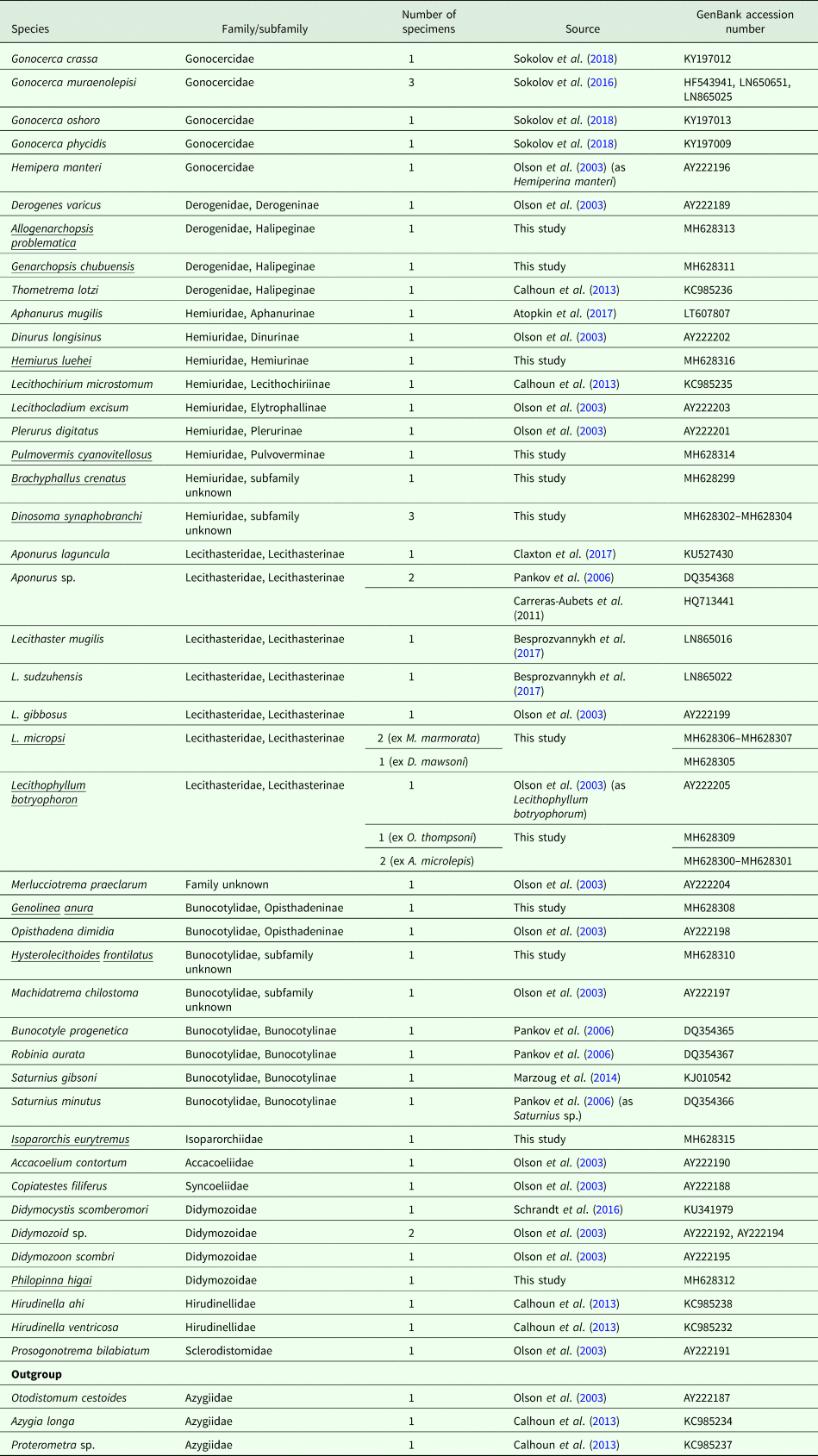
Phylogenetic tree constructions were performed using our data and the nucleotide sequences of 28S rDNA of hemiuroidean trematode specimens from the NCBI GenBank database (Table 1). The following species were originally studied: Allogenarchopsis problematica (Faust, 1924), cercaria [ex Semisulcosipra reiniana (Brot, 1876), midgut; agricultural canal near Hino River, Yasu, Japan], Genarchopsis chubuensis Shimazu, 2015, adult [ex Rhinogobius flumineus (Mizuno, 1960), stomach; agricultural canal near Ane River, Nagahama, Japan], Hemiurus luehei Odhner, 1905, adult [ex Ophidion rochei Müller, 1845, stomach; the Black Sea near Sevastopol, Russia], Pulmovermis cyanovitellosus Coil and Kuntz, 1960, adult [ex Laticauda semifasciata (Reinwardt in Schlegel, 1837), lung; Ishigaki Island, Japan], Brachyphallus crenatus (Rudolphi, 1802), adult [ex Salvelinus leucomaenis (Pallas, 1814), stomach; the Sea of Okhotsk, Siglan Bay], Dinosoma synaphobranchi Yamaguti, 1938, adult [ex Antimora microlepis Bean, 1890, stomach; the Sea of Okhotsk near south-eastern Sakhalin), Lecithaster micropsi Zdzitowiecki, 1992, adult [ex Dissostichus mawsoni Norman, 1937, intestine; the Amundsen Sea and Muraenolepis marmorata Günther, 1880, intestine; the Ross Sea], Lecithophyllum botryophoron (Olsson, 1868), adult [ex Oneirodes thompsoni (Schultz, 1934), intestine; Simushir Island area and A. microlepis, stomach; the Sea of Okhotsk near south-eastern Sakhalin], Genolinea anura (Layman, 1930), adult [ex Pleurogrammus monopterygius (Pallas, 1810), intestine; Simushir Island area], Hysterolecithoides frontilatus (Manter, 1969), adult [ex Siganus fuscescens (Houttuyn, 1782), intestine; the South China Sea near Nha Trang, Vietnam], Isoparorchis eurytremus (Kobayashi, 1915), adult [ex Silurus asotus Linnaeus, 1758, air bladder; Shin-asahi, Takashima, Japan], Philopinna higai Yamaguti, 1936, adult [ex Sarcocheilichthys variegatus (Temminck and Schlegel, 1846), fin; Lake Biwa, Takashima, Japan].
List of taxa, incorporated into molecular analysis: systematic position according to Gibson (Reference Gibson, Gibson, Jones and Bray2002a, Reference Gibson, Gibson, Jones and Bray2002b, Reference Gibson, Gibson, Jones and Bray2002d, Reference Gibson, Gibson, Jones and Bray2002f, Reference Gibson, Gibson, Jones and Bray2002j, Reference Gibson, Gibson, Jones and Bray2002l); Pozdnyakov and Gibson (Reference Pozdnyakov, Gibson, Bray, Gibson and Jones2008); Pankov et al. (Reference Pankov, Webster, Blasco-Costa, Gibson, Littlewood, Balbuena and Kostadinova2006); Urabe and Shimazu (Reference Urabe and Shimazu2013) and Sokolov et al. (Reference Sokolov, Atopkin, Gordeev and Shedko2018) with correction according to our data

Underlines texts indicates the species studied during this study.
Species identification was performed according to different authors (Skrjabin and Guschanskaja, Reference Skrjabin, Guschanskaja and Skrjabin1955a; Telford, Reference Telford1967; Yamaguti, Reference Yamaguti1971; Nikolaeva et al., Reference Nikolaeva, Iskova, Parukhin, Solonchenko and Greze1975; Gibson, Reference Gibson, Margolis and Kabata1996; Bray and Cribb, Reference Bray and Cribb2000; Kuramochi, Reference Kuramochi, Fujita, Saito and Takeda2001; Sokolov and Gordeev, Reference Sokolov and Gordeev2013; Urabe and Shimazu, Reference Urabe and Shimazu2013; Shimazu, Reference Shimazu2015a, Reference Shimazu2015b). Specimens destined for molecular analysis were fixed in 96% ethanol and stored at +4 °C.
Genomic DNA of the first part of species – B. crenatus, D. synaphobranchi, G. anura, H. luehei, H. frontilatus, L. botryophoron, L. micropsi – was extracted using a ‘hot shot’ technique (Truett, Reference Truett and Kieleczawa2006). Nuclear 28S rDNA fragment, including D1–D3 domains, was amplified using a polymerase chain reaction (PCR) with the following primers: 28S-A (5′-TCG ATT CGA GCG TGA WTA CCC GC-3′) (Matejusova and Cunningham, Reference Matejusova and Cunningham2004) and 1500R (5′-GCT ATC CTG AGG GAA ACT TCG-3′) (Tkach et al., Reference Tkach, Littlewood, Olson, Kinsella and Swiderski2003). The initial PCR reaction was carried out in a total volume of 25 µL containing 0.25 mm of each primer pair, 5 µL DNA in water, 1 × Q5 polymerase buffer, 2.5 mm dNTP and one unit of Q5 DNA polymerase (New England Biolabs, Massachussets, UK). The amplification of a 1230 bp fragment of 28S rDNA was performed in a GeneAmp 9700 (Applied Biosystems, Massachussets, USA) with a 1 min denaturation hold at 98 °C; 35 cycles of 10 s at 98 °C, 5 s at 55 °C and 20 s at 72 °C; followed by a 2 min extension hold at 72 °C. Negative and positive controls, using both primers, were used. The PCR products were directly sequenced using an ABI Big Dye Terminator v.3.1 Cycle Sequencing Kit, as recommended by the manufacturer, with the internal sequencing primers 300F, ECD2, 900F and 1200R (Tkach et al., Reference Tkach, Littlewood, Olson, Kinsella and Swiderski2003). The PCR products were analysed using an ABI 3130xl genetic analyser at the Department of Cell Biology and Genetics, Far Eastern Federal University. The voucher specimens of the studied species are deposited in the parasitological collection of the Zoological Museum of Federal Scientific Centre of the East Asia Terrestrial Biodiversity, Far East Branch of the Russian Academy of Sciences, Vladivostok, Russia: B. crenatus (without a number), D. synaphobranchi (# AM14.1, AM11, AM3), G. anura (# 754); H. frontilatus (without a number), H. luehei (without a number), L. botryophoron (# AM1.1, AM1.x, 805), L. micropsi (# 654, 676, 700TOA).
The rest of the five species, namely A. problematica, G. chubuensis, P. cyanovitellosus, I. eurytremus and P. higai were studied in the following way. Extraction was performed with a Wizard® SV Genomic DNA Purification System (Promega). A nuclear 28S rDNA fragment, including D1–D3 domains, was amplified using a PCR with the following primers: LSU-5 and 1500R (Olson et al., Reference Olson, Cribb, Tkach, Bray and Littlewood2003). The initial PCR reaction was carried out in accordance with Olson et al. (Reference Olson, Cribb, Tkach, Bray and Littlewood2003). The amplification of a 28S rDNA fragment was performed in MyCycler TM (Bio-Rad): 40 cycles of 10 s at 94 °C, 30 s at 50 °C and 60 s at 72 °C. The PCR products were sequenced by the FASMAC Sequencing Service (Kanagawa). The voucher specimens of these species (collected from the same host species at the same or close sampling localities) are deposited in the National Museum of Nature and Science, Tokyo (catalogue numbers: A. problematica – NSMT-Pl 5851–5853; G. chubuensis – NSMT-Pl 6347; P. cyanovitellosus – NSMT-Pl 6348; I. eurytremus – NSMT-Pl 5861–5868; P. higai – NSMT-Pl 5391). All sequences have been submitted to GenBank (Table 1).
Ribosomal DNA sequences were assembled with SeqScape v.2.6 software provided by Applied Biosystems. Alignments and estimation of the number of variable sites and sequence differences were performed using the MEGA 7.0 (Kumar et al., Reference Kumar, Stecher and Tamura2016). Alignment of nucleotide sequences was performed using Clustal W algorithm with gap opening penalty and gap extension penalty values, which were 15 and 5, respectively. Phylogenetic analyses of the nucleotide sequences were performed using the Bayesian (BI) algorithm MrBayes v.3.6.2 (Huelsenbeck et al., Reference Huelsenbeck, Ronquist, Nielsen and Bollback2001) software. The best nucleotide substitution models were estimated with jModeltest v.2.1.5 software (Darriba et al., Reference Darriba, Taboada, Doallo and Posada2012), using the Bayesian Information Criterion (Huelsenbeck et al., Reference Huelsenbeck, Ronquist, Nielsen and Bollback2001). The best nucleotide substitution model for 28S rDNA sequence data was TVM + I + G, a transversional model with estimates of invariant sites and γ-distributed among-site variation (Darriba et al., Reference Darriba, Taboada, Doallo and Posada2012). The significance of the phylogenetic relationships was estimated by posterior probabilities (Huelsenbeck et al., Reference Huelsenbeck, Ronquist, Nielsen and Bollback2001).
Results
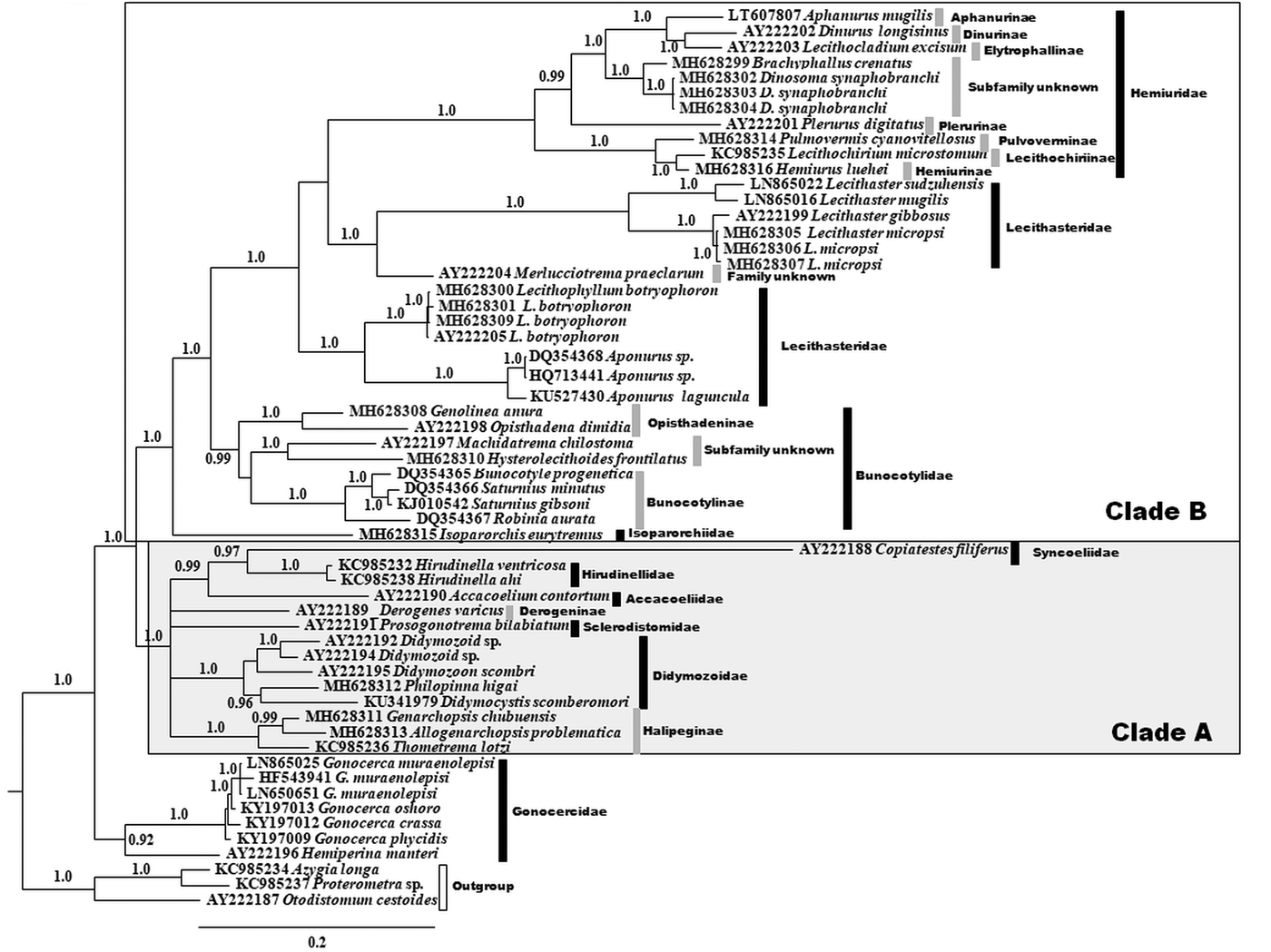
The length of the 28S rDNA locus of the species was studied and the outgroup species in the alignment was 1224 base pairs (bp), including 737 variables and 616 parsimony-informative sites. These data were used for phylogenetic relationship reconstructions. Most of the studied hemiuroidean trematodes were within two highly supported clades, A and B, which were sister groups to each other. Hemipera manteri (Crowcroft, 1947) was joined to Gonocerca spp. with moderate statistical support. This clade is basal relative to the clades A and B.
Сlade A is polytomic and contains representatives of the families Accacoeliidae, Syncoeliidae, Didymozoidae, Hirudinellidae and Sclerodistomidae, and derogenid subfamilies Derogeninae and Halipeginae. At the same time, members of the Syncoeliidae, Hirudinellidae and Accacoeliidae families form a well-supported monophyletic group. Families Hirudinellidae and Didymozoidae, and subfamily Halipeginae are presented on the tree by more than one species and form well-supported monophyletic groups. The phylogenetic relationship between Derogeninae and Halipeginae is poorly resolved.
Сlade B unites the isoparorchiid, bunocotylid, lecithasterid and hemiurid trematodes. The Bunocotylidae is the sister group to the Hemiuridae + Lecithasteridae group and the Isoparorchiidae is basal relative to representatives of these three Hemiuroidea families. Within the Bunocotylidae, there are three well-supported groups of the species: Opisthadena dimidia Linton, 1910 + G. anura, Machidatrema chilostoma (Machida, 1980) + H. frontilatus and [Bunocotyle progenetica Chabaud and Buttner, 1959 + Saturnius spp.] + Robinia aurata Pankov, Webster, Blasco-Costa, Gibson, Littlewood, Balbuena and Kostadinova, 2006. The Hemiuridae + Lecithasteridae group contains three well-supported lineages. The first one unites representatives of the genera Aphanurus Looss, 1907, Dinurus Looss, 1907, Lecithocladium Lühe, 1901, Brachyphallus Odhner, 1905, Dinosoma Manter, 1934, Plerurus Looss, 1907, Pulmovermis Coil and Kuntz, 1960, Lecithochirium Lühe, 1901 and Hemiurus Rudolphi, 1809. The second lineage contains Merlucciotrema praeclarum (Manter, 1934) and Lecithaster spp., and the third contains L. botryophoron and Aponurus spp.
Discussion
Bunocotylids
Gibson and Bray (Reference Gibson and Bray1979) established the Bunocotylidae and considered this family as a group of trematodes closely relevant to the Hemiuridae, but differing from the latter due to a secondary loss of an ecsoma. These authors divided the Bunocotylidae into four subfamilies: Bunocotylinae, Opisthadeninae, Aphanurinae and Theletrinae.
Brooks et al. (Reference Brooks, O'Grady and Glen1985, Reference Brooks, Bandoni, MacDonald and O'Grady1989) concluded that bunocotylids are the sister group of hemiurids based on the cladistic analysis of their morphological features. In the phylogenetic reconstruction of these authors, a terminal clade consisting of bunocotylids and hemiurids was combined sequentially with derogenids, lecithasterids, dictysarcids, didymozoids, sclerodistomids and isoparorchiids into a large monophyletic group. Eventually, Brooks et al. (Reference Brooks, O'Grady and Glen1985, Reference Brooks, Bandoni, MacDonald and O'Grady1989) proposed a new taxonomic model of the Hemiuridae that includes all of the above groups. Gibson (Reference Gibson, Margolis and Kabata1996) did not adopt the system of the Hemiuridae proposed by these authors and considered hemiurid and bunocotylid trematodes in accordance with the taxonomic concept of Gibson and Bray (Reference Gibson and Bray1979).
León-Règagnon et al. (Reference León-Règagnon, Pérez-Ponce de León and Brooks1996, Reference León-Règagnon, Pérez-Ponce de León and Brooks1998) and León-Règagnon (Reference León-Règagnon1998) recognized the Bunocotylidae sensu Gibson and Bray, 1979 as the subfamily of the Hemiuridae. In designation of the taxonomic rank of bunocotylids, these authors referred to Brooks et al. (Reference Brooks, O'Grady and Glen1985). In the cited publication, however, the taxon Bunocotylinae is not mentioned. León-Règagnon (Reference León-Règagnon1998) established a new genus, Machidatrema, and affiliated it with this subfamily. The genus Machidatrema, according to the author, includes four species. One of these, M. frontilatum (Manter, 1969), previously belonged to the family Lecithasteridae, genus Hysterolecithoides Yamaguti, 1934. Later, Bray and Cribb (Reference Bray and Cribb2000) carried out a revision of the genera Machidatrema and Hysterolecithoides. Both genera were placed by them into the subfamily Hysterolecithinae of the family Lecithasteridae and species M. frontilatum was returned to genus Hysterolecithoides.
The molecular analysis performed by Blair et al. (Reference Blair, Bray and Barker1998) did not support the taxonomic model of the Hemiuridae proposed by Brooks et al. (Reference Brooks, O'Grady and Glen1985, Reference Brooks, Bandoni, MacDonald and O'Grady1989). However, bunocotylid species were not studied in the paper of Blair et al. (Reference Blair, Bray and Barker1998).
In the systematics of the Hemiuroidea proposed by Gibson (Reference Gibson, Gibson, Jones and Bray2002a), the Hemiuridae sensu Gibson and Bray, 1979 and Bunocotylidae sensu Gibson and Bray, 1979 were united within one family: Hemiuridae, with the preservation for all four subfamilies of bunocotylids of similar ranks within the Hemiuridae. The taxonomy of the Hemiuridae proposed by Gibson (Reference Gibson, Gibson, Jones and Bray2002a) is now generally accepted.
The result of our analysis united M. chilostoma, H. frontilatus and representatives of the subfamilies Opisthadeninae and Bunocotylinae (including members of their type genera) into a well-supported monophyletic group, occupying a sister position to the Hemiuridae + Lecithasteridae group (Fig. 1). As noted above, (León-Règagnon, Reference León-Règagnon1998; Bray and Cribb, Reference Bray and Cribb2000), they hold opposite points of view on subfamiliar/familiar affiliation of M. chilostoma and H. frontilatus: the subfamily Bunocotylinae of the family Hemiuridae s. lato and the subfamily Hysterolecithinae of the family Lecithasteridae. It should be noted that previous phylogenetic reconstructions of hemiuroids, created using partial sequences of 28S rDNA or a combination of 18S and 28S rDNA partial sequences, highly supported clustering of M. chilostoma with representatives of the Opisthadeninae and Bunocotylinae was not observed (Pankov et al., Reference Pankov, Webster, Blasco-Costa, Gibson, Littlewood, Balbuena and Kostadinova2006; Marzoug et al., Reference Marzoug, Rim, Boutiba, Georgieva, Kostadinova and Perez-del-Olmo2014; Bao et al., Reference Bao, Roura, Mota, Nachón, Antunes, Cobo, MacKenzie and Pascual2015; Atopkin et al., Reference Atopkin, Besprozvannykh, Beloded, Ngo, Ha and Tang2017; Faltýnková et al., Reference Faltýnková, Georgieva, Kostadinova, Bray, Klimpel, Kuhn and Mehlhor2017; Sokolov et al., Reference Sokolov, Atopkin, Gordeev and Shedko2018).
Phylogenetic relationships of the superfamily Hemiuroidea obtained with Bayesian algorithm based on partial 28S rDNA sequences. Nodal numbers are posterior probabilities that indicate statistical support of phylogenetic relationships.

Our findings resurrect the family Bunocotylidae and it is now possible to establish two subfamilies: Opisthadeninae and Bunocotylinae, and the M. chilostoma + H. frontilatus group. The phylogenetic connections between these two subfamilies and the group were poorly resolved (Fig. 1). It is interesting that the Aphanurinae, which is affiliated to Bunocotylidae according to Gibson and Bray (Reference Gibson and Bray1979), does not show phylogenetic proximity to bunocotylid trematodes (Fig. 1; see also Atopkin et al., Reference Atopkin, Besprozvannykh, Beloded, Ngo, Ha and Tang2017).
Family Bunocotylidae Dollfus, 1950 emend
Diagnosis [based on Gibson (Reference Gibson, Margolis and Kabata1996), with changes]. Hemiuroidea. Body usually small, fusiform to elongate. Distinct ecsoma absent, but vestige may remain. Body surface without crenulate plications. Ridges or flanges around body can be present at the level of oral sucker, posterior margin of ventral sucker and close to posterior extremity. Ventral sucker normally inside anterior half of worm. Pharynx well developed. Oesophagus normally short. Gut caeca normally end blindly near posterior extremity or occasionally form cyclocoel. Testes two, pre-ovarian in hindbody, tandem to symmetrical. Seminal vesicle saccular or tubular, in forebody or hindbody. Pars prostatica tubular or vesicular, short or long, may extend into hindbody. Ejaculatory duct present or absent. Sinus sac present, occasionally absent. Hermaphroditic duct present, within sinus sac when latter present, may extend to form temporary sinus-organ. Genital pore median, at the level of pharynx or posterior to it. Ovary oval, rarely bilobed, between testes and vitellarium. Laurer's canal and canalicular seminal receptacle absent. Juel's organ and uterine seminal receptacle present or absent. Blind seminal receptacle present or absent. Uterus normally almost entirely in hindbody, mainly pre- to mainly post-ovarian. Eggs numerous, small, without filaments. Vitellarium one or more entire, occasionally irregular masses, posterior or postero-lateral to ovary. Excretory arms extend to forebody, united or blinded. Parasitic mainly in stomach of marine teleosts.
Type genus: Bunocotyle Odhner, 1928
The family Bunocotylidae differs from its sister cluster, the Hemiuridae + Lecithasteridae group, by the following combination of features: (i) body surface without crenulate plications, (ii) distinct ecsoma absent, (iii) genital pore at the level of pharynx or posterior to it, (iv) sinus-sac, if present, contains only a hermaphroditic duct that can form a temporary sinus-organ, (v) vitellarium is represented by one or more entire (rarely irregular) masses. If there are more than two vitelline masses, then these are Juel's organ and a uterine seminal receptacle.
Notice that an ecsoma is completely absent in Machidatrema spp., Hysterolecithoides spp., opisthadenines, and the majority of bunocotylines (Gibson and Bray, Reference Gibson and Bray1979; León-Règagnon et al., Reference León-Règagnon, Pérez-Ponce de León and Brooks1998; Bray and Cribb, Reference Bray and Cribb2000; Blasco-Costa et al., Reference Blasco-Costa, Montero, Gibson, Balbuena, Raga, Shvetsova and Kostadinova2008). There is a vestigial ecsoma in bunocotyline species R. aurata, however see Pankov et al. (Reference Pankov, Webster, Blasco-Costa, Gibson, Littlewood, Balbuena and Kostadinova2006). According to the evolutionary model of Gibson and Bray (Reference Gibson and Bray1979) and León-Règagnon et al. (Reference León-Règagnon, Pérez-Ponce de León and Brooks1998), the absence of an ecsoma is plesiomorphic for hemiuroidean trematodes and the presence of this structure is an apomorphic feature of this hemiurid ancestor. These authors assumed that bunocotylids had evolved from a hemiurid ancestor and considered the absence of an ecsoma in bunocotylids as a secondary loss. Given the basal position of bunocotylids in the (Hemiuridae + Lecithasteridae) + Bunocotylidae subclade; however, we hypothesize that the absence of ecsoma is plesiomorphy for the Bunocotylidae. In the light of this hypothesis, the ecsoma of hemiurids and the vestigial ecsoma of R. aurata are homoplasies. This conclusion is consistent with the assumption of Atopkin et al. (Reference Atopkin, Besprozvannykh, Beloded, Ngo, Ha and Tang2017) regarding the primordial nature of ecsoma in hemiurid trematodes.
Cercariae are described for the species that belong to the genera Bunocotyle, Hemiurus, Brachyphallus, Lecithochirium, Lecithocladium, Lecithaster Lühe, 1901 and Lecithophyllum Odhner, 1905 (e.g. Chabaud and Buttner, Reference Chabaud and Buttner1954; Køie, Reference Køie1989, Reference Køie1990, Reference Køie1995; Køie et al., Reference Køie, Karlsbakk and Nylund2002) from the (Hemiuridae + Lecithasteridae) + Bunocotylidae subclade. The similarity and difference of the cystophorous cercariae of the hemiuroids manifests itself primarily through the morphology of the caudal vesicle ( = caudal cyst). The cercariae of the genus Bunocotyle have a single appendage on the caudal vesicle: the caudal filament, which is probably one of the variants of an excretory appendage (see Chabaud and Buttner, Reference Chabaud and Buttner1954). This feature makes them comparable to сercariae of the genera Hemiurus, Brachyphallus, Lecithocladium and Lecithaster (see Hunninen and Cable, Reference Hunninen and Cable1943; Køie, Reference Køie1989, Reference Køie1995). The caudal filament of the Bunocotyle’s cercariae, however, is very long, slightly motile and deprived of additional appendages (e.g. membranous folds and furcae), which distinguish it from immotile excretory appendages in Lecithaster spp. cercariae and motile appendages in cercariae of the other three genera. To date, cercariae are described only for a limited number of hemiuroidean subfamilies and families (see e.g. Littlewood and Bray, Reference Littlewood and Bray2001). In this connection, adequate phylogenetic and taxonomic interpretation of hemiuroids’ cercarial morphology is not yet feasible.
Hemiuridae + Lecithasteridae group
The monophyly of the group is convincingly demonstrated with good support. The family Lecithasteridae in this group is represented by the genera attributable to the nominative subfamily: Lecithaster, Lecithophyllum and Aponurus Looss, 1907 (see Gibson and Bray, Reference Gibson and Bray1979; Gibson, Reference Gibson, Gibson, Jones and Bray2002d). Genera Lecithophyllum and Aponurus are sister taxa in our tree (Fig. 1). Merlucciotrema praeclarum is the nearest neighbour to the genus Lecithaster. Gibson and Bray (Reference Gibson and Bray1979), Bray (Reference Bray1996) and Gibson (Reference Gibson, Gibson, Jones and Bray2002а) place M. praeclarum into the hemiurid subfamily Plerurinae. The results of our analysis, however, are the same as the previously published data (Olson et al., Reference Olson, Cribb, Tkach, Bray and Littlewood2003; Pankov et al., Reference Pankov, Webster, Blasco-Costa, Gibson, Littlewood, Balbuena and Kostadinova2006; Marzoug et al., Reference Marzoug, Rim, Boutiba, Georgieva, Kostadinova and Perez-del-Olmo2014; Bao et al., Reference Bao, Roura, Mota, Nachón, Antunes, Cobo, MacKenzie and Pascual2015; Atopkin et al., Reference Atopkin, Besprozvannykh, Beloded, Ngo, Ha and Tang2017; Faltýnková et al., Reference Faltýnková, Georgieva, Kostadinova, Bray, Klimpel, Kuhn and Mehlhor2017; Sokolov et al., Reference Sokolov, Atopkin, Gordeev and Shedko2018), and show that this parasite is phylogenetically distant from plerurines (Fig. 1). The closeness of M. praeclarum to Lecithaster spp. is consistent with the opinion of Skrjabin and Guschanskaja (Reference Skrjabin, Guschanskaja and Skrjabin1955b) regarding the belonging of this species (as Musculovesicula praeclarus in these authors) to Lecithasteridae. The point of view of these authors was based on the morphology of vitellarium, which in this species, as in many lecithasterids, is represented by an unpaired star-shaped mass. The relationships between subgroups of M. praeclarum + Lecithaster spp. and L. botryophoron + Aponurus spp. are poorly resolved on our tree (Fig. 1).
The Hemiuridae sensu Gibson, 2002 remaining after exclusion of bunocotylids and M. praeclarum form a monophyletic subgroup (Fig. 1). Taking into account the research of Faltýnková et al. (Reference Faltýnková, Georgieva, Kostadinova, Bray, Klimpel, Kuhn and Mehlhor2017), the following species are also integrated into this subgroup: Glomericirrus macrouri (Gaevskaja, 1973) (Glomericirrinae), Elytrophalloides oatesi (Leiper and Atkinson, 1914) (Elytrophallinae), Ectenurus lepidus Looss, 1907 (Dinurinae) and Lecithochirium caesionis Yamaguti, 1942 (Lecithochiriinae). Our analysis does not support the monophyly of two hemiurid subfamilies: Plerurinae sensu Gibson, 2002 and Lecithochiriinae sensu Gibson, 2002. Dinosoma synaphobranchi (Plerurinae) turned out to be close to B. crenatus (Lecithochiriinae) and the subgroup formed by them does not have direct phylogenetic connections with representatives of the type genera of the corresponding subfamilies Plerurus digitatus (Looss, 1899) and Lecithochirium microstomum (Chandler, 1935). Note that earlier, Skrjabin and Guschanskaja (Reference Skrjabin, Guschanskaja and Skrjabin1955a) united genera Dinosoma and Brachyphallus in subfamily Brachyphallinae, although the genus Dinosoma was placed in it as a member of the tribe Plerurea.
Other hemiuroids
Our research of phylogeny revealed that isoparorchiids share a recent common ancestor with the (Hemiuridae + Lecithasteridae) + Bunocotylidae subclade (Fig. 1). In the previous molecular genetic studies based on 18S rDNA, the phylogenetic positions of the Isoparorchiidae were poorly resolved (Blair et al., Reference Blair, Bray and Barker1998; Pankov et al., Reference Pankov, Webster, Blasco-Costa, Gibson, Littlewood, Balbuena and Kostadinova2006; Bao et al., Reference Bao, Roura, Mota, Nachón, Antunes, Cobo, MacKenzie and Pascual2015). The morphological features of adult isoparorchiids show that these trematodes are close to the members of our clade A (Gibson and Bray, Reference Gibson and Bray1979; Brooks et al., Reference Brooks, O'Grady and Glen1985; Blair et al., Reference Blair, Bray and Barker1998). Isoparorchiid cercariae have a unique morphology, combining the presence of the delivery tube, multiple filaments on the caudal vesicle and the absence of an excretory appendage (Ito, Reference Ito1953; Besprozvannykh and Ermolenko, Reference Besprozvannykh and Ermolenko1989). This combination of characteristics distinguishes them from cercariae with filaments on the caudal vesicle, which are characteristic of some members of clade А (A. problematica) and the (Hemiuridae + Lecithasteridae) + Bunocotylidae subclade (Lecithochirium spp.) (see Arvy, Reference Arvy1963; Matthews, Reference Matthews1981; Køie, Reference Køie1990; Urabe and Shimazu, Reference Urabe and Shimazu2013).
Highly supported inter-family relations within clade А have so far been identified only for Syncoeliidae, Hirudinellidae and Accacoeliidae (Fig. 1; see also Atopkin et al., Reference Atopkin, Besprozvannykh, Beloded, Ngo, Ha and Tang2017; Sokolov et al., Reference Sokolov, Atopkin, Gordeev and Shedko2018). The close phylogenetic relationship between these families was first revealed by molecular genetic studies by Calhoun et al. (Reference Calhoun, Curran, Pulis, Provaznik and Franks2013). These connections were not strongly supported in the publication of these authors, however.
Our study confirms the previously obtained data regarding the basal position of Gonocercidae compared with the rest of the hemiuroidean trematodes (Sokolov et al., Reference Sokolov, Gordeev and Atopkin2016, Reference Sokolov, Atopkin, Gordeev and Shedko2018). At the same time, it cannot yet be reliably confirmed whether genus Hemiperina Nicoll, 1913 belongs to this family (Fig. 1; see also Sokolov et al., Reference Sokolov, Atopkin, Gordeev and Shedko2018).
Author ORCIDs
Ilya I. Gordeev http://orcid.org/0000-0002-6650-9120
Acknowledgements
Authors are grateful to Julia M. Korniychuk (Sevastopol), Vitaliy V. Pospekhov (Magadan) and Takahide Sasai (Suma Aqualife Park, Kobe) for help in the material collection.
Financial support
This work was supported by the Russian Scientific Foundation (grant number 17-74-10203).
Conflict of interest
None.
Ethical standards
Not applicable.