

1. Introduction
The goal of this work is to test the hypothesis that children choose words to say that are dominantly based on their own speech-production abilities in the earliest period of language development.Footnote 1 Phonological characteristics of word targets children chose to say were compared with their actual productions of those words from longitudinal spontaneous speech and language data samples. Comparison of children's actual productions with phonological patterns in their word targets can shed light on whether they are choosing words to say that match their production capacities, or attempting word targets that contain sounds and syllable types far beyond their early speech-production capacities.
The relationship between lexical and phonological development has been studied using word repetition paradigms (e.g., Schwartz et al. Reference Schwartz, Leonard, Frome Loeb and Swanson1987) to test ‘selection’ theories. However, longitudinal cross-language data based on children's spontaneous functional use of words has the potential to make important contributions to understanding patterns that children show in their functional language environment in contrast to experimental repetitions in a cross-sectional study. As a preliminary step in considering the generality of information on this question across languages, we analyzed spontaneous language samples from two French and two English-learning children (see Davis et al. Reference Davis, van der Feest and Yi2018, in press, for a larger study of English-learning children) during their first 50 words period.
The question arises of the theoretical motivation for considering relationships between phonetic capacities and the emerging lexicon in this early period. In typically developing children, word types expand rapidly and production system output patterns are largely intelligible by age four (Sander Reference Sander1972). If children produce word targets that reflect their production capacities, we predicted that they would choose words to say largely composed of labial and coronal stop consonants and CV syllable types, often reported as characteristic of earliest child speech inventories in output. In contrast, a lexical strategy would be presumed dominant if phonological properties of word targets are diverse, including multi-syllable words that contain late developing sounds such as fricative and liquids. Diversity in the phonological composition of word targets would suggest that the child is choosing to express ideas with words rather than choosing words to say that mainly include sounds she can say. Pierrehumbert (Reference Pierrehumbert, Bybee and Hopper2001) has suggested that developmental progress toward adult-like capacities for storage and retrieval of lexical and phonological dimensions may be changing over time, but is driven by lexical factors in children older than four. Earlier investigations of ‘selection and avoidance’ tested the proposal that children's production system capacities may have an important influence on words they choose to say (e.g., Leonard et al. Reference Leonard, Schwartz, Morris and Chapman1981, Schwartz and Leonard Reference Schwartz and Leonard1982, Schwartz et al. Reference Schwartz, Leonard, Frome Loeb and Swanson1987). According to this perspective, children choose to say words with sounds they can produce and avoid words with more complex phonological characteristics that they cannot produce. Words like mama, bed and big would dominate, because children can produce those words easily by closing their lips (i.e., with labial sounds). In contrast, children would not choose to say words like cap or cake because they have less capacity to raise the tongue body in the back of the mouth required for the [k] sound (i.e., velar sounds) and no visual cues are available to them about how to pronounce velar sounds, except that they are not pronounced with lip closure.
Vihman has proposed that some children build their early vocabulary around whole-word-level phonological structures characterized as ‘templates’ for targets they attempt (Vihman and Croft Reference Vihman and Croft2007, Vihman Reference Vihman and Aronoff2016). According to Vihman, words children choose to say contain regular phonological features relative to the number of syllables and segment types. For example, children may produce CVC words containing two different consonants as CVCV words, regardless of the target characteristics (e.g., bag, /baeg/-> /baedi/ and coke, /kok/-> /dodi/). More recent research supports a production system focus for understanding early language development with data based on the babbling to early word transition period (e.g., Stoel-Gammon Reference Stoel-Gammon2011).
Alternatively, some other contemporary research suggests that aspects of early words such as neighborhood density that children derive from characteristics of language input (e.g., Storkel Reference Storkel2009) or the pressure on the phonological system from growth in vocabulary size (e.g., Pierrehumbert Reference Pierrehumbert, Bybee and Hopper2001, Munson et al. Reference Munson, Edwards, Beckman, Cohn, Fougeron and Huffman2011) might affect which words children choose to say. These authors propose a more perceptual-cognitive argument for observable patterns of words and sounds in output. Importantly, these studies have largely focused on children four and older (although see Stokes Reference Stokes2010, Reference Stokes2014; Storkel and Lee Reference Storkel and Lee2011). Overall, the bulk of studies of lexical-phonological relationships centres on experimental cross-sectional studies of children four years of age or older. As a result, our longitudinal study of spontaneous functional output at the onset of word use can contribute in unique ways to understanding potential interfaces of phonology with vocabulary grown in the earliest period.
A concurrent strand of research on language acquisition has encompassed studies of children in varied language environments. The goal of this research is to understand patterns of speech acquisition at a more general level than is permitted by studies of English-learning children only. A few authors have analyzed phonetic production patterns relative to vocabulary growth in other languages. De Boysson Bardies et al. (Reference de Boysson-Bardies, Vihman, Roug-Hellichius, Durand, Landberg, Arao, Ferguson, Menn and Stoel-Gammon1992) considered French, Swedish, Japanese, and English children at the 0-, 4-, and 15-word points. Other cross-language studies of the phonology of the early word period (Gildersleeve-Neumann et al. Reference Gildersleeve-Neumann, Davis and MacNeilage2013 for Ecuadorean Quichua; Kern et al. Reference Kern, Davis, Zink, d'Errico and Hombert2010 for French, English, Arabic, and Dutch; Lee et al. Reference Lee, Davis and MacNeilage2007 for Korean) have established common phonological patterns across languages as well as the presence of ambient-language influences. These researchers have not consistently mapped phonological patterns onto vocabulary growth to consider potential relationships between phonology and the growth in the lexicon in motivating which words children choose to say in this early period. A value of this research for understanding acquisition at a general level is that researchers have established both general patterns in production output that appear to be consistent across languages (Kern et al. Reference Kern, Davis, Zink, d'Errico and Hombert2010) and early appearance of ambient-language-specific patterns in output inventories (e.g., Lee et al. Reference Lee, Davis and MacNeilage2007). Overall, relatively few studies have compared potential relationships between lexical and phonological factors in the earliest developmental periods across languages. Accordingly, this study includes a comparison of French- and English-learning children, so as to permit a consideration of the potential for sound patterns present in ambient-language input to influence which words children choose to say in early acquisition.
To evaluate acquisition patterns in these two languages, some knowledge of the phonological characteristics of each is needed. English is a Germanic language with a large number of spoken dialects worldwide. General American dialect is the most broadly spoken in the United States of America, where the two English-learning participants reside. General American dialect has approximately 14–16 vowel phonemes, all oral vowel qualities, with front vowels being most frequent overall. There are 24 consonant phonemes in most spoken variants, with alveolars being the most frequently observed place of articulation and oral stops the most frequent manner of articulation (Mines et al. Reference Mines, Hanson and Shoup1978). One-syllable words are most frequent, accounting for approximately 75% of word types (Roberts Reference Roberts1965). Frequent syllable types include CVC and CV, accounting for approximately 50% of observed syllables (French et al. Reference French, Carter and Koenig1930).
French is a Romance language and encompasses a number of varieties around the world. The variety analyzed for these two French-learning children is spoken in France. French has 16 vocalic phonemes among which there are 12 oral vowels and four nasals; three semi-vowels (j, w, ɥ); and 17 consonants (five labials, nine coronals, three dorsals) (Marchello-Nizia Reference Marchello-Nizia, Bonvini, Busuttil and Peyraube2011, Waugh and Monville-Burton Reference Waugh, Monville-Burston and Comrie2011). There is a preference for CV syllable structures (Lexique 3 database, New et al. Reference New, Brysbaert, Veronis and Pallier2007). Most frequent word patterns reflect this preference. The most frequent initial phonemes in words do not differ much in CVC and CVCV word forms. CV seems more diverse for initial phonemes (with /s, p, k/ being most frequent initial phonemes in CVC and CVCV and /l, d, s/ for CV). Thus, while syllable structure in French shows a preference for syllables that are also most frequent in babbling (CV), frequent word forms in French do not mostly begin with easily pronounced sounds (those with a labial place of articulation). However, de Boysson-Bardies et al. (Reference de Boysson-Bardies, Vihman, Roug-Hellichius, Durand, Landberg, Arao, Ferguson, Menn and Stoel-Gammon1992) found that French-learning children produced a high frequency of labials in the earliest word period.
Relative to early milestones for sound types and combinations that children produce with regularity during their earliest period of word use, a large body of research has established information about central tendencies in children's early production output patterns across languages. Researchers over a number of studies have found consistency in the sounds in children's early speech output. Common consonantal preferences for labial and coronal place, and stop, nasal, and glide manner are common in English (e.g., Stoel-Gammon Reference Stoel-Gammon1985; Davis et al. Reference Davis, MacNeilage and Matyear2002). Simple CV and CVCV syllable shapes are described as characteristic in first word forms (e.g., Stoel-Gammon Reference Stoel-Gammon1985, Vihman Reference Vihman, Ferguson, Menn and Stoel-Gammon1992), and consonant initiations with vowel terminations are described (e.g., Kent and Bauer Reference Kent and Bauer1985). Patterns characteristic in babbling also dominate children's output throughout the single word period (e.g., Vihman et al. Reference Vihman, Ferguson and Elbert1986, Davis et al. Reference Davis, MacNeilage and Matyear2002, Stoel-Gammon Reference Stoel-Gammon2011).
The goal of this preliminary study is to consider phonological patterns across the first 50-word period of language development in two French and two English-learning children. The general question to be explored is whether these children show evidence of choosing words to say (i.e., word targets) that are motivated by their own production system capacities in this earliest period of word use, implying a phonologically driven ‘selection’ approach (Ferguson and Farwell Reference Ferguson and Farwell1975, Schwartz et al. Reference Schwartz, Leonard, Frome Loeb and Swanson1987). In this case, word targets may be very close to the children's actual production patterns, indicating that they are choosing to say words containing sounds they can produce (i.e., mine but not cookie). Alternatively, their choices of words to say may reflect an emphasis on the words and ideas they wish to express (i.e., they may choose to say the word giraffe), not on their own phonological capacities. In this case, their word targets may exhibit a broad array of syllable types and sound patterns relative to their own limited phonological capacities during this early period. These limited phonological capacities in the actual productions of words they choose to say occur in their spontaneous output. We will evaluate this question by comparative analysis of spontaneous word target patterns (SW-T) and children's actual production patterns (SW-A) for those targets that are produced in functional speaking contexts. Analysis will centre on syllable-structure capacities and consonant place in initial position, two aspects of output that differ between French and English. Monosyllabic words are more frequent in English (Roberts Reference Roberts1965) compared with French. French shows more use of labials in this early period than English (Boysson-Bardies et al. Reference de Boysson-Bardies, Vihman, Roug-Hellichius, Durand, Landberg, Arao, Ferguson, Menn and Stoel-Gammon1992).
Our hypotheses, consistent with early research on ‘selection’ based on production capacities (Schwartz and Leonard Reference Schwartz and Leonard1982) as well as on Stoel-Gammon's continuity approach (Stoel-Gammon Reference Stoel-Gammon2011), which states that children use sound patterns from babbling in their early word forms, are as follows:
1. Children will choose words to say that match their capacities for producing syllable types. These patterns characterize both child-internal production system capacities and external input from their ambient language. English exhibits mainly closed, one-syllable words (Ladefoged and Maddieson Reference Ladefoged and Maddieson1996) and these syllable types occur in studies of early inventories (Davis et al. Reference Davis, MacNeilage and Matyear2002). French shows more use of open, two-syllable word forms (Rousset Reference Rousset2004). In a spoken corpus, Delattre (Reference Delattre1965) counted more open syllables in French (CV 53%; CVC 17%; CCV 14%; VC 2%).
2. Children will choose words to say that have labial consonants in word-initial position. These capacities are founded in child-internal production system capacities (i.e., activating the motor system is supported by producing sounds that have labial initiations because no tongue movement is necessary, MacNeilage et al. Reference MacNeilage, Davis, Kinney and Matyear2000). Research for both French and English shows that coronals are most frequent (Ladefoged and Maddieson Reference Ladefoged and Maddieson1996).
2. Methods
In this section, we describe the methods of the present study, first the participants, followed by how the data were collected, and finally how the analysis was conducted.
2.1 Participants
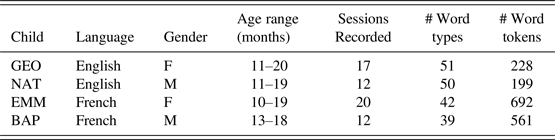
Four typically developing monolingual children in their earliest stage of word production (i.e., 0–50 word types) participated. GEO and EMM were female, and NAT and BAP were male. Table 1 summarizes participant characteristics and the number of spontaneous speech recording sessions analyzed.
Participant characteristics and amount of individual data analyzed.

For the English-learning children (GEO and NAT), the original research team administered the Battelle Developmental Screening Inventory (Guidubaldi et al. Reference Guidubaldi, Newborg, Stock, Svinicki and Wneck1984), to establish normal motor/cognitive development. Hearing screenings established normal hearing thresholds. Parent reports established that there were no significant medical diagnoses for either child. For the French-learning children (EMM and BAP), typical development was established by means of a parental questionnaire. The questionnaire was developed for use on the PREMS (Premiers Mots) grant project financed by the Agence Nationale de la Recherche (ANR: National Agency for Research in France).
2.2 Data collection
The original research team collected the English data on GEO and NAT as part of a larger study of babbling and early speech in typically developing American English learning children between eight and 36 months, funded by the National Institutes of Health in the United States. The database analyzed is now available as a part of the Texas Davis database available publically on PhonBank (Rose et al. Reference Rose, MacWhinney, Byrne, Hedlund, Maddocks, O'Brien, Wareham, Bamman, Magnitskaia and Zaller2006). The team audiotaped each child's spontaneous vocal output weekly to biweekly for one hour in a home environment to provide a view of their functional choices of words to say and sound patterns employed to produce those words within a familiar environment. No attempt was made to interfere with normal routines; sessions included playing, eating, and other daily experiences.
The French data for EMM and BAP is part of a larger database constructed for the PREMS project. The PREMS corpus encompassed longitudinal data gathering for eight children learning French, English, Tunisian-Arabic, and Berber. For the present analysis, we selected two children within a French language environment who were video-recorded for approximately one hour every two weeks between 10 to 30 months of age. This data is also publicly available on PhonBank.
2.3 Data analysis
Data analysis was the same for the two language groups, so as to ensure consistency of outcomes. The only difference, which accounted for the different number of tokens in the two language groups, was that the Texas data available on PhonBank included only the first 250 transcribed utterances in each one-hour session, a decision made by the original research team. In contrast, the French data included all word-based tokens occurring within each one-hour data collection session. We used analysis procedures available on Phon (Rose et al. Reference Rose, MacWhinney, Byrne, Hedlund, Maddocks, O'Brien, Wareham, Bamman, Magnitskaia and Zaller2006). Analysis began within the session where each of the four children was producing a perceptually recognizable word type agreed on by the researcher and the caregiver present with the child. Analysis continued until the session where each of the four children produced 50 cumulative word types understood by familiar adults in the context. The number of sessions and the age range for each child are given in Table 1. We eliminated onomatopoeic words (i.e., vroom to mimic a car moving) and non-words (i.e., boo without any meaningful contexts) from analysis. For each word type selected for analysis (e.g., puppy), tokens of that type were also analyzed (i.e., all the children's renditions of puppy). Within each child's spontaneous samples, both types of data were analyzed.
Spontaneous Words – Target (SW-T) indicated a perceptually rhythmic syllable-like form. The form was designated as a ‘word-based target’ because it had a clear meaningful ‘target word’ or communicative function, agreed upon by the parent and the observer (e.g., /ka/ while reaching for a toy car). We analyzed all spontaneous target words (i.e., SW-Ts) in the samples that met these criteria, using Standard English broad transcriptions for the word targets available within the Phon program.
A second analysis focused on the child's Actual Production of the Spontaneous Word types above (i.e., Spontaneous Words – Actual (SW-A). A coder trained during the original grant projects in transcription of child speech using broad phonetic transcription conventions had transcribed SW-A data. For the SW-T /kar/ above, the child's actual production, or SW-A, might be /ka/. Importantly, we did not design the analysis to evaluate precise word-level accuracy for words in the corpus, but to compare overall patterns in word targets versus overall patterns in the children's actual productions of those words for syllable shapes and place of articulation dimensions in initial word position.
The rationale for this approach to the data analysis was based on an analysis of the relationships between patterns in children's word targets (SW-T) and their actual productions (SW-A). We interpreted close similarity between frequency of SW-T and SW-A phonological patterns as indicating that children were choosing word types to say that matched their actual production abilities. We interpreted significant differences between SW-T and SW-A patterns as indicating that the children were choosing lexical types to say that did not necessarily reflect their own ability to produce the sounds in those words.
For both word targets (i.e., SW-T; car) and children's actual production of those word targets (i.e., SW-A; ka), CV, CVC, and CVCV word forms were analyzed for the four children. These word forms accounted for over 90% of the word types produced by these four children. In addition, to consider the relative frequency of labials in word initial position, we analyzed consonant place dimensions. These phonological dimensions were labial, coronal and dorsal place of articulation. To gain a preliminary look at cross-language generality of findings, we included data from two English-learning and two French-learning children. We analyzed patterns within and across the two language groups.
3. Results
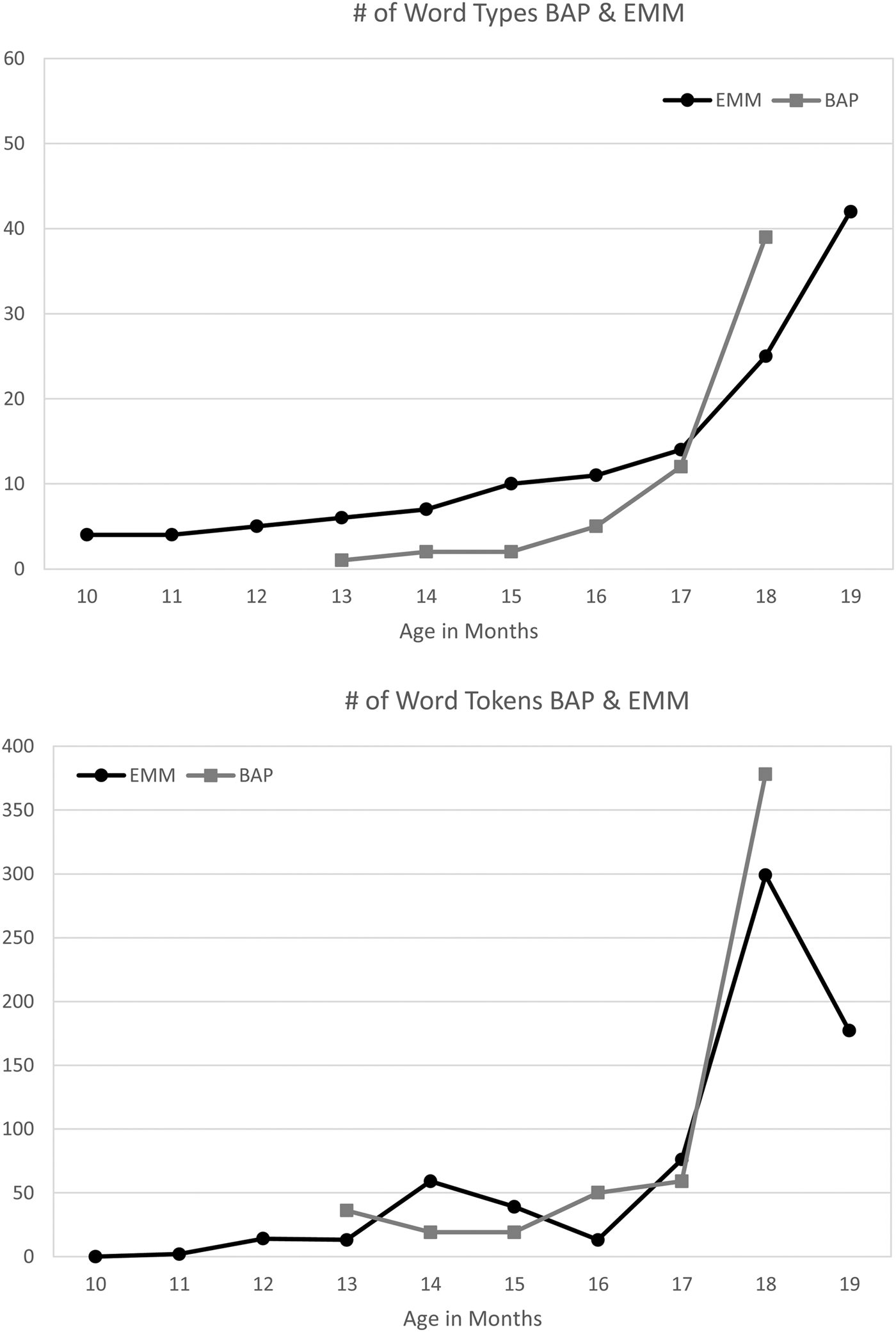
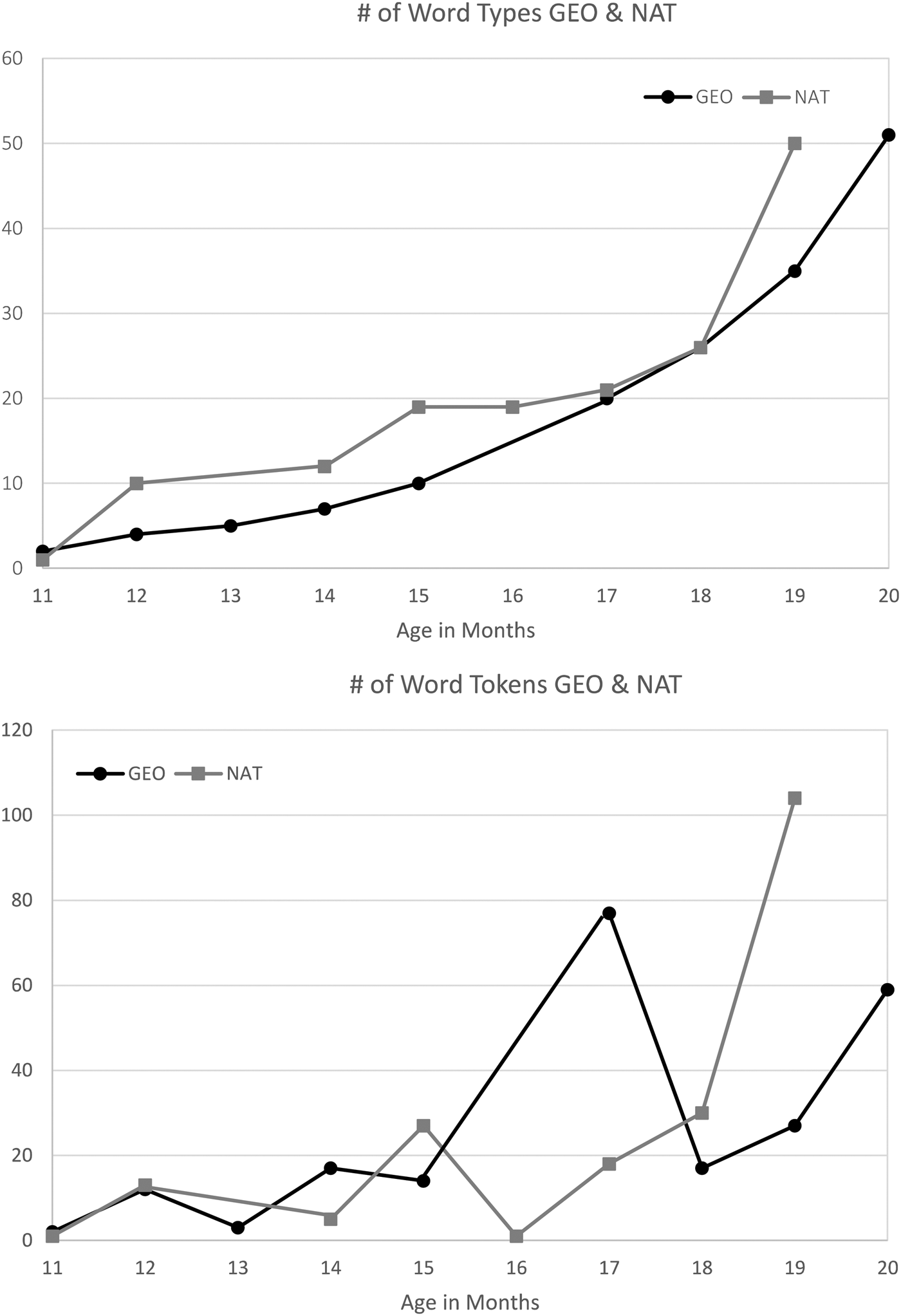
We described types and tokens analyzed in both French and English as a preliminary step to describing the data analyzed. In Figures 1 and 2, the first graph shows the number of types for the two children in each language, and the second shows the number of tokens for the same two children. For French types, BAP produced somewhat fewer than EMM at the earlier sessions but surpassed EMM at about 17 months. For tokens, both these French children showed variation across ages, with fewer than 50 word tokens (except for BAP at 16 months and EMM at 14 months) until about 17 months of age. In Figure 2, both English-learning children showed variation in the number of tokens across ages. These two children produced fewer than 40 word tokens per month except at 17 and 20 months for GEO and 19 months old for NAT. For both groups, the trajectory for tokens was far less regular than the trajectory for types.
Overview of Word Types and Tokens for French-learning children.

Overview of Word Types and Tokens for English-learning children.

3.1 Statistical analysis
To evaluate the two hypotheses given in section 1, we compared patterns in SW-T and SW-A syllable structures and place of articulation dimensions in initial position across sessions for all four children. We used a generalized linear regression with a negative binomial distribution using the glmm ADMB package in R (Fournier et al. Reference Fournier, Skaug, Ancheta, Ianelli, Magnusson, Maunder, Nielsen and Sibert2012).
3.2 Word forms (syllable structures)
The first hypothesis (repeated from section 1) stated that children will choose words to say that match their capacities for producing syllable shapes. They will not show any significant differences between actual word they produce (SW-A) and the target words they choose (SW-T).
We analyzed each language group data set with its own regression model. We did not statistically compare French to English due to the discrepancy of frequencies between the two groups of children (the French children had more word tokens). However, we descriptively discuss the difference(s) between the French and English language groups. Number of CV, CVC, and CVCV syllable structures was the dependent variable. Both regression models included ‘vocabulary’, ‘child’, ‘spontaneous word measure’ (i.e., SW-T vs. SW-A), ‘syllable structure’, and ‘interaction of spontaneous word measure by syllable structure’ as fixed effects.
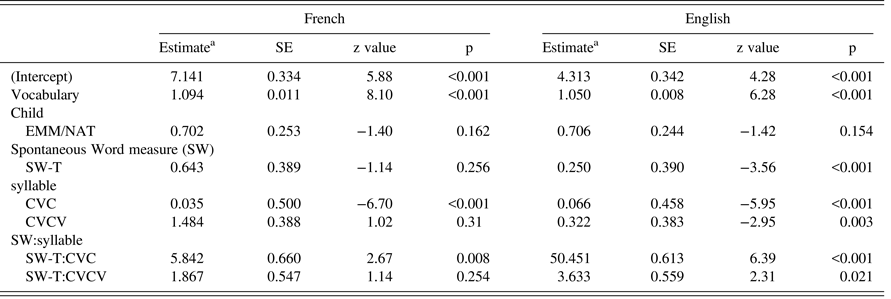
Table 2 displays regression results. To test the overall effect of fixed factors in a generalized linear regression effect model we ran an F-test. Results indicated that within their own language group, the French- and English-learning children were not significantly different from one another in patterns of syllable structure use: French children, F (1, 87) = 1.953, p = 0.166, English-learning children, F (1, 93) = 2.027, p = 0.158. However, there were different outcomes across the two language groups.
Results of generalized linear effects regression on French and English SW-T and SW-A word structures.

a exponential estimate. Note: The intercept represents the reference condition: the child was BAP, the American child was GEO, spontaneous word measure was SW-T, and syllable structure was CV.
The two French-learning children showed no significant difference between SW-T and SW-A for syllable structures, F (1, 87) = 1.290, p = 0.259. The children showed a significant interaction of syllable structures (CV, CVC, and CVCV) with differences between SW-T and SW-A, F (1, 87) = 4.193, p = 0.018. Pairwise contrasts showed that the children's actual productions (i.e., SW-A) of early words included significantly more CV (z = 6.703, p < 0.001) and CVCV (z = −5.800, p < 0.001) structures. SW-T included significantly more CV (z = 2.130, p = 0.033) and CVCV (z = −2.599, p = 0.009) structures. Relative to Hypothesis 1, the French group can be seen as dominantly choosing SW-T that were not different from their own capacities for production (i.e., SW-A) as illustrated by the lack of significant difference between SW-T and SW-A patterns.
Relative to the numbers of CV, CVC, and CVCV syllable structures in both SW-A and SW-T, French-learning children showed significantly more CV than CVC structures (z = –6.670, p < 0.001). However, the numbers of CV and CVCV structures were not significantly different from each other (z = 0.990, p = 0.320).
In contrast, both English-learning children showed a significant difference in syllable structures between SW-T and SW-A, F (1, 93) = 12.648, p < 0.001. This result indicates that their choices of words to say (i.e., SW-T) showed differences from their actual productions (SW-A) of those words. For these two children, there was a significant interaction of syllable structures with differences between SW-T and SW-A, F (1, 93) = 23.209, p < 0.001. Pairwise contrasts showed that CV word forms occurred significantly more in their actual productions (SW-A) than in their word targets, (SW-T) (z = 3.556, p = 0.001). Conversely, CVC word forms occurred significantly more in SW-T than in the children's SW-A (z = –2.535, p = 0.003). For example, the children's actual production (SW-A) was likely /bʊ/ for their SW-T form “book (/bʊk/)”. Final consonant deletion is very frequent in this developmental period (Kim and Davis Reference Kim, Davis and Barbara2015), likely contributing to the production of CVs in these English-learning children's SW-A. Relative to Hypothesis 1, this result indicates that children are showing significant differences between their actual productions (SW-A) and their word targets (SW-T). They are using CV structures in SW-A (likely consistent with use of final consonant deletion). They are producing more targets with CVC and CVCV forms consistent with patterns that are more (CVC) and less (CVCV) frequent respectively in their ambient language input.
Relative to the frequency of CV, CVC, and CVCV syllable structures of for both SW-A and SW-T words, English-learning children showed significantly more CV structures than CVC (z = –5.900, p < 0.001) and CVCV structures (z = –6.670, p < 0.001). French-learning children showed comparable frequencies of CV and CVCV forms, whereas English-learning children demonstrated dominantly CV structures over CVCV. This result indicate a role for ambient-language input, as French has a higher number of CVCV forms (Rousset Reference Rousset2004).
3.3 Labial place of articulation
The second hypothesis articulated in section 1 stated that children will choose words to say that have labial consonants in word initial position, and that they will not show any significant differences between actual word they produce (SW-A) and the target words they choose (SW-T).
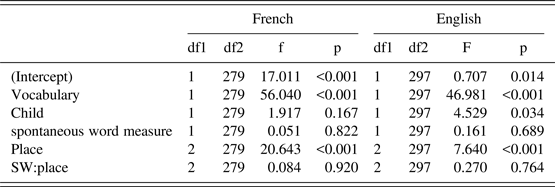
Regression models for both French and English learning children included ‘vocabulary’, ‘child’, ‘spontaneous word measure’ (SW-T vs. SW-A), ‘place’ (labial vs. coronal vs. dorsal), as well as an interaction term: ‘spontaneous word measure’ by place as fixed effects. An F-test evaluated the overall effect of fixed factors in these regressions (see Table 3).
Results of F-test to examine overall effect of fixed factors for regressions in both French and English.

Results indicated no significant difference between the two French children's patterns, F (1, 279) = 1.919, p = 0.167. In contrast, there was a significant difference between the two English children, F (1, 297) = 4.529, p = 0.03, indicating that the English-learning children showed individual differences from one another relative to use of labial place of articulation in initial position in contrast with their syllable structure results.
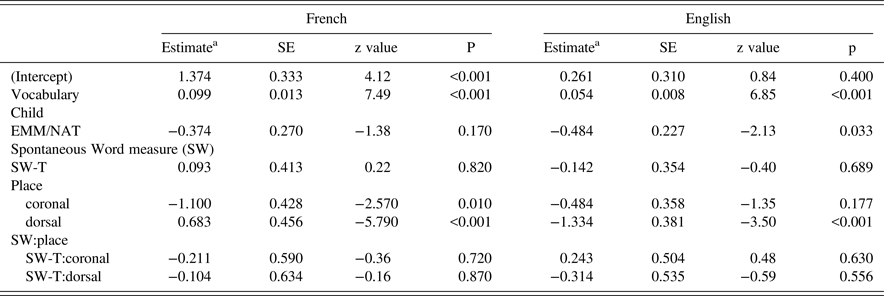
The goal of the analysis of labial place of articulation in initial position was to evaluate the hypothesis that children choose words to say that contain more initial labials because labial frequency is higher in early child sound inventories (Vihman Reference Vihman, Ferguson, Menn and Stoel-Gammon1992), thus within their capacities. We analyzed the data in each language group with its own regression model relative to testing the place of articulation hypothesis. The results of the regressions including exponential estimate and statistics are presented in Table 4. In this analysis, the dependent variable was the frequency of labial place of articulation sounds in word initial position.
Results of generalized linear effects regression on the number of sounds based on place of articulation between SW-T and SW-A in French and English.

a exponential estimate. Note: The intercept represents the reference condition: the French child was BAP, the American child was GEO, spontaneous word measure was SW-T, and place was labial. Each term was compared to the reference condition.
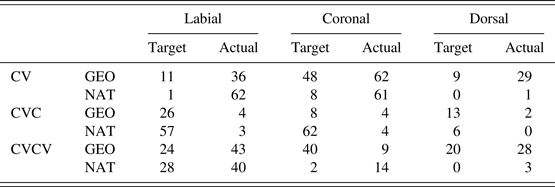
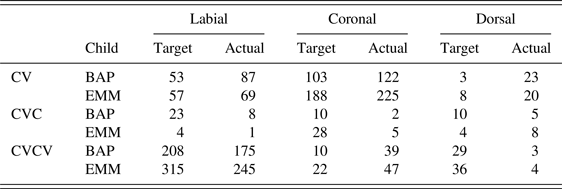
Within language groups, the three phonological dimensions of place of articulation were significantly different for both French-learning (F (1, 279) = 20.643, p < 0.001), and English-learning children (F (1, 297) = 7.640, p < 0.001) (see Table 3). In both language groups, labials were significantly more frequent than dorsals, but there was no significant difference between labials and coronals (see Table 4). The differences between SW-T and SW-A for place of articulation characteristics were not significant for either French-learning (F (1, 293) = 0.051, p = 0.822) or English-learning children (F (1, 297) = 0.161, p = 0.690). Relative to evaluating Hypothesis 2, significant differences between dorsals and both coronals and labials indicates that for both these places of articulation in word initial position, the children are choosing words to say that fit their production system capacities. Both coronals and labials are frequent in early sound inventories in comparison to dorsal place of articulation (Davis et al. Reference Davis, MacNeilage and Matyear2002). However, these results do not support a unique outcome for only labial place of articulation in word-initial position as was predicted in Hypothesis 2.
3.4 Summary of Statistical Results
We analyzed French- and English-learning children's data independently with their own regressions, due to the discrepancy in token frequencies between the two language groups. We then compared pairs of regressions descriptively between the French and English language groups for syllable structures (Hypothesis 1) and place of articulation in initial position (Hypothesis 2) dimensions. Overall, within each language group, French and English children were not significantly different from one another in patterns of syllable structure use (i.e., there were no significant individual differences between the two children within each language).
Across language groups, descriptive comparisons indicated that French and English children showed different patterns for syllable structures. French children showed no significant difference between SW-T and SW-A for CV, CVC, and, CVCV structures. This result for the French-learning children confirms Hypothesis 1 that the children were actually producing (SW-A) the syllable shape dimension of target words (SW-T) with no significant differences.
In contrast, English-learning children showed a significant difference between SW-T and SW-A for CV and CVC structures but not for CVCV structures. For these English-learning children, CVs were significantly more frequent in their actual productions (i.e., SW-A) than in their word targets (i.e., SW-T). In contrast, CVCs were significantly more frequent in their SW-Ts (word targets) than in SW-As (actual productions). This result for the English-learning children rejects Hypothesis 1. The English-learning children were choosing to say more diverse word targets (i.e., CVC) respectively than their actual production capacities (i.e., CV). However, for CVCV word structures, the lack of significant difference between SW-T and SW-A would confirm Hypothesis 1 and indicate that children are selecting CVCV word targets to say that are within their production capacities. Examples of these types of word forms in this period might include mama, daddy, or baby, where the SW-T would match the children's production capacities.
For the dimension of labial place of articulation in word-initial position (Hypothesis 2), the two French children were not significantly different from each other whereas the two English-learning children showed significantly different results (i.e., individual differences) for this analysis. The frequencies of the three ‘places of articulation’ in initial position were significantly different for both French and English-learning children. Both language groups showed a similar pattern of difference across the three place of articulation dimensions. For both groups, labials were most frequent, even though English labials were not significantly more frequent than English coronals. These results in both languages might confirm Hypothesis 2 as indicating that children choose words to say that have labial consonants in word initial position. The children are choosing words to say that fit their production system capacities. Relative to the finding of no significant difference between labials and coronals in English, both coronals and labials are frequent in early sound inventories in comparison to the dorsals (Davis et al. Reference Davis, MacNeilage and Matyear2002). However, these results do not support a unique outcome for only labial place of articulation in word-initial position in English, as had been predicted in Hypothesis 2.
4. Discussion
The goal of this preliminary study of four children in two language environments was to consider relationships between children's phonological capacities and the words they choose to say in the first-50-word phase of child language acquisition. To evaluate the generality of children's earliest output patterns relative to the potential interfaces of phonological capacities with lexical ‘selection’ of word targets to say, we compared French and English-learning children. Syllable structures (Hypothesis 1) and labial frequency in word-initial position (Hypothesis 2) were analyzed to compare potential ‘selection’ in this period across the two language groups. These two properties can potentially discriminate French and English-learning children's patterns, evaluating a role for ambient-language input in the words children choose to say relative to the issue of ‘selection’.
To evaluate lexical selection, word targets the children attempted (i.e., SW-T) were compared with their actual productions of those targets (i.e., SW-A). In this way, we could evaluate whether they were actually producing syllable structures and segmental patterns that matched the patterns found in their word targets. If they were, we could infer that the children were showing evidence of choosing word targets to say that matched their own production system capacities (i.e., ‘selection’). Alternatively, were the children selecting word targets with diverse sound patterns and syllable shapes that did not take into account their own abilities to produce the sounds and syllable shapes in those word targets? That outcome would support the conclusion that the children were saying words with a broader set of phonological properties not significantly related to their own production capacities.
Why does this question matter? The larger context of this study centers on the potential for a relationship between children's phonological capacities and the words children are choosing to say in their functional output in this earliest period of language acquisition. If children demonstrate ‘selection’ in their spontaneous word targets, we have predicted a lack of significant differences in syllable structures and place of articulation between their target words and their actual production patterns for those words. Lack of ‘selection’ predicts a lack of significant associations in syllable structures and place of articulation between SW-T and SW-A. ‘Selection’ indicates that phonological capacities and the emerging lexicon are associated. Lack of selection indicates that they are more autonomous from one another in early development. This question has potential to influence our understanding of the typical course of acquisition of phonological and vocabulary aspects of language across this earliest period.
What do the results obtained here tell us? As a background issue, neither language group showed significant within-language individual differences from one another in their patterns of syllable structure use. However, differences in syllable structures produced across the two language groups were evident. The French-learning children showed no significant difference between SW-T and SW-A patterns for CV, CVC, or CVCV structures, confirming Hypothesis 1 and indicating that these two French-learning children were selecting words to say that matched their own capacities for actually producing syllable shapes. Overall, the French children produced more CV than CVC words. They did not show a significant difference between CV and CVCV words. This finding suggests a role for ambient-language input, as French shows both more open syllables (Delattre Reference Delattre1965) and more disyllables than English (Rousset Reference Rousset2004).
The two English-learning children showed significant differences between SW-T and SW-A for CV and CVC but not for CVCV structures. They produced significantly more CV structures in their SW-A. In contrast, there were significantly more CVC structures in their SW-T. Relative to raw frequencies, English-learning children's CV words were significantly more frequent than either CVCs or CVCVs. This difference between SW-A and SW-T in the English-learning children may relate to two factors: the dominance of CVC structures in English word targets (Roberts Reference Roberts1965) and final consonant deletion in children in this developmental stage (e.g., Kim and Davis Reference Kim, Davis and Barbara2015). This outcome does not confirm Hypothesis 1 for CV or CVC forms. There were significant differences in the expected direction relative to children's phonological capacities: more CVs in their SW-A and more CVCs in their SW-T. In contrast, for CVCV structures, the English-learning children did not show significant differences between SW-A and SW-T, confirming Hypothesis 1 for this syllable shape. Importantly, CVCVs fall within children's reported phonological capacities in this developmental period and also may be found in a number of early word targets in the first 50 word period (e.g., mama, baby) indicating an association between the two syllable shapes for these English-learning children.
For the labial place of articulation in word-initial position tested in Hypothesis 2, in both language groups, labials were more frequent than coronals and dorsals, but there was no significant difference between labials and coronals in English. Relative to evaluating Hypothesis 2, the finding that labials and coronals could not be distinguished, as they showed non-significant differences from one another, indicates that for both of these places of articulation in word-initial position, the English-learning children are choosing words to say that fit their production system capacities. Both coronals and labials are frequent in early sound inventories (Davis et al. Reference Davis, MacNeilage and Matyear2002). However, these results do not support a unique outcome for only labial place of articulation in word-initial position, as we did not predict more frequent coronal use in Hypothesis 2.
The low use of dorsals is consistent with reports of low dorsal use in early inventories (Stoel-Gammon, Reference Stoel-Gammon1985). Dorsals were produced less frequently in this earliest period in both SW-A and SW-T. For place of articulation in initial word position, these results indicate that children may be choosing to say word targets that are consistent with their place of articulation capacities, as has been reported in a number of studies of this earliest period of word use. Thus, the place of articulation results for these two languages provide more straightforward evidence for ‘selection’ in this earliest period than was found for syllable-shape properties.
4.1 Clinical implications
Chronologically older children functioning developmentally in this early period of language acquisition (i.e., a child may be five years old chronologically but producing vocal output comparable to 12–15-month-olds developmentally) frequently need intervention to achieve age-appropriate outcomes or to achieve maximal functional communication. These outcomes could help interventionists to consider whether to focus on phonological or vocabulary capacities in intervention. Children with delayed or disordered acquisition of the phonological and/or vocabulary aspects of language may persist in use of language output that is characteristic of this early first 50-period; low growth in vocabulary and/or immature production patterns. Consideration of patterns of development in children developing typically can provide a needed backdrop to understanding the appropriate focus of intervention for these children. If early patterns of vocabulary words children choose to say are founded largely within a child's phonological production capacities, then intervention should emphasize awareness of production system capacities in choosing intervention targets to facilitate vocabulary growth. Alternatively, if vocabulary choice factors dominate from the onset of word use, then vocabulary growth should be the focus, without pursuing direct intervention for phonological accuracy. These results for syllable shapes and place-of-articulation properties in word-initial position generally support the use of word stimuli containing open CV syllables and labial or coronal place of articulation, as founded on children's own production capacities. CVCV forms may also be within the children's capacities. Dorsal word targets would likely be less effective. This question should be explored further in intervention studies with clients functioning in this developmental age range.
4.2 Study limitations/directions for future research
We tested the hypotheses in this study to evaluate the potential for ‘selection’ in the words children choose to say in the earliest period of word use in language acquisition. However, the number of children studied is small; results should be confirmed in a larger cohort and in differing language pairs to consider the generality of these findings more broadly. In addition, because the analyses were completed with existing data, the differences in analysis procedures in the two language groups (i.e., the number of tokens analyzed) precluded more rigorous quantitative testing of cross-language similarities and differences. To consider cross-language differences, the hypotheses were focused on two potential aspects of difference between English and French in this early phase, limiting the number of factors affecting word choice to syllable shapes and place of articulation in word-initial position. In contrast to this preliminary cross-language study, investigation of a larger cohort in a single language would permit consideration of more of the potentially relevant phonological factors that might go into ‘selection’ for word choices, including manner of articulation and vowels. It is also possible that children's attempts which are understood by adults may also influence their early word choices. Future studies should also analyze similar forms for different targets.
Due to the small number of children in each language group, cross-language differences on this topic should be explored in larger cohorts of language pairs as well.
4.3 Summary
Hypothesis 1 centred on syllable structure comparisons of target words with actual productions. CV forms are highest in these four children's SW-A in both languages. CVCV forms are somewhat more frequent in the two French children's SW-A, perhaps related to the frequency of multi-syllables in their ambient-language input. The English-learning children show lower frequency of CVC's in their actual output (SW-A), likely related to the frequent occurrence of final consonant deletion at this earliest stage. Relative to evaluating Hypothesis 1, the two French-learning children showed no significant difference between SW-T and SW-A for syllable structures and can be seen as dominantly choosing words to say that were not different from their own capacities for production. Both English-learning children, in contrast, showed a significant difference in syllable structures between SW-T and SW-A indicating that their choices of words to say showed differences from their actual productions of those words. This finding would connote a vocabulary orientation at the level of syllable structures; the English-learning children were choosing words to say with syllable structures (CVCs) that were more complex than they could actually produce. This strategy emphasizes choosing words to say that express the ideas the children wish to communicate, not selecting words based on internal-production-system restrictions.
Relative to Hypothesis 2, a comparison of SW-T and SW-A productions more strongly supports an interpretation of phonological ‘selection’ of word targets containing labials and coronals by these four children in two language groups during their earliest period of word use.
Overall, analysis of spontaneous word use in a functional communication environment did not produce a clear answer on the presence of ‘selection’ that was consistent across languages or across phonological dimensions tested. Ambient-language input affected the interpretation of the results. In addition, while the children's actual capacities were clear (i.e., labial and coronal CVs dominated in both languages, their relationship with their word target patterns relative to ‘selection’ was not consistent. There were differences in syllable structure findings between the two language groups, while segmental findings supported a ‘selection’ hypothesis for place of articulation in word-initial position (albeit for labials and coronals, not for labials alone).
Appendix
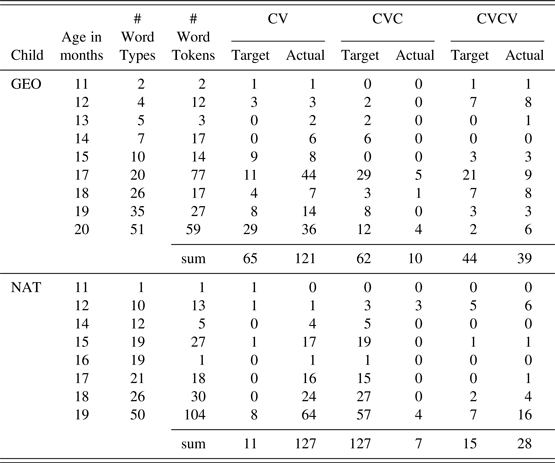
Frequencies of English Word forms across the period of study.

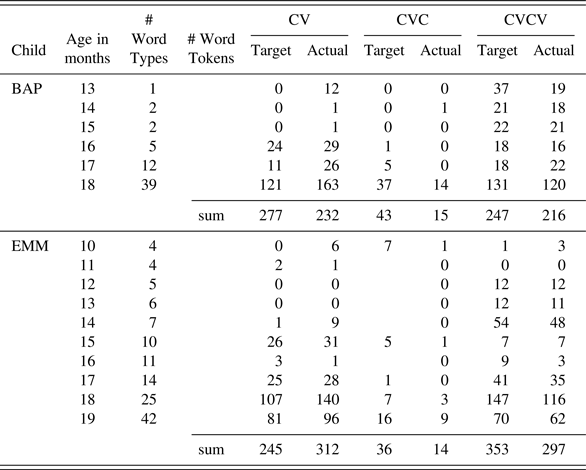
Frequencies of French Word forms across the period of the study.

Total number of Labial, Coronal and Dorsal across the sessions for English children.

Total number of Labial, Coronal and Dorsal across the sessions for French children.