INTRODUCTION
The production and comprehension of relative clauses involve complex cognitive processes for the computation of linguistic structure called filler–gap dependencies, which play a crucial role in determining the difficulty of relative clauses (e.g. Frazier, Reference Frazier and Coltheart1987; Gibson, Reference Gibson1998; Hawkins, Reference Hawkins1999; O'Grady, Reference O'Grady1997). The filler–gap dependency in relative clauses is the structural relationship between a gap and its head, as represented in the following examples in Japanese.
(1) [___ kuma-o hikkaita] panda bear-ACC scratched panda‘The panda which scratched a bear’
(2) [kuma-ga ___ hikkaita] pandabear-NOM scratched panda‘The panda which a bear scratched’
The relative clause with a subject gap shown in (1) is called a subject relative clause, and the one with a direct object gap in (2), an object relative clause. In these examples, gaps are indicated by underlines and relative clauses by square brackets. Since Japanese is a head-final language, the head panda follows the relative clauses, and it acts as a filler for the gap.
Assuming the filler–gap dependency in relative clauses in Japanese, this article investigates preschool Japanese-speaking children's comprehension of the two types of relative clauses shown in (1) and (2). I examined which type of relative clause was easier than the other by focusing on children's grammatical knowledge of the case markers -ga and -o. This is because these case markers are the only cues to identify the gap positions in (1) and (2) and it is generally believed that preschool children often misuse case markers in sentence comprehension tasks (e.g. Hayashibe, Reference Hayashibe1975; Iwatate, Reference Iwatate1980; Suzuki, Reference Suzuki, Ettlinger, Fleisher and Park-Doob2004; Reference Suzuki2007). I will demonstrate that preschool children comprehend a subject relative clause and an object relative clause equally well, if they can use case markers for sentence comprehension.
Comprehension of relative clauses
Adult native speakers of Japanese read a subject relative clause faster than an object relative clause in self-paced reading tasks (Miyamoto & Nakamura, Reference Miyamoto, Nakamura, Garding and Tsujimura2003; Nakamura, Reference Nakamura2003). The structural distance hypothesis (e.g. O'Grady, Reference O'Grady1997; O'Grady, Lee & Choo, Reference O'Grady, Lee and Choo2003) accounts for this result by suggesting that the hierarchical distance between the gap and the head of the relative clause is the determining factor of the difficulty. The hierarchical distance is the degree of embedding calculated by the number of nodes intervening between the gap and the head. In this view, a subject gap is closer to the head than a direct object gap because there is only an IP node above the subject gap, whereas there are IP and VP nodes above the direct object gap. Thus, a subject relative clause is easier than an object relative clause, and the well-known easiness of the subject relative clauses by English-speaking adults (e.g. Holmes, Reference Holmes1973; King & Just, Reference King and Just1991) and children (e.g. de Villiers, Tager-Flusberg, Hakuta & Cohen, Reference de Villiers, Tager-Flusberg, Hakuta and Cohen1979; Tavakolian, Reference Tavakolian, Goodluck and Solan1978) is also accounted for.Footnote 1
However, recent studies focusing on effects other than the filler–gap distance, such as the animacy of argument NPs and topicality, report that an object relative clause is not necessarily more difficult than a subject relative clause (e.g. Montag & MacDonald, Reference Montag, MacDonald, Taatgen and van Rijn2009; Mak, Vonk & Schriefers, Reference Mak, Vonk and Schriefers2006). Regarding children, Brandt, Kidd, Lieven and Tomasello (Reference Brandt, Kidd, Lieven and Tomasello2009) tested German- and English-speaking children, and discovered that children found an object relative clause with an inanimate head easier to comprehend than that with an animate head.
There are only a few studies that have systematically investigated the contrast between subject and object relative clauses in Japanese. Hakuta (Reference Hakuta1981) examined preschool children's comprehension of relative clauses embedded in SOV and OSV structures by using an act-out task. Overall, the easiness of an object relative clause compared with a subject relative clause was observed, and he suggests that this is because the order of thematic roles for the NPs in the object relative clause is consistent with a typical ‘agent–patient’ pattern in Japanese. On the other hand, no effect of the gap positions was reported in Harada, Uyeno, Hayahsibe and Yamada (Reference Harada, Uyeno, Hayahsibe and Yamada1976), where preschool and school-aged children were tested by an act-out comprehension task.
There are two fundamental problems in these Japanese studies. One is that they tested complex sentences where relative clauses function as a subject or a direct object (or even other grammatical relations). This makes it impossible to examine the effect of gap positions alone. In addition, these complex sentences are often extremely difficult for preschool children in the experimental task. For example, children were required to act out center-embedded sentences in Harada et al. (Reference Harada, Uyeno, Hayahsibe and Yamada1976), but the correct responses were almost 0% in children aged between three and six. This indicates that the required task and/or the experimental sentences were far beyond the children's control.
The other problem is that the previous studies did not examine whether children had acquired case markers for sentence comprehension. As is seen in the examples in (1) and (2), the only differences between the subject and object relative clauses are the case markers used in the first NPs. This means that the grammatical knowledge of case markers is a prerequisite for the comprehension of relative clauses. If children cannot use these case markers as cues to identify the structural differences between (1) and (2), the experiment is unable to assess the knowledge of relative clauses. In this case, it is highly plausible that the first NP be treated as an agent and the second NP as a patient due to the perceptual strategy (Bever, Reference Bever and Hayers1970).
The present study deals with these problems in three ways, the first two of which were adapted from the study of L2 Korean by O'Grady et al. (Reference O'Grady, Lee and Choo2003) . First, we tested the relative clauses as shown in the forms of (1) and (2), rather than those used to modify an NP as a subject or a direct object of a sentence. This was done for the purpose of focusing on the gap effect. Second, we conducted two tests involving the same participants: one for relative clauses and the other for case markers. The results of the case-marker test help interpret the results of the relative-clause test with respect to whether children make use of case markers as cues for sentence comprehension. Third, in order to minimize extraneous factors such as comprehension strategies, experimental sentences (or clauses) were provided in context. It is suggested that a preceding discourse context helps Japanese-speaking children demonstrate their grammatical knowledge of scrambling (Otsu, Reference Otsu, Hoekstra and Schwartz1994), topicalization (Sano, Reference Sano2004) and single-argument sentences (Suzuki, Reference Suzuki2007). Although it is arguable how discourse context facilitates children's sentence comprehension, children surely benefit from a previously mentioned element for lexical access. I assume that this also holds true for the comprehension of relative clauses, and that discourse context provides children with an optimal circumstance to implement the task required in the two experiments.
METHOD
Participants
Thirty children participated in this study. There were sixteen males and fourteen females. All of them were monolingual Japanese speakers residing in Japan. Their ages ranged from 5 ; 1 to 6 ; 8, and their mean age was 5 ; 10. All the participants completed the case-marker test and the relative-clause test in this order with a short break between the tests.
Materials and procedure
A picture selection task was used for both the relative-clause test and the case-marker test. In the relative-clause test, following a context sentence shown in (3), a subject relative clause as in (4) or an object relative clause as in (5) was provided verbally.
(3) Kuma to panda-ga imasu.Bear and panda-NOM exist‘There are a bear and a panda.’
(4) [___ kuma-o hikkaita] panda bear-ACC scratched panda‘The panda which scratched a bear’
(5) [kuma-ga ___ hikkaita] pandabear-NOM scratched panda‘The panda which a bear scratched’
A picture for the context sentence included three pairs of the same animals. For instance, three pairs of a bear and a panda, all of which were not doing any activity, were shown for the sentence in (3).Footnote 2 The next picture for the experimental phrase showed the same three pairs but this time three different scenes were shown. In one scene, they were not doing anything, in another scene, a bear was scratching a panda, and in the other scene, a panda was scratching a bear. Children were asked to point at either a particular animal or a scene that matched the given phrase.
This test was given as a ‘which-is-that-game’ and it had already been introduced in the practice session in the following way. For example, children were shown three mice in one picture and given a context sentence, Nezumi-ga imasu ‘There are mice’. Next, while an experimenter said Dore-ka na? ‘Which is that?’, an assistant showed another picture of a sleeping mouse, a crying mouse and a mouse which did not do anything. Then the experimenter gave children a cue phrase, ne-teiru nezumi ‘a sleeping mouse’, so that they could understand that they were supposed to select the one that was sleeping. Children were easily able to deal with this game and pointed at the sleeping mouse.
There were five tokens each for a subject relative clause and an object relative clause. Five reversible verbs were used in the experimental sentences: hikkaku ‘scratch’, onbu-suru ‘carry on one's back’, tobikoeru ‘jump over’, nameru ‘lick’ and tataku ‘hit’. For each verb, a pair of animals was selected from saru ‘monkey’, koara ‘koala bear’, uma ‘horse’, simauma ‘zebra’, inu ‘dog’, neko ‘cat’, kuma ‘bear’, panda ‘panda’, tanuki ‘raccoon’ and kitune ‘fox’. For each pair, a subject relative clause and an object relative clause were created, which made two sets of experimental sentences. One set was used for half of the participants and the other set for the remaining participants, so that each child heard the same animal pair with a particular verb only once in the experiment.Footnote 3 The order of the experimental sentences was pseudo-randomized so that the same sentence pattern was not given consecutively. The test was conducted in a quiet room. It took approximately 10 minutes for each child to complete the task.
In the case-marker test, children were given a context sentence as in (6), immediately followed by an experimental sentence as in (7) or (8).
(6) Kuma to Panda-ga imasu.bear and panda-NOM exist‘There are a bear and a panda.’
(7) Kuma-ga hikkakimasita.bear-NOM scratched‘The bear scratched (the panda).’
(8) Kuma-o hikkakimasita.bear-ACC scratched(The panda) scratched the bear.'
An experimental sentence was a single-argument sentence with a transitive verb. The subject sentence in (7) was used to test nominative -ga. When the target was accusative -o, an object sentence as in (8) was used. Japanese permits argument drop, which allows us to test whether children can use -ga and -o independent of the effect of word order.
In terms of pictures, a single picture depicting two animals was shown for the context sentence. For the experimental sentence, two pictures were shown: that of a bear scratching a panda and that of a panda scratching a bear, for the present example. The children had to point at the picture that matched the meaning of the given sentence.
There were five tokens each for a subject sentence and an object sentence, and the reversible verbs used in this test were the same as those used in the relative-clause test. Experimental sentences and context sentences were made and used in the same way as in the relative-clause test.
Before the experimental session, a practice session was held, where five sentences that included intransitive verbs were used. The experiment was conducted in a quiet room. It took approximately 5 to 8 minutes for each child to complete the task.
RESULTS
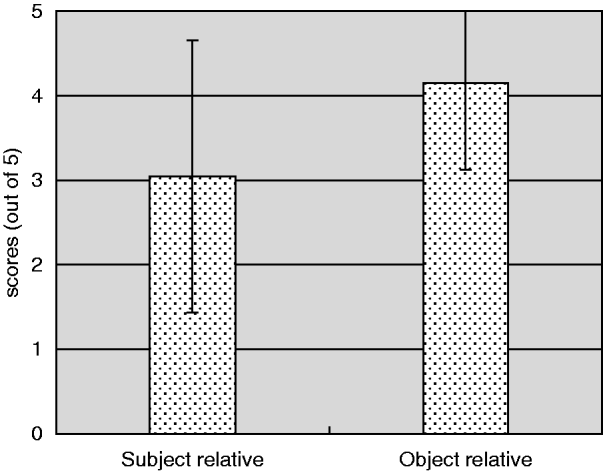
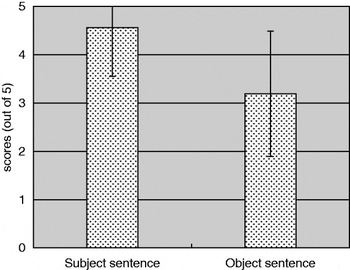
The data from twenty-seven subjects were analyzed. Three children were excluded from the analysis: two of them always chose the rightmost pictures throughout the two tests, and there was an experimental error in the case of one child. The results of the two tests are summarized in Figures 1 and 2.
Mean correct responses in the relative-clause test.
Mean correct responses in the case-marker test.

In the relative-clause test, the children selected a correct picture 60·8% of the time for a subject relative clause and 83·0% of the time for an object relative clause. No child selected the picture where two animals were doing nothing. A paired t-test shows that the scores on the object relative clause are significantly higher than those on the subject relative clause (t(26)=3·982, p<0·001). The performance of individual children also disclosed their superior performance on the object relative clause. There were seventeen children who performed better on the object relative clause than on the subject relative clause. This number is much larger than the number of children who performed better on the subject relative clause than on the object relative clause (n=4) (χ2(1, N=21)=8·048, p=0·005) and who performed equally well on the subject relative clause and the object relative clause (n=6) (χ2(1, N=23)=5·261, p=0·022). Generally, the results of the relative-clause test suggest that the children find the object relative clause easier than the subject relative clause.
In the case-marker test, the children performed better on the subject sentence (91·1%) than on the object sentence (63·7%), and there was a significant difference between them (t(26)=4·839, p<0·001). This indicates that for single-argument sentences, children used nominative -ga better than accusative -o.
DISCUSSION
The relative-clause test revealed the children's superior performance on an object relative clause over a subject relative clause, which is inconsistent with the structural distance hypothesis. On the other hand, the results of the case-marker test suggest that for the children's comprehension of a single-argument sentence, the accusative case marker is more difficult than the nominative case marker.
Taking these results into account, I believe that the children's poor performance on a subject relative clause is due to their inability to use the accusative case marker for sentence comprehension. To clarify this idea, we will compare the subject relative clause in (9) with the object sentence in (10).
(9) [___ kuma-o hikkaita] panda bear-ACC scratched panda‘The panda which scratched a bear’
(10) Kuma-o hikkakimasita.bear-ACC scratched‘(X) scratched the bear.’
What is common in these examples is the accusative case marker as a cue for sentence comprehension. If children are unable to use it, they are likely to fail in comprehending both (9) and (10).
However, the knowledge of the accusative case alone does not ensure a correct interpretation of (9) because it is a necessary condition in order to identify the position of a gap in the relative clause. What is additionally required for the comprehension of the relative clause involves the formation of the filler–gap dependency: to associate the gap with the head. On the other hand, the knowledge of the case marker in (10) is both necessary and sufficient conditions for the correct interpretation of (10) besides the knowledge of the verb. A filler–gap dependency is not involved in single-argument sentences.
Since the main purpose of this study is to investigate the relative difficulty in the filler–gap dependency between subject and object relative clauses, I would like to minimize the effect of the difficulty rooted in the case markers per se. One way to do this is to consider the data from the children who have no difficulty in using the case markers in the case-marker test. For this, I set a criterion of 80% correctness (four out of five tokens) on both subject sentences and object sentences in the case-marker test, and assume that the children who met this criterion have no problem in using a case-marking cue in the relative-clause test.
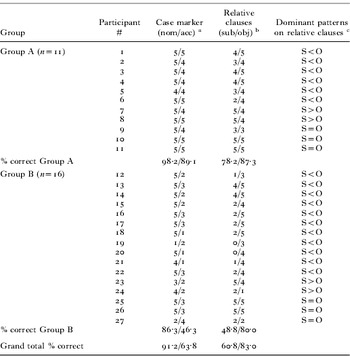
Eleven children met this criterion, and they were classified into Group A (mean age=5 ; 11), as shown in Table 1. Their mean correct responses in the relative-clause test disclosed that there was no statistically significant difference between their scores on the subject relative clause (78·2% correct) and those on the object relative clause (87·3% correct) (t(10)=1·614, p=0·138). In this group, six children performed better on the object relative clause than on the subject relative clause, two children performed in the opposite way, and three children performed equally well for the two types of relative clauses. On the other hand, sixteen children in Group B (mean age=5 ; 10), who did not meet the criterion of 80% correctness in the case-marker test, performed rather differently in the relative-clause test. Their scores on the object relative clause (80·0% correct) were significantly higher than those on the subject relative clause (48·8% correct) (t(15)=3·930, p=0·001), and the number of children who performed better on the object relative clause (n=11) was more than twice the number of other children (n=5) in this group.
Scores on each test item (out of 5) by individual children

notes: a nom=nominative case; acc=accusative case.
b sub=subject relative clause; obj=object relative clause.
c Dominant patterns show which type of relative clause is scored greater/lesser or equal.
These results suggest that for the children who could use case markers for the comprehension of single-argument sentences, there was no difference in the difficulty between the subject and the object relative clauses. Interestingly, this observation is consistent with the recent finding on children's production of relative clauses reported by Ozeki and Shirai (Reference Ozeki, Shirai, Matsumoto, Oshima, Robinson and Sells2007) . They counted the frequency of the subject and the object relative clauses in the spontaneous speech of five Japanese-speaking children, and reported that there was no difference in the frequency between the subject relative clause (35·6%) and the object relative clause (34·7%). The dominance of the object relative clause does not exist in the naturalistic production data as well as the comprehension data analyzed in the present study.
I believe that the data from the children in Group A reflect their grammatical knowledge of relative clause formation, but there may be a potential problem in this type of comprehension task: the possibility that the children might refer only to the case-marked NP and a verb, and ignore the remaining part of the phrase. Consider the real-time processing of the following example.
(11) [kuma-ga/-o hikkaita] pandabear-NOM/-ACC scratched panda
Children should first identify the case marker used in the first NP. Second, when they hear the verb, they need to identify the grammatical relation of the first NP and give it an appropriate thematic role. Continuously, when a head comes, they are supposed to put a gap (either a subject gap or a direct object gap) to form a filler–gap dependency. In the present task, however, children may take only the first two steps to complete the task itself because, without referring to the head noun, it is possible to understand how the first NP is involved in the event described by the verb. I admit there is no direct way to examine this ‘first-NP strategy’ by using the data at hand, and this should be seriously considered for future research.
However, a comparison of the two tests is suggestive. It is worth reporting that in Group A, there was no correlation between the scores of the subject sentence and those of the object relative clause (r=0·179, p=0·599) and between the scores of the object sentence and those of the subject relative clause (r=0·267, p=0·428), and mean scores in the relative-clause test is significantly lower than those in the case-marker test in this group (t(10)=2·631, p=0·025). These results imply that what children do for the interpretation of relative clauses is not exactly the same as what they do for the interpretation of single-argument sentences.Footnote 4 Possibly, a more complex process (i.e. the third step – forming a filler–gap dependency) is involved in the comprehension of relative clauses.
CONCLUDING REMARKS
Assuming that the relative difficulty/easiness of relative clauses is observable in the off-line picture selection task, I conclude here that unlike adults' sentence processing, there is no difference in the difficulty of children's comprehension between the subject relative clause and the object relative clause in Japanese. This suggests that the structural distance hypothesis is not supported in children's performance. Why is children's performance different from that of adults? One possibility is that children's structural representation is different from that of adults in that there is no gap in the children's relative clauses. The processing of the gapless relative clauses predicts no asymmetry in the difficulty between the two types of relative clauses. The other possibility is that children's limited working memory capacity (e.g. Gathercole, Pickering, Ambridge & Wearing, Reference Gathercole, Pickering, Ambridge and Wearing2004) forces them to prefer the closer gap to the head in terms of linearity. This predicts a preference for the object relative clause, but this effect is cancelled out by the structural distance, resulting in no difference between the two types of relative clauses.
These theoretical implications are tentative since they are solely dependent on the results of the off-line task. Considering that the processing difficulty regarding the filler–gap dependency has been observed in the on-line task by adults, I believe that future research needs to investigate children's real-time processing of the two types of relative clauses to measure the cost required for their interpretations.