INTRODUCTION
Dating objects of cultural heritage and art is essential for their evaluation, for differentiation between the original works and later imitations, and for recognition of repaired and/or restored works. Accurately dated objects of cultural heritage also can be particularly important to the history of the region or nation. In this work, we present the radiocarbon (14C) age data of historically important objects from the museum collection of the Franciscan Monastery of the Holy Spirit in Fojnica, Bosnia and Herzegovina.
Fojnica (43°58′N, 17°54′E) is a town and municipality in central Bosnia and Herzegovina, located west of the capital Sarajevo. The Monastery was founded in AD 1668 and houses an important part of the nation’s cultural heritage. It includes a library of about 12,500 volumes, including 13 incunabulas and 156 works written in Bosnian Cyrillic. Most of the works are philosophical and theological, printed from the 16th to the 19th centuries. The library archive preserves more than 3000 documents from the Ottoman Empire, with 13 of them dating back to AD 1481.
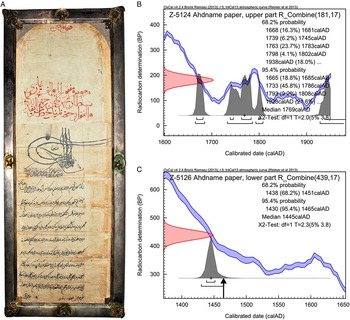
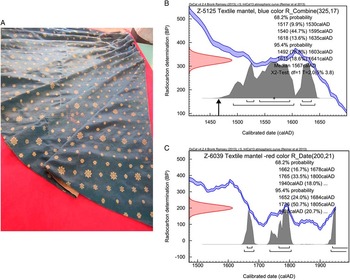
Over the centuries, the activity of the Franciscan monks was in numerous cases essential in keeping religious and national identity by collecting and preserving historically important documents. The collection in the Monastery museum holds the 15th century Ahdname (Fojnička ahdnama) (Figure 1A). An ahdname is a type of Ottoman charter commonly referred to as a treaty. It was an important part of the Ottoman diplomacy in that it set forth a contractual agreement between two states, usually between the Ottoman Empire and European nations (Theunissen Reference Theunissen1998; Oršolić Reference Oršolić2000; Goffman Reference Goffman2002). It was influential in the way it helped to structure society and maintained the agreements made between nation-states. The well-known examples of Ottoman Ahdnames were the Venetian Ahdnames (a list of 24 ahdnames in period from AD 1403 to AD 1641), used to maintain political and commercial links between the Venice and the Ottoman Empire. Also, the Ottoman Empire imposed Ahdnames on the Republic of Ragusa (present Dubrovnik, Croatia) from AD 1458 to AD 1649 (in total 14 documents, of which most were destroyed) (Miović and Selmani Reference Miović and Selmani2007). The Republic of Raguza was required to give up their sovereignty to the Ottoman Empire because they had become a tributory state of the Empire. The Fojnička ahdnama is assumed to have been issued by Sultan Mehmed II the Conquerer in AD 1463 to the Catholic monks of recently conquered Bosnia, granting them full religious freedom and protection. According to the historical event, the Ahdname was taken over by Fra Anđeo Zvizdović in AD 1463 (on May 28) from the Ottoman Sultan Mehmed II the Conqueror in the military camp Milodraže near Fojnica, Bosnia (present Bosnia and Herzegovina) (Šabanović Reference Šabanović1949; Džaja Reference Džaja2012). The collection in the Monastery museum holds the Mantel that is assumed to have belonged to Fra Anđeo Zvizdović (lived AD 1420–1498) (Figure 2A). In 2013 the 550th anniversary of the event was celebrated in the Milodraže lands.
(A) The Ahdname (Fojnička ahdnama), calibrated curve for the weighted mean value of (B) the upper part of the Ahdname, and (C) the lower part of the Ahdname. The arrow in part (C) indicates the expected age.

(A) The Mantel that was assumed to have belonged to Fra Anđeo Zvizdović. Calibrated curves for two textile samples from (B) blue-colored outer layer (the weighted mean value) and (C) red-colored lining material. The arrow in figure B indicates the expected age. (Colors refer to online version.)

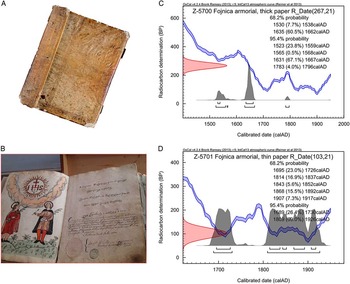
The museum also houses the Book of Coats of Arms, the so-called the Fojnica Armorial (Fojnički grbovnik) [Figure 3(A and B)]. Armorials are individual families’ collections of coats of arms, dating back to the early Middle Ages. Their purpose was to confirm those families’ lineal decents from the noble ancestors. Armorials are highly relevant as primary heraldic sources, both for the coats of arms of the individual families and the entire kingdoms. The oldest armorial in the Balkan region is the Korenić-Neorić Armorial, which was made in the late 16th century (AD 1595) and is being kept in the National and University Library in Zagreb, Croatia. The later armorials, such as the Fojnica Armorial, the only known one in Bosnia and Herzegovina, were designed on the basis of that armorial (Fojnički grbovnik 2012). The manuscript is named after the Franciscan monastery in Fojnica where it was kept. It contains a total of 139 coats of arms of some Balkan countries and then-prominent Bosnian families. The size of the Armorial is 30.4 cm×20.5 cm. There are various estimates of its age, from the 16th to 18th centuries, most likely the book dates to the Great Turkish War (AD 1683–1699) or to a period leading up to the war, i.e. in the context of the rebellions against the Ottoman rule during the war (Fojnički grbovnik 2012).
(A and B) The Fojnica Armorial. Calibrated curves for the (C) thick and (D) thin paper samples.

All three objects from the collection of the Fojnica monastery have great importance for interpretation of history in the Bosnia region, particularly in the very turbulent period when the Ottoman Empire occupied most of southeastern Europe and intended to expand further into Europe. Furthermore, the Franciscan Monastery in Fojnica suffered several fires during that period (Džaja Reference Džaja2012). Consequently, there are doubts whether these documents are authentic (Boškov Reference Boškov1979; Džaja Reference Džaja2012). Using 14C dating of different materials from these objects, we tried to evaluate the authenticity of the Fojnica Ahdname, the Mantel of Fra Anđeo Zvizdović, and the Fojnica Armorial.
MATERIALS AND METHODS
All materials were carefully sampled, pretreated, processed to graphite and measured by accelerator mass spectrometry (AMS). Particularly sensitive was sampling of the Ahdname, which consisted of a paper measuring 46.6 cm×17.3 cm, mostly covered with Arabic letters written in Turkish (Figure 1A). Very careful inspection of the Ahdname by the paper experts from the Croatian State Archives showed that the document consisted of two parts of paper glued together: the upper part with red Arabic letters, and the lower part with black Arabic letters. It had been restored with Japanese tissue and laminated with plastic foil. For 14C dating, the paper was sampled by carefully cutting ~2 cm2 of paper (~90 mg) from both the upper and lower portions. The paper samples were soaked in decahydronaphthalene (decalin) (Dadić and Ribkin Reference Dadić and Ribkin1970) to separate the plastic foil after which the Japanese paper was removed. The paper adhesive was removed by dissolution in hot water. Both samples were then treated by the ABA method at 80°C and freeze dried.
The Mantel (Figure 2A) consisted of two types of textile: a dark blue-colored with gold-colored stars outer layer and a red-colored inner lining. The outer layer was manufactured from wool, and the lining from linen. The samples were examined by a binocular microscope and appeared to be relatively clean, but were also additionally microscopically examined after each pretreatment step. The samples were soaked in acetone in ultrasonic bath, in order to remove any possible grease-like molecules, and rinsed thoroughly with ultrapure water (adapted after Bruhn et al. Reference Bruhn, Duhr, Grootes, Mintrop and Nadeau2001), followed by ultrasonic bleaching by 1% sodium hypochlorite solution and then ABA method at room temperature (Van Strydonck et al. Reference Van Strydonck, De Moor and Bénazeth2004; Brock et al. Reference Brock, Higham, Ditchfield and Bronk Ramsey2010). The samples were freeze dried.
The Fojnica Armorial [Figure 3 (A and B)] was composed of two types of paper, thick and thin, both of which were dated (~80 mg and ~50 mg of paper, respectively). Paper samples were treated by ABA method at 80°C and freeze dried.
Pretreated paper and textile samples were further processed to graphite for the AMS measurement. Graphite targets were prepared by the following chemical procedures: (1) CO2 production by oxidation in presence of CuO and Ag at 850°C, and (2) reduction of CO2 by Zn at 450°C to graphite and iron powder at 550°C as a catalyst (Krajcar Bronić et al. Reference Krajcar Bronić, Horvatinčić, Sironić, Obelić, Barešić and Felja2010; Sironić et al. Reference Sironić, Krajcar Bronić, Horvatinčić, Barešić, Obelić and Felja2013). The 14C AMS measurement of graphite targets was performed at the Scottish Universities Environmental Research Centre (SUERC, East Kilbride, Scotland) radiocarbon laboratory (see Tables 1 and 2, GU code) and the Center for Applied Isotope Studies, University of Georgia (Athens, Georgia, USA) (see Tables 1–3, UGAMS code). Aliquots of CO2 gas prepared from the samples were analyzed for δ13C on an isotope ratio mass spectrometer (IRMS) in the respective laboratories.
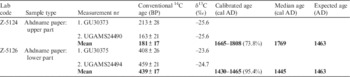
Results of 14C dating Ahdname paper samples, for individual measurements and weighted mean values. The highest posterior density range of calibrated age span within 2σ is given in bracket. GU code=Glasgow University; UGAMS code=University of Georgia.

Results of 14C dating the Mantel, two types of textile samples, for individual measurements and weighted mean value. The highest posterior density range of calibrated age span within 2σ is given in bracket. GU code=Glasgow University; UGAMS code=University of Georgia

Results of 14C dating the Fojnica Armorial. The density range of the calibrated age spans within 2σ is given in brackets.

The 14C results were calibrated using the software OxCal v 4.2.4 (Bronk Ramsey Reference Bronk Ramsey2009, Reference Bronk Ramsey2016) and IntCal13 calibration curves (Reimer et al. Reference Reimer, Bard, Bayliss, Beck, Blackwell, Bronk Ramsey, Buck, Cheng, Edwards, Friedrich, Grootes, Guilderson, Haflidason, Hajdas, Hatté, Heaton, Hoffmann, Hogg, Hughen, Kaiser, Kromer, Manning, Niu, Reimer, Richards, Scott, Southon, Staff, Turney and van der Plicht2013).
RESULTS AND DISCUSSION
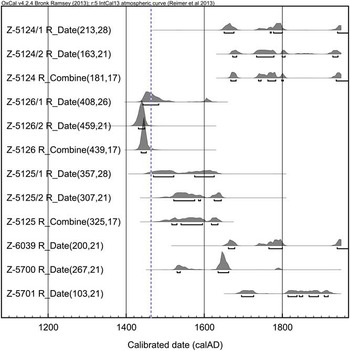
The results are presented separately for the Ahdname document (Fojnička ahdnama), the Mantel of Fra Anđeo Zvizdović, and the Fojnica Armorial (Fojnički grbovnik.). All results are presented as conventional 14C ages and calibrated age spans of the highest posterior density range within 2σ, as well as median cal AD values. If a sample was measured twice, the weighted mean value of the two measurements obtained by using chi-squared statistics to justify combining dates (R_Combine function in OxCal; Bronk Ramsey Reference Bronk Ramsey2009, Reference Bronk Ramsey2016) was used for calibrated age span. For comparison, expected or assumed ages are also given. In Figure 4, we show the summary of all 14C results presented as the calibrated 14C data distribution for individual and combined data within 2σ confidence.
Calibrated 14C data distributions for individual and combined data within 2σ confidence for the Fojnica Ahdname (Z-5124, upper part, Z-5126, lower part), the Mantel of Fra Anđeo Zvizdović (Z-5125, outer layer, Z-6039, lining), and the Fojnica Armorial (Z-5700, Z-5701). The dashed line indicates the expected age of the Ahdnama and the Mantel.

Fojnica Ahdname (Fojnička ahdnama)
As described above, the Ahdname (Figure 1A) consisted of two parts of paper glued together, both of which were dated. Both parts of the Ahdname were measured twice with two graphite sample preparations and the 14C results of all measurements are presented in Table 1 and Figure 4. In Figure 1 the calibrated curves for the weighted mean values of 14C ages of the upper (Figure 1B) and the lower part (Figure 1C) of the Ahdname paper are presented. The results of lower part of the Ahdname (Z-5126) show the narrow calibrated age span of two 14C results and combined data, with slight difference between two measurements (Figure 4), but still in good statistical agreement (t=2.3) (Figure 1C). The calibrated age span, cal AD 1430–1465 (probability 95.4%), corresponded with the expected/historical age of the Ahdname (AD 1463). The results of the upper part of the Ahdname (Z-5124) showed significantly wider calibrated age span, cal AD 1665–1808 (probability 73.8%), cal AD 1928–... (21.6%). There was good agreement with both individual measurements (chi-square test, t=2.0) (Figure 1B), but not with the lower part (Figure 4), i.e. it was younger than the original Ahdname document. The 14C age of the lower part of the Ahdname proved that this part was original, while the age of the upper part was approximately 300 years too young. It seems very likely that the Ahdname had been damaged or partly destroyed sometime in the past and restored afterward. According to the opinion of monks in Franciscan Monastery in Fojnica, the Ahdname was renewed in the 17th–18th century. There was no written evidence about that, only oral tradition. Consequently, the 20th century result (cal AD 1928–… , 21.6%) was rejected in the result interpretation.
Mantel of Fra Anđeo Zvizdović
It was assumed that the dated mantel belonged to Fra Anđeo Zvizdović (Figure 2A), who received the Ahdname in AD 1463 from the Sultan Mehmed II, so it was expected that the age of the Mantel would correspond to that of the Ahdname. Two textile samples from the outer layer and inner lining of the Mantel were dated separately and the results are presented in Table 2 and Figure 4. In Figure 2 the calibrated curves for the 14C age for both textile samples are presented. The results of the Mantel outer layer (Z-5125) showed a relatively wide calibrated age span for two 14C measurements and their combined result and a good coincidence between two individual measurements (chi-square test, t=2.0) (Figure 4). The age span of combined data, cal AD 1492–1641 (95.4%) is younger than expected (AD 1463). However, selected individual measurements of the Ahdname—the lower part (Z-5126/1, cal AD 1436–1516, 85.8%), and the Mantel outer layer (Z-5125/1, cal AD 1452–1530, 46.7%) are partly overlapping (Figure 4) (chi-square test, t=7.2). In this case, the calibrated age span of the Mantel of Fra Anđeo Zvizdović would correspond to a historical event when the Ahdname was received by Fra Anđeo Zvizdović in AD 1463 from the Ottoman Sultan Mehmed II. The 14C result of the Mantel, lining material (Z-6039), showed wide calibrated age span, cal AD 1652–1805 (74.7%), cal AD 1935 (20.7%), younger than the outer layer indicating that the lining had been restored. A very good agreement of the calibrated age of the lining with the upper part of the Ahdname (Z-5124) was observed (chi-square test t=0.5) (Figure 4), which could suggested that both the Ahdname upper part and the Mantel lining material had been renewed at the same time. For the final interpretation of the result the recent age (cal AD 1935– ... , 20.7%) was rejected for the same reason as was described for the Ahdname, as it is younger than historical records for the mantel.
Fojnica Armorial (Fojnički Grbovnik)
Two samples of paper (thick and thin) from the Fojnica Armorial [Figure 3 (A and B)] were dated and the 14C results are presented in Table 3 and Figure 4. In Figure 3C, the calibrated curve for the thick paper showed the calibrated age spans, cal AD 1523–1559 (23.8%) and cal AD 1631–1667 (67.1%). The first interval could be rejected since the Fojnica Armorial was made after 1595, see Introduction (Fojnički grbovnik 2012). Thin paper showed calibrated age spans, cal AD 1689–1730 (26.4%) and cal AD 1809–1926 (69.0%) (Figure 3D). The calibrated 14C ages showed that the Fojnica Armorial consisted of the papers of different ages suggesting that the Armorial was compiled over different times. The watermarks, which were found on many of the pages in the Armorial, corresponded to the paper from the period of the 16th to the middle of the 17th century. This observation was made at the Croatian Academy of Science, Zagreb, in 2011 (Fojnički grbovnik 2012). Our results of calibrated ages of the thick paper (Z-5700) are in good agreement with this assessment.
CONCLUSIONS
14C dating of the three historically important documents/objects related to the period of the reign of the Ottoman Empire in southeastern Europe, from the 15th to the 20th centuries, which particularly influenced the region of the Bosnia, enabled us to evaluate the originality of the objects. The 14C results of the Ahdname, the Mantel of Fra Anđeo Zvizdović, and the Fojnica Armorial samples, all from the museum collection of the Franciscan Monastery in Fojnica, Bosnia and Herzegovina, showed the following:
-
1. The Fojnica Ahdname (Fojnička ahdnama): the lower part of the Ahdname corresponds to the original document/historical age from AD 1463 (cal AD 1430–1465, 95.4%); the upper part of the Ahdname is younger than the original (cal AD 1665–1808, 73.8%), indicating that the later part of the document had been repaired afterwards;
-
2. The Mantel, which was assumed to have belonged to Fra Anđeo Zvizdović, who had received the Ahdname in AD 1463 from Sultan Mehmed II, in the military camp Milodraže near Fojnica, Bosnia, is younger than expected (cal AD 1492–1641, 95.4%). However, partial overlapping of the individual measurements of the Ahdname and the Mantel, outer layer, could suggest that the Mantel belonged to Fra Anđeo Zvizdović. Additionally, the lining material of the Mantel was younger (cal AD 1652–1805, 74.7%). Good agreement between the calibrated age span of the renovated part of the Ahdname and the linig material of the Mantel can suggest that both objects had been renewed in the same time; and
-
3. The Fojnica Armorial (Fojnički grbovnik) was composed of two types of paper of different ages: the thick paper, cal AD 1631–1667 (67.1%), and the thin paper, cal AD 1689–1730 (26.4%), cal AD 1809–1926 (69.0%). This indicates that the Armorial had been compiled in different times.
ACKNOWLEDGMENTS
We especially thank Fra Nikica Vujica, the guardian of the Franciscan Monastery of the Holy Spirit in Fojnica, who initiated the dating of the presented objects from the museum collection of the Monastery. We also thank Ms Tatjana Mušnjak from the Croatian State Archives for useful cooperation.