In many countries, the start of instructed second language (L2) acquisition has been moved forward from the teens to the beginning of primary school in recent years. As a consequence, foreign-language (FL) learners typically are not late (i.e., postpubescent) learners of the L2 anymore; rather, learners start getting FL exposure between the ages of 5 and 8 years. To better understand the acquisition type and the developmental trajectory among early FL learners, this paper explores parallels and differences in FL syntactic development among first-language (L1) German child instructed FL learners of English who started learning English at age 6 in comparison with monolingual children. We also compare our results to findings from early naturalistic child L2 acquisition, on the one hand, and from adult FL acquisition, on the other.Footnote 1
Specifically, we explore similarities and differences between acquisition types in terms of (a) syntactic L1 transfer, (b) input effects on syntactic development, and (c) profile effects in the impact of individual differences on early FL syntactic development.
This study focuses on the interpretation of wh-questions and relative clauses. The development of questions and relative clauses has been much studied in monolingual child development (e.g., Durrleman, Marinis, & Franck, Reference Durrleman, Marinis and Franck2016) and is beginning to receive attention in child L2 acquisition (Roesch & Chondrogianni, Reference Roesch and Chondrogianni2016). Crucially, L1 transfer affects wh-questions and relative clauses in adult FL development (e.g., Grüter, Reference Grüter2006; Hopp, Reference Hopp2017; Rankin, Reference Rankin2014), making them suitable test cases for transfer effects in early FL syntactic development. In consequence, we examine whether the L1 affects early syntactic development in child FL acquisition in ways similar to what has been reported for adult FL acquisition.
First, our study on syntactic transfer, and development allows for delineating age effects in bilingual development (e.g., Meisel, Reference Meisel2009; Schwartz, Reference Schwartz2009). If child FL learners show L1 transfer effects similar to late learners and different from, for example, simultaneous bilingual children, then the acquisition mechanisms are likely to be similar in child FL and adult FL learners in instructional settings.
Second, we focus on possible interactions of L1 transfer with input effects in child L2 development. So far, the scope of transfer effects in child L2 acquisition is unclear, with some studies finding effects of L1 transfer (Haberzettl, Reference Haberzettl2005; Haznedar, Reference Haznedar2001; Unsworth, Reference Unsworth2005) while others report no transfer effects (e.g., Paradis, Rusk, Duncan, & Govindarajan, Reference Paradis, Rusk, Duncan and Govindarajan2017; Thoma & Tracy, Reference Thoma, Tracy and Ahrenholz2006). Part of the reason for these inconclusive results may be that these studies consider different stages in L2 development, which might be differently affected by L1 transfer. According to some models of adult L2 acquisition, a full copy of the L1 forms the initial state grammar in the L2 (Schwartz & Sprouse, Reference Schwartz and Sprouse1996), such that L1 effects should be most pronounced initially and increasing L2 input subsequently attenuates L1 transfer. Other models propose that effects of L1 syntactic transfer may emerge only once learners have received enough L2 input to arrive at higher levels of grammatical competence (e.g., the Developmentally Moderated Transfer hypothesis; Pienemann, Reference Pienemann2005; Organic Grammar; Vainikka & Young-Scholten, Reference Vainikka and Young-Scholten2011). We assess the degree to which these models transfer to child L2 acquisition in accounting for potential differential transfer effects. From a psycholinguistic perspective, then, this study allows for assessing effects of cross-linguistic influence as a function of age of onset and input.
In addition, L2 input has been identified as the primary determinant of the speed of syntactic acquisition and convergence on the target grammar in child L2 acquisition (e.g., Chondrogianni & Marinis, Reference Chondrogianni and Marinis2011; Unsworth, Reference Unsworth, Nicoladis and Montanari2016b). In many studies on (child) L2 acquisition, however, differences in input are confounded with differences in age of onset and/or length of exposure, as learners at the same ages with more input had an earlier start, more time to acquire the L2, or both (e.g., Flege, Yeni-Komsian, & Liu, Reference Flege, Yeni-Komshian and Liu1999). In this study, we avoid these confounds by studying the syntactic development in children with the same ages of onset and the same lengths of exposure who attend different types of schools offering either regular English as a foreign language (EFL) lessons or partial immersion schooling in the L2. Hence, we operationalize type of input via type of school. From an applied perspective, then, this study determines the amount of input required for EFL children to approximate or reach monolingual performance in complex syntax (see Paradis & Jia, Reference Paradis and Jia2016), and it gauges the effects of early partial immersion schooling (Wesche, Reference Wesche, Burmeister, Piske and Rohde2002).
Finally, the study assesses individual factors contributing to the target acquisition of EFL syntax in order to delineate similarities and differences between early FL and child L2 syntactic development (e.g., Paradis, Reference Paradis2011; Paradis et al., Reference Paradis, Rusk, Duncan and Govindarajan2017). We ascertain which internal and external factors contribute to the child FL acquisition of complex syntax. From a developmental perspective, then, this study delineates the effect structure of contributing factors in early FL syntactic development.
We study these questions by testing 243 German-dominant FL learners of English in fourth grade at different regular, partial-, and high-immersion schools in Germany as well as 68 monolingual English children aged between 5 and 8 years in the United Kingdom. The study administered a picture-based interpretation task following Rankin (Reference Rankin2014). In addition, cognitive, linguistic, and social variables were collected to assess the impact of individual differences.
Background
Syntactic transfer in the adult and child L2 acquisition of wh-questions and relative clauses
In L2 and FL acquisition, evidence of L1 syntactic transfer is abundant across learning contexts and across language combinations. For instance, L1 German child and adult learners of English initially transfer the underlying OV (object–verb) word order of German to the L2 (Weigl, Reference Weigl1999; see Sağin-Şimşek, Reference Sağin-Şimşek2006; Sánchez, Reference Sánchez, Angelis and Dewaele2011, for child L2A) and they continue to display persistent transfer of the German verb-second (V2) property in main clauses (Kaltenbacher, Reference Kaltenbacher2001; Rankin, Reference Rankin2012; Robertson & Sorace, Reference Robertson, Sorace, Klein and Martohardjono1999) as well as in wh-questions and relative clauses (Rankin, Reference Rankin, Amaro, Judy and Pascual y Cabo2013, Reference Rankin2014; see also Hopp, Reference Hopp2017).
According to standard generative analyses (e.g., Chomsky, Reference Chomsky1981), both wh-questions and relative clauses are formed by moving a wh-word or relative pronoun to the clause-initial position and indexing its original thematic position via traces or silent copies. In English, subject and object questions (1) and subject and object relative clauses (2) differ both in structure and in surface word order due to the underlying subject–verb–object (SVO) word order without verb raising.
(1)

(2)


In German, subject and object wh-questions and relative clauses differ only in structure, yet not in surface word order, as shown by the translations of the English sentences in (3) and (4). Due to the V2 property in German main clauses, the thematic verb raises into second position in questions, leaving both subject and object in a postverbal position (den Besten, Reference den Besten and Abraham1983). As per the basic OV order of German, a preverbal noun phrase in a relative clause can be either a subject or an object. In German, grammatical roles are disambiguated by case marking on determiners; yet due to the syncretism in the German determiner paradigm, many forms are ambiguous between nominative and accusative, as, for example, in (3) and (4).
(3)
(4)


Due to partial surface word order overlap, English wh-questions and relative clauses can be parsed using a German V2/OV grammar. Specifically, English subject questions as in (1a) overlap with both subject and object orders in German as in (3a) and (3b) and could thus receive both a subject and an object parse. For relative clauses, the object relative clause word order in English (2b) is compatible with both object and subject relative clauses in German (4a and 4b). In contrast, English object questions (1b) and English subject relative clauses (2a) cannot be parsed using German grammar. In sum, partial word order overlap between English and German questions and relative clauses creates so-called cross-linguistic syntactic conflicts (Kaan, Ballantyne, & Wijnen, Reference Kaan, Ballantyne and Wijnen2015), as a surface string can receive alternative parses by the L1 and the L2 grammar, respectively.
Several studies on wh-questions capitalized on these cross-linguistic conflicts to examine L1 activation among adult FL learners. For beginning learners at the L2 initial state, Grüter (Reference Grüter2006) and Grüter and Conradie (Reference Grüter, Conradie, Slabakova, Montrul and Prévost2006) tested whether L1 English and L1 Afrikaans learners of German would transfer properties of their L1 grammar. Because Afrikaans shares the OV/V2 properties with German, Afrikaans learners were expected to pattern like German native controls, while English learners should manifest subject parses of wh-questions as per English grammar (1a). Results of a picture-selection task showed that English learners preferred subject over object interpretations of German questions (3), while Afrikaans learners and German controls preferred object interpretations. For L1 German learners of English at intermediate to advanced proficiency levels, Rankin (Reference Rankin, Amaro, Judy and Pascual y Cabo2013, Reference Rankin2014) finds that the FL learners, unlike English natives, consider subject wh-questions and object relative clauses as partially ambiguous between subject and object interpretations in English, whereas object wh-questions and subject relative clauses only receive the target interpretations. In conjunction, these studies attest that adult FL learners at different levels of proficiency sometimes recruit the L1 grammar when assigning an interpretation to sentences in the L2.
In the present study, we adapt the picture selection task from Rankin (Reference Rankin2014) for German-dominant children acquiring English in instructed contexts. We investigate whether child learners show similar patterns as adult FL learners or whether child EFL learners pattern with monolingual English children in the acquisition of wh-questions and relative clauses.
Wh-questions and relative clauses in child language development
For monolingual children, many studies across different languages report that they acquire subject questions and relative clauses before object questions and relative clauses and perform better in the comprehension of subject than object orders (for wh-questions, see De Vincenzi, Arduino, Ciccarelli, & Job, Reference De Vincenzi, Arduino, Ciccarelli, Job and Bagnara1999; Friedmann & Novogrodsky, Reference Friedmann and Novogrodsky2011; Guasti, Branchini, & Arosio, Reference Guasti, Branchini and Arosio2012; for relative clauses, see Adani, Reference Adani2011; Adani, van der Lely, Forgiarini, & Guasti Reference Adani, van der Lely, Forgiarini and Guasti2010; Durrleman et al., Reference Durrleman, Marinis and Franck2016; Friedmann & Novogrodsky, Reference Friedmann and Novogrodsky2004). In both production and comprehension, subject questions emerge around age 2 to 3, while mastery of object orders is not attained until age 4 to 5 (Correa, Reference Correa1995; De Villiers, Tager-Flusberg, Hakuta, & Cohen, Reference De Villiers, Tager-Flusberg, Hakuta and Cohen1979). For object relative clauses, convergence on target accuracy occurs even later around age 6, and younger children also perform significantly better on object questions than object relatives (e.g., Durrleman et al., Reference Durrleman, Marinis and Franck2016).
Furthermore, the difficulty with object questions and relative clauses is magnified for certain types of questions: among wh-questions, which-questions prove to be the hardest question type for monolingual children to interpret correctly (e.g., De Vincenzi et al., Reference De Vincenzi, Arduino, Ciccarelli, Job and Bagnara1999; Friedmann, Belletti, & Rizzi, Reference Friedmann, Belletti and Rizzi2009). English-speaking children do not master which-questions until age 6 or 7, although they perform to criterion on who-questions earlier (e.g., Avrutin, Reference Avrutin, Grodzinsky, Shapiro and Swinney2000; Goodluck, Reference Goodluck and Di2005). For instance, in a recent study by Contemori, Carlson, and Marinis (Reference Contemori, Carlson and Marinis2018), English monolingual children between age 5 and 7 correctly identified 63% of object which-questions (“Which cow is the goat pushing?”) in a picture selection task, while subject questions were answered at 95% accuracy.
The general asymmetry between subject and object orders has been argued to follow from subject-first orders being the canonical order in that thematic role assignment of agent and patient is linearly mapped onto argument order (Canonicity hypothesis; Friedmann & Novogrodsky, Reference Friedmann and Novogrodsky2004). Further, object orders are more taxing in sentence processing in that they require the parser to revise its initial subject interpretation to an object order (e.g., De Vincenzi, Reference De Vincenzi1991). Given that (object) wh-questions are considerably more frequent in the input than relative clauses, the parser has more experience with revision in question than in relative clause contexts, such that object wh-questions reach target accuracy sooner in child language development than relative clauses. Finally, asymmetries between question types reflect syntactic locality constraints: a moved object constituent crosses the subject bearing similar features so that (relativized) minimality is violated and intervention effects arise (Contemori & Marinis, Reference Contemori and Marinis2014; Friedmann et al., Reference Friedmann, Belletti and Rizzi2009). The greater the similarity of the wh-phrase to the subject in terms of its morphosyntactic features, the larger the intervention effects will be. In consequence, which-questions (e.g., which animal) present greater difficulty in sentences as in (1 and 2) than questions with a bare wh-phrase (e.g., who; Durrleman et al., Reference Durrleman, Marinis and Franck2016; Friedmann et al., Reference Friedmann, Belletti and Rizzi2009).
Summarizing, the monolingual acquisition of wh-questions and relative clauses is characterized by a general subject-over-object preference, earlier acquisition of wh-questions than of relative clauses, and particular difficulty with which-questions.
For child L2 learners of German, Roesch and Chondrogianni (Reference Roesch and Chondrogianni2016) find that early sequential French–German bilingual children aged 4 to 5 years (mean age of acquisition to German: 3 years, 1 month) demonstrate a similar subject preference in the interpretation of wh-questions as monolingual German and simultaneous German–French bilingual children of the same ages. However, in a picture selection task, the bilingual groups differed in their interpretation strategies of wh-questions in which case-marking on the second noun phrase (NP) disambiguated the question (“Welche Maus malt derNOM/denACC Frosch an?”—Which mouse does the frog paint?/Which mouse paints the frog?). The monolingual children integrated case marking on the NP in the parse to disambiguate the question (i.e., they chose the patient referent for the nominative-marked second NP and the agent referent for the accusative-marked NP). In contrast, the bilingual children mapped the case marking directly to the target (i.e., they chose a patient referent upon hearing accusative case and an agent referent for nominative case). Using the same stimuli as Contemori et al. (Reference Contemori, Carlson and Marinis2018), Hopp (Reference Hopp2017) tested L1 German adult learners of English and found that intermediate learners show different interpretation and processing patterns than monolingual English children because the FL learners had difficulties using English morphosyntactic cues to assign an object interpretation. Taken together, these findings suggest that L1 effects may dictate a partially different course of development in sequential and late bilingual than in monolingual acquisition.
In sum, the few studies that compare bilingual and child L2 learners to monolingual children show broad parallels in terms of a general subject-over-object preference; yet they also point to specific differences in how bilingual children and FL adults use morphosyntactic cues for disambiguation (see also Cristante & Schimke, Reference Cristante, Schimke, Schimke and Hopp2018).
Input differences in the child L2/3 acquisition of English syntax
Whereas the studies reviewed above compared group performance between monolingual and child bilingual learners, an increasing body of research investigates how individual differences among child L2 learners affect the acquisition of the target language (for review, see Chondrogianni, Reference Chondrogianni, Bayram, Miller, Rothman and Serratrice2018; Unsworth, Reference Unsworth, Nicoladis and Montanari2016b). Among these factors, effects of input have been identified as paramount (Paradis & Grüter, Reference Paradis, Grüter, Grüter and Paradis2014). For instance, the development of morphology as well as syntax in both production and comprehension is affected by length of exposure, time in L2 schools, or amount of input in the L2 as measured in parental questionnaires (e.g., Chondrogianni & Marinis, Reference Chondrogianni and Marinis2011; Paradis, Reference Paradis2011; Paradis et al., Reference Paradis, Rusk, Duncan and Govindarajan2017; Unsworth, Reference Unsworth2016a, Reference Unsworth, Nicoladis and Montanari2016b). In the present study, we operationalize differences in input as differences in school types, namely, regular schools with two English lessons per week and two types of partial immersion schools offering bilingual programmes, in which 50% and 70% of all lessons are held in English, respectively.
Input across different school types
As in many other countries, the number of schools offering bilingual programs in Germany is steadily increasing. Currently there are over 330 primary schools offering a bilingual program; this corresponds to approximately 2% of all (private and public) primary schools (FMKS, Verein für frühe Mehrsprachigkeit an Kindertageseinrichtungen und Schulen, 2014). Many studies have shown that bilingual programs are particularly effective when they follow immersion principles, that is, if several school subjects (e.g., science, music, sports, arts, and maths) are taught exclusively in the FL (e.g., Pérez-Cañado, Reference Pérez-Cañado2012). In Europe, the term CLIL (content and language integrated learning) is frequently used to refer to bilingual programs, ranging from “bilingual modules” in individual subjects to immersion programs, in which at least 50% of the curriculum is taught in an L2. The most intensive form of such programs are total immersion programmes in which all school subjects are taught in the L2 for several years, corresponding to 100% of the teaching time. In Germany, however, only partial-immersion programs are permitted, because the subject German always has to be taught in German (Kultusministerkonferenz, 2013), that is, the FL can be used as a medium of instruction in up to 70%–80% of the teaching time.
Therefore, immersion and regular (i.e., instructed) foreign language programs, differ regarding the type and intensity of FL input (e.g., Burmeister, Reference Burmeister, Pienemann, Keßler and Roos2006): in regular programs, the FL (e.g., English) is taught as a subject for the duration of one to two lessons per week in primary school, depending on the federal state in Germany. In such a context, the FL is usually taught by introducing several topics (such as colors, body parts, family, or school life; see, for example, Ministry of Education, Baden-Württemberg, 2016), often based on books designed for teaching English as a subject. In bilingual programs, however, English is the medium of instruction, that is, the focus is on learning subject matter (e.g., science, maths, etc.), and the teaching follows the curriculum for this particular subject.
The crucial difference between immersion and regular programs relates to their respective general aims (Burmeister, Reference Burmeister, Pienemann, Keßler and Roos2006): the focus of foreign language lessons in regular primary schools is on developing a positive attitude towards the new language and language learning as well as on language and cultural awareness. The lessons focus on fostering English listening and speaking skills; literacy skills receive less attention. After 4 years of primary school, the children should usually reach or approach level A1 (see, e.g., Ministry of Education, Baden-Württemberg, 2016) of the European Framework of References (Council of Europe, 2001). In immersion programs, by contrast, children experience English in a much more functional way, because the FL is not only used in age-appropriate relevant and authentic contexts but also embedded in subject matter. Therefore, all five skills (i.e., listening, speaking, reading, writing, and mediation) are subject to systematic instruction. At the end of primary school, many children reach level B1 in English reading and level A2 in English writing in immersion programs (e.g., Steinlen Reference Steinlen2016, Reference Steinlen2018).
L1 transfer and input
Against this backdrop, this study investigates how differences in input in the same time span of child FL acquisition affect early syntactic development of wh-questions and relative clauses. We concentrate on (a) input effects on L1 transfer and (b) input effects on convergence of the target language.
First, initial-state models of L1 transfer, such as the Full Transfer/Full Access model (Schwartz & Sprouse, Reference Schwartz and Sprouse1996), propose that the L1 grammar transfers in full to the L2 initial state, and learners subsequently restructure their interlanguage grammar on the basis of L2 input. According to this model, L1 effects should be most pronounced initially and increasing L2 input leads to gradual convergence on the target-language grammar. In contrast, developmental models of transfer hold that transfer of L1 syntax, such as verb-second, emerges only once learners have received sufficient input to overcome default or reduced syntactic representations due to processing limitations (e.g., Developmentally Moderated Transfer hypothesis; Pienemann, Reference Pienemann2005; Organic Grammar; Vainikka & Young-Scholten, Reference Vainikka and Young-Scholten2011).
Second, the amount of input affects the speed and degree of convergence on the target grammar in the child L2 acquisition of morphosyntax (Unsworth, Reference Unsworth, Nicoladis and Montanari2016b). In the present study, we ask how differences in input affect convergence in qualitative and quantitative terms. In qualitative terms, monolingual children show a subject-first preference and earlier and higher accuracy on wh-questions than on relative clauses. Hence, we investigate whether similar acquisitional patterns arise in early FL development. In quantitative terms, we pursue the question whether nonimmersed FL learners can approximate monolingual levels of comprehension accuracy within the same time span as naturalistic child L2 learners who live in an L2 environment (Paradis & Jia, Reference Paradis and Jia2016). Several studies suggest that naturalistic child L2 learners take between 4 and 6 years of sustained exposure to reach similar levels as their monolingual peers (Hakuta, Goto Butler, & Witt, Reference Hakuta, Goto Butler and Witt2000; Saunders & O’Brien, Reference Saunders, O’Brien, Genesee, Lindholm-Leary, Saunders and Christian2006), with older learners demonstrating speedier initial learning (Paradis, Reference Paradis2011). However, some studies on grammatical development suggest that convergence on monolingual peers in morphosyntactic abilities may take longer than 6 years and may not happen until well into the teens (e.g., Jia & Fuse, Reference Jia and Fuse2007; Paradis, Tulpar, & Arppe, Reference Paradis, Tulpar and Arppe2016).
Individual differences in the child L2/L3 acquisition of English syntax
In addition to effects of input, various additional linguistic, cognitive, and social factors affect early child L2 development (Paradis, Reference Paradis2011; Unsworth, Reference Unsworth, Nicoladis and Montanari2016b). Often, these factors are grouped into child-external factors, such as input, parental education, and socioeconomic background and child-internal factors, such as age, knowledge and proficiency in the L1, working memory, phonological awareness, executive control, and other cognitive factors (Chondrogianni, Reference Chondrogianni, Bayram, Miller, Rothman and Serratrice2018). Studying these factors may unearth profile effects in that certain child-internal or child-external factors affect different linguistic domains in different ways. For instance, vocabulary learning and the acquisition of inflection is more affected by input differences than, for example, syntactic or semantic development (e.g., Blom & Bosma, Reference Blom and Bosma2016; Chondrogianni & Marinis, Reference Chondrogianni and Marinis2011; Unsworth, Reference Unsworth2016a). Paradis (Reference Paradis2011) assessed child-external and child-internal predictors of vocabulary knowledge and finiteness marking in 169 English L2 children aged 4;10 years months to 7 years with a mean exposure to English of 20 months. In regression analyses, child-internal factors, that is, verbal short-term memory (nonword repetition), L1, and age, predicted a larger degree of variance than child-external factors such as length of exposure to English or richness of the English environment, that is, the amount of English activities at home. All of these factors contributed significantly to children’s performance in morphosyntax. For wh-questions and passives, Chondrogianni and Marinis (Reference Chondrogianni and Marinis2011) report length of exposure, mother’s English proficiency (wh-questions), and age of onset (passives) as significant predictors among L1 Turkish English learners aged 7;8 years. For complex syntax in L2 production, Paradis et al. (Reference Paradis, Rusk, Duncan and Govindarajan2017) find length of exposure, richness of the L2 environment at home, verbal working memory, and analytical reasoning scores as well as L2 vocabulary to be predictors of the amount of English sentences consisting of more than one clause. Finally, for the comprehension of wh-questions, Roesch and Chondrogianni (Reference Roesch and Chondrogianni2016) report that both length of exposure and age of onset account for mastery of object-wh questions.
In sum, internal and external factors such as length of exposure, cognitive processing facility, as well as parental background measures predict syntactic development in child L2 learners. However, these findings are specific to naturalistic learners in an L2 environment where they additionally receive partial exposure to the L2 outside of school. Therefore, we ask whether a similar effect can be found in early nonimmersed FL acquisition. In this study, we investigate a wide variety of cognitive and linguistic factors, focusing on students at regular schools. In this subsample, we assess English skills in receptive and productive vocabulary as well as in receptive grammar. In addition, we examine possible effects of cognitive predictors (e.g., working memory, nonverbal IQ, and executive control) and phonological awareness. As linguistic predictors, we include productive vocabulary measures in all previously learned languages. Finally, we consider social factors (e.g., parental education), and personal factors (e.g., gender and age) to delineate the relative scope of internal versus external factors.
Research questions
We pose the following research questions:
1. How does L1 transfer affect early syntactic FL development of wh-questions and relative clauses?
We test whether child FL learners show effects of L1 German in their interpretation of wh-questions and relative clauses. For the sentence types investigated in this study (1 and 2), transfer predicts an interaction of order (i.e., subject vs. object orders) and structure (wh-questions vs. relative clauses), with subject wh-questions and object relative clauses presenting difficulty due to alternative parses being available by the L1 German grammar.
2. How does input quantity affect early syntactic FL development?
We assess the extent to which the groups of FL students in regular and partial-immersion schools show differences in their comprehension of questions and relative clauses. First, we assess whether differences in input across the different school types affect the degree to which L1 transfer occurs with wh-questions and relative clauses in English. Second, we investigate which groups demonstrate the same qualitative patterns as monolingual children, that is, main effects of order and main effects of structure. We also assess whether and when early FL learners catch up with monolingual children in quantitative terms.
3. How do individual differences in linguistic, cognitive, and social factors affect early syntactic FL development?
Using the subsample of students at regular schools, we test which individual factors contribute to the target acquisition of wh-questions and relative clauses to identify whether similar child-internal and child-external factors predict acquisition in child FL as compared to child L2 acquisition.
The study
Participants
We tested 243 9- to 10-year-old German-dominant early FL learners of English in fourth grade at eight different regular and partial-immersion schools in Germany. In addition, we collected baseline data from 68 monolingual English children aged between 5 and 8 years from one primary school in the United Kingdom. The data were collected within the contexts of different larger research projects in Germany and the United Kingdom that partially used different measures of background factors.
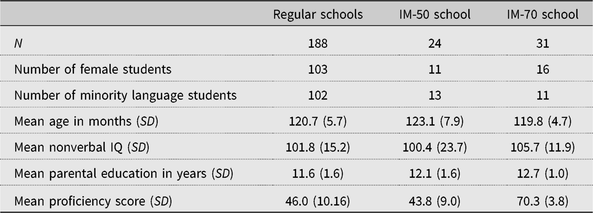
Among the FL learners, there were 188 students at six regular German public schools, where they had been receiving two 45-min English-as-subject lessons per week since Grade 1. Monolingual students grew up speaking German only, and minority-language students acquired a heritage language other than German at home alongside German. In addition, 24 students at a public partial-immersion school were tested. At this school, approximately 50% of all lessons had been taught in English, starting in Grade 1. All teachers are certified English teachers with a diploma in bilingual teaching. Hence, we refer to this school as the IM-50 school. Finally, 31 students attending a private English-immersion school were tested. At this school, 70% of the teaching time is conducted in English from Grade 1 onward, including obligatory extracurricular activities, and the teachers are native English speakers. We refer to this school as the IM-70 school. Table 1 gives an overview of the student groups at the respective schools.
Descriptive statistics for FL students by school, with the tests described in the text below.
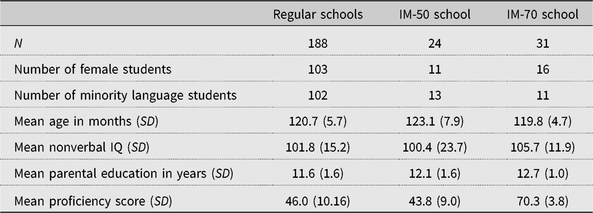
To compare the students in background characteristics across the different schools, we ran one-way Analyses of Variance on age, nonverbal intelligence, parental education and English proficiency (Test of the Reception of Grammar; TROG-2; see below). The groups did not differ significantly in age, F (2, 238) = 0.198; p = .821, or nonverbal intelligence, F (2, 233) = 0.920; p = .400. However, there was a significant between-group difference in parental education, F (2, 179) = 4.355; p = .014.Footnote 2 Post-hoc Tukey tests showed that the effect is attributable to the contrast between the group at regular and immersion schools, while the other groups were statistically indistinguishable. For English proficiency, which was tested by using the TROG-2 (Bishop, Reference Bishop2006), there were highly significant differences, F (2, 232) = 81.316; p < .001: the IM-70 students scored significantly higher than the other two groups, which were not different from each other.
Tasks
Main task
The main task was a picture-selection task adapted from Rankin (Reference Rankin2014). We constructed 10 quadruplets of sentences using the familiar verbs bite and catch as in (5). All questions began with the complex wh-noun phrase “which animal,” and all relative clauses started with the NP “the animal.”
(5)
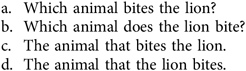
These sentences were spread across five different display types, depicting four to five animals performing biting or catching events on each other (see Figure 1).
Example display for verb bite.

Each display type was paired with one wh-question, one relative clause, and one filler item.Footnote 3 Filler items comprised questions about location (e.g., Which animal is behind/in front of the zebra?) or easily identifiable events (e.g., Which animal eats a banana?). The sentences were distributed across two lists, with each child seeing 30 displays in total, that is, three times the display in Figure 1 and three times nine other displays.
Control tasks
All groups took the TROG-2 (Bishop, Reference Bishop2006) as a standardized test of receptive English proficiency in grammar. In addition, we tested nonverbal intelligence using the first part of the CFT-20R (CFT 20-R: Grundintelligenztest Skala 2; Weiß, Reference Weiß2006) for the students at regular schools and the Standard Progressive Matrices (Raven, Reference Raven1976) for students at the immersion schools. Scores were transformed via age-appropriate T scores to a standardized scale. Parental education in years was measured in detailed parent questionnaires, collecting social, family, linguistic, and other background variables. As the experiment was embedded in different larger research projects, various additional tasks were administered to the respective groups. For the subset of students at regular schools, we also assessed phonological awareness in tasks testing phoneme manipulation in English (following Weber, Marx, & Schneider, Reference Weber, Marx and Schneider2007). Working memory was measured using forward digit span tasks (adapted from HAWIK-IV; Petermann & Petermann, Reference Petermann and Petermann2008). Furthermore, executive function was assessed using the Simon Task (Simon, Reference Simon1969). In addition, we tested productive vocabulary in English and in German in category fluency tasks (adapted from Delis, Kaplan, & Kramer, Reference Delis, Kaplan and Kramer2001). In this task, students named as many items as possible belonging to two semantic categories (“animals” and “food”) within 1 min each, and a composite score was calculated as the mean of the two categories. In all projects, other data were collected for purposes not relevant to the current study, so that they will not be reported.
Procedure
The main experiment, the TROG, and the nonverbal IQ tests were administered in class. In the main experiment, the experimenter explained the task in German and answered questions. Students were given a booklet with the pictures corresponding to the sentences. They were told to circle the target animal that would be the answer to the question. A practice item preceded the experimental items, and a filler item initiated the 30 items. For each item, the experimenter first named all animals from left to right and then read the sentence twice at a slow pace. Students were not given any feedback, and the teachers ensured that students would not miss items or copy from each other. In all, the main experiment took approximately 25 min. The data for the other control tasks were collected in individual testing sessions.
Analysis
We excluded FL students who were bilingual with English as one of the languages (n = 15), 5 at regular schools, 3 at the IM-50 school, and 7 at the IM-70 school. For the remaining participants, responses to the items were coded for accuracy and type of mistakes. Based on performance on the filler items, we also excluded students who answered fewer than 5 of the 10 filler questions correctly, as these students likely did not pay attention to the task. This led to the exclusion of 35 additional FL students, all from regular schools. The remaining data set comprised 68 monolingual English children and 192 FL students. The data were analysed using mixed logistic regression modelling with glmer from the lme4 package in R Studio (Bates, Maechler, Bolker, & Walker, Reference Bates, Maechler, Bolker and Walker2015). Models were kept maximal in terms of the random-effect structure. Where this maximal model did not converge, we first removed the by-item, and then the by-participant random slopes or, subsequently, random intercepts (following Barr, Levy, Scheepers, & Tily, Reference Barr, Levy, Scheepers and Tily2013).
Results
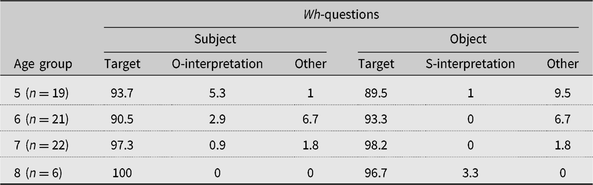
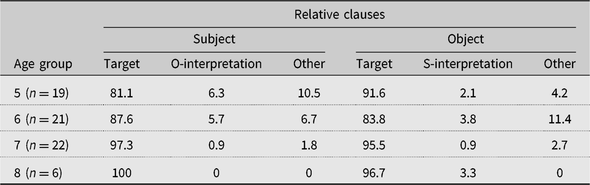
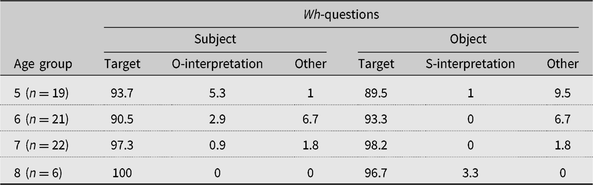
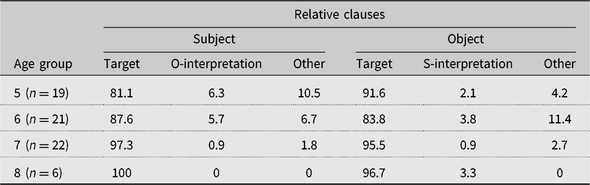
We analysed the results for the monolingual and the FL students separately. For the English monolinguals, Table 2 shows the comprehension accuracy for wh-questions by age group, and Table 3 reports the comprehension accuracy for relative clauses.
Comprehension accuracy in percentage for wh-questions: Monolingual English children, by age.
Comprehension accuracy in percentage for relative clauses: Monolingual English children, by age.
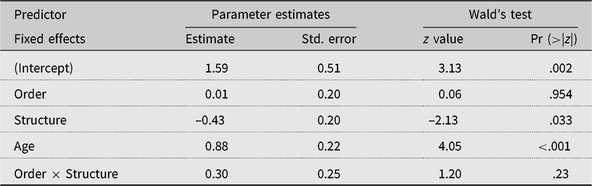
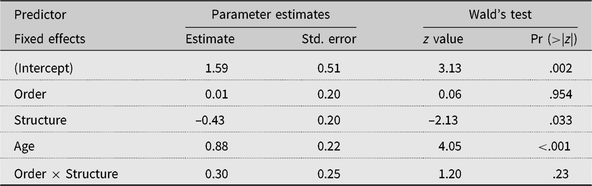
For the monolingual students, we fitted a mixed linear logistic regression for Accuracy, with Order (subject vs. object) and Structure (wh-question vs. relative clause) as well as Age (as group) as fixed effects including their interactions. Participant and Item were included as crossed random factors with random intercepts and uncorrelated random slopes for Order and Structure. Due to convergence issues, we needed to remove the interaction of Order and Structure as random slopes. The final model (Table 4) returned only main effects of structure and age. Despite the overall high interpretation accuracy, comprehension accuracy improved with age, and relative clauses proved to be more difficult to understand than wh-questions.
Mixed-effects logistic regression for monolingual students (n = 68).
In the following, we present the results of the FL students in three steps. First, we tested whether we find evidence of L1 effects. Second, we probed whether differences in input (i.e., type of school), affect the interpretation of questions and relative clauses, and third, we explored the impact of individual differences among the subgroup of students at regular schools.
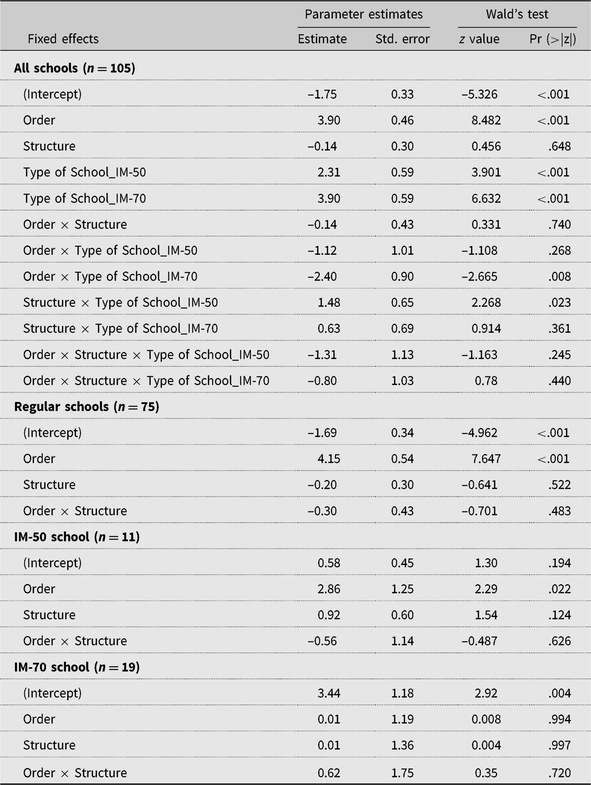
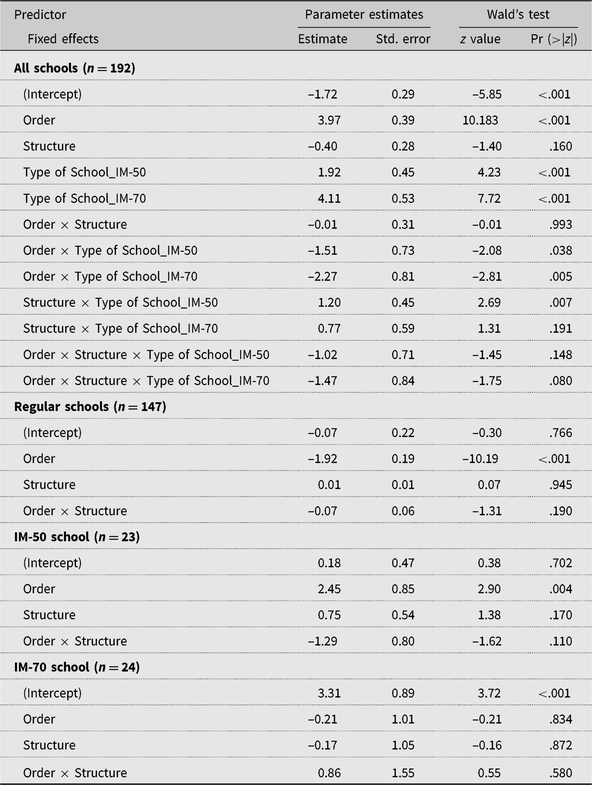
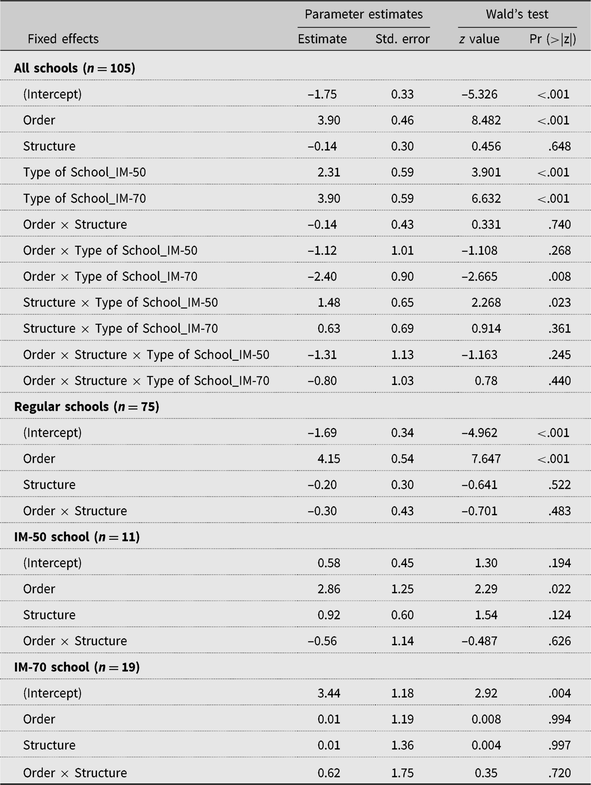
First, to address the issue of L1 transfer effects, we tested for an interaction of order and structure, as recourse to German would predict lower accuracy on subject wh-questions and object relative clauses. We fitted a mixed-linear logistic regression for Accuracy, with Order, Structure, and Type of School as fixed effects (with regular schools as the reference) and Participant and Item as crossed random factors with random intercepts and uncorrelated random slopes for Order and Structure. Due to convergence issues, we needed to remove the interaction of Order and Structure as random slopes. The model that converged (see Table 5) showed main effects of Order, Structure, and Type of School, yet no significant interaction of Order and Structure. However, there was a marginal three-way interaction of Order, Structure, and Type of School. We also ran the models for the monolingual German students only to see whether the inclusion of students who speak a minority language at home on top of German changes the pattern of results (see Appendix A). The pattern of effects does not change, and in particular, there were no interactions of Order and Structure in the subsets of monolingual students either, so we continue to present the results for all students.
Mixed-effects logistic regression for all FL students (n = 192) and by type of school.
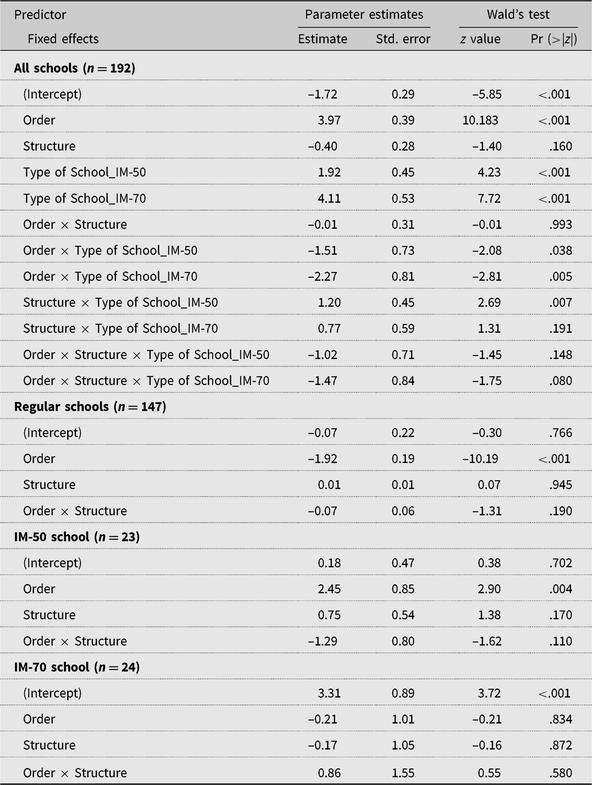
In a next step, we ran individual regressions by school type. For the regular schools, the model included the same random effect structure as above and School as an additional random intercept to control for effects of the six different schools among the students. The final model returned a highly significant main effect of Order, yet no effect of Structure or any interaction of the two (Table 5).
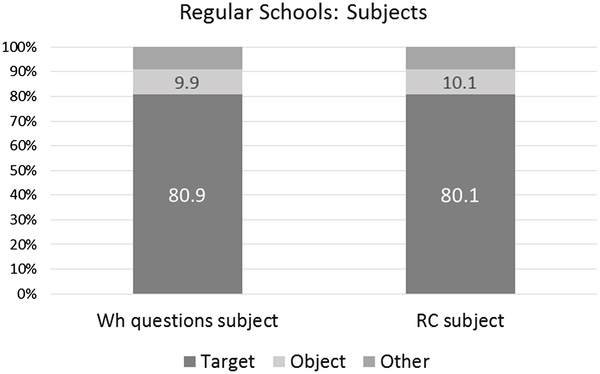
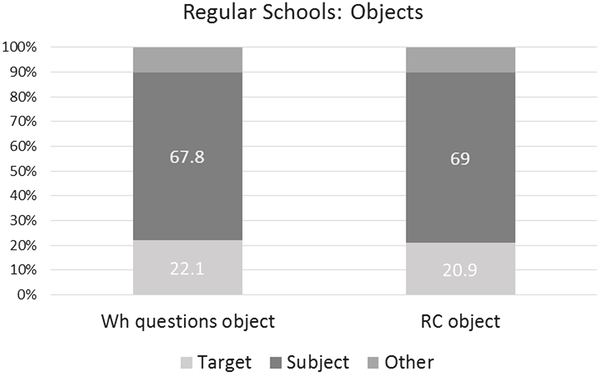
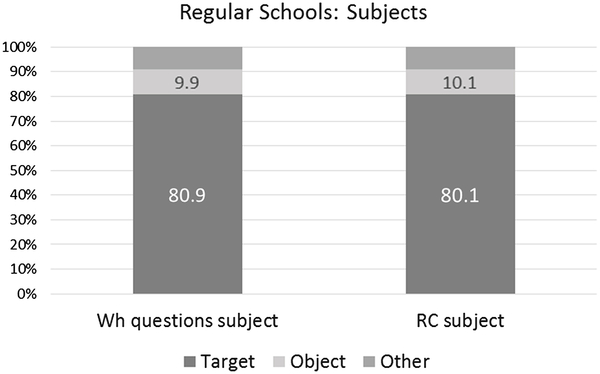
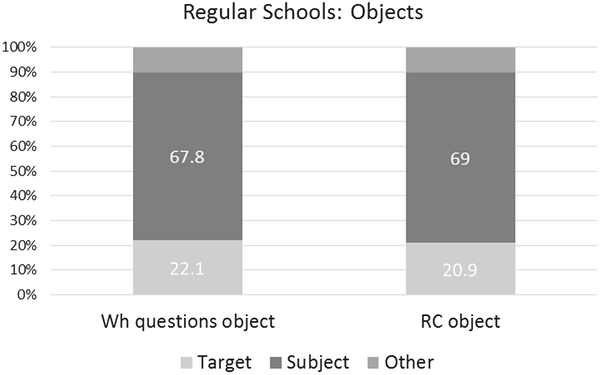
Figures 2 and 3 plot the interpretations of the sentences by condition for the students at regular schools showing the percentages of target responses, responses involving the other animal (i.e., object or subject), and other responses (i.e., the animal named in the question). As seen in both figures, subject orders receive significantly more target interpretations than object orders, which were predominantly interpreted as subject orders. This effect held equally for questions and relative clauses.
Interpretations of subject wh-questions and relative clauses: Students at regular schools (n = 147).
Interpretations of object wh-questions and relative clauses: Students at regular schools (n = 147).
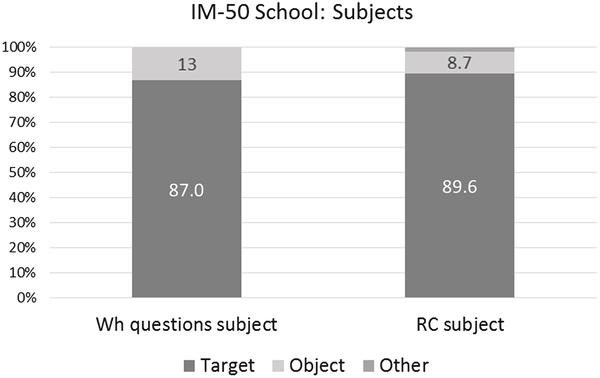
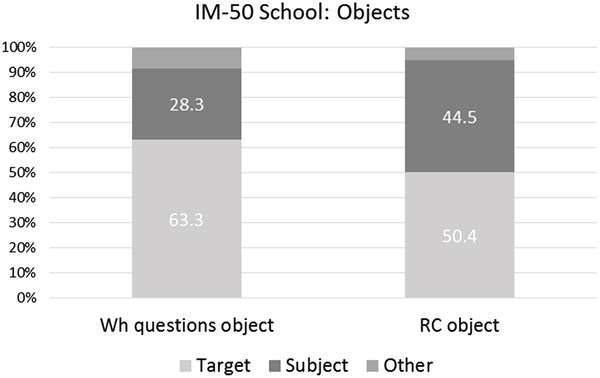
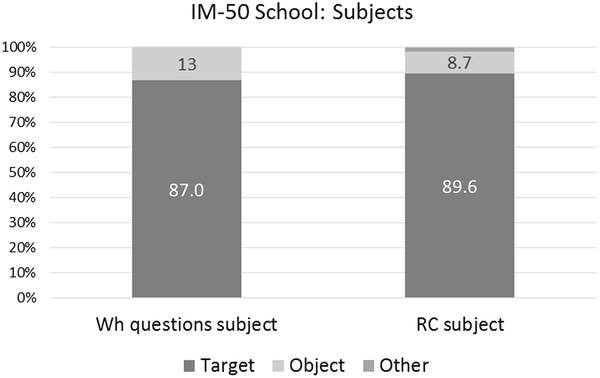
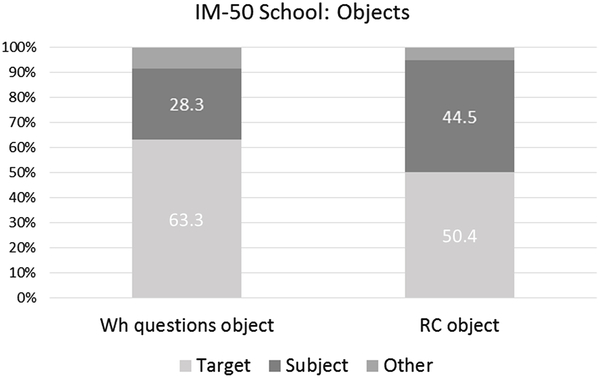
For the IM-50 school, the same random effect structure was used, and only the main effect of Order was significant (Table 5). Figures 4 and 5 show that subject questions and relative clauses received mostly target interpretations, while target interpretations were around chance level for object orders.
Interpretations of subject wh-questions and relative clauses: Students at IM-50 school (n = 23).
Interpretations of object wh-questions and relative clauses: Students at IM-50 school (n = 23).
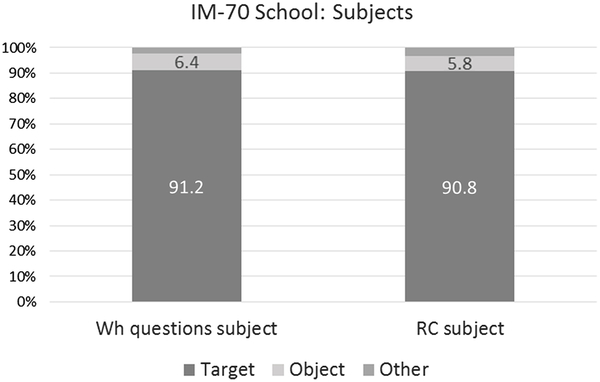
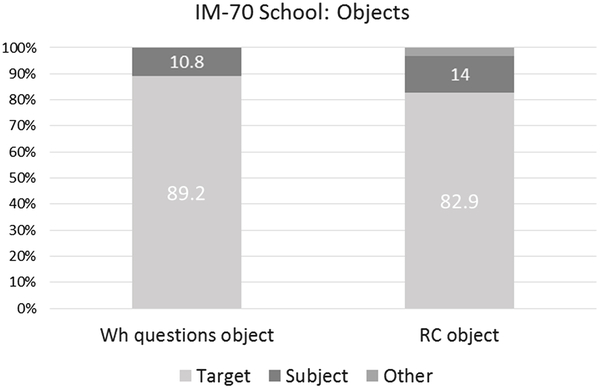
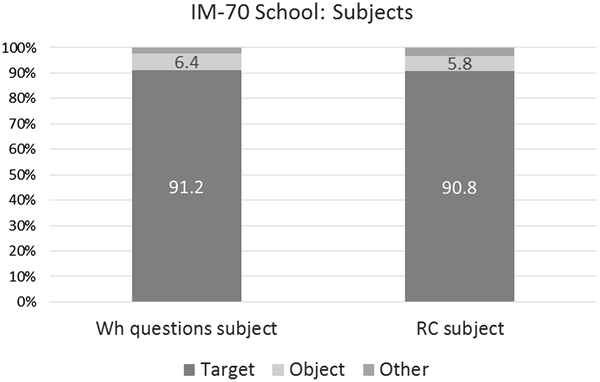
Finally, the model for the IM-70 school (Table 5) did not return any significant effects. As Figures 6 and 7 show, interpretation accuracy was high for both subject and object orders and for both wh-questions and relative clauses.
Interpretations of subject wh-questions and relative clauses: Students at IM-70 school (n = 24).
Interpretations of object wh-questions and relative clauses: Students at IM-70 school (n = 24).
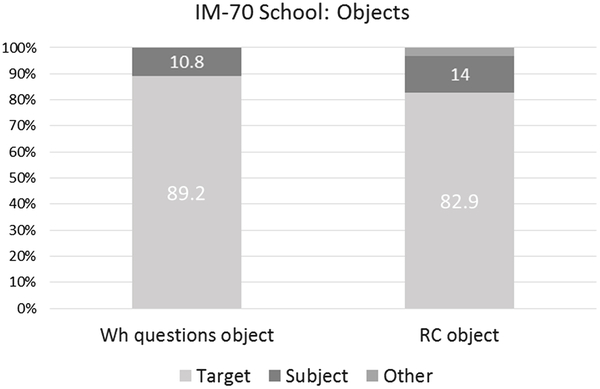
In sum, both the overall and the by-group analyses reveal that neither the students at regular schools nor the students at the IM-50 school showed differences in the proportion of correct responses between the two structures. For both questions and relative clauses, they demonstrated a clear advantage for subject over object orders, with object orders being interpreted correctly below chance among students at regular schools or at chance among students at the IM-50 school. In contrast, the students at the IM-70 school had above-chance accuracy on object orders throughout, and object orders were interpreted as well as subject orders.
Second, we turn to effects of input. The significant effects of Type of School in the overall analysis (Table 5) demonstrate that students differed in their comprehension accuracy ofwh-questions and relative clauses across schools. Overall, comprehension accuracy was highest in the IM-70 school. For the students at the IM-70 school, overall comprehension accuracy was comparable to that among 5- and 6-year-old monolingual children (Tables 2 and 3).
Moreover, there were qualitative differences in the effect structure of the monolingual children and all EFL students. The monolingual group demonstrated a significant effect of Structure (Table 4), indicating that relative clauses pose greater difficulty than wh-questions. In contrast, the EFL students showed only main effects of Order. As Figures 2 through 7 illustrate, the schools predominantly differed in the comprehension accuracy of object orders, while comprehension accuracy for subject orders was universally high. These findings indicate that differences in amount of input predominantly affect the ability to assign an object interpretation in both wh-questions and relative clauses. None of the EFL groups showed a significant effect of Structure, which suggests that object orders are difficult to comprehend, irrespective of the constructions in which they appear.
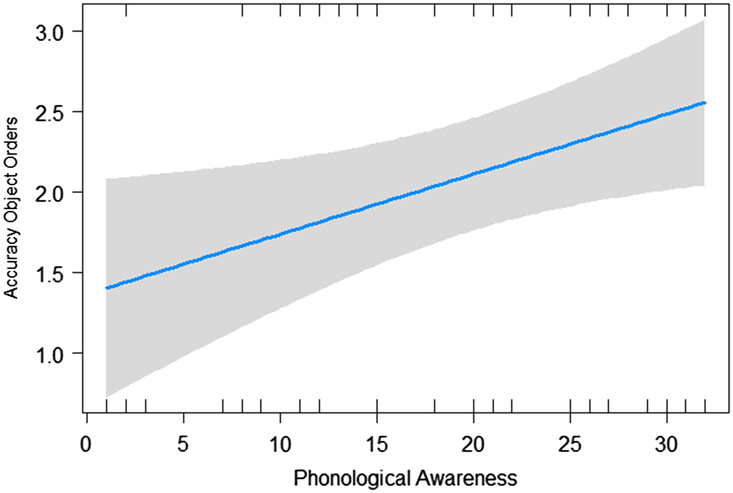
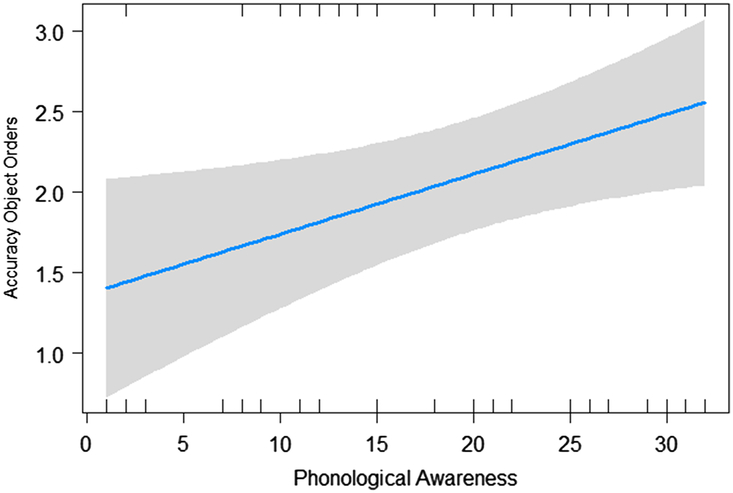
Seeing that object orders present the greatest challenge to the FL learners, we finally assess the contributions of linguistic, cognitive, social, and individual factors underlying the students’ ability to interpret object orders correctly. For this purpose, we focussed on students at regular schools, for whom a large variety of additional measures were available. We fitted mixed logistic regression models to the data with accuracy on object sentences as the dependent variable. Accuracy on object sentences ranged from 0% to 100%, so that there was substantial variability among the students. Fixed factors were age, sex, minority language, parental education, Condition (wh-questions vs. relative clauses), nonverbal IQ (CFT-R), phonological awareness, executive control (Simon Task), verbal working memory (digit span), and productive vocabulary in German and in English (fluency task; see earlier section for task descriptions). Participant and Item were added as crossed and random intercepts with condition as random slopes for each. All continuous factors were scaled and centered, and collinearity was checked. Due to missing data for some factors in some participants, we could only use 112 of the 147 participants for nested model comparisons in order to determine the optimal model. We fitted the optimal model via forward fitting starting from the null model with the intercept only by running chi-square likelihood ratio tests. The optimal model in Table 6 that provided a significantly better fit than a reduced model (χ2 = 5.8371, p = .016) contained only one significant predictor variable, namely, phonological awareness. When added as an individual predictor to the null model, parental education also improved model fit significantly, but its inclusion on top of phonological awareness did not improve the model fit any further (χ2 = 2.1068, p = .147). None of the other factors acted as a significant predictor in any model or improved model fit.
Mixed-effects logistic regression for FL students (n = 112) at regular schools.

Figure 8 plots the relation between phonological awareness and the sum of accurate object interpretations.
Relation between phonological awareness and accuracy on object orders (out of 10): Model output for students at regular schools (n = 112).
Discussion
In this study, we used a picture selection task to probe the interpretation of wh-questions and relative clauses among fourth-grade students at three different types of primary schools, namely, regular schools with two 45-minute lessons of EFL per week, partial-immersion schools with 50% of lessons held in English, and high immersion schools with 70% of lessons held in English.
For students across these schools, we first tested the extent to which L1 transfer affects the early foreign language development of complex syntax. If students made recourse to L1 German in their interpretation of English wh-questions and relative clauses, they should show an interaction of Order and Structure. Subject wh-questions and object relative clauses should be more difficult to comprehend than object questions and subject relative clauses, because the former can receive a competing parse using German syntax.
Neither overall nor in the by-group analyses did any interaction of Order and Structure emerge. Across schools, we found no evidence that the learners resort to their L1 syntax in interpreting questions and relative clauses. Instead, the groups at regular and partial-immersion (IM-50) schools demonstrated a strong and general preference for subject over object orders in both wh-questions and relative clauses, irrespective of whether these surface orders map onto a possible interpretation according to German syntax. In contrast, IM-70 school students had above-chance accuracy on subject and object orders, approximating the overall comprehension accuracy of 5- to 6-year-old monolingual children.
These patterns among early FL learners are different from those found in beginning adult FL learners (Grüter & Conradie, Reference Grüter, Conradie, Slabakova, Montrul and Prévost2006) and intermediate to advanced FL learners (Rankin, Reference Rankin2014) who show effects of L1 transfer in the interpretation of wh-questions. The lack of transfer effects in the regular school and the IM-50 students may be attributed to the effects of a blanket subject-first preference in the interpretation of wh-questions and relative clauses as in early monolingual acquisition (e.g., Roeper & de Villiers, Reference Roeper, de Villiers, Villiers and Roeper2011). As neither the regular students nor the IM-50 group showed effects of Structure, it appears that they did not differ in their interpretation accuracy between wh-questions and relative clauses; instead, they interpreted the first NP as the subject to the same extent in both types of structure. These findings are consistent with the Canonicity hypothesis (Friedmann & Novogrodsky, Reference Friedmann and Novogrodsky2004), which also guides child L1 acquisition.
It may be argued that canonicity effects or a processing strategy favoring subject-first parses may overshadow possible effects of L1 transfer that counteract subject-first interpretations in wh-questions. In this respect, the IM-70 students provide critical evidence, as they had high comprehension accuracy for both object and subject orders, that is, they had overcome a subject-first preference. All the same, this group did not show any differences between conditions indicative of L1 influence. This finding suggests that L1 transfer does not surface even at more advanced stages of child L2 acquisition.Footnote 4 With respect to the interpretation of wh-questions and relative clauses, then, the results do not align with the expectations of initial-state models of transfer (Schwartz & Sprouse, Reference Schwartz and Sprouse1996) or developmental models of transfer (Pienemann, Reference Pienemann2005; Vainikka & Young-Scholten, Reference Vainikka and Young-Scholten2011).
Second, we asked how differences in input would affect early FL development of complex syntax. Input differences were operationalized in terms of type of school. Effects of Type of School became highly significant, in particular for accuracy on object orders. Students at regular and IM-50 schools had below-chance and chance performance on object orders, respectively. This pattern held both for wh-questions, which are frequent in the classroom input and are subject to instruction in textbooks (e.g., Gerngross, Puchta, & Becker, Reference Gerngross, Puchta and Becker2014), and for relative clauses, which do not robustly occur in the input. For students at regular schools, the percentage of non-target subject answers for object orders was virtually the same as the amount of target answers for subject-initial orders. In other words, they do not use word order differences in English to establish interpretive differences. In contrast, the IM-50 group did make a difference between target interpretations of subject orders and non-target interpretations of object orders, suggesting that they develop sensitivity to word order differences in wh-questions and relative clauses. However, they failed to map object orders consistently to object interpretations. Finally, the students at the IM-70 school interpreted wh-questions and relative clauses at levels comparable to the monolingual children aged 5 and 6. Their results indicate that convergence on monolingual performance is possible within a few years of early FL learning provided learners continue to receive extensive English input. Previous studies on English L2 development suggested that the time it takes naturalistic English L2 learners to catch up with their monolingual peers ranges from 4 to 6 years (Hakuta et al., Reference Hakuta, Goto Butler and Witt2000; Paradis & Jia, Reference Paradis and Jia2016; Saunders & O’Brien, Reference Saunders, O’Brien, Genesee, Lindholm-Leary, Saunders and Christian2006). Our findings corroborate this time frame for EFL learners who have received 4 years of exposure to English in instructed high-immersion contexts (IM-70). Further, they underscore that child L2 learners need overall less time than monolingual children to acquire complex syntax (Paradis et al., Reference Paradis, Rusk, Duncan and Govindarajan2017; Tracy & Thoma, Reference Tracy, Thoma, Jordens and Dimroth2009), and they illustrate that partial immersion schooling can yield comparable gains in syntactic development as naturalistic L2 acquisition.
In a third step, we investigated the degree to which individual differences in age, gender, socioeconomic background, and linguistic and cognitive factors affect accuracy on English object orders, using the sample of students at regular schools. The regression analysis found only phonological awareness to be significantly related to students’ ability to interpret object orders correctly. In addition, parental education made an individual contribution to accuracy.
For effects of parental education, the findings resemble the results on the comprehension of passives and wh-questions among naturalistic child L2 learners of English in Chondrogianni and Marinis (Reference Chondrogianni and Marinis2011). In their study, family factors, such as socioeconomic status and proficiency in English as well as length of exposure predicted performance on English syntax as measured in the TROG. Positive effects of maternal education were also found for the comprehension of complex paragraphs among L1 Chinese L2 English learners in Paradis and Jia (Reference Paradis and Jia2016; but see Paradis et al., Reference Paradis, Rusk, Duncan and Govindarajan2017, for syntactic production).
For phonological awareness, the present study echoes results from Farnia and Geva (Reference Farnia and Geva2011), who report positive associations between phonological awareness and child L2 English vocabulary. For the present study, it may be argued that the ability measured in phonological awareness tasks to manipulate words irrespective of their meaning taps into combinatorial skills that are similar to those implicated in the revision of a subject-first preference in wh-questions and relative clauses in sentence comprehension. In both tasks, participants need to override a predominant interpretation and construct a novel structure. Further, the child L2 comprehension of non-canonical word orders has been linked to the development of cognitive control (Cristante & Schimke, Reference Cristante, Schimke, Schimke and Hopp2018). In adult monolingual and bilingual sentence processing, success in recovering from garden-paths is associated with cognitive control ability (e.g., Woodard, Pozzan, & Trueswell, Reference Woodard, Pozzan and Trueswell2016). In the present study, the Simon score for executive control did not contribute to accuracy on object orders, such that there was no direct indication that aspects of cognitive control modulate syntactic development. However, these effects may be task specific, and in light of the poor correlations between various tests of executive control (e.g., Paap & Greenberg, Reference Paap and Greenberg2013), other measures of cognitive control may have acted as significant predictors.
In other respects, though, the effect structure of individual differences differed from those found in previous studies. Partially, discrepancies likely reflect the different variables assessed across studies; yet they may also point to differences between modalities and domains. For instance, Paradis et al. (Reference Paradis, Rusk, Duncan and Govindarajan2017) found L2 vocabulary, verbal memory, and analytical reasoning to be relevant predictors in the production of complex clauses in child L2 English. For our students at regular schools, productive English vocabulary correlated significantly with receptive grammatical skills as measured in the TROG. However, such correlations did not extend to complex syntax, as even bivariate correlations between productive English vocabulary and accuracy on object orders were rather weak, r (114) = .308. Such an asymmetry between studies may point to differences between production and comprehension in that sentence planning implicates different skills than interpretation. These findings also suggest profile effects for different domains in that lexical and syntactic development are dissociable in language comprehension in early FL and L2 contexts (see also Chondrogianni & Marinis, Reference Chondrogianni and Marinis2011; Unsworth, Reference Unsworth2016a).
Needless to say, the present study has a number of limitations. First, it would have been interesting to include younger monolingual children to assess whether children younger than 5 years show similar interpretation patterns as the students at regular and IM-50 schools. Second, it would be desirable to test for a large set of individual differences also among the immersion FL students and to include early FL learners from a different L1 background to see whether the developmental patterns in early FL learning of complex syntax generalize across L1 backgrounds. Future research should also aim to test students at later points of developments (i.e. in secondary school), in order to determine whether and at which point students at regular or IM-50 schools catch up in syntactic development (Paradis & Jia, Reference Paradis and Jia2016).
In conclusion, this study systematically investigated how L1 effects, input, and individual differences affect early FL syntactic development in children with the same ages of onset and the same lengths of exposure at different schools. We found systematic differences between early and late FL acquisition and similarities between child FL and child L2 acquisition. Unlike in adult FL acquisition, early FL learners do not demonstrate L1 transfer effects in the interpretation of wh-questions and relative clauses. Moreover, sufficient input allows FL children in high immersion schools to reach monolingual levels of comprehension within 4 years, while adult FL acquisition remains non-target-like even after considerably longer exposure to these structures (Rankin, Reference Rankin2014). Hence, early FL acquisition appears different from late acquisition both in quality regarding cross-linguistic influence and in the speed of acquisition. Finally, as was also found for naturalistic child L2 learners, parental education and phonological awareness affect the acquisition of early FL syntax. Taken together, these similarities in speed and contributing factors between child FL and child L2 acquisition suggest that early FL and child L2 acquisition proceed along comparable lines.
Acknowledgments
We would like to thank Tom Rankin for allowing us to use pictures from his previous studies, and we thank Teresa Kieseier, Lea Pöschik, and our research assistants for help with data collection. We are indebted to Anke Lenzing, the audience at EUROSLA 28 in Münster, and four anonymous reviewers for helpful comments. Part of the research was funded by the German Federal Ministry for Education and Research (BMBF) as part of the research initiative “Sprachliche Bildung und Mehrsprachigkeit” (FKZ 01JM1401; 2014–2017).
APPENDIX A
Mixed-effects logistic regression for all monolingual German-speaking FL students (n = 105) and by type of school.