Although the role of the native language has been controversial in the history of SLA, every theory of SLA must include an explanatory account of transfer. Current generative theories of SLA are explicit with respect to the role of the first language (L1) at the initial state (Epstein, Flynn, & Martohardjono, Reference Epstein, Flynn and Martohardjono1996; Hawkins, Reference Hawkins2001; Schwartz & Sprouse, Reference Schwartz and Sprouse1996), but there is still little understanding of how transfer influences subsequent development and ultimate attainment (Carroll, Reference Carroll2001; Gregg, Reference Gregg, Ritchie and Bhatia1996; Hawkins; Klein & Martohardjono, Reference Klein, Martohardjono, Klein and Martohardjono1999; Whong-Barr, Reference Whong-Barr, Unsworth, Parodi, Sorace and Young-Scholten2006). For example, many second language (L2) studies have argued in support of the full transfer/full access theory (Schwartz & Sprouse; see also White, Reference White2003), which proposes that the entire L1 grammar defines the initial state of SLA. According to this model, the learner’s hypotheses are constrained by Universal Grammar, and acquisition is conceptualized as a process of grammar restructuring, driven by input or positive evidence. Restructuring is failure driven: The grammar is only restructured if the input cannot be processed given the learner’s current grammar (Klein & Martohardjono; White). However, as White pointed out, it is difficult to reconcile why some effects of transfer are easily overcome, whereas others remain evident even at advanced levels of proficiency. A better understanding of the circumstances in which restructuring will and will not occur is thus needed. The present study considers this question in the domain of aspectual semantics, an area in which the effects of restructuring have not yet been investigated.
There is evidence that restructuring is particularly difficult when learners need to unlearn certain aspects of their L1 in the absence of explicit input that indicates which properties of the L1 are ruled out by the L2. Several studies have shown that learners can show evidence of a L2 parameter setting while continuing to allow the L1 option, in some cases even at advanced proficiency levels (Robertson & Sorace, 1999; Westergaard, Reference Westergaard2003; see also Truscott, Reference Truscott2006). This will be referred to as a problem with the preemption of a L1 option (Trahey & White, Reference Trahey and White1993). In a series of studies on the verb-raising parameter (i.e., a parameter that distinguishes between languages with a strong inflection feature [e.g., French] and languages with a weak inflection feature [e.g., English] and that has consequences for verb placement), White (Reference White1991a, Reference White1991b) demonstrated that French learners of English successfully identified strings such as John always kisses Mary as grammatical although this word order is not permissible in French. Nevertheless, these learners also allowed ungrammatical strings such as *John kisses always Mary, which are permissible only in the L1. These findings, in addition to the results of several subsequent studies in the domains of L2 argument structure and syntax (e.g., Inagaki, Reference Inagaki2001; Juffs, Reference Juffs1996; Mazurkewich, Reference Mazurkewich, Eckman, Nelson and Bell1984; Sorace, Reference Sorace1993; Trahey & White; White, Reference White1987), suggest that it cannot be assumed that positive evidence for a target form in the L2 is also to be understood as implicit negative evidence for the options available in the L1.
Despite this evidence, which suggests that the preemption of L1 options is problematic, successful cases of unlearning have, nevertheless, been observed (Slabakova, Reference Slabakova2002a, Reference Slabakova2006; Yuan, Reference Yuan2001, Reference Yuan2004). Yuan examined both French- and English-speaking learners of Chinese with respect to the verb-raising parameter. Chinese is similar to English—and unlike French—in prohibiting verb-raising in that the word order subject-verb-adverb-object (e.g., *John kisses always Mary) is ruled out. In contrast to the learners in White’s studies (Trahey & White, Reference Trahey and White1993; White, Reference White1991a, Reference White1991b), the French learners of Chinese showed targetlike performance after only 6 months of Chinese instruction.
Slabakova (Reference Slabakova2006) investigated English native speakers’ (NSs’) acquisition of the bare noun–proper name parameter in L2 Italian and also provided evidence of successful preemption. This parameter, proposed by Longobardi (Reference Longobardi2001), provides a unified account for a syntactic word order contrast relevant to proper names and a semantic contrast relevant to bare nouns. The syntactic component of this parameter determines the word order of adjectives that modify proper names—for example, in English, the adjective precedes the proper name (e.g., Ancient Rome), whereas in Italian, the adjective follows the proper name (e.g., Roma antica “ancient Rome”). The semantic component of this parameter accounts for the interpretation of bare plural noun phrases (NPs) in subject position—for example, in English, bare plural NPs such as white elephants allow both a generic (i.e., the species of white elephants) and an existential (i.e., some white elephants) reading, whereas in Italian, only the existential reading is allowed.Footnote 1 The task of the English-speaking learner of Italian is to rule out the generic interpretation. Results indicate that learners are successful with both the syntactic and semantic components of this parameter. Slabakova argued that learners are able to acquire this semantic contrast and to rule out the L1 interpretation on the basis of positive evidence for the syntactic component of the parameter.
The question that remains is what separates the cases of successful acquisition and preemption from the cases of persistent L1 influence. The study by Slabakova (Reference Slabakova2006) was the first to address this issue in the domain of semantics but argued ultimately that the learners’ success was tied to a syntactic property. The present study continues this line of investigation through the examination of the acquisition of a semantic property in the domain of aspect. Specifically, the acquisition of the present progressive in L2 English and of the imperfective marker te-iru in L2 Japanese is examined. The task of the learners of both L2 English and L2 Japanese is similar: Learners must acquire the semantic representation for the target form in the L2 and preempt the L1 semantic representation. Nevertheless, the results show that the L2 Japanese learners are generally more successful than the L2 English learners, particularly with respect to preemption. It is proposed that two factors play a significant role in determining whether preemption remains a problem: (a) the complexity of the semantic computation and (b) the transparency of the input cues available to the learner.
THE INTERACTION BETWEEN LEXICAL AND GRAMMATICAL ASPECT
Tense places an event on a time line, relevant to the time of speech (Reichenbach, Reference Reichenbach1947). Aspect, on the other hand, expresses how an event unfolds in time, focusing on the internal properties of an event, such as whether an event is ongoing or whether an event has already been completed (Comrie, Reference Comrie1976; Smith, 1991/Reference Smith1997). Aspectual interpretation is compositional and is determined by various grammatical sources in a sentence, including lexical aspect, grammatical aspect, and temporal adverbials. Lexical aspect usually refers to the four-way classification system proposed by Vendler (Reference Vendler and Vendler1967) and Dowty (Reference Dowty1979), which distinguishes statives (e.g., know), activities (e.g., run), accomplishments (e.g., run a mile), and achievements (e.g., die). Lexical aspect is not a property of verbs per se but rather is determined compositionally by properties of the verb in conjunction with the verb’s arguments and adjuncts (Smith; Verkuyl, Reference Verkuyl1972). Grammatical aspect, in many languages, is encoded by inflectional morphology, such as the progressive be –ing in English. Here, the focus is on the interaction between accomplishments and achievements and the grammatical morphemes that encode the progressive in English and Japanese.
Central to how Vendler (Reference Vendler and Vendler1967) and Dowty (Reference Dowty1979) distinguished the lexical aspectual classes is the compatibility of a verb phrase (VP) with the progressive. As illustrated in (1), activities and accomplishments occur naturally in the progressive, whereas statives and achievements generally do not.
(1) a. Stative
*Sophia is knowing French.
b. Activity
Sophia is running.
c. Accomplishment
Sophia is running a mile.
d. Achievement
*Sophia is recognizing her friend.
According to Dowty, this pattern is the result of the lexical semantic representation of these verb classes. Traditional accounts of the progressive in English require that the VP, under the scope of the progressive, entails a process (Dowty; Landman, Reference Landman1992). The lexical semantics of activities and accomplishments meets this requirement; therefore, these VPs are compatible with the progressive. In contrast, statives and achievements do not entail processes: Statives are not dynamic and therefore do not progress, whereas achievements consist only of a change of state and are said to happen instantaneously.
Many exceptions to this pattern have, nonetheless, been documented (Dowty, Reference Dowty1979; Rothstein, Reference Rothstein2004; Smith, 1991/Reference Smith1997; Verkuyl, Reference Verkuyl1989). Achievements such as arrive are quite natural in the progressive. Although the details vary, several proposals (Michaelis, Reference Michaelis, Aarts and MacMahon2006; Moens & Steedman, Reference Moens and Steedman1988; Rothstein) have argued that achievements need to undergo a type-shifting or coercion operation in order to be compatible with the semantics of the progressive. According to Rothstein, for an achievement to be acceptable in the progressive, it must first be converted to an (abstract) accomplishment; that is, the type-shifting operation adds a process component to the achievement, which allows the progressive to focus on the point in the event just before culmination. Similarly, certain statives may also be used in the progressive (e.g., John is being a jerk). De Swart (1998) proposed that stative progressives are also the result of coercion: The state is converted into an activity or process in order to resolve the mismatch with the progressive. For both de Swart and Rothstein, constraints on coercion rely on pragmatics; that is, not all achievements can be coerced to combine with the progressive. For de Swart, whether a verb can be coerced depends on both the context and world knowledge—for example, arrive is compatible with the progressive because there are preparatory stages of arrival that can easily be identified as events leading up to the point of culmination. For a verb such as notice, however, it is much more difficult to identify what those preparatory stages could involve (Rothstein).
On the other hand, in Japanese, the interpretation of the grammatical form that denotes the progressive, te-iru, differs depending on the lexical aspect of the VP.Footnote 2 With activities and accomplishments, as illustrated in (2) and (3), the preferred reading is progressive (Jacobsen, Reference Jacobsen1992; Kindaichi, Reference Kindaichi1950; Ogihara, Reference Ogihara1998),Footnote 3 but with achievements, the imperfective marker te-iru always denotes a resultative interpretation. A progressive reading is thus ruled out, as shown in (4), and coercion is not possible. The sentence in (4) literally means The plane has arrived and crucially cannot mean The plane is arriving at the airport.Footnote 4
(2) Activity
Taroo-ga hashitte-iru.
Taroo-nom run te-iru present
“Taroo is running.”
(3) Accomplishment
Taroo-ga hon-o yonde-iru
Taroo-nom book-acc read te-iru present
“Taroo is reading a book.”
(4) Achievement
Hikoki-ga kuko-ni tuite-iru.
plane-nom airport at arrive te-iru present
“The plane (arrived and) is at the airport.” (Hirakawa, Reference Hirakawa2001, p. 226)
The present study focuses on the differences in the interaction between achievements and the aspectual morphemes in English and Japanese: With the imperfective marker te-iru, achievements encode a resultative reading, which indicates that the event has already been completed, whereas with the progressive be –ing, achievements encode a progressive reading, which indicates that the event is about to happen.
Although details vary, in almost all formal semantic accounts (Dowty, Reference Dowty1979; Landman, Reference Landman1992; Verkuyl, Reference Verkuyl1993), the progressive is treated as an aspectual operator (PROG). Researchers have proposed truth conditions for the PROG operator that can account for its interaction with specific VPs (e.g., de Swart, Reference de Swart1998; Dowty; Landman; Parsons, Reference Parsons1990; Verkuyl). Expanding on previous work in English (e.g., Dowty; Landman; Verkuyl), McClure (Reference McClure1995) proposed a crosslinguistic account in which the difference in the behavior of the progressive be –ing in English and the imperfective marker te-iru in Japanese was argued to lie in the semantics of the aspectual operator PROG.Footnote 5 McClure proposed one set of truth conditions for the progressive be –ing and a separate, but related, set for the imperfective marker te-iru. The differences between the truth conditions for the two forms are responsible for the differing interactions with the aspectual classes—achievements in particular.
McClure adopted, with some modification, Dowty’s analysis of the aspectual classes: Accomplishments entail both a process and a change of state, whereas achievements entail only a change of state. Informally, the truth conditions for the progressive be –ing in English specify that a VP in the progressive is true during an interval when the event under the scope of the progressive has begun but has not yet been completed during that same interval. In English, both accomplishments and achievements plus the progressive be –ing will thus be interpreted as events in progress. It is important to note that McClure did not discuss achievements in the progressive as instances of coercion, as does, for example, Rothstein (Reference Rothstein2004).
In contrast, the semantics for the imperfective marker te-iru require that at least one event entailed by the VP has been realized before the specified interval of time, which, for the present tense, is the time at which the sentence is uttered. Accomplishments entail both a process and a change of state. The truth conditions for the imperfective marker te-iru are satisfied even if only the process has been realized; thus, the resulting reading is progressive.Footnote 6 In contrast, achievements entail only a change of state. Therefore, the truth conditions for the imperfective marker te-iru can only be satisfied when the change of state has been realized before the sentence has been uttered. Thus, achievements with the imperfective marker te-iru in Japanese will always be interpreted as resultative.
GOALS OF THE L2 LEARNER AND HYPOTHESES
Under McClure’s (Reference McClure1995) analysis, the task of the learner is to acquire the truth conditions for the aspectual operators that underlie the progressive be –ing and the imperfective marker te-iru. In accordance with full transfer/full access (Schwartz & Sprouse, Reference Schwartz and Sprouse1996), it is assumed that the learner’s initial hypothesis is that the truth conditions for the aspectual operator in the L2 will match those of the L1. Difficulty with accomplishments was not predicted for either the L2 English or the L2 Japanese learners because these learners should be able to rely on the truth conditions of their L1 to successfully interpret the L2 form.
With respect to achievements, the learner has two different goals. First, the learner must acquire the truth conditions for the aspectual operator in the L2. The truth conditions for the progressive be –ing are only satisfied in contexts in which the end point of the event has not been reached. The opposite is true for Japanese. If the learner maps the truth conditions for the L1 aspectual operator onto the L2 operator, achievements will be interpreted incorrectly: Japanese learners of English will interpret an achievement with the progressive be –ing as resultative, and English-speaking learners of Japanese will interpret an achievement with the imperfective marker te-iru as progressive. This will be referred to as the addition task because the learner must acquire a new semantic representation; it is predicted that its acquisition can be facilitated by positive evidence. Second, both groups of learners also need to preempt the L1 semantic representation and rule out the readings available in the L1; that is, Japanese learners of English need to rule out a resultative interpretation for achievements with the progressive be –ing, whereas the English-speaking learners of Japanese need to rule out a progressive interpretation for achievements with the imperfective marker te-iru.
The present study was designed to examine the acquisition of the truth conditions for the aspectual operator in the L2 as well as the preemption of the semantic representation in the L1 in order to evaluate whether the ability to overcome L1 influence depends on the type of evidence available to the learner. Based on the results of earlier studies in the domain of syntax (e.g., Trahey & White, Reference Trahey and White1993), it is predicted that the acquisition of a new semantic representation is easier than the preemption of the existing L1 representation. The addition task can be facilitated by positive evidence, whereas the preemption task should be more difficult, given that there is usually no input that addresses what interpretations are not possible in the L2. These issues are investigated with respect to both development and ultimate attainment through an examination of learners at a range of proficiency levels, including a group of highly advanced learners of L2 English. Given its bidirectional design, this study examines whether the ability to overcome L1 influence is affected by the nature of the target form in the L2 or whether the learning task is similar from English to Japanese and from Japanese to English.
SLA OF ASPECT
A large body of research has investigated the aspect hypothesis (AH), which proposes that learners follow a universal path of development in the acquisition of aspectual morphology (see Bardovi-Harlig, Reference Bardovi-Harlig2000, Li & Shirai, Reference Li and Shirai2000, and Slabakova, Reference Slabakova2001, for reviews). Specifically, proponents of the AH argue that lexical aspectual classes guide early language learners in their acquisition of tense-aspect markers. For example, in English, learners first use progressive morphology with activities and use past morphology with telic VPs such as accomplishments and achievements. Several studies have reported the predicted association between progressive marking and activities in oral production data (Robison, Reference Robison1995), in cloze passages (Bardovi-Harlig & Reynolds, Reference Bardovi-Harlig and Reynolds1995), and in oral and written narratives (Bardovi-Harlig, Reference Bardovi-Harlig1998). Bardovi-Harlig’s (Reference Bardovi-Harlig1998) results show very little use of the progressive with either accomplishments or achievements. However, several issues still remain. First, due in part to a reliance on production data, L2 research has not extended beyond the initial association between activities and the progressive: It is unclear how learners would perform with accomplishments or achievements in the progressive if tested on comprehension or interpretation tasks. Second, as discussed by Salaberry and Shirai (Reference Salaberry, Shirai, Salaberry and Shirai2002) and Slabakova (Reference Slabakova2002b), the properties of the L1 and L2 have not been systematically compared, although it is likely that transfer plays an important role. For example, Rocca (Reference Rocca, Salaberry and Shirai2002) showed that Italian learners of English overextended the use of the progressive to stative verbs, a finding that Rocca attributed to the fact that the imperfective marker in Italian is compatible with statives (see also Collins, Reference Collins2004).
In Japanese much of the research has focused on the imperfective marker te-iru. Although this form allows both progressive and resultative interpretations, the AH predicts that learners will acquire the progressive interpretation first and associate the imperfective marker te-iru strongly with activities—a pattern that has been observed among learners of various L1 backgrounds (Shirai & Kurono, Reference Shirai and Kurono1998). The resultative interpretation has generally been shown to be more difficult for learners (cf. Ishida, Reference Ishida2004). Despite these results, which suggest a universal pattern of development, recent studies (e.g., Nishi & Shirai, Reference Nishi, Shirai, Matsumoto, Oshima, Robinson and Sells2007; Sugaya & Shirai, Reference Sugaya and Shirai2007) have shown that the properties of the native language may play a role as well. Sugaya and Shirai investigated the acquisition of the imperfective marker te-iru by NSs of English, German, and Slavic languages. Unlike English, German and the Slavic languages do not have overt progressive morphology. Specifically, Sugaya and Shirai questioned whether the predicted association between the imperfective marker te-iru and the progressive interpretation would emerge even for learners whose L1 does not have a progressive form. The results of an acceptability judgment task showed the predicted association for low-proficiency learners in both L1 groups, thus supporting the AH. However, on an oral picture description task, these low-proficiency learners performed equally well with both the progressive and resultative uses of the imperfective marker te-iru. These results suggest that the relative difficulty with the resultative interpretation may be influenced by both properties of the native language and task type.
Nishi and Shirai’s (Reference Nishi, Shirai, Matsumoto, Oshima, Robinson and Sells2007) study suggests that crosslinguistic differences at the level of lexical aspect might contribute to the difficulty with the resultative interpretation. Their study compared performance on verbs that differ at the level of lexical aspect in English and Japanese, such as know—which is a stative verb in English, but its translational equivalent in Japanese siru is an achievement—with performance on verbs that are achievements in both languages. Beginning learners had considerably more difficulty with verbs such as know, which suggests that L1-L2 differences also play a significant role at the level of lexical aspect.
Although the results of Sugaya and Shirai (Reference Sugaya and Shirai2007) and Nishi and Shirai (Reference Nishi, Shirai, Matsumoto, Oshima, Robinson and Sells2007) suggest a role for L1 transfer, they do not explicitly address preemption. However, other studies (e.g., Hirakawa, Reference Hirakawa2001; Shibata, Reference Shibata1999) that examined the acquisition of the imperfective marker te-iru have implicitly shown that the preemption of L1 options presents a challenge. Shibata (Reference Shibata1999) found that English-speaking learners of Japanese actually used the imperfective marker te-iru more with achievements on a picture description task. Some of these achievements were used incorrectly to encode a progressive interpretation. Similarly, in a study that used the imperfective marker te-iru as a diagnostic of unaccusativity, Hirakawa found that several learners had difficulty assigning a resultative interpretation to achievements with the imperfective marker te-iru, particularly with the Japanese equivalents of burn, fall, and arrive. In other words, these learners incorrectly assigned these verbs a progressive interpretation, likely due to transfer from English. The present study aims to target this type of error in more detail.
Transfer has also been directly investigated in a body of recent work that has specifically examined learners’ interpretations of aspectual forms (Gabriele, Martohardjono, & McClure, Reference Gabriele, Martohardjono and McClure2003; Montrul & Slabakova, Reference Montrul, Slabakova, Péréz-Lerouz and Liceras2002, Reference Montrul and Slabakova2003; Slabakova, Reference Slabakova2003). In a series of studies, Montrul and Slabakova (Reference Montrul, Slabakova, Péréz-Lerouz and Liceras2002, Reference Montrul and Slabakova2003) investigated the acquisition of the preterite-imperfect contrast in English-speaking learners of Spanish. In spite of the general success of these learners, one context remained difficult even for advanced learners, despite aspectual similarities in the L1 and the L2: Learners had difficulty with achievements such as sell in the Spanish imperfect. According to de Swart (Reference de Swart1998), achievements in the imperfect induce coercion because there is a clash between the semantics of the achievements and the unbounded imperfect. The coercion operator shifts the achievement from a telic event to an atelic process to repair the aspectual mismatch. Montrul and Slabakova (Reference Montrul, Slabakova, Péréz-Lerouz and Liceras2002, Reference Montrul and Slabakova2003) argued that coercion may be difficult, even if the process is available in the L1, because coercion requires recourse to pragmatics and, thus, lies outside the realm of Universal Grammar.
In sum, previous studies (Bardovi-Harlig, Reference Bardovi-Harlig1998; Robison, Reference Robison1995; Shirai & Kurono, Reference Shirai and Kurono1998; Sugaya & Shirai, Reference Sugaya and Shirai2007) have shown that the forms focused on here are difficult to acquire. In L2 English, learners rarely use the progressive with accomplishments and achievements. However, the source of this difficulty has not been fully investigated, taking properties of the L1 into account and probing learners’ interpretations of these forms. In L2 Japanese, several studies (e.g., Shirai & Kurono; Sugaya & Shirai) have shown that the resultative interpretation of the imperfective marker te-iru is more difficult than the progressive interpretation. Nevertheless, these studies have not addressed whether L2 learners transfer the semantic representation of the progressive from the L1. The present study considers not only whether the semantics of the progressive be –ing and the imperfective marker te-iru can eventually be acquired (i.e., addition) but also whether L1 interpretations can also be ruled out (i.e., preemption), thus contributing to our understanding of the transfer of aspectual semantics through the evaluation of whether the ability to overcome L1 influence depends on the type of evidence available to the learner.
LEARNERS OF L2 ENGLISH
Participants
The main participant group consisted of 101 Japanese NSs (mean age = 20, SD = 1.5) who were initially exposed to English at the ages of 12–13 years and who, at the time of testing, were studying at universities in Japan. The University of Michigan English Language Institute Listening Comprehension Test was used as a proficiency measure. Raw scores on this 45-question test ranged from 19 to 42 (M = 29, SD = 5.47). Test scores were used to divide learners into three levels: low proficiency (score of 19–28, n = 46), intermediate proficiency (score of 29–35, n = 39), and high proficiency (score of 36–45, n = 16). All students were studying English in classes taught by English NSs who generally did not use Japanese in the classroom.
A second group consisted of nine Japanese NSs who were living in New York City. Their average length of residence in New York was 7 years. To be included in the analyses, participants had to score at least 40 (of 45) on the University of Michigan English Language Institute Listening Comprehension Test and also be evaluated as near native in an interview. Near-native candidates were asked to answer three interview questions and their answers were tape-recorded. Both the interview questions and the scoring guidelines were based on the University of Cambridge Certificate of Proficiency in English exam. Two English NS judges individually scored each interview on a scale of 1 to 5 in four areas: grammatical resource, lexical resource, discourse management, and global achievement. The judges’ scores were then averaged to produce one composite score for each participant. The 9 participants (of 13) who were selected received composite scores of 4 or above. Finally, 23 English NSs made up the control group.
Story Compatibility Task
An interpretation task was designed to tap learners’ interpretations of aspectual morphology in English. The story compatibility task presented learners with stories that depicted events that were either complete or incomplete (i.e., ongoing). These short stories, narrated in English, were illustrated with two pictures presented in a PowerPoint presentation. The narration of the story (one or two sentences per picture) was digitally recorded and incorporated into the presentation. Following each story, a test sentence appeared on the projection screen for 10 s; this sentence was also played over a speaker. Participants were asked to judge the test sentence on a scale of 1 to 5 and to evaluate whether the sentence was compatible with the story. All of the numbers on the scale were defined qualitatively; for example, 1 corresponded to the statement I definitely cannot say this sentence in the context of the story, 3 corresponded to I might be able to say this sentence in the context of the story, and 5 corresponded to I definitely can say this sentence in the context of the story. Learners were told to leave blank any questions for which they were not sure of the answer.
The story compatibility task targeted the interpretation of accomplishments and achievements with simple past, present progressive, and past progressive morphology. Sentences that targeted the simple past were included as a control. The forms that mark the past, –ed in English and –ta in Japanese, encode basically equivalent semantics regardless of the VP (Ogihara, Reference Ogihara1998). Results for the past progressive will not be discussed here (see Gabriele, Reference Gabriele2005). The story narrations were presented in the simple present so that the narrations did not use any of the aspectual forms targeted in the test sentences.
Eight accomplishments and eight achievements were tested. The VPs that were selected have the same lexical aspectual classification in both languages. For the accomplishments, it was necessary that the verbs encode an ongoing, action-in-progress interpretation with the English progressive be –ing and that the Japanese equivalent of those verbs also encode a progressive interpretation with the Japanese imperfective marker te-iru.Footnote 7 For the achievements, it was necessary that the verbs selected denote a progressive interpretation with the progressive be –ing but that the Japanese equivalents of those verbs unambiguously denote a resultative interpretation with the imperfective marker te-iru.Footnote 8 The English verbs are listed in (5).
(5) Accomplishments: make a cake, build a sandcastle, drink a glass of coke, eat a bowl of ramen, write a book, paint a portrait, read a pile of books, wash a pile of dishes
Achievements: arrive, die, come, return, open intransitive, close intransitive, leave, go (to the store)
For each verb, a complete story context as well as an incomplete (i.e., ongoing) story context were developed. The goal was to elicit learners’ judgments as to the compatibility of sentences in the simple past and present progressive with stories in each context. Filler sentences were also included to test whether the learners understood the aspectual theme of the stories (i.e., event in progress or event completed). Each participant heard 32 test stories (16 verbs each in a complete and an incomplete context) only once and provided a judgment on only one test sentence per story.Footnote 9 For example, if a participant judged a simple past sentence such as The plane arrived at the airport with the complete story context, then that same participant would judge a different sentence type (e.g., present progressive, past progressive, or filler) with the incomplete version of the story. Thus, each participant responded to only half of the target test categories. Roughly equal numbers of participants from each proficiency level were randomly assigned to one of two groups.Footnote 10 Items were counterbalanced across four lists, which were randomized and controlled for ordering effects.
The stories and test sentences for the accomplishment VP paint a portrait are presented in (6).Footnote 11 In (6a), with the complete context, English NSs were predicted to accept the simple past sentence (with a score of 4 or 5) but to reject the present progressive sentence (with a score of 1 or 2). Predicted ratings of the NSs and learners are provided following each test sentence. No difficulty was predicted for the L2 learners with accomplishments in the progressive or with the simple past in general. The reverse judgments are predicted for the incomplete context in (6b), in which the simple past should be rejected and the present progressive should be accepted.
(6) Paint a portrait (accomplishment)
Picture 1: Ken is an artist. At 12:00 he begins to paint a portrait of his family.
a. Complete story context
Picture 2a: At 8:00 he gives the portrait to his mother for her birthday.
i. Past: Ken painted a portrait of his family.
(Expected rating of NSs: 5; L2 English learners: 5)
ii. Present progressive: Ken is painting a portrait of his family.
(Expected rating of NSs: 1; L2 English learners: 1)
b. Incomplete story context
Picture 2b: At 12:30 he paints his mother and father.
i. Past: Ken painted a portrait of his family.
(Expected rating of NSs: 1; L2 English learners: 1)
ii. Present progressive: Ken is painting a portrait of his family.
(Expected rating of NSs: 5; L2 English learners: 5)
The paradigm for the achievement verb arrive is presented in (7). The predicted judgments for the English NSs with achievements are the same as the judgments predicted for the accomplishments: The simple past should be accepted with the complete story context and rejected with the incomplete story context. The progressive, in contrast, should be accepted with the incomplete story context and rejected with the complete story context. The predictions for the progressive differ for the learners. If the learners map the truth conditions for the imperfective marker te-iru onto the progressive be –ing, they are expected to interpret the present progressive sentence The plane is arriving at the airport incorrectly to mean The plane has arrived at the airport. This is the preemption context, and it is predicted that even learners at advanced levels of proficiency may have difficulty with this condition. Furthermore, if learners incorrectly interpret The plane is arriving at the airport to mean The plane has arrived at the airport, they will incorrectly reject the present progressive with the incomplete context, as is illustrated in (7b). This is the addition context, and it is predicted that learners will have less difficulty overcoming transfer here due to the availability of positive evidence.
(7) Arrive (achievement)
Picture 1: This is the plane to Tokyo. At 4:00 the plane is near the airport.
a. Complete story context (preemption)
Picture 2a: At 5:00 the passengers are at the airport.
i. Past: The plane arrived at the airport.
(Expected rating of NSs: 5; L2 English learners: 5)
ii. Present progressive: The plane is arriving at the airport.
(Expected rating of NSs: 1; L2 English learners: 5)
b. Incomplete story context (addition)
Picture 2b: There is a lot of wind. At 4:30 the plane is still in the air.
i. Past: The plane arrived at the airport.
(Expected rating of NSs: 1; L2 English learners: 1)
ii. Present progressive: The plane is arriving at the airport.
(Expected rating of NSs: 5; L2 English learners: 1)
Finally, 16 distracter stories were included to balance the number of items expected to be acceptable and unacceptable.
A week before testing, participants were provided with a comprehensive Japanese-English word list that defined the words and phrases that would be included in the stories. On the day of testing, a brief vocabulary quiz was given to review any potentially difficult items. Participants were tested in small groups. The proficiency test and interpretation task took about 1 h total to complete. All participants were compensated for their time.
Results
Analyses. The main goal of the analyses was to determine if the responses to a given sentence type (e.g., simple past accomplishment) differed depending on the context provided (i.e., complete or incomplete). Because each participant did not respond to all sentence types in both the complete and incomplete contexts, factorial univariate ANOVAs were performed separately for each sentence type with context (i.e., complete vs. incomplete) and proficiency level (i.e., low, intermediate, high, near-native, and NS) as between-subjects factors.
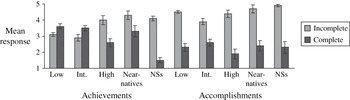
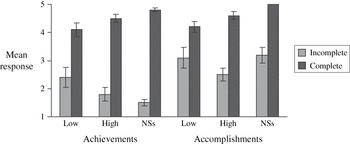
Present Progressive. Results for the present progressive are presented in Figure 1.Footnote 12 Recall that for achievements (e.g., The plane is arriving at the airport), the incomplete story represents the addition context and the complete story represents the preemption context.
L2 English present progressive: Mean responses to achievements and accomplishments. Int. = intermediate.

The results of the ANOVA for the achievements revealed a significant effect for context, F(1, 123) = 28.606, p < .001, a significant effect for proficiency level, F(1, 123) = 3.816, p < .01, and a significant interaction between context and proficiency level, F(4, 123) = 26.098, p < .001. NSs behaved as predicted, assigning high scores on the incomplete context (i.e., plane still in the air) and low scores on the complete context (i.e., plane has landed).
The results for the low- and intermediate-proficiency groups generally followed the pattern predicted by transfer: These learners assigned higher scores to the present progressive with the complete context as opposed to the incomplete context—the opposite of the NSs. The interaction was further examined with a series of t tests for each proficiency level. The t tests confirmed that both the low- and intermediate-proficiency groups assigned significantly higher scores to the present progressive with complete contexts (low: t(44) = 2.723, p < .01; intermediate: t(37) = 2.212, p < .05). The results for the advanced groups are somewhat more complicated. Similar to the NSs, the learners in the high-proficiency group distinguished between the incomplete and complete contexts; they correctly assigned higher scores to the present progressive with the incomplete contexts (high: t(14) = –3.859, p < .01; NS: t(21) = –12.203, p < .001). However, the near-native speakers did not make this distinction. Although their scores were numerically higher on the incomplete context, the t test revealed that the difference between the near-native speakers’ responses in the two contexts was not significant. However, it is possible that the low number of near-native speakers is responsible for this result.
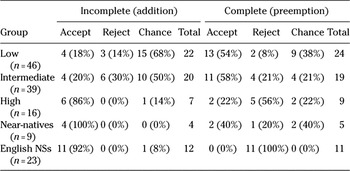
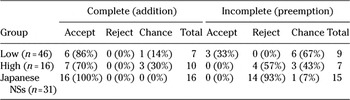
The acceptance and rejection rates for achievement verbs are presented in Table 1. Participants are categorized according to whether they accepted at least 75% of the items (i.e., three of the four items) with a score of 4 or 5, rejected at least 75% of the items with a score of 1 or 2, or performed at chance. Recall that each participant responded to a given sentence type with only one context: complete or incomplete.
Achievements in the present progressive by group

For the incomplete (i.e., addition) context, it was predicted—on the basis of transfer—that the learners at lower levels of proficiency would assign low scores to the present progressive. This is generally the pattern observed. However, the results are also consistent with the prediction that transfer can be overcome at higher proficiency levels, because nearly all of the participants at the advanced proficiency levels correctly accepted 75% of the present progressive sentences with the incomplete context, similar to the NSs.
Although there is evidence of difficulty in the low- and intermediate-proficiency groups, it is not clear whether this difficulty was caused by transfer. Many learners performed at chance, and performance on this context appeared to depend on the particular verb. Thus the overall mean response for each verb was calculated: Learners performed most accurately with the verbs go (M = 4.8), leave (M = 4.4), die (M = 3.7), and close (M = 3.3) but demonstrated difficulty with the verbs return (M = 2.8), come (M = 2.5), arrive (M = 2.1), and open (M = 1.8).Footnote 13 No simple explanation can be found for the reason why some verbs are less problematic than others. These results suggest that deciphering the interaction between the progressive operator and the VP seems to proceed at a different pace for different verbs.
With respect to the preemption task, it was predicted—on the basis of transfer—that learners would incorrectly give high scores in the complete context; that is, they would incorrectly allow the progressive to refer to a complete event. The results in Table 1 show this general pattern: In the low- and intermediate-proficiency groups, about half of the participants accepted 75% of the items. Many of the other learners in the low- and intermediate-proficiency groups performed at chance: They assigned half of the items scores of 4 or 5 and the other half of the items scores of 1 or 2. At the higher levels of proficiency, several of the participants also clearly accepted the progressive with a complete context. With respect to individual verbs, go was the only verb that the L2 learners clearly rejected with the complete context, with an overall mean of 1.5. The results show that the learners had more difficulty with the other verbs: return (M = 3.1), come (M = 3.2), arrive (M = 3.4), leave (M = 3.6), close (M = 3.6), die (M = 3.7), and open (M = 4.5). In sum, preemption remained a problem.
As predicted, there were differences in the results of the incomplete and complete contexts for achievements in the present progressive: Although the lower level learners demonstrated difficulty in correctly accepting the present progressive with an incomplete context, a more targetlike interpretation emerges in the higher proficiency levels. These results suggest that, as predicted, advanced learners perform more accurately when the acquisition task involves the addition of a new representation. The same pattern of development was not found with the preemption context: Individual analyses showed that even some advanced learners allowed the present progressive to refer to complete events.
The results for the present progressive sentences with accomplishments (e.g., Ken is painting a portrait of his family) are also summarized in Figure 1. The ANOVA indicated a significant effect for context, F(1, 123) = 157.670, p < .001, but not for proficiency level, F(4, 123) = 0.843, p = .501. However, a significant interaction was found between context and proficiency level, F(4, 123) = 2.971, p < .05. Independent samples t tests revealed that the distinction was in fact significant for all groups (low: t(44) = 8.439, p < .0001; intermediate: t(37) = 4.871, p < .001; high: t(14) = 6.70, p < .001; near native: t(7) = 5.676, p < .001; NS: t(21) = 7.348, p < .001). As predicted, with accomplishments, all groups successfully accepted the progressive with the incomplete context (i.e., portrait in progress) and rejected the form with the complete context (i.e., portrait completed), which indicates that the nontargetlike responses to the achievements were not due to difficulty with the semantics of the present progressive in general.
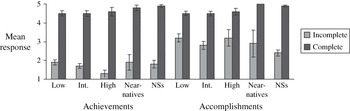
Simple Past.Figure 2 summarizes the results for the simple past. The results for the achievements yielded a significant effect for context, F(1, 123) = 537.913, p < .001, but not for proficiency level, F(4, 123) = 1.584, p = .183, nor was there an interaction between these two factors, F(4, 123) = 1.079, p = .37. Similarly, the ANOVA for the accomplishments in the simple past revealed a significant effect for context, F(1, 123) = 113.952, p < .001, but not for proficiency level, F(4, 123) = 0.810, p = .521, nor was there an interaction between context and proficiency level, F(4, 123) = 2.228, p = .07. In sum, these results for the simple past demonstrate a clear distinction between the incomplete and complete contexts and indicate that the learners follow the same pattern as the NSs.Footnote 14 Furthermore, the targetlike results for the achievements in the simple past indicate that learners do not have difficulty with the lexical aspectual class of achievements per se but rather with the interaction between the achievements and the progressive operator.
L2 English simple past: Mean responses to achievements and accomplishments. Int. = intermediate.

LEARNERS OF L2 JAPANESE
Participants
The main participant group consisted of 33 English NSs who were studying Japanese at high schools or universities (mean age = 21, SD = 6.9). The control group was composed of 31 Japanese NSs, who were undergraduates tested in Japan. All L2 participants were initially exposed to Japanese after the age of 15. The participants had been studying Japanese for an average of 3 years (range: 6 months to 6 years). The listening comprehension section of the Japanese Language Proficiency Test, which is administered by the Japan educational exchanges and services, was used as a proficiency measure.Footnote 15 Raw scores on this 16-item test ranged from 1 to 14 (M = 6.8). Learners who scored below the mean were classified as low-proficiency learners (n = 16), and learners who scored above the mean were classified as high-proficiency learners (n = 17).
Story Compatibility Task
The Japanese version of the task was designed in parallel to the English version. The Japanese verbs are listed in (8).
(8) Accomplishments: keeki-o tsukuru “make a cake,” suna-no shiro-o tateru “build a sandcastle,” koppu ippai-no koora-o nomu “drink a glass of coke,” ippai-no raamen-o taberu “eat a bowl of ramen,” hon-o kaku “write a book,” e-o kaku “paint a portrait,” yamazumi no hon-o yomu “read a pile of books,” yamazumi-no shokki-o arau “wash a pile of dishes”
Achievements: tsuku “arrive,” shinu “die,” kuru “come,” kaeru “return,” aku “openintransitive,” shimaru “closeintransitive,” deru “leave,” iku “go”
Here, only the results for the accomplishments and achievements with the simple past marker –ta and the progressive marker te-iru will be discussed. The stories and test sentences for the accomplishment e-o kaku “paint a portrait” are provided in (9). The stories were narrated in Japanese, whereas the test sentences were both narrated and presented in written form, using Japanese script. All Chinese characters (kanji) were also phonetically transcribed (in hiragana). In the stimuli, the polite form of the verb was used because learners are more familiar with this form: For example, in (9), the polite form of the imperfective marker, te-imasu, was used instead of te-iru.
In the complete context, as illustrated in (9a) for the accomplishment e-o kaku “paint a portrait,” Japanese NSs were predicted to accept the simple past sentence but to reject the sentence with the imperfective marker te-iru. In the incomplete context in (9b), on the other hand, the simple past was predicted to be rejected, and the sentence with the imperfective marker te-iru was predicted to be accepted. No difficulty was predicted for the L2 learners with accomplishments with the imperfective marker te-iru or with the simple past in general.
(9) E-o kaku “paint a portrait” (accomplishment)
Picture 1: Ken-wa gaka desu.
Ken-topic artist be-present
12ji-ni Ken-wa kazoku-no e-o kaki-hajimemasu.
12 o’clock at Ken-topic family-gen picture-acc draw-begin-present
“Ken is an artist. At 12:00 Ken begins to paint a picture of his family.”
a. Complete story context
Picture 2a: 8ji-ni Ken-wa tanjoobi puresento toshite
8 o’clock at Ken-topic birthday present as
okaasan-ni e-o watashimasu.
mother-at picture-acc give-present
“At 8:00 Ken gives the picture to his mother for her birthday.”
i. Past: Ken-wa kazoku-no e-o kakimashita.
Ken-topic family-gen picture-acc draw-past
“Ken painted a picture of his family.”
(Expected rating of NSs: 5; L2 Japanese learners: 5)
ii. Te-iru: Ken-wa kazoku-no e-o kaite-imasu.
Ken-topic family-gen picture-acc draw-te-iru-present
“Ken is painting a picture of his family.”
(Expect rating of NSs: 1; L2 Japanese learners: 1)
b. Incomplete story context
Picture 2b: 12ji 30pun-ni Ken-wa okaasan-to otoosan-no e-o
12:30 at Ken-topic mother and father-gen picture-acckaki-hajimemasu.
draw-begin-present
“At 12:30 Ken begins to paint a picture of his mother and father.”
i. Past: Ken-wa kazoku-no e-o kakimashita.
Ken-topic family-gen picture-acc draw-past
“Ken painted a picture of his family.”
(Expected rating of NSs: 1; L2 Japanese learners: 1)
ii. Te-iru: Ken-wa kazoku-no e-o kaite-imasu.
Ken-topic family-gen picture-acc draw-te-iru-present
“Ken is painting a picture of his family.”
(Expected rating of NSs: 5; L2 Japanese learners: 5)
Stories and test sentences for the achievement tsuku “arrive” are provided in (10). It was predicted that the Japanese NSs would accept the simple past with the complete context in (10a) and reject it with the incomplete context in (10b). For achievements, the predicted NS judgments are the same for the simple past and the sentences with the imperfective marker te-iru. In contrast, if the English NSs map the truth conditions for the English progressive be –ing onto the imperfective marker te-iru, they will interpret the sentence in (10) to mean The plane is arriving at the airport. Thus, in (10a), the learners will incorrectly reject the imperfective marker te-iru with the complete (i.e., addition) context; it was predicted that learners will have less difficulty overcoming transfer in this context. Furthermore, if the English NSs interpret the imperfective sentence in (10) as The plane is arriving at the airport, they should incorrectly accept the sentence with the incomplete (i.e., preemption) context in (10b). It was predicted that even learners at advanced proficiency levels may have difficulty with this context.
(10) Tsuku “arrive” (achievement)
Picture 1: Kore-wa Tookyoo yuki-no hikooki desu. Ima 4ji
This-topic Tokyo bound-gen plane be-present now 4 o’clock desu. Hikooki-wa kuukoo-no chikaku desu.
be-present Plane-topic airport-gen close be-present
“This is the plane bound for Tokyo. It’s 4:00 now. The plane is near the airport.”
a. Complete story context (addition)
Picture 2a: 5ji desu. Jyookyaku-wa kuukoo-ni imasu.
5 o’clock be-present passenger-topic airport-at exist-present
“It’s 5:00. The passengers are at the airport.”
i. Past: Hikooki-wa kuukoo-ni tsukimashita.
Plane-topic airport-at arrive-past
“The plane arrived at the airport.”
(Expected rating for NSs: 5; L2 Japanese learners: 5)
ii. Te-iru: Hikooki-wa kuukoo-ni tsuite-imasu.
Plane-topic airport-at arrive-te-iru-present
“The plane is at the airport.”
(Expected rating for NSs: 5; L2 Japanese learners: 1)
b. Incomplete story context (preemption)
Picture 2b: Kaze-ga tsuyoi desu. 4ji 30 pun-ni hikooki-wa
wind-nom strong be-present 4:30 at plane-topic
mada sora-o hikoo-chyuu desu.
still sky-acc fly-in the middle of be-present
“The wind is strong. At 4:30 the plane is still in the sky.”
i. Past: Hikooki-wa kuukoo-ni tsukimashita.
Plane-topic airport-at arrive-past
“The plane arrived at the airport.”
(Expected rating for NSs: 1; L2 Japanese learners: 1)
ii. Te-iru: Hikooki-wa kuukoo-ni tsuite-imasu.
Plane-topic airport-at arrive-te-iru-present
“The plane is at the airport.”
(Expected rating of NSs: 1; L2 Japanese learners: 5)
Filler sentences were included to test whether the learners understood the aspectual theme of the stories (i.e., event in progress or event completed). Additionally, 16 distracter stories were included to balance the number of items expected to be acceptable and unacceptable. The L2 Japanese participants were provided with a comprehensive word list that was reviewed on the day of testing. Participants were tested in small groups. The proficiency test and interpretation task took about 1 h total to complete. All participants were compensated for their time.
Results
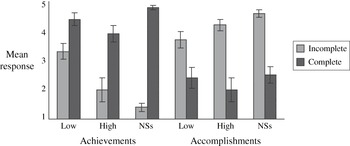
The Imperfective Marker te-iru. The results of the achievement verbs (e.g., tsuite-imasu “has arrived”) used with the imperfective marker te-iru are presented in Figure 3. Recall that, in the Japanese study, the complete context represented the addition task and the incomplete context represented the preemption task.
L2 Japanese imperfective marker te-iru: Mean responses to achievements and accomplishments.

Japanese NSs responded as predicted, assigning high scores in the complete context (i.e., the plane has landed) and low scores in the incomplete context (i.e., the plane still in the air). The ANOVA indicated a significant effect for context, F(1, 58) = 148.015, p < .001, and proficiency level, F(2, 58) = 8.031, p < .01, as well as a significant interaction between these two factors, F(2, 58) = 18.354, p < .001. Learners’ responses were found to generally follow the same pattern as the NSs; they correctly assigned higher scores to achievements with the complete context than with the incomplete context. Independent samples t tests confirmed that this distinction was significant for all groups (low: t(14) = 3.093, p < .01; high: t(15) = 3.942, p < .01; Japanese NSs: t(29) = 22.802, p < .001). Thus, the learners performed more accurately than predicted.
The acceptance and rejection rates for achievement verbs are presented in Table 2. Participants are categorized according to whether they accepted at least 75% of the items (i.e., three of the four items) with a score of 4 or 5, rejected at least 75% of the items with a score of 1 or 2, or performed at chance. Recall that each participant responded to a given sentence type in only one context: complete or incomplete.
Achievements with the imperfective marker te-iru by group
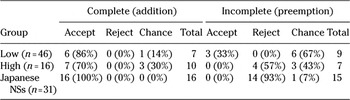
For the complete (i.e., addition) context, it was predicted—on the basis of transfer—that learners at lower levels of proficiency would assign low scores to the imperfective marker te-iru. The results do not provide evidence of transfer in either group. The majority of the learners performed similarly to the NSs; that is, they correctly accepted at least 75% of the test items. In the high-proficiency group, five learners accepted all of the items. With respect to individual verbs, both groups of learners performed well and provided mean responses above 4.0 on six of the eight verbs: The only two verbs that presented difficulty were tsuku “arrive” (M = 3.3) and iku “go” (M = 3.1). These results demonstrate that very few learners had difficulty with the addition task.
For the incomplete (i.e., preemption) context, it was predicted—on the basis of transfer—that the learners would incorrectly accept these sentences. In the low-proficiency group, the results of three learners provide strong evidence of transfer because they incorrectly accepted 75% of these test items; for these learners, preemption was clearly a problem. Most learners performed at chance, however. Mean responses were calculated for each verb: The verbs that presented the most difficulty in the preemption context were iku “go” (M = 4.6), deru “leave” (M = 4.0), kaeru “return” (M = 3.8), and tsuku “arrive” (M = 3.0). The high-proficiency group performed more accurately, with the majority of the learners correctly rejecting 75% of the test items. These results differ from the results of the L2 learners of English, in which even some near-native speakers had difficulty with preemption.
Figure 3 summarizes the results for the imperfective marker te-iru used with accomplishments (e.g., e-o kaite-imasu “painting a portrait”). There was a significant effect for context, F(1, 58) = 67.470, p < .001, but not for proficiency level, F(2, 58) = 2.704, p = .075, nor was there an interaction between context and proficiency level, F(2, 58) = 1.555, p = .220. Participants clearly distinguished between the incomplete (i.e., portrait in progress) and complete (i.e., portrait complete) contexts.
Simple Past.Figure 4 summarizes the results for the simple past. The results for the achievements indicate a significant effect for context, F(1, 58) = 288.764, p < .001, and a significant interaction between context and proficiency level, F(2, 58) = 10.850, p < .001, but no effect for proficiency level, F(2, 58) = 0.271, p = .764. The results for the accomplishments indicate a significant effect for context, F(1, 58) = 74.929, p < .01, and for proficiency level, F(2, 58) = 3.493, p < .05. However, post hoc comparisons did not reveal significant differences between any of the groups. No interaction was found between context and proficiency level, F(2, 58) = 2.036, p = .140. These results indicate that the participants generally performed as expected. Just as in the L2 learners of English, the simple past did not present difficulty for the learners.
L2 Japanese simple past: Mean responses to achievements and accomplishments.

DISCUSSION AND CONCLUSIONS
The goal of this study was to examine the nature of transfer in the domain of aspectual semantics through the investigation of differences in the interaction between lexical and grammatical aspect in English and Japanese. It was predicted that learners’ performance on accomplishments would be better than their performance on achievements, and that performance on the addition context would be more accurate than performance on the preemption context. Finally, the bidirectional nature of this study allowed for the examination of whether L2 learners’ ability to overcome these crosslinguistic differences is influenced by the semantics of the target in the L2.
The hypothesis that learners of both L2 English and L2 Japanese would perform accurately on accomplishments was confirmed, which demonstrates that learners do not have global difficulty with either the semantics of the progressive in English or the imperfective marker te-iru in Japanese. Additionally, the learners’ targetlike results on achievements in the simple past demonstrate that learners do not have global difficulty with achievements. Thus, it becomes clear that it is the interaction between achievements and the progressive be –ing and the imperfective marker te-iru that presents the greatest challenge.
Although these results are consistent with those of previous studies for L2 English and L2 Japanese (e.g., Bardovi-Harlig, Reference Bardovi-Harlig1998; Shirai & Kurono, Reference Shirai and Kurono1998), the novel contribution of this study was the consideration of not only acquisition but also preemption. The results confirmed that the preemption contexts presented the greater problem for the learners of both L2 English and L2 Japanese. The learners of L2 English, at all proficiency levels, performed poorly on the preemption context, allowing the present progressive to refer to complete events. This contrasts with the addition context, in which the task presented difficulty only for learners at lower proficiency levels. For the learners of L2 Japanese, preemption was less of a problem, but there was still evidence of difficulty, particularly among learners in the low-proficiency group who allowed the imperfective marker te-iru to refer to ongoing events. These results for the preemption context contrast with the addition context in which the majority of the L2 Japanese learners were successful, irrespective of proficiency level. In general, this suggests that the task was more difficult for the L2 English learners, with preemption presenting the greatest challenge.
To reconcile the findings of the two groups of L2 learners, their comparability must be addressed: It is necessary to ascertain whether the L2 Japanese learners simply had an advantage because of higher L2 proficiency. The learners in the lower proficiency levels differed with respect to years of L2 study: The low-proficiency L2 English learners averaged 8 years of study (i.e., junior high school through university), whereas the low-proficiency L2 Japanese learners averaged only 2 years (i.e., high school or university). In this respect, the L2 Japanese learners do not have an advantage. The advanced learners demonstrate a greater disparity: The most advanced L2 Japanese learners were still essentially classroom learners. Only 6 of the 17 L2 Japanese learners in the high-proficiency group reported spending time in Japan (M = 4 months abroad). On average, these learners reported using Japanese outside of the classroom for 1 h per week; only five learners reported contact with NSs. In contrast, the high-proficiency L2 English learners (tested in Japan) all reported frequent contact with English NSs either through their jobs or through friendships with foreigners who live in Japan. The near-natives tested in New York City used English on a daily basis. Therefore, it is unlikely that the superior performance of the L2 Japanese participants is due only to an advantage of proficiency, exposure, or use. In fact, the L2 English learners seem to have the advantage. Nevertheless, the results suggest that the learning task was more difficult for the L2 learners of English. I will argue that the explanation for this difficulty lies in both the complexity of the grammatical form in English and the transparency of the input cues available to the learners.
For the L2 English learners, the learning task is likely to be more difficult because it requires that they master the semantics of progressive achievements. Under McClure’s (Reference McClure1995) account, difficulty was predicted with progressive achievements because of the differences between English and Japanese; this proposal does not treat accomplishments and achievements in the scope of the progressive differently. However, several recent accounts have proposed that achievements need to undergo a type-shifting or coercion operation to be compatible with the semantics of the progressive (Michaelis, Reference Michaelis, Aarts and MacMahon2006; Moens & Steedman, Reference Moens and Steedman1988; Rothstein, Reference Rothstein2004). Rothstein proposed that achievements (but not accomplishments) require a semantic type-shifting operation to repair the aspectual mismatch between the VP and the progressive operator. Therefore, there is an extra step in the semantic computation: Achievements must first be converted to abstract accomplishments.
de Swart’s (1998) account of coercion provides an idea of what this extra processing step would entail. In her account, VPs can only be reinterpreted or coerced if an appropriate context is available. For example, the achievement verb die can be coerced to match the requirements of the progressive only if one can identify preparatory stages that can be defined as events leading up to the point of culmination (i.e., death). This extra step in the computation would potentially entail that interpreting progressive achievements would incur an additional processing cost; if the input is more difficult to process, then acquisition may be delayed (Slabakova, Reference Slabakova2002b). Although progressive achievements have not yet been examined in the sentence processing literature, a growing body of evidence suggests that the processing of other instances of aspectual coercion in fact incurs additional processing costs (Brennan & Pylkkänen, Reference Brennan and Pylkkänen2008; Piñango, Zuriff, & Jackendoff, 1999).
If the coercion account is correct, then it is possible that even NSs with L1s that, similar to English, also allow progressive achievements will experience difficulty in their interpretation and processing. This notion would be compatible with the predictions of the AH, which predicts a similar path of development for the progressive regardless of the L1. In the coercion account, the underlying cause of the difficulty with progressive achievements is due to the semantic and pragmatic complexity of the computation. Thus, learners of a different L1 background, such as Korean—which is similar to English in allowing progressive achievements—should be tested. A comparison of Korean and Japanese learners of English would allow us to determine whether the difficulty observed here was a consequence of transfer from Japanese, as argued, or whether the complexity of progressive achievements presents a challenge regardless of the properties of the L1. Preliminary work by Gabriele, Maekawa, and Alemán-Bañón (Reference Gabriele, Maekawa, Alemán-Bañón, Chandlee, Franchini, Lord and Rheiner2009) suggests an advantage for L1-L2 similarity, although even Korean learners are not able to perform at the level of NSs. Moreover, Montrul and Slabakova (Reference Montrul, Slabakova, Péréz-Lerouz and Liceras2002) showed that similarity between the L1 and the L2 does not necessarily facilitate acquisition when learners confront sentence types that entail coercion (see also Gass & Ard, Reference Gass, Ard and Rutherford1984).
In contrast to the L2 English learners, the L2 Japanese learners do not have to master the same type of semantic complexity. The combination of achievements with the imperfective marker te-iru does not require a shift in verb type or coercion. Therefore, the interpretation of achievements as resultative is potentially a much easier task. In fact, a large body of research that addresses the AH has shown that learners tend to associate accomplishments and achievements with tense-aspect markers that encode completion (Li & Shirai, Reference Li and Shirai2000). Furthermore, it seems that this kind of type-shifting, as proposed by Rothstein (Reference Rothstein2004) for English, is unreported in the aspectual domain in Japanese. If this is the case, then Japanese learners of English face an even greater challenge because they need to learn that aspectual mismatches can in fact be repaired via the type-shifting operation.
Finally, the input cues that might serve as the impetus for grammatical restructuring must be considered. There has been little discussion of how learning proceeds in the domain of semantics and what role the input might play. It is important to point out that there are differences that distinguish semantic from syntactic learning. A successful semantic analysis requires that the components of a sentence be successfully integrated (compositionality), and that the sentence be successfully evaluated as true or false with respect to a particular context in the world. The need for this external evaluation presents a clear difference from the type of computation that syntactic learning requires, in which grammatical form is all that matters.
In some cases, the context may transparently guide a learner to restructure his or her grammar. Imagine a particular context in which a L2 learner of English (L1 Japanese) is watching a movie with a friend. In the movie, an old man is on his deathbed, terminally ill but still speaking. A second friend enters the room and asks about the movie. The first friend replies “The old man is dying.” If the L2 learner’s grammar is constrained by the semantic properties of the L1 Japanese, the sentence will be interpreted as The old man is dead. However, the output of the semantic analysis will be transparently incompatible with the real-world context: If the old man is talking, he cannot be dead. This type of incompatibility should drive the restructuring of the grammar and facilitate the acquisition of a new representation in the L2. It is not hard to imagine that this kind of input might be readily available. However, this is not to say that all input will be so transparent. Imagine a different context in which the same L2 learner is now waiting at the train station with a friend. The L2 learner is chatting on her cell phone in the stairwell while the friend waits on the platform. Suddenly, the friend calls down to the L2 learner and says “The train is arriving.” If the L2 learner analyzes this sentence through the L1, the sentence will be interpreted as The train is here. As the L2 learner bounds the stairs to the platform, the train may already be pulling in to the platform. In other words, the learner’s incorrect interpretation will now appear correct. Achievements present only a short window of time before the event is actually realized, and it may often be difficult to distinguish the preparatory stages (e.g., the train approaching) from the point of culmination (e.g., the train at the platform). It is important to note that, in these cases, there will be no impetus for the learner to restructure his or her grammar, and the L1 option will be maintained. In contrast, the L2 Japanese learner is unlikely to face the same type of uncertainty. If an achievement such as tsuku “arrive” is used with the imperfective marker te-iru, it is unambiguously the case that the arrival has already taken place. If the English NS learning Japanese were to incorrectly interpret the form as is arriving, the learner would immediately realize that the output of his or her semantic computation was incorrect.
These examples show that a careful consideration of the input will allow for a better understanding of the circumstances in which learners are able to successfully converge on the target—and thus preempt L1 options—and those circumstances in which convergence is not possible. The input is likely to be particularly important in the domain of semantics in which the cues are often fairly subtle and learners must be able to integrate extralinguistic information into their evaluation of a given form. These results suggest that if the input cues are not salient, a learner may vacillate between the available options until the evidence is strong enough to favor only the target, similar to the model proposed by Valian (Reference Valian1990) for L1 acquisition. Valian argued that L1 learners consider the dual options of a parameter simultaneously, weighing the evidence in favor of one or the other option, before finally converging on the target.
In sum, two factors have been proposed that arguably play a role in determining whether learners will successfully preempt L1 options. First, the grammatical complexity of the semantic target in the L2 is significant. It was argued that the Japanese learners of English faced a more difficult learning task in that the interpretation of progressive achievements in English requires type-shifting or coercion, an additional semantic computation that the English-speaking learners of Japanese do not need to confront. Additional research on both the acquisition and processing of forms that entail coercion is necessary to better understand whether these forms are ultimately acquirable in SLA and to what extent the properties of the native language play a role.
Second, it has been argued that a consideration of the input cues can provide a better understanding of the cases in which grammatical restructuring is not successful. In the domain of semantics, learners must evaluate a given sentence with respect to a particular context. It was proposed that the L2 learners of English again faced a more challenging task.Footnote 16 Achievements in the progressive often allow for a very short window of time before the change of state is actually realized, and the distinction between the event unfolding and the completion of that same event may sometimes be quite subtle. In general, it is proposed that unlearning is certainly possible in the semantic domain but that learners’ success depends on several factors, which include the complexity of the semantic computation of the target and the transparency in which the L1 interpretation can be ruled out by the extralinguistic context.