In a recent issue, Young and Sigelman (Reference Young and Sigelman2008) present evidence of a “Dakota effect,” in which persons born in the Dakotas are disproportionately likely to represent their home state, other states, and also generate government spending directed toward the Dakotas. These authors are unable to explain the causal underpinnings for overrepresentation in Congress or the Dakotan natives' keen ability to direct pork back to these two states.
As is now well established, rational choice modeling can be successfully employed to explain every political phenomenon under the sun, as well as some over the sun. Even the harshest critics of rational choice analysis, such as Green and Shapiro (Reference Green and Shapiro1994), have recently admitted this.Footnote 1 As such, a rational choice model will be employed here, and using fictitious data, empirical analysis will be shown to corroborate the model. We believe this to be a major breakthrough.Footnote 2
The Rational Choice Model
As with most rational choice models, the equations are too complex to be understood by mere rank-and-file political scientists. Thus, the model will not be presented but merely summarized. In sum, the model predicts the Dakota effect.
Empirical Support
Having stated the model is correct, no empirical evidence should be needed. But we recognize some of the readers of this journal may not be convinced by the theoretical model alone. To placate such luddites, we now present direct evidence of the model's veracity.
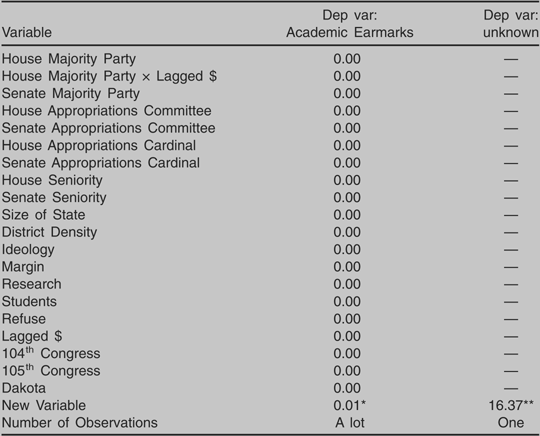
We supplement Young and Sigelman's (Reference Young and Sigelman2008) specification, which supplemented Balla et al.'s (Reference Balla, Lawrence, Maltzman and Sigelman2002) original specification with a Dakota dummy variable, by introducing a New Variable. Data for the New Variable is generated internally from a non-existent source,Footnote 3 and the regression is estimated using the Heckelman Non-Parametric Inference Procedure (HNPIP).Footnote 4
As clearly shown in the first column of Table 1, the New Variable is statistically significant, within a 45% error bound. None of the other variables, including the Dakota variable, come close to this, as predicted by the model. Additional estimations do not support the model and are therefore not reported.Footnote 5
Importance of the New Variable (HNPIP estimates)

* Significant at p < .45;
** significant at p < .00
To further show the power of the model, the New Variable is also used in the final column to explain a totally unrelated result, namely the heretofore previously undescribed “Dragonfly effect.”Footnote 6 Because there is no dependent variable to relate this to, the estimated coefficient is difficult to interpret. However, the New Variable alone explains 137% of the variation.Footnote 7
Conclusion
Once again, rational choice analysis has been used to explain an effect that traditional political science methods could not. Because the model was not presented and the New Variable was not identified, such flexibility will be exploited in future work to explain other important findings in the field of political science. One example is why the two major party labels in the United States, Democratic and Republican, both contain 10 letters. In support of the model, it is found in preliminary analysis that the number of letters in the candidate's party label perfectly explains the winner of each of the last 20 presidential elections. Future work in this area appears promising.
We conclude by quoting Adam Smith: “I'm right because I'm bigger than you.”Footnote 8