INTRODUCTION
The challenges faced by environmental governance in a dynamic world of ecological, economic and societal changes have received considerable attention from academics and policymakers alike (Rauschmayer et al. Reference Rauschmayer, Paavola and Wittmer2009a; EEA [European Environment Agency] 2011). This is also true for the governance of biodiversity in the European Union (EU; in this paper European Union refers to both the EU and its predecessors such as the European Economic Community), where complex and scale-dependent systems of actors and governance frameworks characterize biodiversity governance in spite of commonly agreed goals (Paavola et al. Reference Paavola, Gouldson and Kluvánková-Oravská2009).
The current policy framework for the conservation of biodiversity in the EU is given by the EU 2020 biodiversity strategy (EC [European Commission] 2011). The first of its six targets is to fully implement the Birds and Habitats Directives, which aim to maintain or restore to favourable conservation status all habitats and species of European importance and adequate populations of naturally occurring wild bird species, measures considered essential for preventing further loss and restoring biodiversity in the EU. The time-bound, quantified targets of the EU 2020 biodiversity strategy will accelerate implementation of the directives and achievement of their objectives.
The 1979 directive on the conservation of wild birds (79/409/EEC, now directive 2009/147/EC of the Council and the Parliament, see URL http://ec.europa.eu/environment/nature/legislation/birdsdirective/index_en.htm), often known as the Birds Directive, and the 1992 directive on the conservation of natural habitats and of wild fauna and flora (Council directive 92/43/EEC, see URL http://ec.europa.eu/environment/nature/legislation/habitatsdirective/index_en.htm), more often known as the Habitats Directive, form the backbone of EU nature legislation. The Birds Directive was designed to be compatible with the Convention on the Conservation of European Wildlife and Natural Habitats (the Bern Convention) adopted in the same year. The EU ratified the convention in 1982, but only with the adoption of the Habitats Directive was the legislative basis for full implementation established by giving a legally binding and directly enforceable regime of species and habitat protection in the EU (Coffey & Richartz Reference Coffey and Richartz2003; Ribault Reference Ribaut2004; Lasén Diaz Reference Lasén Díaz2010; Evans Reference Evans2012).
Both pieces of legislation are based on two main pillars, site protection and species protection. Sites designated as special protection areas (SPAs) under the Birds Directive and as special areas of conservation (SACs) under the Habitats Directive comprise the EU Natura 2000 network. This is the largest ecological network in the world set up on a common legal basis, with more than 26 000 sites covering 950 000 km2, or 17.5 % of the land area of the EU (EC 2012; EEA 2012).
As with similar legislation at national level, both directives, which have to be transposed into national legislation by the member states of the EU, contain a set of legal articles concerning what can or cannot be done with wildlife species and their habitats. The scope of these articles may be determined by secondary legislation, or, as in the present case, by several annexes listing the species and habitats to which the various provisions and measures apply. This paper focuses on the Habitats Directive (for a detailed description of the Directive see for example Krämer Reference Krämer2011).
Since the adoption of the Habitats Directive in 1992, the EU has almost doubled its land area from c. 2 400 000 km2 to 4 300 000 km2. There were 12 member states when the Directive was first adopted, and three states joined in 1995, 10 in 2004 and two more in 2007, bringing the current number of member states to 27. Croatia is expected to join the EU on 1 July 2013, having signed an accession treaty on 9 December 2011.
The list of species and habitats that was appropriate in 1992 will clearly inadequately reflect the biodiversity of the enlarged EU. Therefore, as part of the process of agreeing on the terms of the accession of the new member states to the EU, the annexes of the Directive have been revised to various degrees.
This process, known as technical adaptations to the acquis communautaire (namely the detailed laws and rules adopted on the basis of the EU's founding treaties; Jordan Reference Jordan2005) was unique from both a scientific point of view and in terms of governance. As well as legal and governance issues, the candidate countries faced huge challenges with environmental issues during the accession process, especially those requiring heavy investments, such as waste management and wastewater treatment. Hence, it is unsurprising that nature conservation issues have received limited attention in published policy reviews of the accession process (see Carmin & VanDeveer Reference Carmin and VanDeveer2005). Although the outcomes of the negotiations for amendments to the annexes of the Habitats Directive are visible in the amended annexes, to date little has been written about the negotiations behind these changes.
This paper focuses on the changes to the Habitats Directive as a result of the enlargements in 2004 and 2007 involving the accession of 10 countries in Central and Eastern Europe, together with Cyprus and Malta. The changes required for the accession of 12 new member states (here referred to as the EU-12) were negotiated in a coordinated series of meetings and exchanges of information over a period of seven years involving the candidate countries, the existing member states and the European Commission's Directorate General for the Environment (DG Environment), with technical assistance from the European Topic Centre on Biological Diversity (ETC/BD). After a brief overview of the annexes, we describe the negotiations that were held from 1999 to 2006, before reviewing the outcomes and the problems encountered. We finish with a discussion of some consequences of this work and possible future application.
The accession of Austria, Finland and Sweden in 1995 also resulted in amendments to the annexes, but there was a reliance on meetings of existing committees and working groups with no dedicated seminars. This paper does not cover the accession process for Croatia.
The Habitats Directive includes six annexes; four list the habitat types and species to be protected and could be changed due to EU enlargement. Annexes I and II list habitat types and species (and some subspecies) for which member states are obliged to designate SACs. Annex IV lists taxa, usually species but also some genera and subspecies, which are strictly protected by the Habitats Directive throughout their natural range and Annex V lists taxa which may require management measures. A taxon may be listed on both Annexes II and either IV or V if it requires both protected areas and strict protection or management. There is an obligation under Article 17 to report on the conservation status of all habitats and species listed on Annexes I, II, IV and V every six years. Annex III gives criteria for the selection of SACs and Annex VI lists prohibited methods of hunting; neither Annex III nor VI can be amended.
ACCESSION NEGOTIATIONS FOR THE EU-12
Accession negotiations with Hungary, Poland, Estonia, the Czech Republic, Slovenia and Cyprus started on 31 March 1998, and negotiations with Bulgaria, Latvia, Lithuania, Malta, Romania and Slovakia commenced on 13 October 1999. These negotiations determined the conditions under which each applicant country would join the EU. The applicants were expected to accept the acquis by the date of accession.
The negotiations focused on the terms under which the applicants would adopt, implement and enforce the acquis, including the granting of possible transitional arrangements. This, however, had to be limited in scope and duration, and its purpose was to allow new member states to phase in their compliance with certain laws and rules by a date agreed during the negotiations.
After the Commission's screening of the acquis, each applicant country drew up its position on each of the 31 chapters of the EU acquis, prior to starting negotiations, nature conservation being included in Chapter 22 Environment. After extensive consultations with the candidate countries, as described below for the Habitats Directive, the European Commission proposed a draft common negotiating position to the Council. The treaty drafting working group of the Council prepared documents for the negotiating sessions at the level of ministers, and finally the negotiating positions were approved unanimously by the Council and submitted to the European Parliament for assent.
Negotiations were concluded with Cyprus, the Czech Republic, Estonia, Hungary, Latvia, Lithuania, Malta, Poland, the Slovak Republic and Slovenia in December 2002 and the Accession Treaty was signed on 16 April 2003, entering into force on 1 May 2004. The negotiations with Bulgaria and Romania continued until their Accession Treaty was signed on 25 April 2005, coming into force on 1 January 2007.
Negotiations on the Habitats Directive
DG Environment, realising the magnitude of work and the need to fully inform the candidate countries, started a series of events with the aim of disseminating information about the EU nature directives, including the need for adaptations of the annexes of the directives. Examples include the workshop on nature conservation in the Baltic States facing EU requirements, which was organized by the Baltic Environment Forum (an NGO) and co-financed by the EU (held 18–20 October 1998), and the European seminars organized by the European Centre for Nature Conservation (a partner of the ETC/BD) in cooperation with and partly financed by the EU in Debrecen (Hungary, 20–23 March 1999) and Krakow (Poland, 17–20 April 1999). These and other meetings helped to raise awareness in national, regional and (sometimes) local administrations, and in the technical and scientific community who would be involved in the implementation of the legislation. This was also the first time that environmental NGOs became involved.
The DG Environment invited all the candidate countries to make proposals for technical adaptations to the annexes of the Birds and the Habitats Directives using forms initially produced for the earlier negotiations with Austria, Finland and Sweden. For the Habitats Directive, proposals were invited for additions to Annexes I, II, IV and V. A request for a geographical exemption for species of Annexes II, IV and V was also possible, as were changes to the priority status of a habitat or species (priority species and habitat types have a higher degree of protection under Article 6 of the Directive).
The candidate countries were requested to provide information on the distribution and habitat area of the proposed habitat types, and whether there was any correspondence with unit(s) in the Palaearctic habitat classification (Devillers & Devillers-Terschuren Reference Devillers and Devillers-Terschuren1996) and other classifications. The proposal was to be justified by reference to the definition of Habitat of Community Interest in Article 1(c). A description of the habitat type including characteristic species, reasons for any reported decline and key references was also required. Similar information was required for species proposed as additions to, or geographic restrictions from an annex: population size, taxonomy (with synonyms where appropriate), the reason for the proposal (as in Article 1(g)), ecology of the species (including its distribution and most important habitats), red-list status and listing in other international conventions (for example Bern, Bonn or CITES). Scientific advice to DG Environment, including an initial screening of all proposals, was provided by the ETC/BD (and its predecessors) including the associated PHARE Topic Link on Nature Conservation.
It was made clear from the outset that the enlargement exercise would not lead to a general revision of the annexes; only amendments needed to make them more relevant for the new member states could be accepted and it was not possible to make changes to habitats and species only occurring in the 15 ‘old’ member states.
Although all proposals for additions had to meet the definitions given in the Directive described above, it was clear that additional criteria were needed to help assess the proposals. Discussions between the Commission and the ETC/BD in early 2000 led to the following guidelines:
(1) The balance and structure of the existing annexes had to be respected. In general, species added to Annex II should also to be added to one of annexes IV or V. For vascular plants, the previous practice of all species listed on Annex II also being included on annex IV should be maintained;
(2) No new taxonomic groups were to be introduced (such as a previously unrepresented insect order);
(3) Taxonomically disputed species/groups, together with apomictic species and hybrids should be avoided;
(4) Sufficient information must be available to allow an assessment (and implementation);
(5) Preference for species rather than other taxa;
(6) Preference for protection of habitat types rather than individual species;
(7) Where feasible, a preference to amend definitions of existing habitat types rather than add additional very similar types;
(8) The amendments resulting from the changes should not result in new obligations to existing member states except where acceptable to the member states; and
(9) Geographical restrictions to be used only in a limited number of cases in order to maintain the coherence of the annexes for the member states.
The process
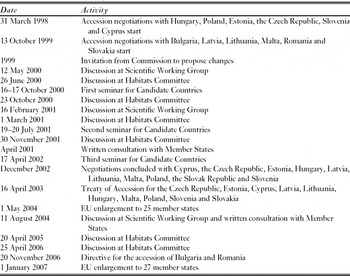
A structured series of consultations followed an initial screening of the first proposals and the candidate countries were invited to three seminars to discuss the proposals (16–17 October 2000, 19–20 July 2001 and 17 April 2002). These seminars involving officials from the relevant ministries and scientists, usually from national agencies for nature conservation, were chaired by the Commission, who were assisted by the ETC/BD. They allowed discussions not only between the candidates and DG Environment, but also among candidates. Candidate countries may also have had objections to other proposals. For example Hungary's proposal to list the rodent Nannospalax leucodon, an endangered species in the Carpathian Basin, was opposed by Bulgaria, where the species is still common. Prior to the first meeting, DG Environment and the ETC/BD summarized the proposals and made initial recommendations.
As a result, many proposals were accepted by DG Environment subject to approval by the existing member states and many were rejected as not being suitable, while, for others, the candidate countries were asked to resubmit proposals with additional information or for some habitat types, revise their proposal to take account of the discussions (see later).
The analyses of the proposals by DG Environment and the ETC/BD experts, together with the outcome of the seminars were also discussed by the Habitats Committee, a group with representatives from each member state established by the Directive as an aid to implementation. Meetings were held on 26 June 2000, 23 October 2000, 1 March 2001 and 30 November 2001. The informal scientific working group associated with this committee discussed the proposals on 12 May 2000 and 16 February 2001, and held a written consultation in April 2001.
The numerous meetings and additional follow-up exchanges of views resulted in a long and intensive process, during which the technically justified needs put forward by the candidate countries were assembled by DG Environment in a consolidated form, and finally, after long discussions (Table 1), received the agreement of the existing member states. The idea behind the very extensive discussions between the member states and the candidate countries was to find agreement before final negotiations in the Council. The results show that this was successful.
A summary of meetings and other relevant events.

At the end of 2002, the Commission agreed to conclude the negotiations with all the candidate countries except Bulgaria and Romania, and tabled a set of proposals for amendments to the Council. The discussions in the Council treaty-drafting working group entered a formal stage where the amendments were no longer at the technical level of the government departments responsible for nature conservation, but rather in the hands of the national ministries charged with the coordination of accession negotiations. The Commission's proposals were accepted by the Council, except for proposals for geographical exemptions for the lynx in Estonia.
The final outcome of the negotiations on the amendments of the annexes of the Birds and Habitats Directives formed a lengthy (133 pages) chapter containing the consolidated new annexes in the Treaty of Accession 2003. No transitional periods for implementation were agreed for the Habitats Directive (see Madalina Reference Madalina2003). The candidate countries were expected to have transposed the Directives into national legislation and to have a complete list of site proposals for Natura 2000 by the day of accession.
Discussions on the annexes continued with Bulgaria and Romania until 2006, with further proposals from both candidate countries. There were no more dedicated seminars and the discussions essentially continued at the margins of meetings on general issues of implementation and by exchange of e-mail. The Habitats Committee and its scientific working group were asked for their views on the final set of proposals by written procedure on 11 August 2004, and at the committee's meeting of 20 April 2005. Rather than including consolidated annexes in the 2005 Treaty of Accession to the EU for Bulgaria and Romania, they were included in a directive of technical adaptations of several directives, adopted by the Council before the date of membership (EU 2006, 2007). This arrangement also allowed the late inclusion of one species, the endemic fish Romanichthys valsanicola in Annexes II and IV(agreed by the Habitats Committee on 25 April 2006), which had been the subject of an EU funded LIFE-Nature project, but had been overlooked during the earlier negotiations.
Since the national governments of the candidate countries were the interlocutors, the ministries responsible for the environment and, in particular, for nature conservation, were in the lead. Little information is available on how widely they consulted with scientific bodies, NGOs or other ministries (for example ministries of agriculture, who are often responsible for hunting and/or forestry, as well as agriculture). However, it is evident from the proposals that in some candidate countries like Slovakia and the Czech Republic, the proposals were developed by a specialist state nature conservation agency in collaboration with experts from universities, research institutes and NGOs. In Romania and Poland, research institutes under the auspices of the national academies of science specializing in nature conservation contributed. In other candidate countries, such as Hungary and the three Baltic states, a variety of research institutes and natural history museums were involved. Participation by NGOs in this exercise was limited, one exception was the WWF Carpathians Programme, who actively lobbied both the Commission and the ETC/BD with proposals for additional habitat types for Annex I (WWF DCP 2004).
The first deadline for proposals was March 2000, but partly as a result of the applicant countries having started negotiations at different dates, only five candidate countries delivered complete proposals, while for the other countries proposals were either partial (three countries) or not delivered (five countries). This resulted in several rounds of proposals to be analysed and discussed. Most proposals were received in late 1999 and early 2000, but there were further proposals, particularly from Bulgaria and Romania who submitted their final proposals in 2004, partly in response to discussions held at DG Environment and comments from the existing member states (see later).
THE OUTCOME OF THE NEGOTIATIONS
Eight hundred and thirty one proposals resulted in 191 species and 33 habitats being added, together with exemptions for eight species (Tables 2 and 3). A complete list of all proposals and outcomes is available (Appendix 1, see supplementary material at Journals.cambridge.org/ENC). Summaries of the amendments to the EU nature legislation as a result of the 2004 and 2007 enlargements are given in EC (2004) and EC (2007a).
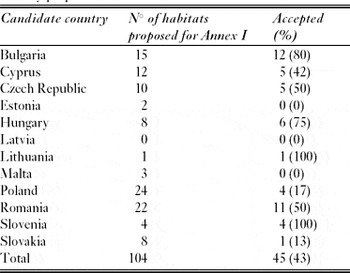
Number of proposals for additional habitat types from each candidate country, and summary of outcomes. Note that the same habitat type may have been proposed by two or more countries, so the total number of proposals is not the sum of the country proposals.

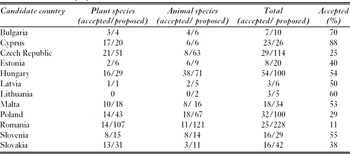
Number of proposals for species (or rarely subspecies) from each candidate country (addition to an annex, geographical exemption or change in priority status), and summary of outcomes. Note that the same species may have been proposed by two or more countries, so the total number of proposals may not be the sum of national proposals.

Habitat types
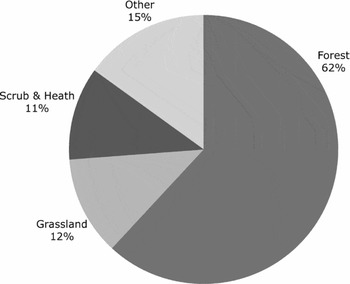
One hundred and four proposals were received for new habitat types and two requests for geographical exemptions. The number of proposals per country varied from 24 (Poland) to none (Lithuania). The majority of proposals (62%) were for forest habitats; grasslands, heaths and scrub accounted for most of the remaining proposals (23%) (Fig. 1). There were no proposals for new marine habitats. New habitats were accepted approximately in proportion to the number of proposals, with forest types accounting for 69% of new habitat types. There were only two requests for geographical exemptions, ‘91G0 *Pannonic woods with Quercus petraea and Carpinus betulus’ from Hungary and ‘1120 *Posidonia beds (Posidonion oceanicae)’ from Malta, which were refused as there was no precedent for such exemptions. When exemptions from Annex II are agreed for species, the species may still be listed on another annex (for example Finland and Sweden have an exemption from Annex II for the fish Lampetra fluviatilis, but it is still listed on Annex V), however this is not possible for habitats, where there is only Annex I.
The distribution of proposals for new habitat types for Annex I by broad habitat groups.

Few habitat types were proposed by more than one candidate country. In the first round of proposals only Slovakia and Poland made separate proposals for the same habitat (for example both proposed Western Carpathian larch and arolla pine forests). Following initial discussions some proposals for habitat types were resubmitted, this was usually when the initial proposal was considered to be too broad. For example, Slovenia originally proposed South-eastern European Scots pine forests, which are very widespread, but after discussions this proposal was resubmitted and later accepted as the more restricted habitat type ‘91R0 Dinaric dolomite Scots pine forests (Genisto januensis-Pinetum)’. In some cases similar proposals were received, which during discussions resulted in a single new habitat type. For example, Romania proposed both Ponto-Sarmatic Steppes and Western Pontic steppes, which led to the new habitat type ‘40C0 Ponto-Sarmatic Steppes’, while a series of proposals from both Bulgaria and Romania led to the new habitat type ‘91AA Eastern white oak woods’.
In many cases, the habitat types proposed were considered to be similar to habitat types already listed on Annex I; in such cases the definition of the habitat type was amended. For example, Slovakia proposed West Carpathian alpine and subalpine calciphilous grasslands (Seslerion tatrae, Seslerio-Asterion), but this is clearly a geographical variant of ‘6170 Alpine and subalpine calcareous grasslands’, which also occurs in the Alps, Pyrenees and other mountain ranges.
Annex I simply lists the habitat types by name, with descriptions being given in a manual adopted by the Habitats Committee (EC 2007b). This manual was first published in 1996 and has been revised each time the EU has been enlarged with descriptions of new habitats added and agreed modifications of existing habitats (Evans Reference Evans2006, Reference Evans2010). The descriptions of new habitats and amendments to existing definitions were initially drafted by the ETC/BD, largely based on material in the proposals and subsequently discussed with the relevant candidate countries and with the existing member states. In some cases discussions (mostly by email) lasted several months before agreement could be reached. For most countries the discussion was between the ETC/BD and scientists in government agencies for nature conservation, but in Bulgaria comments were also received from a group of NGOs.
The descriptions given in the EC manual are generally brief, and many countries, including many of those who joined the EU in 2004 and 2007, have published more detailed guidance targeted at their country; a list of such publications is maintained by the ETC/BD (Evans not dated).
Species
Seven hundred and twenty seven proposals were received covering 684 taxa, with 402 proposals covering 377 animal taxa and 325 proposals for 307 plant taxa (Table 3). The largest number of proposals came from Romania, while the lowest number of proposals came from the three Baltic States (20 from Estonia, six from Lithuania and five from Latvia).
In some cases, the same taxon was proposed by two or more candidate countries with different scientific names, for example the species accepted for Annexes II and IV as Pulsatilla slavica G. Reuss. proposed by Slovakia and Poland was also proposed by Romania as Pulsatilla halleri (All.)Willd. ssp. slavica (G. Reuss) Zamels 1926. For vascular plants, the Flora Europeaea (Tutin et al. Reference Tutin, Heywood, Burges, Moore, Valentine, Walters, Webb, Ball, Chater and Ferguson1968, Reference Tutin, Heywood, Burges, Moore, Valentine, Walters, Webb, Ball, Chater, DeFilipps, Ferguson and Richardson1972, Reference Tutin, Heywood, Burges and Valentine1976, Reference Tutin, Heywood, Burges, Moore, Valentine, Walters, Webb, Chater and Richardson1980, Reference Tutin, Burges, Chater, Edmondson, Heywood, Moore, Valentine, Walters, Webb, Akeroyd, Newton and Mill1993) was taken as the principal taxonomic reference, wherever possible. Often the same taxon was proposed by two or more candidate countries but for different annexes; for example, Pulsatilla slavica was proposed by Poland for Annex II, by Slovakia for annexes II and IV, and by Romania for Annex IV. This species, which is listed on Annex I of the Bern Convention, was finally added to Annexes II and IV.
There were 38 proposals for geographical exemptions from Annexes II and/or IV for 24 species, including nine proposals for the three large carnivores occurring in central and eastern Europe (Canis lupus, Lynx lynx and Ursus arctos). There were also proposals for geographical restrictions for beaver (Castor fiber) from the Baltic States and Poland where beaver has healthy populations, and all were accepted.
In practice, some of the guidelines noted above were not strictly followed. For example, the plant Gladiolus palustris was proposed by Hungary, Poland and Slovakia, and was added to annexes II and IV, although some of the most important populations are in Germany (but happened to be present in its Natura 2000 sites and, as no obligations to propose additional sites were involved, Germany agreed to the proposal). Similarly, although the plant Cerastium dinaricum is potentially protected by its habitat (limestone cliffs) being listed on Annex I, it was added to Annexes II and IV as it is considered a ‘flagship species’ in Slovenia, is widely used in publications aimed at the general public and has even featured on Slovenian postage stamps.
Romania proposed a large number of new species, a large proportion of which were not accepted (Table 3). For plants it was considered that the list, mostly of species endemic to the Romanian Carpathians, would have led to an over-representation of endemics in one region if all had been accepted. For many of the species little information other than descriptions in flora was available. This led to the compromise of accepting only the vascular plant species proposed by Romania which had already been listed on Annex I of the Bern Convention.
Many of the species proposed for Annex II were considered to be adequately protected because their habitat was listed in Annex I. For example, Malta proposed the tree Tetraclinis articulata for Annex IV, but it was not accepted as its localities are covered by the existing habitat type ‘9570 * Tetraclinis articulata forests’. However, this protection depends on the site management for the habitat taking such species into account, which would clearly happen in this case. Many species endemic to serpentine soils in Cyprus were proposed but, after discussion, a new habitat type was proposed and accepted instead, namely ‘62B0 * Serpentinophilous grassland of Cyprus’.
Biogeographical regions
The Habitats Directive makes reference to biogeographical regions, and these are used both for evaluation of site proposals and for reporting, as required by Article 17 of the Directive (Sipkova et al. Reference Sipkova, Balzer, Evans and Ssymank2010; Evans Reference Evans2012). In 1992, there were five regions listed, but, as the EU grows, further regions are required, and a sixth region (the Boreal) was added when Finland and Sweden joined the EU in 1995. As a result of negotiations, additional regions were added in 2004 (Pannonian) and 2007 (Black Sea and Steppic) and boundaries of existing regions in the candidate countries agreed.
No map or delimitations of the regions are given in the Directive and the ETC/BD was asked to produce a map. This was based on maps of potential natural vegetation, but modified to take account of administrative boundaries. The map of biogeographical regions is also used for the Council of Europe's Pan European Emerald Network established under the Bern Convention and there is an agreement that any changes to the map are approved by both the EU Habitats Committee and the Standing Committee to the Bern Convention (ETC/BD 2006). All Natura 2000 sites are automatically part of the Emerald network.
DISCUSSION
The EU's nature conservation legislation illustrates how legislation can be amended to remain relevant with the involvement of actors from both governments and civil society, including the scientific community.
Since the exercise was strictly limited to technical changes necessary because of enlargement, DG Environment's chosen approach was to ask the candidate countries to suggest proposals that they deemed best. As the interlocutors were the governments, only they could make official proposals, and there was a risk that proposals would reflect national rather than European priorities, although discussions between DG Environment and the candidate countries helped address this potential problem. For example, no species of Black Sea sturgeon were proposed although all are considered threatened by IUCN, and a more European perspective may have suggested their proposal. There was a limited role for NGOs or scientific bodies (unless asked to participate by their national authorities), in strong contrast to their important role in assessing site proposals for Natura 2000 and other aspects of implementing the Habitats Directive (Weber & Christophersen Reference Weber and Christophersen2002). The ETC/BD made a limited number of informal suggestions to candidate countries for possible proposals to address some clear gaps in the proposals, for example resulting in a change to existing definitions of dune habitat types to ensure that coastal dune systems in the Black Sea would be protected, but this depended on the goodwill of the candidate countries.
There were no proposals for additional marine habitats and very few proposals for marine species, even though it is widely recognized that the current annexes of the Habitats Directive have a poor coverage of marine species and habitats (see for example Oceana 2006; De Santo & Jones Reference De Santo and Jones2007), partly as the 1992 annexes were prepared at a time when it was not clear if the Directive applied only to inshore waters or to all waters under the jurisdiction of the EU (Evans Reference Evans2012). The lack of proposals may have been due to the requirement that proposals did not impose additional obligations on the existing member states.
It is possible that the aims of the Directive and the structure of the annexes were either not explained clearly enough and/or were misunderstood. This is suggested by a focus on proposals related to site designation rather than strict protection, with 551 proposals for Annex II and 249 for Annex IV although, in the original Directive, Annex IV had more species. There were also many proposals which reflected national rather than European perspectives, with species being proposed which were rare or endangered in the country, but widely distributed and often not endangered in surrounding countries, including existing EU member states. For example, the plant Campanula barbata was proposed by Poland and the elk (Alces alces) by the Czech Republic but, in both cases, although the species were considered threatened in the countries making the proposals, they occurred in several other countries where they were not considered to be threatened. In some cases, species were proposed that were already listed.
As the Habitats Directive was conceived as an EU-scale implementation of the Bern Convention it might have been expected that the majority of species proposed would also be listed on the annexes of the Convention, but this was not the case. It is not clear why, although it may reflect a change in knowledge and priorities between the late 1970s, when the Bern Convention was negotiated, and the early 2000s. Recently, there has been some work by the ETC/BD examining differences between the Bern Convention, in particular its Emerald network, and the annexes of the Habitats Directive, which has led to changes to Resolution 6 (species for which sites must be designated) to the Bern Convention (Council of Europe 2011) to make Resolution 6 and Annex II coherent. Work is still underway for habitats, with changes to Resolution 4 expected in 2013.
The exercise also highlighted the lack of up-to-date and reliable scientific data for many species and habitats. The habitat types listed in Annex I are often defined by reference to plant communities as described by phytosociologists, but there are different schools of vegetation scientists with varying views (Ewald Reference Ewald2003); hence there were long discussions on the interpretation of the different habitat types and whether a proposed habitat type was or was not already covered by an existing habitat type. However, there have been difficulties with the interpretation of Annex I habitats, often leading to differences between countries ever since the Directive was first adopted (see Evans Reference Evans2006, Reference Evans2010). At the time of the exercise, there were no European red lists available for most of the groups of plants and animals, therefore listings in conventions such as Bern, Bonn and Ramsar were used as references. This is one of the reasons which led the Commission to fund a number of European red-list projects which are now available for seven groups of animals and selected vascular plants.
Both proposals and assessments were based on the scientific knowledge available at the time. For example, as noted previously, Bulgaria successfully objected to the Hungarian proposal to add Nannospalax leucodon, but recent studies suggest that the Bulgarian and Hungarian populations are actually different species (Németh et al. Reference Németh, Révay, Hegyeli, Farkas, Czabán, Rózsás and Csorba2009). If this had been known in 2000, it is possible that a different decision would have been taken.
The process of accession to the EU contributed to democratizing civil society in the Central and Eastern European countries of the former Soviet bloc. This was very pronounced in the environmental field, although neither smooth nor easy (Börzel & Buzogány Reference Börzel and Buzogány2010). In most of these countries, environmental NGOs had only begun to form, or those previously existing become better organized and more vocal after the collapse of the Soviet bloc. Strengthening and professionalizing environmental NGOs helps build civil society.
In order to achieve the EU biodiversity targets, and in particular to set up and manage the Natura 2000 network, all sectors of society have to be involved. This is happening through the evolution of appropriate governance structures (Paavola Reference Paavola2004). The need for open dialogue has clearly been recognized, as shown by the early involvement of the scientific working group of the Habitats Committee, regular meetings between DG Environment and the European Habitats Forum (a grouping of NGOs concerned with nature conservation) and in the governance structures developed for the biogeographic seminars (multilateral meetings chaired by the Commission held to evaluate the member state site proposals). The biogeographic seminars allowed not only member state national authorities and their experts, but also experts on behalf of the Commission and the ETC/BD, representatives from environmental NGOs and landowners and land-user organizations to participate in evaluations of site proposals from the member states (Papp & Tóth Reference Papp and Tóth2007; Evans Reference Evans2012).
The process of adapting the annexes of the Habitats Directive mobilized large numbers of government officials and technical experts in the candidate countries. On the EU's side, apart from staff within the Commission services and the ETC/BD, a considerable number of staff from the member states were involved through the Habitats Committee and its scientific working group. Environmental NGOs also participated in the Scientific Working Group but, apart from BirdLife International, which had invested in institutional strengthening of partner organizations in Central and Eastern Europe since in the 1980s, they were not mobilized at the EU level to influence the candidate countries or the Commission. However, since this was very much a technical exercise, at that time most of the NGOs in the region did not yet have the expertise, or the necessary knowledge base, which could only be built up through dedicated projects. This process is an example of how governance structures for biodiversity in Central and Eastern Europe have evolved since the political changes at the end of the 1980s (Kulvánková-Oravská et al. Reference Kluvánková-Oravská, Chobotová, Banaszak, Slavikova and Trifunovova2009). It also provides further empirical evidence of how the Commission's established practice of seeking consensus through multilateral consultations of possibly widely diverging interest, although a resource and time-demanding process, can be successful (Fairbrass & Jordan Reference Fairbrass and Jordan2001). The constant dynamism of EU biodiversity governance was noted by Rauschmayer et al. (Reference Rauschmayer, van den Hove and Koetz2009b) who also highlighted the importance of accounting for historical developments when analysing participation.
The pre-accession funds of the EU began making funds available for these purposes soon after the fall of the Soviet bloc, establishing the PHARE (Poland and Hungary: Assistance for Restructuring their Economies, later extended to other countries in central and eastern Europe) programme in 1989. The ETC/BD was assisted in the analyses by the EEA's PHARE Topic Link on Nature Conservation project which ran from 1998 to 2000 and was followed by another project in 2000 (Halada et al. Reference Halada, Gajdoš and Šúri2001). Hungary was one of the first candidate countries to have a PHARE project covering the technical preparations for implementing the EU's nature legislation. This valuable project, which included technical assistance and ‘twinning’ projects with Finland and Spain (Demeter Reference Demeter2002), started in April 2000, too late to contribute to the process of amending the annexes because Hungary had already made its proposals in September 1999. Similar twinning projects occurred in other candidate countries (for example between France and Poland, and the Netherlands and Slovakia) and still continue in preparation for possible future enlargements (for example between Austria and Serbia). Since then, a number of projects to aid preparations for implementing the EU nature Directives have been financed by pre-accession funds. For example, Croatia has benefited from several such projects to help implement the Habitats Directive, including preparing proposals for technical adaptations.
The principles developed as a result of EU enlargement in 2004 and 2007 were also used for negotiations with Croatia. At present, Iceland, the Former Yugoslavian Republic of Macedonia, Montenegro, Serbia and Turkey are recognized as candidates for EU membership, and the substantial experience accumulated during the process will be useful in future negotiations with these countries.
Although currently there are no plans to revise the annexes of the Habitats Directive other than to accommodate the changes agreed for Croatia's expected accession in 2013, the experience from the 2004 and 2007 enlargements will certainly contribute to any future revision.
The Council of Europe is currently asking for proposals from Eastern Europe to revise the lists of habitats and species for which Emerald sites must be designated, using a modified version of the EU form for proposals, and the ETC/BD has been asked to assist with assessing the proposals. Experience from EU enlargement in 2004 and 2007 will help with this work.
ACKNOWLEDGEMENTS
We thank Angelika Rubin and Micheal O'Briain of the DG Environment of the European Commission who participated in many discussions with us. Angelika is especially thanked for assembling a detailed archive in DG Environment of the numerous documents and innumerable exchanges of views and opinions, and her comments on an earlier version of the manuscript are appreciated. We also wish to thank the editor and reviewers for suggestions and comments which have helped improve the paper. The contents and views contained in the article are those of the authors and do not necessarily represent those of the European Commission, the EEA or the ETC/BD.