In the past decades, many possible causes for difficulties in learning to read have been proposed, ranging from visual deficits to memory problems (for a review, see Vellutino, Fletcher, Snowling, & Scanlon, 2004). Although theoretical accounts vary widely, there seems to be a general consensus about the involvement of a phonological awareness deficit in dyslexia (Elbro, 1996; Torgesen et al., 1999). In general, level of phonological awareness is predictive of reading level in the early stages of reading (Kirby, Parrila, & Pfeiffer, 2003). More specifically, children with dyslexia appear to have difficulties with recognizing and manipulating the separate phonemes in a word (Goswami & Bryant, 1990). This difficulty is evident from the inability of many dyslexic children to perform phoneme blending or rhyme judgment tasks (Brady & Shankweiler, 1991; Morris et al., 1998). Further support for a phonological awareness deficit in dyslexia comes from event-related potential (ERP) and functional magnetic resonance imaging (fMRI) studies demonstrating aberrant neurological activation patterns in dyslexics during tasks demanding phonological skills (Georgiewa et al., 2002). Phonological awareness deficits are hypothesized to interfere with the development of efficient decoding skills and it is considered likely that this deficit is ultimately also related to deficient acquisition of orthographic representations (Dixon, Stuart, & Masterson, 2002).
Because deficits in phonological awareness seem to be one of the major obstacles in learning to read, training programs have mainly focused on improving these skills (for an overview, see Ehri et al., 2001). The idea of a causal link between phonological awareness and reading level is currently under discussion though (Castles & Coltheart, 2004). Even if phonological awareness is a cause and not a result of higher reading levels, there are other skills, such as syntactic and semantic skills, having considerable contributions to reading ability (Hagtvet, 2003). Furthermore, level of phonological awareness is predictive of reading level, but only in the initial stages of learning to read (Badian, 2001; Kirby et al., 2003). Even though training phonological awareness is important, it may be that there are other features of words in addition to phonology that are important in learning to read efficiently, such as their relation to meaning.
Similar suggestions seem to emerge from recent computational modeling. In Harm and Seidenberg's (2004) connectionist's model of reading, processing an unfamiliar word involves decoding a word into its phonemes, after which the meaning of the word is accessed. However, once the word becomes more familiar, the importance of the direct route from orthography to semantics increases. Learning a direct link between orthography and semantics is more difficult to learn because the orthographic and semantic features of a word are mostly unrelated, whereas there is often a direct correspondence between the orthographic and phonological elements. Repeated exposure to the word in combination with its meaning will ultimately lead to a link between orthography and semantics, which is necessary to increase reading speed. Thus, these results of modeling can be taken as support for the hypothesis that practicing words in relation to their meaning can be an effective training paradigm, especially for gaining fluency in reading after initial phases of decoding. Note that these learning effects are item specific and depend on the frequency of reading a word-specific letter pattern (cf. Ehri, 2005; Reitsma, 1983; Share, 1995, 1999).
Several research studies have demonstrated that reading-disabled children read words better when they are presented in a sentence (Archer & Bryant, 2001; Nicholson, 1991). If a word is read faster and more accurately, it may be expected that next readings of that particular word will also be more efficient. Share (1995, 1999) describes this process as the “self-teaching mechanism”: by simultaneously activating the phonology and contextual information of a word, successful reading is accomplished and future word recognition will improve. A single-case study described by Norbury and Chiat (2000) demonstrates that intervention programs that emphasize semantic aspects of words can have substantial positive effects on reading level compared to repeated reading training. Recently, Sandak and coworkers (Sandak, Mencl, Frost, & Pugh, 2004) performed an fMRI study in which alterations in brain activation patterns were studied as a result of reading remediation based on either phonology, orthography, or semantics. The phonologic training had altered cortical activation patterns associated with the development of more direct word recognition and less decoding. Furthermore, both the semantic and the phonologic training resulted in faster reading times of trained words compared to orthographic training.
In contrast to these positive effects of training semantic characteristics of a word is the observation that training words in context (e.g., spoken clue sentences) does not lead to greater improvements in word reading compared to single word training (e.g., Archer & Bryant, 2001). The positive effect of context on word reading in dyslexics may actually be a compensation strategy to circumvent difficulties in decoding (Stanovich, 1986). An important distinction to be made, however, is the difference between context and semantics. In contrast to semantic training, reading with context does not require the children to independently identify and explicitly access the meaning of the word. The context may provide children with the opportunity to guess the target word by top-down processing, after which only partial cues on the identity of the word can be used to confirm the hypothesis. However, in the case of semantic training, after successful decoding, the specific meaning of the target word has to be accessed to perform well on the task. The need to access specifically the meaning of a word during semantic training might provide extra value in remediation of reading disabilities.
To summarize, phonological awareness is predictive of some of the variability in reading outcomes, but not all of it. Therefore, it is important to explore additional factors that may be significant, particularly those that may influence fluency in reading. The main focus of the present study is to examine whether a training program that explicitly involves accessing semantics after visual presentation of a word can be more effective for gaining fluency in reading than a training program that solely aims on improving the orthographic knowledge of words. Improving fluency in reading is at stake here. Especially in languages with a fairly regular orthography, such as Dutch or German, the main obstacle for reading disabled children seems to be gaining fluency in reading (Hutzler, Ziegler, Perry, Wimmer, & Zorzi, 2004; Mayringer & Wimmer, 2000). Some of these dyslexic children do not seem to benefit at all from phonology-based training programs (Torgesen, Wagner, & Rashotte, 1994). Even in languages with a deep orthography there are subgroups of dyslexics (Wolf & Bowers, 1999, 2000) who do not seem to suffer from phonological deficits but who fail to achieve an efficient reading style. Gaining fluency is obviously an important element of learning to read in all languages. Research evidence suggests that reading disabled children need a higher number of repetitions to achieve an adequate level of fluency (Bowers & Wolf, 1993; Reitsma, 1983).
Repeated reading may be a viable remediation technique for dysfluent readers because of the need for more repetitions. The efficacy of this repeated reading type of training has been established many times (for an overview, see Chard, Vaughn, & Tyler, 2002). To promote further improvement in fluency, the repeated reading technique can be combined with the use of limited exposure duration (LED). The target word is only presented for a few hundred milliseconds to discourage the child from using an elaborate decoding strategy during reading. Instead, more efficient word recognition is promoted, which should result in faster reading. Breznitz (1997) claims that using LED during reading can be effective by increasing the information units concurrently available in short-term memory storage. However, the efficacy of LED has not been established unequivocally. Several studies in which exercises were combined with LED demonstrate an improvement in reading (Tan & Nicholson, 1997; van den Bosch & van Schreuder, 1995). The methodological design of these studies did not include a control group who received the same treatment as the experimental group, only without LED, and this makes it difficult to draw strong conclusions. Other studies (e.g., Yap & van der Leij, 1993) were unable to demonstrate a positive effect from training with LED; dyslexic children read less accurately with LED than when given unlimited viewing time.
The aim of the present study is twofold. The effects of involving semantics during word reading exercises are examined in comparison to solely training the orthographic pattern of words. The hypothesis is that combined activation of semantic and orthographic features of written language results in more gains in reading fluency. The second aim of the experiment is to determine the effect of using LED during repeated reading training. Two experiments are reported having these same research goals. In the first experiment two groups of poor readers are studied after 6 and 16 months of formal training in reading to determine whether effects are similar. Results of this first study give rise to a replication with an improved design and a group of poor readers after 11 months of reading education.
EXPERIMENT 1
Method
Participants
A group of 94 Grade 1 students (mean age = 7.3 years, SD = 0.4) and a group of 54 Grade 2 children (mean age = 8.3 years, SD = 0.4) were selected with a serious delay in the development of reading fluency. Teachers of 45 classrooms (approximately 1,100 pupils altogether) selected and nominated from their groups the poorest readers. Reading performance of these children was assessed by using a standardized Dutch word reading test (EMT; Brus & Voeten, 1973) and children, who according to the norms belonged to the 10% poorest readers at their grade levels, were selected as participants. The EMT requires the subject to read as many words as possible within 1 min. The words in the list increased in difficulty, which makes the task suitable and challenging for both disabled and more able readers. Related to the regularity in grapheme–phoneme correspondences in the Dutch language, the reading style of all the children selected could be characterized as accurate but slow, more than a third of words were obviously read with an elaborate decoding strategy.
The experiment was carried out at a time that Grade 1 subjects had received 6 months of reading instruction, whereas 16 months of formal teaching of reading had been given to Grade 2 students. Children with poor auditory or visual acuity, a history of neurological problems, or any other disability that could account for the delay in reading for that matter, were excluded from the study. All subjects were fluent native speakers of the Dutch language. After selection, the children were randomly assigned to one of four conditions, while controlling for reading level and keeping the number of participants in each of the conditions about equal.
Materials and procedures
The experiment followed a 2 × 2 factorial design. Type of training was the first factor: the children received either orthographic or semantic-based repeated reading training. Furthermore, the children performed the exercises with target words presented either with LED or with unlimited viewing time.
The children practiced with 10 target words, which were repeatedly read during the training sessions. The words were concrete, familiar in spoken form, and reading age appropriate. The word structures used for Grade 1 are consonant–vowel–consonant (CVC), CCVC, and CVCC (e.g., kat, stop, and kast). In Grade 2 the following structures were used: CVC, CVCC, CCVC, CCVCC, CVCVC and CVCCVC (e.g., zwart, peper, and modder). Ten control words were selected according to the same structures and principles. An overview of target and control words is given in the Appendix with measures of imageability, frequency, and age of acquisition. It was previously demonstrated that concrete, highly imageable words are easier to learn to read than abstract words (Laing & Hulme, 1999). The target and control words in the present study were all highly imageable (average on a 7-point scale: Grade 1 = 6.1; Grade 2 = 6.3) and very familiar in spoken form to the children (Grade 1 words = 93% of 6-year-olds is familiar with these words, Grade 2 words = 89%). All subjects of the same grade trained with the same target and control words. Equivalence of the lists of target and control words with regard to accuracy and reading speed was established at the start of the experiment (Fs<1). There was a slight difference in reading speed for the Grade 2 subjects: the target words were read on average 300 ms faster, F(1, 53)=7.38, p<.01. However, for the effect of training the amount of improvement will be the crucial measure. The long reading times at pretest provided sufficient room for improvement, without reaching a ceiling effect on either list.
The exercises with the target words were based either on the orthography or on the meaning of the word. The orthographic training consisted of two different formats.
Cluster matching
A cluster of two or three letters was presented to the child. The child was instructed to read the cluster and click on any button on the keyboard when finished. The cluster was removed and one of the target words appeared on the screen. The child then had to decide whether the cluster was present in the word (e.g., tr in train). The cluster could be positioned anywhere in the word. However, there was an equal number of beginning, middle, and end cluster items that were presented in random order to stimulate complete analysis of the word.
Word comparison
A word was presented on the screen. The child had been instructed to click any button on the keyboard after reading the word. The initial word disappeared and one of the target words was presented on the screen. If the two words were identical, the child had to respond “yes.” If the words were different, the correct answer was “no” (e.g., car vs. kar). The letters that differed were positioned at the beginning, middle, or end of the word and position was alternated in a random fashion.
Semantic training
The main goal of the semantic training was to simultaneously activate the semantic and the word specific orthographic characteristics of the target word. The semantic training also had two forms: association and question.
ASSOCIATION. A word was presented on the screen. The child was instructed to press any button on the keyboard after reading the word. The first word disappeared and 1 of the 10 target words appeared on screen. The child had to judge whether the two words belonged to the same semantic category (e.g., spoon and fork). To prevent confusion, the semantic relationship between the two words was either extremely obvious or very unlikely.
QUESTION. A question was presented on the screen. Once read, the child pressed any button. The question was then replaced by one of the target words and the child had to decide whether the answer to the question was correct (e.g., can you drink it? followed by water).
In all exercises the child was required to answer “yes” or “no” by clicking on ← on the keyboard to answer “no” and → for a “yes” response. Feedback about accuracy was given each trial in the form of a “thumbs up” or “thumbs down” picture. One of seven pictures of a dragon informed the child about their reaction time (RT); this type of feedback was used to encourage a child to beat his or her own performance. For instance, a sitting dragon represented a slow response, whereas a picture of a dragon in an airplane meant that the child responded quickly. Proportional improvement (or decrease) with respect to performance on previous trials in the same session was calculated to classify the child's response into one of the seven speed categories.
For each target word, there were eight different orthographic or semantic trials, that is, there were four cluster and four word comparisons, or four associations and four questions. The type of trials and the order of “yes” and “no” answers was semirandomized and balanced in the training sessions to prevent predictability in responding. For each of the 10 target words, a specific comparison or association was not repeated until after 80 items (every third session). A repetition effect of type of trial was therefore minimized.
The target words, the second item to appear on screen in a trial, was shown either with LED or without LED (no LED, until the response was given). After the target word was shown with LED, a visual mask in the form of nonletter symbols was presented for 250 ms. The children in the LED condition received an initial exposure time of 600 ms, which is sufficient to enable accurate perception. During practice the exposure duration was adjusted according to accuracy performance of the child. If 75% or more of the responses were correct, LED for the next session was shortened with 10%. If accuracy rates dropped below 50%, LED was lengthened by 15%. The average LED at the end of the experiment was about 500 ms.
After selection of the subjects, the children were required to read a list of the 10 target words out loud as well as a list of the 10 control words, while the number of errors and total reading time for the list were recorded. In pilot tests with audiotapes, this procedure of determining total reading times appeared to be quite accurate and reliable. Then the children received individual instruction to prepare them for the training. To prevent possible confusions, the child was asked to explain the meaning of the 10 target words. In rare cases it appeared that the word was relatively unfamiliar to the child. In this event the experimenter explained the meaning. Next, a first practice session consisting of 10 items was used to explain the exercises to the children. Following these instructions, the child practiced independently two times a week for a period of 4 weeks. Each training session consisted of 40 items, in which 10 target words were repeated four times. Over sessions each word was thus practiced 32 times. A few days after the child had finished the last session, reading performance was measured for the same word lists as used during the pretest and the number of errors and total reading time per list were noted.
Results
Performance during training was recorded by the computer by registering the RT and accuracy per item. Analyses of responses show that Grade 1 subjects improved their RTs from 4.1 s in the first session to 2.2 s in the last session, F(1, 17)=26.7, p<.001, whereas Grade 2 subjects lowered their RTs about 50% from 2.7 to 1.6 s on average, F(1, 15)=23.7, p<.001. Accuracy rates initially were about 72%. However, during training accuracy slightly diminished, but remained on average 65%. Observations suggested that accuracy rates may have been affected by some confusion about which key on the keyboard signals a “yes” or “no” answer. Mean RTs during the training sessions appeared to be shorter when words were presented with LED, 2.6 versus 2.1 s, F(1, 135)=9.3, p<.01, whereas accuracy was not affected by limiting presentation times. Although this could suggest that the training with LED succeeded in encouraging children to read with a more efficient reading style, without an accuracy tradeoff, the between-subjects comparison prevents any firm conclusion on this. A comparison between the two conditions showed that responses during orthographic training were less accurate (66 vs. 71%); F(1, 135)=31.2, p<.001, but a little bit faster (2.3 vs. 2.4 s, ns) than semantic training.
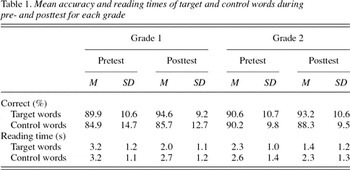
Observations during posttesting strongly suggested that the target words were read with a reading style characterized by more direct word recognition, without a loss in accuracy. The reading speed and accuracy data that was gathered on the pretest and posttest were analyzed with a repeated-measures analysis. Factors were time of testing, type of word, whereas training condition, and LED were entered as between-subject variables. Although the target words were reading age appropriate for each grade, the materials differed and therefore separate analyses were done for each group. The results are presented in Table 1.

Grade 1
A repeated-measures analysis on reading times revealed that overall reading time had improved significantly from pretest to posttest, F (1, 90)=135.77, p<.001, ηp2 = .60. Furthermore, a main effect for type of word indicated that target words were read faster than control words, F (1, 90)=48.39, p<.001, ηp2 = .35. More importantly, the interaction between time of measurement and type of word list showed that the gain was significantly larger for target than for control words, F (1, 90)=31.67, p<.001, ηp2 = .26. The analysis of the accuracy data showed that overall accuracy had improved by training, F (1, 90)=7.60, p<.01, ηp2 = .08. Also, on average the accuracy for target words was higher than for control words, F (1, 90)=39.40, p<.001, ηp2 = .30. No between-subjects effects nor any interaction was found involving LED or condition as a variable (F values < 1).
Grade 2
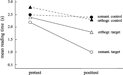
The repeated-measures analysis on reading times demonstrated that reading speed had improved on the posttest compared to the pretest, F (1, 50)=89.22, p<.001, ηp2 = .64. Overall, target words were read faster than control words, F (1, 50)=52.65, p<.001, ηp2 = .51. Additionally, an interaction between time of measurement and type of word indicates that the target words had actually improved more than the control words, F (1, 50)=14.03, p<.001, ηp2 = .22. A significant interaction between time of testing, type of word, and condition, F (1, 50)=8.60, p<.01, ηp2 = .15, indicated that the difference in improvement between the target and control words is larger when the subjects received semantic instead of orthographic exercises (see Figure 1). Results regarding accuracy only demonstrated a significant main effect for type of word, indicating a more accurate performance on target words than on control words, F (1, 50)=4.13, p<.05, ηp2 = .08. No main or interaction effects were found involving LED in either the reading times or in the accuracy analyses (Fs<1). Thus, training with LED did not influence size of training effect.

The mean reading time per word as a function of time of testing (pretest–posttest), type of word (target–control), and type of training (semantic–orthographic) in Grade 2.
Discussion
The goal of the present experiment was to compare the effect of a reading remediation program focused on orthography with the results of training words with a focus on semantics. Furthermore, the influence of LED during the repeated reading exercises was examined. The results clearly demonstrated a substantial improvement in reading time for the trained words compared to the control words. Limiting the exposure duration did not appear to have an effect. Whereas no effect for type of condition was obtained in Grade 1 for the children in Grade 2 the gain in reading speed appeared to be larger when they practiced the reading age-appropriate words with semantic exercises than with orthographic training. The findings evidently are supporting the hypothesis that semantic training is most effective for improving reading fluency. Exercises that call for associating the printed form of a word with semantic aspects do yield an increase in reading speed without an accuracy tradeoff. These results thus corroborate for example the findings of Sandak et al. (2004).
The present results show that training with semantic exercises could be more effective as a means to improving reading speed than orthographically focused training. However, our youngest group of participants with just 6 months of formal reading instruction seem not to benefit from semantic oriented practice in a similar way. In this younger group the orthographic and semantic conditions both had a significant effect on the reading time for the target words, but there was no difference between the two conditions. It is possible that these poor beginning readers require relatively more orthographic processing, preventing them to profit from explicitly focusing on the semantic dimension.
As discussed before, previous research findings led to the conclusion that reading practice in context could have less favorable effects on learning about the specifics of printed words because of top-down guessing processes. Therefore, the design for the present experiment required instead the explicit identification of the word and actively accessing the meaning of a word. One could object though that the current training exercises involved some top-down processing as well. The first stimulus did provide information about the semantic characteristics of a target word. However, that occurred merely in half the cases (only the items that required positive answers). In addition, to comply with the task requirements, deliberate access of the specific meaning of the word was necessary and guessing was not likely a firm basis for choosing a response in the specific task requirements. Furthermore, the questions in the semantic condition of the present experiment were rather general (e.g., is it an animal?), enabling only very limited top-down processing. Therefore, we would argue that the semantic exercises encourage children to identify the word rather independently and additionally process the semantic aspects of the word. Finally, superficial guessing would not be able to explain why this type of exercise allowed them to increase the fluency in reading these words more effectively than the exercises focused on the orthographic pattern.
EXPERIMENT 2
There were several reasons to carry out an additional experiment. First, the possible reading age-dependent effects of orthographic and semantic exercises were examined in a group of seriously delayed readers that are developmentally in between the two groups of the first experiment. If beneficial effects of semantic training over orthographic conditions can be found only after some initial period of reading development, then semantic training in this intermediate group could show more positive effects than orthographic training.
Second, the large number of repetitions in the previous experiment may actually have obscured other or more pronounced effects, for example, effects of LED. The target words were repeated 32 times, and the effects of training seemed to stabilize at the end of the training, even though perfect performance was not obtained. Previous research on word learning curves of poor readers suggested that such a high number of repetitions may not be necessary to reach similar training results (Lemoine, Levy, & Hutchinson, 1993). The results of Lemoine et al. (1993) indicated that, on average, the major gains in time and accuracy during repeated reading reach a maximum after approximately six trials. However, they also found that retention effects were larger if overlearning of the words had taken place. As an attempt to balance the opportunities for effects of training conditions and maintaining retention, the number of repetitions was decreased to 25 in the next experimental training study.
Third, comparisons between the effects of orthographic and semantic exercises were based on between-subjects comparisons in the first experiment. Assignment to practice conditions was semirandomized in an attempt to keep reading level of the groups as equal as possible. Although this procedure was successful as indicated by the results on the pretest, a more sensitive and powerful comparison of conditions is a within-subject design. As in the first study, the children received either orthographic or semantic training in the beginning. However, after independently practicing for 10 sessions word reading of targets and control words was tested and then children received another series of practice sessions in which conditions were switched. As a result, all children received both types of training successively and the order was counterbalanced.
Method
Participants
A new group of 79 reading delayed children from beginning of Grade 2 (mean age = 7.8 years, SD = 0.4; 11 months of reading education) was selected in a similar way as in the previous experiment. Teachers from 16 class-rooms (more than 400 pupils) selected the poorest readers and then reading skill was independently assessed by us using a Dutch norm referenced word reading task (Brus & Voeten, 1973). According to the norms, the children belonged to the lowest 20% of their age group. After selection, the children were randomly assigned to one of four training conditions, while controlling for reading level and keeping the number of participants in each of the conditions about equal.
Materials and procedures
Two series of training sessions were designed with separate lists of 10 target and 10 control words to serve as pre- and posttest in each series. All target and control words were concrete and familiar mono- or bisyllabic words, some included consonant clusters at the beginning or end of the word. Appendix A provides an overview of the target and control words, including measures of imageability, familiarity, and age of acquisition. Overall, the words in the second study could be considered high in imageability (average = 6.3 on a 7-point scale) and very familiar to the subjects (93% of 6-year-olds are familiar with these words). All subjects practiced with the same target words. Accuracy and reading speed for the lists were about equal at the start of the experiment (Fs<1).
The children received the same type of orthographic or semantic exercises as in Experiment 1. Because accuracy rates during training in the first experiment might have been influenced by the required keyboard response, slight alterations were made in the computer program. To make a new item appear, the subjects now had to press the left mouse button and to make yes–no decisions the child had to click on designated buttons on the screen. Only feedback on accuracy was given. A drawing of a happy bear indicated a correct answer, whereas a sad bear was indicative of an error. No feedback regarding reaction speed was given because this specific type of feedback did not seem to have effects in repeated reading training (Donker, Berends, & Reitsma, 2004).
At the start of the experiment, LED was set at 600 ms and adjustments during practice were individually based on RTs and accuracy. If accuracy of previous items was above 75%, and mean RT was shorter than 2 s, the exposure duration was shortened by 10%. If one of these two conditions was not met, LED remained unaltered, and if both of the conditions were not achieved, exposure duration was lengthened with 10%. The advantage of this procedure was that fluency of response was taken into account and LED was not decreased until some fluency was attained, preventing premature increases in level of difficulty.
After individual instruction and a practice session consisting of ten items, the children received 25 items per session. The children practiced three times per week, for a total of 10 sessions. Consequently, each target word was repeated 25 times. After the last session of this first series of sessions, a reading test of practiced target and control words was administered, as well as a test for new target and control words for the next series of practice sessions. The number of errors and total reading time for each list were noted by the experimenter. For the second part of the experiment, the children changed condition. Children who first practiced with orthographic exercises, trained with semantic exercises in the second part of the experiment, and vice versa. Whether children trained with LED or without LED did not change from the first to the second part. After switching conditions, the children again practiced three times a week for a total of 10 sessions. About a week after the 10th session, a final posttest of the target and control words was administered.
Results
The data that were recorded by the computer during training were analysed first. The RTs during training decreased from 3.5 s in the first session to 2.4 s on average, F (1, 319)=65.5, p<.001, whereas accuracy remained stable at about 80%. Apparently, the alterations in required response did result in higher accuracy rates compared to Experiment 1 (about 70%). Training with LED resulted in faster responses (2.5 vs. 2.8 s), F (1, 1559)=15.4, p<.001, but lower accuracy (76 vs. 82%), F (1, 1559)=65.5, p<.001. Also, a within-subject comparison between conditions revealed that during orthographic training accuracy was lower (75 vs. 83%), F (1, 75)=148.4, p<.001, but response times were shorter (2.5 vs. 2.8 s), F (1, 1559)=14.7, p<.001, than during semantic training.
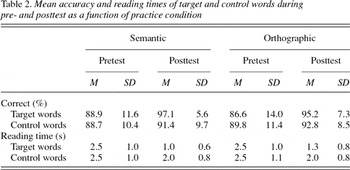
In Table 2, the mean reading times and accuracy rates on the word reading tests during the pretest and posttest for both the semantic and orthographic condition are presented. Observations during testing again suggested that the reading style of the children had changed as a result of the training: more trained words were read with direct word recognition responses instead of by way of elaborate decoding without a trade-off with accuracy.

The pre- and posttest data were analyzed with a repeated-measures analysis. Within-subject factors were time of testing, condition, and type of word. Order of condition, and LED were entered as between subject variables.
Reading speed
Analyses showed that reading times decreased between pre- and posttest, F (1, 75)=444.07, p<.001, ηp2 = .86, and that target words were read faster than control words, F (1, 75)=132.93, p<.001, ηp2 = .64. A significant interaction effect between type of word and time of testing revealed that reading times for target words declined more than reading times for control words, F (1, 75)=194.69, p<.001, ηp2 = .72. Finally, a significant interaction between time of testing, type of word, and condition, F (1, 75)=6.48, p<.02, ηp2 = .08, indicated that the difference in improvement between the target and control words is larger when the subject trained with semantic instead of orthographic exercises. Whereas reading times at the pretests were virtually equal in all conditions, subjects who practiced with semantic exercises improved more than children who practiced with orthographic-based exercises. Order of condition did not influence the latter interaction. Thus, whether a child first practiced with orthographic or semantic training did not yield an overall difference in improvement between conditions.
Accuracy
A main effect for time of testing indicated that posttest scores are on average higher than pretest scores, F (1, 75)=67.77, p<.001, ηp2 =.48. Target words tend to be read more accurately than control words, F (1, 75)=3.85, p<.06, ηp2 = .05. A significant interaction between time of testing and type of word indicated that target words improve more in accuracy over time than control words, F (1, 75)=17.20, p<.001, ηp2 = .19. Furthermore, the average difference between the target and control words is larger if a child has been trained with semantic exercises, F (1, 75)=10.24, p<.01, ηp2 = .12, but this effect was not affected by time of testing. No other significant effects were found, indicating a greater effect on accuracy for either orthographic or semantic exercises, or main or interaction effects involving LED.
Discussion
The aim of the second experiment was to replicate the first study and examine whether semantic exercises after 1 year of formal reading instruction would be more effective than training focused on orthography. The previous experiment found positive effects of semantic exercises beyond orthographic exercises on reading fluency after only 16 months of reading instruction. This second study clearly confirmed the previous findings: repeated reading resulted in sizable gains both in reading time and accuracy for the trained words compared to the control words, and the gains were most pronounced when practicing with semantic assignments. This second experiment implies that reading delayed Grade 2 students, after receiving only 11 months of formal reading instruction, have acquired sufficient knowledge on orthography to benefit from reading exercises that focus on semantics instead of emphasizing only the (smaller) orthographic elements of a word.
No effects were found for LED. It should be noted again that the comparison between LED conditions was between subjects, and therefore should be interpreted with some caution. The conclusion of van den Bosch and van Schreuder (1995) on favorable effects of LED could not, however, be confirmed in the present study in which a proper control group was included. Of course, null findings do not preclude the possibility of beneficial effects of LED in other conditions. Whereas detrimental effects on reading efficiency were previously found (Yap & van der Leij, 1993) with a presentation duration of 200 ms, the present studies employed considerable longer times. It is thus possible that effects of LED appear when shorter presentation durations are used. A shorter LED may more effectively minimize (partial) decoding of a word and might promote direct word reading. More detailed examination of the effect of LED is necessary before strong conclusions can be drawn.
In this second experiment the number of repetitions was decreased compared to the number of repetitions in the first one. Although the between-group comparison prevents firm conclusions, this reduction apparently does not diminish effects of practice in repeated reading. The current experiments were not designed to find an optimal number of repetitions, but there is abundant research evidence showing that poor readers generally need much more practice before they are acquainted with the orthographic form of a word (e.g., Lemoine et al., 1993; Reitsma, 1983; Share 1995, 1999). Sufficient practice may enable the poor readers to gradually store the orthographic form into memory and rely on direct recognition at the time of posttesting.
GENERAL DISCUSSION
The main purpose of the two studies was to examine the effects of different formats of repeated reading on gains in fluency. The crucial comparison was between exercises in which the focus was on the orthography or on the semantics of the word. Furthermore, the effect of presenting words with LED was evaluated, but no effects appeared. The results of the two experiments together indicate that exercises with attention to the semantic characteristics of a word seems to be effective for reading disabled children who received 11 or 16 months of formal training in reading. Gradually establishing word-specific orthographic entries in the mental lexicon is considered to be a fundamental ingredient for the development of fluency. Increasing orthographic representations in memory for words through repeated reading enables the reader in the end to identify printed words more accurately and rapidly (Ehri & Wilce, 1983; Lemoine et al., 1993; Perfetti, 1977, 1985; Share, 1995, 1999). Although both orthographic and semantic exercises in the present experiments seem to facilitate the development of reading fluency, the results indicate that the latter exercises appear to be most beneficial.
The experimental training studies contrasting orthographic and semantic oriented practice clearly show advantages for the task in which semantic judgments are involved. Of course, the various assignments employed in the present studies required several underlying processes in common. For example, even though the semantics-based training focused on the meaning of words, analysis of the orthographic pattern obviously played a role as well. Moreover, there is no way to exclude that via word identification some semantic aspects were triggered in the orthographic conditions. The common components and processes are likely the basis for substantial improvements in fluency in both conditions. For example, in both the orthographic and semantic condition of the second study, the dysfluent readers were able to read the practiced words in the posttest in less than half the time they needed during the pretest. Semantic orientation added significantly to the increase in reading fluency compared to orthographic exercises.
An explanation for the finding that practicing words in combination with their meaning seems to be more appropriate to attain fluency in delayed readers probably is that it more closely resembles the integration of component processes that is typical of fluent reading. Fluent reading processes require an efficient integration of written and spoken language. Recent neuroimaging research strongly suggests that cortical processing of initial reading is qualitatively different from processes that take place in the brain of a skilled reader. A heavy involvement of sublexical, graphophonological decoding at early stages of learning to read in left dorsal regions is gradually supplemented by and integrated with more direct connections between stored orthographic representations, meanings, and phonological word forms in ventral regions (e.g,. Ischebeck et al., 2004; Pugh et al., 2001; Sandak et al., 2004). Lexical specifications in terms of phonologic and semantic characteristics are gradually linked to orthographic specifications of individual words during learning to read (Perfetti & Hart, 2002). The pronunciation and semantic characteristics of a word can then be accessed more readily through its spelling rather than through effortful decoding. The present findings, together with the results of computational modeling (Harm & Seidenberg, 2004) and functional neuroimaging experiments (e.g., Sandak et al., 2004), strongly suggest that attending to the semantic characteristics when learning to read increases the quality of lexical representations and facilitates the development of reading fluency.
One could suggest as an alternative explanation of the present findings that the orthographic condition requires a less elaborate word identification process than the semantic condition. Matching of successive letter strings or clusters only calls for a detailed analysis of the orthographic specifications, and retrieval of the full phonology or semantic representations is not needed. In contrast, orthographic practice may well result in functional associations that facilitate subsequent independent reading of the word. This line of reasoning is, in fact, basically similar to the previous argument for favoring semantic involvement in practicing reading. However, it should be noted that the orthographic conditions also lead to substantial improvements of fluency in all three groups of participants. These positive effects of orthographic practice do not readily support the notion of shallow and superficial processing in this condition.
The current studies were carried out with reading a relatively regular orthography (Dutch). The spelling of words allows beginning readers to decode most words without many errors. Our participants indeed already had fairly high accuracy rates ranging from 85 to 90% on the pretests of the experiments. In comparison to English, problems in acquiring reading skills in regular orthographies often amount to difficulties in attaining fluency (Aro & Wimmer, 2003). One could ask whether the balance between the effects of orthographic and semantic practice is dependent on the regularity of the orthography. Deep orthographies may require relatively more attention to specific spelling sequences than a shallow orthography. An effect of irregularity might then be that orthographic training is profitable for a longer period during the course of learning to read than in the case of Dutch beginners.
Retarded readers were selected for participation in the current experiments. The cause of the reading difficulties of our subjects was not specifically examined, but based on extensive research literature it is likely that deficiencies in phonology contributed to their problems in acquiring fluent reading skills. Semantic conditions seemed to facilitate increases in fluency the most. It might well be that learning to associate the orthographic pattern to semantic representations serves to compensate for less efficient phonological skills, such as unnecessary elaborate decoding. A replication study including normally developing readers is needed to determine whether this is a viable option.
It should be noted again that the results of this experimental training study with dysfluent readers show word-specific effects. According to current theorizing (Harm & Seidenberg, 2004; Perfetti & Hart, 2002; Sandak et al., 2004; Share, 1999) a major source in the development of reading skill is the accumulation and integration of knowledge about individual words. It is no surprise then not to find any progress on control words, and no generalization to standardized reading is readily expected after training only a limited number of words. However, it has been shown that gaining fluency for specific words can help poor readers to better comprehend passages containing these words (Tan & Nicolson, 1997).
In sum, the findings suggest that to increase fluency in disabled readers it is important to make them think specifically about the meaning of words that they are practicing in decoding. Semantic training conditions do result in larger increases in reading efficiency than solely focusing on the orthographic pattern.
APPENDIX A