INTRODUCTION
Babesiosis, which is caused by tick-borne intra-erythrocytic protozoan parasites of the genus Babesia (order Piroplasmida, phylum Apicomplexa), is a well-known disease affecting a wide range of wild and domestic animals, including cervids, cattle, sheep, horses, and dogs (Criado-Fornelio et al. Reference Criado-Fornelio, Martinez-Marcos, Buling-Saraña and Barba-Carretero2003; Hunfeld et al. Reference Hunfeld, Hildebrandt and Gray2008). The interest in Babesia has recently increased with recognition of its role as a zoonotic agent of human babesiosis.
Several hundred cases of human babesiosis have been recorded in the USA and most of them were caused by Babesia microti, a natural parasite of microtine rodents and shrews. The clinical features in patients vary from asymptomatic to life threatening; the fatality rate is about 5% (Hunfeld et al. Reference Hunfeld, Hildebrandt and Gray2008). It is well established that Ixodes scapularis in the USA as well as I. ricinus and I. trianguliceps in Europe are vectors of B. microti (Foppa et al. Reference Foppa, Krause, Spielman, Goethert, Gern, Brand and Telford2002; Gray et al. Reference Gray, von Stedingk, Gürtelschmid and Granström2002; Hunfeld et al. Reference Hunfeld, Hildebrandt and Gray2008). Phylogenetic analysis based on the comparison of the 18S rRNA, beta-tubulin and CCT-eta genes of B. microti has shown a high heterogeneity of this species (Goethert and Telford III, Reference Goethert and Telford2003; Nakajima et al. Reference Nakajima, Tsuji, Oda, Zamoto-Niikura, Wei, Kawabuchi-Kurata, Nishida and Ishihara2009). Thus, B. microti is now recognized as a genetically diverse species complex that comprises several clusters. The most widely distributed cluster of B. microti (designated B. microti ‘US’-type) contains the zoonotic B. microti strains G1, Gray, and Jena/Germany, as well as isolates from microtine rodents from different parts of Eurasia (Gray et al. Reference Gray, Zintl, Hildebrandt, Hunfeld and Weiss2010; Zamoto et al. 2004Reference Zamoto, Tsuji, Kawabuchi, Wei, Asakawa and Ishiharaa, Reference Zamoto, Tsuji, Wei, Cho, Shin, Kim, Leonova, Hagiwara, Asakawa, Kariwa, Takashima and Ishiharab). Some B. microti strains and isolates from rodents and ticks in Germany (Munich), Poland and the United Kingdom belong to a second cluster, B. microti ‘Munich’-type (Pieniazek et al. Reference Pieniazek, Sawczuk and Skotarczak2006; Sinski et al. Reference Siński, Bajer, Welc, Pawełczyk, Ogrzewalska and Behnke2006; Nakajima et al. Reference Nakajima, Tsuji, Oda, Zamoto-Niikura, Wei, Kawabuchi-Kurata, Nishida and Ishihara2009). Two other clusters contain Japanese isolates of B. microti ‘Kobe’-type and B. microti ‘Hobetsu’-type (Tsuji et al. Reference Tsuji, Wei, Zamoto, Morita, Arai, Shiota, Fujimagari, Itagaki, Fujita and Ishihara2001).
In Europe, only 1 confirmed case of human babesiosis caused by B. microti infection has been reported (Hildebrandt et al. Reference Hildebrandt, Hunfeld, Baier, Krumbholz, Sachse, Lorenzen, Kiehntopf, Fricke and Straube2007), and about 40 cases have been caused by Babesia divergens and related parasites. Most cases have occured in splenectomized individuals, and the case fatality rate is about 40% (Gray et al. Reference Gray, Zintl, Hildebrandt, Hunfeld and Weiss2010). In addition to B. divergens, B. venatorum (originally designated EU1) was shown to be the causative agent of 3 cases in Austria, Italy and Germany (Herwaldt et al. Reference Herwaldt, Cacciò, Gherlinzoni, Aspöck, Slemenda, Piccaluga, Martinelli, Edelhofer, Hollenstein, Poletti, Pampiglione, Löschenberger, Tura and Pieniazek2003; Häselbarth et al. Reference Häselbarth, Tenter, Brade, Krieger and Hunfeld2007). The causative agents of 2 fatal cases of babesiosis in Portugal and the Canary Islands were initially identified as B. divergens; however, comparison of nucleotide sequences allowed them to be ascribed in latest reviews to B. divergens-like parasites (Hunfeld et al. Reference Hunfeld, Hildebrandt and Gray2008; Gray et al. Reference Gray, Zintl, Hildebrandt, Hunfeld and Weiss2010). In addition, Babesia closely related to B. divergens (Babesia sp. MO1) caused at least 3 cases of babesiosis in the USA (Herwaldt et al. Reference Herwaldt, de Bruyn, Pieniazek, Homer, Lofy, Slemenda, Fritsche, Persing and Limaye2004; Gray et al. Reference Gray, Zintl, Hildebrandt, Hunfeld and Weiss2010). Moreover, a lethal case of babesiosis in the Caucasian region of the former USSR was caused by Babesia sp. morphologically similar to B. divergens (Rabinovich et al. Reference Rabinovich, Voronina, Stepanova, Maruashvili, Bakradze, Odisharija and Gvasalija1978).
The specific vector of both B. divergens and B. venatorum is I. ricinus (Bonnet et al. Reference Bonnet, Brisseau, Hermouet, Jouglin and Chauvin2009; Becker et al. Reference Becker, Bouju-Albert, Jouglin, Chauvin and Malandrin2009); the natural hosts of B. divergens are cattle and of B. venatorum are roe deer (Zintl et al. Reference Zintl, Mulcahy, Skerrett, Taylor and Gray2003; Duh et al. Reference Duh, Petrovec, Bidovec and Avsic-Zupanc2005). One more Babesia species, Babesia capreoli has been found to infect cervids (roe deer, red deer, and sika deer) in different European countries. Despite a high phylogenetic similarity to B. divergens, B. capreoli differs from B. divergens in its host range and lack of zoonotic potential (Malandrin et al. Reference Malandrin, Jouglin, Sun, Brisseau and Chauvin2010).
A few papers so far describe the prevalence of Babesia in nature in the distribution area of Ixodes persulcatus in Russia. Thus, the aim of this work was to study the prevalence and genetic diversity of Babesia in ticks and small mammals in North Ural and West Siberia.
MATERIALS AND METHODS
Sample collection
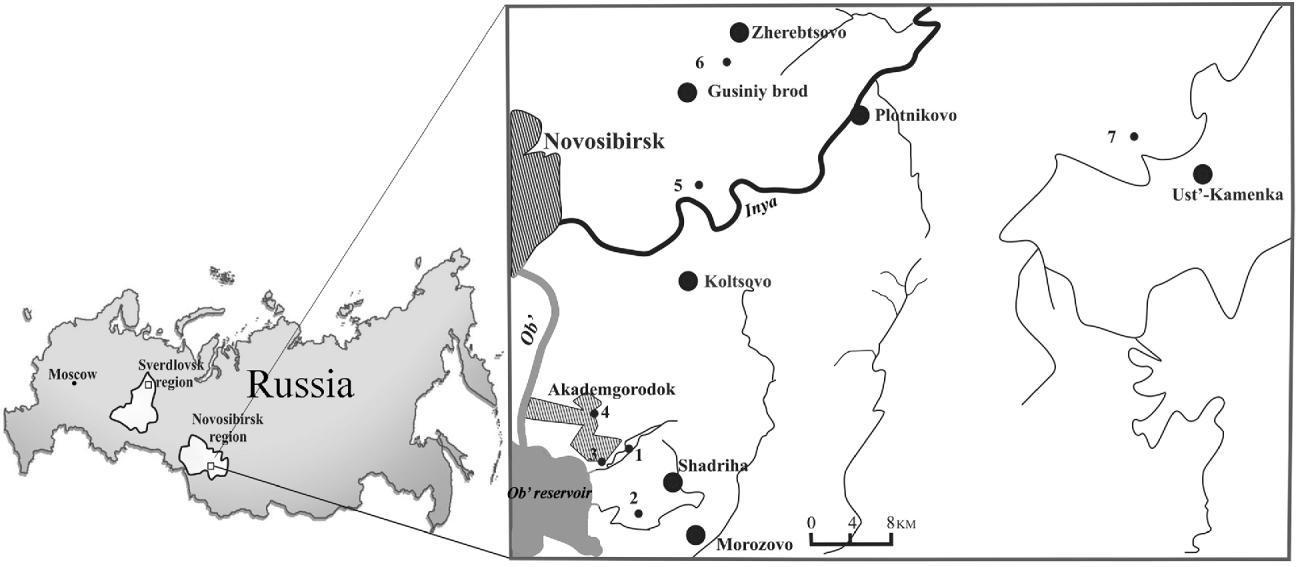
In total, 133 adult I. persulcatus ticks were collected by flagging the vegetation in the Sverdlovsk region, North Ural, (60°N, 59°E) in 2004 and 2009; in addition, 789 I. persulcatus were collected in 7 sampling sites of the Novosibirsk region, West Siberia, (55°N, 83°E) in 2008–2009 (Fig. 1). Ticks were stored at −20°C until used for DNA extraction.
Location of sampling sites in North Ural and West Siberia. The sites of tick collection in the Novosibirsk region are denoted as 1–7.

The sampling site in the Sverdlovsk region was located on the territory of Denezhkin Kamen' Reserve in mixed birch-aspen or pine–birch forests near the northern border of the I. persulcatus distribution area.
The sampling sites in the Novosibirsk region comprised: (1) mixed aspen-birch forest near Novosibirsk Scientific Centre (Akademgorodok), (2) pine forest about 8 km from Novosibirsk Scientific Centre, (3) pine forest near Novosibirsk Scientific Centre, (4) mixed aspen-birch forest near Novosibirsk Scientific Centre, (5) mixed birch-pine forest about 15 km from Novosibirsk, (6) mixed aspen-birch forest about 20 km from Novosibirsk and (7) mixed moist aspen-birch forest about 60 km from Novosibirsk.
Wild small mammals were trapped in the period of I. persulcatus activity. In total, 196 small mammals were caught using live traps in the Sverdlovsk region in June–July 2004–2005, and 285 small mammals were trapped in the Novosibirsk region in May–September 2003, 2006, and 2007. All experiments with animals were conducted in compliance with the Animal Welfare Act at the Institute of Systematics and Ecology of Animals, Siberian Branch of the Russian Academy of Sciences, according to the guidelines for experiments with laboratory animals (Supplement to the Order of the Russian Ministry of Health no. 755 of August 12, 1977). Trapped animals were anaesthetized with diethyl ether. Aliquots of blood were sampled into the tubes containing 50 mm EDTA.
DNA extraction
Total DNA was extracted from crushed ticks using a Proba NK kit (DNA-Technology, Moscow, Russia). Total DNA was extracted from 200 μl of blood according to the method of Boom et al. (Reference Boom, Sol, Salimans, Jansen, Wertheim-van Dillen and van der Noordaa1990).
PCR assay
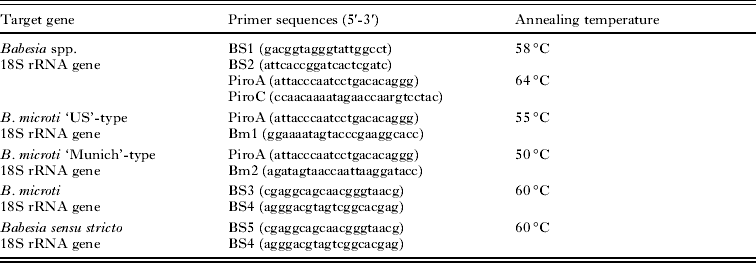
All PCR reactions were performed in 20 μl of the reaction mixture containing 67 mm Tris-HCl (pH 8·9), 16·6 mm (NH4)2SO4, 2 mm MgCl2, 0·01% Tween 20, 200 μ m of each dNTP, 5% glycerol, 0·5 μ m primers, 2 U of Taq DNA polymerase (Institute of Chemical Biology and Fundamental Medicine, Novosibirsk, Russia) and 2 μl of DNA for primary reactions or 2 μl of the primary PCR products for nested reactions. The PCR conditions comprised initial denaturation for 3 min at 94°C followed by 35 cycles of denaturation for 1 min at 94°C, annealing for 1 min at temperatures indicated in Table 1 and elongation for 1–1·5 min at 72°C. DNA extracted from blood samples of the dogs with confirmed babesiosis (Rar et al. Reference Rar, Maksimova, Zakharenko, Bolykhina, Dobrotvorsky and Morozova2005) was used as a positive control.
Primers used for nested PCR

For screening analysis, Babesia DNA was detected by nested PCR with the primers specific to the 18S rRNA gene of known Babesia species (Table 1.). The primers BS1 and BS2 were used for primary reactions, the primers PiroA (Armstrong et al. Reference Armstrong, Katavolos, Caporale, Smith, Spielman and Telford1998, modified) and PiroC, for nested reactions, the final products had a length of 340–390 bp. Second rounds of PCR using the forward primer PiroA and the reverse primer Bm1 specific to B. microti ‘US’-type or the reverse primer Bm2 specific to B. microti ‘Munich’-type were performed to genotype the positive samples from small mammals.
For sequencing analysis, second rounds of PCR with the forward primer BS3 and reverse primer BS4 were performed to amplify the 1272–1277 bp fragments of B. microti 18S rRNA gene, and the reactions with the forward primer BS5 and reverse primer BS4 were conducted to amplify the 1238 bp fragments of Babesia sensu stricto 18S rRNA gene.
Sequencing of the PCR products
Nucleotide sequences of the PCR products purified with GFX Columns (Amersham Biosciences, Piscataway, NJ, USA) were determined at the DNA Sequencing Center of the Siberian Branch of the Russian Academy of Sciences, Novosibirsk (http://sequest.niboch.nsc.ru) using an ABI PRISM 3100 Genetic Analyzer (Applied Biosystems, Foster City, CA, USA) and analysed by the BLASTN (http://www.ncbi.nlm.nih.gov/BLAST) and CLUSTALW (http://www.ebi.ac.uk/clustalw/index.html) programs. Phylogenetic analysis was performed using the MEGA 3.1 software (Kumar et al. Reference Kumar, Tamura and Nei2004). A phylogenetic tree was constructed by the neighbor-joining (NJ) method and, in addition, by maximum parsimony (MP) and minimum evolution (ME) methods. The stability of the constructed trees was estimated by bootstrap analysis with 1000 replicates. The clustering of analysed organisms was identical regardless of which phylogenetic method was used.
Nucleotide sequence accession numbers
The partial 18S rRNA gene nucleotide sequences of B. microti were deposited in GenBank under accession numbers AY943957, AY943958 and GU057383. The partial 18S rRNA gene nucleotide sequences of B. divergens and Babesia sp. (EU1) were deposited under accession numbers GU057385 and GU734773, respectively.
RESULTS
Detection of Babesia DNA in small mammals
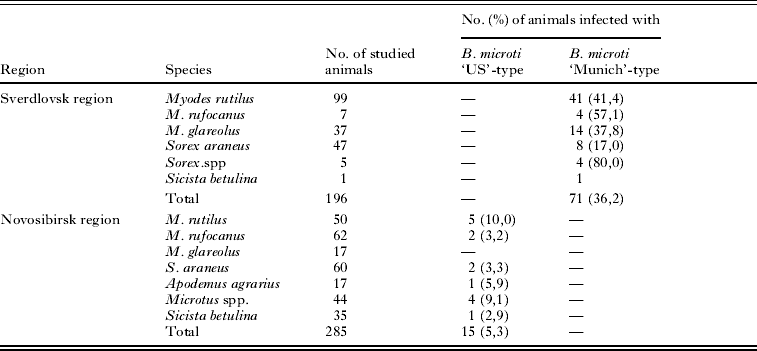
Babesia DNA was found using nested PCR in 71 of the 196 small mammals from the Sverdlovsk region and in 15 of 285 small mammals from the Novosibirsk region. Nucleotide sequences of the 18S rRNA gene were determined for 12 positive blood samples from the Sverdlovsk region and for 6 samples from the Novosibirsk region. All the determined Babesia 18S rRNA gene sequences from small mammals from the Sverdlovsk region were identical to each other (a typical sample was Ubl-104, GenBank accession no. AY943958) and to the sequence of B. microti strain Munich (GenBank accession no. AB071177). However, all the determined sequences from small mammals from the Novosibirsk region (a typical sample was Sbl-11, GenBank accession no. AY943957) were identical to the sequence of B. microti strain G1 (GenBank accession no. AF231348). Species-specific PCR was performed to genotype the other positive samples. All the positive samples from the Sverdlovsk region were successfully amplified with the primers specific to B. microti ‘Munich’-type, and all positive samples from the Novosibirsk region, with primers specific to B. microti ‘US’-type.
B. microti of both ‘Munich’-type and ‘US’-type were found in samples from different species of the examined small mammals: red-backed voles (Myodes rutilus), gray red-backed voles (M. rufocanus), common shrews (Sorex araneus), and northern birch mice (Sicista betulina). Moreover, B. microti ‘US’-type was found in the blood samples from tundra voles (Microtus oeconomus), common vole (Mi. arvalis), East-European field vole (Mi. rossiaemeridionalis), and striped field mouse (Apodemus agrarius), and B. microti ‘Munich’-type was detected in samples from bank voles (Myodes glareolus) and shrews (Sorex tundrensis, S. caecutiens, and S. isodon) (Table 2).
Detection of Babesia microti DNA in blood of small mammals by nested PCR

Detection of Babesia DNA in I. persulcatus
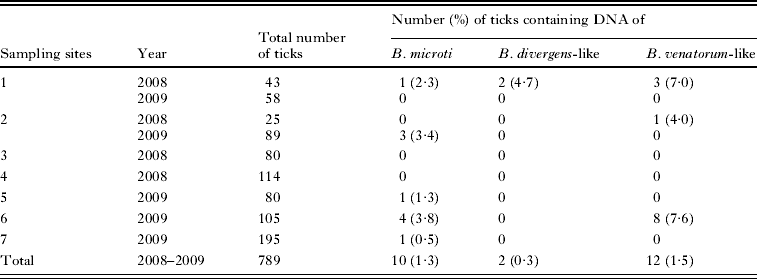
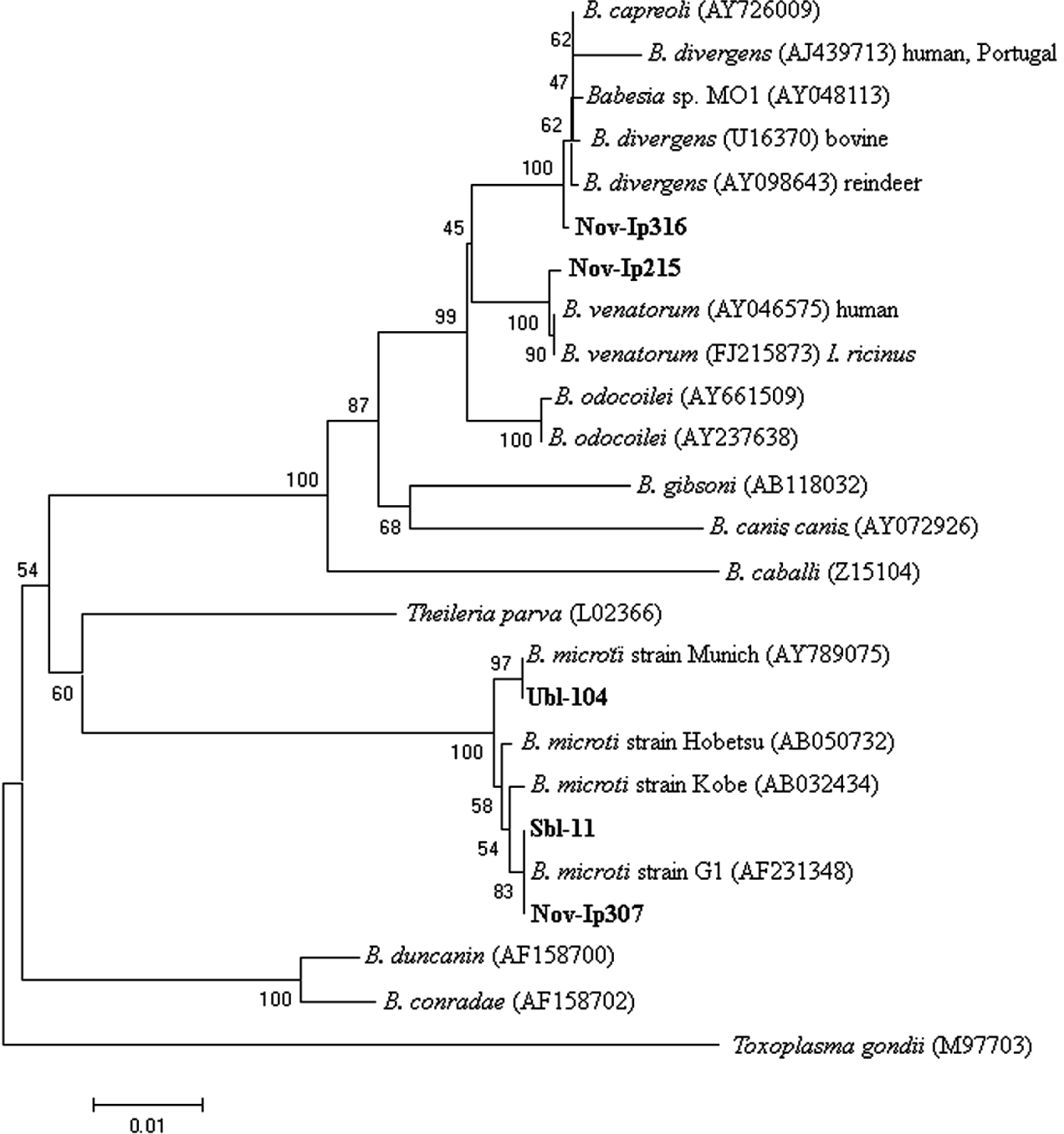
Babesia DNA was undetectable in 133 analysed ticks from the Sverdlovsk region but was found in 24 of the 789 I. persulcatus from the Novosibirsk region. Positive ticks were collected in 5 of the 7 sampling sites located at a distance of 3–65 km from each other (Fig. 1, Table 3). Nucleotide sequences of Babesia 18S rRNA gene fragments (1174–1211 bp) were determined for all positive ticks. The sequences from 10 ticks collected in sampling sites (1), (2), (5), (6), and (7) were identical to each other (a typical sample was Nov-Ip307, GenBank accession no. GU057383) and to the sequence of B. microti strain G1. The sequences from Nov-Ip316 (GenBank accession no. GU057385) and Nov-Ip341 ticks from sampling site (1) showed the highest level of identity (99·5%) to the sequences of B. divergens, B. capreoli, and Babesia sp. MO1 (GenBank accession no. U16370, FJ944827 and AY048113, respectively), and differed from all of them by 6 nucleotides. The determined babesial 18S rRNA gene sequences from 12 ticks from sampling sites (1), (2), and (6) were also identical to each other (a typical sample was Nov-Ip215, GenBank accession no. GU734773) and differed by only 2 of the overall 1174 nucleotides (99·8% similarity) from the 18S rRNA gene sequence of B. venatorum (GenBank accession no. AY046575).
Detection of Babesia spp. in Ixodes persulcatus in the Novosibirsk region

Phylogenetic analysis showed that the sample Nov-Ip316 clustered together with known B. divergens, B. divergens-like, and B. capreoli isolates with a strong bootstrap support, and the sample Nov-Ip215 clustered together with B. venatorum isolates (Fig. 2).
The phylogenetic tree constructed by the NJ method using the 1200-bp sequences of Babesia spp. 18S rRNA gene. The scale bar indicates an evolutionary distance of 0·01 nucleotides per position in the sequence. Toxoplasma gondii was used as an outgroup. The specimens from I. persulcatus (Nov-Ip215, Nov-Ip307, Nov-Ip316) and Mi. oeconomus (Sbl-11) from the Novosibirsk region and M. rutilus from the Sverdlovsk region (Ubl-104) from this study are in boldface.

DISCUSSION
The rodent parasite B. microti is spread worldwide in a wide range of small mammals, including Myodes spp., Microtus spp., Apodemus spp., and Sorex spp. (Goethert and Telford III, Reference Goethert and Telford2003; Zamoto et al. Reference Zamoto, Tsuji, Kawabuchi, Wei, Asakawa and Ishihara2004a). In Russia, B. microti were earlier found on the territory of West Ural in M. glareolus, M. rufocanus, M. rutilus, Microtus oeconomus, Apodemus uralensus, and Sorex spp. (Morozov et al. Reference Morozov, Kovalevsky, Korenberg, Gorelova and Podlesniy2006), and in the Far East in M. rufocanus and A. peninsulae (Zamoto et al. Reference Zamoto, Tsuji, Wei, Cho, Shin, Kim, Leonova, Hagiwara, Asakawa, Kariwa, Takashima and Ishihara2004b). Confirming these data, we found B. microti in North Ural and West Siberia in most of the examined species of microtine rodents (Myodes spp., Microtus spp., Apodemus agrarius, Sicista betulina) and insectivores (Sorex spp).
The site of North Ural examined in this study is located near the northern border of the I. persulcatus distribution area; this site displayed a low abundance of I. persulcatus and small mammals and a mosaic distribution of ticks. In addition to I. persulcatus, I. trianguliceps is abundant in the examined location (Livanova and Livanov, Reference Livanova and Livanov2010). Surprisingly, all the B. microti, found in small mammals from North Ural, were B. microti ‘Munich’-type parasites, previously identified only in Europe. Note, that the B. microti detected in small mammals in the neighbouring regions in West Ural (Telford III et al. Reference Telford, Korenberg, Goethert, Kovalevskii, Gorelova and Spielman2002; GenBank accession no. AY144693) and West Siberia were attributed to the widespread B. microti ‘US’-type. We failed to find any B. microti ‘Munich’-type in I. persulcatus despite a high prevalence of this Babesia in voles and shrews in North Ural. The reason of such discrepancy could be the low number of I. persulcatus analysed, or a smaller portion of infected adult ticks as compared with nymphs (Piesman et al. Reference Piesman, Karakashian, Lewengrub, Rudzinska and Spielmank1986). However, we analysed exclusively adult ticks, because only the adult stage of I. persulcatus could be readily collected by flagging. It was previously shown that I. trianguliceps in the United Kingdom is the most probable vector transmitting B. microti ‘Munich’-type to voles (Bown et al. Reference Bown, Lambin, Telford, Ogden, Telfer, Woldehiwet and Birtles2008). Thus, we cannot exclude involvement of I. trianguliceps in the transmission of B. microti ‘Munich’-type to vertebrate hosts in the examined territory of North Ural.
To date, publications on the detection of B. microti in I. persulcatus ticks are sparse. B. microti DNA was, for the first time, found in 0·9% of I. persulcatus in the northwestern part of Russia (Alekseev et al. Reference Alekseev, Semenov and Dubinina2003). Then it was shown that 3·6–4·0% of I. persulcatus from China contained B. microti ‘Hobetsu’-type, infective for rodents (Sun et al. Reference Sun, Liu, Yang, Xu and Cao2008). In this study, B. microti DNA was, for the first time, found in I. persulcatus from Siberia. All B. microti parasites detected in the ticks were shown to be B. microti ‘US’-type, also detected in small mammals in the same region.
In addition to B. microti, 2 different Babesia species closely related to but distinct from both B. divergens/B. capreoli and B. venatorum were found in I. persulcatus from the Novosibirsk region. To our knowlenge, this is the first detection of Babesia sensu stricto in I. persulcatus ticks. Note, that it is not always possible to reliably differentiate the species from Babesia sensu stricto cluster by phylogenetic analysis due to minor differences in nucleotide sequences. In particular, various bovine B. divergens isolates can differ from each other by 1–2 base pairs in the 18S rRNA gene (reviewed by Gray et al. Reference Gray, Zintl, Hildebrandt, Hunfeld and Weiss2010), whereas 2 apparently distinct species, B. divergens and B. capreoli, differ by only 3 bases in the same gene (Malandrin et al. Reference Malandrin, Jouglin, Sun, Brisseau and Chauvin2010). So far, it remains disputable whether the Babesia isolates found in I. persulcatus are conspecific to any of the valid Babesia species.
Note, that the distribution of infected ticks was highly mosaic. In particular, B. venatorum-like parasites were found only in 3 of the 7 examined sampling sites and in 2 of them, about 7·0% of the ticks were positive. Furthermore, the portion of ticks infected with Babesia spp. in sampling site (1) varied in different years from 0 to 14% .
It is well known that different species of Babesia sensu stricto parasitize different vertebrate hosts. In Europe, parasites from the B. divergens group infect mainly cervids and cattle (Malandrin et al. Reference Malandrin, Jouglin, Sun, Brisseau and Chauvin2010; Zintl et al. Reference Zintl, Mulcahy, Skerrett, Taylor and Gray2003), whereas in the USA Babesia sp. MO-1 naturally infect cottontail rabbits (Spencer et al. Reference Spencer, Goethert, Telford and Holman2006). Further study is necessary to determine the possible hosts of B. divergens-like and B. venatorum-like parasites detected in I. persulcatus ticks in Siberia.
ACKNOWLEDGMENTS
The authors are grateful to S.G. Livanov (Institute of Systematics and Ecology of Animals) for his assistance in sampling and to N.V. Fomenko and S.E. Tkachev (Institute of Chemical Biology and Fundamental Medicine) for their assistance in DNA extraction, and to N.A. Titova for technical support.
FINANCIAL SUPPORT
This study was supported in part by the Siberian Branch of the Russian Academy of Sciences (Integration interdisciplinary project No. 63 and Integration project No. 6).