INTRODUCTION
Reducing systems in which carbon is fixed chemosynthetically by bacteria, e.g. methane, hydrocarbon and brine seeps, dead whale-falls, hypoxic sulphidic settings and hydrothermal vents, are now known to be conspicuous components of the benthic realm (Gage & Tyler, Reference Gage and Tyler1991; Duperron et al., Reference Duperron, Nadalig, Caprais, Sibuet, Fiala-Médioni, Amann and Dubilier2005). A particular type of these systems are those associated with the seafloor seepage of hydrocarbons (e.g. methane), also known as cold-seeps. These systems are known from both active and passive continental margins worldwide, and cover a vast bathymetric range, from the shelf to trenches (Barry et al., Reference Barry, Greene, Orange, Baxter, Robison, Kochevar, Nybakken, Reeds and McHugh1996; Corselli & Basso, Reference Corselli and Basso1996; Olu et al., Reference Olu, Lanc, Sibuet, Henry, Fiala-Médioni and Dinet1997; Olu-Le Roy et al., Reference Olu-Le Roy, Sibuet, Fiala-Médioni, Gofas, Salas, Mariotti, Foucher and Woodside2004; Campbell, Reference Campbell2006). Biological communities at methane seeps are in general dominated by highly endemic chemosymbiotic metazoans, such as bivalves of the families Vesicomyidae, Lucinidae, Thyasiridae, Mytilidae (bathymodiolin mussels), Solemyidae, Manzanellidae and Teredinidae (Cosel & Olu, Reference Cosel and Olu2008, Reference Cosel and Olu2009), together with vestimentiferan tubeworms and free living filamentous bacteria. These particular systems are found where methane or other hydrocarbons are expelled from the seafloor at accretionary prisms, mud and salt diapirs, buried organic-rich sediments associated to slope mass-wasting processes and also nearby sites with high sedimentation rates close to river deltas (Barry et al., Reference Barry, Greene, Orange, Baxter, Robison, Kochevar, Nybakken, Reeds and McHugh1996; Tunnicliffe et al., Reference Tunnicliffe, Juniper, Sibuet and Tyler2003). At the western Atlantic, the presence of these systems has been well documented in the Gulf of Mexico, the Florida escarpment, and in the slope off the coast of Louisiana (Paull et al., Reference Paull, Hecker, Commeau, Freeman-Lynde, Neumann, Corso, Golubic, Hook, Sikes and Curray1984; Carney, Reference Carney1994; Sibuet & Olu, Reference Sibuet and Olu1998; Cordes et al., Reference Cordes, Carneya, Hourdez, Carney, Brooks and Fisher2007). Reports of recent seep communities or taxa off the South American coasts exist also for north-eastern Brazil (e.g. Calyptogena birmani—Domaneschi & Lopes, Reference Domaneschi and Lopes1990), Uruguay (e.g. Lamellibrachia victori—Mañé-Garzón & Montero, Reference Mañé-Garzón and Montero1986), Chile (e.g. Ectenagena australis—Stuardo & Valdovinos, Reference Stuardo and Valdovinos1988; a seep site off Concepción—Sellanes et al., Reference Sellanes, Quiroga and Gallardo2004, Reference Sellanes, Quiroga and Neira2008; Sellanes & Krylova, Reference Sellanes and Krylova2005), and the Yaquina Basin methane seeps off Peru (Olu et al., Reference Olu, Duperret, Sibuet, Foucher and Fiala-Médioni1996). Palaeontological and recent evidences for the presence of these communities are also available for the Paleogene and Neogene in Barbados, Trinidad and Venezuela (Gill et al., Reference Gill, Harding, Little and Todd2005), where their presence has been associated with the accretionary prism at the subduction site of the Caribbean plate below the North Atlantic plate. As in most recent seep sites, the assemblages were dominated by bivalves of the above mentioned families. But Gill et al. (Reference Gill, Harding, Little and Todd2005) also show a comparative list of the taxa from modern seep communities of the Barbados Prism and Gulf of Mexico.
The occurrence of gas hydrates in the Colombian Caribbean was first described by Shipley et al. (Reference Shipley, Houston, Buffler, Shaub, Mcmillen, Ladd and Worzel1979) in Lopéz & Ojeda (Reference López and Ojeda2006). However, only geological research has been conducted on this topic and this was aimed at exploring hydrocarbon sources. In Colombia, the presence of some of these bivalve families has been sparsely reported in taxonomic studies or inventories of the continental margin fauna, but lacking any ecological information. For the family Vesicomyidae, Boss (Reference Boss1967a, Reference Boss1968) described some species based on material collected off northern Colombia. Most recently, Taylor & Glover (Reference Taylor and Glover2009) described two species of the family Lucinidae, found on the middle of the Colombian Caribbean coast. Nearby this area the presence of gas escaping from the seafloor at the shelf and slope (to 1370 m depth) has been reported from off Ciénaga Grande de Santa Marta (Shepard et al., Reference Shepard, Dill and Heezen1968; Shepard, Reference Shepard1973), towards the Gulf of Urabá and has been associated with the presence of diapirs and mud volcanoes (Duque-Caro, Reference Duque-Caro, Bonini, Hargraves and Shagam1984; Ojeda et al., Reference Ojeda, Hernández and Olaya2004; López & Ojeda, Reference López and Ojeda2006).
Recently, several projects have improved our knowledge of the shelf and slope (20 to 940 m depth) benthic fauna of the Caribbean Sea off Colombia (e.g. Macrofauna I, 1998; Macrofauna II, 2001; ANH–I, 2008; and ANH–II, 2009). Among the results of these studies, most relevant are the discoveries of deep water coral habitats off La Guajira, Magdalena and Bolívar (Reyes et al., Reference Reyes, Santodomingo, Gracia, Borrero-Pérez, Navas, Mejía-Ladino, Bermúdez, Benavides, Freiwald and Roberts2005; Santodomingo et al., Reference Santodomingo, Reyes, Gracia, Martínez, Ojeda and García2007), evidence of deep water calcareous algae (unpublished data), and now, biological and geological evidence supporting the presence of cold-seeps in the Sinú and Magdalena areas.
This paper reports on new findings of chemosymbiotic species off Colombia, as well as the presence of other indicators of seep activity, such as authigenic carbonates. These results help to elucidate the biogeographical patterns of chemosymbiotic assemblages in the Caribbean Sea and the western Atlantic area, and are discussed within the geological context of the area.
MATERIALS AND METHODS
Geological setting
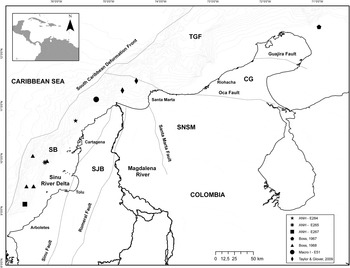
The Colombian Caribbean is located in an active tectonic zone in which the Caribbean and South American plates interact (Figure 1). This interaction has generated magmatic arches (from the Jurassic to the Paleogene), the accretion of ophiolitic fields (e.g. ophiolitic series of the Jurassic) and the formation of a wedge or folded belts denominated in the literature as Sinú and San Jacinto (Duque-Caro, Reference Duque-Caro1979; Toto & Kellogg, Reference Toto and Kellogg1992; Flinch, Reference Flinch, Bartolini, Buffler and Blickwede2003; Sánchez & Permanyer, Reference Sánchez and Permanyer2006). These belts have created a sedimentary basin up to 12 km thick, which was accreted to the South-American margin during the Cenozoic, and extends from Urabá (south-west—Caribbean of Colombia) to Venezuela (Duque-Caro, Reference Duque-Caro1979; Toto & Kellogg, Reference Toto and Kellogg1992).
Map showing the location of the sampling stations, as well as previous references indicating the presence of representatives of the families Vesicomyidae, Solemyidae, Lucinidae and other species associated with methane seeps in the Colombian Caribbean. The stations located in the middle of the Colombian Caribbean belong to the Magdalena area and those located in the southern area correspond to Sinú. Boss (Reference Boss1967a): Vesicomya caribbea; Boss (Reference Boss1968): V. cordata, Ectenagena modioliforma, Calyptogena ponderosa; Macrofauna I (E51): C. ponderosa, V. caribbea, Lucinoma sp. 1, Graecina colombiensis, Acharax caribbaea, E. modioliforma; ANH I E265: C. ponderosa, Lucinoma sp. 1; ANH E267: E. modioliforma, Lucinoma sp. 2, Lucinoma sp. 3. and various pieces of Vesycomyidae; ANH II E284: Cantrainea macleani and tubes of Lamellibrachia sp.; Taylor & Glover (Reference Taylor and Glover2009): G. colombiensis and Jorgenia gracile; TGF: Guajira-Falcon Terrain; CG: Guajira Basin; SJB: San Jacinto Belt; SB: Sinú Belt.

All the continental shelf and slope areas of the southern Colombian Caribbean belong to the Sinú belt, which is bounded to the east by the Romeral fault system and to the west by the Colombia fault system. Lithologically this belt constitutes rocks from the lower Eocene to sediments of recent alluvial and marine origin. The majority is formed by a turbiditic sequence of very fine sediments up to 5000 m thick (Duque-Caro, Reference Duque-Caro1980) and the main characteristic of this belt is the widespread presence of mud diapirism.
According to the geomorphological conditions the southern part of the Colombian Caribbean, where the stations discussed in the present work are distributed, can be separated into two very distinct areas: (i) Magdalena, or the Magdalena Turbidity System (MTS); and (ii) Sinú, or the Accretionary Sinú Prism (ASP).
Magdalena constitutes a wide sedimentary accumulation on the northern part of the continental margin of Colombia. This system began to develop during the Pliocene, forming a sedimentary wedge that remains practically undeformed (Kolla et al., Reference Kolla, Buffler and Ladd1984). According to Ercilla et al. (Reference Ercilla, Alonso, Estrada, Ghiocci, Baraza and Farran2002) the MTS is ~230 km long, covers an area of ~53,000 km2, has a volume of 180,000 km3 and extends into water more than 4000 m deep. This turbidite system is fed by the Magdalena River, which has an average fluvial discharge of 5000 m3 s−1 (Kolla et al., Reference Kolla, Buffler and Ladd1984; Kolla & Buffler, Reference Kolla and Buffler1985; Pujos & Javelaud, Reference Pujos and Javelaud1991). The main geomorphologic features that characterize the seafloor of the MTS are: (i) submarine canyons; (ii) structural highs; (iii) levees and channels; (iv) mass flow deposits; (v) ridges; and (vi) scarps.
The Sinú sector covers most of the area named ASP. The features occurring within this area include drainage systems (broad channels and turbidity channels), anticlinal ridges with associated faults, seabed mounds and mass-transport systems such as slumps and debris flows. The drainage systems include broad lower relief drainage channels occurring mostly in the southern and northern parts of the area and thin high relief turbidity channels that generally occur in the central part of the area (similar to the Magdalena sector). The pathways or directions of flow of these drainage systems are structurally influenced. These drainage systems originate at the shelf and flow down into the abyssal plain. Small seabed mounds occur throughout the Sinú area. The mounds are probably buried mud diapirs, which are common in this area of offshore Colombia. As shortening occurs in some anticlines the mud is concentrated within the core of the anticline and is eventually pushed upwards. However, not all mud diapirs extrude to the seabed—some are trapped by sedimentation. The smaller seabed mounds occur in the east central part of the survey area and they range from 5 m to 10 m height (Rangel-Buitrago & Idarraga, Reference Rangel-Buitrago and Idarraga2010).
Biological sampling
Present investigations were carried out within ongoing research projects INVEMAR–Macrofauna I (1998 and 1999 on the Colombian Caribbean coast, which included samples taken broadly within 300 and 500 m depth), INVEMAR–ANH I (2008, sampled within 170 and 940 m depth) and INVEMAR–ANH II (2009, sampled within 30 and 700 m depth) (Figure 1).
These projects surveyed the area located between La Guajira peninsula (12°34′N–71°50′W) and the Gulf of Urabá (09°02′N–76°02′W). Most of the sampled areas comprised shelf and slope soft bottoms. Samples were obtained aboard BI ‘Ancón’ using a semiballoon trawling net with a mouth opening of 9 × 1 m, equipped with a protective bag of polyethylene with 10 mm stretched mesh-size at the cod-end, and operated at 3 knots in 10 minute hauls. The samples were carefully washed with water in a 500 µm sieve. Each sample was separated immediately, preserved in 70% ethanol and then transported to INVEMAR laboratories for further processing. In the present work we review and discuss only the mollusc collections, with the exception of additional seep indicator taxa (e.g. vestimentiferan tubeworms). Living organisms and shells were counted and identified to the lowest taxonomic level possible, with particular attention given to chemosymbiotic fauna. The taxonomic work was performed at the Museo de Historia Natural Marina de Colombia (MHNMC). The material is deposited in the Molluscs Collection of the MHNMC, Santa Marta, Colombia.
The information presented here is further complemented with a review of the existing records of chemosymbiotic taxa for the area (e.g. Boss, Reference Boss1967a, Reference Boss1968; Bayer et al., Reference Bayer, Voss and Robins1970; Taylor & Glover, Reference Taylor and Glover2009).
RESULTS
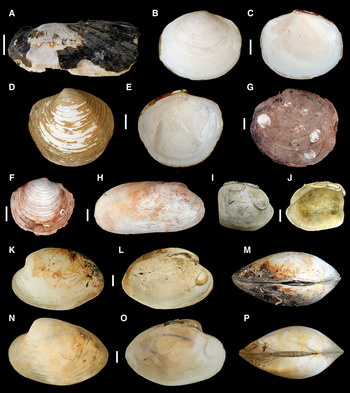
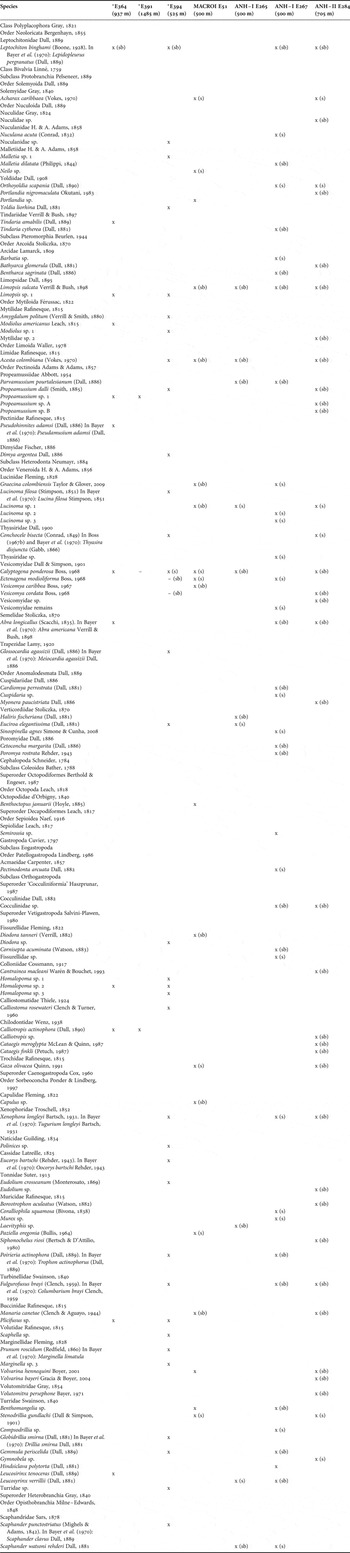
From the INVEMAR–Macrofauna I expedition, the most interesting finding regarding seep fauna was at Station E51 located west of the Magdalena River delta. At this site, the assemblage of chemosymbiotic bivalves included the families Solemyidae, Vesicomyidae, Lucinidae (Figure 2A–E, H & K–P) and Thyasiridae. Solemyids were represented by Acharax caribbaea (Vokes, 1970) (13 articulated valves) constituting the second known record for the species and extending its local range southward. Vesicomyids included Calyptogena ponderosa Boss, Reference Boss1968 (a single valve and a matching pair) and Vesicomya caribbea Boss, 1967 (a living specimen and a set of articulated valves). Locally the latter was known only from La Guajira, thus its local range was extended by our new records. Lucinids were represented also by two species, Lucinoma sp. 1 (a living specimen) and Graecina colombiensis Taylor & Glover, Reference Taylor and Glover2009 (a living specimen). The most conspicuous non-chemosymbiotic bivalves at this site included Limopsis sulcata Verrill & Bush, 1898 (Limopsidae), Acesta colombiana (Vokes, 1970) (Limidae) and Neilo sp. (Neilonellidae). The complete inventory, including sample numbers of all the molluscs obtained at each station, is detailed in Table 1.
Some species of chemosymbiotic bivalves found in the projects Macrofauna I, ANH I and II. (A) Exterior view of Acharax caribbaea, a relatively rare species, of which only the holotype, collected off Palomino was known; (B, C) exterior and interior views of Graecina colombiensis; (D, E) exterior and interior views of Lucinoma sp. 1; (F) exterior view of Lucinoma sp. 2; (G) exterior view of Lucinoma sp. 3; (H) exterior view of Ectenagena modioliforma; (I, J) exterior and interior views of Conchocele bisecta; (K, M) exterior, interior and dorsal views of Calyptogena ponderosa, T 40.15 mm; (N, O) exterior and interior views of Vesicomya caribbea; (P) dorsal view of articulated valves of V. caribbea, T 47.67 mm. T, tumidity. Scale bars: (A–H & K–P) = 1 cm, and (I–J) = 2 mm.

Species of molluscs found at the sampling stations which recorded the presence of families inhabiting reducing settings. *, indicate stations in the southern Colombian Caribbean surveyed by the RV ‘Pillsbury’ (see Bayer et al., Reference Bayer, Voss and Robins1970). Some records in Boss Reference Boss1968: (–). Where information is available, the condition of the material is specified: empty shells (s) or shells with soft-body (sb).

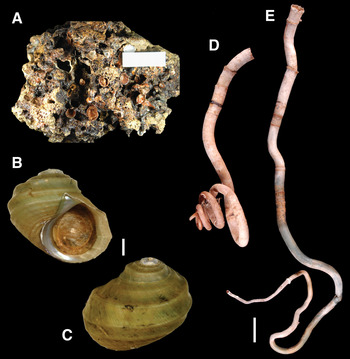
During the INVEMAR–ANH I survey, evidence from seep habitats was obtained from three sampling stations. Articulated valves of C. ponderosa were found at Station E265, located off Golfo de Morrosquillo. At Station E267 located off Arboletes, many fragments and shells corresponding to the above mentioned families of chemosymbiotic bivalves were collected, including two morphotypes of the family Lucinidae (Figure 2F, G). This station was also characterized by the presence of pieces of authigenic carbonates, corresponding to 16.5 kg in weight (Figure 3A).
Further evidence of the presence of seep habitats in the study area. (A) Authigenic carbonates collected off Arboletes (Station E267), scale bar = 4 cm; (B, C) frontal and dorsal views of Cataegis meroglypta, scale bar = 2 mm; (D, E) Lamellibrachia sp. tubes found off northern Cartagena (Station E284), scale bar = 2 cm.

From the INVEMAR–ANH II survey, living specimens of C. ponderosa were obtained at Station E284, north of Cartagena, and also some shells of A. caribbaea, Conchocele bisecta (Conrad, 1849) (Figure 2I, J) and fragments and shells of lucinids. It was remarkable that this station was also characterized by a significant number (>1000) of live specimens of the gastropod Cataegis meroglypta McLean & Quinn, 1987 (Figure 3B, C). Other conspicuous non-chemosymbiotic molluscs at this site included A. colombiana (Limidae), Manaria canetae (Clench & Aguayo, 1944) (Buccinidae) and Cantrainea macleani Warén & Bouchet, Reference Warén and Bouchet1993 (Colloniidae). Also remarkable was the presence for the first time at this site of empty tube worms of the family Siboglinidae (Figure 3D, E).
DISCUSSION AND CONCLUSIONS
Due to the particular geomorphological conditions, it is possible to find well developed sedimentary basins in an active margin at both studied areas (Magdalena and Sinú). These processes contribute to the formation of mud diapirs, which in turn constitute optimal scenarios for the occurrence of seeps. Methane-rich fluids exiting over-pressured regions migrate along low permeability pathways upward or outward, supporting the chemosynthetic communities (Barry et al., Reference Barry, Greene, Orange, Baxter, Robison, Kochevar, Nybakken, Reeds and McHugh1996; Tunnicliffe et al., Reference Tunnicliffe, Juniper, Sibuet and Tyler2003). However, as in most of the South American margin, no cold seep research has been carried out in Colombia so far, and the characteristic of these reducing systems is almost completely unknown.
Previous research that complements our findings includes the reports of Boss (Reference Boss1967a, Reference Boss1968) and Taylor & Glover (Reference Taylor and Glover2009). Boss (Reference Boss1967a) reported the presence of a living specimen of Vesicomya caribbea, off La Guajira peninsula (MV ‘Oregon’, Station 5692), at 375 m depth. Boss (Reference Boss1968) reported and described Vesicomya cordata Boss, Reference Boss1968 and Ectenagena modioliforma Boss, Reference Boss1968 from material collected off ‘Golfo de Morrosquillo’ (north–north-east of Punta Caribana), at 421–641 m depth (Station Pillsbury 394). At this station the lucinid Conchocele bisecta (Boss, Reference Boss1967b) was also present. Calyptogena ponderosa was reported off ‘Golfo de Morrosquillo’ (north–north-east of Punta Caribana), at 933–961 m (Station Pillsbury 364), off ‘Golfo de Morrosquillo’ (north–north-east of Punta Caribana), 421–641 m depth (Station Pillsbury 394) and off Cartagena, at 1417–1767 m depth (Station Pillsbury 391). Recently Taylor & Glover (Reference Taylor and Glover2009) described the lucinid Graecina colombiensis, found off Ciénaga Grande de Santa Marta, at 366 m depth (RV ‘Oregon’, Station 4840, 16 May 1964), and Jorgenia gracile Taylor & Glover, Reference Taylor and Glover2009 found off southern Isla de Salamanca, at 600 m (RV ‘Oregon II’, Station 11248, 9 November 1970), however no information on the habitat at the collection sites was provided.
The presence of living specimens of the bivalves ‘Calyptogena’ ponderosa (its generic placement within vesicomyids is still uncertain; E. Krylova, personal communication) and V. caribbea constitute strong evidences suggesting that active methane seep sites hosting chemosynthetic communities exist from north of the mouth of the Magdalena River (~500 m depth) to the southernmost Colombian Caribbean sea (~1700 m). Vesicomyids are highly adapted to sulphur-rich environments and they are often the dominant taxa in these reducing environments (Krylova & Sahling, Reference Krylova and Sahling2006). They host and derive their nutrition from symbiotic chemoautotrophic bacteria (Krylova & Jenssen, Reference Krylova and Janssen2006; Krylova & Sahling, Reference Krylova and Sahling2006). Calyptogena ponderosa has been also been reported from the Gulf of Mexico (upper slope off Louisiana) as a typical constituent of the cold seep assemblages (Cordes et al., Reference Cordes, Carneya, Hourdez, Carney, Brooks and Fisher2007), in addition to the siboglinid tubeworm Lamellibrachia cf. luymesi van der Land & Nørrevang, 1975, which is most probably the species recorded at Station E284. At hydrocarbon seeps in the Gulf of Mexico these vestimentiferan tubeworms form large bush-like aggregations and obtain their nutrition from sulphide-oxidizing endosymbiotic bacteria (Dattagupta et al., Reference Dattagupta, Miles, Barnabei and Fisher2006). It is also interesting to note that other non-chemosymbiotic species, like the Chilodontidae Cataegis meroglypta, which occurred at high densities at Station E284, has been also reported at the Bush Hill Seep (a hydrocarbon seep with thick growth of tube worms, mussel beds and bacteria mats off Louisiana) and also in Colombia, Trinidad and Barbados (Warén & Bouchet, Reference Warén and Bouchet1993; Gill et al., Reference Gill, Harding, Little and Todd2005). Similarly, the buccinid Manaria canetae and the colloniid Cantrainea macleani are also known to be associated with vestimentiferan bushes at seeps off Louisiana (Bergquist et al., Reference Bergquist, Ward, Cordes, McNeils, Howlett, Kosoff, Hourdez, Carney and Fisher2003). It is necessary to highlight that a fraction of the material (Table 1) was not identified to species level. It is therefore imperative to continue with this process since these data would provide further information about the composition of the communities present in these habitats off Colombia and their connections with other faunas in the Caribbean and Atlantic Ocean.
The generation of authigenic carbonate, as observed at Station E267, is a typical feature of the sites where methane is expelled from the seafloor. Crusts are formed by the precipitation of methane-derived bicarbonate released to pore-water during the anaerobic oxidation of methane (AOM) via sulphate reduction. A consortium of archaea and bacteria mediates the process (Boetius et al., Reference Boetius, Ravenschlag, Schubert, Rickert, Widdel, Gieseke, Amann, Jorgensen, Witte and Pffankuche2000). Sulphide, the other by-product of AOM, is in turn used by free-living filamentous bacteria, e.g. Beggiatoa and endosymbiont sulphide-oxidizing chemosynthetic prokaryotes (e.g. those present in vesicomyids, solemyids and lucinids), as an energy source for primary carbon fixation.
According to Barry et al. (Reference Barry, Greene, Orange, Baxter, Robison, Kochevar, Nybakken, Reeds and McHugh1996), the geological complexity and tectonically dynamic nature of continental margins favour cold seep formation in a variety of geological settings including subduction zones, accretionary complexes, and transform faulted boundaries that produce fault zones, channels and canyons, mud volcanoes or diatremes and submarine artesian springs. Thus, along active tectonic boundaries, faults can intercept and focus fluid migration, enhancing the development and persistence of chemosynthetic communities. These geomorphological characteristics are common at the study area and in this sense it is expected that such environments should be widespread in the Colombian Caribbean. The available data indicate that at least the southern part (Sinú area), where most of our records of chemosymbiotic species occur (Table 1), should be considered as a priority area for the study of seep environments. The scarcity of direct observations of seep communities for the Colombian Caribbean highlights a challenge that should be tackled in the short and medium term in order to gain sufficient information for assessing the current conservation status of these fragile communities. In Colombian waters it is important to improve characterization studies, complement information about taxonomically enigmatic species, carry out DNA sequencing (to establish whether there is gene-flow between zones), describe the ecology of the autotrophic and heterotrophic fauna and describe the geology and geochemistry of the habitats. Support also needs to be found for studies of deeper sites to continue filling gaps in our knowledge about the biogeographical patterns of seep communities at a global scale (Ramírez-Llodra et al., Reference Ramírez-Llodra, Tyler and German2003).
ACKNOWLEDGEMENTS
The results are part of the projects INVEMAR–Macrofauna I (code 210509–10401 funded by COLCIENCIAS) and INVEMAR–ANH I and II (funded by the National Hydrocarbons Agency). Funds during the writing phase of this work have been provided to J.S. by FONDECYT Project 1100166, CONICYT Chile. This paper is the contribution No. 1080 of INVEMAR.