Introduction
The kelp gull (Larus dominicanus Lichtenstein) is a widely distributed species in the Southern Hemisphere which breeds in South America, South Africa, Australia, New Zealand and the sub-Antarctic and Antarctic islands (www.birdlife.org, accessed April 2015). On the South Shetland Islands the kelp gull breeds during the summer in almost all ice-free areas, but mainly on coastal cliffs and pebble beaches (Sander et al. Reference Sander, Carneiro, Mascarello, dos Santos, Costa and Balbão2006).
Deception Island, where kelp gulls have been observed to breed, is known for its historical structures such as the old whaling station in Whalers Bay that was destroyed by a volcanic eruption in 1969. Parts of the wreckage of the old station still remain. In addition to kelp gulls, the island is home to several seabird species which use the area during the breeding season (Bó & Copello Reference Bó and Copello2001).
Kelp gulls breed in three different areas on Deception Island. The largest colony on the rocks of Fumarole Bay contains 40 nests, and the other sites consist of four and five nests along the moraines close to Collins Point and Cathedral Crags, respectively (Bó & Copello Reference Bó and Copello2001). During the 2013/2014 summer, the seabird populations on Deception Island were monitored in order to estimate population numbers. Breeding pairs and nests for all bird species were recorded and mapped using a hand-held GPS receiver by three observers. This is the first record of kelp gulls breeding at the whaling station on Deception Island, using oil tanks as nesting sites.
Results
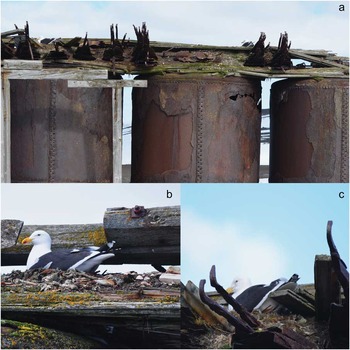
On 2 December 2013, during the annual monitoring of seabird breeding, eight kelp gull nests were recorded in Whalers Bay, Deception Island (63°00'S, 60°40'W). The nests were observed on oil containers that were covered by wooden planks (Fig. 1), c. 200 m from the old whaling station. The nests were built on slopes among the wood and iron structures on the tanks. The nests mainly consisted of vegetation and limpet shells (Nacella concinna Strebel). However, rope and other anthropogenic materials were found in one of the nests.
Oil tanks from the old whaling station, Whalers Bay, Deception Island, serving as a nesting site for kelp gulls. b. & c. Kelp gull nests and the anthropogenic materials, such as a rope, used for nest construction.

Discussion
This is the first report of kelp gulls breeding on oil tanks in the South Shetlands Islands. However, many Charadriiformes have adapted to breed in urban environments using man-made structures for breeding sites (Kubetzki & Garthe Reference Kubetzki and Garthe2007). For example, the herring gull (Larus argentatus Pontoppidan) and lesser black-backed gull (Larus fuscus L.) have been observed breeding on buildings in Britain and Ireland (Cramp Reference Cramp1971), and the black-legged kittiwake (Rissa tridactyla L.) has also been observed breeding on sheds, buildings and towers in the Northern Hemisphere (Turner Reference Turner2009).
For some bird species, colonization of anthropogenic structures can be explained by increases in the number of individuals and the lack of natural areas for reproduction (Kubetzki & Garthe Reference Kubetzki and Garthe2007). The study area has a variety of ice-free areas in which to breed so a lack of nest sites is not compelling the kelp gulls to use the buildings. However, in these areas there are high concentrations of breeding kelp gulls and skuas (Kendal et al. Reference Kendall, Ruhl and Wilson2003). This high density of nests may have resulted in the kelp gulls breeding on the oil containers as a strategy to increase breeding success. Another hypothesis is that by using these man-made structures, which do not require specific resources to build the nest, the kelp gulls are free of competition to breed.
Breeding sites are chosen primarily to provide protection for the chicks and eggs (Turner Reference Turner2009). The choice of location to build a nest is extremely important to ensure the breeding success of a species, and a nest site is chosen to avoid predation (Borboroglu & Yorio Reference Borboroglu and Yorio2004). Research on the mew gull (Larus canus L.) in the Northern Hemisphere indicates that these individuals use the tops of buildings for nesting to avoid predatory mammals (Kubetzki & Garthe Reference Kubetzki and Garthe2007). There are records of elephant seals (Mirounga leonina L.) along the coast of Deception Island but this species is not a predator of kelp gulls. However, the movements of individual seals along the coast and in breeding sites may cause nest destruction and death of chicks. Additionally, there are historic buildings which attract tourism (6373 tourists were recorded in 2013–14; www.iaato.org, accessed April 2015); the resulting anthropogenic activities may also negatively affect kelp gull breeding, resulting in their nesting on containers to ensure breeding success.
Acknowledgements
The project received funding from the National Institute of Science and Technology Antarctic Environmental Research (INCT-APA) that receives scientific and financial support from the National Council for Research and Development (CNPq process: n° 574018/2008-5) and Carlos Chagas Research Support Foundation of the State of Rio de Janeiro (FAPERJ n° E-16/170.023/2008). The authors also acknowledge the support of the Brazilian Ministries of Science, Technology and Innovation (MCTI), Environment (MMA), and Inter-Ministry Commission for Sea Resources (CIRM).
Author contribution
Petry, M.V. performed the field observations and co-ordinated the project. Petersen, E.S., Valls, F.C.L., Aver, G.F. and Petry M.V. wrote the manuscript.