


Party identification is one of the most important variables within empirical American political science, explaining vote choice, political engagement, partisan reasoning, and the influence of partisan elites (Bartels Reference Bartels2002; Campbell et al. Reference Campbell, Converse, Miller and Stokes1960; Green, Palmquist, and Schickler Reference Green, Palmquist and Schickler2002; Lavine, Johnston, and Steenbergen Reference Lavine, Johnston and Steenbergen2012; Lewis-Beck et al. 2008; Sniderman and Stiglitz Reference Sniderman and Stiglitz2012). No other single variable comes close to accounting as well or as consistently for American political behavior. Yet, there remains disagreement on the exact nature of partisanship. Campbell et al. (Reference Campbell, Converse, Miller and Stokes1960) defined partisanship in The American Voter as both a set of beliefs and feelings that culminate in a sense of “psychological attachment” to a political party. This has generated two competing views of partisanship (Arceneaux and Vander Wielen Reference Arceneaux and Vander Wielen2013; Lupu Reference Lupu2013). From an instrumental perspective, partisanship is a running tally of party performance, ideological beliefs, and proximity to the party in terms of one's preferred policies. In the competing expressive approach, fleshed out by Green, Palmquist, and Schickler (Reference Green, Palmquist and Schickler2002) in Partisan Hearts and Minds, partisanship is an enduring identity strengthened by social affiliations to gender, religious, and ethnic or racial groups. These social affiliations with a party and its associated groups promote an emotional attachment to the party, generate stability over time in partisan identification and vote choice, and diminish the political influence of short-term events.
Distinct expressive and instrumental approaches to partisanship have coexisted in political science research since at least the early 1980s when researchers articulated a singular instrumental perspective (Fiorina Reference Fiorina1981; Franklin and Jackson Reference Franklin and Jackson1983). This was met by comparable efforts to formalize and empirically examine an expressive approach (Fowler and Kam, Reference Fowler and Kam2007; Gerber, Huber, and Washington Reference Gerber, Huber and Washington2010; Green, Palmquist, and Schickler Reference Green, Palmquist and Schickler2002; Greene Reference Greene2002; Iyengar, Sood, and Lelkes Reference Iyengar, Sood and Lelkes2012; Lupu Reference Lupu2013; Nicholson Reference Nicholson2012). The expressive approach has gained growing popularity because it can account for the stability of partisan attachments, their relative immunity to short-term economic and political fluctuations, the powerful influence of partisanship on vote choice independently of issue preferences, and the power of partisan elites to influence rank-and-file partisan opinion, evidence of which is difficult to reconcile with the instrumental model (Cohen Reference Cohen2003; Dancey and Goren Reference Dancey and Goren2010). Nonetheless, both approaches continue to attract ardent supporters.
Our goal in this article is not to definitively resolve this theoretical debate, but rather to give it needed nuance. Both models can claim empirical support, and there is growing evidence that instrumental and expressive accounts of partisanship may explain vote choice and public opinion at different times, under differing conditions, and among distinct segments of the electorate (Arceneaux and Vander Wielen Reference Arceneaux and Vander Wielen2013; Bullock Reference Bullock2011; Lavine, Johnston, and Steenbergen Reference Lavine, Johnston and Steenbergen2012).Footnote 1 We advance this research by moving beyond the study of public opinion and electoral choice to focus on political action where we believe expressive partisanship is especially powerful. Researchers have documented the influence of partisanship on electoral engagement and voter turnout (Abramson and Aldrich Reference Abramson and Aldrich1982; Campbell et al. Reference Campbell, Converse, Miller and Stokes1960; Rosenstone and Hansen Reference Rosenstone and Hansen1993), but have paid far less attention to the instrumental and expressive bases of partisan-driven political engagement.
WHY DIFFERENTIATE INSTRUMENTAL AND EXPRESSIVE FORMS OF PARTISANSHIP?
At one level, it may seem exceedingly difficult to separate expressive and instrumental approaches to partisanship at a time when partisanship and political ideology have come into growing alignment in the form of partisan sorting (Levendusky Reference Levendusky2009). As is now well documented, liberals have become more Democratic and conservatives more Republican over the last several decades (Abramowitz Reference Abramowitz2010; Bafumi and Shapiro Reference Bafumi and Shapiro2009; Mason Reference Mason2014). But this apparent alignment of partisanship and instrumental aspects of ideology may be illusory. Ellis and Stimson's (Reference Ellis and Stimson2012) distinction between operational ideology, based on policy issue preferences, and symbolic ideology, grounded in liberal–conservative self-placement, helps explain why. They note that “elite polarization and the resultant clarity of elite partisan messages have done nothing to reduce the number of citizens who mismatch operational and symbolic attitudes” (p. 150). They find a pronounced disjuncture between operational and symbolic ideology among self-identified conservatives who frequently hold liberal issue positions. This conclusion is consistent with Fiorina and colleagues’ (Reference Fiorina, Abrams and Pope2011) position that Democrats and Republicans differ only modestly on policy issues.
Our goal—to identify the origins of campaign involvement in either expressive or instrumental aspects of partisanship—is important for several reasons. Our first concern is with normative democracy. If campaign engagement is grounded in instrumental policy considerations, then campaign donations, volunteering, and other activities will increase the electoral success of those candidates and parties most in synch with the engaged electorate's issue preferences. This should lead, in turn, to the enactment of legislation consistent with those preferences. But if campaign engagement stems from expressive partisanship, its policy implications are less clear and its advancement of normative democratic goals less certain. Consider the subset of contemporary political conservatives who hold liberal economic and social policy stances—roughly 30% of conservatives according to Ellis and Stimson (Reference Ellis and Stimson2012). To the extent to which these conflicted conservatives work on behalf of Republican candidates (as some surely do), they send a distorted political signal in support of candidates who do not promote their policy goals.
In contrast, there are circumstances in which normative democratic goals may be furthered by expressive partisanship. Voters may support a party on the basis of their ethnic, racial, or religious identity because the party treats group members with respect by, for example, appointing group members to high-level political positions. Active support for a party that promotes one's group's social standing, if not tangible economic outcomes, may be beneficial beyond the enactment of legislation because it can influence the way in which group members are treated in society at large. In similar fashion, support for a party that endorses a voter's values, such as patriotism or a respect for tradition, may be beneficial because the party protects the flag or denounces historical revisionism even if its specific economic policy agenda is at odds with that of the voter. Such forms of engagement, motivated by group status or broad values, may contravene one's immediate issue positions, but advance democracy nonetheless. It is important to underscore, however, that the advance of normative democratic ideals is less clear and far less certain if partisanship is more expressive than instrumental in nature.
Second, from a practical political standpoint, campaigns can be run very differently depending on whether voters are driven to take action on the basis of expressive versus instrumental considerations. A candidate facing an electorate engaged by instrumental concerns needs to focus on policy and address a range of issues. In contrast, a candidate facing supporters with highly expressive partisan concerns can run a campaign built more on slogan than substance. Generating anger at the opposing side, a process we examine in this article, is a highly effective way to elicit political engagement and action from those with expressive partisan concerns.
For these reasons, we believe it is important to extend research on the instrumental and expressive aspects of partisanship to the study of campaign involvement. From our perspective, political action constitutes a realm of political behavior in which expressive partisanship should be especially powerful because emotion is so intimately tied to action. We find that partisan actions taken during an election campaign, such as donating money and working for a candidate, are driven by partisan identity and that the emotions that drive action are highly responsive to the threats and reassurances implicit within an election campaign. These findings lend support to an expressive model of partisanship and underscore a realm of political behavior in which it plays a central role.
POLITICAL PARTICIPATION
It has been known for some time that Democrats and Republicans vote at higher rates, participate more actively in politics, care more about it, and follow it more closely than political independents (Brady, Verba, and Schlozman Reference Brady, Verba and Schlozman1995; Campbell et al, Reference Campbell, Converse, Miller and Stokes1960; Rosenstone and Hansen Reference Rosenstone and Hansen1993). There is reason to believe that the heightened political activity that has accompanied partisan sorting and polarization over the last several decades could stem from either expressive or instrumental partisan concerns. On the one hand, involvement might be expressive, grounded in partisan loyalty and the protection and advancement of the party independently of policy issues. Partisan identities have strengthened in recent years, increasing political activity and driving the powerful enmities and emotions that underlie action (Iyengar, Sood, and Leikes Reference Iyengar, Sood and Lelkes2012; Mason Reference Mason2014). On the other hand, campaign involvement could be largely instrumental, based on the protection and advancement of valued public policies and political ideology. Despite our earlier discussion disavowing issues as the basis of partisan ideological sorting, there is continued disagreement on this point. Abramowitz (Reference Abramowitz2010) underscores large gaps between Democrats and Republicans on issues such as health care and racial matters, and it is possible that strong emotions and action have risen in their defense.
In this article, we compare an instrumental and expressive account of partisanship and examine the degree to which each model explains campaign involvement and the powerful emotions in which it is grounded. Before turning to this comparison, however, we flesh out both approaches, drawing heavily on social identity theory to develop the expressive model.
PARTISANSHIP AS AN EXPRESSIVE SOCIAL IDENTITY
Social identity theory provides a strong foundation for the study of partisanship and political involvement. A social identity involves a subjective sense of belonging to a group that is internalized to varying degrees, resulting in individual differences in identity strength, a desire to positively distinguish the group from others, and the development of ingroup bias (Tajfel Reference Tajfel1981). Moreover, once identified with a group or, in this instance, a political party, members are motivated to protect and advance the party's status and electoral dominance as a way to maintain their party's positive distinctiveness (Huddy Reference Huddy2001). In developing the theory, Tajfel and Turner (Reference Tajfel, Turner, Austin and Worchel1979) placed key emphasis on this need among group members “to differentiate their own groups positively from others to achieve a positive social identity” (Turner et al. Reference Turner, Hogg, Oakes and Wetherell1987, 42).
This motivation to protect and advance group status is a cornerstone of social identity theory and is the psychological foundation for the development of ingroup bias. It also increases with identity strength, generating the expectation that the strongest partisans will work most actively to increase electoral victory and partisan group status (Andreychick and Gill Reference Andreychick and Gill2009; Ethier and Deaux Reference Ethier and Deaux1994; Fowler and Kam Reference Fowler and Kam2007). The social identity model of partisan politics is not very different from that advanced to explain the ardor and actions of sports fans. Weakly identified fans may attend games when the team is doing well and skip those where defeat is likely, but strong fans persevere and participate, even when the team is sure to lose, in order to boost their team's chances of victory.
Our emphasis on partisan action grounded in the need for positive social status differs from the approach outlined by Green, Palmquist, and Schickler (Reference Green, Palmquist and Schickler2002, 11), who consciously distance themselves from social identity theory's motivational aspects, saying, “Our perspective. . . .differs from what is commonly termed social identity theory. . .. We focus on how people categorize themselves and remain agnostic about the underlying psychological motives that impel people to form social identities.” From our perspective, in contrast, the motivational underpinnings of social identity theory are central to understanding its expressive nature and ability to motivate political action. Partisans take action precisely because they wish to defend or elevate the party's political position. Their internalized sense of partisan identity means that the group's failures and victories become personal. In that sense, we provide a more complete and dynamic account of expressive partisanship than found in previous political behavior research.
The maintenance of positive group distinctiveness is an active process, especially when a group's position or status is threatened, helping account for the dynamic nature of partisan political activity (Huddy Reference Huddy, Huddy, Sears and Jervis2013; Mackie, Devos, and Smith Reference Mackie, Devos and Smith2000). Elections pose threats to both a party's power and less tangible goods such as group members’ collective social standing, and electoral involvement is one way in which partisans can defend their party against such potential losses or can ensure gains. When fully developed, a social identity account of partisanship accommodates fluctuations in political interest and involvement, viewing it as a response to intergroup threat and reassurance. The strongest partisans respond actively to threat as a way to defend the group. This is consistent with extensive research on the dynamics of collective action, which frequently occurs in response to threatened group status and is most common among strong movement identifiers (Simon and Klandermans Reference Simon and Klandermans2001; Simon et al. Reference Simon, Loewy, Stürmer, Weber, Freytag, Habig, Kampmeier and Spahlinger1998; Tajfel & Turner, Reference Tajfel, Turner, Austin and Worchel1979; Van Zomeren, Postmes, and Spears Reference van Zomeren, Postmes and Spears2008). But strong partisans should also respond actively to reassurance because such expressive behavior feels inherently good in much the same way that assured victory increases fan enthusiasm and turnout at a sporting event.
Expressive Partisanship and Action-Oriented Emotions
Emotions play a central role in explaining political engagement because they are intimately tied to action (Damasio Reference Damasio1994; Frijda Reference Frijda1986; Izard Reference Izard1993). Self-reported emotions can be sorted into very basic positive and negative dimensions that are equated with behavioral approach and avoidance tendencies. On balance, anger and positive emotions are considered approach emotions that are most likely to drive action (Huddy, Feldman, and Cassese Reference Huddy, Feldman, Cassese, Neuman, Marcus, MacKuen and Crigler2007; Lerner and Tiedens Reference Lerner and Tiedens2006). In politics, anger motivates political interest and protest activity, and positive enthusiasm is associated with political engagement (Groenendyk and Banks Reference Groenendyk and Banks2013; Marcus, Neuman, and MacKuen Reference Marcus, Neuman and MacKuen2000; Smith, Cronin, and Kessler Reference Smith, Cronin and Kessler2008; Valentino et al. Reference Valentino, Brader, Groenendyk, Gregorowicz and Hutchings2011; van Zomeren, Spears, and Leach Reference van Zomeren, Postmes and Spears2008). For political partisans, anger is most likely to arise in response to electoral threats, whereas positive emotions increase under conditions of reassurance; both threat and reassurance are thus conditions likely to arouse action-oriented emotions and generate political activity among strong partisans.
Emotions are a major facet of group life, including partisan politics, and are often most intense among the strongest group identifiers, who feel angrier than weak identifiers in response to a collective threat (Rydell et al. Reference Rydell, Mackie, Maitner, Claypool, Ryan and Smith2008; van Zomeren, Spears, and Leach Reference van Zomeren, Postmes and Spears2008). Green, Palmquist, and Schickler (Reference Green, Palmquist and Schickler2002) note that there were differing partisan emotions after George W. Bush was deemed to be the winner of the contentious 2000 presidential election, with Republicans feeling “thrilled” and “relieved,” Democrats feeling “angry” and “cheated”, and independents feeling far less emotion. Strong group identifiers are also more likely than weak identifiers to vilify an opposing group under conditions of threat (Huddy Reference Huddy, Huddy, Sears and Jervis2013; Mackie, Devos, and Smith Reference Mackie, Devos and Smith2000). A similar dynamic is at work within electoral politics.
Strong group identifiers also feel more positive emotion when their group status is enhanced. For example, strong partisans in the United States feel increased schadenfreude, a complex positive emotion, when they read about bad things happening to or reflecting poorly on a political candidate of the other party. They even feel this positive emotion in reaction to events that are clearly negative, such as an increased number of U.S. military deaths in Iraq (Combs et al. Reference Combs, Powell, Schurtz and Smith2009). We expect strong partisans to feel similarly positive when something good happens to their party or they anticipate electoral victory. This expectation helps explain an interesting paradox. If strong partisans expect to win an election there is little instrumental need for them to participate. Yet the heightened positive feelings generated by an expected victory will motivate them to get involved because positive emotion is a prelude to action.
Measuring Partisan Social Identity
The traditional measure of partisanship does not distinguish between an instrumental and expressive basis for it and captures very minimal variation in partisan strength, merely distinguishing strong from not-so-strong identifiers and leaning independents. To better test an expressive approach to partisanship we measure partisan identity as a multi-item scale that assesses an internalized sense of party membership. Measuring gradations in social identity strength is crucial to identifying the individuals who react most strongly to collective threat, feel the strongest emotions, and are most likely to take action in defense of their political party (Huddy Reference Huddy2001; Reference Huddy, Huddy, Sears and Jervis2013). As a consequence, psychologists typically measure social identities with multiple items to create a fine-grained scale of identity strength. There is some precedent and empirical support for measuring partisanship in this way. Steven Greene (Reference Greene2002, Reference Greene2004) developed a 10-item scale of partisan social identity, based on Mael and Tetrick's (Reference Mael and Tetrick1992) Identification with a Psychological Group Scale, which had good measurement properties and was a better predictor than the standard partisanship measure of a range of political variables including political involvement. Green, Palmquist, and Schickler (Reference Green, Palmquist and Schickler2002) also measured partisanship with three items, similar to those in Greene's (Reference Greene2002) scale, for inclusion in a 1999 Roper Starch survey; they found close ties between this scale and the traditional measure. Unfortunately, even though the multi-item identity measure of partisanship is sorely needed to understand variation in levels of partisan political action, it has not been widely adopted.
INSTRUMENTAL PARTISANSHIP: AN ALTERNATIVE PERSPECTIVE
The instrumental approach to partisanship and political involvement differs from an expressive approach in several key respects. First, instrumental political involvement arises in support of important issues or a strong ideological issue-based agenda (Abramowitz and Saunders Reference Abramowitz and Saunders2006). This is consistent with the instrumental view that partisanship conveys support for the party that most consistently and strongly represents one's interests, ideology, and issue preferences (Fiorina Reference Fiorina1981; Franklin and Jackson Reference Franklin and Jackson1983). Some researchers argue that American partisanship has acquired an increasingly powerful instrumental foundation over time (Abramowitz, Reference Abramowitz2010; Bafumi and Shapiro Reference Bafumi and Shapiro2009). From this instrumental perspective, partisanship should drive political action among those who hold the most intense and ideologically consistent position on issues championed by their political party. This action has little or nothing to do with protection of the party's group status, but is motivated instead by a defense of ideology and issues.
Instrumental partisanship can occur in different forms, however, and political action based on strong, ideologically consistent policy stances is only one form of instrumentality. In an alternative model, campaign action may occur among those holding a strong position on one or more personally important salient issues. Rather than being motivated to defend a broad ideology, a citizen may instead take action in defense of an especially important personal issue such as health care reform or legalized gay marriage. In this instance, sharing the party's broad ideological outlook is less likely to drive instrumental campaign activity than the party's support for a personally important issue.
Second, from an instrumental perspective action-oriented emotions such as anger should arise in response to a threat to a valued policy issue, broad ideology, or to the party that adopts issue stances closest to one's own. From this vantage point, Republican Tea Party activists take action when angered by the enactment of Obamacare or enthused by the prospect of lowered taxes. Democrats take action when angered by attacks on Obamacare or boosted by the passage of legalized gay marriage. In an instrumental framework, partisans feel positive enthusiasm when their ideology, an important issue, or the political party that best represents their interests is likely to succeed or advance; they feel angered when these confront failure. If partisanship is largely instrumental in nature, action-oriented emotions should be grounded in the defense or advancement of key policy concerns.
Third, a multi-item partisan identity scale should have little influence on political activism and action-oriented political emotions independently of issue-linked and ideological concerns. Within the instrumental approach, issues, not identity, drive action-oriented emotion and political engagement.
Finally, calling oneself a strong liberal or conservative is an ambiguous measure of instrumental ideology. From our perspective, a liberal or conservative self-moniker is at least in part an identity (consistent with Ellis and Stimson's (Reference Ellis and Stimson2012) description of symbolic ideology) and serves both expressive and instrumental functions. We demonstrate this here through the inclusion of a multi-item ideological identity scale that is tied to both a strong partisan identity and ideologically extreme and consistent issue positions.
Empirical Strategy
In the research reported in this article we tested both the instrumental and expressive approaches to partisanship. First, we examined political action as a function of instrumental concerns such as a strongly held and ideologically consistent stance on issues and contrasted their effects with that of expressive partisan identity, measured by the multi-item partisan identity scale. Second, we examined the degree to which action-oriented political emotions—anger and enthusiasm—are instrumental or expressive in nature. Specifically, we examined the degree to which political anger is driven instrumentally by threats to ideology and issue positions and is felt most intensely by the strongest ideologues or whether it is expressive in nature, reflecting a threat to one's party status that is experienced most intensely by those with the strongest partisan identity. We also examined the degree to which political enthusiasm is driven by similar competing forces: the likely success of one's ideology and issue positions or promised electoral victory and enhanced party status.
Research Studies
We drew on data from four studies conducted among populations that differ in their level of political activity: a highly engaged sample recruited from political blogs, and less politically engaged samples of students, New York (NY) State residents, and a national YouGov panel. The inclusion of an activist population was especially important in this study to ensure a fair test of instrumental and expressive partisanship among those who are most actively engaged in American politics. Respondents in the blog and student studies were disproportionately Democratic, and all analyses were replicated separately among Democrats and Republicans (see Online Appendix 3). Virtually all findings were fully replicated among Democrats and Republicans when analyzed separately, with one exception that we note later. For ease of presentation, we combined findings for Democrats and Republicans in this article. The four studies are as follows:
-
1. Blog Study: More than 3,000 respondents were recruited from political blogs to participate in an online survey conducted from March 17 to May 2, 2008, during the 2008 presidential election using the socially mediated Internet surveys (SMIS) technique developed by Cassese and colleagues (Reference Cassese, Huddy, Hartman, Mason and Weber2013). The study included 145 Republicans, 1,828 Democrats, and 1,080 independents.Footnote 2 Analyses are confined to Republicans and Democrats because independent leaners were not asked the party identity questions (n = 1,973).
-
2. New York State Poll: 806 adult New York State residents participated in a random-digit dialing telephone survey conducted during May 2011.Footnote 3 The sample contained 191 Republicans, 284 Democrats, and 317 independents. Analyses include Republicans, Democrats, and independent leaners (n = 677).Footnote 4
-
3. YouGov Study: 1,100 adult YouGov panelists chosen to represent a national sample participated in an online survey conducted from November 15–30, 2011. The sample contained 327 Republicans, 403 Democrats, and 370 independents. Analyses include Republicans, Democrats, and independent leaners (n = 942).
-
4. Student Study: 315 undergraduate students participating in a political science subject pool at Stony Brook University completed an online survey in spring 2010. The sample contained 50 Republicans, 168 Democrats, and 97 independents. The analytic sample is confined to Republicans and Democrats because independent leaners were not asked the party identity questions (n = 218).
Sample Description
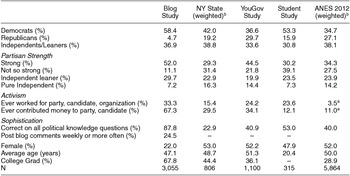
The characteristics of respondents in all four studies are presented in Table 1. The blog sample is the most partisan and politically active as expected (Lawrence, Sides, and Farrell Reference Lawrence, Sides and Farrell2010). More than 50% of blog respondents describe themselves as strong partisans compared with 45% of the YouGov sample and roughly 30% of students and NY residents. Blog respondents are also more likely than others to have contributed money to a political campaign or worked for a party or candidate and are far more politically sophisticated as assessed by a five-item knowledge quiz that included questions about the positions held by Dick Cheney, John Roberts, Nancy Pelosi, and Harry Reid, and the name of the majority party in the House of Representatives.Footnote 5
Full Sample Characteristics

a. Question refers only to the 2012 election.
b. Data are weighted to relevant benchmark demographics. The NY study is weighted to match NY State demographics. The ANES includes the online and face-to-face components weighted to national demographic benchmarks.
Measures
Traditional Partisan Strength
In all four studies, traditional partisan strength is based on the standard ANES question: “Generally speaking do you think of yourself as a Democrat, a Republican, or an Independent?” Those who answered Democrat or Republican were asked if they were a strong or not very strong Democrat/Republican and independents whether they were closer to Democrats or Republicans (leaners). The scale was then folded to ignore partisan direction, limiting partisan strength to two levels (strong, not very strong) in analysis of the blog and student studies (excluding leaners) and to three levels (leaner, not very strong, strong) in the NY poll and YouGov study.
Partisan Identity
The partisan identity scale is similar to that used for national identity (Huddy and Khatib Reference Huddy and Khatib2007; Theiss-Morse Reference Theiss-Morse2009). Questions are worded for a specific party based on a respondent's answer to the initial standard partisanship question for partisans in all four studies, and for partisan leaners in the NY and YouGov studies (see Table 2).
Partisan Identity by Study
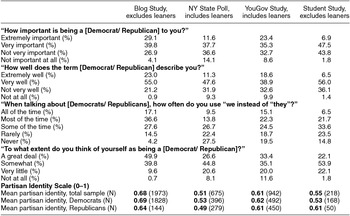
Note. Entries in the top panels are percentages; entries in the bottom panel are mean partisan identity scores in which 1 represents the strongest identity.
Partisan identity was stronger among the more actively engaged blog than the YouGov sample, and both groups expressed stronger identification on average than student and NY respondents, ranging from a high of .68 in the blog study to a low of .51 among NY residents, on a 0 to 1 scale. There were only modest differences in partisan identity strength between Republicans and Democrats. Partisan identity was lower among Republicans than Democrats in the blog study (t = −2.64, df = 1845; p <. 01) and the NY poll (t = −1.96, df = 673, p <. 1) and slightly higher among Republicans than Democrats in the student study (t = 2.49, df = 216; p <. 05). The four identity items were combined to form a reliable partisan identity scale in each study (α ranged from .81 to .90).
Current Campaign Activity
This measure was assessed in the blog, YouGov, and student studies. Blog study respondents were asked about their likely involvement in the ongoing 2008 presidential election campaign, students about their involvement in the 2010 congressional campaign, and YouGov panelists about their upcoming involvement in the 2012 presidential campaign.Footnote 6 Respondents were asked four questions: whether they planned to contribute money to (1) presidential/congressional candidates and (2) political organizations and planned to volunteer (3) for presidential/congressional candidates and (4) political organizations. All four questions were combined to form a reliable scale of current electoral activity in the blog (α = .74), YouGov (α = .85), and student study (α = .74).
Past Electoral Activity
This indicator was assessed in the blog and NY studies with two items drawn from the ANES survey: “Have you ever worked for a political candidate, political party, or any other organization that supports candidates?” and “Have you ever contributed money to a political party or candidate?” The past electoral activity scale was somewhat less reliable than current activity; the correlation between the two items was .30 in the blog study and .36 in the NY poll.
Ideological Issue Intensity
To measure instrumental facets of partisanship, respondents in the blog study were randomly assigned three questions on social (gay marriage, abortion, and prayer in schools) or economic issues (taxes on the wealthy, government spending on health care, and government spending on public education) (see Online Appendix 1 for exact question wording). These items formed reliable social (α = .71) and economic issue scales (α = .86) that ranged from very liberal to very conservative. New York State residents were asked three questions on public health insurance, tax increases versus spending cuts, and gay marriage that were combined to form a moderately reliable ideologically consistent issue scale (α = .63). YouGov respondents were asked five policy questions on immigration reform, the Affordable Care Act, legalized abortion, gay marriage, and whether the government should reduce the deficit or unemployment (α = .76). Students were asked three policy questions on public health insurance, gay marriage, and government services vs. spending (α = . 59). In addition, respondents in the YouGov and student studies were asked to rate the personal importance of each issue on a four-point scale that ranged from very important to not at all important.
The final ideological issue intensity measure was calculated in the blog and NY State studies by folding the issue scale at 0 (neutral). In the YouGov and student studies, each issue was weighted by its importance, additively combined to reflect important strong ideologically consistent positions, and then folded at 0 (the neutral point). As we show, weighting made little difference to the political effects of ideological issue intensity.
The bivariate correlation between partisan identity strength and ideological issue intensity was relatively weak in all three studies (ranging from .05 to .13).Footnote 7 When the scales were unfolded to reflect both direction and strength, the correlations between partisan identity and issue ideology were much higher (ranging from r = .57 to .67). In other words, Democrats are more likely to endorse liberal than conservative issue positions but someone can be a very strong Democrat and yet hold weakly liberal positions on a set of issues, and vice versa.
Nonetheless, there were some mismatches between ideology based on issues and partisan identity. Across the four studies, 20% to 34% of Republicans held non-conservative issue positions, and 1% to 25% of Democrats held non-liberal issue positions. Thus, even with a sizable association between ideological issue position and partisan identity, there is room for ideological and partisan discordance.
Ideological Self-Placement and Identity
Respondents in the blog and student studies placed themselves on a five-point liberal–conservative ideology scale: very liberal, moderately liberal, moderate, moderately conservative, and very conservative. This was folded to form a three-point ideological strength scale (very liberal/conservative, moderately liberal/conservative, or moderate). Respondents in the NY State Poll placed themselves on a three-point scale (liberal, moderate conservative). This was folded to form a dichotomous measure of moderate (0) vs. conservative/liberal (1). Finally, respondents in the YouGov study who were at least slightly liberal or conservative on a seven-point scale were asked the four partisan identity questions listed in Table 2 modified for either liberal or conservative identity (α = . 81). There was a large correlation between liberal or conservative ideological identity and partisan identity (r = .47) and a slightly weaker correlation between ideological identity and the weighted ideological issue intensity scale (r = .37), suggesting that ideological identity is a mix of expressive and instrumental factors.
Partisan Threat and Reassurance Experiment
We conducted an experiment in both the blog and student studies in which respondents were randomly assigned to one of four experimental conditions (threat vs. reassurance × in-party vs. out-party source) and a fifth control condition. They read a fictitious blog entry in which a member of their own or the other party claimed their party would win (reassurance) or lose (threat) the upcoming election. In the threat condition, sample blog phrases for Democrats included “Republicans will hold onto middle Americans” and “Republicans will be back in control in 2008.” In the Republican threat conditions, Democrats served as the source of threat. In the reassurance condition, sample phrases for Democrats included “Republicans should get used to being in the minority for the foreseeable future” and “Hey, Republicans, it sucks but it's time to seriously face facts. We’re in trouble in 2008.” For Republicans in the reassurance condition, Republicans were portrayed as the likely winners. The wording of all experimental conditions is provided in Online Appendix 2. Because in- and out-party source had little difference on felt emotion, these conditions are combined in subsequent analyses.Footnote 8
The experiment in the student study included a third factor to better compare the effects of instrumental and expressive threat and reassurance in a 2 × 2 × 2 factorial design (threat vs. reassurance × in- vs. out-party source × party status vs. issues); this design resulted in eight conditions plus three others that are omitted from the analyses.Footnote 9 The rhetoric in the party status conditions was comparable to that used in the blog study (without any reference to issues). The issue-based rhetoric referred to policy gains or losses without mentioning a loss or gain in status for either political party. For example, Democrats in the issue threat condition read a blog entry that included the following phrases: “This election is shaping up as a backlash against larger government” and “We can forget about improving our health care system.” In the Democratic issue reassurance condition, the blog entries suggested victory for health care and gay marriage. The Republican threat condition made reference to the success of health care and gay marriage initiatives, whereas the Republican reassurance condition suggested there would be a backlash against massive government spending and an end to socialized medicine.
After reading the blog entry, respondents were asked six questions on how they felt while reading it—whether they were angry, hostile, and disgusted (anger) and hopeful, proud, and enthusiastic (enthusiasm). They were asked to respond on a four-point scale (a great deal, some, a little, not at all). Reliable scales were created for both anger and enthusiasm in each of the studies (α ranged from .88 to .93).
RESULTS AND DISCUSSION
Campaign Activism
Party Identity and Issues
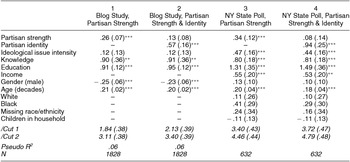
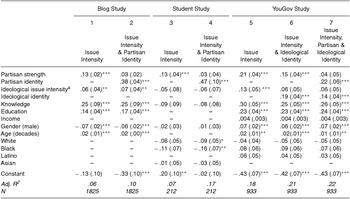
Initial analyses provide support for an expressive view of partisan political action. Past and current political activity were regressed onto partisan identity, ideological issue intensity, traditional folded partisan strength (ranging from leaner, not very strong, and strong Democrat/Republican), education, and key demographics linked to political engagement (gender, age, racial/ethnic background). Partisan identity is significantly linked to past electoral activity (Table 3) and current campaign activity in all studies (Table 4).Footnote 10 In contrast, the multi-item ideological issue intensity scale is only linked to past electoral activity among NY State residents and current activity among blog activists. Ideological issue intensity has no significant connection to past electoral activity in the blog study or to current activity in the student study, suggesting its effects are weaker and less consistent than that of partisan identity.
Determinants of Past Electoral Activity

Note. Entries are ordered probit coefficients with robust standard errors in parentheses. All variables range between 0 and 1 except for age, which is measured in decades. “Other race” is the omitted category for race/ethnicity in the NY State poll. All tests of significance are two-tailed. Models in the NY State poll are based on multiple imputed values for income, which makes it difficult to provide a value for the Pseudo R2 .
* p <. 1. ** p < .05, ***p < .01.
Determinants of Current/Future Campaign Activity

Note. Entries are OLS regression coefficients with robust standard errors in parentheses. All variables range between 0 and 1 except for age, which is measured in decades. All tests of significance are two-tailed. * p < .1, ** p < .05, ***p <. 01.
a. Ideological issue intensity is measured in the blog study as a folded measure of ideological consistency across three issues; in the student study it is measured as a scale created by combining three issues weighted by their subjective importance and then folded at the ideological midpoint; in the YouGov study, it is measured by combining five issues weighted by their subjective importance and then folded at the neutral midpoint. See the text for details.
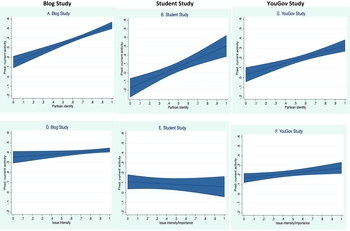
The impressive relationship between partisan identity and electoral activity is apparent in panels A, B, and C of Figure 1 in which the predicted level of current campaign activity is plotted across levels of partisan identity (from columns 2, 4, and 7 of Table 4). In the blog study, white males with the weakest partisan identity are predicted to score between .1 and .2 on the activity scale. This increases to more than .5 for white males with the strongest partisan identity as seen in panel A, Figure 1. In the student study, white males with the weakest partisan identity are essentially at 0 on the scale, whereas those with the strongest identities are at roughly .3, as seen in panel B.Footnote 11 In the YouGov study, white males with the weakest identity are at roughly .03, whereas those with the strongest identities are at .3. Partisan identity is thus powerfully associated with current electoral activity in both nonactivist and activist samples. The effects of partisan identity are also larger and more consistent than ideological issue intensity measures in all instances, as can be seen by comparing panels A and D, B and E, and C and F in Figure 1. The slopes for partisan identity are substantial and positive as already noted. Ideological issue intensity increases campaign activity, but to a lesser degree than partisan identity.
Predicted Value of Current Campaign Activity by Partisan Identity and Ideological Issue Intensity

Half the blog sample was asked about social issues and the other half about economic issues. Ideologically consistent and extreme positions on social issues are associated with past (β = .25, s.e. = .18) electoral activity, although this increase is barely significant in a one-tailed test of significance and the coefficient remains far smaller than that of partisan identity (β = .54, s.e. = .22). A strong, ideologically consistent position on social issues does not increase current activism, however. Moreover, an ideologically consistent position on economic issues affects neither past nor current activity.
The power of partisanship is less evident when measured in the traditional fashion and folded. This traditional measure of partisan strength predicts past and current political activity, but its coefficient is much smaller than that of partisan identity. As seen in Tables 3 and 4, the traditional partisan strength measure has a modest positive effect on past and current political activity when partisan identity is omitted from the model (columns 1 and 3, Table 3; columns 1, 3, 5, and 6, Table 4). Moreover, the coefficient for partisan identity is 1.5 to 4 times greater than that of partisan strength in the initial models.Footnote 12
The weak effect of traditional partisan strength on political action is not simply a measurement issue. When we reran analyses in column 2 of Tables 3 and 4 for the blog study, replacing partisan identity with each one of the four identity items (leading to eight additional tests), all eight coefficients were larger than the coefficient for the traditional partisanship measure alone (in column 1 of Tables 3 and 4). The coefficients for the single identity items were 1.3 to 2.2 times larger than the coefficient for traditional partisan strength for past activism and 1.9 to 2.4 times larger for current activism.
We also tested an important alternative instrumental model of partisan campaign activity in which activity depends on holding a strong stance or on holding a strong stance that is personally important on one or more issues. We reran models in Tables 3 and 4, replacing the ideological issue intensity scale with all issues included simultaneously. In the blog and NY State studies, each issue was folded at its neutral point. In the YouGov and student studies, each issue was folded and weighted by its importance. In the blog study, a strong position on gay marriage increased past (β = .34, s.e. = .15) and current involvement (β = .10, s.e. = .04), but a strong position on the other two social issues or the three economic issues did not boost activism. A strong position on health care increased past activism (β = .21, s.e. = .12) in the NY State study, and a strong position on health care among those who rated the issue as important increased current activity (β = .13, s.e. = .05) in the YouGov study. But in no instance did the inclusion of single issues decrease the size of the coefficient for partisan identity.
Overall, these analyses only slightly alter the findings presented in Tables 3 and 4. A strong position on gay marriage increased past and current action in the blog study in 2008 and a strong stance on health care boosted past action in the NY State study and current activity in the YouGov study in 2011. But a strong partisan identity was far more likely than strong ideology or commitment to a single issue to drive campaign activity.
As a final check on the instrumental model, we reestimated models in columns 2 and 4 of Table 3 and columns 2, 4, and 7 in Table 4, substituting the ideological issue intensity scale with the strength of each issue position, congruence with party stance on the issue, and their interaction. In the YouGov study, a congruent stance on health care increased current activism. In the blog study, those incongruent with the party on health care were less likely than others to have taken past action. In the NY State study, those with a party-consistent stand on gay marriage were more likely to have taken past campaign action. But once again, partisan identity had a large and significant effect on campaign action in all analyses.
Ideological Identity
To this point, we have ignored the effect of ideological self-placement on campaign action. As we noted at the outset, ideological self-placement is not a clear-cut measure of instrumental ideological concerns and may also convey expressive facets of a liberal or conservative identity. To analyze its effect, we replaced ideological issue intensity with a folded measure of liberal–conservative self-placement in the models shown in columns 2 and 4 in Table 3 and columns 2, 4, and 7 in Table 4 for the blog, NY State, and student studies. Ideological self-placement had no significant effect on past or current activism in the blog, NY State poll, or student study.
The YouGov study included a more fully expressive measure of ideological identity, which we added to analyses in Table 4 (column 7). As seen in that table, ideological identity significantly accounts for campaign activity, in addition to partisan identity. The coefficient for partisan identity remains larger than either issues or ideological identity, but ideological and partisan identities are linked, as we noted earlier, and the inclusion of ideological identity reduces the coefficient for partisan identity (from .30 to .22). This lends support to our prediction that expressive identities (partisan or ideological) are a more effective precursor to action than instrumental ideological considerations.
As noted, the samples tend to be skewed toward Democrats, the blog study seriously so, and all analyses in Tables 3 and 4 were repeated separately for Democrats and Republicans. The greater power of partisan identity than instrumental concerns to shape political action is replicated among both Democrats and Republicans. Partisan identity significantly increased current and past electoral activity among both Democrats and Republicans in 9 of 10 separate tests (see Tables A3–1 to A3–5 in Online Appendix 3). The one exception is that strong Republican identity was not associated with heightened past electoral activity in the blog study.
Partisan Identity and Emotion
We turn next to the blog and student studies to compare expressive and instrumental accounts of the action-oriented emotions aroused by partisan threats and reassurances.
Anger and Enthusiasm
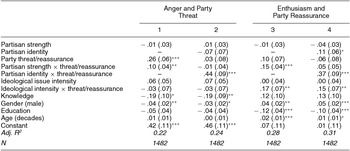
In the blog study, strongly identified partisans responded to a threatening experimental message with greater anger, and to a reassuring message with greater enthusiasm, than did weak partisans. These effects are large and dominate other factors in Table 5 (columns 2 and 4). The traditional folded partisan strength measure has a modest significant interaction with threat and reassurance when identity is excluded from the model, as seen in columns 1 and 3 of Table 5. However, this effect is erased by the inclusion of party identity and its interaction with threat or reassurance. The large and significant interaction between partisan identity and threat/reassurance on both emotions is fully replicated when analyses are run separately among Democrats and Republicans (Online Appendix 3, Tables A3–6 and A3–7). In essence, strongly identified partisans react with greater emotion than weakly identified partisans to the prospect of winning or losing an election.
Experimental Threat and Reassurance as Determinants of Anger and Enthusiasm, Blog Study

Note. Entries are unstandardized OLS coefficients with robust standard errors in parentheses. All variables range between 0 and 1 except for age, which is measured in decades. Issue and party threat are coded 1 and reassurance is coded 0 in columns 1 and 2; reassurance is coded 1 and threat is coded 0 in columns 3 and 4. All tests of significance are two-tailed. * p < .1, ** p < .05, ***p < .01.
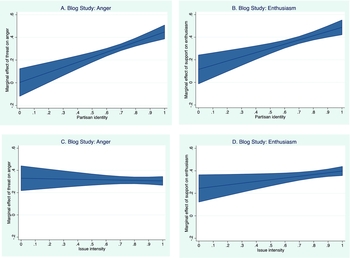
Instrumental concerns also influence emotions in the blog study. Strong issue ideologues do not react more angrily to threat, but do feel more enthusiastic when exposed to a reassuring message. Overall, the coefficient for the interaction between ideological issue intensity and reassurance is less than half the size of the coefficient for the comparable interaction with partisan identity. Analyses thus provide intriguing evidence that action-arousing emotions are a product of both expressive and, to a lesser extent, instrumental concerns. The stronger effect of partisan identity than ideological intensity on emotional response to partisan threat and reassurance is apparent in Figure 2, which depicts the marginal effects of threat and reassurance on anger and enthusiasm across levels of partisan identity (panels A and B) and ideological issue intensity (panels C and D). The figure shows clearly that threat and reassurance arouse the most powerful emotion among the strongest partisan identifiers in the blog study. In contrast, ideologically intense respondents are no more likely than others to react to threat with anger and are only slightly more likely to react positively to reassurance.
The Marginal Effect of Experimental Party Threat and Reassurance on Anger and Enthusiasm by Partisan Identity and Ideological Issue Intensity

We reran analyses replacing the combined issue intensity scale with the intensity of each issue, interacted with whether or not the respondent held a position congruent with that of his or her party. In the blog study, holding a strong party-congruent position did not predict greater anger in the threat condition. When reassured, however, those with a position congruent with that of their party on abortion, prayer in school, or health care felt more enthusiastic. Consistent with findings in Table 5, there was an even larger interaction between partisan identity and threat or reassurance in each of these analyses.
Instrumental and Status-Based Threat and Reassurance
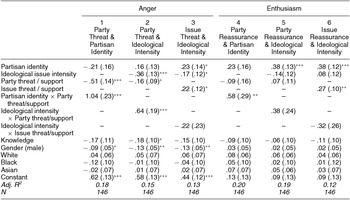
The degree to which action-oriented emotions are aroused by losses and gains to party status or to policy issues is contrasted directly in the student study. We present findings separately for party and issue-based threat and reassurance, given the small sample sizes. When students were exposed to a threat or a reassurance to their party's electoral status, the most strongly identified partisans reacted with greater action-oriented emotion than did weak partisans, as seen by a large, significant interaction between identity and party threat/support in columns 1 and 4 of Table 6. Party threat also motivated anger among those who hold strong ideologically consistent issue positions that they regard as personally important, as seen in column 2 of Table 6. This reaction to threat was smaller than that experienced by strongly identified partisans and was not replicated for enthusiasm. Nonetheless, a threatened electoral loss can generate anger in those who care the most about issues.Footnote 13
Experimental Party and Issue-Based Threat and Reassurance as Determinants of Anger and Enthusiasm, Student Study

Note: Issue and party threat are both coded as 1 and support is coded as 0 in columns 1–3; support is coded as 1 and threat is coded as 0 in columns 4–6. Entries are unstandardized OLS coefficients with robust standard errors in parentheses. All variables range between 0 and 1. All tests of significance are two-tailed.
* p < .1, ** p < .05, ***p < .01.
Students with strong, consistent issue positions, however, did not react to policy-based threat or reassurance with increased anger or enthusiasm (Table 6, columns 3 and 6). In the experimental issue-based blog post, the party position on health care and gay marriage was either threatened or reassured. But anger did not increase among those who held the party's position most strongly on gay marriage and rated it as personally important. Likewise, those with a strong position on gay marriage that was consistent with their party did not feel more enthusiastic when the party's position was bolstered by the experimental blog message. The same held for health care. Those who most strongly endorsed the party's position on government health care spending and rated it as important did not react more emotionally than others when that position was threatened or reassured in the blog posting. These findings make clear that the emotional ups and downs of an election campaign are tied far more closely to status-related concerns over winning and losing than to policy-related gains and losses, lending further empirical support to an expressive model of partisanship.
Political Effects of Anger and Enthusiasm
Emotion is a well-documented prelude to action. In a final step, we examined the effects of the anger and enthusiasm aroused by the blog entry on current campaign involvement, which was assessed after the respondents read the experimental blog post in both the blog and student studies. This is not an ideal test because the current activism questions inquired about likely action at a time, some four to eight months before the election, when respondents may have already taken action, potentially weakening the influence of the blog posting. In a simple test, we regressed current campaign activity on the anger or enthusiasm felt while reading the blog entry while controlling for past activity. In the blog study, enthusiasm (β = .07, s.e. = .02), but not anger was a significant predictor of current activism. In the student study, anger (β = .15, s.e. = .05) but not enthusiasm significantly predicted current activism. Not surprisingly, past activism had a very large effect on current activism in both equations (β = .48, s.e. = . 02 in the blog study and β = .27, s.e. = .06 in the student study). Even in this difficult test, the emotion felt in reading the blog entry boosted slightly the intention to volunteer or donate to a party or candidate, albeit with different emotions driving this in the two studies.
CONCLUSION
This article extends the study of partisanship by focusing on its link to political campaign involvement and examining whether partisan political actions largely reflect an expressive social identity and the defense of party status or the instrumental protection and advancement of policy and ideology. Findings underscore the power of an expressive partisan identity to drive campaign involvement and to generate strong emotional reactions to ongoing campaign events. The greater power of partisan identity than instrumental issue positions on action suggests that partisan identity is capable of driving passionate behavior even among political sophisticates (Miller Reference Miller2011).
The findings generated by this research are grounded in social identity theory, a well-established approach to intergroup relations that is supported by a vast empirical literature (Huddy Reference Huddy, Huddy, Sears and Jervis2013). Viewing partisanship as a social identity illuminates the dynamic nature of political campaign involvement. Strong partisans react to partisan threat with increased action, helping explain rising levels of political involvement in recent presidential elections as electoral margins decline and the probability of losing increases for both parties. Social identity theory also generates a number of other predictions, many of which remain untested, about American political behavior as partisan identity intensifies: elevated elite partisan influence, increased conformity around key party issues, growing intolerance of those in the other party, heightened party cohesion that reduces internal conflict, the vilification of internal dissenters, and the optimism of strong partisans who are motivated to see the party as infallible.
Findings uncovered in this study also suggest that an “all or nothing” approach to partisanship as either instrumental or expressive, but not a mix of both, may prove to be an unnecessary simplification. We come down firmly on the side of expressive partisanship as the primary driver of campaign involvement, especially in close elections when the threat of electoral loss looms large. These are the circumstances in which victory or defeat is most palpable and status loss or gain most obvious and dramatic. Not surprisingly, someone with a strong partisan identity will feel elated after an election victory and depressed after defeat. But party status is less likely to be affected by a single legislative victory or defeat because that event does not alter the formal balance of partisan power and status. At these times, between elections, other identities and political considerations—based on concerns about a specific issue or event—may drive political involvement and action. In that sense, a singular focus on the collection of data during an election campaign may inadvertently elevate the power of expressive over instrumental partisanship.
The greater emotionality of strong partisans, especially their greater anger in response to threat, helps explain the vitriolic nature of current party politics (Iyengar, Sood, and Lelkes, Reference Iyengar, Sood and Lelkes2012). Once angry, partisans are less influenced by information and more likely to act; they minimize the risk associated with action, take riskier actions, and in general drive politics in an extreme direction (Huddy, Feldman, and Cassese Reference Huddy, Feldman, Cassese, Neuman, Marcus, MacKuen and Crigler2007). In a revealing study, Hartbridge and Malhotra (Reference Harbridge and Malhotra2011) found that strong partisans were the only group of Americans to express less support for bipartisanship than partisan politicians of their party.
In the beginning of this article, we discussed the potentially deleterious consequences of expressive partisanship. But we do not wish to portray expressive partisanship as thoroughly pernicious. It has its place as a vehicle for democratic engagement, providing partisans with a stake in an election and a reason to get involved. Of course, the positive side of intense partisan identities is increased political involvement. Strong partisan enthusiasm for party candidates does increase voter turnout and other forms of electoral activity (Marcus, Neuman, and MacKuen Reference Marcus, Neuman and MacKuen2000). Expressive partisanship becomes more troubling, however, when stripped of instrumental content. In that sense, Ellis and Stimson's consternation at decoupled symbolic and operational ideology generates parallel concerns about the disjuncture between expressive and instrumental partisanship. To the extent to which the two diverge, partisans are vulnerable to partisan elite influence and subject to empty campaign rhetoric, and they may be aroused to take action on behalf of candidates who support issues that they oppose.
The social nature of partisanship revealed in our research provides a tantalizing glimpse of the insights to be gained by regarding partisanship and partisan emotions as a product of intergroup relations and conflict. We look forward to a growing body of research in this vein.
Supplementary materials
To view supplementary material for this article, please visit http://dx.doi.org/10.1017/S0003055414000604





Comments
No Comments have been published for this article.